

SCRIPTURE READING: Philippians 2:1-13
“1 If, then, there is any comfort in Christ, any consolation from love, any partnership in the Spirit, any tender affection and sympathy, 2 make my joy complete: be of the same mind, having the same love, being in full accord and of one mind. 3 Do nothing from selfish ambition or empty conceit, but in humility regard others as better than yourselves. 4 Let each of you look not to your own interests but to the interests of others. 5 Let the same mind be in you that was in Christ Jesus,
6 who, though he existed in the form of God,
did not regard equality with God
as something to be grasped,
7 but emptied himself,
taking the form of a slave,
assuming human likeness.
And being found in appearance as a human,
8 he humbled himself
and became obedient to the point of death—
even death on a cross.
9 Therefore God exalted him even more highly
and gave him the name
that is above every other name,
10 so that at the name given to Jesus
every knee should bend,
in heaven and on earth and under the earth,
11 and every tongue should confess
that Jesus Christ is Lord,
to the glory of God the Father.
12 Therefore, my beloved, just as you have always obeyed me, not only in my presence but much more now in my absence, work on your own salvation with fear and trembling, 13 for it is God who is at work in you, enabling you both to will and to work for his good pleasure.”
It’s good to be with you. I always love to preach here. You know me, and I know you. You love me, and I love you. What could go wrong?
As many of you know, I had a very bad fall the day before Easter almost six months ago. I fractured my skull in three places, and broke my neck in a couple places, And I put a big scare into my family, didn’t I? Yeah. I want to thank you all for the care, for your prayers, for the meal train, and for your love that surrounded me and my family these past months. My late mother would have said that my guardian angel was working overtime. I figure my room wasn’t ready. Anyway, here I am, and here you are, so let’s hear some good news.
Would you pray with me: May the words of my mouth and the meditations of our hearts be acceptable in your sight, O Lord, our rock and our Redeemer. Amen.
When Brent invited me to guest preach today, he told me what the reading was and I shared with him that Philippians 2:1-13 is a foundational reading for my Christian faith.
Now, Brent is not on vacation; he’s at the Southern New England Conference of the United Church of Christ Annual Meeting, with John and Janet Canning, our delegates. And right about now he’s listening to The Rev. Dr. Senator Raphael Warnock preach. And you get to hear me. But Jimmy Carter told us long ago that life isn’t fair, so, you know.
But anyway, Brent said this is the reading. And I thought, oh, that’s right in my wheelhouse.
Let me share a little background on the text, and then I will tell you why it is important for me. The whole reading is a series of encouragements from Paul to the church in Philippi, and admonitions about how to live the Christian life. He had founded this church in Philippi and had this very warm relationship with them. And the letter reflects this warmth and this sort of intimacy and love. He is writing to them from a Roman prison, but you wouldn’t know it from the tone of the letter. You’d think he’d just won the lottery. The church in Philippi had sent him a gift of money in prison by way of his friend Epaphroditus, who got there and gave him the money. And Paul sent this letter back to the church in Philippi with Epaphroditis. There was no postal system to speak of. (There actually was a postal system in the Roman Empire, but that’s neither here nor there.) But Epaphroditus brings this letter back, and we have the letter.
Embedded in the center of our passage is a poem, a beautiful poem about Christ, which most likely was a hymn that the Philippians would have known. Paul most likely did not write this hymn, but he’s quoting this hymn that they would have known.
You know how the words to hymns are sticky. You know what I’m talking about? You remember the words to hymns, but you don’t remember just texts from the Bible as well. Hymn texts are sticky. A good deal of what I know about the Christian faith I acquired from hymns, singing hymns in junior choir and senior choir. For example, there is more good Christology in “Hark the Herald Angels Sing” than in many a theological book.
So this is a hymn. It’s a hymn about Christ’s humility, that though he was in human form he shared Divinity with God the Father. He did not consider it something to be exploited, or held on to, or grasped or gripped. But he gave it up. He emptied himself, taking the form of a slave, even dying a slave’s death on the cross. And it has this form where it kind of goes down to his death on a cross, and then there’s a “therefore.” Therefore his name is highly exalted. It’s a wonderful, wonderful hymn. I know it by heart (not in this translation).
I’ll tell you why that hymn is salient for me. I grew up in the church. I sang in the Junior and then in the Senior Choir. My Sunday School faith was a pretty simple moralistic dualism. If you’re good God is happy, and if you are not good God is displeased. “He sees you when you’re sleeping, he knows when you’re awake. He knows if you’ve been bad or good, so be good for goodness sake.”
When I was 15 my mother became ill with colon cancer, and when I was 18, after many years of suffering, she died, two weeks into my first semester of college. To say I was lost would be an understatement, but my Sunday School faith didn’t have much to offer really, and I really didn’t want to have too much to do with this god who took my mom, or at least allowed her to be taken. I know she didn’t abandon me, but you feel abandoned when you’re a kid and your parent dies.
It’s a long story from there to here, and I will spare you the details, but when I ended up in seminary and started to really think deeply about who this God was, I was drawn to Jesus as the crucified and forsaken one. God incarnate in his human form who has solidarity with all of us humans in all our suffering, our sense of abandonment, our sense of forsakenness, all the marginal people, the last, the least, and the lost. That was a God I could embrace. I went to seminary looking for answers, and when someone asks me if I found them, I say, “Not really, but I got better questions.”
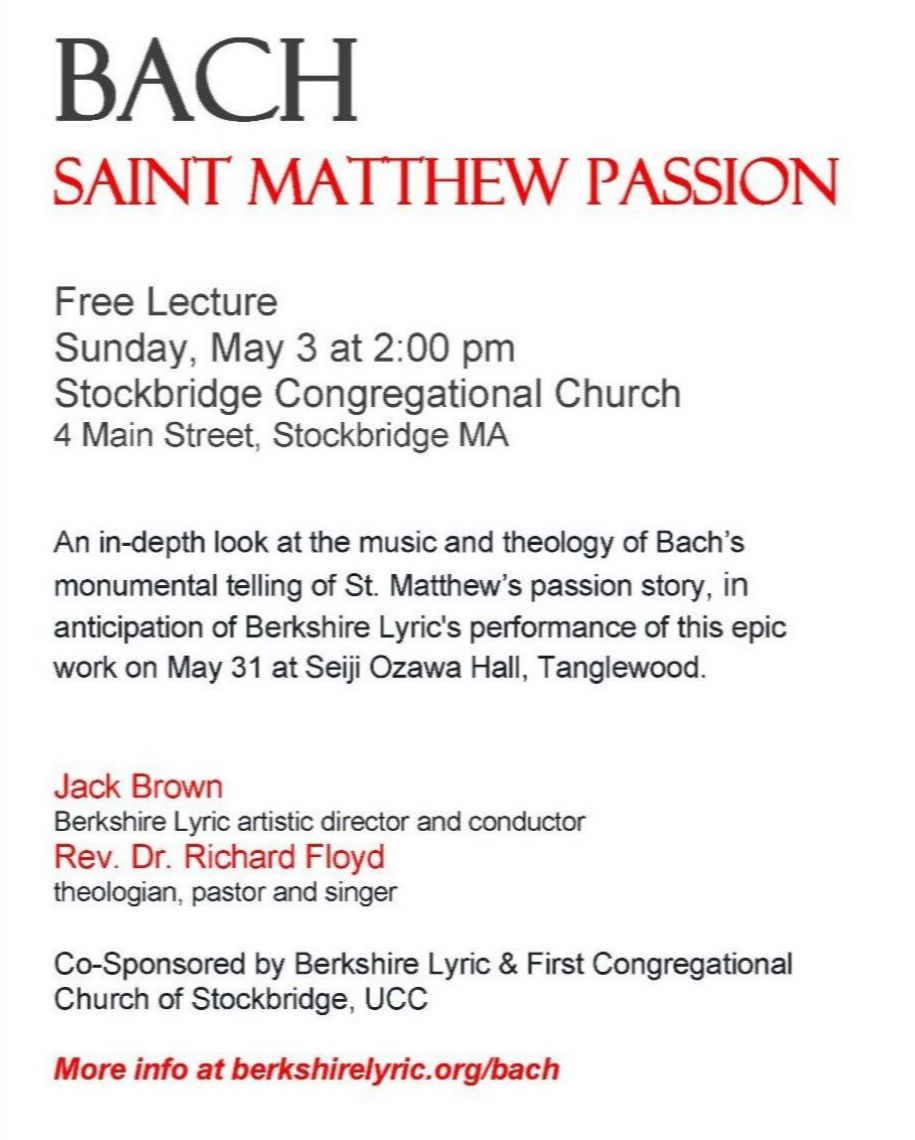
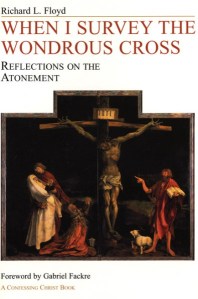
And so, the cross and all it means became a theological preoccupation of mine through most of my ministry. I’m kind of a “Johnny one note.” It’s a good note, an important note. And I had three academic sabbaticals in Britain with my family, in 1989 at Oxford University, in 1995 at St. Andrews University in Scotland, and 2001 at Cambridge University in England. And I studied the subject of the cross and what it means, and I wrote a book about it. The title of my book is “When I Survey the Wondrous Cross: Reflections on the Atonement.” That title comes from the Isaac Watts hymn we will sing after the sermon.
Isaac Watts, by the way, was a Congregationalist. I don’t know if you knew that. When I was a kid, I thought he was an Episcopalian, because it always said Isaac Watts in the Episcopal hymnbook. But no, he was one of us. His English Puritan church sang only the psalms in meter. They were good Calvinists, and were kind of suspicious of music and things like that, dangerous stuff like music. And one day as a teenager, he came out of worship and complained to his father that the music was boring. That music was really boring. His father, as fathers would do, said, “Well, do you think you can do better?” And 756 hymns later, the answer is “yes,” he could and he did! Some of our favorite hymns: “Joy to the World,”“ When I Survey the Wondrous Cross,”“ Our God Our Help in Ages Past, ”“I Sing the Mighty Power of God,”“ My Shepherd Will Supply My Need, ”just to name a few.
So the cross, for me, is the symbol of God in his human form in Jesus Christ, being God with us. God With Us, in the whole smear of human existence, the whole struggle of being a human being in this life. He shared our humanity in all its fullness.
I was born at the very end of the middle of the Twentieth Century, which was the bloodiest and most brutal century in human history, though, sadly, we are on pace to set a new record. I came of age during the time of the assassinations in our country of John Kennedy and Robert Kennedy and Martin Luther King, Jr. and the war in Vietnam. It was the cross that led me back to the Christian faith as a young adult. Only Christian faith with a cross at its center was adequate to make sense of these tragedies of my early adulthood, and the brokenness and brutality of life in this world.
While I was in seminary a very important book came out: Jurgen Moltmann’s “The Crucified God.” Jurgen Moltmann was a German Reformed theologian. I still remember a question from the Introduction, “What does it mean to recall the God who was crucified in a society whose official creed is optimism, and which is knee deep in blood?” Pretty good question, huh?
In 1990, I was honored to meet Moltmann, and to be on a panel with him in Princeton, at the Center of Theological Inquiry. He told his story of being a German teenager at the end of World War 2 when the Germans were running out of troops, and they started enlisting old men and young boys to fight what was left of the war. I think he was 16 when he was enlisted to man an anti-aircraft battery, and he told of watching his other young teenage boy comrades being maimed and dying around him. And then when the war was over, the Allies took him prisoner and he went to a prisoner of war camp in England, where some good Christian gave him a King James Bible, which he read from cover to cover, and had a conversion experience, which I guess that’s one way to call it. He concluded that only a crucified God could help him make sense of what his country had been involved in, make sense of the manifold brutalities of the war and the European Holocaust. He became a Christian and one of the finest theologians of his time.
Now, the theme of Paul’s letter to the Philippians is humility. I just read an article in the Atlantic about how there have been 3 or 4 recent books assaulting humility and compassion. “We’ve got to get rid of that. We’ve got to stop taking care of people. You know, it’s the welfare state.” Popular books. No compassion, no empathy, no humility.
But for Paul, his model was Christ, the self-emptying of God in Christ. The Greek word for self-emptying is kenosis. It means “relinquishing,” “giving up”, “handing over,” “letting go.” Opening your hands. It is contrasted with “grasping,” “clinging,” “holding on,” “gripping.”
There is a wonderful contrast hidden in plain sight in this little hymn in Philippians: Adam — did you know Adam is not a proper name, it means “human” in Hebrew. Adam, the first human – any grasping in that story? What did Adam grasp? The fruit. It wasn’t an apple. Apples don’t grow in the Middle East. It could have been a date or pomegranate. But it was a fruit, and he grasped it. Christ in the New Testament is often contrasted with Adam. Adam, the first human, and then Christ is the new human. So Adam, humans in our natural state are grasping, whereas Christ, the new Adam, the new human, isn’t grasping, but relinquishing, emptying, humble.
So, Paul’s admonitions to the Philippians are based on Christ’s humility. I need to say a word about humility in the ancient world. There are many lists of virtues in the New Testament that echo similar lists of virtues in pagan writings of the time. They are what we might expect: courage, honesty, strength, and the like. But notable in its absence is humility. It is hard for us to realize how radical the Gospel message of humility was at the time. A crucified messiah was on nobody’s bingo card. That Jesus chose humility, taking the form of a slave, even dying a slave’s death on a cross, was a scandal then, and it’s still a scandal.
Humility was not a virtue. The word virtue derives from the Latin “vir,” which means male. To be virtuous was to be manly. Humility was not considered a manly virtue. We men have a lot to answer for, really. But Jesus freely chose to humble himself and be an atoning sacrifice for the whole world. Somebody should tell hyper-Christian Pete Hegseth to have a closer reading of the Gospels as he touts his manly warrior-ethic version of Christianity. Perhaps he should start with the Letter to the Philippians. Or the Sermon on the Mount. Or the “Golden Rule.”
As some of you know, I am part of a wonderful Zoom Bible study that meets every Wednesday at 1:00. You are welcome to join us! The link is on our church website. Our group this week was a great help to me on Wednesday when I asked them what might this passage means for us as Christians today.
One person said that what Paul is describing here is exactly the opposite of the world we live in. Humility is still radical and still a scandal. Grasping, on the other hand, is widely accepted as the way to get ahead in our society. Rugged individualism is the American way, whereas Paul believes that faith is a team sport and takes place in community. Does anybody know where the Bible says, “God helps those who help themselves?” No. It’s not in the Bible. Who knows where that came from? How about ambition, competition, anything goes, dog eat dog. None of that is here. Paul, rather, admonishes them: “Do nothing from selfish ambition or empty conceit, but in humility regard others as better than yourselves. Let each of you look not to your own interests but to the interests of others.” Do we see a lot of that in our leaders and “successful” people? Do we see it in celebrities and famous people? Maybe Dolly Parton… Does the world we live in reflect the humility that Paul describes?
The late writer David Foster Wallace gave a now famous commencement speech at Kenyon College in 2005. He told this story: “There are these two young fish swimming along and they happen to meet an older fish swimming the other way, who nods at them and says “Morning, boys. How’s the water?” And the two young fish swim on for a bit, and then eventually one of them looks over at the other and goes “What the hell is water?”” Fish don’t see the water they swim in and we don’t see the socially-constructed world we take for granted, with all its assumptions about the way things are, and who’s in and who’s out, and who’s worthy and who’s not worthy, and who’s cool and who’s not cool.
The people in Jesus’s day didn’t see the water they swam in either, which was the occupation of the Roman Empire, the most powerful empire in the history of the world at that time, which they kept in power in collaboration with the religious authorities in power. Power was maintained by violence and the threat of violence. Crucifixion was a slave’s death, reserved for those who threatened the power of Rome. One of the reasons the four Gospels are reticent about talking about Jesus’s crucifixion — this wasn’t Mel Gibson’s “Passion of the Christ” which goes into agonizing ongoing details of the death of Jesus. They were reticent about any details. And why do you think that is? Because everyone had seen a crucifixion. They knew what it was like. They didn’t need to be told. When there was a slave revolt the Romans would line the streets with dead and dying men hanging on crosses, sometimes thousands of them. It was a warning. It was “See that? You mess with Rome’s power and that’s what you end up with.”
Jesus’s death was a state execution. Does that happen today in our world? Sadly, it does. The extra- judicial killings of people in the Caribbean in small boats who may or may not be drug dealers, but we’ll never know because they don’t get due process, they don’t get their day in court. The administration decides they don’t like them, so they kill them. Or what we saw on TV, the murder of Renee Good and Alex Pretti by ICE authorities in Minneapolis. Which we saw. We saw the video.
The alternative realm that Jesus proclaimed and embodied, that he called the kingdom of God, was a threat to those in power, and so they murdered him. And that was that.
Except it wasn’t! Because he didn’t stay dead, and his followers turned the world upside down by seeking a new world, seeking a better way, living a better way, a way of compassion, of empathy, of love, kindness and humility.
So, here’s Paul, moldering in a Roman prison writing to the church in Philippi, admonishing them to be loving as Jesus loved, and humble as Jesus was humble. Was this new way easy? No, it was not easy. Philippi was the capitol of Greek Macedonia and many Roman soldiers retired there. It was like the Berkshires, you know? So, the church was surrounded by fellow citizens who had sworn an oath to Caesar as Lord. The Greek is “kyrios,” the same word that Christians used to talk about Jesus. Jesus is Lord. So, there’s a conflict in values and culture. There was social tension and occasionally outbreaks of persecution for these Christians.
Still, Paul encourages them. He says, “Therefore, my beloved, just as you have always obeyed me, not only in my presence but much more now in my absence, work on your own salvation with fear and trembling, for it is God who is at work in you, enabling you both to will and to work for his good pleasure.”
Now, I have always been a bit intimidated by the phrase “work on your own salvation with fear and trembling,” but Paul softens it a little bit by saying “it is God who is at work in you, enabling you both to will and to work for his good pleasure.” I really like how the Message paraphrases these two verses: “What I’m getting at, friends, is that you should simply keep on doing what you’ve done from the beginning. When I was living among you, you lived in responsive obedience. Now that I’m separated from you, keep it up. Better yet, redouble your efforts. Be energetic in your life of salvation, reverent and sensitive before God. That energy is God’s energy, an energy deep within you, God himself willing and working at what will give him the most pleasure.” I like that energy, that vitality.
So imitating Christ should not scare us, it should not frighten us. It’s not the same as impersonating him. There is only one Jesus Christ, the Incarnate Word of God. Only one. His humility is the model for Christian humility. But we can imitate his humility. The way of Christ does not mean pulling yourself up by your spiritual bootstraps. It means walking together in community into the new and better way that Christ has begun among us. It means recognizing the water we swim in. It may mean changing the water we swim in. It means rejecting the fear that divides us and warns us off challenging unjust power and evil.
And the best Good News for today is that you are already in Christ by virtue of your baptism, and by your participation in the church, which is Christ’s body. You’re already in. Here you are, God’s beloved, worshipping and being the church by your very presence. So, just be who you already are! Love God, love your neighbor. And as Paul wrote to the little flock in Philippi, so long ago, “Be energetic in your life of salvation, reverent and sensitive before God. That energy is God’s energy, an energy deep within you, God himself willing and working at what will give him the most pleasure.” Amen.
“I preached this sermon on September 27, 2026 at the First Congregational Church of Stockbridge (UCC), Massachusetts. For the YouTube video go here: https://stockbridgeucc.org/sermons/the-self-emptying-god/?fbclid=IwY2xjawU0oZRleHRuA2FlbQIxMQBwZG9mAXNydGMGYXBwX2lkEDIyMjAzOTE3ODgyMDA4OTIAAR7PxH_0Nswq_aI-7G2Pz34PJl3HAFU7kyzWvpCmBErhTRuvR9bz1Q9MPdjpoQ_aem_9lV7HZDh2WsRXvhYPzuEZQ)