
Unknown's avatar

The claims of Caesar and the claims of God: A Sermon on Matthew 22: 21

When the Pharisees trap Jesus by asking him if it is lawful to pay taxes to Caesar, they are asking him about the limits of the law. Law tells you only what you must do, or face a penalty.  Jesus raises the stakes on their question, by asking an even more important question of them, “To whom do you belong?”

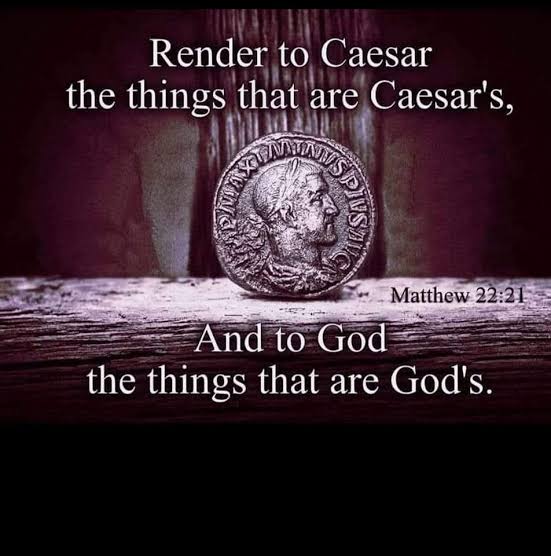
“Show me a coin,” he says, which in and of itself would have embarrassed the Pharisees, as they fumbled in their purses for a denarius. These hated Roman coins were considered objects of blasphemy. “Whose image is on it?” Jesus asks them.  “Caesar’s!” they reply. “Ok,” Jesus says, “if it has Caesar’s image on it, it must belong to Caesar, so give it to him.  But give to God that which belongs to God.”

The Pharisees would not have missed his meaning.  While the money was made in the image of Caesar, they were made in the image of God, and it was to God that they belonged. When Jesus is put to the challenge, he often ends up being the challenger.  And in this story Jesus challenges us.

Like the Pharisees, we look for the limits of our responsibilities, the boundaries of the allowable.  “What can I get away with” is as far as many people go when it comes to framing their relationship to the rest of society.  And some understand their faith as a matter of doing the minimum they must do for God.

The state has claims on the Christian.  We follow the laws, we pay taxes, we vote, we do jury duty, we may be called to serve in the armed forces in times of war.  These are the responsibilities of citizenship. The Christian is a citizen, and as such, follows the laws of the state.  Even when Christians intentionally break the law out of conscience, as some tax resisters, non-violent demonstrators, and conscientious objectors do, they acknowledge the right of the state to exact punishment according to its laws.

Honoring the claims of the state, however, is hardly enough to give life meaning.  If I ask you where you look for identity and meaning in your life, I doubt that you would answer that you find it by not going through red lights and by paying the IRS on time.  No, you would look elsewhere: to the things you hold dear, to higher loyalties, to commitments and promises you have made, to people you love and who love you.

So Jesus doesn’t deny the claims of Caesar, but he refuses to get caught in the trap that has been laid for him.  If he had said don’t pay taxes to Caesar, he would have pacified the Pharisees, but the Romans would have arrested him.  If he had merely said, “Pay Caesar!” he would have appeased the Romans, but alienated the crowd, who resented and hated Rome.  Jesus knew well that these pious Pharisees believed the doctrine that human beings were made in the image of God.  By equating the image of God that people bear with the image of Caesar that Roman money bore, Jesus contrasted a lesser and a greater loyalty.  In effect, Jesus is saying, “The money may belong to Caesar, but you belong to God.”

You belong to God.  What does that mean?  It means that the mystery that is your life is a gift of God.   That the air you breathe, the earth you walk upon, the people God has given you to love and be loved by, are all a gift.  One of the root causes of so much human agony is that people are trying to find themselves apart from God.  St. Augustine said to God, “You have made us for yourself, and we find no rest until we rest in you.”

To be made in the image of God is a wonderful gift, but many people have never opened it, and it sits on the table all wrapped up in ribbons with a card.  If they would only open the card it says, “I love you!”  “For God so loved the world, that he gave his only Son” and whatever humankind knew before about their identity, they now know something else: that the image of God that they bear looks like Jesus.  That is what God has provided for us: a name and a face to help us know our true identity.   Jesus is the human face of God, a face we can now see in countless human faces every day.

You belong to God.  And the claims of God on you are not the claims of law but the claims of love. The Christian is driven, not by the desire to find the minimum that is required of us, but by gratitude.  The claims of God are the claims of a lover.  They are not the things we must do to escape penalty, but the things we want to do after we say “Yes” to God.

The claims of God are the claims of gratitude and grace. When you say, “Yes!” to God, and acknowledge his incarnate Son, you know not only that you belong to God; you belong to others who also bear the image of God.  And others belong to you; you cannot live your life alone, but are part of a human network of love.  All around you are people who bear the image and likeness of God, and your destiny and theirs are inter-related.  “No man is an island,” said John Donne, and he is right.

To see the human face of God in Jesus Christ and to learn to recognize it in those around you is one of the tasks of the Christian, and also one of the keys to finding the true meaning of your life.  It also pretty well defines the mission of the church.   When you inventory the activities and programs of this congregation that reach out to others, like “Eat for Heat,” Christian Center luncheons, Habitat for Humanity, and Stephen Ministry, you see a basic pattern.  Heat, food, lodging, and personal care-giving: these are gestures of connectedness and compassion given by one human being to another, who share a common identity as those who bear the image of God.

So, the Christian faith is truly subversive not in that it challenges the claims of the state.  No, as I said, the Christian is a citizen.  And often a better citizen than one who feels no responsibility to the state, who doesn’t vote and ducks jury duty because it is inconvenient, and turns a blind eye to the law. And often a better citizen than the unthinking patriot with the “my country right or wrong” bumper sticker.

A Christian patriotism may include dissent to the policies of the state.  Someone needs to tell the President that expressing dissent is not giving comfort to the enemy, but one of the responsibilities of the conscientious citizen.

But the real subversive aspect of Christian faith is not dissent.  It is the belief that we do not live for ourselves, that we do not get meaning from the things we acquire and possess, that we do not find happiness by running our own lives in blissful autonomy, or believing that we belong to ourselves.

We belong to God, body and soul.  That is good news to those who can hear it, but it calls into serious question our rampant consumerism, our conspicuous consumption, our reliance on violence and control to get our way, our ignoring of the invisible poor and dispossessed, and our national arrogance toward the rest of the world.  Because we belong to God, and we belong to each other.  So yes, by all means, “Give to Caesar the things that belong to Caesar, but give to God the things that belonged to God.”

That’s what Jesus said!  “When the Pharisees heard this, they were amazed, and left him and went away.”  Amen.

(I preached this sermon on October 20, 2002 at First Church of Christ in Pittsfield, Congregational in Pittsfield, Massachusetts)

Unknown's avatar

“The Self-Emptying God” A Sermon on Philippians 2:1-13

SCRIPTURE READING: Philippians 2:1-13

“1 If, then, there is any comfort in Christ, any consolation from love, any partnership in the Spirit, any tender affection and sympathy,  2 make my joy complete: be of the same mind, having the same love, being in full accord and of one mind. 3 Do nothing from selfish ambition or empty conceit, but in humility regard others as better than yourselves. 4 Let each of you look not to your own interests but to the interests of others.  5 Let the same mind be in you that was in Christ Jesus,

Unknown's avatar

“Moved to Compassion” A Sermon on Luke 7:1-17

“After Jesus had finished all his sayings in the hearing of the people, he entered Capernaum. A centurion there had a slave whom he valued highly and who was ill and close to death. When he heard about Jesus, he sent some Jewish elders to him, asking him to come and heal his slave. When they came to Jesus, they appealed to him earnestly, saying, “He is worthy to have you do this for him, for he loves our people, and it is he who built our synagogue for us.” And Jesus went with them, but when he was not far from the house, the centurion sent friends to say to him, “Lord, do not trouble yourself, for I am not worthy to have you come under my roof; therefore, I did not presume to come to you. But only speak the word, and let my servant be healed. For I also am a man set under authority, with soldiers under me, and I say to one, ‘Go,’ and he goes, and to another, ‘Come,’ and he comes, and to my slave, ‘Do this,’ and the slave does it.” When Jesus heard this he was amazed at him, and, turning to the crowd following him, he said, “I tell you, not even in Israel have I found such faith.” When those who had been sent returned to the house, they found the slave in good health.

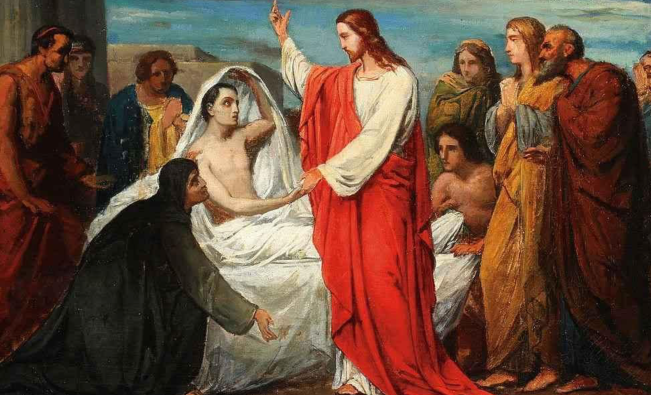
Soon afterward he went to a town called Nain, and his disciples and a large crowd went with him. As he approached the gate of the town, a man who had died was being carried out. He was his mother’s only son, and she was a widow, and with her was a large crowd from the town. When the Lord saw her, he was moved with compassion for her and said to her, “Do not cry.” Then he came forward and touched the bier, and the bearers stopped. And he said, “Young man, I say to you, rise!” The dead man sat up and began to speak, and Jesus gave him to his mother. Fear seized all of them, and they glorified God, saying, “A great prophet has risen among us!” and “God has visited his people!” This word about him spread throughout the whole of Judea and all the surrounding region. (Luke 7: 1-17)

What makes you cry? What moves you? I may have been an emotional person before I suffered a Traumatic Brain Injury 25 years ago, but I certainly am one now. I get choked up, sometimes even when I’m preaching. If that happens this morning, don’t be concerned. It won’t bother me and it shouldn’t bother you. My TBI makes me “emotionally labile,” but you needn’t have a head injury to be moved to tears. I’m just an extreme case, a literal “head case.” There’s even a word for it: “Tearful or given to weeping.” It is called “lachrymose” from the Latin for “weeping.” Lachrymose: isn’t that a cool word?

There are certain texts or songs that move me to tears. Dr. King’s “I have a dream” speech gets me every time. I weep through John 1 “In the beginning was the Word, and the Word was with God and the Word was God.”

Some of the music that chokes me up is about weeping itself, as in the St. Matthew’s Passion. When Peter weeps after betraying Jesus: “Just then the cock crew. Then Peter remembered the words of Jesus, when he said to him: “Before the cock crows, you will deny me three times.” And Peter went out and wept bitterly. It’s even more poignant in the German: “bitterlich.”

Or the aptly named “Lacrimosa” from Mozart’s Requiem. “Full of tears will be that day; When from the ashes shall arise. The guilty man to be judged.” I’ve sung that twice now with Berkshire Lyric at Ozawa Hall and I had to really bear down to get through it both times. Also, the music is really beautiful. Which doesn’t help.

So, I’ve always believed one should pay close attention to these choked-up moments in your life because they mean something important. They mean that something authentic has moved you deeply in your soul.

That is what is going on in our stories today. We have two stories from Luke where Jesus is deeply moved by the suffering of others. He is moved by the centurion’s faith, and he is moved by the grieving widow in Nain, whose only son has died.

Our theme for this morning is compassion, which Jesus both practices and embodies. In telling the story of Jesus, a generation or more after Jesus’s death, Luke is trying to teach the church what God is like, and therefore, what God’s people should be like, a community of compassion.

Remember how Luke describes Jesus reading the Isaiah scroll in his home synagogue in Nazareth. He read:

“The Spirit of the Lord is upon me,

because he has anointed me

to bring good news to the poor.”

That was Jesus’s calling: To bring good news to the poor. So, who are the poor? The poor are those who suffer. They may be wealthy or impoverished, but in their suffering they are poor.

In our first story the Roman centurion fears for the life of a favorite slave. In Luke’s view of the Gospel’s inclusivity, even a hated Roman enemy is not outside the scope of Jesus’s love and attention. The centurion is not literally poor, for he is a powerful soldier with authority over a hundred men, but he is poor in his need. His slave is dying and he heard about Jesus and believes Jesus can heal him. Jesus is “amazed” by his faith and heals the slave.

I want to say something about the Greek word translated here as compassion. Compassion literally means “suffering with.” The Greek word here translated as “compassion,” is splagchnizomai (that’s easy for me to say!) It comes from splagchna, which means “intestines; guts.” Jesus’s reaction to the widow’s plight is literally visceral, gut wrenching, brought on by empathy for a mother who lost her child, one of the most difficult of all human experiences.

Jesus also knows that having lost her only son as well as her husband, she is now doubly vulnerable. For in the patriarchal world of the first-century Roman Empire, widows were solely dependent on their male relatives for sustenance and safety. Here is compassion, suffering with the sufferer.

Now Luke’s Gospel describes many acts of compassion by Jesus, but he only uses this particular long hard-to-pronounce word for compassion three times, and the other two are some of your favorite stories that are found only in Luke. Can you guess what they might be? What comes to mind?

First, there is the story of the good Samaritan, who had compassion on the man beaten by brigands and left by the side of the road to die. We see Luke’s universality there, too, since the Samaritan is a hated enemy, who shows mercy after the official representatives of the religious establishment passed by on the other side of the road.

The other example is the story of the waiting father and his two sons. The father sees the lost prodigal from far off and has compassion for him.

So, likewise, Jesus is moved to compassion for the widow. Picture with me these two processions that meet outside the city gate in the village of Nain. One is a procession of death, with the dead son on a stretcher, his bereaved mother, and a great crowd of mourners headed to the graveyard.

The other is a procession of life, with Jesus, his disciples, and a great crowd of exuberant followers. The two processions collide, and the procession of life wins. Jesus raises the dead son from death to life, the first time he does this.

Why does Luke place this here in his story? Soon, in Luke 7:22, Jesus will tell John the Baptist’s disciples to report back to John that they have seen and heard miraculous signs and wonders, including the raising of the dead

The Good News that Jesus brings means the leveling of established positions and privilege. My teacher and friend, Max Stackhouse, went to India for a year with his family, where Max was a guest professor at United Theological Seminary in Bangalore. It was a life-changing experience for Max, who came to view the Indian caste system as a great systemic evil.

He told me how the Good News of Jesus was powerfully attractive to the lowest castes in India. Christians make up only 2.3% of the population, and many of them had been Dalits, whom we once labeled “Untouchables.”

Jesus comes with good news for the poor, the last, the least and the lost of society. He touches the Untouchables. And he comes with good news for us, the privileged, who are also poor in our own ways.

Henri Nouwen once described Jesus’ life of compassion as the “path of downward mobility.” Jesus chooses suffering, rejection, and death rather than the path of “upward mobility” toward privilege and power.

Jesus didn’t reach down and lift the poor up from above. He became poor “he suffered with” and according to Luke, it was this very suffering that led him to the cross, “for us and all people.” Jesus’ crucifixion and resurrection are what enables redemption, atonement, indeed, relief from suffering for all humanity.

Jesus’ “path of downward mobility” differs from the idea today that compassion means helping “those less fortunate than we are.”

One of the things I truly love about the Cathedral of the Beloved is the way the leaders erase the distinction between the helpers and the help-ees. Sure, we prepare a meal to serve, but we all eat it together in a community. The Food Program at United Church of Christ, Pittsfield, does the same thing; you can’t tell whose is there for food or there to volunteer. Sometimes those groups overlap. And this gives everyone dignity and erases the stigma.

In Jesus we see this important distinction between compassion and pity. Jesus knows you can’t love down, from a place above or apart. Even some of the terms we use, such as “the underprivileged,” or the “less fortunate” keep us above those we serve, who like us, are beloved children of God.

Real compassion, as embodied by Jesus, runs counter to our culture’s constant call for success, achievement and wealth. Real compassion is a call to suffer with the powerless.

A Christian faith true to the life and teachings of Jesus should never seek to be powerful and rise above others. That is why I have condemned Christian Nationalism, and the popular and rich preachers of the Prosperity Gospel as being false to what Jesus stood for.

We are not in a society that honors or displays much compassion. This very week the richest man in the world cut aid, food, and medicine, to the poorest people on earth, some of whom will now die. We daily see new polices that are the opposite of compassion, they are cruel and mean and go to the heart of who we are as a country. And in my opinion, the cruelty is not a bug, but a feature. It’s the point. The obscene worship of wealth and power is directly opposite of what Jesus taught and who he was.

There has been some push-back from the Christian Church. We’ve seen a brave Episcopal bishop, Marianne Budde, gently entreat the President to have mercy on the scared and vulnerable. The Roman Catholic church has declared the war on immigrants to be incompatible with Catholic Social Teaching. The Presiding Bishop of the Evangelical Lutheran Church, Elizabeth Eaton, has spoken out about misinformation on social media about her church’s funding when General Flynn tweeted that the Lutheran Church was “a money-laundering scheme.” Our own United Church of Christ has spoken out, and there is an Immigration Support Meeting  today at 2:30.

So, what can we do? I have two suggestions. First, I suggest we partner with any groups on the ground who are working to implement compassion for those who are suffering. Our UCC Conference has lists of organizations that are helping immigrants.

Secondly, let us continue to be a laboratory of the compassionate community. Let us continue to live out the radical inclusivity that Jesus taught and embodied. Let is continue to be faithful to our covenant, and to being “Open and Affirming” to all people. Let us pray with and for each other and support each other. Let us tell the truth in love, and not give in to our fears. Let us reach out to those in our communities that are being harmed.

Finally, let us be faithful followers of Jesus Christ, our Risen Lord and Savior. We may not be the powerful of society, but we are not powerless. There is a different kind of power available to us through him who loved us. For I am convinced that nothing will separate us from the love of God, not life or death, not oligarchs and autocrats. Nothing will separate us from the of God in Jesus Christ our Lord.  And the truth of that moves me deeply and chokes me up! Amen.

(I preached this sermon on February 9, 2025 at the First Congregational Church at Stockbridge, Massachusetts. A YouTube video of the service is here:)

Unknown's avatar

“So Great a Cloud of Witnesses” A Sermon on Hebrews 12: 1-2

Prayer: May the words of my mouth, and the meditations of our hearts, be acceptable in your sight, O Lord, our Rock and our Redeemer. Amen.

Happy All Saints Sunday! I contemplated calling this sermon “The Saints Preserve Us!” but I thought that might be too alarming just two days before a fraught election.

But I do want to talk about the saints, both those “here below” as the Doxology says, and those among “the heavenly host.”

Continue reading →

Unknown's avatar

“The Healing Touch” A Sermon on Mark 1: 40-45

Christ_cleans_leper_man

“A leper came to him begging him, and kneeling he said to him, “If you choose, you can make me clean.”  Moved with pity, Jesus stretched out his hand and touched him, and said to him, “I do choose. Be made clean!”  Immediately the leprosy left him, and he was made clean. After sternly warning him he sent him away at once, saying to him, “See that you say nothing to anyone; but go, show yourself to the priest, and offer for your cleansing what Moses commanded, as a testimony to them.”  But he went out and began to proclaim it freely, and to spread the word, so that Jesus could no longer go into a town openly, but stayed out in the country; and people came to him from every quarter.”  —Mark 1: 40-45 Continue reading →

Unknown's avatar

Christmas Eve Reflections

I lead a little weekly Bible Study on Zoom and yesterday we had the story of the birth of Jesus from Luke Chapter 2. The Christmas story is a good one in which to ponder how we read Scripture since it is so familiar to us. After nearly a half century of studying Scripture for preaching I am still finding discoveries in texts that I thought were “settled.” The Christmas story is one such text.

Continue reading →

Unknown's avatar

Book Review: “Useful Wisdom: Letters to Young (and Not-So-Young) Ministers” by Anthony B. Robinson

Book Review: “Useful Wisdom: Letters to Young (and Not-so-Young) Ministers” by Anthony B. Robinson, Cascade Books, 2020. (Link to the book at Wipf and Stock here.)

By Richard L. Floyd

This little book is well-titled, for it is both useful and wise. In the interest of transparency, let me say that I have known Tony Robinson as a friend and interlocutor for decades. During that time, I have admired his many writings, which are clearly and concisely written, and grow out of his pastoral experience and long years as a church consultant. Continue reading →

Unknown's avatar

A Reflection on Forty-Five Years of Ordained Ministry

On this day forty-five years ago, September 21, 1975, I was ordained into the Christian Ministry of Word and Sacrament at the Newton Highlands Congregational Church, United Church of Christ, in Newton Highlands, Massachusetts. I was 26. Continue reading →

Unknown's avatar

Forty-five years in Ministry and I’m Finally a Televangelist! My YouTube Debut.

I filled in to lead worship for my pastor daughter today. Her amazing worship team put together an engaging and inspirational multi-media worship experience unlike any I have ever been a part of. It’s a new world we are living in, and my message was about how I have taken the lessons I have learned from my brain injury to think about life after the Pandemic. How we might use our religious imaginations to see what “new normal” might look like, because in the life of faith there is no going back: