
Unknown's avatar

Matthew, Luther and Bach: Reflections on St Matthew Passion

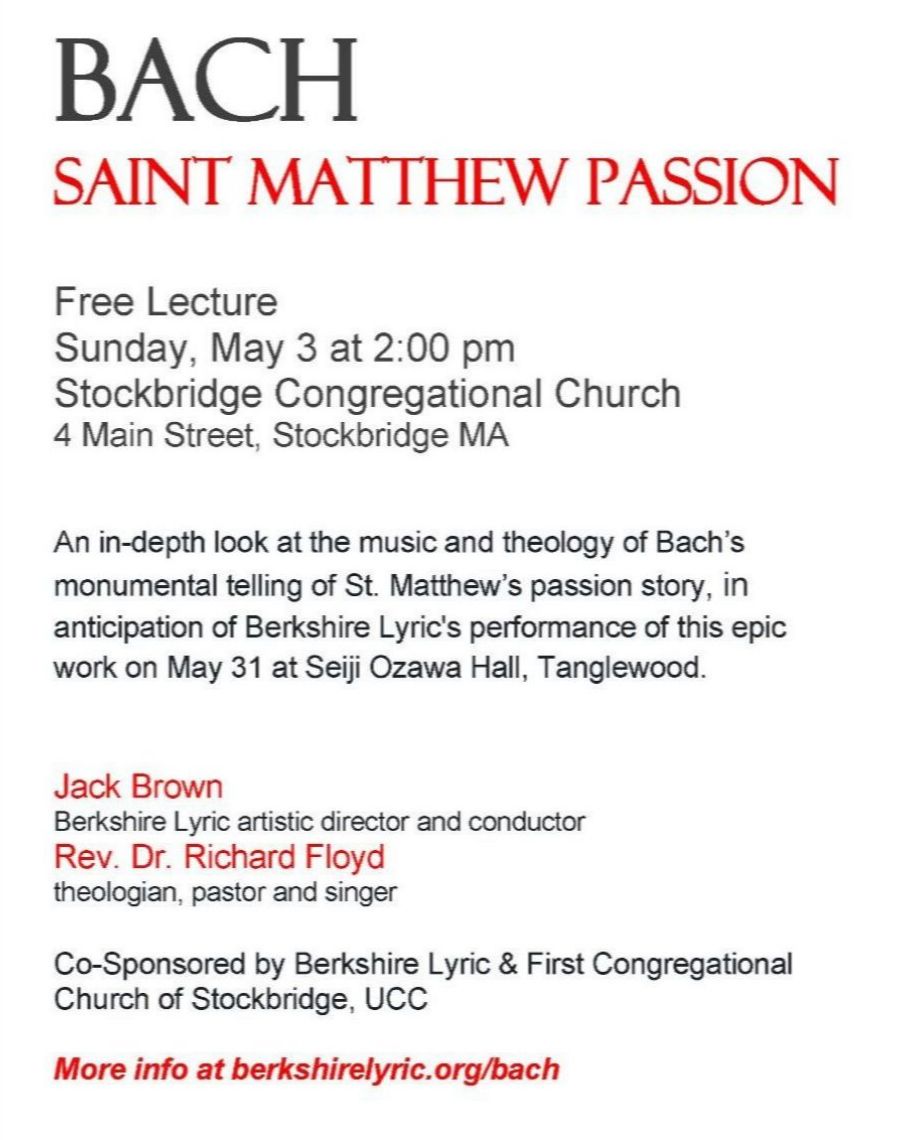
I participated in this public lecture with Berkshire Lyric Music Director Jack Brown and Bass Soloist Doug Williams. What follows are my remarks.

  1. Who was St. Matthew? As we focus on J.S. Bach’s St Matthew Passion, the question comes to mind, “What makes this Oratorio so great?

We are going to spend some time exploring Bach himself, but there are other elements and influences that are foundational for the work that we want to examine, namely the Gospel of St. Matthew itself, and the Reformation theology of Martin Luther that was so important to Bach’s theology and faith.

We will start with Matthew. “Who was St. Matthew? And what is his Gospel about?”

Matthew’s Gospel is called “The First Gospel” because it is the first of the four gospels in the New Testament canon. But, despite that title, it was not the first one written: that would be Mark, who invented the genre of gospel, which means “good news.”

Matthew knew Mark’s Gospel, but enlarges and extends the scope of Mark’s narrative both at the beginning, with a genealogy and a birth narrative, and at the end, with post-resurrection appearances by Jesus to his disciples.

Without Matthew’s additions to Mark, we would know nothing of the Magi meeting Herod and going home by another way, or the Great Commission to the disciples on the mountain in Galilee, to name just a few.

Matthew’s Gospel is sometimes referred to as the Ecclesiastical Gospel because it contains so much admonition to the church on how to be the church.

Indeed, it is fair to say that the purpose of the Gospel is not so much about giving an account of the historical Jesus, as it written for the church in Matthew’s time and for all time, including ours.

And when was Matthew’s time? Certainly, it was within the last third of the First Century. A.D. And how do we know this? Because in 70 A.D. the Romans under Titus attacked Jerusalem and destroyed the Second Temple, something Matthew knew about.

So, his time may have been in the 80’s or 90’s of the first century, some 50 to 60 years after the events he is writing about.

What Matthew has done is in essence collapsing time, so that the events of his passion narrative feel contemporaneous to his generation of Christians. The historical Jesus of Nazareth and the Risen Christ become conflated.

We had a good example of that recently in our Zoom Bible study. In Chapter 18 of Matthew, Jesus is giving admonition on how to deal with conflict in the church.  Jesus tells Peter that forgiveness is inexhaustible. “Forgive 77 times, or 7 times 70!” Then he says “where 2 or 3 are gathered in my name, there I am in the midst of them.” See what Matthew has done there? Clearly, the earthly Jesus of Nazareth who was soon to die on a Roman cross was not going to always be there, but the Risen Christ of Easter, which hasn’t taken place yet in the narrative will be.

Matthew is addressing his congregation, which we think was a group of Jewish Christians that had been expelled from their synagogue. As a Jewish Christian leader Matthew is keen to underscore that God the Father of Jesus Christ and the God of Israel are one and the same God, and the story of Jesus is in continuity with the Promise to Israel and is the completion of the covenant. That is why Matthew’s Gospel is choc-a-bloc with quotations and prophecies from the Hebrew Bible.

So, Matthew is writing for his own congregation in his own time, but also writing for all the ages, including ours.

I like this notion of collapsing time to make the story contemporaneous, so that it not just a story from long ago, but in some way our story, the story of the church and its Risen Savior, Jesus Christ.

And I think Bach has done this as well in his St Matthew Passion, collapsing time, so that we become witnesses to the Passion and Crucifixion. That what makes this masterpiece so existentially compelling and so moving to each generation of listeners, even to secular folks in the Netherlands.

2. The theology of Martin Luther which Informs Bach’s St. Matthew Passion

For us to understand the theology that informs Bach’s St Matthew Passion we must turn to the Protestant Reformation of the sixteenth century, and especially to its most important figure, Martin Luther. Bach was a faithful, orthodox Lutheran, deeply steeped in both the Lutheran theology and the Lutheran musical heritage.

Who was Martin Luther? He was born in 1483. His father wanted him to be a lawyer and he started the study of law but soon abandoned it. After some personal crisis, some say he was caught in a lightning storm and vowed that if God spared him, he would become a monk. Others say it was the death of a close friend. In either case, Luther did become a monk, and dedicated himself to the Augustinian order, devoting himself to fasting, long hours in prayer, pilgrimage, and frequent, perhaps too frequent, confession.

He was ordained to the priesthood in 1507 and started teaching at the University of Wittenberg, where he stayed as Professor of Old Testament for his whole career. From 1510 to 1520, Luther lectured on the Psalms, and on the books of Hebrews, Romans, and Galatians. As he studied these portions of the Bible, partly with Desiderius Erasmus’ new annotated translation directly from the original Hebrew and Greek, Luther became critical of Catholic doctrines supported by the Latin Vulgate translation of the Bible. He began to view the use of terms such as “penance” and “righteousness” in new ways. He became convinced that the church had become corrupted in both doctrine and practice, and had lost sight of what he saw as several of the central truths of Christianity.

In 1516, Johann Tetzel, a Dominican friar, was sent to Germany by the Roman Catholic Church to sell indulgences to raise money in order to rebuild St. Peter’s Basilica in Rome. The next year Luther sent a strongly-worded letter to his bishop protesting the sale of indulgences. He enclosed in his letter a copy of his “Disputation on the Power and Efficacy of Indulgences”, which came to be known as the Ninety-five Theses.

Indulgences offered full forgiveness of one’s sins in return for a monetary payment. Luther objected to a saying attributed to Tetzel that, “As soon as the coin in the coffer rings, the soul from purgatory also springs.” Luther insisted that, since forgiveness was God’s alone to grant, those who claimed that indulgences absolved buyers from all punishments and granted them salvation were in error. Christians, he said, must not slacken in following Christ on account of such false assurances.

Luther continued his protestations and refused to renounce all his writings, and in 1521 he was excommunicated by Pope Leo the Third. Eventually the Emperor declared Luther an outlaw and demanded his arrest. 

But Luther had the local prince, Frederick III on his side, and Luther was able to avoid arrest. Luther’s disappearance during his return to Wittenberg was planned. Frederick had him intercepted on his way home in the forest near Wittenberg by masked horsemen impersonating highway robbers. They escorted Luther to the security of the Wartburg Castle at Eisenach. During his stay at Wartburg, Luther translated the New Testament from Greek into German and poured out a torrent of doctrinal and polemical writings.

This break with Rome thrust Luther into the role of principle architect of what became known as the Protestant Reformation. 

As we reflect upon Luther’s theology’s influence on Bach, it is helpful to know what shaped it. Remember, Luther was an Augustinian friar, and St. Augustine was profoundly influenced by the letters of St. Paul, especially Paul’s Letters to the Romans and the Galatians, which speak of “freedom from the law.”  The law in Paul’s time was the Jewish Torah, but Luther equated the Roman Catholic teachings on indulgences and other doctrines with Paul’s critique of “works of the law.”

Luther has a robust atonement theology, and you will see this theology of the cross manifest in Bach’s St Matthew Passion, with its powerful images of Jesus as “the lamb of God, slain for the sins of the whole world.”

Luther neatly summarizes his theology in a paragraph in the Smalcald Articles, one of the Lutheran Confessions.  He wrote:

“The first and chief article is this: Jesus Christ, our God and Lord, died for our sins and was raised again for our justification (Romans 3:24–25). He alone is the Lamb of God who takes away the sins of the world (John 1:29), and God has laid on Him the iniquity of us all (Isaiah 53:6). All have sinned and are justified freely, without their own works and merits, by His grace, through the redemption that is in Christ Jesus, in His blood (Romans 3:23–25). This is necessary to believe. This cannot be otherwise acquired or grasped by any work, law, or merit. Therefore, it is clear and certain that this faith alone justifies us … Nothing of this article can be yielded or surrendered, even though heaven and earth and everything else falls (Mark 13:31).”

By the time of Bach’s St. Matthew Passion in 1827, the Protestant Reformation was a vital religious movement three centuries old, and Lutheranism was deeply established. Luther’s German translation of the Bible had consolidated the German language. In 1455 Johannes Gutenberg had printed a complete Latin Bible using his new movable-type printing press, and the Bible was universally available in German by Bach’s time. 

Luther was also a musician and wrote dozens of hymns that were part of the theology and spirituality of Lutheranism. Bach knew them well. Although he served in secular posts, and as a musician in a Calvinist court, where music was not as important, his heart was as a Lutheran church musician, and from the time of his appointment to St. Thomas Church in Leipzig, he never looked back.

So, Bach’s St Matthew Passion is deeply infused with both the theology and piety of Lutheranism. This choral masterpiece interprets two chapters of Matthew’s Gospel (26 and 27) using Luther’s German translation, through this lens. Both the libretto and the extraordinary music function to collapse time and make us, and every generation who hears it, eye-witnesses to the events of the Passion of Christ and to his crucifixion. The genius of Luther and the genius of Bach combine to bring us this gift.

3. The Faith of J. S. Bach

In Bach’s day the old Christian verities were being challenged by the rise of Enlightenment Science and Philosophy, but Bach held on to the Lutheran faith, not only in doctrine but also in his personal piety. This deep piety infuses his St Matthew Passion with a genuine pathos and a wide appeal, that engages people, even those who do not share his Christian faith.

One of the keys to his faith is in his biography.  Bach’s life was full of loss, grief and suffering. Both his parents died six months apart when he was ten, and he went to live with his oldest brother Johan Christian Bach.

Thomas Hobbes famously described life in the Seventeenth Century as “Nasty, brutish and short.” Life expectancy was around 35 or 40 because of high infant and child mortality. Bach’s first wife, Maria Barbara, had seven children, three of whom died in infancy.  She herself, died suddenly thirteen years into their marriage. His second wife, Anna Magdalena had thirteen children, only six of whom survived to adulthood.

Despite all this, there is nothing melancholy about Bach’s music, which is frequently triumphant and celebratory. He loved and enjoyed his family. And he loved his music.

Following Martin Luther’s theology, he believed all Christians were called to their several vocations or callings. He understood his music to be a divine calling and dedicated his life and music to the glory of God. He often signed his compositions with the initials “S.D.G.” (Soli Deo Gloria – To God Alone the Glory). Since he believed music was a divine calling meant for the “refreshment of the spirit” and to glorify God, he applied this to both his sacred and secular works.

The root word of passion is the Latin verb pati, which means “to suffer,” “to endure,” or “to undergo”. It entered English through the Old French passion and Latin passio (suffering), originally referring to the crucifixion of Jesus Christ before evolving to mean intense emotion or desire.

Bach’s St Matthew Passion is a story of redemption by the suffering and death of Jesus. Like any good Lutheran of his time, Bach would have believed that humans without God are in a state of sin, a problem that we cannot rectify by ourselves. At the end of part 1 of St Matthew Passion Bach employed “O man, bewail thy grievous sin” a famous Lutheran Passion hymn written by Sebald Heyden in 1530.

“O man, thy grievous sin bemoan,

Whence, from His Father’s bosom flown,

To earth came Christ, our Savior;

Of virgin mother, undefiled,

For us was born the holy Child,

To be our Mediator.

Unto the dead new life He gave,

The sick from ev’ry ill He saved,

Until His hour of anguish,

When He would be our sacrifice,

Pay for our sins the awful price,

Yea, on the cross would languish.”

This is standard Christian orthodoxy. The Creed says “for us humans and for our salvation, Jesus Christ came down from heaven, and by the Holy Spirit was incarnate of the Virgin Mary, and became human. For our sake he was crucified under Pontius Pilate, he suffered death and was buried, and rose again on the third day in accordance with the Scriptures.”

That act of suffering love and sacrifice “does for us that which we cannot do for ourselves.” But unlike other major doctrines no church council ever declared the “how” of Christ’s atoning sacrifice. For centuries the church believed that Christians access the saving act of Christ through the sacrament of the mass, where the sacrifice is literally re-enacted on the altar by the priest.  

Luther and all the other Reformers rejected this doctrine of transubstantiation. With the Bible in Greek and Hebrew newly in his hands, Luther believed that Christ’s atoning sacrifice on the cross was “once and for all time” and could not be re-enacted. Bach would have believed this. It is often noted that there is no resurrection in the St Matthew Passion. Bach, good Lutheran that he was, didn’t need to put it in since the cross was “a finished work” that itself brought satisfaction and justification to the sinner. The resurrection was merely God’s Amen to the saving work of Christ.

Jesus goes voluntarily to his death out of love. Bach’s faith is on display the way he juxtaposes the crowds “Let him be crucified” with the soprano recitative “He has done well for us all” and the soprano aria “In love my Savior Now is Dying.” “It is out of love that my Savior intends to die, Although of sin and guilt He knows nothing, So that my soul should not have to bear, Everlasting damnation, and the penalty of divine justice.”

Bach knew his share of suffering, but he drew consolation, comfort and hope from his faith in his Savior Jesus Christ. It is this faith, devotion and piety that has given us this splendid masterpiece.

4. “Then and Now” A Reflection on the Gap between Bach’s Time and Ours

The Age of Enlightenment was breaking out in Bach’s time, but he was more a creature of Pre-Enlightenment times. His influences were Martin Luther and the Gospels rather than Voltaire and Isaac Newton.

Bach’s worldview is far from our own. There is an important book by the late Yale theologian, Hans Frei, titled The Eclipse of Biblical Narrative. Frei’s thesis is that there has been a radical change in the way people have understood the Bible since the Enlightenment. 

Prior to the Enlightenment, Christians, most of them illiterate, understood the world of the Bible as continuous with their world. In other words, they understood the Biblical story to be their story. They were in it!  They knew the story from statues and stained-glass windows in Gothic cathedrals. They knew the story from catechisms and creeds, from Passion Plays and religious festivals. If they owned one book, it was the Bible. 

With the coming of the Enlightenment and the rise of science a new worldview developed. Empiricism meant that all things were scrutinized, held at arm’s length for observation, if you will. Frei contends that post-Enlightenment Christians, even if they claim the Christian story as their own story, can never be in the story in the same way that Bach was.

The reactions to this eclipse of biblical narrative have varied. Fundamentalists deny modernity and resort to a claimed literalism. Modernists accommodate the Bible to fit modern assumptions of what can be real. I’m thinking, for example, of Thomas Jefferson’s taking scissors to the Bible, cutting out all the parts he couldn’t believe in, such as the miracles of Jesus.

Our worldview is shaped by our time and our experience of it. Bach’s world was a world of ignorance and superstition. Christians believed that God controlled the weather. They believed in witches and demons, and in a literal hell from which God alone could save them.

So, as Post Enlightenment people, when we approach a biblical text, we instinctively ask, “Did this happen? Is it factual?” That is the Enlightenment question. But it wasn’t Bach’s question.

As some of you know, I lead a weekly Zoom Bible study. In that class I often remind them of the relationship of text to context. The text never changes, but the context is always changing. The Gospel of St. Matthew is the same today as it was in Bach’s time, although he read it in German, and we read it in English, if we read it at all.

But the context is very much different. As I said previously, in Bach’s time life was short, infant and child mortality was high. There were periodic famines. Germany had suffered the Thirty Years War (1618-1648) a generation before Bach was born. That war was still in the memory of Bach’s elders. How bad was that war that raged across Europe for three decades? In that bloody war an estimated 4.5 to 8 million soldiers and civilians died from the effects of battle, famine, or disease, with parts of Germany reporting population declines of over 50%.

No wonder that many of the Lutheran chorales, such as the ones Bach employed in the St Matthew Passion, are preoccupied with suffering and death and the sweet consolations of heaven. Death was the context, the lens if you will, with which Bach and his contemporaries viewed biblical texts.

In the academic study of scripture, we refer to the theory of interpretation as hermeneutics, which gets its name from the Greek god Hermes, the herald or messenger of the gods. He’s the guy with wings on his helmet. He is Mercury in the Roman mythology. He’s the guy who flies from here to there, to bring messages from the gods to humanity.

So, Hermeneutics is the study of interpretation, of how we get from here to there; how we get from an ancient text to a contemporary meaning. How do we get from a fixed text to interpret it in a new context.

An example of this interplay between text and context I often share with my class is what happened to me after September 11, 2001. I preached from a three-year lectionary of prescribed scripture texts, and in 2001 I’d been preaching for 25 years, which meant the same texts had been before me 8 times. In the fall of 2001, the Old Testament readings were from the books of Jeremiah and Lamentations and were pretty ghastly laments about the destruction of Jerusalem by the Babylonians in 587 BC. Here’s a sample:

“My joy is gone; grief is upon me;

    my heart is sick.

Listen! The cry of the daughter of my people

    from far and wide in the land:

“Is the Lord not in Zion?

    Is her King not in her?”

(“Why have they provoked me to anger with their images,

    with their foreign idols?”)

“The harvest is past, the summer is ended,

    and we are not saved.”

 For the brokenness of the daughter of my people I am broken,

    I mourn, and horror has seized me.

Is there no balm in Gilead?

    Is there no physician there?

Why then has the health of the daughter of my people

    not been restored?

O that my head were a spring of water

    and my eyes a fountain of tears,

so that I might weep day and night

    for the slain of the daughter of my people!” (Jeremiah 8: 18)

They referred to “the burning city.”  The previous 8 times I had read them, I thought, what in God’s name could I possibly I say about these gruesome texts? So, I chose other ones. Now, in 2001, with the world trade center burning and falling, a new context brought new life to old texts.

My point, and I do have one, is that we read and hear St. Matthew with very different eyes and ears then the people in Bach’s time. Having said that, the beauty and artistry of St Matthew Passion still invite people in. Invite even secular people in, as we noted about the popularity of the annual Passion in the Netherlands, one of the most secular countries on earth.

So, even if Bach’s world and ours are so very far apart, his musical masterpiece keeps finding and reaching new audiences. A piece of music written in 1727 still engages and thrills us, as you will discover if you are in Ozawa Hall on May 31.

5. Conclusion: What Makes Bach’s St Matthew’s Passion Great? A Reflection on A Work that Transcends its Time

Jack says that many musicians claim Bach as the best musician ever, and that the St Matthew Passion is his most brilliant work. That can be debated, of course. For example, the great Swiss Reformed theologian of the 20th Century, Karl Barth, claimed that when God was in His heavenly court, He listened to Bach, but when He retired to his private chamber, he listened to Mozart. But I think we can all agree that Bach was a musical genius and St Matthew Passion is a great masterpiece. What makes it great?

Let’s start by asking why Bach is great. Here’s the composer who wrote the B Minor Mass, the Brandenburg Concerti, the Six solo Cello Suites and the Goldberg Variations, to name but a few of his masterpieces.

I have a theory. In 2008, the Canadian author, Malcolm Gladwell, wrote a bestselling book called Outliers. Gladwell examines the factors that contribute to high levels of success. To support his thesis, he examines why the majority of Canadian ice hockey players are born in the first few months of the calendar year, how Microsoft co-founder Bill Gates achieved his extreme wealth, how the Beatles became one of the most successful musical acts in human history. 

Throughout the book, Gladwell repeatedly mentions the “10,000-Hour Rule”, claiming that the key to achieving world-class expertise in any skill, is, to a large extent, a matter of practicing the correct way, for a total of around 10,000 hours. 

So, the Canadian ice hockey players born in the first months of the year got more ice time than those born later. Bill Gates grew up in Palo Alto, California and had access to a Stanford University mainframe computer for many years, and the Beatles were the house band, first in Liverpool, and then in Hamburg, Germany before becoming an international  “overnight” sensation.

You get the idea. Now let’s look at J. S. Bach through the lens of the Gladwell thesis. Sebastian, as they called him, was born into a multi-generational musical family. The Bach family had already produced several composers when Sebastian was born in Eisenach, the youngest child of the city musician Johann Ambrosius Bach.

His family, particularly his uncles, were all professional musicians who worked as church organists, court chamber musicians, and composers. Bach’s father presumably taught him the violin, his own primary instrument, along with basic music theory principles.

As I mentioned, Bach’s parents died when he was 10 and Sebastian moved in with his eldest brother, Johann Christoph Bach, the organist at St. Michael’s Church in Ohrdruf.  There he studied, performed, and copied music, including his brother’s, despite being forbidden to do so. He also received instruction on the clavichord from his brother. Johann Christoph exposed him to the works of composers of the day, including South Germans such as Johann Caspar Kerll, Johann Jakob Froberger, and Johann Pachelbel (under whom Johann Christoph had studied); North Germans such as Georg Böhm, Johann Reincken and Friedrich Nicolaus Bruhns from Hamburg, and Dieterich Buxtehude; Frenchmen such as Jean-Baptiste Lully, Louis Marchand, and Marin Marais; and the Italian Girolamo Frescobaldi. Sebastian studied theology, Latin, and Greek at the local gymnasium, but he never earned a university degree, something that vexed him throughout his life.

So, even before he had his first post as a musician, he had been exposed to many styles and some of the finest composers in Europe at the time.

By the time he composed St Matthew Passion in 1725 he was forty years old and had put in his 10,000 hours of music. That and his musical genes and exposure to the Bach family business make him an outlier.

Now I must turn to the first half of Jack’s Credo:

“Anything of real value

happens in community, (the solitary agent is overrated)

does not usually happen quickly,

involves steady work and patience,

must have one foot in tradition,

must be nurtured with a bias towards steady positive forward action,

involves mastering some detailed complexity before you get to the brain float,

must be done with love (different than niceness, but crucially includes kindness)”

Bach had put in the work: steady work and patience, and he had one foot in tradition. Tradition for Sebastian was not just his conservative musical tradition, but his deeply held Lutheran faith. We post-Enlightenment people make a distinction between secular and sacred. Sebastian would have made no such distinction. For example, when he was at the court of Leopold of Anhalt-Köthen he composed very little sacred music, since Leopold was a Calvinist and they didn’t employ much music. Still, Bach signed each composition “to God be the glory.” And as one in the Calvinist tradition, I want to go on record that we got it wrong about music and the Lutherans got it right!

A final reason Bach is great is his character. He was a principled man. There is often a fine line between principled and stubborn. We have already seen this in Martin Luther, whose stubbornness kept him from backing down from his principles even when the weight of both church and state were pressuring him to renounce his writings.

Bach could also be stubborn.  He sometimes engaged in petty quarrels over principles with the Leipzig town council, who often treated him quite badly. This stubbornness also served his dogged pursuit of perfection in his art. By the time he composed St Matthew Passion he had had years of writing weekly cantatas for the liturgical year. He had absorbed all there was to be learned from the best composers and musicians in Europe, including Vivaldi, who was a big influence on him.

So, St Matthew Passion was composed at the height of his powers. Like a painter with a full palette, he created a masterpiece that transcends its own time. He was the final flower of the Baroque. He was the best and last of the Baroque, much like Jonathan Edwards was the best and last Puritan.

We are blessed to be able to hear (and sing) this timeless masterpiece.

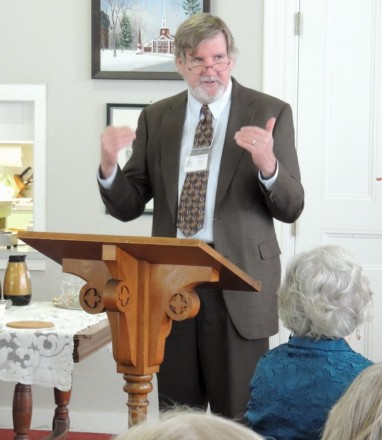
(Photo: Berkshire Lyric Music Director Jack Brown (left) Me, and Bass Soloist Doug Williams at Ozawa Hall, Tanglewood, Lenox, Massachusetts. 2024.)

Unknown's avatar

“How then shall we speak of the atonement?” A Reflection for Good Friday

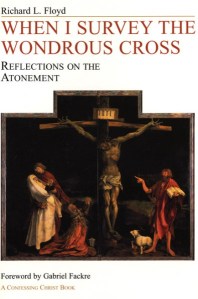
(This essay was first written in 1995 for my study of the atonement with Professor Richard Bauckham at St Andrews University in Scotland. It later appeared as a chapter in my book When I Survey the Wondrous Cross: Reflections on the Atonement. Some of the references, therefore, are dated.)

The Apostle Paul wrote to the Christians in Rome “God shows his love for us in that while we were yet sinners Christ died for us.” The death of Jesus Christ was understood by the earliest church, not least by Paul himself, as a divine act of reconciliation between God and humanity. Which is to say that Christ’s death on the cross was understood from the beginning as an atoning death. Continue reading

Unknown's avatar

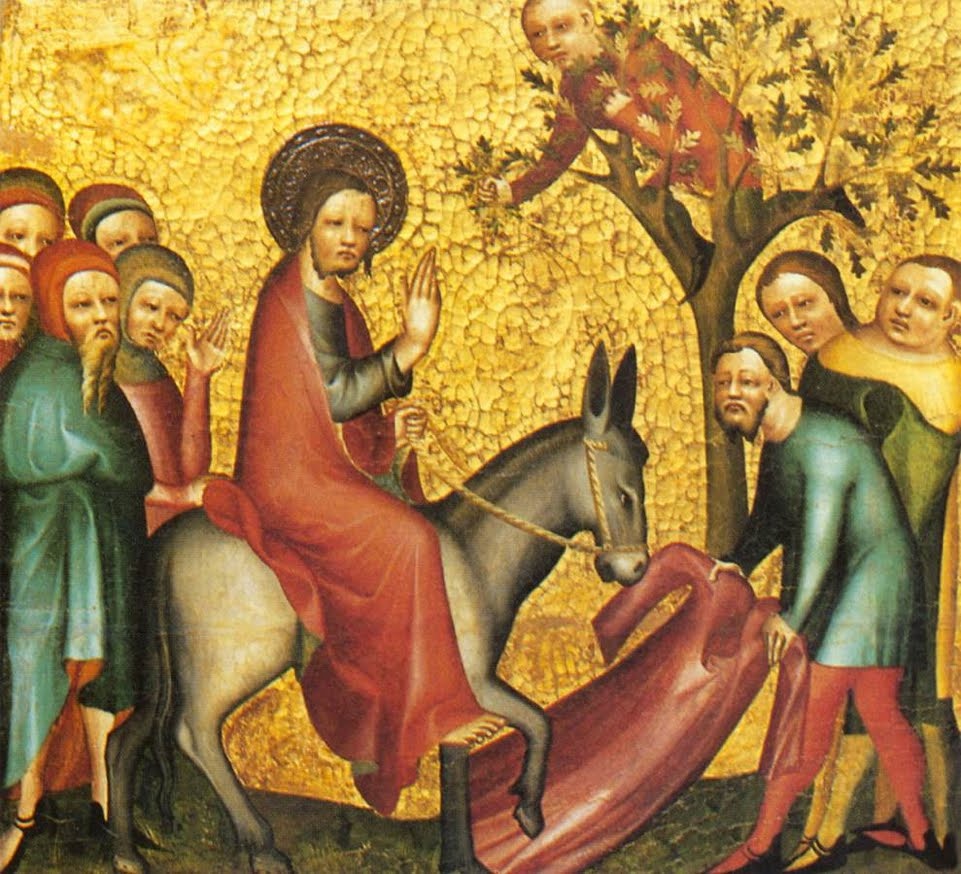
“He knew where he was going!” A Devotion for Palm Sunday

“They were on the road, going up to Jerusalem, and Jesus was walking ahead of them; they were amazed, and those who followed were afraid. He took the twelve aside again and began to tell them what was to happen to him, saying, “See, we are going up to Jerusalem, and the Son of Man will be handed over to the chief priests and the scribes, and they will condemn him to death; then they will hand him over to the Gentiles; they will mock him, and spit upon him, and flog him, and kill him; and after three days he will rise again.” —Mark 10:32-34 Continue reading

Unknown's avatar

“The Message of the Cross” A Sermon on 1 Corinthians 1:23-25

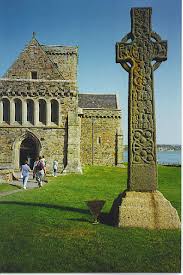
Iona crossA minister friend and mentor of mine, Herb Davis, once told me that every preacher has only one sermon in him, or her. According to Herb, every Sunday the preacher serves up that one sermon in a variety of ways. It may look like a different sermon, but at the heart of it, there’s just the one!

When I was growing up my family always had some sort of a roast at Sunday dinner, which was usually served in the middle of the day after we came home from church. Then the remains of that roast would reappear in various guises throughout the week. For example, let’s say it was a pork roast. The roast might reappear on Monday night in a soup, and on Tuesday night as my Dad’s signature roast pork chop suey and so on. So is that really the way it is? Do the people of God get fed leftovers every Sunday?

I hope not. I think what Herb was saying is that every preacher’s one basic sermon provides the core convictions out of which that preacher delivers the Gospel. And if Herb is right about the one-sermon theory, than I suppose today’s epistle lesson would have to be the text for my one sermon. Let’s hear it again: Paul writes, “We preach Christ crucified, a stumbling block to Jews and folly to Gentiles, but to those that are called, both Jews and Greeks, Christ the power of God and the wisdom of God. For the foolishness of God is wiser than human wisdom, and the weakness of God is stronger that human strength.” (I Corinthians 1: 23-25)

This is what Paul calls the message of the cross. Paul believed that Jesus was the Jewish Messiah and that God raised him from the dead. The cross on which Jesus had died became for him the symbol of that Good News of God’s vast unconditional love for all humankind. Paul believed that in Christ’s dying and rising two important new things had occurred. First, there was now a new age of God’ activity, and, secondly, there was now a new community, the church, made up of both Jews and Gentiles. Continue reading

Unknown's avatar

“The Cross and Forgiveness”

Lent 2014As we enter Holy Week and look ahead to Easter I would like to reflect on some of the threads of our Lenten study these past few weeks in the light of the cross and resurrection.

You will recall that forgiveness means a wiping away from memory of the offense, so that it is as if it never happened, leading to restoration of the relationship.

At the very first meeting we reflected on how extraordinary the idea of forgiveness is, since the human impulse for retribution and revenge runs very deep.

So if forgiveness is such a hard thing for us, what explains the amazing stories we saw and heard, first about Desmond Tutu and the South African Truth and Reconciliation Committees, and then the story of Louis Zamperini forgiving his Japanese captors decades after his imprisonment? (As told in Laura Hillenbrand’s best-selling book Unbroken). Continue reading

Unknown's avatar

The Cross and Violence: A Rumination

Is the cross of Jesus Christ implicated in the violence of our world? More specifically, does the church’s theology of the cross, expressed in its various views of atonement, contribute to fostering violence?

The English word “atonement” was made up by the pioneering translator, William Tyndale, when he translated the Bible into English. It was retained by the King James Bible translators and has made its way into common usage. It literally means “at-one-ment,” the bringing together of that which was separated. It translates several Hebrew and Greek words that are also often translated as “reconciliation,” depending on the context. And that which was separated and needed to be brought together was twofold, the estrangement of enemies needed to be reconciled, and the estrangement of the holy God with the sinful and broken world. The way the cross functions to effect these reconciliations is the Christian idea of atonement.

But do ideas of the atonement foster violence? It is a question that arises out of my own experience in the church. In 1995 when I was living in St Andrews, Scotland, and working on what would later become my book on the atonement, “When I Survey The Wondrous Cross:” Reflections on the Atonement, I wrote an essay on some of the objections to the idea of substitutionary atonement. At the end of the chapter I made note that there were some critics who felt that the cross itself was an emblem of violence, but I didn’t really address this view in depth, because frankly, I thought it was a fringe view without much merit. I still do.

But the view that the cross itself is a cause of violence has been gaining traction in the last decade or so. There have been a spate of books addressing the issue, and in recent years I am hearing ordinands and new ministers repeating these views to the effect that the cross is not, as the church has always claimed, “good news,” but is instead “bad news.”

Let me share a couple of anecdotes. The first was at an ecclesiastical council a few years ago. The candidate told us that she didn’t believe in substitutionary atonement. “Fair enough,” I replied, since there have been some dubious ideas under that banner. “But what do you then make of the death of Christ?” “Christ’s death,” she said, “was the price he paid at the hands of the powerful for his advocacy of an inclusive community.” Admitting that it is at least that, I asked, “Then does the cross have any meaning for salvation?” “No!” she said.

My second anecdote took place in a seminar on the atonement I gave several years ago to United Church of Christ (USA) ministers. During the Q and A time it became clear to me that many of the ministers were uncomfortable with talk of the cross, and some found it offensive. One young man, a bright newly-minted UCC minister said, with some passion, “No good thing came from the cross.”

This rejection of the cross is not new; there have always been critics of the cross as far back as the New Testament. For example, Paul wrote to the Corinthians: “We proclaim Christ crucified, a stumbling-block to Jews and foolishness to Gentiles, but to those who are the called, both Jews and Greeks, Christ the power of God and the wisdom of God.” (1 Corinthian 1:23)

But what is troubling to me is that the attacks on the cross in recent years come from within the church. It comes from seminary professors, and increasingly from pastors. This should concern us, as such teaching and preaching against the cross confuses the faithful and saps the church of the vital nerve center of the faith that is so needed to meet the challenges of our age, including the problem of violence.

That violence has been done in the name of the cross cannot be denied. It isn’t hard to conjure up images of the misuse of the cross as a symbol of violence: the crusaders’ cross on the tunics of invading soldiers in the Middle Ages, the Good Friday pogroms of Eastern Europe and Russia where mobs of Christians would periodically terrorize Jewish neighborhoods, or the burning crosses of  the Ku Klux Klan in the American South.

These and other examples would seem to implicate the cross in the world’s violence, and in racism, anti-Semitism, and imperialism.

But the whole argument against the cross hinges on the important distinction between whether the cross, in and of itself, is a cause of violence, or whether when violence is done in the name of the cross, it is a betrayal of the cross’s true meaning.

I will be arguing for the latter, that where the cross is used to justify or induce violence it is a betrayal of the cross, which is the very center of God’s story of redeeming love to humankind.

Jesus’ crucifixion itself is, of course, a horrific act of violence, but Christian faith, from its early days, has interpreted it as a divine act of reconciliation. My own view, influenced by my St Andrew’s tutor Richard Bauckham, is that the first Christians understood Jesus’ death from the very beginning as an atoning, sacrificial death, and that was expressed in the earliest church’s pre-Markan proclamation that then shaped the written Gospels we have today. This view runs counter to the often-received line that Paul hijacked the faith and created a theology of the cross that was missing from the church’s earliest proclamation.

I argued in my atonement book that ideas of sacrifice and substitution are both biblical and necessary to fully express the radical nature of this divine act of love. Now there are various nuanced and sophisticated discussions about the precise nature of the atonement, and for that I would refer you to my book. My more focused mission when I speak in congregations has been as a witness to the cross in the mainline church, where the crucial center of the Christian story is in danger of being lost.

For we need to keep the whole Christain story in view when we look at any part of it, and I think that is one of the problems that some of the critics of the cross have, in that they focus on the cross, wrenched out of its larger narrative.

So while I am interested in theories of atonement, and want stronger rather than weaker arguments around the “what” of the cross, I want always to view it within the larger Christian story. In that story Jesus Christ, who died on the cross “for us and for all humanity,” must be seen as the One who is “the same, yesterday, today and tomorrow,” and who, as the divine Word, was at the beginning of creation, and will be at the end, on the Day he comes to judge the living and the dead.

But let us be clear that the cross is not just any part of the Christian story, but the very center and climax. And by the cross I mean more than just Golgotha, but, like Paul, I use “the cross” as a kind of theological shorthand to describe the whole saving center of the story as shown in the life, passion, death and resurrection of Jesus.

In that story I see an act of God, who does for us what we cannot do for ourselves, saving us from sin and death. Therefore, my view is that the work of Christ on the cross is constitutive for salvation and not merely illustrative of it. And it is this high view, with its lineage back to St. Anselm, which is particularly under attack from the critics of the cross.

So let me briefly share with you the views of those who consider the cross bad news, then let me to tell you why I think that they are wrong, and finally let me tell you why the word of the cross is good news indeed.

Why some critics of the cross consider it to be “bad news”.

As I have said, I believe that those who do violence in the name of the cross misunderstand and betray it’s true meaning. But I also consider the critics of the cross to misunderstand its true meaning as described in scripture and tradition.

The chief criticism is that the cross is an act of violence against Jesus by God. One of the chief proponents of that view is Professor Dolores Williams of Union Theological Seminary in New York. She has argued that the church should replace the cross with the mustard seed as the primary Christian symbol, because she views the cross as a symbol of violence, especially violence against woman and children.

Mennonite theologian Denny Weaver, another critic of the cross, sums this view up it like this: “The motif of Jesus as the substitute object of punishment, which assumes the principle of retribution, is the particular image that feminists and womanists have found very offensive. It portrays God as the chief exacter of retribution. God punishes — abuses — one of God’s children for the sake of the others. And the Jesus of this motif models passive submission to innocent and unjust suffering for the sake of others.” (Weaver, Violence)

The objection here, so the argument goes, is that Jesus’ obedience to God the Father in accepting the cross demonstrates passivity and submission, and in so doing encourages the acceptance of violence against women by men.

A related charge made by some liberation theologians, such as James Cone, link substitutionary atonement specifically to defenses of slavery and colonial oppression, using ideas of submission, passivity and sacrifice to keep oppressed people in their place.

“Delores Williams calls the Jesus of substitutionary atonement, the “ultimate surrogate figure.” After depicting numerous ways in which black women were forced into a variety of surrogacy roles for white men and women and black men, Williams says that to accept satisfaction or substitutionary atonement and the image of Jesus that it supplies is to validate all the unjust surrogacy to which black women have been and still are submitted. ”

“Such examples show that atonement theology that models innocent, passive suffering does have specific negative impact in the contemporary context.” (Weaver, Violence)

Why the critics are wrong

These views seem to me to say more about the suspicions of the writers than the actual biblical narrative and the atonement theories that are their conceptual representations. After all, if you are looking in the wrong end of the telescope, everything will look small. They are looking at the social consequences of the misuse of Biblical and theological texts, but they are not looking at the texts themselves.

So what I think is needed is a theological interpretation of the cross that takes seriously the complexity of the scriptures. To do that there are some features that are necessary that I find missing or inadequate in the views of the critics of the cross. I have identified 7.

1. Many of the critics do not have a robust view of sin. It was human sin that caused Jesus’ death and Jesus himself “became sin” to save us from sin. That is, he who was sinless died a sinner’s death by the law of his own people, for according to Deuteronomy 21:23 “cursed be the one who hangs from a tree,” a verse Paul quotes in Galatians 3:13.

So it was human sin that killed Jesus, the same sin that we all know in our own lives. Condemned by the twin pillars of the highest civilization of the time, Roman law and Jewish religion, Jesus was crucified by humanity, not at its worst, but at its best.

So the crucifixion wasn’t an aberration, but the kind of event that happens routinely in our fallen sinful world. And this is why the endless debate over who killed Jesus misses the point of the narrative, for when the fingers get pointed, the great Lenten chorale Herzleibster Jesu has it just right, “I it was denied thee, I crucified thee.”

Lest you think this is a gloomy view let me be quick to say that I believe that God’s grace is greater than our sin, but that is no excuse to pretend that sin is not real or powerful. Many pastors have had to defend the prayer of confession in their liturgy against those who say, “I don’t feel I am a sinner.”

Toward the end of my ministry I started replying to that, “Well, then the Gospel is a solution for a problem you don’t believe you have.” In much the same way, many of the critics of the cross see only evil structures and systems, but they do not see the human sin in all of us that is complicit in them. So God’s act of redeeming love on the cross to save us from sin and death is a solution to a problem they don’t recognize.

2. The critics often conflate violence with evil. A good deal of the world’s violence is evil, and I agree that it would be a better world if we tried non-violent solutions to most problems. I ceased to be a pacifist many years ago as Max will attest, but I still have what I call “a preferential option for the non-violent.”

But as Reinhold Niebuhr taught us, there are times and places when only force will stay the hand of evil against the innocent victim. For example, in 1995 if the 400 armed Dutch UN peacekeepers in the so called “safe zone” at Srebrenica had been authorized to use force against the Serb ethnic cleansers, the genocidal murder of 8000 Bosnian men and boys might well have been prevented. Which reminds us that sometimes even non-violence can be complicit with evil.

3. In a similar vein many of the critics of the cross romanticize non-violence. Denny Weaver, author of The Non-violent Cross, raises non-violence to such an exalted place in his theology that it becomes, in Willis Elliott’s phrase, “Salvation by non-violence.” Here the principle of non-violence is used to judge even God’s behavior, so that the violence of Jesus’ cross rules it out as a loving act of God.

This romanticism of non-violence is utopian. It doesn’t take account of the facts on the ground, which is the power of sin and death. God’s victory doesn’t come cheap. God defeated sin and death on the cross at great cost to himself. The horrific violence of Jesus’ cross reflects the real world we live in. In a utopian world, a letter to The New York Times might have fixed it. But in our world, it took considerably more.

4. The critics don’t take Jesus’ Jewishness seriously enough. When we look at the cross theologically we must keep before us that it is Christ who died for our sins, not just any man, but the Jewish messiah. We need to be reminded that Christ is not Jesus’ last name, but the title given him by his followers, a title previously reserved for the figure of God’s anointed, the messiah.

The pre-Markan proclamation that lies behind the New Testament is a thoroughly Jewish interpretation of the death and resurrection of Jesus. That is why the New Testament has so many echoes from the Old Testament.

Why is Jesus’ cross different? Crucifixions were a commonplace in the ancient Roman world, but the significance of this particular cross was the claim that it was God’s anointed who suffered and died. It was their own traditions that allowed these Jews to understand Jesus’ death as an atoning sacrificial death. For example, one of our earliest passages in the New Testament is 1 Cor. 15: 3ff where Paul rehearses the gospel that had been handed down to him that “Christ died for our sins in accordance with the scriptures.”

And the reason it could be understood thus was because the Hebrew scriptures contained stories such as the binding of Isaac in Gen. 22, the description of a suffering servant in the Servant Psalms in Isaiah, especially Isaiah 53, and passages like Psalm 22, which is the source of Jesus’ words from the cross, “My God, my God, why has thou forsaken me? Without this Jewish context the cross is hard to understand properly.

5. The critics don’t take the Trinity seriously. Doctrines are “conceptual redescriptions of the biblical narrative” (Frei).  The doctrine of the Trinity understands the whole Christ event within the inter–dependence of the divine persons. Jesus’ very human experience of being abandoned by the God he called Father, in which he endures the condition of the sinner before God, can be viewed as arising from a Trinitarian act in history, an act to which the Father intentionally sent him and which in obedience Jesus accepted. The cross is, therefore, a Trinitarian act of mutual consent in love between the Father and the Son in the Holy Spirit.

This goes a long way to countering the charge that the cross is a symbol of violence, exploitation or even child abuse.  If you start with a big G god and a human Jesus you have a nnitarian god. But Christians do not know such a god without Jesus. And such a unitarian God, one who requires the sacrifice of the human Jesus is problematic, to say the least. But if we understand the obedient death of the Son as in some real sense a loving act in which it is God who dies for us, we move away from these problems.

The critics also say that substitutionary atonement means God is punishing Jesus. P. T. Forsyth made an important distinction here. He says the cross is penal, in that Jesus, though innocent, voluntarily takes on the sentence that we deserve. But though the cross is penal, it is not punishment, since Jesus is innocent. “For what would the Father punish him? And how could the Father punish the Son, with whom he is always well pleased.”? (Forsyth)

6. The critics have too limited a canon. Like Marcion, the second century heretic who made up his own canon, Luke is their favorite Gospel. Marcion had one Gospel and ten letters of Paul, and no Old Testament, since he believed the God of the Old Testament was a different (and not very nice) God.

The modern critics of the cross often share Marcion’s love for Luke, but not for Paul, who (after God the Father) is their chief villain, for Paul’s cross-centered Gospel. We all have favorite Gospels, and I love Luke as much as the next person, but the thickness of the biblical story is partly a result of the richness and complexity of the canon.

7. Finally, the critics have an inadequate eschatology of the cross. Again we must understand the cross within the framework of Second Temple Jewish monotheism, with its energetic eschatological expectations for a future return of God and his messiah.

The God of Israel was expected to act in the future. Second Isaiah, for example, expects a new exodus, which will show decisively God’s identity as creator and ruler of all things. The first Christians, who had experienced this new exodus in Jesus, understood that God was continuing the story, and “a new narrative of God’s acts becomes definitive for his identity.” (Bauckham, p 71.) The God who acted in the Exodus had now acted again in the cross and resurrection of Jesus.

When the church included Jesus, a human being, humiliated and exalted, into the identity of God, they were saying something radically new about the identity of God. In the dying and rising of Jesus, God had done a new thing that could only be adequately described in the language of Old Testament eschatology. It was the restoration from exile, the new creation, the healing of the rift between God and Israel and more. The sign that Pilate put over Jesus’ head on the cross read, “King of the Jews.” Who could the king of the Jews be other than the messiah of God? Meant by Pilate as a joke, the church could see the truth of it in light of their new faith that in Jesus Christ God had once again acted decisively as expected.

Why the cross is “good news”

1. The cross is the death of ideology. It provides the critical principle which de–centers our preoccupation with both individual and corporate concerns. It calls into question any ideology that would use the Gospel to further its own ends.

The cross provides the church with a anti-ideological bias that protects the Gospel from being blown about by any number of contemporary cultural winds, or co–opted by any number of alternative faiths, religious and secular. The cross also protects the church from both utopianism and cynicism, because it keeps in view that the resurrected one remains the crucified one.

Likewise, the cross helps the church to understand its life and discipleship in other ways than by the canons of success and power that the world so values. It teaches the church to recognize its true hope in the God who raised the dead from the illusory hopes the world holds out for both individuals in the face of death and for human history in the face of futility.

So the church is able to live in real hope only because the cross has taught it where properly to look for hope. Christian hope lies beyond all human endeavors and accomplishments and beyond all possibilities inherent in the natural world. Christians love the world God made and for which his Son gave his life, and we work and pray to make it more like the kingdom to come. At the same time, we know that our true hope lies only in the God who raised the crucified, who is the God who raises the dead. Such hope transcends both personal death and cosmic futility.

2. The cross shows God’s solidarity with all human suffering including suffering caused by human violence. On the cross Jesus suffers an agonizing death, but perhaps more than his physical suffering was the anguish he experienced by the total abandonment of the One he called Father, which he expresses when he cries out from the cross, “My God, my God, why have you forsaken me.” (Psalm 22:1, Matthew 27:46))

In this experience of abandonment Jesus knows solidarity with all human suffering, and if we take his divine nature seriously then God knows this, too, and in some sense experienced it on our behalf, and by doing so redeemed it, which we can only see in Easter hindsight. So not only did Jesus suffer (which is what passion means) but his suffering and death are not incidental to the glorious story of divine atonement and human redemption but quite literally crucial.

Now some of the critics charge that the cross exalts human suffering, and encourages people to accept it. We must admit that suffering, in and of itself, is not redemptive, and so we should be careful not to romanticize suffering. But suffering is such a universal feature of the human condition that surely it must be good news to know that our God understands our suffering, and in Jesus, was himself “a man of sorrows and acquainted with grief.” (Isaiah 53)

3. The cross models forgiveness. From the cross Jesus prays, “Father forgive them, they know not what they do,” and in doing so embodies the loving mercy of God.

This radical forgiveness is the only power that can break the cycles of revenge and retribution that fuel so much of our world’s violence. One of the most powerful moments of Christian witness in my lifetime was when Pope John Paul the Second forgave the man who had shot him, Mehmet Ali Agca. The Pope was shot and seriously wounded in 1981. In 1983 he visited his assailant in prison and spoke privately with him for about 20 minutes. He later said, “What we talked about will have to remain a secret between him and me. I spoke to him as a brother whom I have pardoned and who has my complete trust.”

How ironic it seems to me that the word of the cross is being accused of causing violence, when its message judges and condemns violence

4. The cross is all about God’s love. When we look at the passages in Scripture that speak of God’s love, they more often than not reference the cross as the chief evidence. For example, John 3:16: “For God so loved the world, that he gave his only begotten Son, that whosoever believeth in him should not perish, but have everlasting life.” Or Romans 5:8: “God demonstrates His own love toward us, in that while we were yet sinners, Christ died for us.” Or Romans 8:31, 32: “If God is for us, who can be against us? He who did not spare his own Son, but gave him up for us all—how will he not also, along with him, graciously give us all things?”

And not just in Scripture, but in our traditions, too, we see a cross-centered understanding of God’s love. So the Heidelberg Catechisms beloved first question, “What is your only comfort in life and death?” is answered thus: “That I belong– body and soul, in life and in death—not to myself, but to my faithful Savior, who at the cost of his own blood has fully paid for all my sins…so that everything must fit his purpose for my salvation… he also assures me of eternal life….”

Far from being the cause of violence the word of the cross is God’s love at work, and only that love offers healing and wholeness to our broken world.

It is true that the word of the cross is not a word everyone will hear. As Paul wrote to the Corinthians: “For the message about the cross is foolishness to those who are perishing, but to us who are being saved it is the power of God . . . For Jews demand signs and Greeks desire wisdom, but we proclaim Christ crucified, a stumbling-block to Jews and foolishness to Gentiles, but to those who are the called, both Jews and Greeks, Christ the power of God and the wisdom of God. For God’s foolishness is wiser than human wisdom, and God’s weakness is stronger than human strength.” (1 Cor. 1:23ff)

(Note: This address was given at the First Congregational Church UCC in Stockbridge, Massachusetts on Palm/Passion Sunday, April 1, 2012. It is essentially a re-working of my paper “The Cross and Violence: Is the Word of the Cross Good News, or is it Bad News?” delivered at the 25th Craigville Theological Colloquy, July 2008. I have shortened it and edited it for a lay audience, eliminating most citations and footnotes. The original can be found here.

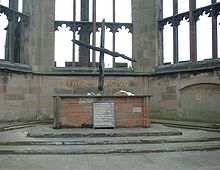
(The photo is of the burnt wooden cross at Coventry Cathedral after it was burned by bombing in WWII)

Unknown's avatar

They’ll Know Him in his Cross A sermon for Palm/Passion Sunday on Philippians 2:5-11

When Jesus entered Jerusalem on that first Palm Sunday many who looked to him to overthrow the Roman oppressor. His entry not on a charger but on a donkey was a living parable that here was a different kind of power. And those who shouted “Hosanna!” on Sunday were quick to shout “Crucify him!” on Good Friday when he didn’t show the kind of power that the world understands all too well.

Christ’s cross confronts us still as the place where divine power and human sin collide. He took our sin to that cross, and it died there along with him. It is no accident that the cross is the symbol of our faith. Paul tells the Philippians:

“Let the same mind be in you that was in Christ Jesus,
who, though he was in the form of God,
did not regard equality with God
as something to be exploited,
but emptied himself,
taking the form of a slave,
being born in human likeness.
And being found in human form,
he humbled himself
and became obedient to the point of death–
even death on a cross.
Therefore God also highly exalted him
and gave him the name
that is above every name,
so that at the name of Jesus
every knee should bend,
in heaven and on earth and under the earth,
and every tongue should confess
that Jesus Christ is Lord,
to the glory of God the Father.” (Philippians 2:5-11. NRSV)

Let us be very clear what is claimed here: that it is the fact of Jesus’s death as a slave that makes him Lord, his death as a nobody that makes him exalted at the right hand of God. And if God, the Father Almighty, who created the heavens and the earth, and Jesus, the man of Nazareth, share a divine identity, what does the cross tell us of the identity of God?

It tells us first of all that what the world values is not what God values. The Roman Empire that crucified Jesus was constructed on power, violence, and might, all delivered with ruthless efficiency, and the cross was the supreme instrument of Roman values. The cross was a slave’s death, designed to dispose of the nobodies of the world, and put fear into the hearts of other nobodies so they wouldn’t challenge Rome’s power.

But the crucifixion puts God squarely on the side of the nobodies. The cross condemns the brutal social arrangements then and now that trample the poor, that put the concerns of the powerful ahead of the nobodies of the world. The cross condemns every injustice that treats people as expendable; every cynical deal that seeks gain at the expense of others.

The cross says God has different values, seeks a different way, a way of servanthood and humility, a way that seeks the good of others, a way that rejects violence and injustice, a way in which everybody is somebody. In God’s values there aren’t any nobodies, for God’s own son was once regarded as a nobody and died a nobody’s death, forgiving those who killed him even as he cried out in utter forsakenness.

This is the Christian God, the crucified God, who turns the world’s values upside down. If you want to know about this God take a good look at Jesus. Notice how he befriends the poor, touches lepers, eats with sinners. There weren’t any nobodies in Jesus’s book.  Only sinners to be saved, broken people to be made whole, dying people to be given new life,  sorrowful people to be made glad, remorseful people to be forgiven.

Look to Jesus: that is where the Christian finds identity and purpose, from Jesus Christ and him crucified. And not just for our personal spiritual life, but for the whole world. For his cross redeems our sins, but also our politics, our marriages and families, our business practices, our churches and everything else about our world. George MacLeod, the founder of the Iona Community, once wrote,

I simply argue that the cross be raised again at the center of the marketplace as well as on the steeple of the church. I am recovering the claim that Jesus was not crucified in a cathedral between two candles, but on a cross between two thieves; on the town garbage heap; at a crossroads so cosmopolitan that they had to write his title in Hebrew and in Latin and in Greek . . .at the kind of place where cynics talk smut and thieves curse, and soldiers gamble. Because that is where he died.  And that is what he died about.

People have asked me why my theology is so centered on the cross of Jesus. Why should somebody as generally cheerful as I am want to focus on such a gloomy subject? The story of my coming to the cross is a story of coming to know God in a whole new way. Although I was raised in the church as a child, I decided to be a Christian as an adult, because the cross of Christ rang true for me, as an answer equal to the world’s harsh truths. My mother died when I was eighteen, and my sunny childhood faith was tested and found wanting. We live in a world where people we love can get sick and die, where injustice is often done, where bad things happen to good people as well as bad, but in my young life I had never known this and I had a lot of trouble accepting it. At this vulnerable time in my life, the time when I was leaving home, my world was turned upside down, and I found myself in a darkness I had never known.

Some of you, probably most of you, have known such darkness, because the world brings it to us in time.  There is, in such times, no light, no hope, no word of comfort. Nicholas Wolterstorff, who teaches theology at Yale, writes about such a time, when  his son died suddenly at the age of twenty-five.  Wolterstorff write this about his time of darkness:

I am at an impasse, and you, O God, have brought me here. From my earliest days I heard of you. From my earliest days I believed in you. I shared in the life of your people: in their prayers, in their work, in their songs, in their listening for your speech and in their watching for your presence. For me your yoke was easy. On me your presence smiled.

Noon has darkened. As fast as she could say, “He’s dead,” the light dimmed. And where are you in the darkness? I learned to spy you in the light. Here in this darkness I cannot find you. If I had never looked for you, or looked but never found, I would not feel this pain of your absence. Or is it not your absence but your elusive troubling presence?

Will my eyes adjust to this darkness? Will I find you in the dark—not in the streaks of light which remain, but in the darkness? Has anyone ever found you there? Did they love what they saw? Did they see love? And are there songs for singing when the light has gone dim? The songs I learned were all of praise and thanksgiving and repentance. Or in the dark, is it best to wait in silence?” (Nicholas Wolterstorff, Lament for a Son, Eerdmans, 1987)

Wolterstorff asks whether anyone has anyone ever found God in the darkness? I did. It took time, and not a little waiting in silence. But as I look back at it I would say that it wasn’t me that found God so much as God who found me. Found me in the darkness! And the God who found me was not a stranger to darkness. Here was a God who knew what I knew, who experienced what I had experienced. Who knew sorrow and was acquainted with grief.

And in this solidarity of suffering I recognized something I had never expected to know in the dark. I knew I was loved, loved by the crucified God, the God who,by some mystery, fully and passionately entered into human life to redeem and transfigure it. And not human life at its best, but human life at its very worst, at a state execution, where a man was beaten half to death and nailed to a tree to die a slow humiliating and painful death. “It was now about noon,” Luke writes of the crucifixion, “and darkness came over the land.”

In my time of darkness I finally realized that I didn’t have the resources to fix the world, much less my own life. I couldn’t even heal the deep grief and loss I felt. But I knew, believed, trusted, the presence of God in all my troubles and trials. Knew and believed in God’s power to transform renew, heal and restore the broken suffering world.

And forty years later I still believe it. And when I look at the world today, in Africa, the Middle East, the Balkans, or even on North Street in Pittsfield, I see a world that cannot save itself and needs the redemptive power of God which is demonstrated in the cross.

And I try never to forget what I know, that the Risen Christ of Easter is the crucified Jesus of Good Friday. The Risen Christ of Easter still bears the marks of the nails that killed him. Because when I am happy and healthy and well fed, I want a God without a cross, a God who will prop up my life and maintain the things I want, and not cause me too much a trouble, a nice God who dwells in sunlight and doesn’t trouble my conscience or demand too much of me. No elusive troubling presence, thank you, just God in his place.

And God’s place, it is sad to say, is often the church, for even the church tries to domesticate God. Even the church tries to sell God like so much snake oil as a nostrum for being healthy and happy, but, if the truth be told, faith should come with a warning label. Maybe that is what the cross is, a warning label! Because those who look to Jesus Christ and his cross for their identity will find that they will invariably  share his passion for this world, and his vocation to be the love of God for a fallen world, and like him go out to embody God whatever the cost. “Take up  your cross,” he says, “and follow me!”

That doesn’t make life easy, but it makes it interesting, and in the end deeply satisfying in a way that others can not know. For by some strange Gospel equation only the empty know what it is like to be filled, only the humble know what it is to be exalted, only those who have wept can know what real joy is, and only those who in some very real way have lost their lives will find the true life that comes from God. The Christian may start out as a consumer of religion, but will soon be called to be a servant, “just as the Son of Man came not to be served but to serve, and to give up his life as a ransom for many.”

Jesus gave up the form of God to take the form of a slave, even unto a slave’s death on a cross. But now the slave is master, whom we call Lord! Now the humbled one is the exalted One who sits at the right hand of God the Father!  Now by his cross we, nobodies in the eyes of the world and, too often in our own eyes as well, are raised up to new life in him and with him.

And someday, in the fullness of time, in God’s good hour, the whole world will see and know Jesus as he is, no longer in darkness but in unspeakable light! They’ll no longer view him as an executed slave, a loser and a nobody, dead on a cross, but as the Lord of time and eternity; the Lord before whom every knee should bend, and every tongue confess that he is Lord. And when they do they’ll see that the risen Christ is still the crucified Christ, that the glorified Lord still bears the visible wounds on his hands and feet and side. Because the only way to really know Jesus, is to know him in his cross!

He died upon the lonely tree
forsaken by his God.
and yet his death means all to me
and saves me by his blood.

The world will never know his worth
the wise will never see,
But those forsaken, broken, bowed,
will recognize that tree.

And know that there God’s love does reign
and conquers sin and death;
Thwarts hate and evil, comforts pain,
gives hope while there is breath.

The nations grasp at wealth and power
while wars like tempests toss,
But finally in God’s good hour,
they’ll know him in his cross

Then wars will cease and weapons fall,
and fear will melt away.
For Christ will be their all in all,
from day to endless day.
© 2001  Richard L. Floyd

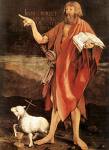
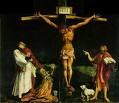
( I preached this sermon at The First Church of Christ in Pittsfield.  It was included in the Festscrift for my teacher and friend Gabriel Fackre, Story Lines. Edited by Skye Fackre Gibson. Eerdmans, 2002.  The concluding poem is a hymn text I wrote in 2001.  The picture is John The Baptist pointing to the Crucified Jesus from the Isenheim altarpeice by Matthias Gruenwald.)

Unknown's avatar

“He Died Upon the Lonely Tree” A Passion Hymn

“He Died Upon the Lonely Tree”
C. M.

He died upon the lonely tree
forsaken by his God.
And yet his death means all to me
and saves me by his blood.

The world will never know his worth,
the wise will never see,
But those forsaken, broken, bowed,
will recognize that tree.

And know that there God’s love does reign,
and conquers sin and death;
Thwarts hate and evil, comforts pain,
gives hope while there is breath.

The nations grasp at wealth and power,
while wars like tempests toss,
But finally in God’s good hour,
they’ll know him in his cross.

Then wars will cease and weapons fall,
and fear will melt away.
For Christ will be their all in all,
from day to endless day.

Suggested tune: Bangor

© 2001 Richard L. Floyd