“So Jesus called the disciples and said to them, “You know that among the Gentiles those whom they recognize as their rulers lord it over them, and their great ones are tyrants over them. But it is not so among you; but whoever wishes to become great among you must be your servant, and whoever wishes to be first among you must be slave of all. For the Son of Man came not to be served but to serve, and to give his life a ransom for many.”—Mark 10:42-45 Continue reading
Tag Archives: Jesus Christ
“Down to Earth” A Sermon on John 13:1-17
I started my ministry 43 years ago in two small congregations in two adjacent tiny towns in Maine about 9 miles apart. When I lived in Maine just about the nicest compliment you could give someone was to say they were “down to earth.” It meant that they weren’t puffed up about their own importance. They were reliable, sensible, responsible, unpretentious and humble. Continue reading
“Tried and Found Wanting”
“For you, O God, have tested us; you have tried us as silver is tried.”—Psalm 66:10
I’ve noticed that many of the people I follow on Twitter describe themselves as “Jesus Follower.” I’m guessing they think this is more personal and less institutional than just labeling themselves “Christian.” Some of them seem aware of the bold audacity of their claim, and modify “Jesus Follower” with something self-deprecating such as “I’m not very good at it.”
I have tried to be a Jesus follower most of my life, so my profile could well be “trying to be a Jesus follower.” I’m not very good at it! G. K. Chesterton famously observed, “Christianity has not been tried and found wanting; it has been found difficult and not tried.” Continue reading
“The Community that Mercy Makes”
“Once you were not a people, but now you are God’s people; once you had not received mercy, but now you have received mercy.” —1 Peter 2:10
The First Letter of Peter was written to encourage Christians in Asia Minor who were being persecuted for their faith. Most of them were Gentile converts to Christianity, and Peter reminds them that their inclusion in the church and in the promises of God was by an act of divine mercy made real by the cross and resurrection of Jesus. Continue reading
“First Things First”
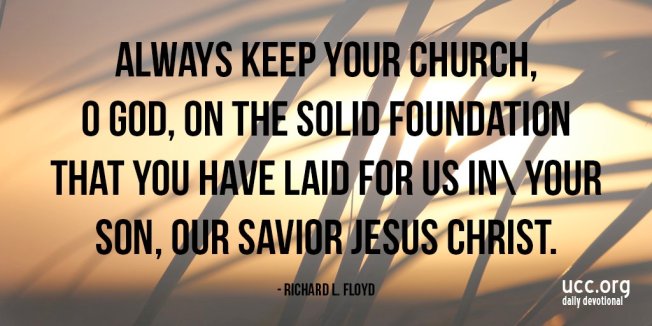
“For no one can lay any foundation other than the one that has been laid; that foundation is Jesus Christ.” —1 Corinthians 3:11
My secular friends sometimes ask me, “Why the church?”
I hear myself come up with different answers at different times. “Because of the community.” They say, “Couldn’t you just join a book group?” Continue reading
“The Time of Trial” A Daily Devotional on Luke 22:39-40
“Jesus came out and went, as was his custom, to the Mount of Olives; and the disciples followed him. When he reached the place, he said to them, ‘Pray that you may not come into the time of trial.’” —Luke 22:39-40
Since I was a child I have prayed the line from the Lord’s Prayer “lead us not into temptation.” Too often my “temptations” have been of the trivial sort, such as whether to eat that second cupcake. My mother liked to quote New Yorker writer Alexander Woollcott, “All the things I really like to do are either illegal, immoral, or fattening.”
But the newer translation of this line is “save us from the time of trial,” which echoes Jesus’s words here to the disciples. Continue reading
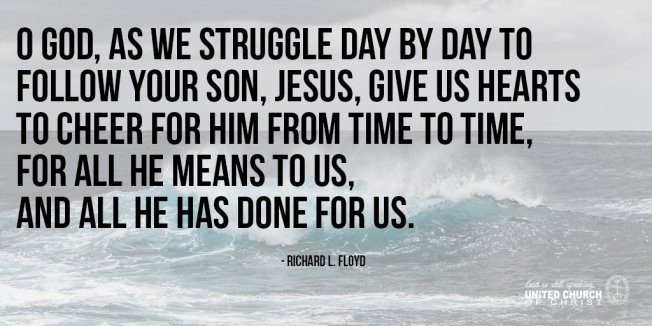
“Cheering for Jesus!” A Daily Devotional
“Jesus Christ is the same yesterday and today and forever.” —Hebrews 13:8
My friend John, an ophthalmologist and former congregant of mine, led several dozen trips to Ecuador on “eye missions.”
I went with him on a couple of them. Our team worked together with area churches, and one day he introduced me to a local pastor, who immediately invited me to preach at their Sunday evening service. Continue reading
“Holy Weeping” A Sermon on Romans 12: 9 -18 and Revelation 21:1-4
Our two scripture readings today both speak about crying. The first reading speaks to the church on earth today, what I was taught as a child to call the church militant, and the second reading speaks to the church in heaven, what I was taught to call the church triumphant. Perhaps those terms are too martial for us today, but by whatever names it is the distinction between the church here and the church hereafter.
In the first reading Paul admonishes the Roman Christians on how to be the church now, and one of the things he tells them they need to do is to “rejoice with those who rejoice and to weep with those who weep.”
The second reading is from the Revelation of St John the Divine. I have a soft spot for the writings of St John the Divine, as I was baptized at the Cathedral of St John the Divine in New York, which is the world’s largest gothic cathedral (so I come by my high church inclinations honestly.)
In this beautiful passage from Revelation, St. John describes the holy city, the New Jerusalem at the end of time and history. He says then there will be no more crying there because God will “wipe away every tear from their eyes.”
So in engaging these two texts about the here and the hereafter, I started thinking about the function of crying in our lives, and especially in the church. I did a little research on crying, and discovered that we don’t know all that much about it. There are several competing theories about why humans cry, including those theories of evolutionary biologists who think it may have some social function. Continue reading
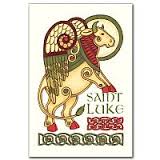
What I Love about the Gospel of Luke
For our Lenten adult study we have been looking at each of the four Gospels and Brent (our pastor) has asked me to share briefly with you what I love about the Gospel of Luke.
Each of the Gospels has features about it I love. Like many Christians my idea of the Gospel of Jesus Christ is a mixed-upped conflation in my mind of all four Gospels.
When I started studying the Bible as a young man I began noticing how each Gospel tells the story in a somewhat different way, and something about that bothered me. I wondered, “Where they differ what is the truth of the story?”
One of my teachers helped me with this by having me imagine a beloved mother with four children, and upon her death each child wrote a remembrance of her. Each child’s remembrance of their mother would be different, but they would all be true.
Another helpful analogy I heard was that the Gospel is like a diamond, when you turn the diamond the light catches different facets of the precious stone. Each of the four Gospels is a different facet of the one Gospel of Jesus Christ.
It was in the Christmas story where I first noticed the differences in the several Gospels. Mark and John say nothing about the birth of Jesus. Only in Matthew do we hear about the visit of the Magi, their meeting with Herod and his slaughter of the innocents, and Mary and Joseph’s flight to Egypt.
But it is especially Luke we think of most often at Christmas time. Only Luke has the annunciations to Elizabeth and Mary, Mary’s Magnificat, and only in Luke do we have the choir of angels addressing the shepherds.
And so these early chapters of Luke might be a good place for me to start to tell you what I especially love about Luke. Continue reading
“The Message of the Cross” A Sermon on 1 Corinthians 1:23-25
A minister friend and mentor of mine, Herb Davis, once told me that every preacher has only one sermon in him, or her. According to Herb, every Sunday the preacher serves up that one sermon in a variety of ways. It may look like a different sermon, but at the heart of it, there’s just the one!
When I was growing up my family always had some sort of a roast at Sunday dinner, which was usually served in the middle of the day after we came home from church. Then the remains of that roast would reappear in various guises throughout the week. For example, let’s say it was a pork roast. The roast might reappear on Monday night in a soup, and on Tuesday night as my Dad’s signature roast pork chop suey and so on. So is that really the way it is? Do the people of God get fed leftovers every Sunday?
I hope not. I think what Herb was saying is that every preacher’s one basic sermon provides the core convictions out of which that preacher delivers the Gospel. And if Herb is right about the one-sermon theory, than I suppose today’s epistle lesson would have to be the text for my one sermon. Let’s hear it again: Paul writes, “We preach Christ crucified, a stumbling block to Jews and folly to Gentiles, but to those that are called, both Jews and Greeks, Christ the power of God and the wisdom of God. For the foolishness of God is wiser than human wisdom, and the weakness of God is stronger that human strength.” (I Corinthians 1: 23-25)
This is what Paul calls the message of the cross. Paul believed that Jesus was the Jewish Messiah and that God raised him from the dead. The cross on which Jesus had died became for him the symbol of that Good News of God’s vast unconditional love for all humankind. Paul believed that in Christ’s dying and rising two important new things had occurred. First, there was now a new age of God’ activity, and, secondly, there was now a new community, the church, made up of both Jews and Gentiles. Continue reading