Unknown's avatar

Gerard Manley Hopkins: Poet of A Vast Incarnation

British poet and Jesuit priest Gerard Manley Hopkins (1844-1889) is once again a subject of interest, prompted by the recent full-dress and somewhat controversial biography by Paul Mariani (Gerard Manley Hopkins: A Life, Viking 2008).

Hopkins is one of my favorites. When I was at Oxford in 1989 there was a display of his original poems and notes for poems at Christchurch College where I was taking a lecture. I loved to go and look at these strange and wondrous scribblings with Hopkins’ own unique pointing and punctuation. Hopkins’ verse often discerns the grandeur of God in the commonplace. Here is one of my (many) favorites:

As kingfishers catch fire, dragonflies draw flame;
As tumbled over rim in roundly wells
Stones ring; like each tucked string tells, each hung bell’s
Bow swung finds tongue to fling out broad its name;
Each mortal thing does one thing and the same:
Deals out that being indoors each one dwells;
Selves—goes itself; myself it speaks and spells,
Crying What I do is for me: for that I came.
I say more: the just man justices;
Keeps grace: that keeps all his goings graces;
Acts in God’s eye what in God’s eye he is—
Christ. For Christ plays in ten thousand places,
Lovely in limbs, and lovely in eyes not his
To the Father through the features of men’s faces.

Unknown's avatar

Don’t be Afraid of Mussels

I write in defense of mussels, the stepchild of the shellfish world. I am not talking about the dreaded freshwater zebra mussels that are threatening our lakes here in the Berkshires, but the delectable marine blue mussel.

The French love them. You can’t walk a block in Paris without seeing a bistro with a “Moules” sign. For some reason though, Americans, who will happily pound down their weight in steamers and Littlenecks have been slow to warm to these succulent little morsels.

Many years ago I had a wonderful congregant, Gladys Brigham, whose father had been a Congregationalist missionary to the Middle East in the nineteenth century. He had gone to Bangor Theological Seminary, and the family still had a summer cottage on Isleboro, one of Maine’s most charming islands. When my children were still children Gladys invited us all to spend a few days there and she joined us for a couple of them. At low tide there were more mussels than you could shake a stick at, so I harvested a batch, cleaned and de-bearded them, and steamed them with a little garlic and white wine. “These are delicious,” opined Gladys, who was close to ninety, and had been coming to this very spot for the better part of the Twentieth Century. “I’ve never had a mussel before.” I was dumbfounded: “Why not?” “People here don’t eat them.”

I have a theory about this. First, mussels are subject to Red Tide (dinoflagellates), which is harmless to the mussel but contains toxins that can harm humans with paralytic shellfish poisoning. If back in the day Uncle Wendell got wicked sick from eating a mussel it might have put everybody off their feed for awhile. Today governments strictly monitor for toxins at fishing sites, so that is no longer a problem. And besides, clams are subject to Red Tide, too, so I don’t get it.

The other bad rap mussels get is that they are hard to clean, and it is true that if you harvest them yourself it is a bit of a chore to scrub them up, de-beard them, and scrape the barnacles off them. And if you are not careful, there will always be a closed one that is, in fact, just a shell full of mud and it will muddy your broth.

But the last few years I have been able to buy beautiful mussels from Prince Edward Island in the grocery store. These are fresh, clean, scrubbed and de-bearded, and need minimal handling. Just make sure that they are alive, discarding any whose shells have opened or are cracked. Give them a good rinse in cold water. I put them in a bowl and leave them in the sink with the water gently running for a while.

So get yourself some mussels. This is the best time of year for them, as the claim is that the best months to eat them end in “–ber,” and here we are in September with two more “–ber” months to go. And the best thing of all is that, although their flavor resembles that of the treasured lobster, they are cheap. My PEI mussels come in two pound mesh bags, and are often available for $2.49 a pound. I got some last week for $1.99 on sale. The lobsters in that tank nearby were $11.99. Tough decision? No.

There are many ways to treat a mussel, but I like them done with as little fanfare as possible (except when I make them Chinese style with garlic and fermented black beans, but that is another post for another day). Mussels contain a lot of water, so you don’t need to drown them when you cook them. Here’s a simple recipe similar to what the French call Moules Marinieres (they would use butter, reduce the broth, and add more butter at the end, but I like it this way):

2 lbs mussels, cleaned and de-bearded
4 tbs extra virgin olive oil
½ yellow onion, chopped
2 tbs garlic, peeled and finely chopped
½ tsp crushed red pepper (optional)
½ cup dry white wine.
¼ cup chopped fresh parsley

Drain the rinsed mussels in a colander. You’ll want a wide pan with a tight lid. Heat the oil over medium heat, and cook the onion until soft. Toss in the garlic, crushed red pepper, and parsley. Then gently add the mussels (the shells will break if you’re hard on them.) Gently stir to mix, add the white wine and cover. Give the pan a gentle shake from time to time and start checking the mussels after about five minutes. If they are not opening turn the heat up a bit and cover again. They should all be open after ten minutes. You can serve them now, but I prefer to remove the mussels to a platter with a slotted spoon, and strain the broth through a sieve covered with cheesecloth to catch any sand. You can pour the broth over the mussels or serve it on the side (as I do). Enjoy.

Wine pairings: The French might drink Muscadet with them, and they wouldn’t be wrong. A crisp Sauvignon Blanc is always nice. When we were with our daughter in Provence I ordered mussels (albeit Provencal style with tomato) and she said “Try the Rose.” I did, and it was very good, so a dry Rose from the South of France works just fine. But don’t break the bank on cheap eats, any good dry white will do.

(Photo by R.L. FLoyd)

Unknown's avatar

To Friend or not to Friend, that is the Question?

If you’ve read Malcolm Gladwell’s The Tipping Point, and who hasn’t, you may recall running across Oxford Professor Robin Dunbar’s famous “Social Brain Hypothesis,” in which he posits that 150 is the average size of a group that is manageable for the human brain.

Dunbar and his researchers found numerous examples of social groups of about 150, where that was the ideal managable size, including church congregations, sustainable military units, and guild members in some on-line video games.

As someone who spent my entire vocational life serving as a leader in congregations this has the ring of truth about it. Relationships in a congregation are pretty complex, but it is clear to me that each member has a different set of layered friendships. This fits with Dunbar’s findings. His team found a pattern where each person has five intimate friends, 15 close friends, around fifty in the next layer, and finally the 150 of the whole group.

This got me ruminating about Facebook, the popular social networking utility. Founded in 2003 at Harvard, Facebook expanded to other colleges in the Boston area, then to Ivy League Colleges and Stanford, and finally opened up to anybody over 13.

My tribe, the Baby Boomers, have discovered it with a vengeance. This has caused ticklish situations for the kids who still think of it as their space, and leave pictures of bongs, beer pong competitions, and their classy Cinco de Mayo tequila shot contest posted on their Facebook wall for Mom and Dad (not to mention prospective employers) to view.

Facebook now has over 300 million members world-wide and is growing, which means you may get “friended” any minute by people from High School that you haven’t seen in four decades. I joined a few months ago, and have already just broken the 200 friends mark, which according to Dunbar’s hypothesis, is too many for my brain to manage (and my brain is injured, which makes it even tougher.)

Facebook cross references your connections and suggests friends for you, and you soon realize that you know a lot of people. But are they really your friends? Do you want them in your life, even your on-line one? So to friend or not to friend, that is the question?

As a public service to my readers I offer you these guidelines:

  • Accept all friend requests if you actually know the person. This may sound obvious, but you’d be surprised how many people accept a friend request, and their first communication is “Do I know you?” Awkward!
  • Don’t drink and friend. My son taught me this one, so now when I’ve been dipping into the single malt late at night I refrain from making friending decisions. This eliminates next day friending remorse.
  • Don’t over-reach. Some people like to friend everybody they can find in the world who shares their name, which might be OK if your name is Melchior Kwitkor, but unruly if it’s John Smith. Best to avoid this one.
  • Don’t pad your friends list by friending or “fanning” a lot of celebrities and groups. If you love Van Morrison (I do) fine, become his friend (bad example, he probably doesn’t have one), but don’t become friends with the Sons of Lithuania unless you are actually Lithuanian.
  • Don’t friend your kids’ friends unless you are actually friends with them. Otherwise, it’s just sketchy.
  • Ask yourself, “If I actually saw this person “in person,” would we have anything to say to each other?”
  • Ask yourself, “Would I want to have lunch with this person?”
  • Ask yourself, “If I still sent out Christmas cards, would this person be on my list?”
  • Don’t friend old girlfriends or boyfriends. It’s just not a good idea. (See “Don’t Drink and Friend,” above)
  • Don’t friend people you really don’t like. My kids call these “frenemies,” a distinction lost on me.
  • Don’t get all competitive about collecting friends. You’ll end up with way too many and you will begin to hate your Facebook page.

How many is too many? About 150.

Unknown's avatar

More Ruminations on Prayer

Last Sunday’s New York Times Magazine article “Is There a Right Way to Pray?” (by Zev Chafets) stresses the dizzying diversity of practices among different religious traditions. But even within all this diversity there seems to be a common felt need.

This raises the question of whether the impulse to pray is a universal human experience, an example of what my tradition calls “common grace.” Could it be that we are “hard-wired” to speak our deepest needs, hopes and fears to the Other who transcends us.

Author Frederick Buechner suggests as much when he writes: “Everybody prays whether you think of it as praying or not. The odd silence you fall into when something very beautiful is happening or something very good or very bad. The ah-h-h-h! that sometimes floats up out of you as out of a Fourth of July crowd when the sky-rocket bursts over the water. The stammer of pain at somebody else’s pain. The stammer of joy at somebody else’s joy. Whatever words or sounds you use for sighing with over your own life. These are all prayers in their way.”

These are all prayers because in some sense they are addressed not merely to oneself but to an(other.) To use the language of Martin Buber, prayer in any form is an “I-Thou” relationship, where our address, even when it starts as interior monologue, finds the unseen conversation partner. The “I” finds a “Thou.”

My friend and former colleague Rabbi Dennis Ross and I used to talk about this from the perspectives of our respective traditions. He uses this language of “I-Thou” from Buber to explore all our relationships, including the primal relationship with God, in his fine and accessible book God in Our Relationships. Like Beuchner, Rabbi Ross (who is also a social worker) finds prayer not by looking inward to special spiritual states, but by paying attention to one’s relationships. It is here, in the shared quotidian activities of ordinary life that God may be discerned and known. Rabbi Ross says, “The I-Thou relationship comes easily and often, over breakfast or at work, in the classroom or at the gym as well as in turning points of life.”

Unknown's avatar

“Gimme! Thanks! Oops! And Wow!”

I always thought I had a simple explanation for the types of prayer. In innumerable sermons, children’s messages, confirmation classes, and adult education sessions I told people there are four kinds of prayer: Adoration, Confession, Thanksgiving, and Supplication.

To quote from my own A Course in Basic Christianity: “Many prayers begin with Adoration, which is a prayer that asks for nothing but simply praises God and expresses our love for God.

Often such prayer brings us to a realization of God’s majesty and power and our humbleness in relationship to it and we are drawn to Confession, which is prayer that expresses to God the things for which we are sorry and need forgiveness.

Thanksgiving is prayer that expresses gratitude to God for all the blessings we have received at God’s hands

Supplication is prayer that asks God for something to be accomplished, whether for ourselves, which is called Petition, or for others, which is called Intercession. If you take the first letter of each type of prayer, Adoration, Confession, Thanksgiving and Supplication, you get the word ‘acts.’”

>Pretty neat and simple. But in Sunday’s NYT Magazine in an article by Zef Chafets asking “Is There a Right Way to Pray,” Rabbi Marc Gellman does it even better when he is quoted as saying, “But really, when it comes right down to it, there are only four basic prayers. Gimme! Thanks! Oops! And Wow!” Now that is simple.

Does it fit my template? Well. let’s see: Gimme is Supplication (Gimme for me is Petition, Gimme for them is Intercession); Thanks is Thanksgiving, obviously; Oops is Confession; and Wow is Adoration. There you have it. Wow!

Unknown's avatar

Where I Ruminate on My Ordination on this its Anniversary

I was ordained to the Christian ministry on this day in 1975 at the Newton Highlands Congregational Church in Newton Highlands, Massachusetts, by the Metropolitan Boston Association of the United Church of Christ. Dudne Breeze, the pastor, preached the sermon, and a good one it was. Jerry Handspicker, my teacher at Andover Newton Theological School and the associate pastor, offered the ordaining prayer, which asked God to endow me with all manner of things for my ministry, and he seemed in deadly earnest. After thirty-four years I now understand why. Jerry, ironically, also presided at the service of thanksgiving for my ministry when I retired five years ago, so he book-ended my three decades of active ministry. We sang “Holy, holy, holy,” and “Be Thou My Vision.” My then girlfriend, now wife, Martha, made me a handsome set of liturgical stoles. Good food was served. There were probably grape leaves.

There were no tongues of fire or other obvious signs and wonders, although the whole event was wondrous to me, and when the clergy laid their hands on me I felt an enormous weight, a feeling about ordination that has never entirely left me.

I got to my first parish in rural Maine and realized soon enough that I didn’t know what I was doing, and that feeling has never entirely left me either. My first congregations (I had two) taught me how to be a minister every bit as much as seminary, and I will always be grateful to them. God blessed me throughout my ministry with wonderful saints of the church who encouraged and sustained me, and put up with me even when I was acting like a damn fool.

Early in my ministry I refused all honoraria, and thereby offended nearly everyone that offered me one. I was shopping for clothes the week before my wedding, and the good Roman Catholic salesman at the haberdashery rang me up with a ten percent clergy discount. I tried to explain all the high-minded reasons I couldn’t accept it and watched his face fall. I called my mentor Fred Robie, the sage of Sanford, who simply said, “My Daddy taught me that when someone gives you something, you say ‘thank you.’” Lesson learned. Would that everything I needed to learn was that simple.

What else did I learn?

  • I learned that a wedding rehearsal is the meeting of two clans, and that at any moment violence might break out.
  • I learned that a pastor needs a tender heart, but a thick skin.
  • I learned that when you are relating to broken people some of their brokenness may get aimed at you. I learned that you aren’t supposed to take this personally, although I invariably did.
  • I learned that the faithful aren’t much impressed by the BEM document, especially if you want to move around the furniture in the chancel.
  • I learned that for some folks it’s not the height, depth, or breadth of a sermon that is decisive, but its length.
  • I learned that exercising discipline around baptism involves water, and lots of it is hot.
  • I learned that what I said in the pulpit and what people heard were not necessarily the same.
  • I learned that sometimes peoples lives were moved and even changed by what they heard even when it wasn’t what I said.
  • I learned to love some difficult people.
  • I learned that around pledging time Chicken Little competes with Jesus Christ as head of the church.
  • I learned that we clergy preach salvation by grace to the people, but act as if it were by works for us.
  • I learned that it is a high privilege to spend time with dying people.
  • I learned that struggling with a text all week, and then breaking it open for the congregation on Sunday sometimes felt like the best job in the world. And sometimes it didn’t.
  • I learned that God is good all the time.

Like everyone else I had my good days and my bad days. And like any moderately self-aware person who prays I know my failings better than anyone except God (and perhaps Martha). But I learned it really is all about grace. I am proud (in a good way) to have been a minister.

Unknown's avatar

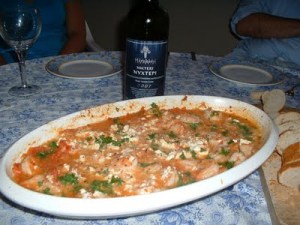
My Big Fat Greek Shrimp and Tomato Saganaki with Feta

We had something similar to this in the pretty seaside town of Molyvos on the Island of Lesbos back in 2003. Martha’s grandparents emigrated to America from Lesbos, and it was her first time visiting there. It’s a beautiful place.

This summer Andrew and Jess came back from the Greek Islands and reported having a version of it in Santorini, though they claim mine is better, which may just be because there is more of it.This is a tourist dish with no claim to authenticity, but it is yummy. And, once you’ve cleaned the shrimp, easy and pretty foolproof.

I use frozen easy-peel shrimp that come in 2 lb bags. You will need a heavy-bottomed skillet, and an ovenproof serving dish (I use a Le Crueset enameled one, but you could do it any shallow casserole or baking dish.)

4 tablespoons extra virgin olive oil
1 yellow onion chopped
4 garlic cloves, finely chopped
½ tsp crushed red pepper (or to taste)
2 lbs jumbo shrimp, peeled and de-veined
2 large fresh tomatoes in season, coarsely chopped (or use a 14.5 oz. can of diced tomatoes)
1 cup of crumbled feta cheese
Salt and pepper to taste
¼ cup flat-leaf parsley, rinsed and chopped

Preheat oven to 400 degrees F. Heat the oil in the skillet over medium heat and cook the onion, stirring occasionally until it is soft, about 5 to 10 minutes. Add the garlic and cook for another minute, then add the red pepper flakes and tomatoes, and let it cook for another ten minutes or so until some of the liquid has evaporated and the sauce begins to thicken. Add the shrimp and cook for a few minutes, stirring now and then, until they turn pink and begin to firm up (don’t overcook them).

Turn the mixture into the baking dish, sprinkle the feta over the top, and put it in the oven for 10 minutes until everything is bubbling nicely. Salt and pepper to taste (the feta should be all the salt you need), and sprinkle with the parsley.

Although in Greece this is typically a starter, it will easily feed four people as dinner with some crusty bread and a Greek salad. In the best of all worlds your kids will bring you a white wine back from Santorini to have with it (as mine did), but any sturdy crisp white will go just fine (feta is a tough flavor match for wine.) White Retsina works if you’ve acquired a taste for it, which most people who aren’t Greek haven’t. Enjoy.

(Photos: R.L. Floyd)
Unknown's avatar

>Robert Reich explains the Public Option and it doesn’t sound so scary to me

>

I have been hearing that the “Public Option” in Health Care Reform will never happen, that it is “off the table,” and a “non-starter.” So what makes the “Public Option” so scary to our elected officials?
I just watched this video by Robert Reich, former Secretary of Labor, and it doesn’t sound scary to me. In fact, it makes a lot of sense to me. So who is scared by this? And what can be done to assure that our broken health care system can be fixed? As he says: this is our last chance. “In a few weeks this will all be history.”
Unknown's avatar

The best little bands you’ve never heard of! Volume 1: Middlefish Pond.


There must be thousands of them out there. Just in my own circle of friends there are a handful of guys (yes, all guys) who play in bands that only meet periodically, but have been doing so for decades. Many started with friends while in school, but keep meeting, writing songs, practicing and recording. Whether you call them garage bands or indie rock bands these guys are the true amateurs (from the Latin verb amo: to love), but their music is anything but amateurish. Some use professional sidemen when they record. All write their own songs, no cover bands here.

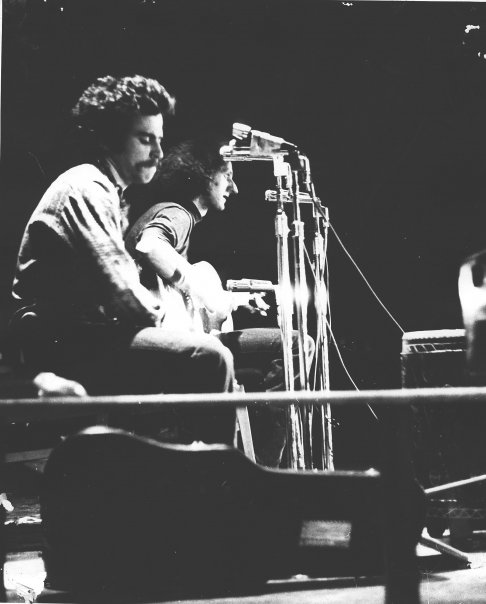
The first band I am going to feature is the oldest. Middlefish Pond will celebrate its fortieth anniversary next year. And I was there at the founding. During the beginning of my senior year at Coe College in Cedar Rapids, Iowa I met two very cool freshmen long-hairs named Tom Winter and David Kameras. Tom and I shared an apartment briefly the next summer, but the less said about that the better. David and I worked together on an underground newspaper called the Catalyst, which got us briefly busted in downtown Cedar Rapids for hawking papers without a license. David took a picture of the undercover officer who was questioning me on the street, and we put it on the cover of our next issue. But, as usual, I digress.
Soon Tom and David formed a band and were playing gigs at “the Pub,” which was the student snack bar in Coe’s Gage Memorial Union, and, despite the promising name, didn’t serve alcohol.
But it was a popular venue for plays (I was in Spoon River Anthology there) and music, and Tom and David soon became sort of a house band for the Pub. They named their band Middlefish Pond, after a beautiful setting in the Amana Colonies we used to go to and hang out at, not to put too fine a point on it.
Their two-man mostly acoustic band was lots of fun to listen to. They played lively up-tempo tunes with irreverent often goofy lyrics, reminiscent of Steve Goodman, John Prine, and Frank Zappa. Both guys wrote songs and sang and they often had intricate harmonies. David played viola and drums, Tom played guitars and harmonica. He once tried to teach me to play guitar, and I can still play House of the Rising Sun and Cocaine, but unfortunately, there was little call for either in my 30 years as a pastor.
So the year went by and in 1971 I graduated and went off to Boston to seminary, and the boys kept playing at Coe and other venues in Cedar Rapids and Eastern Iowa, and they eventually graduated, got jobs, got married, and went their separate ways- but the band played on. I haven’t seen David since 1971, but recently reconnected on Facebook and was astonished to find out that MFP was still alive. Tom came on his motorcycle to visit me at the parsonage in my first pastorate in West Newfield, Maine about 1975, but there was a Church Ladies Bazaar going on, and I think it freaked him out, so he left abruptly. I couldn’t be happier that these two terrific guys are still making music, and that it is now easily available due to the wonder of the Internet.
Here is how they describe themselves on the album notes of their most recent album, Last Chance to Breathe: “Middlefish Pond is a two-person vocal group spawned in the fertile terrain of eastern Iowa in 1970, now a commuter relationship between Random Fill Studio (Chicago area) and Amanapond Music (ASCAP) (Washington area). The band, which plays original songs sharing a satiric blues-rock-folk-often political-Zen sensibility, is comprised of songwriters David Kameras on vocals, viola and drums, and Tom Winter on vocals, acoustic and electric guitars, bass guitar, harmonica and bazouki. The team has also drawn, as circumstances require, on kazoo, variable speed electric drill and ambient sound (including locusts on the current release). Speaking of which…. 

 Last Chance To Breathe showcases the group’s more recent efforts, touching on themes of love, loss, class, race, courage and obsession, filtered through a comic-mystical lens. This is music that reminds one of Chicago blues, Delta blues, Steve Goodman, Shel Silverstein, Siegel-Schwall, David Lindley, Warren Zevon, LeRoy Marinell and Frank Zappa, all in a good way, of course. 

Shock your family, astonish your friends, or just settle back with a good pair of headphones and groove to Last Chance To Breathe pursue new and exciting, yet still irreverent, directions.”
So check these guys out. I think you’ll enjoy Middlefish Pond. To buy Last Chance to Breathe go to:
To see their site with blog and pictures go to:
(photos: above, then at Coe; below, now. Left to right in both, David Kameras, Tom Winter)
Unknown's avatar

Help! My Facebook Page, like Billy Pilgrim, has become “unstuck in time.”

I noticed it earlier today, Labor Day, Monday September 7, 2009. I opened my homepage and the top post was from Rachel Flynn, who was “moving to New York tomorrow.” Wait a minute, I recalled that she had said that on Friday, and I knew there had been several posts since Friday. What is going on?

I looked at the previous post. It was from my New Zealand Internet friend Jason Goroncy promoting his excellent blog, Per Crucem ad Lucem, on Saturday at 8:13 pm.
The previous post was Donna Schaper enjoying the end of summer and looking forward to events in September, posted on September 3.

“And so it goes” at Kurt Vonnegut might say. In his book Slaughterhouse Five, one of my favorites, his protagonist, Billy Pilgrim “becomes unstuck in time” and experiences past and future events out of sequence. So one moment he is experiencing his life as a middle-aged married dentist in upstate New York, and in another he may be back as a young chaplain’s assistant in WW2 experiencing the firebombing of Dresden in a bunker the Germans have put him as a P.O.W, and in another moment he is naked in a zoo on the planet of Tralfamadore with B-movie starlet Montana Willdhack, both having been kidnapped by the Tralfamadorians as examples of earthlings. You get the idea.

If you are one of the handful of people on earth who read blogs, but doesn’t have a Facebook page, here’s how it works (when it isn’t broken): you scroll down your homepage, and all your “friends” posts cascade down the wall in order of posting time. To have your Facebook page become unstuck in time is most disconcerting.
I thought it might be a problem with my computer, but posted about it and got two responses from other people that said it was happening to them too. I can only access their posts from the little notifications thingy in the bottom right corner.
I just checked to see if they fixed it, but no: Rachel is still moving to New York tomorrow. Unstuck in time. Sorry Rachel!
I hope they can fix it.