Unknown's avatar

“Moved to Compassion” A Sermon on Luke 7:1-17

“After Jesus had finished all his sayings in the hearing of the people, he entered Capernaum. A centurion there had a slave whom he valued highly and who was ill and close to death. When he heard about Jesus, he sent some Jewish elders to him, asking him to come and heal his slave. When they came to Jesus, they appealed to him earnestly, saying, “He is worthy to have you do this for him, for he loves our people, and it is he who built our synagogue for us.” And Jesus went with them, but when he was not far from the house, the centurion sent friends to say to him, “Lord, do not trouble yourself, for I am not worthy to have you come under my roof; therefore, I did not presume to come to you. But only speak the word, and let my servant be healed. For I also am a man set under authority, with soldiers under me, and I say to one, ‘Go,’ and he goes, and to another, ‘Come,’ and he comes, and to my slave, ‘Do this,’ and the slave does it.” When Jesus heard this he was amazed at him, and, turning to the crowd following him, he said, “I tell you, not even in Israel have I found such faith.” When those who had been sent returned to the house, they found the slave in good health.

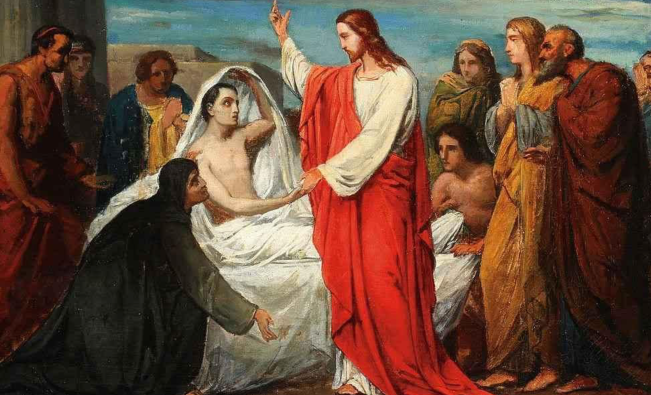
Soon afterward he went to a town called Nain, and his disciples and a large crowd went with him. As he approached the gate of the town, a man who had died was being carried out. He was his mother’s only son, and she was a widow, and with her was a large crowd from the town. When the Lord saw her, he was moved with compassion for her and said to her, “Do not cry.” Then he came forward and touched the bier, and the bearers stopped. And he said, “Young man, I say to you, rise!” The dead man sat up and began to speak, and Jesus gave him to his mother. Fear seized all of them, and they glorified God, saying, “A great prophet has risen among us!” and “God has visited his people!” This word about him spread throughout the whole of Judea and all the surrounding region. (Luke 7: 1-17)

What makes you cry? What moves you? I may have been an emotional person before I suffered a Traumatic Brain Injury 25 years ago, but I certainly am one now. I get choked up, sometimes even when I’m preaching. If that happens this morning, don’t be concerned. It won’t bother me and it shouldn’t bother you. My TBI makes me “emotionally labile,” but you needn’t have a head injury to be moved to tears. I’m just an extreme case, a literal “head case.” There’s even a word for it: “Tearful or given to weeping.” It is called “lachrymose” from the Latin for “weeping.” Lachrymose: isn’t that a cool word?

There are certain texts or songs that move me to tears. Dr. King’s “I have a dream” speech gets me every time. I weep through John 1 “In the beginning was the Word, and the Word was with God and the Word was God.”

Some of the music that chokes me up is about weeping itself, as in the St. Matthew’s Passion. When Peter weeps after betraying Jesus: “Just then the cock crew. Then Peter remembered the words of Jesus, when he said to him: “Before the cock crows, you will deny me three times.” And Peter went out and wept bitterly. It’s even more poignant in the German: “bitterlich.”

Or the aptly named “Lacrimosa” from Mozart’s Requiem. “Full of tears will be that day; When from the ashes shall arise. The guilty man to be judged.” I’ve sung that twice now with Berkshire Lyric at Ozawa Hall and I had to really bear down to get through it both times. Also, the music is really beautiful. Which doesn’t help.

So, I’ve always believed one should pay close attention to these choked-up moments in your life because they mean something important. They mean that something authentic has moved you deeply in your soul.

That is what is going on in our stories today. We have two stories from Luke where Jesus is deeply moved by the suffering of others. He is moved by the centurion’s faith, and he is moved by the grieving widow in Nain, whose only son has died.

Our theme for this morning is compassion, which Jesus both practices and embodies. In telling the story of Jesus, a generation or more after Jesus’s death, Luke is trying to teach the church what God is like, and therefore, what God’s people should be like, a community of compassion.

Remember how Luke describes Jesus reading the Isaiah scroll in his home synagogue in Nazareth. He read:

“The Spirit of the Lord is upon me,

because he has anointed me

to bring good news to the poor.”

That was Jesus’s calling: To bring good news to the poor. So, who are the poor? The poor are those who suffer. They may be wealthy or impoverished, but in their suffering they are poor.

In our first story the Roman centurion fears for the life of a favorite slave. In Luke’s view of the Gospel’s inclusivity, even a hated Roman enemy is not outside the scope of Jesus’s love and attention. The centurion is not literally poor, for he is a powerful soldier with authority over a hundred men, but he is poor in his need. His slave is dying and he heard about Jesus and believes Jesus can heal him. Jesus is “amazed” by his faith and heals the slave.

I want to say something about the Greek word translated here as compassion. Compassion literally means “suffering with.” The Greek word here translated as “compassion,” is splagchnizomai (that’s easy for me to say!) It comes from splagchna, which means “intestines; guts.” Jesus’s reaction to the widow’s plight is literally visceral, gut wrenching, brought on by empathy for a mother who lost her child, one of the most difficult of all human experiences.

Jesus also knows that having lost her only son as well as her husband, she is now doubly vulnerable. For in the patriarchal world of the first-century Roman Empire, widows were solely dependent on their male relatives for sustenance and safety. Here is compassion, suffering with the sufferer.

Now Luke’s Gospel describes many acts of compassion by Jesus, but he only uses this particular long hard-to-pronounce word for compassion three times, and the other two are some of your favorite stories that are found only in Luke. Can you guess what they might be? What comes to mind?

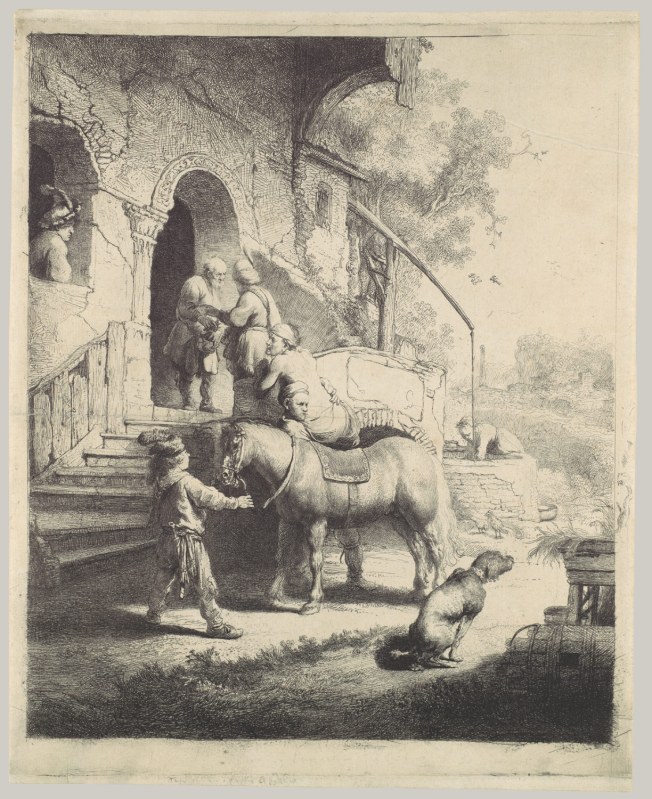
First, there is the story of the good Samaritan, who had compassion on the man beaten by brigands and left by the side of the road to die. We see Luke’s universality there, too, since the Samaritan is a hated enemy, who shows mercy after the official representatives of the religious establishment passed by on the other side of the road.

The other example is the story of the waiting father and his two sons. The father sees the lost prodigal from far off and has compassion for him.

So, likewise, Jesus is moved to compassion for the widow. Picture with me these two processions that meet outside the city gate in the village of Nain. One is a procession of death, with the dead son on a stretcher, his bereaved mother, and a great crowd of mourners headed to the graveyard.

The other is a procession of life, with Jesus, his disciples, and a great crowd of exuberant followers. The two processions collide, and the procession of life wins. Jesus raises the dead son from death to life, the first time he does this.

Why does Luke place this here in his story? Soon, in Luke 7:22, Jesus will tell John the Baptist’s disciples to report back to John that they have seen and heard miraculous signs and wonders, including the raising of the dead

The Good News that Jesus brings means the leveling of established positions and privilege. My teacher and friend, Max Stackhouse, went to India for a year with his family, where Max was a guest professor at United Theological Seminary in Bangalore. It was a life-changing experience for Max, who came to view the Indian caste system as a great systemic evil.

He told me how the Good News of Jesus was powerfully attractive to the lowest castes in India. Christians make up only 2.3% of the population, and many of them had been Dalits, whom we once labeled “Untouchables.”

Jesus comes with good news for the poor, the last, the least and the lost of society. He touches the Untouchables. And he comes with good news for us, the privileged, who are also poor in our own ways.

Henri Nouwen once described Jesus’ life of compassion as the “path of downward mobility.” Jesus chooses suffering, rejection, and death rather than the path of “upward mobility” toward privilege and power.

Jesus didn’t reach down and lift the poor up from above. He became poor “he suffered with” and according to Luke, it was this very suffering that led him to the cross, “for us and all people.” Jesus’ crucifixion and resurrection are what enables redemption, atonement, indeed, relief from suffering for all humanity.

Jesus’ “path of downward mobility” differs from the idea today that compassion means helping “those less fortunate than we are.”

One of the things I truly love about the Cathedral of the Beloved is the way the leaders erase the distinction between the helpers and the help-ees. Sure, we prepare a meal to serve, but we all eat it together in a community. The Food Program at United Church of Christ, Pittsfield, does the same thing; you can’t tell whose is there for food or there to volunteer. Sometimes those groups overlap. And this gives everyone dignity and erases the stigma.

In Jesus we see this important distinction between compassion and pity. Jesus knows you can’t love down, from a place above or apart. Even some of the terms we use, such as “the underprivileged,” or the “less fortunate” keep us above those we serve, who like us, are beloved children of God.

Real compassion, as embodied by Jesus, runs counter to our culture’s constant call for success, achievement and wealth. Real compassion is a call to suffer with the powerless.

A Christian faith true to the life and teachings of Jesus should never seek to be powerful and rise above others. That is why I have condemned Christian Nationalism, and the popular and rich preachers of the Prosperity Gospel as being false to what Jesus stood for.

We are not in a society that honors or displays much compassion. This very week the richest man in the world cut aid, food, and medicine, to the poorest people on earth, some of whom will now die. We daily see new polices that are the opposite of compassion, they are cruel and mean and go to the heart of who we are as a country. And in my opinion, the cruelty is not a bug, but a feature. It’s the point. The obscene worship of wealth and power is directly opposite of what Jesus taught and who he was.

There has been some push-back from the Christian Church. We’ve seen a brave Episcopal bishop, Marianne Budde, gently entreat the President to have mercy on the scared and vulnerable. The Roman Catholic church has declared the war on immigrants to be incompatible with Catholic Social Teaching. The Presiding Bishop of the Evangelical Lutheran Church, Elizabeth Eaton, has spoken out about misinformation on social media about her church’s funding when General Flynn tweeted that the Lutheran Church was “a money-laundering scheme.” Our own United Church of Christ has spoken out, and there is an Immigration Support Meeting  today at 2:30.

So, what can we do? I have two suggestions. First, I suggest we partner with any groups on the ground who are working to implement compassion for those who are suffering. Our UCC Conference has lists of organizations that are helping immigrants.

Secondly, let us continue to be a laboratory of the compassionate community. Let us continue to live out the radical inclusivity that Jesus taught and embodied. Let is continue to be faithful to our covenant, and to being “Open and Affirming” to all people. Let us pray with and for each other and support each other. Let us tell the truth in love, and not give in to our fears. Let us reach out to those in our communities that are being harmed.

Finally, let us be faithful followers of Jesus Christ, our Risen Lord and Savior. We may not be the powerful of society, but we are not powerless. There is a different kind of power available to us through him who loved us. For I am convinced that nothing will separate us from the love of God, not life or death, not oligarchs and autocrats. Nothing will separate us from the of God in Jesus Christ our Lord.  And the truth of that moves me deeply and chokes me up! Amen.

(I preached this sermon on February 9, 2025 at the First Congregational Church at Stockbridge, Massachusetts. A YouTube video of the service is here:)
Unknown's avatar

“How to be a Neighbor” A Devotion on Luke 10: 29

“But wanting to justify himself, the lawyer asked Jesus, “And who is my neighbor?”
—Luke 10:29

The lawyer in The Parable of the Good Samaritan tried to trick Jesus so he asked him, “What must I do to inherit eternal life?” Jesus answered by the Book: love God and love your neighbor. But the lawyer sought a loophole: “And who is my neighbor?” What he really wanted to know was “who is not my neighbor?” Continue reading

Unknown's avatar

“Down to Earth” A Sermon on John 13:1-17

I started my ministry 43 years ago in two small congregations in two adjacent tiny towns in Maine about 9 miles apart. When I lived in Maine just about the nicest compliment you could give someone was to say they were “down to earth.” It meant that they weren’t puffed up about their own importance. They were reliable, sensible, responsible, unpretentious and humble. Continue reading

Unknown's avatar

“Signing up for the Loyalty Program”

“Do not let loyalty and faithfulness forsake you; bind them around your neck, write them on the tablet of your heart. So you will find favor and good repute in the sight of God and of people.” —Proverbs 3:3-4

Many of the companies I do business with, such as on-line retailers, airlines, and hotel chains, have “loyalty programs.” They offer “rewards” to customers who are loyal to their brand. Continue reading

Unknown's avatar

“The Great Laboratory of Love” A Devotion on Ephesians 4:1-3

“I beg you to lead a life worthy of the calling to which you have been called, with all humility and gentleness, with patience, bearing with one another in love, making every effort to maintain the unity of the Spirit in the bond of peace.” —Ephesians 4:1-3

A pastor friend of mine is known to have told his congregation, “If there isn’t somebody here who rubs you the wrong way you need to come around more often.” Continue reading

Unknown's avatar

“Looking for Light in the Shadow of Death” A Sermon on Matthew 4:12-23

shadow

“The people who walked in darkness have seen a great light, and those who sat in the region and shadow of death light has dawned.”

The “Shadow of Death.” That doesn’t sound very good, does it?

I asked Rabbi Josh Breindel of Temple Anshe Amunim in Pittsfield about the phrase and he said it is quite literally “shadow of death” in Hebrew. He said it is a colloquial saying and means something like “mortal peril.” We are all acquainted with that image from the 23rd Psalm: “Yea, though I walk through the valley of the shadow of death, I shall fear no evil, for Thou art with me.”

Two of the traditional themes for the Epiphany season are “light shining in the darkness” and the “calling to Christian discipleship,” and I hope to combine them today. Continue reading

Unknown's avatar

Reflections on Living in a World with a Trump Presidency without Leonard Cohen

cohenSince the numbing election I’ve been imbibing in the music and poetry of Leonard Cohen. I didn’t start out on this road as some sort of masochistic exercise. I just wanted to reacquaint myself with the work of this troubled genius who juggled so many contradictions within himself and his art.

Cohen was God-haunted while denying any traditional understanding of God. He followed Buddhism “religiously” while he still never stopped being deeply informed by his Jewish identity. Much of his poetry and song verse bristles with Biblical imagery and apocalyptic vision. Continue reading

Unknown's avatar

“The God of the Far Off” Toward the Ministry of Inclusion

Prodigal sonWhat an extraordinary week this has been for our country! The great Swiss theologian Karl Barth liked to admonish the church that it must read both the Bible and the newspaper, because we Christians live in the world.

And what a week of news it was! There were two historic Supreme Court decisions that will change our national life in significant, and in my opinion, profoundly positive, ways.

On Thursday, by a 6-3 decision, the Court upheld the Affordable Care Act, which makes health care available to all Americans.

And on Friday, by a 5-4 decision, Marriage Equality became the law of the land.

The reason I am here before you instead of our pastor Brent Damrow is that he is in Cleveland at the General Synod of the United Church of Christ, representing the Massachusetts Conference. I am sure he will have stories to tell about the celebrations taking place there, as our national church has been a long and tireless advocate for equal rights for the LGBT community and a supporter  of marriage equality.

I believe that these two historic Supreme Court decisions share a common idea, and that is the idea of “inclusion.”

And a third extraordinary event in our national life also happened on Friday. President Obama climbed into the bully pulpit in Charleston, South Carolina to give the eulogy for the Honorable Reverend Clementa Pinckney, the pastor of the Emmanuel AME Church who, along with eight of his congregants, was murdered by a gunman while attending a Bible study at the church on June 17.

President Obama gave a stirring eulogy for Pastor Pinkney, but he was addressing not only those present, but also the nation. I’d like to share with you some excerpts of his eulogy:

The alleged killer could not imagine how the city of Charleston . . . .the state of South Carolina, how the United States of America would respond — not merely with revulsion at his evil act, but with big-hearted generosity and, more importantly, with a thoughtful introspection and self-examination that we so rarely see in public life.

Blinded by hatred, he (the alleged murderer) failed to comprehend what Reverend Pinckney so well understood — the power of God’s grace . . .

This whole week, I’ve been reflecting on this idea of grace . . .

According to the Christian tradition, grace is not earned. Grace is not merited. It’s not something we deserve. Rather, grace is the free and benevolent favor of God as manifested in the salvation of sinners and the bestowal of blessings. Grace.

As a nation, out of this terrible tragedy, God has visited grace upon us, for he has allowed us to see where we’ve been blind. He has given us the chance, where we’ve been lost, to find our best selves. We may not have earned it, this grace, with our rancor and complacency, and short-sightedness and fear of each other — but we got it all the same. He gave it to us anyway. He’s once more given us grace. But it is up to us now to make the most of it, to receive it with gratitude, and to prove ourselves worthy of this gift.

Martha and I were driving to Onota Lake in Pittsfield for a walk on Friday when the President’s eulogy came on the radio. We got to the parking lot at the boat ramp, but we didn’t get out of the car. We sat in the car until it was over, and when it was over I had tears streaming from my eyes.

The President was addressing the painful facts of racial relations in today’s America. He mentioned that in response to the massacre at the church the Confederate flag had been taken down in the South Carolina capitol and elsewhere. That flag, he said, was a symbol of our nation’s “original sin,” slavery.

The president had both the Bible and the newspaper in mind as he gave this incandescent speech. I don’t know of such a theologically astute presidential address since Abraham Lincoln’s second inaugural.

And once again I would argue that inclusion is the big idea that binds all these events together. Inclusion.

I believe in the power of ideas to shape societies, and, as my teacher, mentor and friend, Max Stackhouse taught me, to examine where they come from and what they mean. So I want to do a little bit of that with you today about the idea of inclusion. Continue reading

Unknown's avatar

What I Love about the Gospel of Luke

St LukeFor our Lenten adult study we have been looking at each of the four Gospels and Brent (our pastor) has asked me to share briefly with you what I love about the Gospel of Luke.

Each of the Gospels has features about it I love. Like many Christians my idea of the Gospel of Jesus Christ is a mixed-upped conflation in my mind of all four Gospels.

When I started studying the Bible as a young man I began noticing how each Gospel tells the story in a somewhat different way, and something about that bothered me. I wondered, “Where they differ what is the truth of the story?”

One of my teachers helped me with this by having me imagine a beloved mother with four children, and upon her death each child wrote a remembrance of her. Each child’s remembrance of their mother would be different, but they would all be true.

Another helpful analogy I heard was that the Gospel is like a diamond, when you turn the diamond the light catches different facets of the precious stone. Each of the four Gospels is a different facet of the one Gospel of Jesus Christ.

It was in the Christmas story where I first noticed the differences in the several Gospels. Mark and John say nothing about the birth of Jesus. Only in Matthew do we hear about the visit of the Magi, their meeting with Herod and his slaughter of the innocents, and Mary and Joseph’s flight to Egypt.

But it is especially Luke we think of most often at Christmas time. Only Luke has the annunciations to Elizabeth and Mary, Mary’s Magnificat, and only in Luke do we have the choir of angels addressing the shepherds.

And so these early chapters of Luke might be a good place for me to start to tell you what I especially love about Luke. Continue reading

Unknown's avatar

“To Sing and Love as Angels Do”: Singing our Faith

Singing“To sing and love as angels do” is a line from one of Isaac Watts’ hymns (he wrote over seven hundred). I love the phrase. It places singing right up there with loving as one of those activities that pleases God. I have long pondered the central place singing holds in worship, and its importance to the worshiper. Here is an excerpt of an article I wrote about “the worshiping self:”

“In hymn singing the worshiping self experiences transcendence as one among many within a congregation. There, in worship, God the other is addressed by the singer, not in isolation, but as one voice among many others. The hymn singer uses the body as well as the intellect in an integrated act of worship engaging the whole self. Hymn singing also roots the worshiping self within the life of the congregation among whom the singer works and plays, rejoices and weeps. Since the congregation is the local embodiment of the church catholic (what P. T. Forsyth called “the great church”), the hymn singer is part, not only of the congregation physically present, but also the great congregation, both the ecumenical church in its geographical breadth, and the communion of saints in its temporal length across ages and generations.

Additionally, the hymn is a repository of the tradition of the great church, and the faithful learn scripture and doctrine from singing as much as they do from sermons and catechesis. Finally, and most significantly, the singer of hymns not only addresses God, but is, at the same time, addressed by God, so that hymn singing becomes an event of grace. The singer is addressed as a forgiven and justified sinner, and it is often in the singing of the hymns, that the worshiping self is able to experience the grace of justification, and respond with faith and obedience.” (“The Worshiping Self” in Persons in Community: Theological Voices from the Pastorate. Edited by William H. Lazareth. Eerdmans, 2004.)

I also believe that music in general and singing in particular can give us access to the divine presence as no other medium can, which is why even non-believers often are lovers of Bach’s great religious works. Even though my writing is primarily theological and devotional, I have sometimes turned to writing hymns because there is something I want to express that I can in no other way (to see some of my hymns go here.)

I recently wrote:

Singing can help faith, for sometimes we can sing words that we are not yet able to say. I have often noticed singers in choirs who would not call themselves believers belting out sacred music as if they meant it.

Perhaps they do mean it. Who is to say that a singer singing out “And he shall reign for ever and ever” in Handel’s Messiah is not expressing a faith and hope that he or she might have trouble putting into spoken words? (From my Still Speaking Daily Devotional, to see it all go here)

Singing binds us together and reminds us we are not alone. “Our personal faith may wax and wane, but the church’s faith goes on from generation to generation. I like to think of it as a great choir, where each part supports and strengthens every other part, creating something beautiful and harmonious. ”

(Photo: Easter Sunday, 2014, at the First Congregational Church UCC of Stockbridge, MA, where I am a member.)