Unknown's avatar

“Turning the World Upside Down”

“When the mob could not find Paul and Silas, they dragged some believers before the city authorities, shouting, ‘These people who have been turning the world upside down have come here also.’” Acts 17:6

WorldPaul and Silas got in big trouble in Thessalonica. Paul preached for several days, explaining that Jesus was the Messiah and that he had to suffer and die. Many listeners were convinced and followed them.
But there was backlash. Luke writes, “They formed a mob and set the city in an uproar.” They said, “These people who have been turning the world upside down have come here also.”

They didn’t mean it as a compliment, but “turning the world upside down” is exactly what the Good News about Jesus did that day. Continue reading

Unknown's avatar

“Rich in Things and Poor in Soul” A Sermon on Luke 12:13-21

self storageI don’t know about you, but I have too much stuff. Eleven years ago we moved from a sixteen-room house (a big old parsonage) to an eight-room house. Before we moved we had a huge yard sale. Still, it was a good two years before we could put both our cars into the two-car garage. This may sound like what my daughter calls a “first world-problem,” and it is!

We Americans have too much stuff, and it is not good for our souls. I grew up in a middle-class American family of five. We had a one-level ranch house with three bedrooms, two of them very small, with small closets. My brother and I shared a bunk bed. We had a one-car garage. Our house was built on a concrete slab, so there was no basement. We had an attic, just a crawl space, and my Dad had to climb up there every year to get the Christmas tree stand. Not much room to store stuff.

How things have changed! Look at the four square feet around you. That is the per-capita share of the American self-storage industry, according to the Self-Storage Association, a trade group. They say that “the country now possesses some 1.875 billion square feet of personal storage. All this space is contained in nearly 40,000 facilities owned and operated by more than 2,000 entrepreneurs, including a handful of publicly traded giants like Public Storage, Storage USA, and Shurgard.” (From Slate, “Self-Storage Nation” by Tom Vanderbilt) Continue reading

Unknown's avatar

I finally got to hear my new baptismal hymn!

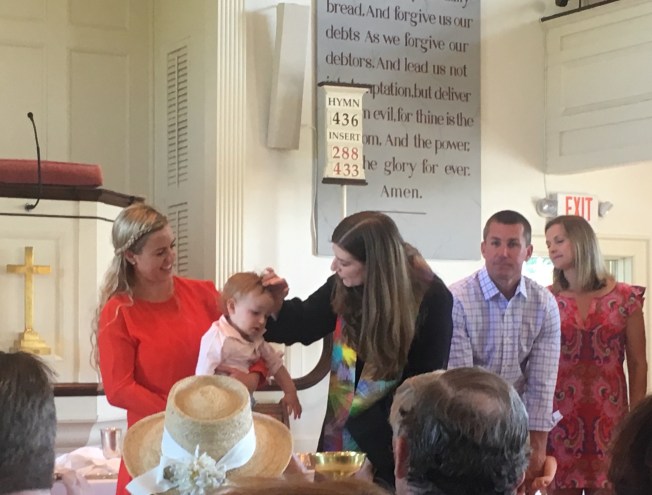
BaptismI wrote the baptismal hymn text “Come here by the waters” early last year, and though several pastors have told me they have used it in worship, I had never heard it sung by a congregation until this morning.

We worshipped this morning at the church in RI where my daughter, Rebecca, is pastor. She administered five baptisms, and they sang my hymn. She has chosen it before, but never when I was present.

She made a clever move with it that I hadn’t thought of. She divided the first two verses and the final two, singing the former before the baptisms and the latter right after. This makes sense because the first two are invitational (“come bring us your child) and the latter two are blessings (Bless us with your presence, your Word, and your power) and doxologies. Here are the words.

Come Here by the Waters

Come here by the waters, come bring us your child.
We’ll call on God’s Spirit, so loving and wild.
These people and parents will speak their firm vow.
This child full of blessing belongs to Christ now.

Your promise enduring will follow her* days,
And lead to a life filled with service and praise.
You’ll bless her** and keep her** and always be there,
Through life’s many changes you’ll watch her with care.

Bless us with your presence, your Word, and your power,
That we may be faithful in every new hour.
Let church be a place that is brimming with love,
And bless these dear children with grace from above.

We praise you and thank you for all you provide,
For blessings and graces that reach far and wide.
Praise Father, praise Son, and the Spirit divine,
Both now and forever, and far beyond time.

(*or his, or their) (** or him, or them)

Tune: Cradle Song 11.11.11.11.

© Richard L. Floyd, 2015

(To learn more about this hymn, and for both accompaniment and melody line reproducible music go here. Photo: R.L. Floyd, 2016)

Unknown's avatar

“And in a supporting role . . .” Hulda the Prophet

Hulda 2“Hilkiah (the high priest) and those the king had sent with him went to speak to the prophet Huldah, who was the wife of Shallum son of Tokhath, the son of Hasrah, keeper of the wardrobe.” —2 Chronicles 34:22

The prophet Hulda gets a scant 9 lines in the Bible, and in them we learn more about her husband than we do about her.

Nonetheless, she must have been impressive, for when King Josiah needed a prophet to authenticate the Word of God, it was to Hulda that he turned. Continue reading

Unknown's avatar

“Finding the Perfect Church”

No perfect church“But we have this treasure in clay jars, so that it may be made clear that this extraordinary power belongs to God and does not come from us.” —2 Corinthians 4:7

After I retired from active pastoral ministry my wife and I were ecclesiastically homeless for a few years. We went to church, but we couldn’t commit to one.

We sometimes felt like Goldilocks at the Bears’ residence. One congregation had good preaching, but not so great music. Another had terrific music, but the sermons were on the light side.

This period was an unhappy time in our lives, for we are serious “church nerds” and needed a church home. We knew there was something unfaithful about “church shopping” and being, to use Eugene Peterson’s phrase, “tourists and not pilgrims.”

The problem was there was no perfect church. Thomas More coined the word Utopia in 1516 to describe a perfect society on a fictional island in the Atlantic Ocean. Utopia in Greek means “not a place.”

There has never been and there never will be Utopia. There is no perfect congregation, just the ones we’ve got, full of imperfect people that God loves and calls to be the church. And we knew ourselves well enough to realize that if we ever found the perfect church, as soon as we joined it, it wouldn’t be perfect anymore.

Prayer: Holy One, bless us all in your church with your extraordinary power, that through your imperfect people, your perfection may shine brightly for the world to see.

(This is my United Church of Christ Daily Devotional for April 9, 2016. To see the original go here. Meme is used courtesy of the UCC.)

Unknown's avatar

“Of Fig Trees and Second Chances” A Sermon on Luke 13:6-9

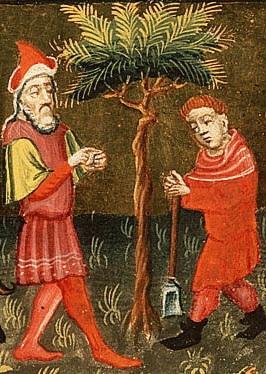
266_AlexanderMstrJHlsCrppWmnPrblBrrnFigKoninklijke_BibliotheekTheHague1430CROP-1Author T. C. Boyle has an intriguing short story entitled “Chicxulub.” Chicxulub is the name of an enormous asteroid (or perhaps a comet) that collided with the earth sixty-five million years ago on what is now the Yucatan peninsula, leaving an impact crater one hundred and twenty miles across, and twelve miles deep.

Boyle’s short story intersperses such episodes of catastrophic natural disasters with a story of one night in the life of one family. The main characters are a husband and wife, parents of a 17-year old daughter named Maddy. They receive a phone call from a hospital: “There’s been an accident!”

Apparently Maddy has been hit by a drunk driver while walking home from the Cineplex. They head to the hospital in that dream state of shock that overtakes those in the midst of disaster. At the hospital they are unable to get much information out of the staff. They are told she is in surgery. They wait and wait. Finally a young doctor comes out and speaks to them. He drops his eyes. “I’m sorry,” he tells them.

When I first read the story I was deeply moved, even though I knew it was a work of fiction. But Boyle was toying with his readers. He was toying with me. Because in the end we learn that Maddy is not dead. The dead girl on the gurney is a sixteen year old friend of hers, Kristi, who borrowed Maddy’s I.D. to get into an NC-17 movie in the next theater. Maddy gets another chance. Continue reading

Unknown's avatar

“The God of the Far Off” Toward the Ministry of Inclusion

Prodigal sonWhat an extraordinary week this has been for our country! The great Swiss theologian Karl Barth liked to admonish the church that it must read both the Bible and the newspaper, because we Christians live in the world.

And what a week of news it was! There were two historic Supreme Court decisions that will change our national life in significant, and in my opinion, profoundly positive, ways.

On Thursday, by a 6-3 decision, the Court upheld the Affordable Care Act, which makes health care available to all Americans.

And on Friday, by a 5-4 decision, Marriage Equality became the law of the land.

The reason I am here before you instead of our pastor Brent Damrow is that he is in Cleveland at the General Synod of the United Church of Christ, representing the Massachusetts Conference. I am sure he will have stories to tell about the celebrations taking place there, as our national church has been a long and tireless advocate for equal rights for the LGBT community and a supporter  of marriage equality.

I believe that these two historic Supreme Court decisions share a common idea, and that is the idea of “inclusion.”

And a third extraordinary event in our national life also happened on Friday. President Obama climbed into the bully pulpit in Charleston, South Carolina to give the eulogy for the Honorable Reverend Clementa Pinckney, the pastor of the Emmanuel AME Church who, along with eight of his congregants, was murdered by a gunman while attending a Bible study at the church on June 17.

President Obama gave a stirring eulogy for Pastor Pinkney, but he was addressing not only those present, but also the nation. I’d like to share with you some excerpts of his eulogy:

The alleged killer could not imagine how the city of Charleston . . . .the state of South Carolina, how the United States of America would respond — not merely with revulsion at his evil act, but with big-hearted generosity and, more importantly, with a thoughtful introspection and self-examination that we so rarely see in public life.

Blinded by hatred, he (the alleged murderer) failed to comprehend what Reverend Pinckney so well understood — the power of God’s grace . . .

This whole week, I’ve been reflecting on this idea of grace . . .

According to the Christian tradition, grace is not earned. Grace is not merited. It’s not something we deserve. Rather, grace is the free and benevolent favor of God as manifested in the salvation of sinners and the bestowal of blessings. Grace.

As a nation, out of this terrible tragedy, God has visited grace upon us, for he has allowed us to see where we’ve been blind. He has given us the chance, where we’ve been lost, to find our best selves. We may not have earned it, this grace, with our rancor and complacency, and short-sightedness and fear of each other — but we got it all the same. He gave it to us anyway. He’s once more given us grace. But it is up to us now to make the most of it, to receive it with gratitude, and to prove ourselves worthy of this gift.

Martha and I were driving to Onota Lake in Pittsfield for a walk on Friday when the President’s eulogy came on the radio. We got to the parking lot at the boat ramp, but we didn’t get out of the car. We sat in the car until it was over, and when it was over I had tears streaming from my eyes.

The President was addressing the painful facts of racial relations in today’s America. He mentioned that in response to the massacre at the church the Confederate flag had been taken down in the South Carolina capitol and elsewhere. That flag, he said, was a symbol of our nation’s “original sin,” slavery.

The president had both the Bible and the newspaper in mind as he gave this incandescent speech. I don’t know of such a theologically astute presidential address since Abraham Lincoln’s second inaugural.

And once again I would argue that inclusion is the big idea that binds all these events together. Inclusion.

I believe in the power of ideas to shape societies, and, as my teacher, mentor and friend, Max Stackhouse taught me, to examine where they come from and what they mean. So I want to do a little bit of that with you today about the idea of inclusion. Continue reading

Unknown's avatar

“God’s Good Pleasure”

Cherry blosoms

“Work out your own salvation with fear and trembling; for it is God who is at work in you, enabling you both to will and to work for God’s good pleasure.”— Philippians 2:12-13

This passage reminds me of those jokes in which someone asks, “I’ve got some good news and some bad news. Which do you want to hear first?”

I’m inclined by temperament to want the bad news at once, so the bad news from Paul comes first: “Work out your own salvation with fear and trembling.” Uh oh! This sounds to me like a counsel of despair, for who among us has the power to save ourselves? Is this the ultimate bad self-help advice? And that “fear and trembling” part is scary.

So what’s the good news? The good news is that Paul knows this salvation process is a collaboration with God “who is at work in you.”

That’s sounds much better, because only with God at work in us can we ever choose and accomplish the things that please God.

And what pleases God? Today’s passage follows directly after a beautiful hymn that describes how Jesus, in humble obedience to God, emptied himself of privilege and power to become a servant. Apparently that is the sort of thing that contributes to God’s “good pleasure.”

Prayer: O Jesus, before your name every knee should bend on heaven and earth, help us day by day to follow in your way, that both our will and our works may please God.

(This is my Daily Devotional for April 27, 2015. To subscribe to the UCC STILLSPEAKING Daily Devotional go to:http://www.ucc.org/feed-your-spirit/daily-devotional/

(Photo: R. L. Floyd, 2015)

Unknown's avatar

“The Message of the Cross” A Sermon on 1 Corinthians 1:23-25

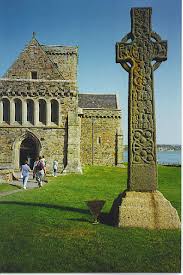
Iona crossA minister friend and mentor of mine, Herb Davis, once told me that every preacher has only one sermon in him, or her. According to Herb, every Sunday the preacher serves up that one sermon in a variety of ways. It may look like a different sermon, but at the heart of it, there’s just the one!

When I was growing up my family always had some sort of a roast at Sunday dinner, which was usually served in the middle of the day after we came home from church. Then the remains of that roast would reappear in various guises throughout the week. For example, let’s say it was a pork roast. The roast might reappear on Monday night in a soup, and on Tuesday night as my Dad’s signature roast pork chop suey and so on. So is that really the way it is? Do the people of God get fed leftovers every Sunday?

I hope not. I think what Herb was saying is that every preacher’s one basic sermon provides the core convictions out of which that preacher delivers the Gospel. And if Herb is right about the one-sermon theory, than I suppose today’s epistle lesson would have to be the text for my one sermon. Let’s hear it again: Paul writes, “We preach Christ crucified, a stumbling block to Jews and folly to Gentiles, but to those that are called, both Jews and Greeks, Christ the power of God and the wisdom of God. For the foolishness of God is wiser than human wisdom, and the weakness of God is stronger that human strength.” (I Corinthians 1: 23-25)

This is what Paul calls the message of the cross. Paul believed that Jesus was the Jewish Messiah and that God raised him from the dead. The cross on which Jesus had died became for him the symbol of that Good News of God’s vast unconditional love for all humankind. Paul believed that in Christ’s dying and rising two important new things had occurred. First, there was now a new age of God’ activity, and, secondly, there was now a new community, the church, made up of both Jews and Gentiles. Continue reading

Unknown's avatar

“Our eyes are on you”

AT

“We do not know what to do; but our eyes are on you.” – 2 Chronicles 20:12

“It took many years in the ministry for me to be able to say, “I don’t know what to do,” but it was something of a turning point for me. . .  There is often a certain kind of functional atheism that creeps into the way we do business in the church. We might open our meeting with a prayer, but we fully expect to take care of business ourselves.” (From today’s Daily Devotional) Read whole post

(Photo: Appalachian Trail in S. Egremont, Massachusetts. By R.L. Floyd)