

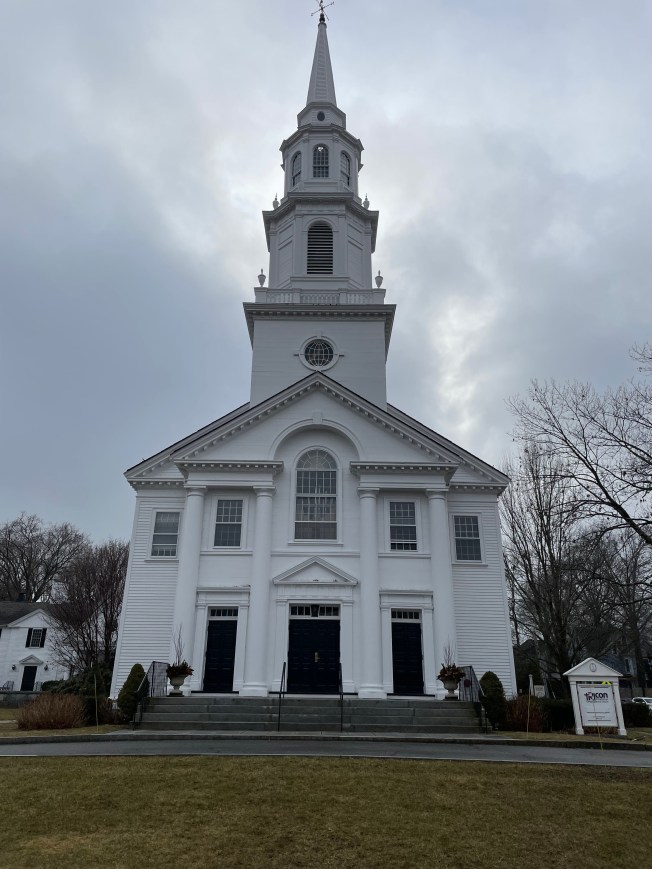
I want to thank you for inviting me to preach in this faithful, historic church. I have known this church since my Andover Newton days more than half a century ago, and I have known and admired several of your former pastors. You are a flourishing congregation with lively engaging worship. I often livestream your services. In Rebecca and Martha, you have two gifted, faithful preachers and worship leaders. I love your music. You are richly blessed and I give thanks for you,
Let us pray: May the words of my mouth and the meditations of our hearts, be acceptable in your sight, O Lord, our Rock and our Redeemer. Amen.
Rebecca tells me you’ve been reading “Searching for Sunday” by Rachel Held Evans. I love her writings, and I loved that book.
As you may know, both words for breath in the Bible, ruak in Hebrew, and pneuma in Greek, can also mean wind and spirit, a wonderful ambiguity. I like ambiguity in the Bible; it makes you think.
Rachel Held Evans wrote this about breath: “The Spirit is like breath, as close as the lungs, the chest, the lips, the fogged canvas where little fingers draw hearts, the tide that rises and falls, twenty-three thousand times a day in a rhythm so intimate we forget to notice until it enervates or until a supine yogi says pay attention and its fragile power awes us again. Inhale, exhale, expand, release. In the beginning God breathed.”
We start today with Ezekiel’s vision of the valley of the dry bones. They were dry. (I’m thinking of Johnny Carson and Ed McMahon on the Tonight Show) “How dry were they?” They were very dry. They had no breath in them, no life in them, no possibilities.
No possibilities. That’s what I want to reflect with you on today as we stand peering over the edge of Lent into the coming marking of the Passion and Death of our Lord Jesus Christ.
Let’s reflect on what it means to have no possibilities. Stanley Hauerwas once said, “The only requirement for resurrection is to be dead.”
So, in our readings for today the bones are dead, and Lazarus is dead.
Let’s start with these dry bones. Who was Ezekiel and what was going on during his time? Let me fill in some of the backstory. Since ancient Israel figures so prominently in our Biblical story it is easy for us to forget that it was never a great power, but a tiny nation perpetually stuck between rising great powers to its north and south. Israel did have a brief heyday under the monarchies of King David and his son Solomon, but after that it was pretty much downhill. The kingdom split in two and had a tragic succession of more or less corrupt kings.
Finally, in 587 BC, after a long and horrific siege, the powerful Babylonian Empire conquered Jerusalem. And they did a very thorough job of extinguishing the national flame of Israel. The three foundations of Israel’s identity at the time were 1. The monarchy. 2. The Temple. and 3. The land.
So, first the Babylonian conquerors murdered the king’s sons before his eyes, put his eyes out and took him captive to Babylon to live out his days. Then they burned the Temple to the ground, along with most of the rest of Jerusalem, and they took ten thousand of the most important surviving citizens in chains back to Babylon, where they stayed in exile for 50 years.
And it is out of this dire period, which we call the Exile, that some of the most profound theology in the Bible was forged, as Israel wrestled with the question of what kind of God must this be who allowed (or perhaps even made) such things to take place.
From this period, we get the Book of Job’s profound wrestling with the question of evil, we get a handful of our favorite Psalms, and perhaps, most of all, we get Isaiah of the Exile, who didn’t know at the time that he was writing a good bit of the libretto for Handel’s Messiah. And we get the prophet Ezekiel and his vivid vision of the valley of the dry bones.
So, Israel in Exile had all the necessary conditions for resurrection. It was dead. It had no possibilities. Their important things were lost and gone. They had lost their land. They had no monarchy. They had no place to worship. They were in exile, far from home, far from their beloved Zion, which is both the name of the mountain on which the temple had stood, and a nickname for Jerusalem.
Psalm 137, made famous as a song in Godspell, expresses their lament for their lost life:
“By the rivers of Babylon—
there we sat down and there we wept
when we remembered Zion.
On the willows there
we hung up our lyres.
For there our captors
asked us for songs,
and our tormentors asked for mirth, saying,
“Sing us one of the songs of Zion!”
But how could we sing the Lord’s song
in a foreign land?”
That is the context in which God speaks to (or through) the prophet Ezekiel who is in exile up in Babylon with his wife. The dry bones are the house of Israel. They had lost everything.
Did you ever lose everything, or thought you did?
I did. I’m here to tell you another story of the loss of possibilities. It is partly my story, mostly God’s story, and before I am finished, I hope you can recognize it in some sense as your story, too. It is a story about discovering God in one’s losses. It is a story about grace, and gratitude. It is a story of reversals.
The story I want to tell today begins twenty-six years ago on a warm August morning when I had a catastrophic bicycle accident while riding in a century ride, a hundred-mile ride. I went over the handlebars of my bike and hit my head. I suffered a Traumatic Brain Injury (TBI) that left me profoundly disabled. I had trouble sleeping. I had a constant ringing in my ears. I had been a choral singer since the age of six, but I couldn’t even listen to music. My brain couldn’t process it. Music was just noise. I had trouble praying (and I’m a praying guy). God seemed remote if not entirely. absent
I had a nearly a decade of very poor health, including suffering from a severe clinical depression. Because of my accident and illness, I suffered a series of losses. In addition to losing my health, I eventually had to give up my pastorate, and so, I lost, all at once, my job, my vocation, my community and my home, since we lived in a parsonage.
And an accident or chronic illness is a family affair. It doesn’t just affect you, but also those around you. At one point I asked my wife, Martha, why she didn’t leave me. She said, “I would never leave you!” I said, “I would leave me if I could.” Rebecca was a junior in High School at the time.
So, we had some very difficult years, and then about nine years later something remarkable happened. I got better. I went off all my medications. I was no longer a depressed guy with a brain injury, just a guy with a brain injury, which I can assure you is a big improvement.
And gradually even my brain injury improved some. Neurologists used to believe that when parts of the brain died the functions they controlled were lost forever. Now they are learning through MRI brain imagining that other parts of the brain can restore lost functions. It’s called neuroplasticity. As a former basketball player, I like to think of it as if other parts of the brain “come off the bench” to help out the team. We don’t use the word recovery, but I did gradually improve and got some of my life back.
My story would be a more typical American success story if I could tell you I did something really heroic or courageous to get better, but I didn’t. I didn’t pull myself up by my spiritual bootstraps. No, but I had lots of help, especially from my family, but also from the church we joined.
And I began writing again and preaching again now and then, something I couldn’t have done before. And in 2010 I started singing again, and I’m now in my 16th year singing with the fabulous Berkshire Lyric Chorus, and on May 31, I will be singing St Matthew Passion by J. S. Bach in Ozawa Hall at Tanglewood. And on August 7, we are singing in the Shed with the Boston Symphony Orchestra and opening for YoYo Ma. How cool is that? And here I am!
So, I live in gratitude for this unexpected chapter in my life. I’m grateful to be alive, and to enjoy my two children and my four grandchildren. I’ve had my losses. My Mom died when I was 18, and my Dad died when I was 34. I treasure each new day I am given.
I’ve been reading about J. S. Bach’s time at the cusp of the Enlightenment when the pseudo-science of alchemy claimed that with something called a “philosopher’s stone,” one could turn lead into gold. It isn’t true, but In my experience the real magic is turning suffering and loss into faith, hope and love.
And so, this is where I hope you find this big story that is mostly God’s story and partly my story to be something of your story, too. To accept that you can be honest in admitting that our world is broken, and that in some sense, you are broken as well. That you can realize that your own vulnerabilities and neediness are not flaws, but the very conditions for recognizing and receiving the gracious generosity of God, who loves us with a vast love through Jesus Christ our Savior.
I often find that people in the recovery community are better at understanding this than many Christians. Their first step is to admit that in themselves, they are powerless; lacking in possibilities of their own making. The turn to a “higher power” One of my favorite writers is Anne Lamott, herself in recovery. Do you know her writing? If not, you should. She writes, “The difference between you and God is that God doesn’t think He’s you.”
The Bible is a story about a God who makes a way when there is no way. God breathes into the dry bones and they live. Jesus tells Lazarus, four days dead, to come out, and he does. Jesus said to Martha, “I am the resurrection and the life, he that believes in me, though he were dead, yet shall he live; and whosoever lives and believes in me shall never die.”
I was ordained fifty years ago last September 21st in the Newton Highlands Congregational Church by the Metropolitan Boston Association of the United Church of Christ. Hands were laid upon me, and the Holy Spirit of God was invoked over me.
Since that day, I have stood at countless pulpits and at countless gravesides, and I have repeated those words of Jesus over the bodies of the dead. “I am the resurrection and the life, saith the Lord; he that believeth in me, though he were dead, yet shall he live; and whosoever lives and believes in me shall never die.” “Can these bones live?” Can Lazarus live? Can we live? Catch your breath, and walk with the church from Lent into Holy Week, in confident faith in the God whose Spirit still hovers over creation, and whose breath still revives that which had been dead, and who makes a way where there appears to be no way. Amen.
(I preached this sermon on March 22, 2026 at the Trinitarian Congregational Church in Concord, Massachusetts, where my daughter is the Senior Minister. To watch a YouTube video of this sermon go to https://www.youtube.com/watch?v=dbdxoEpKmYA&t=1237s)



 When I Survey . . .