Unknown's avatar

The Shepherd Window: “Lost and Found”

church-window4-224x300

When I was growing up my family went to the Church of the Holy Communion in Norwood, New Jersey. It was a little church, built in the neo-Gothic style so beloved by Episcopalians. It had a cloister that connected the church with the parish house. Years later, when I had sabbaticals at Oxford and Cambridge, I felt right at home among the grand stone piles.

When I was in second grade a classmate of mine died in a sledding accident, and his family donated a memorial window to the church in his memory. That window helped shape both my faith and my theology.

Here is a piece I wrote about it for today for the United Church of Christ’s Still Speaking Daily Devotional:


“Lost and Found”

By Richard L. Floyd

“Which one of you, having a hundred sheep and losing one of them, does not leave the ninety-nine in the wilderness, and go after the one who has been lost until he finds it? When he has found it he lays it upon his shoulders and rejoices.” – Luke 15:4,5

When I was in the second grade a boy in my Sunday school class named Kim was killed when he overshot the mark on his sled, went into the road, and was hit by a car. Nobody I knew had ever died before and his death left quite an impression on me. I remember my mother and father sitting me down and telling me the sad news.” Read more

Unknown's avatar

“The Cross and Forgiveness”

Lent 2014As we enter Holy Week and look ahead to Easter I would like to reflect on some of the threads of our Lenten study these past few weeks in the light of the cross and resurrection.

You will recall that forgiveness means a wiping away from memory of the offense, so that it is as if it never happened, leading to restoration of the relationship.

At the very first meeting we reflected on how extraordinary the idea of forgiveness is, since the human impulse for retribution and revenge runs very deep.

So if forgiveness is such a hard thing for us, what explains the amazing stories we saw and heard, first about Desmond Tutu and the South African Truth and Reconciliation Committees, and then the story of Louis Zamperini forgiving his Japanese captors decades after his imprisonment? (As told in Laura Hillenbrand’s best-selling book Unbroken). Continue reading

Unknown's avatar

A Son’s Remembrance of His Mother on her Birthday: Frances Irene Floyd. March 4, 1914-September 18, 1967

Frances Irene Floyd

(I first published this in 2010, but thought the 100th birthday warranted a repeat)

Today is my mother’s birthday. She was born on this day in 1914, and died on September 18, 1967 at the age of 53 from cancer. She died too young. She would have been 96 today.

Her older sister outlived her by 40 years. She’s died now too, as has my Dad, so there is hardly anyone who even remembers her. But I do.

She most likely wouldn’t have died in this day of regular diagnostic tests and improved cancer treatments. But in the 1960’s cancer was considered by most people to be a death sentence, and usually was.  Her doctor told us she had it, but asked us not to tell her, because the news would be so emotionally devastating she might lose hope.  So in addition to having to deal with her dying, we had to lie to her.  She was a smart woman and finally figured it out and made us tell her.

I was eighteen when she died. She was told by her doctor in September of 1966 that she had about three months to live, and she said  “Nonsense, I will live to see my daughter and son graduate (from college and high school,  respectively) next spring, and she did, although she was in a wheelchair.  My sister was engaged to be married, and the date was moved up to early September in the hopes she could participate. She couldn’t, since she was in the hospital dying.

That day, my Dad, my younger brother, and I left immediately after the reception, still in our morning suits, full of champagne punch (at least I was), to visit her in the hospital with a fist full of Polaroid photos to show her of the wedding.  She was delighted, but didn’t have much energy to enjoy them.

A few days later I said my goodbyes to her (though far too much remained unsaid) and then I traveled 1400 miles away to go to college.

Two weeks later she died, and I came home for the funeral. No single event in my life as her early death has had such an impact on the rest of my life.

I often think of her on March 4. She said it was the only day of the year that was a command (“march forth!”), and when she was a kid she thought she was a big deal because she was born on Inauguration Day, but Congress moved that to January in 1933, so she lost that distinction.

Though I often think of her on her birthday, it sometimes isn’t until later in the day. Some years I have forgotten it completely, and later in the week realized that I was sad on that day for seemingly no reason. But the heart often knows better than the mind.

Mostly I think about what she missed. She never knew my wife, and my son and daughter. She never knew I graduated from college or became a minister. She never met any of her seven grandchildren or my brother’s wife. She was cheated.

Her short life was in many ways remarkable for a woman of her generation. She was born in Oklahoma City and grew up in Wichita, Kansas, where she went to college, a rare thing for women in the 1930’s. She became a librarian, one of the few vocations open to women back then, along with teachers and nurses. After graduation she got a job at the Wichita Public Library.

She was a dreamer and what we once called a “bookworm.” She always had her nose in a book, and expanded her rather conscribed universe through her imagination. Her parents were good people, pious Midwestern Protestants, and she lived at home with them throughout her mid-twenties, as unmarried women were expected to.

But she wanted more out of life. She dreamed about far off places she had read about in books. She dreamed of the England of Jane Austen and Dorothy Sayers. And like many Americans in her day from the cultural hinterlands she dreamed of New York City, then in its heyday, where Dorothy Parker and James Woolcott could exchange bon mots in the Algonquin Club. It was a far cry from Wichita.

By her late twenties she was considered an “old maid,” most likely never to be married. She wasn’t accepting any of this.

So she decided to change her life. Against her parents’ wishes she applied to Columbia Library School (now sadly gone),  arguably the best in the country, and when she got in, she went.  She packed her suitcase and took the train by herself to New York, and got a room at the International House near Riverside Church and never looked back.

She loved New York. Like so many people who go there she had big dreams. She wanted to be a writer, and scribbled short stories in her spare time.  I have many of them. They are not particularly good, overly self-conscious and somewhat formal in style, but they are interesting and really not bad.  She was a good writer, but she tried others’ voices and never found her own.  She used to joke that she had rejection slips from all the best periodicals. One of her grandsons is a writer and won an O’Henry Award a few years ago for one of the years’ best short stories. She would have liked that.

When she graduated from Columbia she got a job at the New York Public Library on Forty-Second Street, and went to work every day between the storied lions. There she got such a good reputation for cataloguing books that she was asked from time to time to do it for the Library of Congress.

She became an Episcopalian, which I expect didn’t go down too well with her folks back in Wichita, in a day when anti-Catholicism was still an ugly feature of much of Protestantism, though to be fair, I never heard any of it from them.

She met my Dad, a handsome intellectual Bostonian, while she was working at a summer job at the University of New Hampshire, where he was teaching while a Ph.D. candidate back at Columbia. They discovered they both lived in New York, and when they got back to the City they started dating, and eventually married.

I am the second of their three children. My sister and I were born in New York City and my kid brother was born in New Jersey, where we moved when my parents realized that New York wasn’t a terrific place to raise kids, especially when you had limited means.

Church was important to my mother and she was on the altar guild and worked on the annual bazaar, and baked pies for the Bake Sale, and if we were lucky she might make one for us.

I thought of her the other day when I was in church. It was an Episcopal  Church and the rector, who was celebrating, is a woman, as is the  associate priest, as were the two acolytes. So the communion table was surrounded by women, and no one thought a thing about it. My mother would have liked that, although in her day it would have been a complete flight of fancy to imagine it.

She was a proto-feminist in a quiet way. My sister went to Vassar when it was a women’s college, and my mom was very proud of her. Nearly thirty years later my own daughter graduated from Wellesley College, and I thought of my mother on that day, too, although she would have been equally proud of my son’s graduation, for she was nothing if not fair.  And what would she make now of my daughter going to divinity school?

When we were growing up in the suburbs she took a job as a librarian in a middle school nearby. Her students loved her and she encouraged them all to read, read, read. I suspect she often quietly overlooked a library fine on an overdue book if it was a hardship for the student’s family to pay it.

Last spring I wrote a paper about my love of mystery novels, another passion she passed on to me. I mentioned her in it and got this remarkable anonymous comment: “If your mother was the Mrs. Floyd who was the Wandell librarian in the ’60s, I remember her! She was wonderful. In fact, I use FLOYD as a password on book-related websites (what greater homage?).”

I have now outlived her by 7 years, and she has been gone from my life for so long I can’t recall her voice, and I can remember her appearance mostly from old pictures. I sometimes glimpse something of her in the faces of my daughter and my two nieces, and see inklings of her ways when they labor at crossword puzzles or slaughter one another at Scrabble.

I woke up in the wee hours this morning and started thinking of her and tears welled up in my eyes, even though she has been gone 43 years. So I guess I still grieve.

But mostly I am grateful for the years I had with her. She gave me words, books, music, a dry sense of humor and above all, faith. She also gave me a lively sense of the communion of saints, and makes me acutely aware of our connection to those who have gone before us and help make us who we are.

So here’s to you Mom. Happy Birthday!

Unknown's avatar

Some Winter Posts Worthy of your Time

Winter scene

In my peregrinations around the blogosphere I came across two very wise and well-written posts by ministerial colleagues of mine. I hope you will check them out.

First, the incomparable Mary Luti, whose blog, sicut locutus est, should be on your blogroll, wrote “Why I Teach.” Here’s a sample:

I want students to take someone else’s wisdom for a serious test drive. I want them to rent with an option to buy; to suspend suspicion and develop a bias toward faith in the considered opinions of others; to respect the authority of authorities instead of keeping up the fiction that all ideas have equal value and that all opinions count the same.

Secondly, Emily Heath, a Vermont pastor and top-notch blogger, has a beautiful and bravely personal post called “Falling: Recovery, Silence and the Church.”  Here’s an excerpt:

But the more I thought about it (new Boston mayor Marty Walsh’s openly talking about his recovery during the campaign), the more I felt sad for the church. If an admission of being in recovery can actually help someone in the hardball world of politics, why is it so feared in the very place where redemption should be celebrated? Why aren’t we, people who talk about grace and forgiveness and new life, in the business of teaching people what to do when they fall? Why don’t we acknowledge these things so that we can help people know where to turn when they need help to get back up?

There are mountains of ephemera in the blogosphere, but well-written wisdom, like gold, is where you find it.

(Photo by R.L. Floyd, 2014)

Unknown's avatar

The Calling of Disciples: A Sermon on Vocation

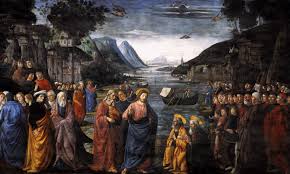
Ghirlandaio

John 1:29-42

 What is vocation? We typically think of vocation as our job or profession, but the idea is much larger and richer than that, so let’s take a look at it, starting with a little word study.

Vox is the Latin word for “voice,” as in Vox Populi, the “voice of people.” The Latin verb “to call” is vocare, as it still is in Italian. The noun form is vocatio.

There is a whole cluster of English words that have these Latin words as their root, words that refer to voice, to speaking and calling. For example, when we “speak out” we are being “vocal.” The whole collection of words we use to speak is our “vocabulary.” And, of course, a person’s calling is his or her “vocation.”

In Christianity (and its mother Judaism) our God is a God who has a voice, a God who speaks and calls.

But God’s speaking is different than our human speaking in an important way. We make a distinction between human speech and action.

But for God there is no such distinction: the Word of God doesn’t just say something, it does something. So, for example, in Genesis 1, God creates the worlds with a word. Recall how God said, “Let, there be light! And there was light.”

And recall also how God says in Isaiah 55, “My word will not return to me empty, but will accomplish that which I purpose.” Isaiah himself is an example of a prophet, a person called by God to speak for Him, so that when the prophet speaks, his words are heard by the people as the Word of God.

Likewise in John’s Gospel, we see that Jesus is called “the Word of God.”  John 1: “In the beginning was the Word” intentionally mirrors Genesis 1, “In the beginning God created the heavens and the earth.”

But to say that Jesus is “the Word of God” is to say more than that he speaks the Word of God, as Isaiah did or the other prophets did.

No, in Jesus, we see this intimate connection between speech and act, between word and deed. Because Jesus is both the one who speaks the Word of God, and he is also the one who accomplishes it, by his life death, and resurrection.

And so we see in today’s Gospel from John, at the very beginning of Jesus’ ministry, the calling of the first disciples, which sets in motion the drama of the rest of the Gospel.

Why does Jesus call disciples? To answer that we need some background on what Jesus’ ministry was all about. First of all, Jesus comes into a time and place where God was expected. The people had been waiting, longing, hoping for the coming of God’s reign in the form of his anointed one, which is the word “messiah” in Hebrew, and “Christ” in Greek.

The role of John the Baptist in the story is important because many at the time thought that John the Baptist was a figure like Elijah. Elijah was often thought to be the one who would come before the messiah, a forerunner figure.

Many people saw John the Baptist in this same light, and his appearance in the wilderness raised expectations for the coming of the Messiah. When Jesus shows up preaching and teaching many thought he was the expected One.

In our reading today the evangelist describes Andrew and Peter as disciples of John the Baptist, who leave him to follow Jesus.

So Jesus calls disciples for a very particular reason, which is hinted at by his calling twelve of them. This mirrors the twelve tribes of Israel. This is just one of many indications that Jesus understood himself to be the carrier of God’s special calling of Israel.

And what was Israel’s special calling? We get an inkling of it in our Old Testament reading today, where God says to Israel, “I will give you as a light to the nations, that my salvation may reach to the end of the earth.” (Isaiah 49:1-7)

In theological terms we refer to this special calling as “election.” In the Bible election is never for itself. No, election is always to accomplish the purposes of God.

The “chosen people,” whether we are referring to Israel or the church or both, are not called because they are better than others, but because God has use for them. And if we pay careful attention to the stories of the people God calls in scripture, it becomes quite clear that God doesn’t call the qualified, but rather qualifies the called. Think of Abraham and Sarah, well past their prime, Jacob, the liar and thief, Moses, the murderer, and Mary the poor teenage unwed mother. These are people like us and people we know.

So once again, you may be thinking, “Well, that’s really interesting Rick, and we’re glad you got to use your high school Latin, but what’s all this got to do with us?”

And the answer to that is that it has everything to do with our identity as a congregation and our understanding of our mission. In other words, our vocation informs both “who we are” and “what we do.”

I am talking about our vocation as church. We don’t just come to church, we are called to be the church. There’s a difference.

Here’s a hint about our calling. In the Call to Worship for this morning I referenced the UCC Statement of Faith several times. Twice it refers to God’s call. The first call is in the beginning: “God calls the worlds into being.” There’s Genesis 1 again.

The second call from God is through Jesus, “He calls us into his church to accept the cost and joy of discipleship.”

So the church is called as an instrument of God’s purposes, and those purposes are the same as in the original creation.

To begin to think about ourselves that way, as being called for God’s purposes, will change both our identity and mission. We are not merely a voluntary association of individuals with a benevolent and spiritual focus, although we are that.

But we are more than that, we are called, we have a vocation.

This concept of vocation was very important to our Puritan forbearers here in New England. We talked about this in our Men’s Book Group on Wednesday. Before the Reformation vocation was understood to be only for the religious life, for the monk, nun, or priest.

The Reformers changed that. Luther and Calvin believed that there was a general calling to repentance and a godly life for all Christians, and there were particular callings to life’s several vocations, as we understand them today.

So calling was no longer just for the clergy, and it still isn’t. Calling is for us all, and what are we called to be? Disciples of Jesus. And what is a disciple? A disciple is quite simply a follower or a student. One who hears the call of Jesus.

Jesus called those first disciples by asking them, “What are you looking for?” And later he invites them to “Come and see!”

And they might not have known what they were looking for, as many of us do not, but they knew it when they saw it. And they said, “We have seen the Messiah.”

They heard the call and answered it.

I want to talk now about the power of words as it relates to our callings, and I can think of no better example than Martin Luther King, who was a very important influence on me, and on my own call to ministry.

I was fourteen when Dr. King gave his “I Have a Dream Speech” in Washington, D.C. at the Lincoln Memorial. I was there last month and felt as if I was standing on holy ground.

I had grown up in the church, but in Dr. King’s speech I heard a new power in some familiar words. Dr. King’s father was a minister, and Martin grew up in the thought-world and language-world of the church.

The African-American church had retained the moral grammar of the faith that had been largely lost in the mainline church, the language of justice and righteousness, and in the civil rights movement Dr. King and others gave it back to the whole country as a gift in their words.

When I first heard Dr. King’s words they rang true. They had behind them such moral force. His use of familiar scripture, such a Isaiah 40, “Every valley shall be exalted,” and of shared national language such as the words of “My Country ‘tis of Thee” re-awakened the moral imagination of much of the country.

In Dr. King’s speech fifty years ago I became awakened to the power of words to shape the life of individuals and societies, and years later I discerned a call, there’s that word again, a call to the ordained ministry.

And throughout my long ministry I have often pondered the power of words, to heal or hurt, to inspire or dampen the spirit, to free or repress. And I believe that a society that de-values words is at risk, because it ceases to know when it is lying to itself, and can’t recognize truth when it hears it.

But the right word at the right time can change a life or change a society.

I invite you to recall such moments in your own life. Perhaps you were listening to a sermon, or the words to a hymn, or a scripture reading, and suddenly those words were not something you were just overhearing, but words that were addressed to you.

And it is in such moments that “vocation” takes place; when you hear the voice of God calling. And when that happens there is no turning back, because the Word of God has a life of its own in your life.

You know how Brent (our pastor) often begins worship with the words “No matter who you are, or where you are on life’s journey, you’re welcome here.” This language is part of what we in the United Church of Christ call “the extravagant welcome of our God.”

These are good words. The purpose of this welcoming language is to create no barriers that will keep people away from our life together here, and several people have told me how reassuring it is to them.

But, in the interest of full disclosure, I need to tell you there is danger in all this extravagant welcome, and it should come with a warning label.

Because once you say to yourself, “I feel welcome here. This could be my church,” a new thing may happen. You are very likely to have one of those moments I just described, when the words you hear become the Word of God that feel as if they were directly addressed to you. Then you hear the call of God and recognize your vocation. Then you move from attendance to discipleship, from observing Jesus to following him. Then you accept “the cost and joy of discipleship.”

Those moments will change your life.

So what is God calling you to do? Who is God calling you to be?

What is God calling us to do? Who is God calling us to be?

And let the people say: Amen.

I preached this sermon at my home congregation, the First Congregational Church (UCC) in Stockbridge, Massachusetts on January 19, 2014.

(Picture: The Calling of the Apostles by Ghirlandaio)

Unknown's avatar

“From Here to There and Back Again” The Journey from Text to Sermon

On the other hand

“For as the rain and the snow come down from heaven,

   and do not return there until they have watered the earth,

making it bring forth and sprout,

   giving seed to the sower and bread to the eater,

so shall my word be that goes out from my mouth;

   it shall not return to me empty,

but it shall accomplish that which I purpose,

   and succeed in the thing for which I sent it.”  (Isaiah 55:10-11)

The title for today’s gathering was announced as “Getting from There to Here.” As I reflected on it I wondered if perhaps “getting from here to there” might be more apt. “Here” being the text in front of you, to “there, ” the sermon. That works.

But as I thought more about it I saw the wisdom of  “from there to here.” From “there,” “the strange new world of the Bible,” to “here,” the world we live in. And I thought of some of the various locutions we have used over the years to capture this movement from text to sermon, such as “from text to context” or “from Word to world.”

Then I considered the many ways I have approached the writing and preaching of sermons, and I realized this movement from text to sermon was more dialectical and less linear than any of these ways of speaking about it.

As I thought about it, the more I liked the sub-title of The Hobbit, which as you may know is “There and back again.” So perhaps “here to there and back again” is more like it.

From here to there and back again describes a journey that is not just a straight line, but rather more like a journey without a  map or even a predetermined end. And I like this way of thinking, because it captures how I have experienced sermon preparation in my four decades as a preacher.

I start with a Biblical text, and then I live with that text throughout the week on my journey, revisiting it and wrestling with it and worrying it until I begin to hear something of the voice of God in it, and by then the contours of the journey begin to show themselves, as do even the purpose of the journey and it’s destination.

The process seems to take on a life of its own, which is another way of saying that the Word of God is alive. I like today’s Isaiah text where God uses the agricultural metaphor of rain and snow watering the earth and making it produce to describe the way his Word works, “It shall not return to me empty, but it shall accomplish that which I purpose, and succeed in the thing for which I sent it.”

And I want to say a bit about what I mean when I say “the Word of God,” which can mean one thing or another, even sometimes one thing and another, or even three things depending on the context.

One way of thinking about this that has helped me comes from Karl Barth. He wrote about the threefold understanding of the Word of God.  First, there are the written words of the Bible, then there are the spoken words of the preacher, and finally, and most importantly, there is the living Word, Jesus Christ.

This living Word is mediated through both the written words and the spoken words. The prayer I began my sermon with today is based on this idea: “Through the written word, and the spoken word, may we behold the living Word, even Jesus Christ our Lord.”

And that is not to say every text needs to be understood Christologically (although it can be), as in the text we have from Isaiah today. But to say there is a living Word is to say that whenever we hear the Word of God as direct address to us, it is the same Word of the same God, who came to us and for us and became the Word made flesh.

So when I talk about the Word of God in sermon preparation, it may be a reference to the text itself, the words, or to the proclamation in the form of a sermon, the Word preached, or to both, but the goal of the journey is, through the finite human words of the text, and the finite human words of the preacher, to transcend this finitude to hear the living Word of God. And I believe this is the primary task and challenge of preachers, and of the church, for that matter.

Let me say a little bit more about the words of the text and the words of the preacher as the Word of God. I think of them by analogy to the doctrine of the two natures of Christ. Jesus is truly human and truly divine, not half and half or some other percentage.

And in much the same way (although not identically) the words of our Scriptures, the Old Testament and the New Testament, are truly human and truly divine. Human in every way, written (and edited) by human beings, and truly divine through the agency of the Holy Spirit of God who inspired the writers to write them, the same Holy Spirit the church invokes when we read them.

And the same thing can be said about the words of the preacher. A sermon is not written in some special spiritual words, but in the same human words that we use in everyday speech. Since everyone in this room is a preacher I don’t have to belabor the point that we are all human, even all-too human. Yet the Holy Spirit that inspired the writers of Scripture is the same Holy Spirit that inspires the preacher, and the same Holy Spirit that the church invokes and invites as it prepares to hear the Living Word of God from the frail words of scripture and the frail words of the preacher.

This is admittedly a high view of preaching, and some might say it claims too much for the preacher. I would say quite the opposite. It is the views of preaching that put emphasis on the personality and performance of the preacher that claim too much for the preacher.

The claim that the preacher is to be a minister of the Word of God is much like the church’s understanding of the celebrant at the eucharist. The principal was established early in the church during the Donatist controversy. The Donatists were heretics, so the question arose whether the baptisms they performed were valid. And the church agreed that “the efficacy of the sacrament does not depend on the sanctity of the celebrant.” So the preacher may be more or less gifted with the homiletical arts, but it is not those gifts that are decisive. What is decisive for the preacher is that he or she has been set apart to deliver the church’s proclamation, so that the church may hear in it the living Word of God. It is not about the preacher. It is about the church hearing the Word of God.

This is a (nearly) sacramental view of preaching, that the preacher should say what the sacrament shows. And in both cases neither the preacher nor the celebrant has control over the Holy Spirit of God, as if we somehow could control God. No, Christ is not truly present in the sacrament nor truly alive in the preached Word because we invoke his name, but rather because he himself commanded us to do these things and promised to be present with us when we did.

So with this high view before us, and a text in front of us, how do we get from there to here or from here to there and back again?

The first thing I want to say about approaching a text is the expectation that God will speak through it. Which is to say that the high view I propose operates out of trust. I think it was Richard Hayes who wrote about a “hermeneutic of trust.” For decades we have been talking and hearing about “a hermeneutic of suspicion,” and that has had its place as an corrective to the Scriptures being misused as instruments of oppression and injustice, “texts of terror,” as my teacher Phyllis Trible so eloquently called them. But there has been a heavy price to pay for the widespread “hermeneutic of suspicion” that has so pervaded the academy for decades, in that many preachers now reflexively distrust the texts.

And I think it is sometimes necessary and appropriate to distrust a text, but it shouldn’t be where we start. Sometimes distrusting a text along the way will lead you to the Word of God.

So the text is in front of us. Perhaps it is an assigned text from the lectionary. I like that, because I can be a lazy sinner who is inclined to make my favorite texts do tricks for me, but that is just me.

Perhaps the Bible is open on our desk, perhaps it is on our computer screen or smartphone, but there it is. First things first: read the text.

Read it in expectation that God’s Word can be heard in it, but don’t rush to decide what it means or even what it has to say. Texts need time. They need to be listened to. I have always described my sermon preparation as inhabiting a text. Living in it.

Another good way to think about it is to “stand under” the text so as to understand it. And the preacher stands under the text along with the rest of the church.

I am really talking about hermeneutics now more than the homiletical side of things. So you all know the various ways to worry a text into view. Read it in the original languages if you have them. Read it in several translations. Look up any key words or phrases in a Bible Dictionary. Take a stroll through some commentaries. Find out its genre and its original context. In other words do your homework. I once preached a sermon that involved Herod, and added “you remember him from the Christmas story.” My dear friend Luther Pierce, a retired UCC minister, shook my hand at the door and said, “Good sermon, Rick, but you conflated Herod the Great with Herod Antipas. Different Herod.” Oops!

So once you’ve done your due diligence and you have the text in your grasp, reflect on the context. Those of you who were preaching in the weeks after 9/11 may recall that the Common Lectionary texts were from Jeremiah and Lamentations, texts we had all avoided in the past because they are horrible cries of despair for the destruction of Jerusalem. All of a sudden after 9/11 texts about the city of devastation and the burning tower became eerily contemporary.

Which is to say contexts change. The immediate context of any preacher is the life of the congregation, and when I talk of inhabiting a text, I am referring to going about one’s pastoral duties with the text in mind. From here to there and back again.

Then there are the larger contexts of the communities in which we live and the country and world we are a part of. Sometimes contexts demand our attention.

We rarely get the kind of compelling clarity about the relationship between text and context that we got after 9/11, but keeping the text in mind as we think about the multiple contexts will often show us the way to go, the particular context that needs to be addressed by the Word of God.

The dialectic of the journey of text to context and context to text means straddling two worlds with the hope we can find in them the same story.

I had the privilege of preaching my daughter’s ordination sermon back in June, and afterwards Mary Luti said, “I like the way you went back and forth from the story in the scriptures to your story now.” And her comment made me realize that I preach that way because to me it is the same story.

I immediately thought of Hans Frei’s The Eclipse of Biblical Narrative, a wonderful and important book. Frei’s thesis is that prior to the Enlightenment Christians inhabited the Biblical Story. They understood it as their story. They were part of it. The Enlightenment changed that as we held the story at arm’s length like any other observable phenomenon.

The task of the preacher is to repair the breach; to make the Christian Story our story again. I am reminded of Bruno Bettelheim’s book, The Uses of Enchantment, where he argues for the re-enchantment of the world for children through fairy tales.

Letting the words of scripture and the words of the preacher be the Word of God for God’s people requires a similar kind of re-enchantment. It means the church realizing that the Story isn’t just back there, but is still going on and we are characters in it.

Let’s look quickly at our Isaiah text for today to see how this might be done. The text is from Isaiah of the Exile and the context is a people who have no reason to be hopeful, since they have lost the three pillars of their identity, their temple, their land and their nation.

The promises made to their ancestors Abraham, Isaac and Jacob seem null and void. Their prospects seem dim, their possibilities few.

Into this context God speaks through the prophet. “My ways are not your ways, my thoughts are not your thoughts.” “You know that rain and snow we sometimes get in the desert? That is what my word is like. It will not come up empty. It will make happen that which I promised.”

And that is what the Word of God sounds like.

And when we hear this story, can it speak to us, where our prospects seem dim and our possibilities few? Can it speak to a declining church too often eager to call it a day? Can it speak to a nation full of grave injustices and inequalities? Can it speak to a world of death and terror?

When Isaiah speaks the Word of God to the exiles he lets them see what can’t be seen, and makes them believe what they can only know by trust in the one who speaks to them. The Word makes them part of the story again, the story that began at the beginning when God said “light” and there was light, the story that saw their ancestors freed from bondage, the story that seemed to come to an end, but now God says to them, “No, it’s not ending. Not at all. I will lead you through the desert of your journey into my own future.” And what will it be like? It will be like this:

“You shall go out in joy, and be led back in peace; the mountains and the hills before you shall burst into song, and all the trees of the field shall clap their hands. Instead of the thorn shall come up the cypress; instead of the brier shall come up the myrtle; and it shall be to the Lord for a memorial, for an everlasting sign that shall not be cut off.”

And let the people say: Amen.

I preached this sermon at the New England Pastor’s Meeting of Confessing Christ, West Boylston, Massachusetts, on September 26, 2013.

Unknown's avatar

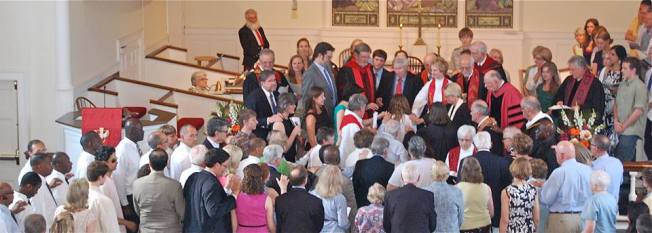
An Ordination Sermon: The Secret Sauce of Ministry. A Recipe in Two Parts

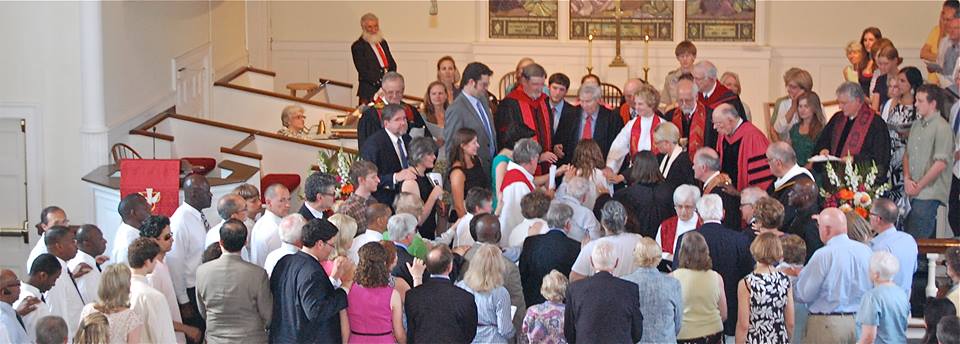
Laying on of hands

The Secret Sauce of Ministry
A Recipe in Two Parts

Hebrews 12:1-2
Philippians 2:1-11

As some of you know I like to cook. This time of year, when the weather gets fine, I fire up my grill and do some grilling and barbecuing. And I love to sit on my back porch near the grill with a cold beverage and read cookbooks, of which I have many, or as Martha would say, “too many.”

Many of these grilling and barbecuing books contain recipes for a “secret sauce.” I have been noticing lately that the term “secret sauce” has migrated from its culinary context and is now being employed as a metaphor for that special something that makes things work properly.

For example, I recently heard a journalist talking about “the secret sauce” that would create “a grand bargain” to overcome the Congressional budget impasse. Good luck with that.

So I started to wonder, “ What’s the secret sauce of ministry?”  If I had to come up with a simple recipe for what makes ministry faithful and effective what would it be?

So here’s my recipe, which comes in two parts, which I hope you will take away with you today for your own ministry, whether lay or ordained.

1. The first part of the secret sauce is this: You can’t do it alone. Rebecca couldn’t have come to this day alone, and she can’t do her ministry alone. No one does it alone.

How does one come to know God? And to love God? And to want to serve God?

When I look out at this congregation I see so many here today who have helped to shape and influence Rebecca. I am reminded of the scripture from Hebrews we just heard that says we are “surrounded by a great cloud of witnesses.” The image is from the ancient stadium where the races were held, and the cloud of witnesses are the spectators who cheer the racers on.

This great crowd includes both the living and the dead, “the church militant” and “the church triumphant.”

So among the crowd present in the congregation today are many members of Rebecca’s family, let’s call them “the crowd of the proud.”

In addition to Martha and myself, are Rebecca’s brother Andrew and his wife, Jessica. Rebecca’s maternal grandparents, Art and Marianne Talis, are here. As are several assorted aunties, an uncle, and a cousin.

These family members represent a great line going back through generations of Talises and Beers, Floyds and Laffoons, and, let me tell you, there is a lot of church in these families.

We represent a great ecumenical melting pot, from the Greek Orthodox faith of Rebecca’s grandfather’s forbears, to the German Protestantism of her grandmother.

My mother’s father, Bill Laffoon, a descendant of French Huguenots, was a deacon at his Congregational Church in Wichita, Kansas. His schooling ended with the 6th grade, but saw to it that his two daughters went to college during the height of the Depression.

Granddaddy read his Bible every day, and his speech was sprinkled with scripture verses.

So when I was growing up my mother also had a scripture for every occasion, I thought she was so wise, she’d say, “Sufficient unto the day is the evil thereof.” And, “Do not cast your pearls before swine.” When I went to seminary I discovered that they weren’t original with my mother, but came from Jesus in the Sermon on the Mount.

Years later, Rebecca had the same experience at Yale when she learned where all my wise sayings came from.

On the other side of the family, I think today also of Martha’s grandmother, Marta Beer, which in our family is a family name and not a beverage. My Martha is named after her. She raised three daughters by herself in wartime Germany, and was another great churchwoman.  How proud she would be.

This rich ecclesiastical family DNA has helped to shape and form Rebecca into a minister. They are all part of this congregation today, a part of the cloud of witnesses.

But there’s more. For as grand as Rebecca’s family legacy of ministry is, and as important as family support and nurture is, family alone cannot make a minister.

And so I look around this room and I see many people from Rebecca’s past, a number of the good people of the First Church of Christ in Pittsfield, where Rebecca was baptized and confirmed. I see some of her Sunday School teachers, youth group leaders, mentors and supporters, who have made the trip down here today from the Berkshires.

And when I look around today I also see many other friends, Pittsfield neighbors, UCC and ecumenical colleagues, and folks from the Berkshire Association, who have been part of Rebecca’s life.

I see some of her Wellesley College roommates up in the balcony. I see Yale classmates and New Haven friends, and, of course, all of you from Green’s Farms Church, members and staff, who have so warmly embraced Rebecca in your community, and are now such an important part of this most recent chapter in her life.

There are others, too, I must mention, who are neither related to Rebecca nor have ever met her, who she knows from the books she loves and the scriptures she studies. Those many other witness, men and women of the church:  prophets, apostles, martyrs, evangelists, theologians, reformers, writers and thinkers down through the ages. They are part of this great crowd, too. They were all witnesses to God, and to God’s vast love for us in Jesus Christ.

So all of you here, and all the unseen but present, make up the great cloud of witnesses, who cheer us all on as we go about our several ministries, and especially cheer Rebecca on today. I thank God, for you and for them.

So to take nothing away from Rebecca, who as you know, is a remarkable young woman and certainly gets much of the credit for us being here today, she hasn’t done it alone. Because this ministry business is a team sport, and I have just described to you just how really big the team is.

Nobody gets to ministry alone, and nobody does ministry alone, because you can’t do it alone.

So that’s the first part of the recipe for the secret sauce of ministry.

2. The second part of the recipe for the secret sauce of ministry is this: It’s not about you. To do ministry in the name of Jesus Christ you have to get out of your own way.

What does this mean? Recall how Jesus was always confusing the disciples by saying things like “the one who would gain his life must lose it.” And “The one who exalts herself will be humbled, but the one who humbles herself will be exalted.”

And the disciples never quite understood what he was trying to teach them until after Easter. Their hopes had been dashed on Good Friday as they fled from him and his cross. But after Easter all those things he said made sense. He was showing them a way, a way of selflessness, of servant-hood, a way to be a person for others.

And recall also how our brother Paul kept writing to churches that were fighting, and saying in one form or another, “It’s not about you!”

To the Corinthians he wrote, “What we preach is not ourselves, but Jesus Christ as Lord and ourselves as your servants for Jesus’ sake (2 Cor. 4,5). And a couple of lines later in that same letter he wrote them, “We have this treasure in earthen vessels to show that the transcendent power belongs to God and not to us.” (2 Cor. 4:7).

What was he trying to tell them about ministry? That “it’s not about you.” To be a minister you have to get out of your own way. And the reason that you have to get out of your own way is first to make space for God to work in and through you. And you have to get out of your own way, secondly, to make space for the other, the ones you minister to.

I was with Mary Luti at a meeting the week before last and I told her how excited I was that she would be laying holy hands on Rebecca and doing the prayer of ordination today. I said to Mary, “It is so fitting because it was under your ministry that Rebecca started discerning her call.”

And Mary demurred and said, “I really didn’t do that much.” And I thought she was just being humble. But as I started pondering the recipe for the secret sauce of ministry, I realized she was quite right.

And you know why she was right? Because it wasn’t Mary who called Rebecca into the ministry. Mary was just doing her job, which is how ministry works. Rebecca was a questioning young woman in a pew in Cambridge, and Mary was doing her job, which was to share the God she knows and loves. And Rebecca was in the right time and the right place with the right person, and God’s Holy Spirit works like that, in what seems mundane, but can at the same time be quite marvelous.

Our society cultivates a cult of personality, a cult of celebrity, but ministry is not about that. There are celebrity ministers, but the good ones, the faithful ones, know it is not about them.

The word minister actually means one who represents another. The Europeans use it this way in describing their government officials: the minister for finance, or the foreign minister. These are the ones who represent the government in their particular area of expertise

Likewise, a Christian minister is one who represents Jesus Christ. And representing Jesus Christ means taking the form of a servant. Jesus once told his disciples, “Whoever would be great among you must be your servant, and whoever would be first among you must be your slave; even as the Son of man came not to be served, but to serve, and to give his life as a ransom for many.” (Mt 20:25-28.)

Not to be ministered to, but to minister. Not to be served but to serve.

This is counter-cultural in our self-obsessed society. To tell people to get out of their own way for God and for others is not a particularly popular philosophy today. When I peruse the magazines at the super-market checkout there are titles such as Self, Us, People (meaning famous self-absorbed people) but I don’t see Servant or Ministry magazine.

There was a fascinating interview with director Sofia Coppola in last Sunday’s New York Times about her new movie, The Bling Ring. The movie is based on a true story about five teenagers from the San Fernando Valley in California, who were so obsessed with the culture of personality and the trappings of celebrity that they started breaking into celebrity’s homes and stealing stuff.

They would often just walk in through an unlocked front door, or climb in an open window. They robbed people like Lindsay Lohan and Paris Hilton.

In the course of a nine-month spree they looted more than 3 million dollars worth of jewelry and designer clothes. I found the story shocking, but part of it got me chuckling to myself. Apparently they broke into Paris Hilton’s home six times before she even noticed. “She had so much stuff that it took awhile for her to realize someone had broken in.”

Have you seen the bumper sticker that says, “The one who dies with the most stuff wins?” A better, truer one would say, “The one who dies with the most stuff dies.”

Sofia Coppola said she chose this subject for her movie because she has two small daughters, and she fears for them growing up in this glittery world of celebrity culture, a culture that sends the message that it really is all about you and your stuff. She describes hearing some of her daughter’s 6 year-old friends talking about what they wanted to be when they grew up, and a couple of them said, “I want to be famous.” She asks, “Where does that come from?” I don’t think we knew about that when we were six years old.”

And that is a challenge for ministry these days. I am particularly thinking of parents and youth ministers. How do we raise our children in a society that tells them it really is all about us?

When we were driving through the countryside in France we would sometimes see vast fields of sunflowers as far as the eye could see. The sunflowers would be facing East toward the rising sun in the morning, and as the sun moved through the sky the sunflowers would turn toward it, so that at dusk they would have turned completely toward the West. In fact the French world for sunflower is tournesol, which literally means “turn to the sun.”

Sunflowers do this because they are heliotropic; they need the sun to live. By analogy, we are theotropic, we need God to live, and we are made to bend our love toward God and others. But we too often bend our love toward ourselves, and that is where we get in trouble, for instead of living for God and others we try to love ourselves and control things as if we were God.

And that is what is so beautiful about our second reading today from Philippians; it turns the equation entirely upside down. God in Christ bends toward us, and shows us what love looks like.

The late British theologian Colin Gunton said,

 Sin is for the creature to think and act as if it were the creator. But here in Philippians 2 Jesus is godlike precisely in going the other way.

Here Jesus empties himself even of his divinity to become a servant, “a man for others” as Dietrich Bonheoffer described him.

And it is this humility, this self-emptying, this relinquishing of privilege, that Paul wants the church in Philippi to emulate. He writes them to “let the same mind be among you that was in Christ Jesus.”

The church in Philippi was having one of those squabbles that have been known to happen in congregations, even in our own time. Paul admonishes them to get out of their own way, and have the very same mindset as Jesus, the mindset that led him to empty himself, and in humility take the form of a servant, the mindset that ultimately led to his death on the cross.

But it’s not so easy to have the same mindset as Jesus. Remember those WWJD bracelets, that stood for “what would Jesus do?” Some people criticized those WWJD bracelets for being overly simplistic. Because asking, “What would Jesus do? doesn’t really solve the problem. It usually isn’t that hard to know what Jesus would do. People talk about the hard passages in the Bible, and there are some, but the parts that really challenge and convict me aren’t the parts I don’t understand, but the parts I do. “Love your enemies.” “Feed the hungry.” “Welcome the stranger.”  “Share your possessions.” “Turn the other cheek.” “Take up your cross and follow me.” Just to name a few.

So the hard part, after you figure out what Jesus would do, is doing it.

To “practice what we preach,” to “walk the walk as well as talk the talk” is where we pretty consistently fail, and why we need grace and forgiveness to keep trying. And the good news is that is exactly what we get from our God, grace and forgiveness.

In the cross of Jesus Christ, God does for us what we cannot do for ourselves, and saves us from ourselves, among other things, such as sin and death.

All ministers, you and me, lay or ordained, even Rebecca, fail at being consistently Christ-like. But the wisest ministers know that our ministry is at its most faithful when we realize that it is not about us, when we get out of our own way, as Jesus did, to be a servant, as he was a servant, to serve as he served, to love as he loved, and to be a person for others.

And here’s the beautiful thing: if you follow this recipe you don’t really lose yourself at all, you will actually find yourself. Only the empty can be filled with the new life God wants for us. Jesus said, “I came that you might have life, and have it in abundance.” (John 10:10)

Because this self- emptying doesn’t mean we lose our personalities or our personal identities. On the contrary, when our love bends toward God and others, as those sunflowers bend toward the sun, when we lose ourselves in service, when we live for others, we are most ourselves, our own true best selves as God intended us to be.

Just as Jesus’ exalted lordship is ultimately revealed in his humble servant-hood.

Let us listen to it again:

“Let the same mind be in you that was in Christ Jesus,

who, though he was in the form of God,

did not regard equality with God

as something to be exploited,

but emptied himself,

taking the form of a servant

being born in human likeness.

And being found in human form,

he humbled himself

and became obedient to the point of death—

even death on a cross.

Therefore God also highly exalted him

and gave him the name

that is above every name,

so that at the name of Jesus

every knee should bend,

in heaven and on earth and under the earth,

and every tongue should confess

that Jesus Christ is Lord,

to the glory of God the Father.”

And let the people say: Amen.

I preached this sermon at the Ordination of my daughter, Rebecca Megan Floyd, on June 9, 2013, at the Green’s Farms Congregational Church, UCC, in Westport, Connecticut.

Unknown's avatar

“I Crucified Thee!” A Sermon for Palm/Passion Sunday

Crucifixion(As we prepare for Holy Week I offer this sermon of mine from 2004, my last year (as it turned out) as pastor at First Church in Pittsfield. Mel Gibson’s controversial film Passion of the Christ had brought the issues of the cross into the public view, and provided an opportunity to address this (quite literally) “crucial” subject.)

“This year  more than other years, there has been interest in the meaning of the passion of Christ because of the new Mel Gibson movie. I am not going to talk about the movie very much since I haven’t seen it. Seth Rogovoy from the Berkshire Eagle asked me to see it and be on a panel, but I said I wasn’t going to see it. But I had read the book!

I haven’t seen it for two reasons. The first is the same reason I have never seen Schindler’s List or Saving Private Ryan. I’m a wimp. I experience film as a powerful medium, and I am emotionally effected by movie violence. Somehow I can deal with battles between hobbits and orcs, but the depiction of historical violence I find very disturbing.

The second reason I haven’t seen it is subtler, and perhaps harder to understand. It is my feeling that there are some things that shouldn’t be put on film, and I personally feel that the death of Jesus is one of them. That may seem hypocritical since I have a reproduction of Matthias Grünwald’s Crucifixion on the wall of my study. Artists have always depicted biblical events. Why not film artists? For me, it is the appearance of reality about film, that “You Were There” quality that makes it so powerful.

I know people who have loved this movie and people who have hated it, people who have felt their life changed by it and people who have walked out of it. I have spoken to people who felt the movie was anti-Semitic and people who didn’t. It seems the movie for some people has served as a kind of cinematic Rorschach test for beliefs people already hold.

However accurate the film is, there is at least one sense in which the movie is not quite biblical, and that is in its detailed depiction of the event. None of the Gospels really describe the crucifixion. There is a restraint about the Gospel accounts, a kind of modesty before the obscenity and horror of the event. Of course, the harsh truth is that none of the Evangelists needed to be told what a crucifixion was like. Whether they wanted to or not most of them had seen crucified slaves along the roads. Tens of thousands of the enemies of Rome, real or perceived, were crucified in the first century AD, so Jesus’ crucifixion was just another one of those.

When the movie came out the cover of Newsweek asked in boldface type: “Who really killed Jesus?” That question arises out of a long and shameful history of Christian anti-Semitism. The foundation of this anti-Semitism has been the attempt to attach historical blame for the crucifixion to the Jews. For centuries in Christian Europe violence toward Jews frequently took place on Good Friday.

We must acknowledge the sad truth that for Jews the cross has been an emblem of persecution just as for Islam it has been an emblem of the Crusades. To admit this is not to apologize for the cross, but it is to apologize for the reprehensible acts that have been done in its name.

The truth is that the responsibility for Jesus’ death lies at the feet of all humankind. That the characters in the Gospel accounts of the Passion were Romans or Jews is incidental to the significance of the cross. We must never forget that Jesus and all his followers were Jewish. Let us remember, too, that “Second Temple Judaism” was not monolithic, but had parties and factions, and some of them were hostile to Jesus.

We do know that crucifixion was never a Jewish method of execution; that would have been death by stoning. A cross was a Roman device, and his executioners were Roman soldiers. So from a strictly historical point of view it must be said that Jesus was the victim of a Roman state execution.

But to the question, “Who killed Jesus? The better answer must be, “I didYou didWe did.”  Which is to say that it was human sin that killed Jesus. He not only died for our sins, he died because of our sins. That is expressed in the second verse of the hymn “Ah, holy Jesus,” which asks:

“Who was the guilty? Who brought this upon thee?

Alas, my treason, Jesus, hath undone thee!

Twas I, Lord Jesus, I it was denied thee;

I crucified thee.”

And the second station of the cross in the Roman Catholic Church prays: “My Jesus, this cross should be mine, not Thine; my sins crucified Thee.”

How can this be? How can a man who died two thousand years ago in Jerusalem have anything to do with me? How can I be guilty? In much the same way church members have sometimes told me that they don’t feel like the confession of sin in our service relates to them. They don’t feel as if they have done any of the things we confess, such as being unjust to their neighbors, or fouling the environment, or what have you.

I try to explain to them that a general confession is just that, general. The prayer speaks for a broader constituency that any of us, or even all of us within the congregation. For when we come before God we don’t come merely as individuals, we come as part of the human family. And as part of the human family we participate in vast social, political and economic networks, many of them unjust and even evil.

Which is to say, that to some extent, we all have blood on our hands, although none of us likes to think about it. In Dostoevsky’s profound novel The Brothers Karamazov, he tells the story of “The Grand Inquisitor.” Christ comes back again to earth, and who he is and what he stands for are too threatening to the status quo for him to be allowed to live. The question is asked, “If Christ walked among us again, would we kill him again?”

John Thomas has written, “Our fingerprints on the nails are easy to overlook, but they are there. Holy Week presses us to see that we too, are violators. Some years ago,” he writes, “I watched a documentary on the Holocaust, titled “Shoah,” which included expected scenes of horror. But for me, the most disturbing portrait of evil was the benign face of an elderly man who had worked for the German state railroad. His job was to issue tickets to Jews forced into cattle cars for transport to the gas chambers. This bewildered-looking man couldn’t comprehend that his bureaucratic job had anything to do with the horror of the Holocaust. He didn’t shoot Jews or toss them in the ovens. He just issued tickets.”  Thomas concludes, “You and I don’t flay the skin off Jesus. But we do issue tickets. Our complicity in evil is real and often profoundly undramatic. Until we face that reality, the Passion is little more than a tragic movie, and we will miss the truth of our own profound need for the redemption of Easter.” (United Church News, April 2004)

But at the foot of the cross we can be set free to recognize ourselves among the guilty. We can identify ourselves among the crowd, both on Palm Sunday when they cried, “Blessed is he who comes in the name of the Lord,” and on Good Friday, when they shouted “Crucify him.” A disappointed angry mob is dangerous, probably not all that different from the crowd that mutilated the bodies of the slain American workers in Fallujah in Iraq this week. Such shameful acts of violence and horror take place all the time, not just in the past, not just “in history.” At the foot of the cross can we acknowledge that even the very best of us bears some resemblance to the worst of us? Can we recognize ourselves as sinners in need of redemption?

Can we put aside the tendency to blame “the other” for human sin and evil? Can we leave behind the need to point an accusing finger at those who are not like us, whether they are poor, or black, or Muslim or Jewish, so that we don’t have to confront our own sin?

This sounds like a grim exercise, but it is a necessary one. Because the Gospel is often bad news before it is able to be Good News. God’s judgment and mercy are two sides of the same coin. And so when we admit our sin, and the sin of the human family of which we are a part, we can then receive the forgiveness God wants for us. At the foot of the cross we can see that Jesus died not only because of our sins, but also for our sins, to take them away and free us for new life with him and for each other.

And this is only possible because Jesus’ death is not just any death. No, the incredible claim we make is that “In Christ, God was reconciling the world to himself.” If Jesus had been just another man, even a very good man, then he is, at best, an example to us of the power of sacrifice, and, at worst, just another martyr to human violence. Then his death is merely a tragedy. Because suffering is never, in and of itself, redemptive. Just ask anyone who suffers. To believe otherwise is masochism.

But why is his death redemptive? Why is Jesus’ death different from all the other tragic deaths in history? Why is his death different from all the other men who ended up on Roman crosses? The answer is not that he suffered more. Others have suffered more, even at the hand of Christians.

So what is it that makes his death different, and makes his cross not a symbol of shame, but a symbol of faith? The full story will be told next Sunday on Easter. It is the resurrection that makes the difference. It is the resurrection that transforms the cross from an emblem of horror into an emblem of God’s wondrous love.

To the eyes of Easter faith the bitter cross is viewed as an act of Israel’s God, consistent with who God had been in the past, a God who rescues and saves, who liberates and reconciles. So the cross is transformed into an atoning, redeeming, reconciling divine act of grace. God in Jesus Christ gives up his life in humble obedience. He takes our sin and the judgment that goes with it and puts it to death on the cross with himself. That is how the cross becomes the symbol of Christian faith, not as a way to blame others for sin, but to admit our own sin and marvel at the lengths that God will go to take it away.

If you want to know what God is like, look to Jesus, and him crucified! There you will see the very nature of God. As C. S. Dinsmore once wrote, “There was a cross in the heart of God before there was one planted on the green hill outside Jerusalem.”

The cross tells us that God’s grace is bigger than our sin. The extent of that love should humble us. As Isaac Watts penned, “When I survey the wondrous cross, on which the prince of glory died, my richest gain, I count but loss, and pour contempt on all my pride.”

That is what the cross stands for, the vast love of God, and our humble contrition before it when we consider the weight of our now-forgiven sins. To turn the cross into a symbol of Christian triumphalism, or of a Crusade, or of persecution is to betray its meaning. To make the cross an emblem of hate like the twisted crosses of Nazism or the Ku Klux Klan is to crucify Christ all over again.

But to admit “I crucified Thee” is not an empty pious gesture. Nor is it mere breast-beating. It is an honest admission of our need to have our sins forgiven, and not only ours but the sins of the whole world, our need to be reconciled to God and to our neighbors. The Good News that we preach is that God has already accomplished this for us through the cross. We need only take what he gives us, and we will find that when we turn to him, he is already coming to meet us.

So let us come to his table today in humility and contrition as those who need forgiveness, as those who need God’s grace.  And let us find in him, whose body was broken for us, and whose blood was shed for us, both bread for the journey and food for eternal life.  Amen.

(I preached this sermon on Palm/Passion Sunday, April 4, 2004 at First Church of Christ, Congregational in Pittsfield, Massachusetts)

(Painting: “Crucifixion” by Matthias Grunewald)

Unknown's avatar

“God With Us” A Sermon for the Fourth Sunday of Advent

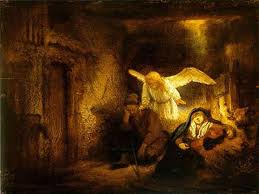
Joseph and the angelIn Luke’s gospel it is Mary who is front and center in the story of the nativity of Jesus, and in our minds I think that is where she stays.  But in Matthew we get more of a glimpse of Joseph.  Joseph is a shadowy figure in the pages of scripture; he is introduced in the genealogy as the “husband of Mary, of whom Jesus was born, who is called the Messiah.”  We see him in this story about Jesus’ birth and again briefly in the events of Jesus’ childhood, the circumcision at the temple, the flight to Egypt to escape Herod, and in a small story about Jesus as a twelve year old when he gets separated from his parents on a trip to Jerusalem and turns up at the temple, teaching the elders. Then Joseph disappears from the story, except for references to Jesus as the carpenter’s son.

But though Joseph seems to be what is called a supporting character, without him the drama of salvation could not have taken place, and I would submit that that is just the way God works, with supporting characters who appear for a little bit and do what needs to be done and then disappear from the story. But they are always a part of the story and the story wouldn’t be complete without them.

And it seems safe to say that without Joseph, Jesus could never have become who he became.  Joseph must have played an important forming and nurturing part in the life of Jesus.  There has been much speculation about Jesus’ upbringing in the carpenter shop in Nazareth.  The scriptures tell us nothing, but if Joseph lived until Jesus was at least twelve, as Matthew indicates, then Joseph becomes the primary male role model for the young Jesus.

One noted scholar speculates that Mary and Joseph were from the ranks of the humble and pious multitudes, the kind of people who loved God and maintained the law as best they could, but without the means to carry it out to the letter in all its intricacy.  If this is true it would go far in explaining Jesus’ attack on the Pharisaic understanding of religion and his quest for a new freedom to live for God.

In any case, in the story of Jesus’ birth Joseph is most remarkable in the way he responded to this crisis in his life. The young woman to whom he is betrothed is found to be pregnant. This is more than a matter of divorce, the law demands her life by stoning for adultery, for betrothal carried the weight of marriage in those days. So Joseph dismissing her quietly to avoid public disgrace was an act of integrity. But what is even more remarkable is that when he has this strange dream, in which an angel of the Lord appears to him and tells him not to be afraid to take Mary as his wife for the child conceived in her is from the Holy Spirit, he believes the angel and does what the angel said to do.

The angel said something else about this child: they are to name him Jesus, for he will save his people from their sins, and that all this fulfills what Isaiah had written: “Behold, a virgin shall conceive and bear a son, and he shall be called Emmanuel,” which means, “God is with us.”

Let me invite you to consider this Christmas the statement that God is with us.  Consider that God is with us not just in high moments of religious insight, in worship and in prayer, or some mystical moment when all seems clear, but rather in the ordinary events that befall us in this life.

One of the implications of the Christian doctrine of the Incarnation of God in Jesus Christ is that God is no longer remote, but is with us in ordinary life and that our story is inextricably wrapped up with God’s story. There is more to it than that to be sure; there is a cross as well as a cradle and we need Easter to interpret Christmas, and perhaps Pentecost to interpret them both for without the Holy Spirit it all becomes just a story from long ago that can touch the heart, but not change the life.

But God is with us now, because of Jesus Christ. We can see his human face and know that there is something of him in the other human faces we see. God is with us in our exalted moments of joy, when we get glimpses of the joy God wants for us.  Perhaps a sunset does it for you, or a sunrise (I’m told they are pretty.)  Or perhaps watching a child at play, or a fresh snowfall.

I saw a fine movie this week called “A River Runs Through It” in which fly-fishing becomes the entranceway into a realm of pure awe and wonder in the midst of some very tragic human life.  To know that our story and God’s story touch and intertwine can transfigure some pretty ordinary stuff into something special. Perhaps it is only as story that we understand our lives, which otherwise remain rather elusive.

In “A River Runs through It” the writer’s father, who is a minister, asks him a question that made Norman wonder if he understood his father at all “You like to tell true stories, don’t you? he asked, and I answered, “Yes, I like to tell stories that are true.”  Then he asked, “After you have finished your true stories some time, why don’t you make up a story and the people to go with it?  Only then will you understand what happened and why.  It is those we live with and love and should know that elude us.”

So it is that our own personal stories may only be understood in the light of this vaster story that begins at the moment of creation and will end in glory in God’s own good time and finds its center around two poor Palestinian peasants wondering what the birth of this child might mean.  That the angel promised that the child means “God is with us” must have addressed their perplexity as it can address ours.

For it means God is with us not just in those fleeting moments of joy, but in moments of confusion and despair, of faithlessness and doubt, the kind that comes to all of us at one time or another.  Emmanuel means God is with us as we try to get our minds around what happened on a Monday night in a neighboring community, as we struggle to understand the incomprehensible fact that an eighteen year old boy walked into a sporting goods store in our community and legally bought an assault rifle and used it to kill people.  The God of Good Friday who is also the God of Christmas was with us as Wayne Lo began killing people, and the first tear that was shed at Simon’s Rock was God’s tear, not only for the dead and wounded and their families but for a world which still makes such moments possible.

So “God with us” is not the stuff of Kodak commercial sentimentality; it means God really with us in all the grandeur and misery of human life, in Bosnia and India and Somalia and the homeless mean streets of our cities as well as by the Christmas tree in the warmth of our living room. The mystery of the Incarnation puts God right in the thick of it all.  For God did not stay remote, high above the heavens, but ventured into the precarious life of an infant born into a marginal family in a precarious political situation.  That should give us pause from turning the Christian religion into something ethereal and apart from human life.  As Frederick Buechner remarked wryly, “One of the blunders religious people are particularly fond of making is the attempt to be more spiritual than God.”

This Christmas I invite you to discover God in the everyday ebb and flow of your life, in the ones you love as well as the ones who drive you up a wall, in your moments of consternation as well as in your high moments of joy.  Take the time this Christmas to take it all in.  If you spend all your time in frenzied preparation, you may just not be paying attention, and miss the time of your visitation, and never learn, as Joseph did, what supporting role you are called to play in this great big story of which our story is valued as an important part by the God who, whatever else he may be, is most assuredly with us, through Jesus Christ our Lord. Amen.

I preached this sermon at First Church of Christ in Pittsfield, Congregational, twenty years ago this week, December 20, 1992, after a gun slaying at a school, in nearby Simon’s Rock College on December 14. I posted this after the Sandy Hook School slayings in Newtown, CT, which were on the 20th anniversary to the day. Lord have mercy.

Unknown's avatar

Christian Teachings about Life after Death: A Pastor Ruminates

stream 2I have been asked to speak about “Christian teachings about the after-life.” This is final installment in a series of helpful presentations on preparing for death. There have been presentations on wills and bequests, end of life care, grieving and the like. And once again Max (Stackhouse) has asked me to bat clean-up and talk about theology.

One of my friends in the church said to me last week, “Oh, your talk is theology, so it won’t be practical.” She was kidding, I think, but let me respond to her remark by suggesting that a theology about death and what comes after it may be the most practical aspect of all for the Christian preparing for death. It is a shame how theology has come to have a bad name, even in the church.

Because theology is not some specialty for professional theologians, but simply the way we talk about God. That is what theology means, the logos of the theos, the word about God. And everybody has a theology, at least implicitly, so the more we can make it examined and explicit the more chance we will get it better rather than worse.

So right off the bat let me suggest a better title for what I hope to do here. I much prefer the phrase “life after death” to the term “afterlife,” because I think the former rightly expresses the Christian belief in the reality of death, while the latter can obscure the boundary between death and whatever comes after it.

I want to explore with you four ideas or concepts: 1. The reality of death, 2. Immortality of the soul, 3. Resurrection of the body, and 4. Eternal Life. Finally, I want to summarize the features of an adequate Christian theology of life after death, and the promises of the Gospel that are our hope in the face of death.

1.The Reality of Death

The first concept to ponder is the reality of death.  Some of the earliest thinking about death in the Bible is about its not only ending one’s natural life, but also severing our relationship with God. For Israel human purpose was to praise God, and death put an end to it. This relational view was visualized in spatial terms, so that places like Sheol and “the Pit” were places far from God.

Christianity inherited this relational view of life with God, and sees death as its cessation and the opposite of the fullness of life that God intends for us. So unlike some other religions that view death as an illusion or an escape, for Christians, death is real, as are the sense of loss and grief that accompany death, which are also real and nothing to ashamed of or denied. I have said at countless funerals: “There is nothing unchristian about grief; Jesus himself cried at the grave of his friend Lazarus.”

Moreover, Jesus himself died, and his own death provides a template for thinking about this. The creeds say quite simply, “He died and was buried.”

So accepting the reality of death is an important first step in thinking about it properly as Christians. In my nearly forty years of ministry I sometimes counseled people who wanted to deny or blunt this reality. People often asked for much-loved sentimental poems to be read at the funeral. I would gently suggest something more appropriate, but I was pastorally sensitive enough to allow their selection to be read if they insisted, knowing that I would get up and say something quite contradictory in my homily.

Let me give you some examples of poems that deny or minimize the reality of death, and I apologize in advance if these are your favorites.

Here’s a line from A. L. Frinks’ the Rose Beyond the Wall:

“Shall claim of death cause us to grieve
And make our courage faint and fall?
Nay! Let us faith and hope receive–
The rose still grows beyond the wall,”

Another and even better known poem about death is James Whitcomb Riley’s Consolatio:

“I cannot say, and will not say
that he is dead. He is just away.
With a cheery smile, and a wave of the hand,
he has wandered into an unknown land.”

“We do not sorrow as those who have no hope” (1 Thess. 4:13), but we do sorrow. So while as Christians we have much more to say than death is real, it is where we must start, reminding ourselves that Jesus, in his human nature, really did die, as all human beings do.

To make this point I once began an Easter sermon years ago by saying that “On Good Friday Jesus was as dead as a doornail.” I wasn’t trying to be shocking, but I was surprised by how many people took offense to this statement.

I know something of death. Both my parents died too young, I have worked in a funeral home, been an EMT, and a minister for nearly four decades. I have been present at many deaths, and each time I have been struck by how clear the line is between the living and the dead. And yet everything I know about death is on this side of it, as it is for us all. But  one thing I do know about death: it is real.

So if the first theme is the reality of death, how shall we properly think and talk about what comes after?

2. Immortality of the Soul.

One very prevalent idea of life after death is immortality of the soul. I would like to explore this popular idea with you, and show you why it is an inadequate view for Christians, admitting that in my early years it was my own view.

Let me share something about that with you. My own theology of death and what comes after it was shaped, at least in part, by my childhood bedtime prayer, a somewhat terrifying one from the New England Primer:

“Now I lay me down to sleep,
I pray the Lord my soul to keep,
If I should die before I wake,
I pray the Lord my soul to take. Amen.”

I didn’t know it at the time, but in my child’s imagination I had adopted a somewhat Platonic dualism about the human person, separating body and soul into the perishable and imperishable.

My own children, at the insistence of my wife, had a more sanitized version of that prayer that didn’t get them pondering sudden death in the nighttime. Whether they are better off for this is open for discussion. But in my own early thought-processes I figured that if such a sad event as my childhood death did take place, it would only be my physical body, and this invisible spiritual thing “the soul” would go swiftly to God. This is the essence of the idea of immortality of the soul.

I was taken aback to be told that this view, while widely held, was not particularly Christian. I learned in seminary that the Hebrew word translated as “soul,” nephesh, more rightly means “self,” in other words, the whole person.  Harrell Beck, my wonderful Old Testament professor, liked to say that your fingernails are as much a part of your soul as any other part, which is to say human selves are embodied. Or as I like to think of it: we don’t have a body so much as we are a body.

It is from the Greeks, and especially from Plato, that we get the notion of a disembodied soul housed in a physical body, an idea that still clings to many Christian ideas about an afterlife.

These ideas were ambient in the ancient Near East and in the Hellenistic world in which the New Testament was written, and they lived in uneasy tension with the more holistic Hebraic views of personhood. We even get a whiff of Greek dualism in the New Testament, such as in First Corinthians, one of the undisputed letters of Paul. He writes in 1 Corinthians 5:1:

For we know that if the earthly tent we live in is destroyed, we have a building from God, a house not made with hands, eternal in the heavens.

So if the disembodied immortal soul flying away from the perishable body is not the Christian theology of life after death, how are we to think about it?

3. The Resurrection of the Dead

Resurrection of the dead is the cardinal Christian idea of life after death. It is rooted in the resurrection of Jesus, which pervades all New Testament thinking. In Jesus’ resurrection God has vindicated the humiliated and crucified Jesus, and begun the eschatological process of the salvation of humanity and the world, a process to be completed at the end of history, when Christ comes in glory to judge the living and the dead.

This distinguishes Christian theology from other views that see life after death as something intrinsic to the human person. Resurrection of the dead, on the other hand, is about the discontinuity between life and life after death. The rupture of death is overcome only from God’s side by God’s action. So resurrection of the dead is not resuscitation, but a new creation analogous to the first creation. It is not resurrection of the flesh, but resurrection of the body, a new kind of life that we can only guess at. When Paul  speculated on what kind of body we would have in the new life he employed the oxymoron “spiritual body” to refer to what form are we raised.

There are clues to this mystery in the post-resurrection appearances of Jesus. After Jesus is raised he appears to the disciples in bodily form; he is the same, but also transfigured in some way. The accounts contain mysteries: sometimes he is recognized, but other times he is not, as in the road to Emmaus story, when the disciples only know him when he breaks bread. Yet he still bears the marks of the Roman nails in his hands and feet.

However we want to take these narratives they point to the consistent conclusion that the new life postmortem is embodied life.  The Christian belief in the resurrection of the dead is a theological interpretation based on the death and raising of Jesus. The expectation of a resurrected body also emphasizes the continuity of personality and the integrity of personhood. I said that Christian views stress discontinuity between life and life after death, but here we see continuity of personality after death. So we have both discontinuity and continuity as the person really dies, but in the new life is the same person as before death, although changed. So it is not some spiritual part of you that lives the new kind of life; it is you, embodied and recognizable to God as you. This contrasts to various views of a disembodied postmortem existence, such as immortality of the soul and reincarnation.

It is important to remind ourselves that, while we are not surprised by the claim of Jesus’ resurrection and have difficulty with the idea of a general resurrection, for the people at the time of Jesus death it was just the opposite. A general resurrection vindicating Israel involving a Davidic messiah or the Son of Man was part of the general religious imagination. The resurrection of an individual however was not, which is why the raising of Jesus was understood as the beginning of the eschaton, the final reckoning, restoration and vindication of God and his faithful. We hear this in the language of Jesus being the first-fruits and the forerunner.

The raising of Jesus then is the primary theological template by which all things are measured, including death and life after death. Consistently in the New Testament death is viewed through the lens of the resurrection of Jesus Christ. In 75 places in the New Testament the principle Greek adjective that means “dead,” nekros, is the object of either egeiro “to awaken” or anastasis, “to raise.

This raising from the dead makes Christianity an Easter faith, and so the Christian sees death in Easter light. Because Jesus is raised we too will be raised with him. This is a far different idea than immortality of the soul. Let us take a few moments to contrast them.

The great scholar Oscar Cullmann wrote an important book in 1956 called Immortality of the Soul or Resurrection of the Dead in which he starkly contrasted these two views. Some of his critics have complained that he contrasted them too sharply. They may be right, but the book remains an important one for understanding the predominant Christian views.

Cullmann’s thesis is, and I quote, “The widely accepted idea of ‘The immortality of the soul’ is one of the greatest misunderstandings of Christianity. The concept of death and resurrection is anchored in the Christ-event, and hence is incompatible with the Greek belief in immortality.”

Cullmann deftly illustrates his point by looking at the death of Socrates in contrast to the death of Jesus. He writes:

The death of Socrates (as described by Plato) is a beautiful death. Nothing is seen here of death’s terror. Socrates cannot fear death, since indeed it sets us free from the body. Whoever fears death proves that he loves the world of the body, that he is thoroughly entangled in the world of sense. Death is the soul’s great friend. So he teaches; and so, in wonderful harmony with his teaching, he dies — this man who embodied the Greek world in its noblest form.

Cullmann then turns to the death of Jesus:

In Gethsemane He knows that death stands before Him, just as Socrates expected death on his last day. The Synoptic Evangelists furnish us, by and large, with a unanimous report. Jesus begins ‘to tremble and be distressed’, writes Mark (14:33). ‘My soul is troubled, even to death.’ . . .

In Luke 12:50 it is completely impossible to explain away the ‘distress’ in the face of death, and also in view of the fact that Jesus is abandoned by God on the Cross [Mark 15:34], it is not possible to explain the Gethsemane scene except through this distress at the prospect of being abandoned by God, an abandonment which will be the work of Death, God’s great enemy.)Jesus is afraid, though not as a coward would be of the men who will kill Him, still less of the pain and grief which precede death. He is afraid in the face of death itself. Death for Him is not something divine : it is something dreadful. . . .

Here (in Jesus’ death) is nothing of the composure of Socrates, who met death peacefully as a friend. To be sure, Jesus already knows the task which has been given Him: to suffer death; and He has already spoken the words: ‘I have a baptism with which I must be baptized, and how distressed (or afraid) I am until it is accomplished’ (Luke 19:50). Now, when God’s enemy stands before Him, He cries to God, whose omnipotence He knows: ‘All things are possible with thee; let this cup pass from me’ (Mark 14:36). And when He concludes, ‘Yet not as I will, but as thou wilt’, this does not mean that at the last He, like Socrates, regards death as the friend, the liberator. No, He means only this: If this greatest of all terrors, death, must befall Me according to Thy will, then I submit to this horror. Jesus knows that in itself, because death is the enemy of God, to die means to be utterly forsaken. Therefore He cries to God; in face of this enemy of God He does not want to be alone. He wants to remain as closely tied to God as He has been throughout His whole earthly life. For whoever is in the hands of death is no longer in the hands of God, but in the hands of God’s enemy. (Oscar Cullmann, Immortality of the Soul or Resurrection of the Dead)

Here Cullmann has eloquently expressed the New Testament view of death as the enemy of God. For another example we can turn to Paul, who calls death “the last enemy.” Because death in the New Testament is not merely the end of biological life, it is also a power that insinuates itself into our living of these days. I’ll say more about this now as we turn to the idea of eternal life.

4. Eternal Life.

The final concept I want to explore is eternal life. One of the problems we have as moderns in understanding the world of the New Testament is its conception of time. There is a persistent eschatology that sees events both in the present and the future. Theologians refer to this as “the already and the not yet.”

Advent is a good time to talk about this, for while we have too often boiled Advent down to merely preparing for celebrating the birth of Christ, it is also a season of anticipating Christ’s second coming.

We see this in the memorial acclamations of many Christian liturgies: “Christ has died, Christ is risen, Christ will come again. ”

Eternal life is one of those concepts that sits in an eschatological frame, or to put it another way, has an “already but not yet” quality about it. In early Christian preaching Jesus is said to offer eternal life to his followers, not just post-mortem, but now before death. In John 5:24, for example, Jesus says. “The one who hears my word . . . has eternal life: he does not come unto judgment, but has passed from death to life.”

But this realized aspect of eternal life does not take away from the reality of death, and the promise is that eternal life in its fullness lies on the other side of the resurrection.

The words said at many graveside committal services speak of “the resurrection to eternal life.” For example, this one from the Book of Common Prayer:

“In sure and certain hope of the resurrection to eternal life
through our Lord Jesus Christ, we commend to Almighty
God our brother or sister N.; and we commit his or her body to the ground;
earth to earth, ashes to ashes, dust to dust.”

Notice the reality of death here expressed in the ashes and dust.

As I mentioned earlier, death in the New Testament is more than the final cessation of biological life, but also a power that can insinuate itself into our living. In some sense the realized eternal life in Christ is the opposite of the power of death, which Christ defeated by his cross and resurrection.

And eternal life is not an individualistic state. Eternal life is life with Christ and in Christ and by extension a life in community, in the church, which is his body. Many contemporary speculations about life after death are very individualistic, but the Christian hope is a corporate and communal hope, the hope to join the communion of saints.

There is a wonderful sermon by Jonathan Edwards, the second pastor of this church, on 1 Corinthians 13: 8-10, called Heaven is a World of Love in which Edwards explores the metaphor of the communion of saints as a heavenly choir.

How many of you know it? (No hands) I wish it were better known because it is a better example of the essential Edwards than the terrifying Enfield sermon, Sinners in the Hands of an Angry God, which everybody seems to know.

In Heaven is a World of Love Edwards begins by beautifully describing heaven and all its social arrangements, and in so doing puts forth a protest against the social arrangements that we know so well on earth; for in Edward’s heaven there is no pride or jealously, there is decency and wisdom, and an equal prosperity among all. He says, “Love (poured out from God) resides and reigns in every heart there.” And then he says: “Every saint there is as a note in a concert of music which sweetly harmonizes with every other note, and all together employed wholly in praising God.” So life after death is life in community.

5. What then can we say about life after death?

Having said all this, and leaving much more out in my brief time today, what can the Christian cling to in the theologies of life after death? I’ll sum up my main points:

  • Christians understand life after death through the lens of the resurrection of Jesus Christ.
  • For the Christian, death is not an illusion or an escape, but a reality. Death is God’s enemy, yet God has overcome it through the cross and the raising of Jesus from the dead.
  • Life after death is not intrinsic to the human person, but a gift of God in the raising of Jesus Christ.
  • Life after death is bodily life with continuity of personality and integrity of personhood. It is not a part of you that lives the new life, but you.
  • Life after death is relational and communal, where we join in the communion of saints across all times and places.
  • Life after death is relational and imagined  as spatial, nearer or farther to God.
  • The purpose of life after death is for the praise of God. In the words of the Shorter Catechism, “The chief end of men and women is to love God and enjoy him forever.”
  • Both the living and the dead live between the times, in “the already but not yet” between the first and second coming, as we wait with the church on earth and the church in heaven for the Day when Christ comes in glory at the consummation of all things.

The basis for all this is, of course, faith in the God we know here and now, the God revealed in Jesus Christ.  In Don Hammond’s (the outgoing interim pastor) graceful ministry among us he has said again and again in a variety of ways something like this, “Whoever you are, whatever you have done, know that you are truly and forever loved.”

The Christian hope for this life and the next is rooted in this Gospel truth about the love of God, that God’s grace is greater than our sin, that God’s love is stronger than anything else in the world, even death, the last enemy, which God defeated on the cross.

There are numerous eloquent witnesses to this love in the New Testament, but none is better than this by the Apostle Paul in Romans 8 and I will close with it:

If God is for us, who is against us? 32 He who did not withhold his own Son, but gave him up for all of us, will he not with him also give us everything else? 33 Who will bring any charge against God’s elect? It is God who justifies. 34 Who is to condemn? It is Christ Jesus, who died, yes, who was raised, who is at the right hand of God, who indeed intercedes for us. 35 Who will separate us from the love of Christ? Will hardship, or distress, or persecution, or famine, or nakedness, or peril, or sword? 36 As it is written, “For your sake we are being killed all day long; we are accounted as sheep to be slaughtered.” 37 No, in all these things we are more than conquerors through him who loved us. 38 For I am convinced that neither death, nor life, nor angels, nor rulers, nor things present, nor things to come, nor powers, 39 nor height, nor depth, nor anything else in all creation, will be able to separate us from the love of God in Christ Jesus our Lord.

Amen.

I delivered this paper at the First Congregational Church of Stockbridge, MA on December 9, 2012, the Second Sunday of Advent.