Unknown's avatar

Ruminations on Late Winter and Late Lent


I have been outdoors more this Lent than perhaps ever before.  There has been lots of winter hiking and snowshoeing, which has been a real and unexpected blessing for me, since for various health reasons I have been unable to hike the trails for a couple of years, something I have sorely missed.

So many of my Lenten reflections have been on snowy trails in the nearby Pittfsfield State Forest, just a ten-minute drive from my home.  During the week there is hardly anyone there; often I hike for hours without seeing a soul.

I have gone out in all kinds of weather, and joyfully watched the daily changes that were taking place there, just as I was noticing the daily changes taking place within me.

I have always loved to be outdoors, but in my theological writings I have shied away from too much talk about it because it so easily degenerates into a kind of nature worship, or the garden variety pantheism of so much popular culture.

God is surely known in his Word, Jesus Christ, in the preaching of the same, and in the bread we share and the cup we drink together.  He is known to in the daily life of his congregations, where I served for more than thirty years.  These things I know.

But this Lent I found God’s presence too in the small rivulets running under the ice even in the hard frozen days.  Many of my Lenten Ruminations here on this blog have been illustrated with photos I have taken in the forest, with my ancient digital camera.  I wasn’t sure why.

It took some time before I made the connection between what I was seeing in the woods and streams and what was taking place in my own Lenten journey.

Today I went hiking in the rain with my daughter and her boyfriend for about three and a half hours.  It was mostly just drizzle or light rain.  The snow and ice are melting from the week-end’s heavy rains, the brooks and streams are filling up.  It is late winter.  A week from today is officially spring (though not really here!)

Today I saw a roaring swollen brook and I felt somewhere deep inside me that my Lent this year is almost over, and that I am almost ready.

I was wet, but happy.

(Photos:  top, Swollen Stream by R. L. Floyd;  bottom: Wet but Happyby R. M. Floyd)

Unknown's avatar

Tony Robinson: “Glenn Beck advises leaving your church. What gives?”


With apologies to my friends in the U.K., Down Under, and around the world, I am going to focus on one of our current domestic concerns here in the States.

Because we have a serious problem that is profoundly influencing our national political  discourse. We are plagued here right now with right wing demagogs (we have left wing ones, too, but far fewer and hardly anybody is listening to them) who are spilling their venomous bile by means of Cable TV and Talk-radio.  People like Rush Limbaugh, who are essentially entertainers, have millions of listeners who believe their every pronouncement.

The worst of these fear-mongers tend to be on the Fox Network, which has become the house organ for the very worst impulses of the Republican party. But this is not so much about politics as about the poisoning of any chance of serious adult conversation about important matters facing our country and both parties.

The current bad boy is a clown named Glenn Beck (photo, left), and the only reason I mention him at all (because he is truly worthy of our inattention) is many people believe his nonsense, and he recently advised Christians to leave their churches if they heard any mention of social justice, which I would imagine might be all of them if they are reading the same Bible I am.

My friend Tony Robinson has written insightfully about this on several blogs, where he often gets flamed. I liked this post from Friday so much I am going to post it in its entirety, with his permission. This is from a Seattle on-line site called Crosscut:

March 12, 2010

Glenn Beck advises leaving your church. What gives?

What is it about our lives today that this kind of distortion of simple truths about the church, and its commitment to “social justice,” sells so well?

Holding a placard with the trademark hammer and sickle of Communism in one hand, and the swastika of Nazism in the other, Fox News commentator Glenn Beck last week told his listeners that churches that talk about “social justice” are really fronts for Communism and Nazis and they should flee them as fast as they are able.

“I beg you look for the words ‘social justice’ or ‘economic justice’ on your church’s website. If you find it run as fast as you can. Social justice and economic justice they are code words. Now, am I advising people to leave their church? Yes.”

Beck’s urging of disaffiliation cuts a broad swath in the ecclesiastical landscape, running from the Unitarians to the Catholic Church. In between he would catch mainline Protestants like the United Methodists, Presbyterian Church USA, and United Church of Christ, the Black Church tradition, as well as many Evangelical and Pentecostal congregations.

Responding to Beck, Evangelical leader Jim Wallis urged “Christians to leave Glenn Beck.”

Whether you look to the Scriptures of the Old or New Testaments or to historic teaching of popes and theologians, a concern for a just society is an unavoidable part of Christian faith and teaching. From the Old Testament prophet Micah, “What does the Lord require of you but to do justice, love kindness, and walk humbly before God,” to Jesus’ preaching, “The Spirit of the Lord is upon me, because he anointed me to bring good news to the poor. He has sent me to proclaim release to the captives and recovery of sight to the blind, to let the oppressed go free, to proclaim the year of the Lord’s favor” — justice is part of the message.

Is social justice the whole message? No, it is but one part of Christianity though certainly an integral one.

Still, Beck’s flamboyant claim that religion fronting a political agenda is a turn-off found confirmation (though not the kind Beck has in mind) in a recent Pew Research study of “Religion Among the Millennials,” (ages 18 – 29). While the majority tends to be believers, this group is disaffiliating from churches. But according to Pew they are not leaving because churches care about social justice; pretty much the opposite. “Youth’s disaffection is largely due to discomfort with religiosity having been tied to conservative politics.” If there’s too much politics in religion, at least the millennials see that as more of a Religious Right issue.

On another recent occasion Beck went after the idea of “community.” Speaking to the Conservative Political Action Conference, Beck claimed that the Founders were against community. Listening to his weird rant, I found myself recalling the eloquent words of John Winthrop [picture: above right], Puritan leader and first governor of the Massachusetts Bay Colony, as he preached aboard ship before landing in the new world.

As the Arabella drew toward land, Winthrop warned that the only way to avoid a figurative shipwreck “and to provide for our posterity is to follow the Counsel of Micah, to do justly, to love kindness, to walk humbly with God, for this end, we must be knit together as one man, we must entertain each other in brotherly Affection, we must be willing to abridge ourselves of our superfluities, for the supply of others necessities . . . we must delight in each other, make others’ Conditions our own, rejoice together, mourn together, labor and suffer together, always having before our eyes our Commission and Community in the work . . .”

One would have to count Winthrop among the founders, I’d think.

So what does the popularity of a person who so distorts both religion and history, as seems to be Glenn Beck’s stock-in-trade, tell us? That this kind of things sells? But that begs the question. What does that tell us? That the long and ugly American tradition of anti-intellectualism and right-wing demagoguery is alive and well? That contemporary Americans are now so ill-informed about history and theology that they will buy this? Or does this suggest some new low-water mark in American culture?

I find it hard to say for sure what the Beck phenomenon tells us. Except possibly this, the anxiety level in America today is very high — orange alert for sure, maybe red. And anxiety, in such large and steady doses, makes us stupid.

(Anthony B. Robinson is an author and teacher who is former senior pastor at Plymouth Congregational Church in Seattle. For the past several years, his column on religion and values appeared in the Seattle Post-Intelligencer.)

Unknown's avatar

Who’s afraid of the big bad cross? The bloodless theology of the mainline church. Thoughts on 2 Corinthians 5:16-21.

If you were to worship in an American conservative evangelical church that hasn’t yet sold its soul to the prosperity Gospel, there is a good chance you may soon hear a sermon about the cross.

Not so in many Mainline churches.  I have been ruminating about why this is, given the cross’ important place in the New Testament, especially in Paul’s writings, of which the Epistle Lesson appointed for tomorrow, 2 Corinthians 5:16-2, is a prime example.

This passage is clearly about the atonement, which was a word invented by Tyndale (“at-one-ment”) to translate the same Greek word that is also translated as “reconciliation.”

I expect there will be many sermons preached from it in “our” pulpits on how we need to be ambassadors of reconciliation, which is an important message and one I have preached myself.

But what you are less likely to hear is why we Christians are to be ambassadors of reconciliation.  And that reason is clearly because “God was in Christ reconciling the world to himself,” which goes right to the heart of the Gospel, the act of God in Christ that became known as the atonement.

I have stopped using the term “liberal,” because it’s practically useless as a identifier, and its new substitute “progressive” carries political baggage that I find unhelpful.  I realize “mainline” has its own problems, but at least it covers a wider range of both theological and political positions.

So why do “we” (by whatever name) generally like the idea of reconciliation, yet not like the idea of atonement, even though they mean the same thing?

I have some thoughts.  One reason is some bad teaching in some of our seminaries, based on a view (false, in my view) that the cross is a bad business that perpetuates violence, which I have addressed elsewhere.  There is a current cottage industry making the rounds with this view, and many of our newer ministers, indoctrinated by it, are just uncomfortable or downright hostile to any atonement theology, however nuanced.

Another reason is that many folks who end up with our denominations are refugees from various traditions that have had excessive or morbid preoccupations with “the power of the blood,” and/or who have been subject to formulaic atonement theories that make God into a monster that needs blood sacrifice.  I have addressed that as well, in my book, When I Survey the Wondrous Cross:  Reflections on the Atonement.

I realize that some atonement theories can be monstrous, and I am aware of Stanley Hauerwas’s typically biting comment that if “you need a theory to worship Christ, go worship your theory.”

Nevertheless, what the word atonement connotes is at the crux (which is Latin for cross ) of our Gospel and proclamation if we are still to be called Christians.

And “the power of the blood,” however it has been misused, is just theological shorthand for Christ dying on our behalf, an act of the triune God, that does for us what we cannot do for ourselves, namely reconciling us to God and to one another.  This is why Paul says we are now ambassadors of reconciliation.

Yesterday I sent out a Passion hymn text to a number of my colleagues, thinking they might want to use it on Passion/Palm Sunday or during Holy Week.  Most thanked me, some said they would use it, but several said they had a problem with the” blood“ in it.

The first verse is:

“He died upon the lonely tree
forsaken by his God.
And yet his death means all to me
and saves me by his blood.”

If you want to see the rest of the hymn it can be found here.

As Passiontide and Good Friday loom, “we” might do well to ask ourselves just what it is we are going to preach about if “the work of Christ” and its symbolic language is off limits?

Unknown's avatar

“There is nothing to be afraid of!” A sermon on Psalm 27:1-2

When my daughter was a little girl she went through a fearful period when she would wake in the night, and come into our bedroom and stand quietly quivering next to our bed, typically on my wife’s side, where there was considerably more sympathy to be had, and where she was sometimes invited to stay under our covers until she fell back asleep.

It was actually kind of eerie. She would just stand there like an apparition until one or both of us awoke, and we would ask her what was the matter, and she would say in a little trembling voice, “I’m scared.”

And I would invariably say in a big Dad voice, “There is nothing to be afraid of, go back to bed.” It happened frequently enough for long enough to become a family story.

I was reminded of this last September, for during her very first week at Yale Divinity School, there was a well-publicized murder of a young woman in a Yale lab on what was supposed to be her wedding day.

My daughter’s new apartment is not far from the lab, where the victim’s body was eventually found hidden inside a wall, and the night her body was found, the dean at Yale e-mailed all the students warning them to be extra vigilant, as there might be a dangerous person in the vicinity. It turned out that the murder suspect was a colleague of the victim’s from work, and that allayed some of our fears that a random serial killer might be rampaging through the streets of New Haven.

But before we knew that, and on the night she received the e-mail from the dean, my now very confident 25 year-old daughter, who is tall and imposing, and graduated from Wellesley, where they teach the women that they can conquer the world and many of them do, called me on the phone, and her first words, in that same trembling little voice from long ago, were, “I’m scared.”

And I, of course, said, “There’s nothing to be afraid of,” and she started giggling. Then I told the truth and said, “I’m scared, too,” for I had indeed been worrying about her.

And, in fact, when she was a little girl, my reassurance that there was nothing to be afraid of was only a half-truth, the kind we parents must tell our children for a time. It was true that she was safe and sound in our big parsonage, with all the doors securely locked and with us present, and that is all I was trying to convey to her.

But the larger truth that you don’t tell a small child is that there is plenty to be afraid of in our world, and all of us learn that sooner or later.

And not too much later in her young life, we had some very real events to make a child, or an adult for that matter, afraid. First, we had an arsonist setting fires on people’s back porches while they were sleeping, right in our immediate neighborhood, and I worked patrolling shifts for our newly formed neighborhood watch organization.

Then we actually had a serial killer who kidnapped and eventually murdered several children, one of whom played in Little League with the son of some good friends of ours. The man was eventually caught when he tried to snatch a girl off the main street of Pittsfield just a few hundred feet from the church where I served. She wisely wriggled out of her back-pack and ran away, and an alert driver behind them wrote down his license plate.

So not long ago she reminded me of all these things and said, “Dad, no wonder I was a fearful child, there were dangerous people in our neighborhood. I should have been afraid.”

Our world has plenty to be afraid of, no only from disturbed people, but from earthquakes like the ones in Chile and Haiti, and hurricanes like Katrina, and droughts and famines and other natural disaster, as well “the evil men do to one another.”

But it is also a wonderful world, as Louis Armstrong sang long ago, and I love to hike in it and bike in it and watch its sunsets and listen to its birdsong.

It is, in the larger Christian story, a world made good by God, but fallen. And fear is part of its fallen-ness.

In one of the darker chapters of human history, the poet W. H. Auden captured our plight the way that sometimes only a poet can. In his poem September 1, 1939, as the Nazi tanks rolled into the Low Countries to begin the war that would engulf the world in flames and blood, he sat at a bar in New York City, and described the human condition thus. We are, he wrote:

“Lost in a haunted wood,
Children afraid of the night
Who have never been happy or good.”

The story we will be hearing again in the next weeks is the story of God’s rescue mission to this fallen and fearful world through the work of the man Jesus of Nazareth. It is itself a fearful story, even for those of us who know the glorious outcome, but we have miles to go before we get there.

Psalm 27 talks about fear. Here the Psalmist, who from now on I will call “David,” moves back and forth from declarations of great confidence like the opening to lists of all the many things he has every right to be afraid of.

And I really like this, because I believe that faith lives in the midst of our fears.

John Calvin writes about this passage: “When David declares, “My heart shall not fear,’ this does not imply that he would be entirely devoid of fear, — for that would have been more worthy of the name of insensibility than of virtue.”

In other words, David had every right be afraid of the army encamped about him. Imagine it. He sees their campfires every night, he can hear their trumpets, and he knows they can attack him at any time. I’d be afraid, too.

And Calvin goes on to say: “Under the terms, camps and armies, [David] includes whatever is most formidable in the world.”

So though the names and faces of the powerful who hold the world in thrall will change, the truth of the Psalm remains: “Although all men should conspire for my destruction, I will disregard their violence, because the power of God, which I know is on my side, is far above theirs.”

The Good News here is that the principalities and powers of this age, and any age, are ultimately subordinate to the power of God, though as the rest of Psalm 27 amply shows, they manage through their subordinates (in this case “the army encamped about David”) to give both David and, with the necessary changes, us, plenty about which to be afraid, at least in the short run.

This faith in the power of God, as Calvin writes, is not the complete absence of fear, as in a more Eastern religious calm through meditation and detachment. No, the fears are quite real.

So faith always lives in the midst of our fears, but it is that same faith that knows “when the trial comes, our faith will prove invincible, because it relies on the power of God.”

And the final power of God will finally be made manifest in weakness, on a Roman cross. This Jesus knows, and this is why he must go to Jerusalem.

So there are two kinds of fears, and they are quite different, though it is often hard to distinguish between them, because they get all wrapped up in each other.

First, there are the real fears, as when David has an enemy encamped around him, or when we had an arsonist, and then a serial killer in our neighborhood. Or when someone ties to blow up the airplane you are on with explosives in his jockey shorts. These are real fears.

But there is also a kind of fear that is not real. It holds some kind of power over us, and it is not attached to a specific threat. This kind of generalized fear is not good for us. It makes us less than who God wants us to be. It robs us of dignity and courage, and makes us act in ways that are not worthy of us.

And I am convinced that some of the nastiness in our public discourse right now is based on exactly that kind of fear.

The Great Recession we are in, or have just gone through, depending on who you believe, is something that most of us have never known in our lifetime. It has stirred up a lot of the second kind of fear, the unnamed and unknown fears about our future, and the future of our country. It is true that there are real things to fear from it, like losing our jobs or our homes or our pensions. That is real fear,

But the second kind is different; the general pervasive kind of fear that takes on a larger life of its own. It begins to eat us up, and attaches itself to every part of life. I call it 4 o’clock in the morning fear.

Do you know what I am talking about? Do you know that kind of fear? I suspect you do.

I know I do. I know it all too well. And there is just enough reality in our fears to give them some credibility, but their power over us is larger than they deserve.

And I know that these are the kind of fears that can debilitate one’s life, and in some real way, they are the very opposite of faith, and so they must be dealt with.

So here we are in Lent, the season of self-examination and repentance.

My Lenten admonition to you all, both as individuals and as a congregation, is to figure out those fears that keep you from being who God has made you to be. Identify them, name them, and call their bluff, because they really have no actual power over you that you don’t give them.

That is the Good News on which we can stand secure. Because in that final trip to Jerusalem that Jesus was waiting to make, and ultimately did make, he defeated the powers that threaten us, including our unreal fears, along with some other big things “that go bump in the night,” like death and sin.

Oh, we still sin, and we still die, and we will still be afraid, but the power has gone out of them. Because Jesus took them all to the cross with him, and there they died with him. And believing that is a good part of what makes us Christians.

For the real power in the world is the power of the living God, that we are called to live out of day by day, even in those fearful times when we can’t see it or feel it.

So as I used to say my daughter, “There is nothing to be afraid of.” And this time I really mean it.

“The LORD is my light and my salvation, whom shall I fear?
The LORD is the stronghold of my life;
of whom shall I be afraid?” Amen.

(This is excerpted from a sermon entitled “Whom Shall I Fear?” that I preached at Charlemont Federated Church, Charlemont, MA, on February 27, 2010)

Unknown's avatar

Dietrich Bonhoeffer on living in the “Middle of the Village”


Dietrich Bonhoeffer (1906-1945)  wrote this to his friend Eberhard Bethge from prison the year before he was executed by the Nazis:

“I find all this talk about human limits questionable. (Can even death, since people hardly fear it now, or sin, which people hardly even comprehend now, still be called genuine “limits?”) I always have the feeling we are merely fearfully trying to save room for God; I would rather speak of God at the center than at the limits, in strength rather than in weakness, and thus in human life and goodness rather than in death and guilt.

As far as limits are concerned, I think it best simply to remain silent and to leave the unresolvable unresolved. The belief in resurrection is not the “solution’ to the problem of death. The “beyond” of God is not the “beyond” of our cognitive capacity. Epistemological transcendence has nothing to do with God’s transcendence. God is “beyond” our lives. The church is found not where human capacity fails, at the limits, but rather in the middle of the village. This is the sense of the Old Testament, and we still do not read the New Testament enough from the perspective of the Old Testament.

(Dietrich Bonhoeffer to Eberhard Bethge Tegel prison, April 30,1944)

I read this as a call for the church to be fully engaged in the life around it, and not be a conventicle that separates itself from the “world.”  Certainly Bonhoeffer himself engaged his times and society, and gave his life for doing so.  But it is so hard to be “in the world and not of it.”

Unknown's avatar

Is God’s Love Fair? Ruminations on The Prodigal Son Story


My late aunt never had children, but she doted on her nephews and niece, and one of her principles was fairness.  If she gave something to one of us, she would make sure she gave something equivalent to all of us.  We always all got the same birthday check.  She was fair.

There is a lot to be commended about fairness. We taught it to our children, and children learn to spot unfairness pretty quickly. “That’s not fair!” can be heard on any playground, and rightfully so, since fairness is an important part of what makes any society workable, be it the small society of a school playground or the large one of a nation.  Laws should be fair.  Fairness is akin to justice, and the world would be a better place if there were more of it.  We all want our fair share, and resent it if our neighbor is getting more than his.

In my first congregation I once preached on the story of the rich man and the beggar, also called Dives and Lazarus, which is also (and only) in Luke (16:19-31).  My church treasurer, a hard working Maine Yankee, got me trapped at the door and said, why didn’t Lazarus (the beggar) just go out and get a job?  Why should Dives have to help him?  “It isn’t fair!”

Which is one of the reasons this week’s Gospel (Luke 15:11-32) is such a scandal to us.  It isn’t fair.  The older son played by the rules, and the prodigal didn’t.  Yet the Father loves them both, even if their deserving is unequal.

Remember the parable of the workers in the vineyard?  Jesus says the ones who come late will get paid the same as the ones who worked all day.  “That’s not fair!”  Try explaining that policy to either union or management.

But in the divine economy it is all grace, which by definition is unfair because the recipient is undeserving.  “While we were still sinners Christ died for us.”  “That’s unfair!”  You bet it is, and it’s a good thing, too, because without that grace, who among us could stand?

There are many rich and insightful ways to approach this wonderful story.  But to me the best one is to see it as the Christian doctrine of atonement in miniature.

Gabriel Fackre’s writes,

“Jesus’ tale of the father’s welcome of the errant son is an anticipation of the Father’s embrace of the sinner on Calvary.  Neither the rigor of the earthly Semitic father nor the holiness of the heavenly Father can indulge the self-centered flight of the son/sinner. But the wrath over wasted substance does not descend on either prodigal. Where did it go? “There is a cross in the heart of God‘ said Charles Dinsmore. The broken heart of God is when the divine love absorbs the divine wrath (Luther) with its consequences, the suffering of God on the cross for the sins of the world. So too only the suffering love of the earthly father, mercy taking judgment into itself, can account for the rush forward to greet the returning prodigal.

What triggered the father’s response?  The Son’s return, of course.  But the father’s act was not evoked by a moral calculus- “he’s back because he’s sorry!“-for the father’s run and reach began without knowledge of the return’s rationale, while the son was “still far off.” Forgiveness is not dependent on good works here, no more than on the cross; agape is unconditional.

In both cases some human event is inextricable from the release of suffering love toward the sinner: a prodigal son in the human story, an obedient Son in the divine story. There is no proclamation of how the compassionate God came among us without the account of Jesus on the cross, any more than there is a story of the father’s embrace without the travel home of the prodigal. Finally, we are left with the narrative itself rather than a fully satisfying theory about it.” (Gabriel Fackre, Foreword to When I Survey the Wondrous Cross: Reflections of the Atonement.  Richard L. Floyd, Pickwick, 2000, Wipf and Stock 2010)


So even the laborers in the vineyard who show up late do need to show up to get their pay, even if they have little work to show for it.

And the prodigal son, who has taken his inheritance (which in those times was like telling your father to “drop dead!) and wasted it, still has to return.

We all come before God with empty hands, with nothing to show but our sins, and still God the heavenly Father, like the earthly father in the parable, has been waiting and watching for us all along.

Keep in mind that those who heard Jesus tell this story fell into two groups, the Pharisees (the older brother types) who knew they deserved God’s love, and the sinners, mostly  tax-collectors and prostitutes, (the younger brother types, like the prodigal son), who knew they didn’t.

Neither understood the amazing grace of Jesus’ story, and the radical invitation to come home.  As Herb Davis said this week in his sermon notes, “There is something worse than being dead, and that is being lost.”  Only those who have been lost really understand this.  The prodigal son understood, for he had hit bottom.

For most of the rest of us, whose lostness is less obvious, the story remains a scandal, as indeed, the whole Gospel is, especially the part about the cross.  Because “It’s just not fair!” No it isn’t.  It’s grace.  God’s love isn’t fair.

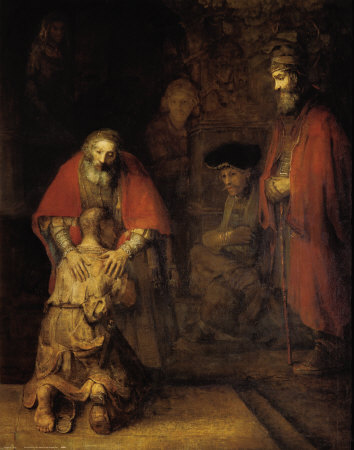
(Photo:  Rembrandt:  The Return of the Prodigal)

Unknown's avatar

A Poem for Late Winter and Lent by Arnold Kenseth


My friend the late Arnold Kenseth was a Congregational minister and a first-rate New England poet with an eye for God’s presence in the world all around him.

It’s late winter here in the Berkshires (he lived about forty miles from here in S. Amherst).  I matched up his poem with a photo I shot yesterday of a still frozen lake while snowshoeing on the Taconic Crest Trail on the Massachusetts/ New York border.

I thought Arnold’s poem has a Lenten ring to it.

A COLLECT FOR COMPASSION

There in the rudest tree
Where winter grips and rocks
The black indefinite cold,
Comes the small chickadee,
And like my soul, pipes
Anxious prayer, implores
An opening of doors,
Some crust and surety.
My hand, give him his bread!
May whirlwind God pause
From His storms and come
To me with Cup and Crumb.
Arnold Kenseth (The Ritual Year, 1993)

(Photo: R. L. Floyd,  Frozen Lake,  March 8, 2010)

Unknown's avatar

“Walking the Walk:” Prayer as Action.


P.T. Forsyth (1848-1921) is so quotable that you can practically open any of his books at random and find nuggets of truth and grace, which is pretty much what I have done today.

This one is on prayer.  For Forsyth prayer was not at all passive, but powerfully active. Here is one of his thoughts about what today we might call “walking the walk as well as talking the talk.” It is a perfect thought for Lent:

A prayer is also a promise. Every true prayer carries with it a vow. If it do not, it is not in earnest. It is not of a piece with life. Can we pray in earnest if we do not in the act commit ourselves to do our best to bring about the answer? Can we escape some kind of hypocrisy? This is especially so with intercession. What is the value of praying for the poor if all the rest of our time and interest is given only to becoming rich . . .

If we pray for our child that he may have God’s blessing, we are really promising that nothing shall be lacking on our part to be a divine blessing to him. And if we have no kind of religious relation to him (as plenty of Christian parents have none), our prayer is quite unreal, and its failure should not be a surprise.

To pray for God’s kingdom is also to engage ourselves to service and sacrifice for it. To begin our prayer with a petition for the hallowing of God’s name and to have no real and prime place for holiness in our life or faith is not sincere.

The prayer of the vindictive for forgiveness is mockery, like the prayer for daily bread from a wheat-cornerer. No such man could say the Lord’s Prayer but to his judgement.

What would happen to the Church if the Lord’s Prayer became a test for membership as thoroughly as the Creeds have been? The Lord’s Prayer is also a vow to the Lord. . .

Great worship of God is also a great engagement of ourselves, a great committal of our action. To begin the day with prayer is but a formality unless it go on in prayer, unless for the rest of it we pray in deed what we began in word. (“The Soul of Prayer,” p 27-28)

(Photo:  R. L. Floyd, Living Water 2,  Pittsfield State Forest, March 2010)
Unknown's avatar

P. T. Forsyth on “The Sin of Prayerlessness”


Prayer often does not comes easily for me.  Like many theologs I frequently would rather talk about God than to God.  There have been times when I was too full of guilt, or shame, or whatever, to have the kind of self-scrutiny that honest prayer requires.  I confess that some of these long periods of prayerlessness have been during times when I was writing lofty theological ideas.  Sometimes I know I am just avoiding God because He just seems too much for me, which is, of course, a lie.  I am reminded of Abraham Heschel’s insight that “if it seems that God is silent in our time, it is because we are avoiding him.”

But prayer is essential to faith.  P.T. Forsyth once said that “prayer is to religion what research is to science.”  Recently Kevin Davis, whose blog, “After Existentialism, Light,” is well worth a visit, posted one of my favorite quotes about prayer from Forsyth.

This Forsyth quote always judges me, but also somehow lifts me up. It also has about it the ring of truth from a man who knew what prayer was about. In this Lenten Season of self-examination and repentance it is just what I need. Perhaps you, too?

The worst sin is prayerlessness. Overt sin, or crime, or the glaring inconsistencies which often surprise us in Christian people are the effect of this, or its punishment. We are left by God for lack of seeking Him. The history of the saints shows often that their lapses were the fruit and nemesis of slackness or neglect in prayer. Their life, at seasons, also tended to become inhuman by their spiritual solitude. They left men, and were left by men, because they did not in their contemplation find God; they found but the thought or the atmosphere of God. Only living prayer keeps loneliness humane. It is the great producer of sympathy. Trusting the God of Christ, and transacting with Him, we come into tune with men. Our egoism retires before the coming of God, and into the clearance there comes with our Father our brother. . . .

Not to want to pray, then, is the sin behind sin. And it ends in not being able to pray. That is its punishment — spiritual dumbness, or at least aphasia, and starvation. We do not take our spiritual food, and so we falter, dwindle, and die. “In the sweat of your brow ye shall eat your bread.”(“The Soul of Prayer,” in A Sense of the Holy, p. 137)

If you don’t know this little book on prayer, which is a reprint of three of Forsyth’s sermons, you should, for it is one of the best around. It is a favorite of Eugene Peterson, who wrote a foreword to one of the newest editions.

(Photo: R. L. Floyd.  Living Water.  Churchill Trail, Pittsfield State Forest,  3/2010)

Unknown's avatar

God’s Ways are not our Ways: Ruminations on Isaiah 55:8-9 for the Third Sunday in Lent.


The Psalm (even thought it isn’t one) appointed for this Sunday is from Isaiah 55, one of my favorite portions of scripture. For those of us who have earned our bread as theologians and ministers of the church, and who sometimes assume an unhealthy knowledge and familiarity with the ways of God, there is a word here we need to hear again and again:

For my thoughts are not your thoughts,

nor are your ways my ways, says the LORD.

For as the heavens are higher than the earth,

so are my ways higher than your ways

and my thoughts than your thoughts.

What can we know of God’s ways that are not merely a projection of our own hopes and desires? The God we worship is very often an idol of our own imagination, carefully constructed to advance our interests and causes.

It is just at this point, I believe, that much of Mainline Christianity went off the rails. We started speaking of God in general, and not of God “the Father of our Lord Jesus Christ.”

Even less did we want to talk about the crucified God, a scandal in New Testament times and no less one today (1 Corinthians 1:23 ff).

But if we can know anything about the ways of God, which are not our ways, it is in the Crucified One. For this is the form in which he has chosen to show us himself.

Karl Barth, writing on this subject, writes,

“We have to see what Peter had to see, namely, that there is no flight or escape to another Christ in another and more radiant form, because it is in this (crucified) form that He is the temporal and eternal truth which encounters us. He encounters us in this form, or not at all. But if this is so, we have to accept the total otherness and strangeness and isolation of God in Him and His isolation He speaks remorselessly of the God whose thoughts are not ours, nor his ways ours (Isaiah 55:8), who is not directed by us, by whom we ourselves must be directed, whom we can only recognize as our Lord and Judge, and before whom we must acknowledge the worthlessness of all our thoughts and beliefs and dreams of what is meant by God or divine. It is of this God that the Crucified speaks. And He does so as this God alone can Himself speak of Himself.” (Church Dogmatics, 4.3.1, p 415-416)

It is this God, the Crucified One, whom we prepare to encounter in the coming weeks of Lent and what is to follow.
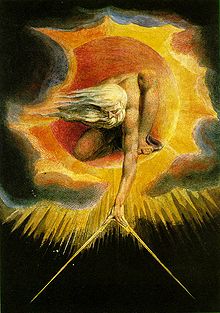
(Picture: William Blake, The Ancient of Days)