Unknown's avatar

I Was Ordained Fifty Years Ago Today

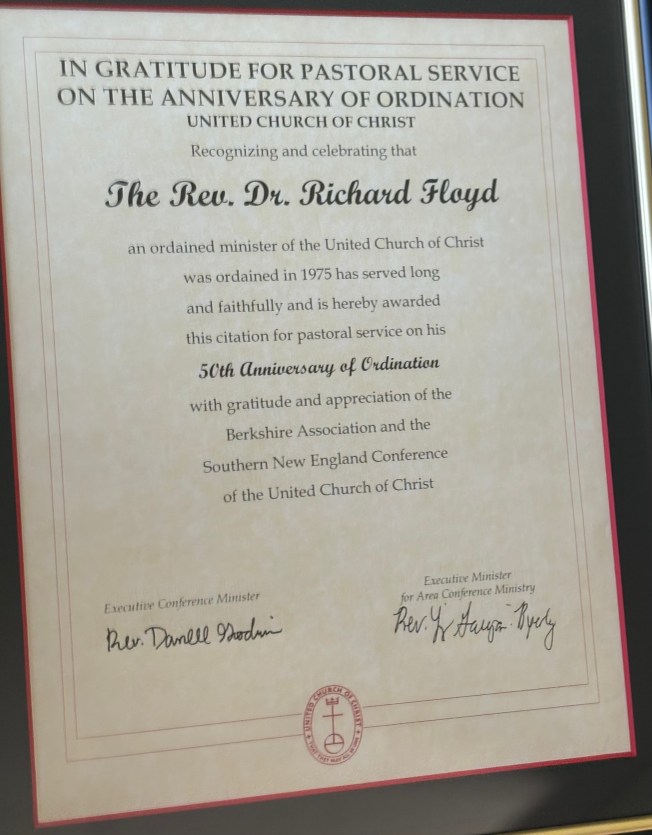
On this day fifty years ago, September 21, 1975, I was ordained into the Christian Ministry of Word and Sacrament at the Newton Highlands Congregational Church, United Church of Christ, in Newton Highlands, Massachusetts. I was 26.

I had had my ecclesiastical council weeks before and waited for a call for a church before I could be ordained. Late in the summer it came. I was called to be the pastor of the Congregational Churches of Limerick and West Newfield, a “Two-point charge” serving two small congregations nine miles apart in the Northwest corner of York County, Maine. I had preached my neutral pulpit sermon in nearby Fryeburg, and a candidating sermon in each of the two churches.

I remember my ordination vividly. The church secretary, Irene Fultz, had designed. printed and mailed out the invitations. My family was there. My Associate Conference Minister, Oliver Powell, was there. The Reverend Joanne Hartunian, represented the Metropolitan Boston Association. The Reverend Meredith (Jerry) B. Handspicker, presided over the Laying on of Hands, and gave the Prayer of Ordination (after the ordained ministers were assembled he invited the whole congregation to participate, the first time I had seen this. It is commonplace now in the UCC.) The Reverend Walter Telfer, Director of Field Education, gave a Charge to the Congregation. The Reverend Michael J. Maguire led the congregation in a prayer of Confession. I presided at Holy Communion and gave the Benediction for the first time. The Reverend Dudne M. Breeze, our pastor, gave the sermon. He admonished me to be a Minister of the Word of God. I now know how wise that counsel was and how hard it would be.

I served those two little churches for four years and have never been happier. I married Martha while there and those churches threw us a big party. I trained as an EMT and became a firefighter.

Next, we went to Bangor, where I was Chaplain at Bangor Theological Seminary and Associate Pastor of the Hammond Street Church, United Church of Christ. There I ministered to students and congregants. I was a founder of Maine Clergy and Laity Concerned (CALC) a national anti-war organization. I chaired the Social Justice Committee of the Maine Council of Churches.

Finally, I came to Pittsfield, Massachusetts, in 1982 to be the Pastor of the First Church of Christ in Pittsfield. I had three sabbaticals from there: Oxford (1989), St Andrews (1995) and Cambridge (2000). I studied and wrote articles and books while on those wonderful respites from active ministry.

I stayed in Pittsfield for twenty-two years and would have stayed longer if I hadn’t sustained a traumatic brain injury (TBI) in a bicycle accident and had to retire early on disability. That crash was exactly 25 years ago and equally divides my ministry into before and after my disability.

I eventually discovered a new chapter in my life. I started writing. I wrote hymns. I started this blog, I wrote devotions for the United Church of Christ’s Daily Devotional, and I found a new ministry of the Word in my words. I became active in the First Congregational Church of Stockbridge.

So, there you have it. Here I am 50 years later. I once kept count of how many weddings I officiated at, but I have lost count well into several hundred. The same for baptisms, confirmations. I can’t count the hospital visits, the funerals and graveside committals I was part of. I’ve held people’s hands in Rehab Facilities and Psychiatric Wards. I’ve put my arms around people in overwhelming grief. I’ve been humbled by theses encounters.

I have heard numerous confessions. I have listened to more kinds of human consternation and misery than you can imagine. I have also been privileged to be part of people’s lives at some of their more poignant moments. I have shared many joys and sorrows. I have “wept with those who weep, and rejoiced with those who have rejoiced.” (Romans 12:15)

I have led countless Bible Studies and other courses for adults. I have authored “A Course in Basic Christianity” for adults. I think of it as a course to teach you “everything you should have learned in Confirmation Class, but probably didn’t because you had your mind on other things.”

I’ve valued the relationships of my clergy friends and colleagues in the United Church of Christ and other Christian denominations. I served  the Massachusetts Conference of the United Church of Christ as their representative to the Massachusetts Commission on Christian Unity for twelve years. There, I made many friends and came to appreciate the richness of the “Great Church” of Jesus Christ.

I have also treasured the relationships I have had with my Jewish brothers and sisters in the clergy. We have become trusted friends and interlocators, and in that safe space of friendship have had rich and deep conversations about both what unites and divides us. It was a great honor that the family of my dear friend Rabbi Harold Salzmann asked me to speak at his funeral at Temple Anshe Amunin in Pittsfield.

I’ve witnessed people’s lives changed by their confrontation with the Gospel of Jesus Christ. And I, myself, have been profoundly changed by a life-long engagement with Jesus and his Gospel of freedom and grace. Jesus is still the most interesting and engaging part of our faith, and after fifty years he is still the one with whom I have to deal in thought and deed and prayer.

I have struggled to be faithful to the truth as I have known it. My reach has exceeded my grasp. I have pondered the deep things of the faith and have written countless articles, papers, and three and a half books. I have spent years trying to reform my denomination and restore its historic theological and ecumenical vision through leadership in such activities as the Confessing Christ movement, the Mercersburg Society, and the Craigville Colloquies.

I have also, to be quite honest, been a leader throughout my fifty year ministry, in an enterprise that is in decline in institutional vigor and societal esteem. The schools where I received my masters and my doctorate are no longer there. The mainline church in whose rocky vineyard I have labored is smaller, poorer, and less respected than it was before I began. My last church, where I served for 22 years,  sold its grand gothic meeting house to another congregation, and merged with a nearby UCC church.

But I do not despair about this. God will not be left without witnesses. The church of the future, I believe, will be smaller, leaner, and more faithful. People won’t go because it’s “the thing to do” as it once was.

They’ll go because they have found something of great value to which they are committed. Or they will go because they are searching for something important that seems missing in their lives, something more durable, something deeper than the shallow seductions and distractions of our consumer culture that values having more than being.

And society needs the church to model a community that welcomes and values all of God’s children. A space where love is stronger than hate, faith stronger than fear, and kindness and compassion are shown to the vulnerable among us, which is all of us.

So, while I have regrets about my failings and limitations as a minister, I have none about choosing this calling and living it out for five decades. My daughter has chosen to be a pastor, and I watch with awe at how gifted and faithful she is. It is young clergy such as she who give me much hope for the church of the future. I thank God for sustaining me through this long calling, and for calling me in the first place despite my manifold frailties and failures. To God be the glory.

“Now to him who by the power at work within us is able to accomplish abundantly far more than all we can ask or imagine, to him be glory in the church and in Christ Jesus to all generations, forever and ever.” Amen. —Ephesians 3:20-21.

(This morning in worship, The First Congregational Church of Stockbridge blessed me by prayer and the laying on of hands. A livestream of the service is available on the church’s website.)

Unknown's avatar

I was ordained forty years ago today

I was ordained to the Ministry of Word and Sacrament forty years ago today. Over the years I have ruminated on this blog about my ordination. Here are bits of two of my favorites. This first one is from 2009, but I’ve changed the dates as needed:

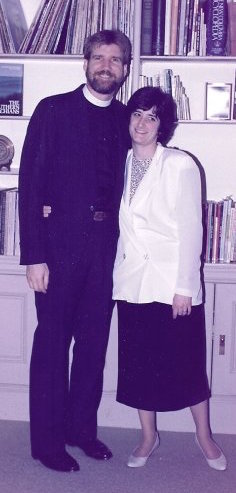
Martha and meI was ordained to the Christian ministry on this day in 1975 at the Newton Highlands Congregational Church (UCC) in Newton Highlands, Massachusetts, by the Metropolitan Boston Association of the United Church of Christ. Dudne Breeze, the pastor, preached the sermon, and a good one it was. Jerry Handspicker, my teacher at Andover Newton Theological School and the associate pastor, offered the ordaining prayer, which asked God to endow me with all manner of things for my ministry, and he seemed in deadly earnest. After forty years I now understand why. Jerry, ironically, also presided at the service of thanksgiving for my ministry when I retired 10 years ago, so he book-ended my three decades of active ministry.

At the ordination we sang “Holy, holy, holy,” and “Be Thou My Vision.” My then girlfriend, now wife, Martha, made me a handsome set of liturgical stoles. Good food was served. There were probably grape leaves.

There were no tongues of fire or other obvious signs and wonders, although the whole event was wondrous to me, and when the clergy laid their hands on me I felt an enormous weight, a feeling about ordination that has never entirely left me.

I got to my first parish in rural Maine and realized soon enough that I didn’t know what I was doing, and that feeling has never entirely left me either. My first congregations (I had two) taught me how to be a minister every bit as much as seminary, and I will always be grateful to them. God blessed me throughout my ministry with wonderful saints of the church who encouraged and sustained me, and put up with me even when I was acting like a damn fool.

Early in my ministry I refused all honoraria, and thereby offended nearly everyone that offered me one. I was shopping for clothes the week before my wedding, and the good Roman Catholic salesman at the haberdashery rang me up with a ten percent clergy discount. I tried to explain all the high-minded reasons I couldn’t accept it and watched his face fall. I called my mentor Fred Robie, the sage of Sanford, who simply said, “My Daddy taught me that when someone gives you something, you say ‘thank you.’” Lesson learned. Would that everything I needed to learn was that simple.

What else did I learn?  Continue reading

Unknown's avatar

Clergy evaluation committees and why they are a bad idea

multiple fingers pointing blame at man

Every relationship needs thoughtful reflection and mutual careful feedback, and the relationship between a clergy person and a congregation is no different from any other in this respect. But stand-alone committees formed only for the purpose of evaluating clergy are a bad idea. I call such a committee a posse, by analogy with those hastily gathered bands of citizens that helped the sheriff look for the fleeing miscreants in old Westerns.

Most clergy have existing structures within which mutual conversation and evaluation can take place. They may be parish councils, diaconates, elders, vestries, consistories, or whatever depending on one’s denomination and its polity. The one thing that separates these from the clergy evaluation committee is that they have other work they do, and collaborate with the clergy person in doing it. Around that work mutual trust is formed, and so the evaluative function is just one of many and not the sole focus of the committee.

I have written elsewhere about the commodification of ministry, and the poor models for ministry that come more and more out of the corporate world with little theological undergirding or even much thought.

It is true that the relationship between the ordained leader of a congregation and that congregation partakes of some of the same dynamics as a business relationship, accountability, transparency, trust, but at its best is more like a marriage than a job. As in a marriage there is an “us-ness” about the enterprise, the old word is covenant, and the relationship is characterized by mutuality, forgiveness, affection, and grace. You don’t work for each other but with each other.

So the clergy evaluation committee, the posse, invites trouble because it has no other function than to criticize the clergy person, and, as we all know, an “idle mind is the Devil’s playground.”

If there is nothing for them to do things will find them. In any congregation there are disgruntled people, and a constant stream of criticism is corrosive to clergy morale and not helpful in assessing what is really going on in the congregation. Thus begins what I call “death by a thousand cuts.” The posse is a bad model. It just is.

By way of illustration, try setting up an evaluation committee for your spouse and let me know how that works out for you.

A better model is to let the appropriate body, which shouldn’t be too big, have regular mutual conversations about what each party needs more or less of to make the congregation and its leader flourish. Then the focus is off real and imagined wrongs and shortcomings, and on the task of assessing the mission and ministry of the congregation.

The very worst model is when the posse gets formed to address “a crisis” with the clergy person. This is usually the beginning of the end of the relationship, and often signals that they want you gone, but are too ashamed of their part in the dysfunction to tell you the truth. The signs of this are demands for micro-bookkeeping, and regular “progress” reports. It is akin to getting to the marriage counselor so late that the only task left is amicable divorce.

If you see this beginning to happen to you, a new committee forming to “help” you, please protest right away and find a better model. Because (Floyd’s axiom): Once the posse gets formed, you will never outrun them.

Unknown's avatar

Do ministers work for the church?

I have written before about my mixed feelings about the “professionalization” of the clergy. The relationship was once more like a marriage covenant than a job.  Lately I notice more and more that the relationship between clergy and congregation is construed as a contractual one borrowed from the corporate world.  And I also note with sadness that this model is at the heart of much clergy/congregation conflict when one or both parties feel aggrieved that the contract is not being properly carried out.  A covenant has room for forbearance and forgiveness; a contract does not.

When I was ordained, the preacher (Dudne Breeze) admonished me to be a minister of the Word of God.  He didn’t admonish me to be the CEO or the COO, or even to be a faithful employee of the congregation.  My job I knew was not to make the congregation flourish but to make the Gospel real.

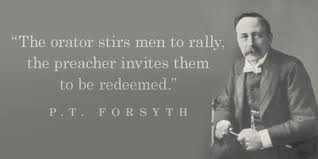
There were times in my ministry when I had to stand against the majority will of the congregation on behalf of the Gospel.  This is no fun when you have come to love your congregation. Years ago I came across this great letter that P.T. Forsyth (1848-1921) wrote to his new congregation in Cheetham Hill, England.

He made it plain that although they had called him he had a prior and higher call. Can you imagine a beleaguered pastor saying something like this today to an angry board of trustees?

“You have called and I have answered gladly. But it is not your call that has made me a minister. I was a minister before any congregation called me. My election is of God. Paul speaks of ‘a faithful minister of the new covenant’ … The minister of this covenant, therefore, the minister of Christ, has his call, first, in the nature of God and God’s Truth; second, in the nature of man and man’s need. We have on one side the divine Gospel; we have on the other the cry of the human. His call is constituted both by the divine election and the requirements of human nature. Would that some who are sure of their election by God, were as sure of their election by man, and their fitness to adapt God’s truth to human nature. It is not therefore the invitation of any particular congregation that makes a man a minister. It is a call which on the human side proceeds from the needs rather than from the wishes of mankind, from the constitution of human nature as set forth in Christ, rather than from the appointment by any section or group of men. I am here, not to meet all your requisitions, but to serve all your needs in Jesus Christ. You have not conferred on me my office, and I am Christ’s servant more than yours, and yours for His sake. The minister is not the servant of the Church in the sense of any special community or organization. The old Latin theologians used to subscribe themselves V.D.M., Minister of the Word of God,—Minister not of the Church, but of that Christian human nature which our particular views and demands so often belie. A minister may, on occasion, never be so much of a minister as when he resists his congregation and differs from it.” (“The Pulpit and the Age”)

The church could user fewer employees and more ministers..

Unknown's avatar

Ruminations on the Perplexing Task of Ministry: Arnold Kenseth’s “Ordination”

I have been ordained now nearly thirty-six years, and although I can rattle off a pretty coherent explanation of the meaning of ordination my own has never entirely lost a sense of mystery and wonder about it.

My daughter is presently in her final year of divinity school and about to present her ordination paper this week, and I think it was reading hers that got me ruminating on my own.

Being a minister of the church is a living conundrum, as Karl Barth describes it so well in his section on “the Task of Ministry”: “As ministers we ought to speak of God. We are human, however, and so cannot speak of God. We ought therefore to recognize both our obligation and our inability and by that very recognition give God the glory. This is our perplexity. The rest of our task fades into insignificance in comparison’ (The Word of God and the Word of Man, p. 186).

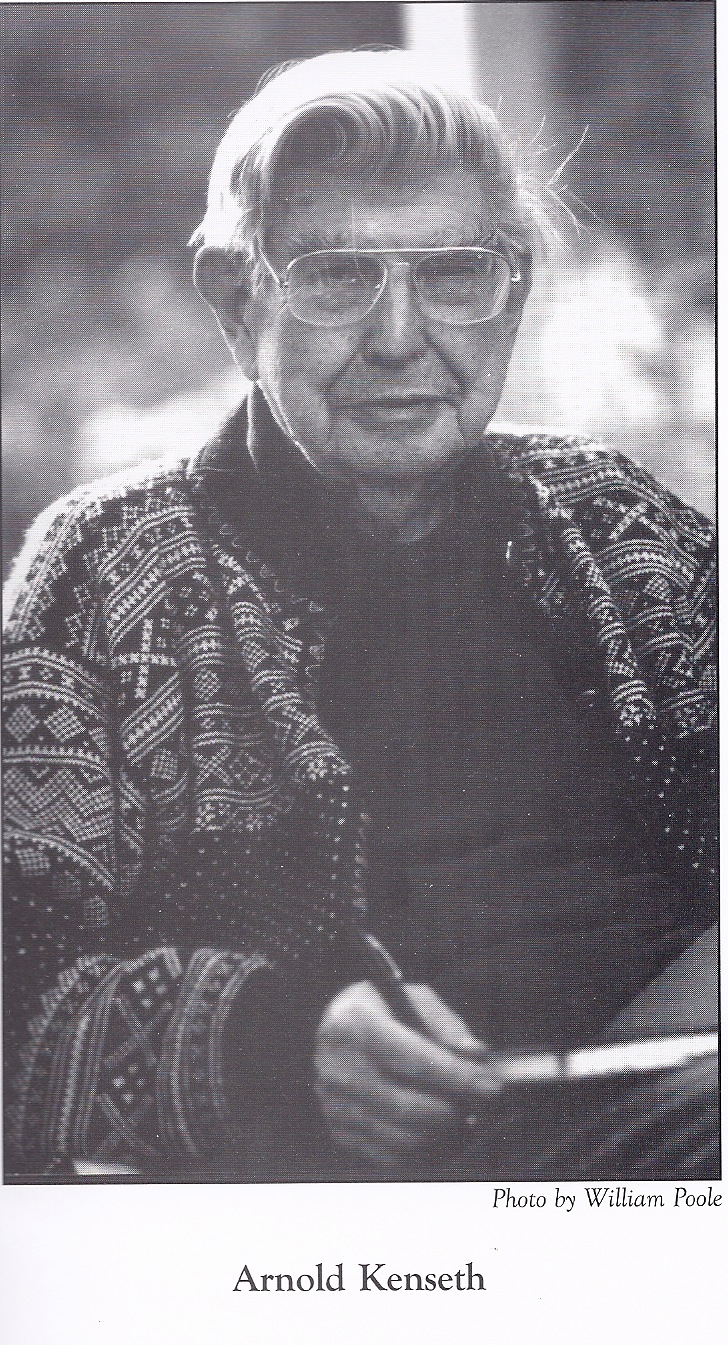
Where prose fails to capture this paradox poetry frequently does better.  I have often turned to the poetry of my friend Arnold Kenseth, who died in 2003, especially the collection of poems he entitled “Reflections of an Unprofitable Servant.” Here’s one of my favorites:

Ordination

I was anointed. A fire. Yes, I tell you.
An adazzle. His rare thump numbed me, awed
Me down to size and up to Him. Prayed, pawed
By the laying on of hands, myself anew
And aloft; I became lion to roar Him,
Eagle to lift Him, donkey to bear Him. I,
In that sunburst, languaged with seraphim,
Promised myself to be (Ha!) His emissary.

I did not, friends, manage much. True, I found
Fluency, but not roar. I have been sparrow;
And though jackass as most, I could not be least
Even for Him.  He was scarlet and vast
And radiant and restful. He sang such sound
I heard the earth unloose itself from sorrow.

(Arnold Kenseth, Seasons and Sceneries, Windhover Press, 2002)

Unknown's avatar

Where I Ruminate on My Ordination on this its Anniversary

I was ordained to the Christian ministry on this day in 1975 at the Newton Highlands Congregational Church in Newton Highlands, Massachusetts, by the Metropolitan Boston Association of the United Church of Christ. Dudne Breeze, the pastor, preached the sermon, and a good one it was. Jerry Handspicker, my teacher at Andover Newton Theological School and the associate pastor, offered the ordaining prayer, which asked God to endow me with all manner of things for my ministry, and he seemed in deadly earnest. After thirty-four years I now understand why. Jerry, ironically, also presided at the service of thanksgiving for my ministry when I retired five years ago, so he book-ended my three decades of active ministry. We sang “Holy, holy, holy,” and “Be Thou My Vision.” My then girlfriend, now wife, Martha, made me a handsome set of liturgical stoles. Good food was served. There were probably grape leaves.

There were no tongues of fire or other obvious signs and wonders, although the whole event was wondrous to me, and when the clergy laid their hands on me I felt an enormous weight, a feeling about ordination that has never entirely left me.

I got to my first parish in rural Maine and realized soon enough that I didn’t know what I was doing, and that feeling has never entirely left me either. My first congregations (I had two) taught me how to be a minister every bit as much as seminary, and I will always be grateful to them. God blessed me throughout my ministry with wonderful saints of the church who encouraged and sustained me, and put up with me even when I was acting like a damn fool.

Early in my ministry I refused all honoraria, and thereby offended nearly everyone that offered me one. I was shopping for clothes the week before my wedding, and the good Roman Catholic salesman at the haberdashery rang me up with a ten percent clergy discount. I tried to explain all the high-minded reasons I couldn’t accept it and watched his face fall. I called my mentor Fred Robie, the sage of Sanford, who simply said, “My Daddy taught me that when someone gives you something, you say ‘thank you.’” Lesson learned. Would that everything I needed to learn was that simple.

What else did I learn?

  • I learned that a wedding rehearsal is the meeting of two clans, and that at any moment violence might break out.
  • I learned that a pastor needs a tender heart, but a thick skin.
  • I learned that when you are relating to broken people some of their brokenness may get aimed at you. I learned that you aren’t supposed to take this personally, although I invariably did.
  • I learned that the faithful aren’t much impressed by the BEM document, especially if you want to move around the furniture in the chancel.
  • I learned that for some folks it’s not the height, depth, or breadth of a sermon that is decisive, but its length.
  • I learned that exercising discipline around baptism involves water, and lots of it is hot.
  • I learned that what I said in the pulpit and what people heard were not necessarily the same.
  • I learned that sometimes peoples lives were moved and even changed by what they heard even when it wasn’t what I said.
  • I learned to love some difficult people.
  • I learned that around pledging time Chicken Little competes with Jesus Christ as head of the church.
  • I learned that we clergy preach salvation by grace to the people, but act as if it were by works for us.
  • I learned that it is a high privilege to spend time with dying people.
  • I learned that struggling with a text all week, and then breaking it open for the congregation on Sunday sometimes felt like the best job in the world. And sometimes it didn’t.
  • I learned that God is good all the time.

Like everyone else I had my good days and my bad days. And like any moderately self-aware person who prays I know my failings better than anyone except God (and perhaps Martha). But I learned it really is all about grace. I am proud (in a good way) to have been a minister.