Unknown's avatar

“What do you know about being God?” Reflections on Job

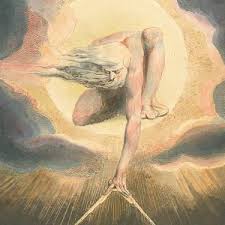
Blake“Where were you when I laid the foundation of the earth?” – Job 38:4

My friend Andy and I had just finished a prayer for the needs of the world when we started lamenting how endless those needs always are.

“If I were God . . .” Andy said, and stopped himself. “Always be suspicious,” he said, “of any sentence that begins, ‘If I were God!'”

We were not the first people to question the troubling gap between what we believe about our God and the immense suffering in our world. The Bible is full of just such questions.

Some of the very best of these questions are found in the Book of Job, which is the story of a good man enduring unbearable suffering. Job desperately wants to know why? His three “friends” offer him their pious answers, which are variants of “You had it coming!”

Their view that suffering is always deserved lingers: “What goes around comes around.”

But what if it isn’t true? What if the divine mystery is more complex than that? What if bad things do happen to good people? What if the punishment doesn’t always fit the crime? Read more. (From my Daily Devotional for today)

Unknown's avatar

“The Church of the Troubled Hearts”

heart3I have seen congregations named “The Church of the Redeemer” and “The Church of the Good Shepherd” and “The Church of All Souls,” but I have never seen a church named “The Church of the Troubled Hearts.” It might not attract a big following, but it would name who we are. Because our hearts are troubled, troubled about our future, our finances, our children, our health, our relationships, our congregations and our faith.

(from my Daily Devotional for today) Read more


Unknown's avatar

The Shepherd Window: “Lost and Found”

church-window4-224x300

When I was growing up my family went to the Church of the Holy Communion in Norwood, New Jersey. It was a little church, built in the neo-Gothic style so beloved by Episcopalians. It had a cloister that connected the church with the parish house. Years later, when I had sabbaticals at Oxford and Cambridge, I felt right at home among the grand stone piles.

When I was in second grade a classmate of mine died in a sledding accident, and his family donated a memorial window to the church in his memory. That window helped shape both my faith and my theology.

Here is a piece I wrote about it for today for the United Church of Christ’s Still Speaking Daily Devotional:


“Lost and Found”

By Richard L. Floyd

“Which one of you, having a hundred sheep and losing one of them, does not leave the ninety-nine in the wilderness, and go after the one who has been lost until he finds it? When he has found it he lays it upon his shoulders and rejoices.” – Luke 15:4,5

When I was in the second grade a boy in my Sunday school class named Kim was killed when he overshot the mark on his sled, went into the road, and was hit by a car. Nobody I knew had ever died before and his death left quite an impression on me. I remember my mother and father sitting me down and telling me the sad news.” Read more

Unknown's avatar

“The Cross and Forgiveness”

Lent 2014As we enter Holy Week and look ahead to Easter I would like to reflect on some of the threads of our Lenten study these past few weeks in the light of the cross and resurrection.

You will recall that forgiveness means a wiping away from memory of the offense, so that it is as if it never happened, leading to restoration of the relationship.

At the very first meeting we reflected on how extraordinary the idea of forgiveness is, since the human impulse for retribution and revenge runs very deep.

So if forgiveness is such a hard thing for us, what explains the amazing stories we saw and heard, first about Desmond Tutu and the South African Truth and Reconciliation Committees, and then the story of Louis Zamperini forgiving his Japanese captors decades after his imprisonment? (As told in Laura Hillenbrand’s best-selling book Unbroken). Continue reading

Unknown's avatar

A Son’s Remembrance of His Mother on her Birthday: Frances Irene Floyd. March 4, 1914-September 18, 1967

Frances Irene Floyd

(I first published this in 2010, but thought the 100th birthday warranted a repeat)

Today is my mother’s birthday. She was born on this day in 1914, and died on September 18, 1967 at the age of 53 from cancer. She died too young. She would have been 96 today.

Her older sister outlived her by 40 years. She’s died now too, as has my Dad, so there is hardly anyone who even remembers her. But I do.

She most likely wouldn’t have died in this day of regular diagnostic tests and improved cancer treatments. But in the 1960’s cancer was considered by most people to be a death sentence, and usually was.  Her doctor told us she had it, but asked us not to tell her, because the news would be so emotionally devastating she might lose hope.  So in addition to having to deal with her dying, we had to lie to her.  She was a smart woman and finally figured it out and made us tell her.

I was eighteen when she died. She was told by her doctor in September of 1966 that she had about three months to live, and she said  “Nonsense, I will live to see my daughter and son graduate (from college and high school,  respectively) next spring, and she did, although she was in a wheelchair.  My sister was engaged to be married, and the date was moved up to early September in the hopes she could participate. She couldn’t, since she was in the hospital dying.

That day, my Dad, my younger brother, and I left immediately after the reception, still in our morning suits, full of champagne punch (at least I was), to visit her in the hospital with a fist full of Polaroid photos to show her of the wedding.  She was delighted, but didn’t have much energy to enjoy them.

A few days later I said my goodbyes to her (though far too much remained unsaid) and then I traveled 1400 miles away to go to college.

Two weeks later she died, and I came home for the funeral. No single event in my life as her early death has had such an impact on the rest of my life.

I often think of her on March 4. She said it was the only day of the year that was a command (“march forth!”), and when she was a kid she thought she was a big deal because she was born on Inauguration Day, but Congress moved that to January in 1933, so she lost that distinction.

Though I often think of her on her birthday, it sometimes isn’t until later in the day. Some years I have forgotten it completely, and later in the week realized that I was sad on that day for seemingly no reason. But the heart often knows better than the mind.

Mostly I think about what she missed. She never knew my wife, and my son and daughter. She never knew I graduated from college or became a minister. She never met any of her seven grandchildren or my brother’s wife. She was cheated.

Her short life was in many ways remarkable for a woman of her generation. She was born in Oklahoma City and grew up in Wichita, Kansas, where she went to college, a rare thing for women in the 1930’s. She became a librarian, one of the few vocations open to women back then, along with teachers and nurses. After graduation she got a job at the Wichita Public Library.

She was a dreamer and what we once called a “bookworm.” She always had her nose in a book, and expanded her rather conscribed universe through her imagination. Her parents were good people, pious Midwestern Protestants, and she lived at home with them throughout her mid-twenties, as unmarried women were expected to.

But she wanted more out of life. She dreamed about far off places she had read about in books. She dreamed of the England of Jane Austen and Dorothy Sayers. And like many Americans in her day from the cultural hinterlands she dreamed of New York City, then in its heyday, where Dorothy Parker and James Woolcott could exchange bon mots in the Algonquin Club. It was a far cry from Wichita.

By her late twenties she was considered an “old maid,” most likely never to be married. She wasn’t accepting any of this.

So she decided to change her life. Against her parents’ wishes she applied to Columbia Library School (now sadly gone),  arguably the best in the country, and when she got in, she went.  She packed her suitcase and took the train by herself to New York, and got a room at the International House near Riverside Church and never looked back.

She loved New York. Like so many people who go there she had big dreams. She wanted to be a writer, and scribbled short stories in her spare time.  I have many of them. They are not particularly good, overly self-conscious and somewhat formal in style, but they are interesting and really not bad.  She was a good writer, but she tried others’ voices and never found her own.  She used to joke that she had rejection slips from all the best periodicals. One of her grandsons is a writer and won an O’Henry Award a few years ago for one of the years’ best short stories. She would have liked that.

When she graduated from Columbia she got a job at the New York Public Library on Forty-Second Street, and went to work every day between the storied lions. There she got such a good reputation for cataloguing books that she was asked from time to time to do it for the Library of Congress.

She became an Episcopalian, which I expect didn’t go down too well with her folks back in Wichita, in a day when anti-Catholicism was still an ugly feature of much of Protestantism, though to be fair, I never heard any of it from them.

She met my Dad, a handsome intellectual Bostonian, while she was working at a summer job at the University of New Hampshire, where he was teaching while a Ph.D. candidate back at Columbia. They discovered they both lived in New York, and when they got back to the City they started dating, and eventually married.

I am the second of their three children. My sister and I were born in New York City and my kid brother was born in New Jersey, where we moved when my parents realized that New York wasn’t a terrific place to raise kids, especially when you had limited means.

Church was important to my mother and she was on the altar guild and worked on the annual bazaar, and baked pies for the Bake Sale, and if we were lucky she might make one for us.

I thought of her the other day when I was in church. It was an Episcopal  Church and the rector, who was celebrating, is a woman, as is the  associate priest, as were the two acolytes. So the communion table was surrounded by women, and no one thought a thing about it. My mother would have liked that, although in her day it would have been a complete flight of fancy to imagine it.

She was a proto-feminist in a quiet way. My sister went to Vassar when it was a women’s college, and my mom was very proud of her. Nearly thirty years later my own daughter graduated from Wellesley College, and I thought of my mother on that day, too, although she would have been equally proud of my son’s graduation, for she was nothing if not fair.  And what would she make now of my daughter going to divinity school?

When we were growing up in the suburbs she took a job as a librarian in a middle school nearby. Her students loved her and she encouraged them all to read, read, read. I suspect she often quietly overlooked a library fine on an overdue book if it was a hardship for the student’s family to pay it.

Last spring I wrote a paper about my love of mystery novels, another passion she passed on to me. I mentioned her in it and got this remarkable anonymous comment: “If your mother was the Mrs. Floyd who was the Wandell librarian in the ’60s, I remember her! She was wonderful. In fact, I use FLOYD as a password on book-related websites (what greater homage?).”

I have now outlived her by 7 years, and she has been gone from my life for so long I can’t recall her voice, and I can remember her appearance mostly from old pictures. I sometimes glimpse something of her in the faces of my daughter and my two nieces, and see inklings of her ways when they labor at crossword puzzles or slaughter one another at Scrabble.

I woke up in the wee hours this morning and started thinking of her and tears welled up in my eyes, even though she has been gone 43 years. So I guess I still grieve.

But mostly I am grateful for the years I had with her. She gave me words, books, music, a dry sense of humor and above all, faith. She also gave me a lively sense of the communion of saints, and makes me acutely aware of our connection to those who have gone before us and help make us who we are.

So here’s to you Mom. Happy Birthday!

Unknown's avatar

The Calling of Disciples: A Sermon on Vocation

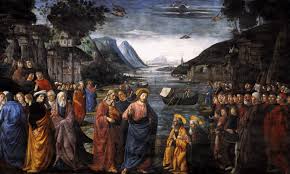
Ghirlandaio

John 1:29-42

 What is vocation? We typically think of vocation as our job or profession, but the idea is much larger and richer than that, so let’s take a look at it, starting with a little word study.

Vox is the Latin word for “voice,” as in Vox Populi, the “voice of people.” The Latin verb “to call” is vocare, as it still is in Italian. The noun form is vocatio.

There is a whole cluster of English words that have these Latin words as their root, words that refer to voice, to speaking and calling. For example, when we “speak out” we are being “vocal.” The whole collection of words we use to speak is our “vocabulary.” And, of course, a person’s calling is his or her “vocation.”

In Christianity (and its mother Judaism) our God is a God who has a voice, a God who speaks and calls.

But God’s speaking is different than our human speaking in an important way. We make a distinction between human speech and action.

But for God there is no such distinction: the Word of God doesn’t just say something, it does something. So, for example, in Genesis 1, God creates the worlds with a word. Recall how God said, “Let, there be light! And there was light.”

And recall also how God says in Isaiah 55, “My word will not return to me empty, but will accomplish that which I purpose.” Isaiah himself is an example of a prophet, a person called by God to speak for Him, so that when the prophet speaks, his words are heard by the people as the Word of God.

Likewise in John’s Gospel, we see that Jesus is called “the Word of God.”  John 1: “In the beginning was the Word” intentionally mirrors Genesis 1, “In the beginning God created the heavens and the earth.”

But to say that Jesus is “the Word of God” is to say more than that he speaks the Word of God, as Isaiah did or the other prophets did.

No, in Jesus, we see this intimate connection between speech and act, between word and deed. Because Jesus is both the one who speaks the Word of God, and he is also the one who accomplishes it, by his life death, and resurrection.

And so we see in today’s Gospel from John, at the very beginning of Jesus’ ministry, the calling of the first disciples, which sets in motion the drama of the rest of the Gospel.

Why does Jesus call disciples? To answer that we need some background on what Jesus’ ministry was all about. First of all, Jesus comes into a time and place where God was expected. The people had been waiting, longing, hoping for the coming of God’s reign in the form of his anointed one, which is the word “messiah” in Hebrew, and “Christ” in Greek.

The role of John the Baptist in the story is important because many at the time thought that John the Baptist was a figure like Elijah. Elijah was often thought to be the one who would come before the messiah, a forerunner figure.

Many people saw John the Baptist in this same light, and his appearance in the wilderness raised expectations for the coming of the Messiah. When Jesus shows up preaching and teaching many thought he was the expected One.

In our reading today the evangelist describes Andrew and Peter as disciples of John the Baptist, who leave him to follow Jesus.

So Jesus calls disciples for a very particular reason, which is hinted at by his calling twelve of them. This mirrors the twelve tribes of Israel. This is just one of many indications that Jesus understood himself to be the carrier of God’s special calling of Israel.

And what was Israel’s special calling? We get an inkling of it in our Old Testament reading today, where God says to Israel, “I will give you as a light to the nations, that my salvation may reach to the end of the earth.” (Isaiah 49:1-7)

In theological terms we refer to this special calling as “election.” In the Bible election is never for itself. No, election is always to accomplish the purposes of God.

The “chosen people,” whether we are referring to Israel or the church or both, are not called because they are better than others, but because God has use for them. And if we pay careful attention to the stories of the people God calls in scripture, it becomes quite clear that God doesn’t call the qualified, but rather qualifies the called. Think of Abraham and Sarah, well past their prime, Jacob, the liar and thief, Moses, the murderer, and Mary the poor teenage unwed mother. These are people like us and people we know.

So once again, you may be thinking, “Well, that’s really interesting Rick, and we’re glad you got to use your high school Latin, but what’s all this got to do with us?”

And the answer to that is that it has everything to do with our identity as a congregation and our understanding of our mission. In other words, our vocation informs both “who we are” and “what we do.”

I am talking about our vocation as church. We don’t just come to church, we are called to be the church. There’s a difference.

Here’s a hint about our calling. In the Call to Worship for this morning I referenced the UCC Statement of Faith several times. Twice it refers to God’s call. The first call is in the beginning: “God calls the worlds into being.” There’s Genesis 1 again.

The second call from God is through Jesus, “He calls us into his church to accept the cost and joy of discipleship.”

So the church is called as an instrument of God’s purposes, and those purposes are the same as in the original creation.

To begin to think about ourselves that way, as being called for God’s purposes, will change both our identity and mission. We are not merely a voluntary association of individuals with a benevolent and spiritual focus, although we are that.

But we are more than that, we are called, we have a vocation.

This concept of vocation was very important to our Puritan forbearers here in New England. We talked about this in our Men’s Book Group on Wednesday. Before the Reformation vocation was understood to be only for the religious life, for the monk, nun, or priest.

The Reformers changed that. Luther and Calvin believed that there was a general calling to repentance and a godly life for all Christians, and there were particular callings to life’s several vocations, as we understand them today.

So calling was no longer just for the clergy, and it still isn’t. Calling is for us all, and what are we called to be? Disciples of Jesus. And what is a disciple? A disciple is quite simply a follower or a student. One who hears the call of Jesus.

Jesus called those first disciples by asking them, “What are you looking for?” And later he invites them to “Come and see!”

And they might not have known what they were looking for, as many of us do not, but they knew it when they saw it. And they said, “We have seen the Messiah.”

They heard the call and answered it.

I want to talk now about the power of words as it relates to our callings, and I can think of no better example than Martin Luther King, who was a very important influence on me, and on my own call to ministry.

I was fourteen when Dr. King gave his “I Have a Dream Speech” in Washington, D.C. at the Lincoln Memorial. I was there last month and felt as if I was standing on holy ground.

I had grown up in the church, but in Dr. King’s speech I heard a new power in some familiar words. Dr. King’s father was a minister, and Martin grew up in the thought-world and language-world of the church.

The African-American church had retained the moral grammar of the faith that had been largely lost in the mainline church, the language of justice and righteousness, and in the civil rights movement Dr. King and others gave it back to the whole country as a gift in their words.

When I first heard Dr. King’s words they rang true. They had behind them such moral force. His use of familiar scripture, such a Isaiah 40, “Every valley shall be exalted,” and of shared national language such as the words of “My Country ‘tis of Thee” re-awakened the moral imagination of much of the country.

In Dr. King’s speech fifty years ago I became awakened to the power of words to shape the life of individuals and societies, and years later I discerned a call, there’s that word again, a call to the ordained ministry.

And throughout my long ministry I have often pondered the power of words, to heal or hurt, to inspire or dampen the spirit, to free or repress. And I believe that a society that de-values words is at risk, because it ceases to know when it is lying to itself, and can’t recognize truth when it hears it.

But the right word at the right time can change a life or change a society.

I invite you to recall such moments in your own life. Perhaps you were listening to a sermon, or the words to a hymn, or a scripture reading, and suddenly those words were not something you were just overhearing, but words that were addressed to you.

And it is in such moments that “vocation” takes place; when you hear the voice of God calling. And when that happens there is no turning back, because the Word of God has a life of its own in your life.

You know how Brent (our pastor) often begins worship with the words “No matter who you are, or where you are on life’s journey, you’re welcome here.” This language is part of what we in the United Church of Christ call “the extravagant welcome of our God.”

These are good words. The purpose of this welcoming language is to create no barriers that will keep people away from our life together here, and several people have told me how reassuring it is to them.

But, in the interest of full disclosure, I need to tell you there is danger in all this extravagant welcome, and it should come with a warning label.

Because once you say to yourself, “I feel welcome here. This could be my church,” a new thing may happen. You are very likely to have one of those moments I just described, when the words you hear become the Word of God that feel as if they were directly addressed to you. Then you hear the call of God and recognize your vocation. Then you move from attendance to discipleship, from observing Jesus to following him. Then you accept “the cost and joy of discipleship.”

Those moments will change your life.

So what is God calling you to do? Who is God calling you to be?

What is God calling us to do? Who is God calling us to be?

And let the people say: Amen.

I preached this sermon at my home congregation, the First Congregational Church (UCC) in Stockbridge, Massachusetts on January 19, 2014.

(Picture: The Calling of the Apostles by Ghirlandaio)

Unknown's avatar

“We Give Thee but Thine Own” A Stewardship Sermon

Wheat“The earth is the Lord’s and everything in it.” (Psalm 24:1)

In late summer Brent (Damrow, our pastor) called me and ask me to preach today as “a witnessing steward.” He said the concept, which was used at Old South Church when he was there, was to have someone with an outsider’s view help the congregation think about stewardship.

I said I would glad to do it, but I didn’t know how much of an outsider’s view it would be since Martha and I had decided to join the church the next time new members were received. Brent assured me that it would be all right, but little did I know it would be on the very same day. Later in this service I will remove my robe and join the other new members. So in these last minutes of my outsider status let me share with you some thoughts about stewardship.

I have preached many stewardship sermons, but this is the first time I have ever preached one where I wasn’t the pastor, and I have to tell you it is very liberating. Since the pastor’s salary is typically one of the largest items in a congregation’s budget, as it should be, we ministers sometimes feel sheepish about preaching on stewardship, as if people might think we have an ulterior motive. So here I am; I don’t need a job or seek a raise. I come to you as one without guile.

But I do have an agenda, and since I come without guile, I’ll tell you what it is. I want to accomplish two things in this sermon. The first thing I want to do is give you a clear understanding of what Christian stewardship is. And the second thing I want to do is to share ideas that will help you be a Christian steward.

So, first things first. What is stewardship? Both Claire and Joanne, in their eloquent testimonies the past two Sundays about what this congregation means to them, expressed that their dictionaries weren’t much help in explaining stewardship. I figured out the problem: they needed a Bible dictionary, and I just happen to have one, two, actually.

Here’s what I found. The principal Greek word for steward is oikonomos. It has the same root from which we get our English words “economy” and “economics.”

The oikonomos was the servant, typically a slave in Jesus’ time, who took care of any household of note. He was entrusted to take care of what belonged to the master. In the Book of Genesis Joseph was steward to Potiphar’s household in Egypt. Everyone in Jesus’s day would have known the term, a house manager who takes care of what belongs to the master.

Now our English word steward is what we call a dynamic equivalent translation. There wasn’t a word in English that meant exactly what oikonomos meant in Greek. So when Tyndale and the other early translators of the Bible were casting about for an equivalent they came up with steward, which originally comes from the Old English “stie-weard.”  “Sty” is the pen where the pigs were kept, pigsty being one of my mother’s favorite metaphors for my room when I was a teenager. And we know “ward” from words like warden, the one in charge. So “a sty-ward,” a steward is literally “the keeper of the pigpen” Not very elegant, but there it is.

Are you still with me?  Good! So we’ve established that the steward is entrusted to look after the master’s possessions. A Christian steward is entrusted with the things that belong to God.

So what belongs to God? This is where we need a good refresher course in theology 101, and especially a good doctrine of creation. And here I turn to the beginning of Psalm 24. “The earth is the Lord’s, and everything in it.” Or for you old timers who grew up on the King James Version, as I did, “The earth is the Lord’s, and the fullness thereof.” Either way, what belongs to God? (Someone shouts out “everything!”) That’s right, everything!

The great creeds of the church say the same thing, “We believe in God Almighty, maker of heaven and earth, and of all things, visible and invisible.”

So you see the weight of these important words, steward and stewardship. They mean the taking care of everything of God’s, and I could preach a whole sermon on the environmental and ecological implications of Christian stewardship, but that’s a sidebar for you to muse on. I expect Brent will do that at some point.

I want to say one more thing about stewardship before I get practical with you and it is this. The steward is expected to make good use of the things with which he or she is entrusted. The keeper of the pigs doesn’t just sit there and watch them in the pigsty. No, the steward must feed them, protect them from predators, and see that they are healthy.

There is an active quality to stewardship. We see that in the reading you just heard, the Parable of the Talents. The servant who buried his money in a field was untrustworthy, not worthy of trust, because he passively protected the money and didn’t actively seek to make it prosper.

So stewardship is the active tending of everything God entrusts to us, which is everything.

And the steward is the one who does it.

You can see it’s a pretty big job! So Part Two of this sermon is to give you some guidance on how to be a trustworthy steward.

But you may be asking, “OK, Rick, I get it, but if stewardship is such a big category and means taking care of everything of God’s, the air, the water, the earth, our health, why in the church does it always lead to talking about money?”

And that’s a great question. And I have a great one-word answer for that: Jesus.

Did you know that Jesus talked about money more than any other topic except the kingdom of God. Why do we think that is? Because he knew the symbolic power of money, and its perils and risks for the disciple. “You can’t serve God and money,” he once said, and he meant not just the physical money, but mammon, who is the personification of wealth, the god of money.

Because Jesus knew money could be an idol. Remember the rich young ruler who went away sorrowful from Jesus because he was too attached to his money, and the rich fool who built bigger barns to store his wealth? These stories and parables Jesus tells are warnings about spiritual health. Because he knew that money can be a bar to discipleship.

Or it can be a bridge. Jesus also said, “Where you treasure is there will your heart be also.” So we have too often sold stewardship backwards when we say, “the church needs your money,” since the more important need is for you to give money to the church.

So the crucial stewardship question for each of us is not, “How much of what I possess shall I give to God?” The crucial stewardship question for each of us is, “How much of everything God has entrusted to me will I keep for myself?.”

And I promised you I would help you with some ideas on how to be a Christian steward, and now I will.  Let us think on what are the values or attributes of Christian stewardship that we find in the Bible. I can identify several:

  • Christian stewardship is intentional. You need a plan. If you wait to look into your purse or wallet in the parking lot to see what’s in there for God, you need to work on that. That is why we will provide you with a pledge card that is simply a written record of your intention for the year.
  • Christian stewardship is regular. Now you have a plan, you need to follow it. To give each week in worship will also remind you of what you are doing; you are being a trustworthy steward.
  • Christian stewardship is generous. In many mainline churches such as our UCC the average pledge is somewhere between 1 and 2 percent of income. It will be hard for a congregation to flourish with poor stewardship like that, and again, I’m not talking about the budget, but about the level of discipleship. Whatever your level of giving it needs to be generous.
  • Christian stewardship means giving God our best: the first fruits of what we have received. We don’t give to God the leftovers; we give off the top. In the agricultural world of the Bible the first fruits meant bringing the early crop to God as a thanksgiving, and a reminder where it had come from. The farmers consecrated the crop before God, and likewise we can consecrate our life and work before God. The great J. S. Bach wrote the Latin words soli Deo Gloria on every piece of music he ever wrote, sacred or secular, because to him his work was for the glory of God. He consecrated his work before God.
  • Christian stewardship is proportional. Remember the widow’s mite? Nowhere in the Bible does it say, “Give fifty-two bucks.” What it does say is “give in proportion to what you have received.” The Biblical tithe, or ten percent, is the most obvious example, but for some a tithe would be easily done and for others, impossible. Whatever we give it should be proportional to our ability to give and to that which God has entrusted to us.
  • I saved the best for last.  Christian stewardship is cheerful. “The Lord loves a cheerful giver.” (2 Corinthians 9:7) When we change the way we think about stewardship from a theology of scarcity to a theology of abundance, something mysterious happens. Giving becomes a personal act of faith for each of us, and a shared act of the compassionate community for all of us. God has provided us with plenty. And if we can enlarge the pie of our available resources by faithful stewardship we can then do more for the glory of God, more for our church, more for our communities, and more for the world. Because God wants more for us and for this congregation than mere survival. God wants us to flourish, and has provided us with more than enough to do so.

So, in conclusion, if I’ve done my job here, you know what a steward is, and you know how to be one. I invite you to enjoy the process of thinking and praying about how you will use all that the master has given.

And as you do so, recall those words that Jesus said the master spoke to the good stewards: ‘Well done, good and trustworthy servants. You have been faithful over a little; I will set you over much. Enter into the joy of your master.’ Amen.

I preached this sermon at First Congregational Church UCC, Stockbridge, Massachusetts on October 27, 2013.

(Photo: R.L. Floyd. Somewhere in NW Iowa)

Unknown's avatar

“Anticipation”: A Sermon for the First Sunday of Advent (Year C)

Sandy“There will be signs in the sun, the moon and the stars, and on the earth distress among the nations confused by the roaring of the sea and waves.  People will faint from fear and foreboding for what is coming upon the world, for the powers of the heavens will be shaken. Then they will see the Son of Man coming in a cloud with power and glory.” (Luke 21:25-36)

In this passage the world is being shaken loose. It occurs to me that the upheavals described in apocalyptic texts like this one are very much like the language of creation only in reverse. In the first chapter of Genesis God calls things into being one after the other and pronounces them good. The sun and moon, the earth and waters, and all the living things are summoned into life by God’s creative Word. A world takes shape.

But in our Gospel today that world is shaken to its foundations. The secure, predictable world we have come to know and rely upon is threatened and can no longer be relied upon.  The primordial chaos that the original creation turned back, now threatens to break loose upon the world. Then at the very climax of the distress the Son of Man appears in power and glory.

Those early Christians who heard these words in the New Testament period no doubt heard them as reassuring words. Words that expressed the faith that although the world around them was up for grabs and insecure Christ was still in charge and coming soon.

Isaac Watts expresses the mood of this passage in this hymn:

“Deep are his counsels, and unknown,
But grace and truth support his throne;
Through gloomy clouds his ways surround,
Justice is their eternal ground.

In robes of judgement, lo! he comes,
Shakes the wide earth and cleaves the tombs;
Before him burns devouring fire;
the mountains melt, the seas retire.”

Although we may not share the world view of first century Christians let me suggest that their description of a world where everything is being shaken loose can speak to our own sense of insecurity in a world whose foundations are shaken.

How many of us have felt the secure world we knew was being shaken to its foundations?  Our life is a perpetual series of change. We move, we gain or lose a job, we marry,  have a child, someone we love gets sick or dies, a relationship ends, things change.  In truth we live among flux and change all the time. It is not always cataclysmic change, but change nevertheless.

Last spring I was coming back from my Princeton program and I stopped in Bergen County, New Jersey to visit the little town I grew up in. The small old  church looked very much the same as when I left over forty years ago, but much else had changed. The house I grew up with was torn down shortly after I left, but there were also new roads and developments, and as I drove around I got disoriented sometimes by the changes. The town that exists in my own mind and the town that exists now bear some resemblance, but are not quite the same town, just as I am not the eighteen year old who left that town so many years ago.

There was an obituary this week for someone who worked at The Busy Bee, a Pittsfield restaurant that I have heard about, but was long gone even when I got here in 1982, displaced by the misguided urban renewal of the nineteen sixties, the same plan that took away the much missed train station on Depot Street. Folksinger Dave Mallet sings a song that laments these losses:

“I  miss Main Street, where everyone knew you by name,
I miss Main Street, O how this little town change.
It’s all part of progress, changing the old, for the new.
I miss Main Street, What in the world is this world coming to?”

The point is that the security of the familiar is an illusion of time, and in time we eventually all come to know the feeling of a world that no longer feels secure.

Advent invites us to consider what there is of abiding security in the face of the shaking of the foundations. What can be counted on in a world where everything is shaken loose? Listen to the witness of Psalm 46:

“God is our refuge and strength, a very present help in trouble.
Therefore we will not fear, though the earth should change,
though the mountains shake in the heart of the seas;
though its waters roar and foam,
though the mountains tremble with its tumult.”

We need such a word of hope and reassurance. It is too easy sometimes for us  to become fearful and insecure in the face of the world’s changes. Things will change, of that we can be sure, although the changes are often as unpredictable as the results of the recent election.

There was a good slogan on the sign board at Zion’s Lutheran Church this past week. It said:  “Election results: God Reigns!” That is just right. isn’t it?

Advent reminds us that God comes to us not only at the end of time, but also from time to time, in gentle visitations that we may miss for our preoccupation with making a secure world apart from him.

The Advent word is not just a word of reassurance, but also a word of judgement, a word of challenge and an invitation to change. There are things about all of us that need shaking to the foundations, and surely things in our society that could well be shaken loose to make the world a more just and Godly place.

Our attempts to find security can be idols. There are idols of race and clan and class that tempt us to find security there. There can be a fearful clinging to a secure past which is not open to the new thing that God is doing in our midst.

A world where the solidities we have counted on are shaken loose offers us the opportunity for new life, new hope, and new faith in the God who comes to meet us even as the foundations are shaking.

The language of Advent is the language of anticipation for God’s new future. It is not a future we can make for ourselves. It may be something we can not readily see or even imagine. Through thick and thin, through trying times and good times,  faith waits and watches, alert for the coming of our Lord Jesus Christ. Amen.

(I preached this sermon on December 3, 2000 at the First Church of Christ in Pittsfield, Massachusetts)

Unknown's avatar

A Rumination on Loss


A therapist friend of mine believes that most of us, most of the time, given the choice, will choose to feel guilty rather than powerless, since guilt implies that we might have done something different and, thereby, had a different outcome, giving us the impression of some control.

I’ve experienced my share of both, but it is powerlessness that is my theme today.  A little before 9 am on Thursday last, I was preparing to go snowshoeing.  There I was sitting in my pajamas in my living room when I heard a distinct sound like “glub glub,” the dreaded noise that tells you it is time to call your sewer guy to clean out your line.

Martha was down in Boston to be with her sister who had just had knee surgery, so I picked up the phone and called her to get the name of our sewer company.  While I was talking to her I heard with rising panic the loud sound of fast running water, and I ran downstairs to see what was up.  A heavy flow of sewage was pouring out of the downstairs toilet into my living quarters.

Still holding the phone I asked my wife how to turn off the water, and I did that but to no avail.  Then I turned off the toilet, but still the deluge continued.  I stood there barefoot in raw sewage powerless, watching as my den and library filled up with dirty water.

What to do? I called 911. ( I was reminded of the old Smothers’ Brothers bit when Tommy fell in a vat of chocolate, and he yelled “fire,” figuring no one would come to rescue him if he yelled “chocolate”!)

The fire department came in about ten minutes (that was the last call I could make as the water shorted out the phone. I searched for my little-used cell phone.)

Meanwhile, I watched dirty water rising into my living space, darkening the wall-to-wall carpet.  We have a raised-ranch, so there is no basement.  Soon the carpets were all covered.  The heavy flow then went over the threshold into the garage, and then, when the garage was covered, out into the driveway.  This went on for over an hour.

Eventually the DPW came and found the sewer clog in the street and it stopped flowing, and I was faced with the dismal aftermath.  Being a Calvinist I have never liked the nihilistic metaphor “Shit happens,” but it seemed apt now in a quite literal way.

I called a cleaning service and soon they drove by my house to a neighbors and I chased them down.  “We’ll be down soon, they said”  Later they arrived, and the first thing the guy said was, “Your house is trashed!”  (He was obviously on loan from the Diplomatic Corp.)

What had to be done?  The rooms must all be gutted and sanitized.  Everything paper, cloth, leather, or porous that was touched by the 4 to 6 inches of raw sewage must go.  The door frames must go.  The sheet rock up to six inches above the water line must go.

These rooms contained the ephemera of my life.  My beloved books were in these rooms, Bible commentaries, most everything by Karl Barth, everything by P.T. Forsyth.   Lots of novels and poetry.  Most of these have been boxed and moved to high ground.  How they fare from the days of humidity and odor only time will tell.

Into the dumpster go my Harvard blue books; old term papers (“Antiochene versus Alexandrian Exegesis” for Gerald Cragg); a friend’s dissertation (sorry Jason); high school basketball and cross country clippings (“Floyd leads strong harrier field!”); papers and articles from my radical anti-Vietnam days.

My children’s pictures were in these rooms, as were Christmas ornaments from 35 years of family Christmases (recently packed away so carefully).

Into the dumpster go my first stereo speakers, KLH, from1972.  They were still sounding great.

The dumpster is covered with today’s snowfall and today it is a repository of my life’s momentos.  I understand that they are not the life itself.

And as losses go, this is a relatively small one. Nobody died.  It is only stuff.  I could be living in a tent on a medium strip in Haiti.

Still, every loss resonates with old losses.   And my litany of old losses is a long one:  my mother died when I was 18, the same year the city took our home to build a school.   Some best friends from childhood, college and seminary were all gone by the time I was thirty.  Then ten years ago I lost my health, and six years ago I lost my vocation.  Lots of losses.

Loss, powerlessness, and vulnerability remain my unseen companions.  Since my bike accident ten years ago I have lost the illusion that the world is a safe place.  I don’t feel safe in a car.  I don’t feel safe in my own home.  I feel the world is a dangerous place.  The world is a dangerous place.

But I remain one who stands under the word of God, and so I turn to the Psalms, especially the Psalms of Lament.  They have a formal structure that simply put goes something like this: “complain, complain, complain, complain, praise.”

Psalm Six is a good example.  Here the poor Psalmist is crying all night and day over his troubles.  His bones ache.  His soul is in anguish. He’s got enemies (the usual stuff).  He’s had a bad day. He argues with God that if God lets him die he will no longer be able to praise him (a sort of pre-death Kubler-Ross bargaining.)  In the end he is satisfied that the LORD hears and receives his prayer.

Sometimes that’s all you get, but it is enough.

Unknown's avatar

“Witnesses to the Resurrection” Church scandals and the faithful who stay


My friend Tony Robinson, author, speaker, preacher, and peripatetic traveler for the good of the church, is an acute observer of what is going on in our world.

I heartily recommend his website Anthony B. Robinson, and especially the page called “What’s Tony Thinking?”  A few days ago he posted some good thoughts from Peggy Noonan on the Roman Catholic clergy sex abuse story.  He wrote:

“I am becoming a fan of Peggy Noonan’s Saturday columns in the Wall Street Journal. This week she wrote on the Catholic clergy sex abuse troubles concluding by saying, “There are three great groups of victims in this story. The first and most obvious, the children who were abused, who trusted, were preyed upon and bear the burden through life. The second group is the good priests and good nuns, the great leaders of the church in the day to day, who save the poor, teach the immigrant, and literally, save lives. They have been stigmatized when they deserve to be lionized. And the third group is the Catholics in the pews–the heroic Catholics of America and now Europe, the hardy souls who in spite of what has been done to their church are still there, still making parish life possible, who hold high the flag, their faith unshaken. No one thanks those Catholics, sees their heroism, respects their patience and fidelity. The world thinks they are stupid. They are not stupid, and with their prayers they keep the world going, and the old church too.

One might say the same of many “heroic laypeople” in all sorts of congregations and communities of faith amid failures of leadership and scandals and disarray among higher ups. So many good people keep on keeping on in the face of disappointment, deceit and challenge. They are the witnesses to the resurrection.”


That last observation is a particularly wise one, I think.  I can remember sometimes looking out at the congregations I have served after a particularly nasty fight over something ephemeral and wondering, “Why do they even bother to come back every Sunday?  There must be more here than meets the eye.”  And, of course, the answer is that there is!

As somebody once said about Noah’s ark: “If it wasn’t for the storm outside,  one couldn’t stand the stench inside.”   Still, Tony is just right.  These faithful are living witnesses to the resurrection.