Unknown's avatar

“A Chorus of Trees”

“Then shall all the trees of the forest sing for joy before the Lord; for he is coming” –Psalm 96: 12, 13.

“What are these excitable trees singing and clapping about? They are celebrating the coming of God, a coming worth getting excited about, full of promise for the restoration, judging, cleansing and healing of all things. And this coming will not be only for people and nations, but for all that belongs to the Creator, “the whole earth and everything in it. Which means that our Advent hope for the coming of God is not a private “spiritual” matter, but a hope of quite cosmic proportions.” (From “Tear Open the Heavens” Advent Devotion 2014. The United Church of Christ)

This devotional of mine for December 22  from the UCC Advent Devotionals was made into a very moving YOUTUBE video. Thanks to Katherine Schofield for this. I tried to put the eschatology back into Advent, and I think she captured it.

Unknown's avatar

Remembering C. S. Lewis

C.S. LewisC. S. Lewis died on this day in 1963, the same day President John F. Kennedy was shot. Aldous Huxley also died on that day.

Lewis was a mainstay of our house. We read The Chronicles of Narnia to our children, enjoyed The Space Trilogy, and were edified by Lewis’s everyman Mere Christianity which was always engaging, even when his amateur theologian status was showing.

It is ironic that this curmudgeonly linguist who loved his whisky has become such an icon to contemporary Evangelicalism in America. It is true that Lewis was a critic of “Big Science,” but he was not a “no-nothing” and would be horrified by some of the positions on science some of his admirers advocate.

Still, his admirers get it right that he was a thoughtful and clever Christian apologist. I read a recent interview with Margaret Atwood who defended the Narnia books against their critics. She said that if you overlook the misogyny and preachiness they are rather good. And it would be unfair to use 21st Century sensibilities to discredit his work as if he were not a man of his time.

Much of his writing seems dated, but he is still eminently quotable. Here’s one of my favorites:

”A man can no more diminish God’s glory by refusing to worship Him than a lunatic can put out the sun by scribbling the word ‘darkness’ on the walls of his cell.”

Unknown's avatar

“To Sing and Love as Angels Do”: Singing our Faith

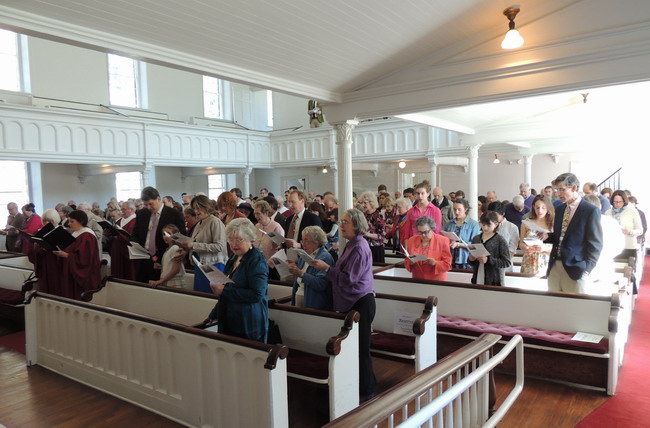
Singing“To sing and love as angels do” is a line from one of Isaac Watts’ hymns (he wrote over seven hundred). I love the phrase. It places singing right up there with loving as one of those activities that pleases God. I have long pondered the central place singing holds in worship, and its importance to the worshiper. Here is an excerpt of an article I wrote about “the worshiping self:”

“In hymn singing the worshiping self experiences transcendence as one among many within a congregation. There, in worship, God the other is addressed by the singer, not in isolation, but as one voice among many others. The hymn singer uses the body as well as the intellect in an integrated act of worship engaging the whole self. Hymn singing also roots the worshiping self within the life of the congregation among whom the singer works and plays, rejoices and weeps. Since the congregation is the local embodiment of the church catholic (what P. T. Forsyth called “the great church”), the hymn singer is part, not only of the congregation physically present, but also the great congregation, both the ecumenical church in its geographical breadth, and the communion of saints in its temporal length across ages and generations.

Additionally, the hymn is a repository of the tradition of the great church, and the faithful learn scripture and doctrine from singing as much as they do from sermons and catechesis. Finally, and most significantly, the singer of hymns not only addresses God, but is, at the same time, addressed by God, so that hymn singing becomes an event of grace. The singer is addressed as a forgiven and justified sinner, and it is often in the singing of the hymns, that the worshiping self is able to experience the grace of justification, and respond with faith and obedience.” (“The Worshiping Self” in Persons in Community: Theological Voices from the Pastorate. Edited by William H. Lazareth. Eerdmans, 2004.)

I also believe that music in general and singing in particular can give us access to the divine presence as no other medium can, which is why even non-believers often are lovers of Bach’s great religious works. Even though my writing is primarily theological and devotional, I have sometimes turned to writing hymns because there is something I want to express that I can in no other way (to see some of my hymns go here.)

I recently wrote:

Singing can help faith, for sometimes we can sing words that we are not yet able to say. I have often noticed singers in choirs who would not call themselves believers belting out sacred music as if they meant it.

Perhaps they do mean it. Who is to say that a singer singing out “And he shall reign for ever and ever” in Handel’s Messiah is not expressing a faith and hope that he or she might have trouble putting into spoken words? (From my Still Speaking Daily Devotional, to see it all go here)

Singing binds us together and reminds us we are not alone. “Our personal faith may wax and wane, but the church’s faith goes on from generation to generation. I like to think of it as a great choir, where each part supports and strengthens every other part, creating something beautiful and harmonious. ”

(Photo: Easter Sunday, 2014, at the First Congregational Church UCC of Stockbridge, MA, where I am a member.)

Unknown's avatar

“By Their Groups Ye Shall Know Them”: Celebrating Max L. Stackhouse

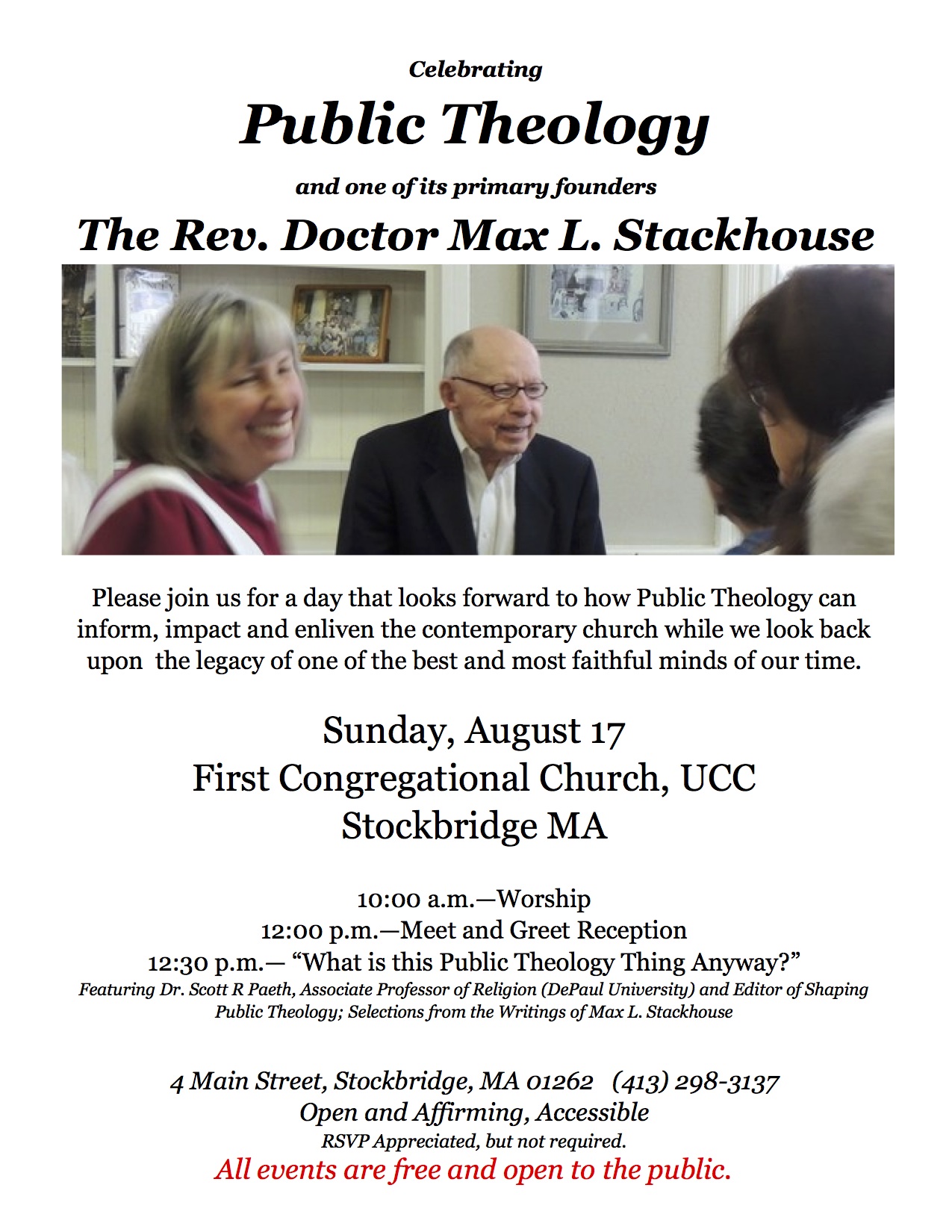
Max Stackhouse FlyerWe had a very moving day today, as we celebrated Max Stackhouse at First Congregational Church, United Church of Christ,  in Stockbridge, Massachusetts, first in our morning worship, then followed by a first-rate public lecture on Public Theology by his former student, Dr. Scott Paeth, one of the editors of a new anthology of Max’s writings, Shaping Public Theology (Eerdmans, 2014). It was not lost on many of us that we were hearing about Public Theology in the congregation where Jonathan Edwards was the second pastor and Reinhold Niebuhr was a member.

Max, and his wife Jean, are well-loved, long-time members of this congregation, and many friends, former students, and colleagues were there. There was very special music from some of Jean’s colleagues at the New England Conservatory, and a beautiful letter/tribute was read from Yo Yo Ma, a board member of BITA, who was unable to be there because he was performing in Cleveland. It was a red letter day. Thanks to my pastor Brent Damrow for putting it all together and for giving me the opportunity to say a few words. Here they are:

“By their fruits ye shall know them.”

Matthew 7:20

 Max’s mentor, James Luther Adams, liked to expand on Jesus’s words “By their fruits ye shall know them” to say, “By their groups ye shall know them.” For me to list all the groups, societies, and institutions Max has founded or been active in would use up all my allotted time this morning

So I’d like to highlight two groups that Max and Jean created here in the Berkshires. When they moved here they planned monthly gatherings of the United Church of Christ clergy and their families in their home on Sunday nights. We’d all share a potluck supper, and then the children would retire to watch a video (Willy Wonka and the Chocolate Factory was a favorite), and the weary pastors and spouses would go to the living room and enjoy friendship and good conversation.

The very first time we went there I firmly instructed my kids during the car ride to address Max and Jean as “Dr. and Mrs. Stackhouse.” When Max greeted us at the front door he knelt down low and said to them “We lived in India, and in India the children call grown-ups Auntie or Uncle, so you can call me Uncle Max.” Andrew nodded soberly and said, “OK, Dr. Stackhouse.” Those gatherings were a blessing to me and to my family, and to many clergy colleagues.

You all know about Max and Jean’s wonderful organization The Berkshire Institute for Theology and the Arts (BITA) that brought together artists, lay people, pastors and scholars for discussions, performances and fellowship. Again Max and Jean opened their home for a meal to the participants.

I mention these to illustrate the commitment that Max (and Jean, too) have to bringing people together to think and talk about important matters, and to share their life with others. Wherever they have lived or traveled around the world, and that list is also huge, they have made deep friendships and countless connections with all sorts of people.

I must confess that in addition to being my teacher, mentor, colleague, and friend, Max is also “a voice in my head.” I think Scott (Paeth) and other former students of Max will recognize how the Stackhousian voice lingers long after the studies are over.

What does this voice say? Well, to take just one example, Max, who is the son and grandson of Methodist preachers has an allergy to hyper-individualistic religion. “Pietism” is the word he uses to describe such impulses.

“Pietism” is a perennial danger for Christians and a regular feature of American religion, where the emphasis is on me: my faith, my experiences. So the Stackhousian voice in my head sometimes says things to me like, “Be careful, Rick, that your faith doesn’t become too individualistic, too private, because faith, though personal, is not private. Your faith is about you, but it’s not all about you.”

Some view a congregation as a collection of beautiful cut flowers collected as in a vase. The beauty is in the individual spirituality, which each person brings to make a beautiful bouquet.

Max, or at least the Stackhousian voice in my head, rejects that view. For Max participation in a congregation is more corporate and organic than that. He might prefer to think of us more like a tree with common roots.

He wants us to think of ourselves as bound together by shared covenants and commitments that are thicker and more transcendent than the sum total of our individual spiritualities. Which is to say that our personal faith is shaped, formed, strengthened and enriched in life together as a congregation.

He wants us to always be asking big questions, such as, “What does it mean to live life together under God?” “What does it mean to be the body of Christ?” He wants us to think about important words such as covenant and vocation.

He believes that out of this shared life and these deep conversations comes a world-transforming Christianity, like that of our Reformed and Puritan forbears, that helps shape our larger community and society.

You can read in Max’s many books the arc of his Christian Social Ethics, but you can also clearly see in his life and commitments the embodiment of his thinking, the caring for peoples and societies by attending to the way they organize themselves and by how they think about who they are together under God.

I give thanks to God for Max’s part, and Jean’s too, in my life and the lives of my family, and also in the life of this congregation. Amen.

(For a podcast of the whole service go here)

Unknown's avatar

Max L. Stackhouse and Public Theology


Max Stackhouse Flyer

 My teacher, mentor, colleague,  friend and Berkshire neighbor Max Stackhouse, one of the primary founders of Public Theology, will be celebrated at our church in Stockbridge on Sunday. (see flyer below)

Dr. Scott Paeth, one of the editors of a new book of Max’s writings, Shaping Public Theology (Eerdmans, 2014) will give a presentation after morning worship.

Several years ago I posted on Max’s  “God and Globalization.” You can find that here. In Max’s body of writings he has persistently challenged the dominate economic view of society (whether capitalist or socialist) as reductionist.For example, here is an excerpt from a letter he sent us back in 2009:

The economies in each area (of his several travels in the world) have some things in common, such as whether people have little or much, they want more, and in all contexts the laws of supply and demand operate. But, what people want more of and why they want what they want, and what they are able to supply and what they demand for what reasons are quite different. These things differ according to their view of and experiences in family life, political power, legal systems, educational opportunities, medical conditions and technological capabilities. In other words, economics is less an independent cause in social stability or change, than a result of the cultural and civilizational fabric. And, here is the main point, these are all deeply influenced by the dominant religion as shaped by the professional leaders of that religion — the clergy, intellectuals, theologians, and charismatic leaders who appeal to the core of the faith and relate it to the social realities the civilization faces. Under the influence of the secularization hypothesis, religion is a by-product of economic (and psychological) factors. (For the whole letter go here.)


If you are in the area join us for this celebration of Max and his important contributions to Public Theology:


Max Stackhouse Flyer

Unknown's avatar

Remembering Willis Elliott: theologian and gadfly

Willis ElliottMy dear friend and colleague Willis Elliott has died. Scott Paeth’s FB post today captures some of the essence of Willis:

“For those who did not know him, he was the often-insightful/often-infuriating gadfly of the United Church of Christ, and a long-time participant in the Confessing Christ group. He died old and full of years”

I met Willis at the very first Craigville Colloquy back in 1984. He spoke at dinner about the “Christian Connection,” the often overlooked piece of the four-church merger that became the United Church of Christ. I thought, “Who is this guy?” Smart, articulate, funny, and insightful. He had a full white beard like Santa Claus, and I thought he was really old, but that was thirty years ago so what did I know?

Later we had him at my congregation as a speaker and with his wife Loree a guest in our home. He was a brilliant, multi-lingual polymath, a former fundamentalist, and at times as difficult and uncompromising as Jeremiah. If there had been a shop that sold iron yokes, Willis might have purchased one. But he could also be an encouraging mentor. Years ago I did a presentation at the MA Conference annual meeting and afterward he made a point to come up and thank me. He also said, “I didn’t know you had it in you!” That was Willis.

In the 1990’s he was one of the founders of Confessing Christ in the United Church of Christ, along with Gabe Fackre, Fred Trost, Jim Gorman, Leslie Zeigler, Barbara Clemons, Bennie Whiten, Herb Davis, Andy Lang, Ted Trost, myself and many others. “Confessing Christ” was an invitation to “joyous theological reflection and serious theological work” on behalf of the ministry and mission of the United Church of Christ.

For years we had our Confessing Christ annual meeting at the church I was serving in Pittsfield, MA, and I got to know Willis well. He was one of the least compromising people I have ever known, and the least career oriented. He had been the librarian and Old Testament Professor at New York Theological Seminary, and before that had served on the national staff of the UCC.

He was a deeply committed Christian, reading the Bible every day in the original languages. His “Think-Sheets,” free of an editorial hand, were challenging, quirky, often brilliant, and, just as often, maddening. They always made you think.

In his latter years his eyesight waned, but he kept up a lively correspondence and participation on the Confessing Christ list-serve conversation.

The “thickness” of the conversation in the United Church of Christ, and the great church, will now be poorer for the loss of his voice, but he had no doubt, and neither do I, that he is now numbered among the great cloud of witnesses. I thank God for him.

Unknown's avatar

“Our eyes are on you”

AT

“We do not know what to do; but our eyes are on you.” – 2 Chronicles 20:12

“It took many years in the ministry for me to be able to say, “I don’t know what to do,” but it was something of a turning point for me. . .  There is often a certain kind of functional atheism that creeps into the way we do business in the church. We might open our meeting with a prayer, but we fully expect to take care of business ourselves.” (From today’s Daily Devotional) Read whole post

(Photo: Appalachian Trail in S. Egremont, Massachusetts. By R.L. Floyd)


Unknown's avatar

Some Lenten Reflections on Forgiveness

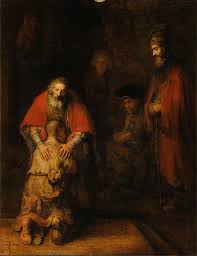
Prodigal son by RembrandtThe idea of forgiveness is so ingrained in our cultural and religious traditions that it is easy for us to overlook what an extraordinary idea it is. Although we tend to separate out “forgiving” and “forgetting” the biblical notion of forgiveness is literally “a forgetting,” in that after the act of forgiveness “it is as if ” the grievance never happened.

It is only the aggrieved party who can do the forgiving, and the act of forgiveness “wipes away” the memory of the grievance so that it no longer has any influence on the relationship. So it is that the phrase “I will remember their sins no more” appears again and again in the Bible, for example, in Isaiah, Jeremiah, and Hebrews.

Before this idea of forgiveness took hold there was simply “revenge,” in which affronts were met with retribution, often disproportionate to the original wrong. These “family feuds,” if we want to call them that, could go on for generations, and still do, as we see sometimes, for example, in the Middle East, where memories of affronts are long.

A moral advance on such indiscriminate retribution was the lex talionis, the “law of retaliation,” which prescribed that the response had to be equal to the offense, as, for example, “an eye for an eye and a tooth for a tooth.”

But the idea of forgiveness moves social relationships into a whole new key, and goes beyond mere justice. Indeed, forgiveness is an affront to justice, which is one of the perpetual accusations made against the Gospel by its critics.

Israel’s God is a god who forgives, but we may recall that the first covenant in the Bible is the covenant with Noah, and in that story God’s forgiveness has limits. “The Lord saw that the wickedness of humankind was great on the earth, and that every inclination of the thoughts of their hearts was only evil continually.” (Genesis 6:5)

So God does not forgive the people and punishes them with a flood. God shows some mercy, enough to save a remnant in the ark, the blameless Noah and his family, and the several species of animals. But God repents of his action, viewing it as a dry run (if you’ll excuse the pun), and promises never to do it again, laying down his arms (so to speak,) and leaving his bow in the sky to remind him.

In Exodus there’s a seeming change in the character and identity of God, in which mercy becomes a key quality. In preparing for today I took two volumes of the Anchor Bible Dictionary, the M volume for “mercy,” and the F volume for “forgiveness.” When I found the entry for “mercy” it said, “see LOVE.”

In Exodus we have a particularly important passage for subsequent Jewish and Christian understandings of God’s identity and character. It is Exodus 34:6-7, when God tells Moses to go up Mt. Sinai with two stone tablets. As you recall, God descended in the cloud, revealed the divine name to Moses, and then proclaimed to him:

“The Lord, the LORD,
a God merciful and gracious,
slow to anger,
and abounding in steadfast love and faithfulness,
keeping steadfast love for the thousandth generation,
forgiving iniquity and transgression and sin,
yet by no means clearing the guilty,
but visiting the iniquity of the parents
upon the children
and the children’s children,
to the third and fourth generation.”

Now this passage is really packed with things to ponder, but I want to highlight three for you.

1. First, this is a big moment in the history of God and his people. The revealing of the divine name tips us off to it, and right after this is the giving of the law and the Sinai covenant. To reveal one’s name is to be in relationship. God chooses to be in relationship with Israel, and renews the previous covenants.

2. Second, while we in our day tend to focus on the individual, and on individual sins, notice that here the emphasis is collective to the people as a people.

3. Third, the relationship is not only collective it is trans-generational, the promise applying across multiple generations.

I would guess that most of what we talk about in this Lenten study over the next few weeks will be about individual acts of forgiveness applied to willful, intentional sins. But the early understandings of forgiveness in the Bible were almost always collective, and almost always for inadvertent sinning.

So I need to say a word about why divine forgiveness was a necessary condition for God and Israel to be in relationship. This is a little hard for us to get our minds around because we tend to think of sin as a moral category, and it was also for Israel. But sin was frequently, perhaps even more frequently, thought about not as morality, but as purity.

God was understood to be holy and humans were not, the creator and the creatures were in different categories. And so we see the development of the elaborate holiness codes in Leviticus, which were designed to produce ritual purity in people so as not to offend God. Even so, it was impossible to keep all the myriad laws required.

Remember I said most sins that needed to be forgiven were inadvertent. So it wasn’t flagrant sinning like robbery, murder, or adultery, the ones we think of in moral categories, which needed to be forgiven so much as the infractions against ritual purity.

This is part of the backstory behind some of Jesus’ conflict with the scribes and the Pharisees who were zealous for the law, the maintaining of ritual purity.

I don’t think I am stating it too strongly to say that our very humanity makes us in need of forgiveness from the God who is holy. And that is why when God chooses to be a forgiving God it is a precondition for us to be in relationship with God at all.

And again, I think if we look at the grand arc of the whole Christian Story in the scriptures of the Old and New Testaments we see how the very identity of God can be understood in terms of forgiveness, the fruits of mercy and love.  So much so that, after Good Friday and Easter, the early disciples of Jesus, all of them Jewish, as he was Jewish, came to call him “Lord,” the name previously reserved for God alone. It is quite remarkable. They saw in his love, mercy, and forgiveness congruence with the character and indenty of their God.

Before I move on to focus on the New Testament I need to mention something else relevant to the idea of forgiveness that will come into play later: that is that the priestly cult in Israel saw one way to blot out the memory of sins was through a blood sacrifice of an animal as an atonement or expiation. The people around Jesus’ had either participated, witnessed, or at least knew about such ritual blood sacrifices from the daily operations of the Jerusalem temple. So when we talk about Jesus’ death as atonement for sin, we are missing the original referent of the metaphor, which is partly why the idea is so hard for us. It’s a dead metaphor. I’ve written a book about all this if you want to know more (see When I Survey the Wondrous Cross: Reflections on the Atonement, Wipf and Stock, 2010)

All these understandings about God’s holiness get carried into the Christian era, so the New Testament also understands sin as an offense against God’s holy law or against another human being. As in the Old Testament forgiveness involves the wiping from memory of the offense by the one affronted so as restore harmony in the relationship.

The seriousness of sin is one of the chief preoccupations of the New Testament. Humans cannot by themselves avoid God’s condemnation. So Jesus says, in the Sermon on the Mount, “Unless your righteousness exceeds that of the scribes and the Pharisees you can not enter the kingdom of heaven.” (Matthew 5:20) And St. Paul flatly declares in his letter to the Romans: “All have sinned and fallen short of the glory of God.” (Romans 3:23)

This is the predicament of the human condition, and the context of Jesus’ ministry. In the retrospective look of the apostolic age it was understood that, as it says in 1Timothy 15, “Christ Jesus came into the world to save sinners.”

Our best example of forgiveness at work is in “The Parable of the Prodigal Son,” (Luke 15:11-32) which I know some of you have been studying. One of the key features of that story is the father’s eagerness to restore his relationship with his lost son. Notice the father forgives the prodigal before the son even has time to deliver his little repentance speech. We should recall that the whole purpose of forgiveness is the restoration of the broken relationship. And in this parable the older brother, who didn’t leave, didn’t sin, and kept all the rules, thinks it is unfair that his deadbeat brother is restored. And it is unfair, because forgiveness is driven not by justice but by love. The older brother thinks he has earned his father’s love by his own achievements. But you don’t earn love. The father loves the prodigal not because he is good, but because he is his.

I’d like to quickly point to two more features of the New Testament idea of forgiveness. The first I have mentioned already: the death of Jesus, which in miniature focuses the whole gospel story. Here the sinless faithful Messiah, betrayed, denied, and abandoned by sinful humanity, obediently goes to his death with forgiveness on his lips, praying to his Father for forgiveness for those who killed him. It is a loving act of atonement.

The second feature, which will come up in our questions, is the way Jesus taught his disciples to pray about forgiveness in the Lord’s Prayer: “forgive us our trespasses (debts, sins), as we forgive those who trespass against us.” Here, and elsewhere, Jesus is saying that the capacity to receive forgiveness is somehow intimately connected to our capacity to forgive. In Matthew 5:23-24, for example, Jesus says, “So when you are offering your gift at the altar, if you remember that your brother or sister has something against you, leave your gift there before the altar and go; first be reconciled to your brother or sister, and then come and offer your gift.” It is as if only those who can forgive can understand it enough to receive it.

( I gave this Lenten Study presentation on March 9, 2014, at the First Congregational Church (UCC), Stockbridge, Massachusetts.)

Picture: The Prodigal Son by Rembrandt

Unknown's avatar

“From Here to There and Back Again” The Journey from Text to Sermon

On the other hand

“For as the rain and the snow come down from heaven,

   and do not return there until they have watered the earth,

making it bring forth and sprout,

   giving seed to the sower and bread to the eater,

so shall my word be that goes out from my mouth;

   it shall not return to me empty,

but it shall accomplish that which I purpose,

   and succeed in the thing for which I sent it.”  (Isaiah 55:10-11)

The title for today’s gathering was announced as “Getting from There to Here.” As I reflected on it I wondered if perhaps “getting from here to there” might be more apt. “Here” being the text in front of you, to “there, ” the sermon. That works.

But as I thought more about it I saw the wisdom of  “from there to here.” From “there,” “the strange new world of the Bible,” to “here,” the world we live in. And I thought of some of the various locutions we have used over the years to capture this movement from text to sermon, such as “from text to context” or “from Word to world.”

Then I considered the many ways I have approached the writing and preaching of sermons, and I realized this movement from text to sermon was more dialectical and less linear than any of these ways of speaking about it.

As I thought about it, the more I liked the sub-title of The Hobbit, which as you may know is “There and back again.” So perhaps “here to there and back again” is more like it.

From here to there and back again describes a journey that is not just a straight line, but rather more like a journey without a  map or even a predetermined end. And I like this way of thinking, because it captures how I have experienced sermon preparation in my four decades as a preacher.

I start with a Biblical text, and then I live with that text throughout the week on my journey, revisiting it and wrestling with it and worrying it until I begin to hear something of the voice of God in it, and by then the contours of the journey begin to show themselves, as do even the purpose of the journey and it’s destination.

The process seems to take on a life of its own, which is another way of saying that the Word of God is alive. I like today’s Isaiah text where God uses the agricultural metaphor of rain and snow watering the earth and making it produce to describe the way his Word works, “It shall not return to me empty, but it shall accomplish that which I purpose, and succeed in the thing for which I sent it.”

And I want to say a bit about what I mean when I say “the Word of God,” which can mean one thing or another, even sometimes one thing and another, or even three things depending on the context.

One way of thinking about this that has helped me comes from Karl Barth. He wrote about the threefold understanding of the Word of God.  First, there are the written words of the Bible, then there are the spoken words of the preacher, and finally, and most importantly, there is the living Word, Jesus Christ.

This living Word is mediated through both the written words and the spoken words. The prayer I began my sermon with today is based on this idea: “Through the written word, and the spoken word, may we behold the living Word, even Jesus Christ our Lord.”

And that is not to say every text needs to be understood Christologically (although it can be), as in the text we have from Isaiah today. But to say there is a living Word is to say that whenever we hear the Word of God as direct address to us, it is the same Word of the same God, who came to us and for us and became the Word made flesh.

So when I talk about the Word of God in sermon preparation, it may be a reference to the text itself, the words, or to the proclamation in the form of a sermon, the Word preached, or to both, but the goal of the journey is, through the finite human words of the text, and the finite human words of the preacher, to transcend this finitude to hear the living Word of God. And I believe this is the primary task and challenge of preachers, and of the church, for that matter.

Let me say a little bit more about the words of the text and the words of the preacher as the Word of God. I think of them by analogy to the doctrine of the two natures of Christ. Jesus is truly human and truly divine, not half and half or some other percentage.

And in much the same way (although not identically) the words of our Scriptures, the Old Testament and the New Testament, are truly human and truly divine. Human in every way, written (and edited) by human beings, and truly divine through the agency of the Holy Spirit of God who inspired the writers to write them, the same Holy Spirit the church invokes when we read them.

And the same thing can be said about the words of the preacher. A sermon is not written in some special spiritual words, but in the same human words that we use in everyday speech. Since everyone in this room is a preacher I don’t have to belabor the point that we are all human, even all-too human. Yet the Holy Spirit that inspired the writers of Scripture is the same Holy Spirit that inspires the preacher, and the same Holy Spirit that the church invokes and invites as it prepares to hear the Living Word of God from the frail words of scripture and the frail words of the preacher.

This is admittedly a high view of preaching, and some might say it claims too much for the preacher. I would say quite the opposite. It is the views of preaching that put emphasis on the personality and performance of the preacher that claim too much for the preacher.

The claim that the preacher is to be a minister of the Word of God is much like the church’s understanding of the celebrant at the eucharist. The principal was established early in the church during the Donatist controversy. The Donatists were heretics, so the question arose whether the baptisms they performed were valid. And the church agreed that “the efficacy of the sacrament does not depend on the sanctity of the celebrant.” So the preacher may be more or less gifted with the homiletical arts, but it is not those gifts that are decisive. What is decisive for the preacher is that he or she has been set apart to deliver the church’s proclamation, so that the church may hear in it the living Word of God. It is not about the preacher. It is about the church hearing the Word of God.

This is a (nearly) sacramental view of preaching, that the preacher should say what the sacrament shows. And in both cases neither the preacher nor the celebrant has control over the Holy Spirit of God, as if we somehow could control God. No, Christ is not truly present in the sacrament nor truly alive in the preached Word because we invoke his name, but rather because he himself commanded us to do these things and promised to be present with us when we did.

So with this high view before us, and a text in front of us, how do we get from there to here or from here to there and back again?

The first thing I want to say about approaching a text is the expectation that God will speak through it. Which is to say that the high view I propose operates out of trust. I think it was Richard Hayes who wrote about a “hermeneutic of trust.” For decades we have been talking and hearing about “a hermeneutic of suspicion,” and that has had its place as an corrective to the Scriptures being misused as instruments of oppression and injustice, “texts of terror,” as my teacher Phyllis Trible so eloquently called them. But there has been a heavy price to pay for the widespread “hermeneutic of suspicion” that has so pervaded the academy for decades, in that many preachers now reflexively distrust the texts.

And I think it is sometimes necessary and appropriate to distrust a text, but it shouldn’t be where we start. Sometimes distrusting a text along the way will lead you to the Word of God.

So the text is in front of us. Perhaps it is an assigned text from the lectionary. I like that, because I can be a lazy sinner who is inclined to make my favorite texts do tricks for me, but that is just me.

Perhaps the Bible is open on our desk, perhaps it is on our computer screen or smartphone, but there it is. First things first: read the text.

Read it in expectation that God’s Word can be heard in it, but don’t rush to decide what it means or even what it has to say. Texts need time. They need to be listened to. I have always described my sermon preparation as inhabiting a text. Living in it.

Another good way to think about it is to “stand under” the text so as to understand it. And the preacher stands under the text along with the rest of the church.

I am really talking about hermeneutics now more than the homiletical side of things. So you all know the various ways to worry a text into view. Read it in the original languages if you have them. Read it in several translations. Look up any key words or phrases in a Bible Dictionary. Take a stroll through some commentaries. Find out its genre and its original context. In other words do your homework. I once preached a sermon that involved Herod, and added “you remember him from the Christmas story.” My dear friend Luther Pierce, a retired UCC minister, shook my hand at the door and said, “Good sermon, Rick, but you conflated Herod the Great with Herod Antipas. Different Herod.” Oops!

So once you’ve done your due diligence and you have the text in your grasp, reflect on the context. Those of you who were preaching in the weeks after 9/11 may recall that the Common Lectionary texts were from Jeremiah and Lamentations, texts we had all avoided in the past because they are horrible cries of despair for the destruction of Jerusalem. All of a sudden after 9/11 texts about the city of devastation and the burning tower became eerily contemporary.

Which is to say contexts change. The immediate context of any preacher is the life of the congregation, and when I talk of inhabiting a text, I am referring to going about one’s pastoral duties with the text in mind. From here to there and back again.

Then there are the larger contexts of the communities in which we live and the country and world we are a part of. Sometimes contexts demand our attention.

We rarely get the kind of compelling clarity about the relationship between text and context that we got after 9/11, but keeping the text in mind as we think about the multiple contexts will often show us the way to go, the particular context that needs to be addressed by the Word of God.

The dialectic of the journey of text to context and context to text means straddling two worlds with the hope we can find in them the same story.

I had the privilege of preaching my daughter’s ordination sermon back in June, and afterwards Mary Luti said, “I like the way you went back and forth from the story in the scriptures to your story now.” And her comment made me realize that I preach that way because to me it is the same story.

I immediately thought of Hans Frei’s The Eclipse of Biblical Narrative, a wonderful and important book. Frei’s thesis is that prior to the Enlightenment Christians inhabited the Biblical Story. They understood it as their story. They were part of it. The Enlightenment changed that as we held the story at arm’s length like any other observable phenomenon.

The task of the preacher is to repair the breach; to make the Christian Story our story again. I am reminded of Bruno Bettelheim’s book, The Uses of Enchantment, where he argues for the re-enchantment of the world for children through fairy tales.

Letting the words of scripture and the words of the preacher be the Word of God for God’s people requires a similar kind of re-enchantment. It means the church realizing that the Story isn’t just back there, but is still going on and we are characters in it.

Let’s look quickly at our Isaiah text for today to see how this might be done. The text is from Isaiah of the Exile and the context is a people who have no reason to be hopeful, since they have lost the three pillars of their identity, their temple, their land and their nation.

The promises made to their ancestors Abraham, Isaac and Jacob seem null and void. Their prospects seem dim, their possibilities few.

Into this context God speaks through the prophet. “My ways are not your ways, my thoughts are not your thoughts.” “You know that rain and snow we sometimes get in the desert? That is what my word is like. It will not come up empty. It will make happen that which I promised.”

And that is what the Word of God sounds like.

And when we hear this story, can it speak to us, where our prospects seem dim and our possibilities few? Can it speak to a declining church too often eager to call it a day? Can it speak to a nation full of grave injustices and inequalities? Can it speak to a world of death and terror?

When Isaiah speaks the Word of God to the exiles he lets them see what can’t be seen, and makes them believe what they can only know by trust in the one who speaks to them. The Word makes them part of the story again, the story that began at the beginning when God said “light” and there was light, the story that saw their ancestors freed from bondage, the story that seemed to come to an end, but now God says to them, “No, it’s not ending. Not at all. I will lead you through the desert of your journey into my own future.” And what will it be like? It will be like this:

“You shall go out in joy, and be led back in peace; the mountains and the hills before you shall burst into song, and all the trees of the field shall clap their hands. Instead of the thorn shall come up the cypress; instead of the brier shall come up the myrtle; and it shall be to the Lord for a memorial, for an everlasting sign that shall not be cut off.”

And let the people say: Amen.

I preached this sermon at the New England Pastor’s Meeting of Confessing Christ, West Boylston, Massachusetts, on September 26, 2013.

Unknown's avatar

Unity in the United Church of Christ: A Theological Reflection

UCC(This year marks the twentieth anniversary of my address to the Executive Council of the United Church of Christ, which I gave in Cleveland , Ohio, on October 17, 1993. I was asked by the Executive Council to reflect theologically with them prior to their meeting. The address that follows is the result of that invitation. This address was also published in Papers from the Initial Meetings of Confessing Christ, November-December 1993.  I reprint it here as given with a few small editorial changes.)

Let me begin my reflections by invoking the motto of the great Reformed Pastor Richard Baxter (1615-1691), which can be translated as:  “In essentials, unity; in nonessentials, diversity; in all things charity.”  (He seems to have got it from the German Lutheran theologian Peter Meinerlin). Baxter referred to essentials as “necessary things” and to nonessentials as “doubtful things,” and it seems to me that many of the strains we experience in the UCC are because of the difficulty in distinguishing between what is essential and what is nonessential, what is necessary and what is doubtful, by which Baxter meant what is open for discussion. To make these distinctions in the United Church of Christ will not be easy, but I am convinced that unless we carry out a continuing and wide-ranging debate on what constitutes our essentials, both our unity and diversity will continue to be imperiled. I speak to you as a lover of the church, a local church pastor who has been through the chairs of denominational and ecumenical life.

I worry about the church these days. Any alert church person knows that the church is undergoing profound and far–reaching changes.  The church of tomorrow will not look like the church of today, of that we can be certain. A flurry of books has appeared on the decline of the mainline churches, such as Loren Mead’s The Once and Future Church, Leander Keck’s The Church Confident, and Jackson Carroll and Wade Clark Roof’s Beyond Establishment: Protestant Identity in a Post–Protestant Age, just to name a few of the most recent ones. All describe changes that are taking place, using words like “crisis” and “malaise.” All offer some tentative steps that may help the church to move in fruitful and faithful directions. None can see clearly what the future church will look like.  Mead is convinced that the new church that is being born out of the old mainline will not be seen clearly during our lifetimes and I tend to agree with him. God is doing a new thing, of that we can be sure, but just what it is that God is doing is not so easy to say.

To prepare ourselves and our church for this future requires the debate about which I have spoken, a debate grounded in study and prayer, a debate that clarifies and articulates what it is that constitutes the United Church of Christ, a debate that seeks passionately to discern the essential defining marks of our life about which we need unity; that defines, too, what are the nonessentials that can be left to Christian freedom in a wide-ranging diversity, and how do we recover the charity in all things that  the Apostle Paul said is the greatest gift God gives to those in the body of Christ?   Let me share with you some of the threats to our unity that I see.

Threats to Unity

1.  A Faulty Inclusivity

The first threat to our unity that I want to suggest to you is what I call a faulty inclusivity. I believe that the gospel creates its own diversity, addressing and calling all sorts and conditions of people. But diversity of “races, tongues and nations” or even theological viewpoints is not the same thing as diversity of faith. To paraphrase P. T.  Forsyth, “Diversity is a fruit and not a root.” Our diversity is rooted in the unity we have in Christ, and in that unity let us strive to be as diverse as possible. But in many cases our diversity has been regarded as a creed extended to everyone and everything without adequate account for the essentials that define our community.

The church needs to be both authentically inclusive about some things and carefully exclusive about others, and needs always to pray for wisdom to discern the difference. Listen to what Loren Mead has to say about this:  “At its worst, exclusivity becomes rigid and legalistic, separating the righteous from the unrighteous according to manmade standards . . . But exclusivity is important because it speaks of something more important than these limited boundaries.  Exclusivity states that there must be a place where a decision, a belief, or an action marks the difference between who is ‘in’ and who is ‘out.’ Exclusivity demands that one who identifies with the Christian community stands for something, not for everything. At its best it engages and focuses energy and anchors community life. Inclusivity goes in the other direction. It opens its arms wide to the diversity of the world, inviting the stranger into community without question. At its best it represents hospitality and prevenient grace — acceptance before it is asked or earned.  It points to the acceptance of the unacceptable.  At its worst it degrades the meaning of membership to a ‘laissez faire’ anything goes.”  (Loren Mead, The Once and Future Church, Alban Institute, 1991, p. 48)

Now I would be the first to cry foul if I perceived the UCC to be faced with a crisis of exclusivity: of rigid, arbitrary, and legalistic bars to membership or participation, but that is not our problem. In the culture of the United Church of Christ “exclusive” is considered a bad word, “inclusive” is a good word. A friend of mine who is a UCC pastor and spent some of his formative years within the ranks of conservative evangelicalism says that the word “inclusive” in UCC circles reminds him of nothing so much as the word “inerrant” in evangelical circles. Nobody really defines it, he comments, but we all are supposed to know what it means, and if you aren’t you are in trouble. It’s used as law, not as gospel. Our problem is not in the area of exclusion; our problem is a faulty inclusivity that often fails to distinguish between the authentic need for Christian confession around membership and the desire to be tolerant and nice.

Let me offer a personal anecdote.  A decade ago when I was relatively new to Berkshire County my friend, the local rabbi, made an appointment to see me. He seemed uncharacteristically nervous and it soon became clear why. Two of his congregants had informed him that they were “members” of one of our UCC churches in Southern Berkshire, and that the pastor of that church told them that there was no problem belonging to both the synagogue and the church, because we worship the same God, “and we are open here to people of all religions,” including, I later found out, some who identified themselves as Buddhists, and some who are Hindus. I told the rabbi that I found that interpretation of local church autonomy incomprehensible, and would look into it.

When I mentioned this to a member of the Church and Ministry Committee, I was told that each local church is responsible for forming its own covenants and requirements for membership and that this church was within its rights. I can’t imagine that the founders and framers of the United Church of Christ ever imagined that a local church would or could decide to become a syncretistic religious fellowship across faith boundaries.

When I talk this way about excluding people from membership in our churches who clearly are not practicing Christians, who are honest enough to say they do not confess faith in God and do not consider Christ to be the head of the church, I hear in response that we are not a creedal church. That is true in comparison to the way creeds function in other communions. We do not hold them up like litmus paper to test people’s orthodoxy. They are “testimonies and not tests.” Nevertheless, the United Church of Christ is a Christian Church in the classical Christian tradition.  Our constitution says that we honor “the historic creeds and confessions of the Christian Church.” We are a church, not a sect, and though we provide space and freedom for a wide variety of viewpoints and perspectives we do not make it up as we go along. Essentials such as the Trinity, the headship of Christ over the church, the two sacraments of Baptism and the Lord’s Supper, the authority of the Bible, just to name a few, are not optional items to be embraced or discarded at our whim. They belong to the whole Christian church of which we are a part. Members join our congregations by profession of faith and that faith has content. Which leads me to my second threat to our unity.

2.  Amnesia about the Church’s Traditions

We are forgetting our heritage. Leander Keck says the mainline churches are like people who inherit a grand estate, but instead of moving in and inhabiting it they have camped out in the backyard, “because they neither knew nor cared how to live in the house.”  (Leander Keck, The Church Triumphant, p. 16) We live in an ahistorical culture where memories are short and tradition is not valued, and, unfortunately, the church is not exempt from that amnesia. But those who lose touch with the living theological heritage we share are condemned to be constantly reinventing the wheel. Now there is a kind of traditionalism that resists all adaptation and change and elevates tradition to the place that only scripture should occupy. This is not what I am talking about. Rather, I refer to an authentic appreciation for the rich tradition that is a treasure bequeathed to us from the past. The church historian Jaroslav Pelikan offers us this epigram;  “Tradition is the living faith of the dead:  traditionalism is the dead faith of the living.” (Jaroslav Pelikan, The Vindication of Tradition, p. 65)  Edmund Burke (1729-1797), the British politician and writer, called the social contract a “partnership not only between those who are living, but between those who are living, those who are dead, and those who are to be born.”  That is what tradition is in the church, the place where the communion of saints get their say.  As Chesterton put it, “Tradition is only democracy extended though time.”  (G.K. Chesterton (1874-1936), Orthodoxy, 1908)

We will always need to find ways to tolerate those in the church that like to color outside the lines; Jesus and the prophets did no less. But let us have lines, even if we have to struggle about where they need to be drawn. Let us have lines, not as boundaries that exclude so much as plumb lines that give a true measure. There can be no pristine orthodoxy. Even the so-called Vincentian canon, the notion of orthodoxy defined as that which has been believed always and everywhere, is a fiction, and none of the doctrines of the church quite measure up to it. Doctrine develops, orthodoxy gets redefined. John Henry Newman said that “Authentic orthodoxy has to change in order to remain the same. In a higher world it is otherwise, but here below to live is to change, and to be mature is to have changed often.”  (John Henry Newman, Essay on Development, quoted in Jaroslav Pelikan, The Melody of Theology.  Cambridge:  Harvard University Press, 1988, p. 55)

So when I speak of orthodoxy I do not mean a rigid, unchanging set of dogmas, but rather that collection of articulations and expressions that allow the church to give God “right praise” which is what orthodoxy means. This includes knowing whom it is that we are praising.  I am arguing for what Hans Frei called “a generous orthodoxy.”  “Generosity without orthodoxy is nothing,” he said, “but orthodoxy without generosity is worse than nothing.” Such orthodoxy’s lines are never fixed or rigid, and must always be redefined. It is the responsibility, even the duty, of the church to do this, as the preamble to our constitution exhorts:  “[The United Church of Christ] affirms the responsibility of the church in each generation to make this faith its own in reality of worship, in honesty of thought and expression, and in purity of heart before God.” But it is not just any faith that we must make our own, it is this faith, previously defined as the “faith of the historic church expressed in the ancient creeds and reclaimed in the basic insights of the Protestant Reformers.” So the historic faith in its basic contours must be made our own, not something new of our own making. And when what is essential gets redefined by each generation, the ecumenical church must get its vote across space, and the communion of saints must get its vote across time. So deciding what is essential for the church’s life must not be left to the whim of every local church and pastor or judicatory on an ad hoc basis.

In this regard, I am dismayed by reports of local pastors using ad hoc baptismal formulas in their baptismal liturgies in the name of inclusive language. This is putting enormous strains on our unity both within the United Church of Christ and ecumenically. I have represented The Massachusetts Conference of the United Church of Christ on the Massachusetts Commission on Christian Unity for nearly a decade. Over that time I have had to defend us against the questioning of some of my ecumenical brothers and sisters about whether we are a bit loose and free with some things on which we thought we had agreement, such as baptism by water in the “name of the Father, the Son, and the Holy Spirit.” In the past, when somebody asked me about irregular baptisms in UCC congregations, I always explained the nature of our covenantal model of ecclesiology and indicated the traditional formula as it appears in the Book of Worship. At the commission’s annual meeting last year we were told about a neighboring state where a common ecumenical baptismal certificate had been created as a tangible expression of Christian unity. This had been signed by judicatory leaders representing Eastern Orthodoxy, Roman Catholicism, and every mainline denomination except the United Church of Christ.  The fact of a conference embracing such a policy makes my previous defense seem disingenuous. It takes little imagination to foresee the ecumenical implication of such a move.

The United Church of Christ is struggling mightily and at every level over the issue of language, as you all know from following the debate that rages around the New Century Hymnal. But it is not simply a matter of a correct or an incorrect approach to this vexing subject.  Professor Gabriel Fackre has identified at least nine discrete positions in relation to inclusive language. This taxonomy of the issue may well help us to sort out its complexity and come to wise solutions. One wise elder suggests that the Hymnal will only be successful if everyone is a little offended by it. But can we ever get it just right? Leander Keck suggests what is behind the call for flawless words is “a technological view of language.” He writes, “What makes this view of language so attractive during the eclipse of God and the entropy of religious vitality of the mainline churches is the implication that proper (i.e., “politically correct”) manipulation of metaphors can bring God back and vivify proper religious experience. Indeed, wherever the God-Reality has been collapsed into our language for God, one can scarcely avoid thinking that changing God-language changes God too, making us the creators and shapers of God instead of acknowledging that it is we who are the created and the shaped.” (Keck, p. 54-55)

A related form of amnesia that threatens our unity and the integrity of our mission is our forgetfulness of the language of Zion, the biblical and theological thought-world that is or should be the church’s proper primary language. I have been noticing for some time now how therapeutic, managerial and political language dominates the church’s discourse. Where once the church spoke of sin and grace, covenant and promise, holiness and righteousness, now we are more likely to hear other tongues. Therapeutic language speaks of co-dependence and dysfunction; managerial language speaks of goals and objectives and accountability; political language speaks of victimization and oppression. These are helpful perspectives to be sure, and the church has always adopted and even baptized the language of the culture around it, but always in the past as second languages.  I am struck by how much these foreign tongues completely dominate churchly discourse. Like second-generation exiles we have forgotten our native tongue and no longer know how to speak to one another in it. And since we no longer speak it in the home and less and less in church it is highly unlikely that our children will learn it, except a few nostalgic phrases the way many second generation immigrant families hold on to scraps of language they learned from grandma. Which leads me to my next point.

3.  The Failure of Transmission

Related to historical amnesia is our failure to transmit the faith to the next generation. The reasons for this are complex and far beyond our control. The network of support structures that not so long ago supported Protestant America are, for better or worse, gone.  The culture will not make people Christian, and in a church as heavily identified with culture as the UCC is, the intentional transmission of the faith will be all the more critical as the culture changes and becomes more secular.

I am currently involved in a doctoral project entitled “Christian Literacy:  Remedial Catechesis for Adults” in which I have designed an eight-week adult curriculum entitled A Course in Basic Christianity. There are 29 participants from my local church in the program, which is in its fourth week. Already we have learned some interesting things. This sample of people has few birthright members of the UCC or its predecessor bodies. The majority learned the faith elsewhere. Most have more understanding of the basic contours of the Christian faith than they thought, but they have had little experience of thinking and speaking theologically. They find, however, when they do it is empowering and exciting. They are relearning a forgotten language that once they knew. This was truer for the older members than the younger ones, however.

In the late nineteenth century Horace Bushnell wrote Christian Nurture and challenged the prevailing conversion model of his day. But Christian nurture then had the support of the family, the school and the culture as well as the church. That synthesis is over, and Christian nurture is now a failure everywhere. The Puritans worried about an unregenerate clergy. We should worry about an unnurtured clergy and laity, and muster everything in our power at every level to educate and nurture our people in the basics of the faith.

Likewise we need a renewed emphasis on evangelism. We are doing this in my congregation, having participated for three years with the Evangelism Institutes sponsored by the Board of Homeland Ministries. Transmission of the faith is never merely done by Christian education but also by invitational evangelism. But of course, it is not opinions that one feels compelled to evangelize about, it is good news; if you regard what you believe as a preference rather than the truth, evangelism will wither, as it so often has and does in our churches. Which leads me to my next threat to our unity.

4.  The Loss of Truth as Criterion

Another threat to unity is the increasingly accepted belief that there cannot be any such thing as truth, only personal preference.  “You like chocolate, I like vanilla. You like Hinduism, I like Christianity.” This is not what religious tolerance once meant, but as it is increasingly getting to be understood, tolerance is becoming a subtle faith of its own that believes that all religious claims are private and relative. This especially undermines Christian faith, which is not a philosophical system at all, but rather a claim about God acting in history. Christian faith is, as Leslie Newbigin once said, “Primarily news and only secondarily views.”  (A Faith for this One World.)

This ideology of pluralism states that all opinions are equally valid, and in doing so relativizes all religious truth claims. Many of the baby boomers who are joining our churches do not believe the Christian faith is true over other faiths, they merely have a preference for it, out of historical nostalgia or familiarity.  In his new book, A Generation of Seekers, sociologist Wade Clark Roof finds that baby boomers are generally inclined to like choice, tolerance of different lifestyles, mixing religion and psychology, and doing what works for them. Roof calls this religious consumerism and individualism “transformed narcissism,” and he suggests that it is what much of what America’s religious future will look like. The genuine openness (as well as the faulty inclusivity) of the UCC is very attractive to some of these people. That is the good news. The bad news is that their loyalty to denominations is very low, they pick and choose only the parts of the faith of the church that meets their needs, they are notoriously lousy givers, and if they feel moved to leave for a better deal or just stop being interested they will drop out without a thought. Every pastor knows this crowd. According to Roof, for the boomers tolerance is equated not with respect across religious lines so much as the belief that religion is an individual enterprise and one cannot talk of truth but only of preference. In an increasingly pluralistic society this attitude is highest among the best educated, those who make up one of our core constituencies. How we deal with the question of truth in a pluralistic world then becomes a pressing question for us, and has many implications for our unity and diversity.

To my mind the most eloquent of the recent Christian thinkers on this question is Bishop Lesslie Newbigin, a British theologian who was for forty years a missionary in India.  Newbigin makes a convincing case that the learned spokesmen and spokeswomen of contemporary Christianity who argue against making exclusive claims of truth on behalf of the gospel are in fact not making Christianity more available to their contemporaries, as they often argue, but are embracing an alternative view of history, an alternative faith actually, and in so doing are selling their birthright for a mess of pottage.

To judge the gospel by the prevailing worldview is to betray it, for the gospel itself is a view of history that calls into question every other way at looking at human history and destiny. To take but one example of how this works let us look at the interpretation of a biblical text. According to modern views a text is best understood from some outside perspective, an Archimedean point from which the observer can make sense of it. From this point of view we examine the text but the text doesn’t examine us.

Newbigin uses the now well-known example of Karl Barth “as he sat under his apple tree in Safenwil, when he discovered to his astonishment that the Apostle Paul was not only addressing his contemporaries in Rome but was actually addressing Karl Barth, and an answer was required.”  (Newbigin, The Gospel in a Pluralistic Society. Grand Rapids: Eerdmans, 1989, p. 98)

Newbigin might say that we have tried to understand the gospel from the point of view of the world, when in fact the world must be understood from the point of view of the gospel. He in no way rules out dialogue and discussion with other faiths and points of view, but admonishes us as Christians to be clear that we have a position that makes claims for itself, which cannot be denied by deciding in advance that all views are equally valid. That is of course just what the ideology of pluralism asks of those who come to the discussion.

One of the dogmas of the ideology of pluralism is the refusal to even consider the question of truth; even some Christians are now asking that truth questions be put aside for the sake of some elusive unity.  Newbigin wants to claim that the Christian religion is the truth, not a truth, one among many. This of course flies in the face of modernity, challenging perhaps its most widely held dogma, that in “private” matters like religion there can be no truth.

Newbigin argues for a view of the Bible as universal history, not as merely a sectarian story for a peculiar people, but the story for all people.  He supports this claim by arguing for Israel and the church to be seen in terms of election to fulfill God’s intention for all humanity, and, finally, for Jesus Christ to be understood as the clue to history. In spelling this out he articulates an interpretation of history that does justice to the biblical narrative.

Jesus Christ, “the clue to history,” is the clue as well to the church’s mission.  Since we need not be ashamed of the particularity of God’s way with the world, we can abandon the reductionism that tries to distill Jesus’ ethics out of the particularity of Jesus’ person. With the coming of Jesus the kingdom of God can no longer be understood as a formal concept “into which we are free to pour our own content in accordance with the spirit of the age.  The kingdom of God now has a name and a face: the name and the face of Jesus. When we pray, ‘Your kingdom come,’ we are praying, or ought to be praying, as the early church did, ‘Maranatha: Come, Lord Jesus.’ The fact that liberal Protestantism separated these two, was willing to talk about the coming of the kingdom but not about the coming of Jesus, is a sign of betrayal.”  (Newbigin, p. 134)

Newbigin decries the conflict between those who see the purpose of the church as the preaching of the gospel of salvation and those who see it as the doing of God’s will of righteousness and peace in this world. He says, and I agree, that this conflict is profoundly weakening the church’s witness. He suggests both parties would benefit from renewed focus on the new being in Christ, the “prior reality, the givenness, the ontological priority of the new reality which the work of Christ has brought into being.” (Newbigin, p. 136)

5.  Loss of Charity

The final threat to our unity is not about substance, but about style. I will call it the loss of charity, which is the Christian term, although in secular discourse it is often called loss of civility. Christians are admonished “to tell the truth in love,” but in the current climate of the church it gets harder and harder to do that. By charity I do not mean denying or glossing over differences. It should be sufficiently clear to you by now that I have strong opinions and I am willing to share them. I expect that others will do likewise, and let the opinions stand on their own. But that is getting less and less possible in the church. The insight that all politics are personal has made all discussions personal. Attacks are frequently made ad hominem.

Loren Mead names this in The Once and Future Church, “Much of the bitter anger in the theological and political conflicts in our denominations comes from the depths of persons who have a sense of loss of the church they loved. The conflicts may be about substantial concerns, but often the anger that surrounds them comes from those feelings of loss. I see this anger in bitter debates leading to the firing of some pastors. I see it in the way clergy scapegoat their executives or denomination. I see it in the way clergy talk about their lay people and the way lay people talk about clergy. I see it in the way people at all levels engage in civil wars or try to purge one another for one reason or another. I do not deny the fact that there is often truth behind many of the angers, but our age of change and the loss of the familiar puts a bitter edge to the anger, often violating the spirit of community.” He concludes, “Building a church for the future will take all the sense of community we can get.”  (Mead, p. 62-63)

It‘s a hard time. Angry and bitter words are spoken, and they hurt. People are more and more pigeonholed into groups and positions. I find time with my clergy colleagues to be less and less a time of support and solidarity and more and more a time of nervous defensiveness.

I know you as members of the Executive Council have been the targets of hard and hurtful accusations. The conflict with the Biblical Witness Fellowship was hard to understand from the sidelines. I am not now, nor have I ever been, a member of the Biblical Witness Fellowship, but I think I understand their sense of loss that things they hold sacred are not valued by many in the United Church of Christ. At least in the circles I move they have little or no significance or impact. Nevertheless, I have frequently heard very uncharitable things said about them that would be completely beyond the pale if said about any other group in the United Church of Christ, which makes me wonder aloud whether our church’s cherished sensitivity to and concern for marginalized groups can include them. I have also heard and read invitations for them to leave the United Church of Christ if they can’t get with the program. I think it would be most unfortunate for our church if that came to pass.  P.T. Forsyth once said, “The church is not to be sneered at if it refuses to place itself wholly on one side or the other of a mere economic, social, or political question and stake its Lord’s fortunes there.  It is bad for a Church, and it might be fatal, to be only on one side in a civil war.”  (Forsyth, Socialism, the Church and the Poor.  London:  Hodder and Stoughton, 1908, p. 33)

Our Unity is in Christ

Which is to say that our unity can never be based on like-mindedness, on some political solidarity or shared cultural life, movement or cause.  No, we are admonished to have the same mind among us that was in Christ Jesus, and it is our relationship to Christ, the head of the church, that we find our unity with each other. It seems to me that our polity is the attempt to order our life by the fact of our unity in Christ. When I was a theological consultant to the UCC sub-committee on ecclesiology I remember Reuben Sheares returning again and again to the point that the parts of the church are in relationship with each other because of the fact that they are in relationship to Christ. The key phrase in the constitution is “in mutual Christian concern and in dedication to Jesus Christ, the Head of the Church, the one and the many share in common Christian experience and responsibility.” I recall thinking, “My God, he really means that! ” and thinking as well, “What a radical belief that is.” Its implications are crystal clear: unity cannot reside in offices, whether we have bishops or not, nor in liturgies, or in creeds, or in causes, or in polity procedures. That is why both Book of Worship and Manual on the Ministry are more descriptive rather than they are normative.

What it means is that we live our common life out in dizzying freedom, the freedom in which Christ has set us free. And those of you who have been on Church and Ministry Committees and wrestled with vexing decisions in the life of our church know that because of that freedom our polity is a lot like the proverbial little girl with the little curl: “When its good its very very good, but when its bad its horrid.”

So to state the obvious, but often overlooked fact, the United Church of Christ has its unity in Christ. What does that mean?  It means our unity is something God-given that we do not create or make happen. The Statement of Faith of the United Church of Christ declares: “In Jesus Christ, the man of Nazareth, our crucified and Risen Lord, God has come to us, sharing our common lot.” In Jesus Christ, God has come to us. Our unity is the result of an act of God, and therefore we need always to look to the acts and purposes of God as attested in the scriptures.

This means we must give up modern theology’s inclination to look at the life of Jesus alone, as if we could know him by analyzing his teachings or delving into his personality. To know who Jesus is is to know what he does, and chiefly in his cross where he saved us from sin and death. This is how early Christology developed (see, for example, Marinus de Jonge Christology in Context:  the Earliest Christian Response to Jesus, 1988) and it is still the way Christians come to know Jesus personally, by what he does for us, not by contemplating his nature. As Catherine Mowry LaCugna says, “The mystery of God can be thought of only in terms of the mystery of grace and redemption. We can make true statements about God — particularly when the assertions are about the triune nature of God — only on the basis of the economy, corroborated by God’s self-revelation in Christ and the Spirit. Theological statements are possible not because we have some independent insight into God, or can speak from the standpoint of God, but because God has freely revealed and communicated God’s self, God’s personal existence, God’s infinite mystery. Christians believe that God bestows the fullness of divine life in the person of Jesus Christ, and through the person of Christ and the action of the Holy Spirit we are made intimate partakers of the living God.”  (LaCugna, God For Us ,The Trinity and Christian Life.  San Francisco:  Harper & Collins, 1991, pp 2,3) To know Jesus is to know him as Christ crucified, as Christ within the self-revelation of the triune God. The act of God in the cross of Jesus and the raising of Jesus, the Christ-event, disclosed Jesus’ identity within the activity of God, so that the church’s subsequent reflection and articulation of the person of Christ arise from that event.

We see this throughout the New Testament. So C. H. Dodd writes, “The great thinkers of the New Testament period, while they worked out bold, even daring ways of restating the Gospel, were so possessed by its fundamental convictions that their restatements are true to its first intention. Under all variations of form, they continued to affirm that in the events out of which the Christian Church arose there was a conclusive act of God . . . ” (C.H. Dodd, The Apostolic Preaching and Its Developments, 1936, p. 185)

The same is true for the theological discussions of the early centuries. So, for example, the Christological and Trinitarian controversies were focused around the vexing question of how the “man of Nazareth” who died on the cross for our salvation and the Eternal God were related. In these debates it is what God does that tells us who God is. For example, St. Athanasius dedicated his career to defending the notion that Christ is God, since Christ is our Savior and it is only God who can save. The doctrine of the Trinity, which is the specifically Christian way of speaking about God, guards this critical Christian truth from being lost or diminished, for it summarizes what it means to participate in the life of God through Jesus Christ in the Spirit.

Too much modern theology cares little for the Trinity and has either diminished or let go altogether the central Christian affirmation that “God was in Christ, reconciling the world to himself.”  (2 Corinthian 5:19)  That act of God in Christ centers on the cross, the lost chord in modern theology. Jesus Christ is our crucified as well as our risen Lord, and, it should go without saying, he couldn’t be the latter without having undergone the former. So with Paul, we preach “Christ and him crucified.” Otherwise, we are in danger of losing what Forsyth once called “the cruciality of the cross” and with it the whole sense of the triune God’s cosmic intervention and continuing activity in the world over which God holds sovereignty and exercises providence.

It is from this loss but a short leap to John Hick’s dubious conclusion about the non-exclusivity of the gospel, as if the gospel, which is about what God has done could abandon its central claim so that it might take its place among the religions. It should come as no surprise to us that someone who edited a book entitled The Myth of God Incarnate should follow it with one titled The Myth of Christian Exclusivity.   If one denies the incarnation then it is quite true that Christianity has nothing unique to say to the world.

But Christian faith does have something unique to say to the world, that God acted in a certain way at a certain time in a particular person: “Jesus Christ, the man of Nazareth, our crucified and risen Lord.” The reality of our unity as the United Church of Christ lies not in discounting or neglecting the particularity of the Christian revelation, but rather in the very act of recognizing and acknowledging it as a gift from God who has acted on our behalf.

But if the gospel is particular in form, it has universal implications. The act of God in Christ was for all the world, for every people in every age.  The Holy God who created heaven and earth and the atoning Christ who saves humankind from sin and death mutually indwell one another along with the Holy Spirit who makes Christ our contemporary.. Could there be a scheme more cosmic than that? Need we to look any further than the activity of the Triune God for our mission toward our fellow humans and within the whole created order?

In Colossians Paul speaks of this cosmic Christ, in whom dwells all the fullness of God. The universality of the gospel lies in its discrete particularity: “God with us” in the human Jesus Christ. So that biblical scholar Martin Dibelius is able to say in his commentary on Colossians, “As Paul confirmed the cosmic significance of the faith in Christ, he maintained the exclusiveness of Christianity and saved the Christian Church from becoming just one mystery religion among others and from being submerged and overcome by syncretism.” (M. Dibelius, Handbuch zum Nuen Testament 12, 1953, p. 39)

Does Christianity then make exclusive claims for itself against the other religions? You bet! Certainly we must be open to dialogue and conversation with other religions, and there are many things we can learn from them, and many common causes we can make with them. But since the gospel is about an act of God that defines both God and humankind, we cannot abandon our central claim, nor can we accept that there might be other gods. Paul tells the Corinthians they can eat meat sacrificed to idols since the idols do not exist,  ” . . . even though there may be so–called gods in heaven or on earth — as in fact there are many gods and many lords — yet for us there is one God, the Father, from whom are all things and for whom we exist, and one Lord, Jesus Christ, through whom are all things and through whom we exist.”  (1 Corinthians 8:5,6. NRSV)

Likewise the creeds of the early church insist that there can be but one God and Lord. In the Nicene-Constantinopolitan Creed the church confesses its faith in one Lord Jesus Christ (echoing 1 Corinthians 8:5ff); the Apostle’s Creed uses the Johannine rather than the Pauline formula:  ” . . .his only son our Lord” (echoing John 3:16). Both creeds clearly extend the New Testament faith that there can be but one Lord.

It is a challenge for the church today to remain clear and unapologetic about our faith in Jesus Christ, the one in whom God has acted, as the sufficient revelation of the Holy God, while at the same time remaining tolerant and open to others, and carrying about ourselves a proper Christian humility, befitting those who have been given all things by God through no credit of our own.

Many gods vie for our loyalty today, various cults and sects, New Age spirituality, and the subtle secular God’s of success, power, wealth, war, political ideologies of the right and the left, and other forms of seduction. God has made us worshiping creatures. We will worship someone or something and if it is not the Holy God something else will fill the vacuum.

In the face of these other calls to our allegiance, we are challenged to know Jesus Christ not only as the Lord of history and the savior of the world in whom all the fullness of God dwells, but also as our own personal Lord and Savior. We are challenged by him to take our faith with utmost seriousness. He calls us to decision, to commitment, to conversion, to repentance, to a new way of life with him.

I am convinced that the United Church of Christ from the very outset has been a daring ecclesial experiment in Christian freedom. If we seek our unity elsewhere than in Christ, we have no future together. In Christ, our future is promise.

I would like to end with a prayer by P.T. Forsyth, which some of you may know because it is in the back of the Pilgrim Hymnal.  Let us pray:

A Prayer for the Church

We beseech thee, O Lord, for thy Church throughout the world.  May it grow in the faith of the cross and the power of the resurrection.  May thy spirit minister to it continually the redemption and reconciliation of all things.  Keep it in thy eternal unity, in great humility, in godly fear, and in thine own pure and peaceable wisdom so easy to be entreated.  Make it swift and mighty in the cause of the Kingdom of Heaven.  Cover, establish, and enlighten it, that it may see through all that darkens the time, and move in the shadow of thy wing, with faith, obedience, and sober power.  (P.T. Forsyth, Intercessory Services for Aid in Public Worship.  Manchester, England:  John Heywood, Ltd., 1896, p. 8)