Unknown's avatar

“Breathe on Me, Breath of God” A Sermon for the Fifth Sunday in Lent

I want to thank you for inviting me to preach in this faithful, historic church. I have known this church since my Andover Newton days more than half a century ago, and I have known and admired several of your former pastors. You are a flourishing congregation with lively engaging worship. I often livestream your services. In Rebecca and Martha, you have two gifted, faithful preachers and worship leaders. I love your music. You are richly blessed and I give thanks for you,

Let us pray: May the words of my mouth and the meditations of our hearts, be acceptable in your sight, O Lord, our Rock and our Redeemer. Amen.

Rebecca tells me you’ve been reading “Searching for Sunday” by Rachel Held Evans. I love her writings, and I loved that book.

As you may know, both words for breath in the Bible, ruak in Hebrew, and pneuma in Greek, can also mean wind and spirit, a wonderful ambiguity. I like ambiguity in the Bible; it makes you think.

Rachel Held Evans wrote this about breath: “The Spirit is like breath, as close as the lungs, the chest, the lips, the fogged canvas where little fingers draw hearts, the tide that rises and falls, twenty-three thousand times a day in a rhythm so intimate we forget to notice until it enervates or until a supine yogi says pay attention and its fragile power awes us again. Inhale, exhale, expand, release. In the beginning God breathed.”

We start today with Ezekiel’s vision of the valley of the dry bones. They were dry. (I’m thinking of Johnny Carson and Ed McMahon on the Tonight Show) “How dry were they?” They were very dry. They had no breath in them, no life in them, no possibilities. 

No possibilities. That’s what I want to reflect with you on today as we stand peering over the edge of Lent into the coming marking of the Passion and Death of our Lord Jesus Christ.

Let’s reflect on what it means to have no possibilities. Stanley Hauerwas once said, “The only requirement for resurrection is to be dead.”

So, in our readings for today the bones are dead, and Lazarus is dead.

Let’s start with these dry bones. Who was Ezekiel and what was going on during his time? Let me fill in some of the backstory. Since ancient Israel figures so prominently in our Biblical story it is easy for us to forget that it was never a great power, but a tiny nation perpetually stuck between rising great powers to its north and south. Israel did have a brief heyday under the monarchies of King David and his son Solomon, but after that it was pretty much downhill. The kingdom split in two and had a tragic succession of more or less corrupt kings.

Finally, in 587 BC, after a long and horrific siege, the powerful Babylonian Empire conquered Jerusalem. And they did a very thorough job of extinguishing the national flame of Israel. The three foundations of Israel’s identity at the time were 1. The monarchy. 2. The Temple. and 3. The land.

So, first the Babylonian conquerors murdered the king’s sons before his eyes, put his eyes out and took him captive to Babylon to live out his days. Then they burned the Temple to the ground, along with most of the rest of Jerusalem, and they took ten thousand of the most important surviving citizens in chains back to Babylon, where they stayed in exile for 50 years.

And it is out of this dire period, which we call the Exile, that some of the most profound theology in the Bible was forged, as Israel wrestled with the question of what kind of God must this be who allowed (or perhaps even made) such things to take place. 

From this period, we get the Book of Job’s profound wrestling with the question of evil, we get a handful of our favorite Psalms, and perhaps, most of all, we get Isaiah of the Exile, who didn’t know at the time that he was writing a good bit of the libretto for Handel’s Messiah. And we get the prophet Ezekiel and his vivid vision of the valley of the dry bones.

So, Israel in Exile had all the necessary conditions for resurrection. It was dead. It had no possibilities. Their important things were lost and gone. They had lost their land. They had no monarchy. They had no place to worship. They were in exile, far from home, far from their beloved Zion, which is both the name of the mountain on which the temple had stood, and a nickname for Jerusalem.

Psalm 137, made famous as a song in Godspell, expresses their lament for their lost life:

“By the rivers of Babylon—

there we sat down and there we wept

when we remembered Zion.

On the willows there

we hung up our lyres.

For there our captors

asked us for songs,

and our tormentors asked for mirth, saying,

“Sing us one of the songs of Zion!”

But how could we sing the Lord’s song

in a foreign land?”

That is the context in which God speaks to (or through) the prophet Ezekiel who is in exile up in Babylon with his wife. The dry bones are the house of Israel. They had lost everything.

Did you ever lose everything, or thought you did?

I did. I’m here to tell you another story of the loss of possibilities. It is partly my story, mostly God’s story, and before I am finished, I hope you can recognize it in some sense as your story, too. It is a story about discovering God in one’s losses. It is a story about grace, and gratitude. It is a story of reversals.

The story I want to tell today begins twenty-six years ago on a warm August morning when I had a catastrophic bicycle accident while riding in a century ride, a hundred-mile ride. I went over the handlebars of my bike and hit my head. I suffered a Traumatic Brain Injury (TBI) that left me profoundly disabled. I had trouble sleeping. I had a constant ringing in my ears. I had been a choral singer since the age of six, but I couldn’t even listen to music. My brain couldn’t process it. Music was just noise. I had trouble praying (and I’m a praying guy). God seemed remote if not entirely. absent

I had a nearly a decade of very poor health, including suffering  from a severe clinical depression. Because of my accident and illness, I suffered a series of losses. In addition to losing my health, I eventually had to give up my pastorate, and so, I lost, all at once, my job, my vocation, my community and my home, since we lived in a parsonage. 

And an accident or chronic illness is a family affair. It doesn’t just affect you, but also those around you. At one point I asked my wife, Martha, why she didn’t leave me. She said, “I would never leave you!” I said, “I would leave me if I could.” Rebecca was a junior in High School at the time.

So, we had some very difficult years, and then about nine years later something remarkable happened. I got better. I went off all my medications. I was no longer a depressed guy with a brain injury, just a guy with a brain injury, which I can assure you is a big improvement. 

And gradually even my brain injury improved some. Neurologists used to believe that when parts of the brain died the functions they controlled were lost forever. Now they are learning through MRI brain imagining that other parts of the brain can restore lost functions. It’s called neuroplasticity. As a former basketball player, I like to think of it as if other parts of the brain “come off the bench” to help out the team. We don’t use the word recovery, but I did gradually improve and got some of my life back.

My story would be a more typical American success story if I could tell you I did something really heroic or courageous to get better, but I didn’t. I didn’t pull myself up by my spiritual bootstraps. No, but I had lots of help, especially from my family, but also from the church we joined.

And I began writing again and preaching again now and then, something I couldn’t have done before. And in 2010 I started singing again, and I’m now in my 16th year singing with  the fabulous Berkshire Lyric Chorus, and on May 31, I will be singing St Matthew Passion by J. S. Bach in Ozawa Hall at Tanglewood. And on August 7, we are singing in the Shed with the Boston Symphony Orchestra and opening for YoYo Ma. How cool is that? And here I am!

So, I live in gratitude for this unexpected chapter in my life. I’m grateful to be alive, and to enjoy my two children and my four grandchildren. I’ve had my losses. My Mom died when I was 18, and my Dad died when I was 34. I treasure each new day I am given.

I’ve been reading about J. S. Bach’s time at the cusp of the Enlightenment when the pseudo-science of alchemy claimed that with something called a “philosopher’s stone,” one could turn lead into gold. It isn’t true, but In my experience the real magic is turning suffering and loss into faith, hope and love.

And so, this is where I hope you find this big story that is mostly God’s story and partly my story to be something of your story, too. To accept that you can be honest in admitting that our world is broken, and that in some sense, you are broken as well. That you can realize that your own vulnerabilities and neediness are not flaws, but the very conditions for recognizing and receiving the gracious generosity of God, who loves us with a vast love through Jesus Christ our Savior.

I often find that people in the recovery community are better at understanding this than many Christians. Their first step is to admit that in themselves, they are powerless; lacking in possibilities of their own making. The turn to a “higher power” One of my favorite writers is Anne Lamott, herself in recovery. Do you know her writing? If not, you should. She writes, “The difference between you and God is that God doesn’t think He’s you.”

The Bible is a story about a God who makes a way when there is no way. God breathes into the dry bones and they live. Jesus tells Lazarus, four days dead, to come out, and he does. Jesus said to Martha, “I am the resurrection and the life, he that believes in me, though he were dead, yet shall he live; and whosoever lives and believes in me shall never die.”

I was ordained fifty years ago last September 21st in the Newton Highlands Congregational Church by the Metropolitan Boston Association of the United Church of Christ. Hands were laid upon me, and the Holy Spirit of God was invoked over me. 

Since that day, I have stood at countless pulpits and at countless gravesides, and I have repeated those words of Jesus over the bodies of the dead. “I am the resurrection and the life, saith the Lord; he that believeth in me, though he were dead, yet shall he live; and whosoever lives and believes in me shall never die.” “Can these bones live?” Can Lazarus live? Can we live? Catch your breath, and walk with the church from Lent into Holy Week, in confident faith in the God whose Spirit still hovers over creation, and whose breath still revives that which had been dead, and who makes a way where there appears to be no way. Amen.

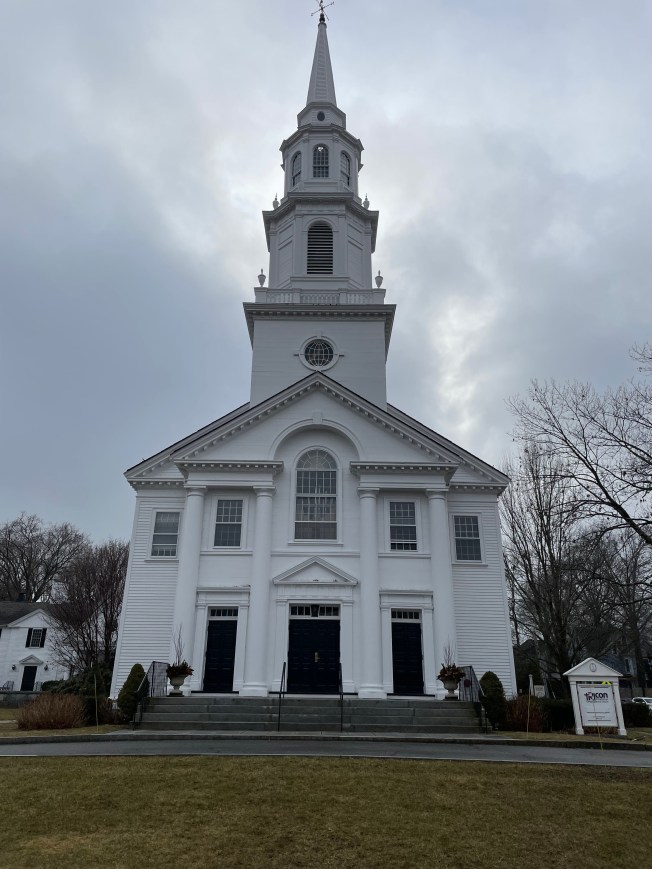
(I preached this sermon on March 22, 2026 at the Trinitarian Congregational Church in Concord, Massachusetts, where my daughter is the Senior Minister. To watch a YouTube video of this sermon go to https://www.youtube.com/watch?v=dbdxoEpKmYA&t=1237s)

Unknown's avatar

Forty-five years in Ministry and I’m Finally a Televangelist! My YouTube Debut.

I filled in to lead worship for my pastor daughter today. Her amazing worship team put together an engaging and inspirational multi-media worship experience unlike any I have ever been a part of. It’s a new world we are living in, and my message was about how I have taken the lessons I have learned from my brain injury to think about life after the Pandemic. How we might use our religious imaginations to see what “new normal” might look like, because in the life of faith there is no going back:

Unknown's avatar

“It was twenty years ago today” My Life with Traumatic Brain Injury

Ride leader. BCA Wednesday Ride

On August 5, 2000 I set off to ride the Greylock Century Ride, a grueling 100 mile ride through the Berkshire Hills of Western Massachusetts. I had already gone up and over Mt. Greylock, the highest point in the state, and up the famous “Hairpin Turn” on Route 2, “The Mohawk Trail.”

At mile 33 I found myself off the road in a drainage ditch  (I found out later they are called “paved waterways” and are designed to keep then snow melt off the road.) The waterway led to a grate. It was too steep to ride back on the road or onto the shoulder so I literally went head over heels onto the pavement, still clipped into my pedals. Continue reading

Unknown's avatar

“Imagining our New Normal?”

“Behold I make all things new!” – Revelation 21:5

Twenty years ago my life changed forever in an instant when I flew over the handlebars of my bicycle and landed on my head. Like Humpty Dumpty I “couldn’t be put back together again.” The name for my new situation is traumatic brain injury (TBI), the injury so many of our troops return with from war. Continue reading

Unknown's avatar

“Rich Toward God” A Stewardship Sermon on Luke 12:13-21

Someone in the crowd said to him, “Teacher, tell my brother to divide the family inheritance with me.” But he said to him, “Friend, who set me to be a judge or arbitrator over you?” And he said to them, “Take care! Be on your guard against all kinds of greed; for one’s life does not consist in the abundance of possessions.” Then he told them a parable: “The land of a rich man produced abundantly. And he thought to himself, ‘What should I do, for I have no place to store my crops?’ Then he said, ‘I will do this: I will pull down my barns and build larger ones, and there I will store all my grain and my goods. And I will say to my soul, Soul, you have ample goods laid up for many years; relax, eat, drink, be merry.’ But God said to him, ‘You fool! This very night your life is being demanded of you. And the things you have prepared, whose will they be?’ So it is with those who store up treasures for themselves but are not rich toward God.” —Luke 12:13-21 NRSV Continue reading

Unknown's avatar

My Blog is Ten Years’ Old: A Retrospective

In the Beginning: 2009-2010

I’d like to thank all of you who have dropped by this blog over the years. It is hard for me to believe a decade has passed since I began it. I started to write again as a personal act of healing which in time morphed into a new chapter of my ministry. Continue reading

Unknown's avatar

“Holy Weeping” A Devotion for Lent

“Rejoice with those who rejoice, weep with those who weep.”—Romans 12:15

One of the stranger symptoms resulting from the traumatic brain injury I got 17 years ago is my tendency to cry at odd times, such as while watching sappy jewelry commercials on TV or foolish pet videos on Facebook. Continue reading

Unknown's avatar

“Taking the Long View” Reflections of a Retired Pastor

Presiding(This is a talk I gave to “The Saints” which is the United Church of Christ retired clergy group in the Connecticut Conference of the UCC. The talk was in Cromwell, CT on May 14, 2015)

I’d like to thank you for inviting me to be with you today. I have great respect for ministry as a high and holy calling, and I enjoy the company of ministers. I am proud to be a minister, and this year is the 40th anniversary of my ordination. And it is good to be in the Connecticut Conference. I never served here, but my daughter, Rebecca Floyd Marshall, is an ordained minister here in CT, serving in Westport. If you bump into her at a Conference meeting introduce yourself.

My talk today is entitled “Taking the Long View” which was the title of a UCC STILL SPEAKING Daily Devotional I wrote for March 14 of last year. I see it was re-printed in your newsletter. I’m going to share with you some of my personal back-story behind the writing of this particular devotional.

I began the devotional with an anecdote about Ralph, a congregant of mine in my first church, who owned an apple orchard: “I drove over to see Ralph at his hilltop orchard a week after I had presided over his wife’s funeral and burial. He was well into his nineties and they had been married for seven decades. I was all of twenty-seven. It took me awhile to find him, because he was out planting apple trees. He seemed glad to see me and said, “You may wonder why I am planting trees that I will never live to see bear fruit. But it’s what I have always done, and I am not going to stop now. There were apple trees in this orchard when I came here that somebody else had planted, and there will be apple trees here after I’m gone.”

I’ve held onto Ralph’s words for forty years, and lately they have helped me as I think about what it means to be a retired minister. That hasn’t been easy for me. Because when I left my role as a pastor it seemed, at first, and for a long while, like the loss of my calling as a minister. Now I have come to realize that, although I am no longer a pastor of a congregation, I am still a minister. When I turned 65 the UCC Pension Boards mailed me a good little book by Paul Clayton entitled Called for Life (Perhaps you all got one, too). I love the play on words in the title, and I do believe we are “called for life” in both senses of the phrase.  Continue reading

Unknown's avatar

Disability and Grace

Ten years ago tomorrow I went over the handlebars of my bicycle and landed on my head. I have written about that day elsewhere.  Since that time I have been grappling daily with being brain injured.  Of course, before that day I grappled daily with being human, an enterprise that continues, but brain injury complicates it considerably.

In fact, “a complication” has been a useful way for me to think about brain injury.  My injury is, of course, in common parlance, “a disability,” and the Social Security Administration has recognized mine as such. It is a credential I would have preferred not to have needed, but it makes me officially disabled.

Yet, I don’t really think of myself as a disabled person, any more than I think of myself primarily as a white person, an ordained person, or a male person. All these realities inform my identity but do not, even in the aggregate, constitute it.

I have always had an allergy to identity politics, and question whether it is helpful for one to think of oneself as primarily identified by race, gender, sexual orientation, or for that matter, disability. If pressed for an identity I would pick a really big one, such as “created in the image of God,” and its new creation correlate, baptism. I say this because I believe that any identity that ignores our relationship with God is bound to be too narrow, and lead to some form of self-deception.

But I understand why people with disabilities often choose to make their disability a primary identity, because other people certainly use disability as a social marker, just as they do for race and gender. If you are in a wheelchair or walk or speak differently that will be part of what defines you. And many people can’t look beyond the obvious. People have a fear of disability, that if that can happen to you, it could happen to them. I think there is also a tendency to distance oneself from the disabled by blaming them for their disabilities.  They must have brought it on themselves by bad behaviors. This helps us maintain the illusion that we can have control over protecting ourselves from becoming disabled by being careful. And sometimes it is true that persons acquire disabilities from poor life choices, but most times that is not true.

My disabilities are largely hidden, since I am able to walk and speak. Nonetheless, enough people in my community know about my accident and its aftermath that I find myself in awkward social situations where people aren’t sure how to approach me. My memory is largely unimpaired (and was good to begin with), but the assumption is that brain injury is largely about memory loss, so I find myself in these painful (and sometimes comical) encounters in the supermarket where people are trying to tell me a story but filling in huge amounts of unnecessary back-story (like the names of their kids that I baptized and have known for over twenty years.) Others talk really slowly and enunciate carefully, and I must resist the temptation to say, “I’m brain injured, not stupid.”

Many people just want me to recover and be better, though I will always have a brain injury. “How are you doing?” they ask empathically and I really want to say fine, but, of course, I am not fine, so I resort to something like, “I am doing OK.” Sometimes I say, “For a man in my condition, I’m in great condition.”

A lot of dealing with injury is self-care, and it is frustrating how much of my time and energy goes into just keeping healthy. There are many things I could once do but now cannot. One of the reasons I resist disability as a primary identity is the temptation to use it as an excuse to do less than I can. For I can still do many things, and need to do them, even when it is hard. The daily challenge is to find the sweet spot between too much and too little activity, and of course, when you live with others, this balance is not always completely under your control. Sometimes I choose to overdo just because the thing I choose is important enough to me to pay a price for several days. But I can only do so much of that or I risk my health, which is easier to protect than to restore.

There is also a level of dependency involved with disability that is very hard for me. I rely on my wife and children and family for love and support and a great deal of care-giving. So in some very real sense my injury is a family affair, something that has to be factored in to all our interactions. I want to be strong and brave and independent, but have to face my reliance on others. The positive part of this is that I often experience their care for me as grace, that is, as something freely given though undeserved. And I am often in awe of their patience and forbearance with me, for I am not always the easiest person to be around, especially when I am tired, which is much of the time.

Even before the accident I was powerfully moved by the pathos at the heart of the Christian story: how God’s power is made manifest in the weakness of the cross of Jesus Christ. I have recounted often before that my mother died when I was 18, and that my return to Christian faith as a young adult was the result of a struggle to make sense of a world where such losses (and others) take place.  It shouldn’t be a surprise that I became a theologian of the cross, which I see, not as a symbol of violence and brutality, but as the place where God’s reconciling love encountered human sin and overcame it.

These last ten years have made me more acutely aware that faith lives in the midst of weakness. Disability has sharpened that awareness for me, but one doesn’t have to be disabled to experience human weakness. As a pastor for over thirty years I learned that people undergoing a crisis of loss or humiliation could often hear the good news of the Gospel in  fresh new ways, or even for the first time. In such moments God speaks. Perhaps only when enough of us is cleared out of the way to silence our own voices can there be the space for us to hear God.

My injury and its deficits also complicate my spiritual life, and that too, has made me aware of faith as a gift that I can’t create in myself. “Grace,” I once heard James Forbes say, “is where you find love in full bloom in a climate where it is too cold to grow.” I’m not very good at faith anymore, so it seems even more of a grace when it is there at all.

During my long ministry I was privileged to spend many hours with the aging and dying. They have been my teachers, helping me prepare for my own aging and dying, and also for disability, which shares many of the same features of limitation and loss. In all these challenges of living one relinquishes features of your previous experience of living. This is painful, but faith can enable us to exercise “a holy relinquishing,” that is literally “graceful.” I have been blessed to witness this again and again among those who retain a wonderful dignity in the face of the indignities visited upon the old, the sick and the dying.

Ultimately, grappling with the complications of disability (or just humanity through its life stages) exists within a horizon of hope. This too, is a gift of faith. I have stood at hundreds of funerals and proclaimed, “‘I am the resurrection and the life,’ said the Lord,” and that promise gives me hope.

I don’t know what that new reality will be like, but I cling to bits of Scripture that give us hints and clues. Paul says, “For now we see through a glass, darkly; but then face to face: now I know in part; but then shall I know even as also I am known. ”(1 Corinthians 13:12)

The scripture that speaks to me most about disability comes from the vision of John the Divine as reported in the 21st chapter of Revelation. John looks up and sees a new heaven and a new earth, and a New Jerusalem coming down from God out of heaven. He says, “God shall wipe away all tears from their eyes; and there shall be no more death, neither sorrow, nor crying, neither shall there be any more pain: for the former things are passed away.”

I take comfort from this promise that God’s ultimate intention for us is a community where we don’t suffer pain or death or loss.  That would have to include disability. No more sleepless nights, no more depression, no more chronic pain, no more anxiety and fear, no more shame. No more of all the things that beset us in this earthly life. Quite a vision!

This horizon of hope often allows me to bounce back from my set-backs, to experience forgiveness for my failings, to face the challenges and complications of each new day, and to enjoy the quotidian little (and sometimes not so little) graces that visit me unbidden and unexpected.

Unknown's avatar

I have a brain injury

I have a brain injury. It is one of the bald facts of my life like being tall or having brown hair. Unlike those facts though, I was not born with a brain injury, but acquired it on August 5, 2000 (see “I Lost My Marbles on the Mohawk Trail”). In my life story that day is a dividing marker. There is the time before my injury and the time after my injury, just as ancient Israel divided its life into before and after the fall of Jerusalem and the Babylonian Exile.

The great thinkers and writers of Israel who gave us some of the best parts of the Bible were preoccupied with why their exile happened. Or more precisely, they asked “What had they done wrong to cause the exile?” Why had God done this to them? As Rabbi Kushner asked in the title of his best-selling book: “Why do bad things happen to good people?”

I honestly don’t ask that question about my accident. I don’t feel guilty about my brain injury. Some things in life just happen that we are powerless to do anything about, and I believe this was one of those things. I don’t believe God throws people off bicycles. And I’m not ashamed about my brain injury, although it has taken me awhile to deal with the strange reactions of many people to my disability.

I bump into people in the grocery store, and they ask me if I am feeling better, and I smile and say I am doing OK, which I am. But the real answer in regard to my brain injury is “no.” I’m not better and, like Humpty Dumpty, I’m not going to be put together again. The task for me is to take care of myself and adjust to my disability from day to day as best I can with a lot of help from my family and my professional caregivers.

So it is what it is. I sometimes grieve for the life I expected to have. I am sometimes sad because I miss my ministry and the purpose and meaning that came with it. But I am unable to do it anymore and that is that. I am grateful for the thirty years I had to do it. I am grateful for my wife and children and family and friends. I am grateful I still have speech and memory, and the cognitive capacities to write and imagine.

And I am one of the lucky ones. Of the roughly 1.4 million who sustain a Traumatic Brain Injury (TBI) each year in the United States 50,000 will die. One of the reason I choose to speak openly about my TBI is there are many of our neighbors out there who have TBI and they are struggling. The CDC estimates over 3 million Americans have a long-term or lifelong need for help to perform their daily activities because of a TBI.

And there will be more. Many returning veterans have TBI from concussive injuries. Many of these heroes will daily struggle to manage stress, control their tempers, solve problems, and deal with life’s emotional issues. Many will have difficulty finding and keeping a job. Many will be unable to work. I am glad that Gary Trudeau has created a sympathetic character with TBI for his Doonesbury comic strip. The more people know about TBI the better.

One of the reasons for better education is that many people with TBI go undiagnosed. Many of these will self-medicate with drugs and alcohol. Untreated and unsupported such people with TBI will have very tough lives, and so will their family and friends.

So I choose to talk and write about brain injury so that more people can know about it, and can seek the support they need. There is support and services for people with TBI. I have been helped by the Massachusetts State Head Injury Program (SHIP). Massachusetts has an active Brain Injury Association, as do other states, and there is a National Brain Injury Association with a good website.

I was recently driving on the highway and saw a billboard from the Brain Injury Association. It pictured a camouflaged helmet, the kind our troops wear in Iraq and Afghanistan. The sign said: “You can’t camouflage a brain injury!” It’s really time we stopped trying to do that.