Unknown's avatar

“We are storied creatures!” A reflection on Psalm 139:16

StoryAs I approach the forty year mark of my ministry I more and more appreciate that one’s life is part of a story. Over that span of years I spent many of my days in the give and take of pastoral ministry while at the same time I was marinating in Scripture preparing to give a good word on Sunday. Here’s a reflection on what it means to have such a storied life:

“We are storied creatures. There is no essential “I” apart from the story I am living, which is populated with a multi-generational cast of thousands. It is quite a story. It begins “in the beginning,” and ends only in God’s own good Time. And, praise be! God has written me into it, giving me a part to play, and, oh look, you have one too!” (From my Daily Devotional for today. See the whole post here.

Unknown's avatar

“Are you choking?” A reflection on worry.

Thorns“As for the seed that was sown among thorns, this is the one who hears the word, but the cares of the world and the lure of wealth choke the word, and it yields nothing.” – Matthew 13:22

“I’ve never been particularly susceptible to the lure of wealth, but I am an expert on “the cares of the world.” It may be in my genes. My grandmother, Irma Grace, was what the family called a “worrywart,” a word you don’t hear much anymore, but one that means “a person who worries too much or who worries about things that are not important.”

My grandmother was the Babe Ruth of worrying. She had long lists of things to worry about, and if one worry got resolved the next one would quickly move to the top of the list. (From my Daily Devotional for today. See more here)


Unknown's avatar

Remembering Willis Elliott: theologian and gadfly

Willis ElliottMy dear friend and colleague Willis Elliott has died. Scott Paeth’s FB post today captures some of the essence of Willis:

“For those who did not know him, he was the often-insightful/often-infuriating gadfly of the United Church of Christ, and a long-time participant in the Confessing Christ group. He died old and full of years”

I met Willis at the very first Craigville Colloquy back in 1984. He spoke at dinner about the “Christian Connection,” the often overlooked piece of the four-church merger that became the United Church of Christ. I thought, “Who is this guy?” Smart, articulate, funny, and insightful. He had a full white beard like Santa Claus, and I thought he was really old, but that was thirty years ago so what did I know?

Later we had him at my congregation as a speaker and with his wife Loree a guest in our home. He was a brilliant, multi-lingual polymath, a former fundamentalist, and at times as difficult and uncompromising as Jeremiah. If there had been a shop that sold iron yokes, Willis might have purchased one. But he could also be an encouraging mentor. Years ago I did a presentation at the MA Conference annual meeting and afterward he made a point to come up and thank me. He also said, “I didn’t know you had it in you!” That was Willis.

In the 1990’s he was one of the founders of Confessing Christ in the United Church of Christ, along with Gabe Fackre, Fred Trost, Jim Gorman, Leslie Zeigler, Barbara Clemons, Bennie Whiten, Herb Davis, Andy Lang, Ted Trost, myself and many others. “Confessing Christ” was an invitation to “joyous theological reflection and serious theological work” on behalf of the ministry and mission of the United Church of Christ.

For years we had our Confessing Christ annual meeting at the church I was serving in Pittsfield, MA, and I got to know Willis well. He was one of the least compromising people I have ever known, and the least career oriented. He had been the librarian and Old Testament Professor at New York Theological Seminary, and before that had served on the national staff of the UCC.

He was a deeply committed Christian, reading the Bible every day in the original languages. His “Think-Sheets,” free of an editorial hand, were challenging, quirky, often brilliant, and, just as often, maddening. They always made you think.

In his latter years his eyesight waned, but he kept up a lively correspondence and participation on the Confessing Christ list-serve conversation.

The “thickness” of the conversation in the United Church of Christ, and the great church, will now be poorer for the loss of his voice, but he had no doubt, and neither do I, that he is now numbered among the great cloud of witnesses. I thank God for him.

Unknown's avatar

“Our eyes are on you”

AT

“We do not know what to do; but our eyes are on you.” – 2 Chronicles 20:12

“It took many years in the ministry for me to be able to say, “I don’t know what to do,” but it was something of a turning point for me. . .  There is often a certain kind of functional atheism that creeps into the way we do business in the church. We might open our meeting with a prayer, but we fully expect to take care of business ourselves.” (From today’s Daily Devotional) Read whole post

(Photo: Appalachian Trail in S. Egremont, Massachusetts. By R.L. Floyd)


Unknown's avatar

If life gives you basil, make pesto!

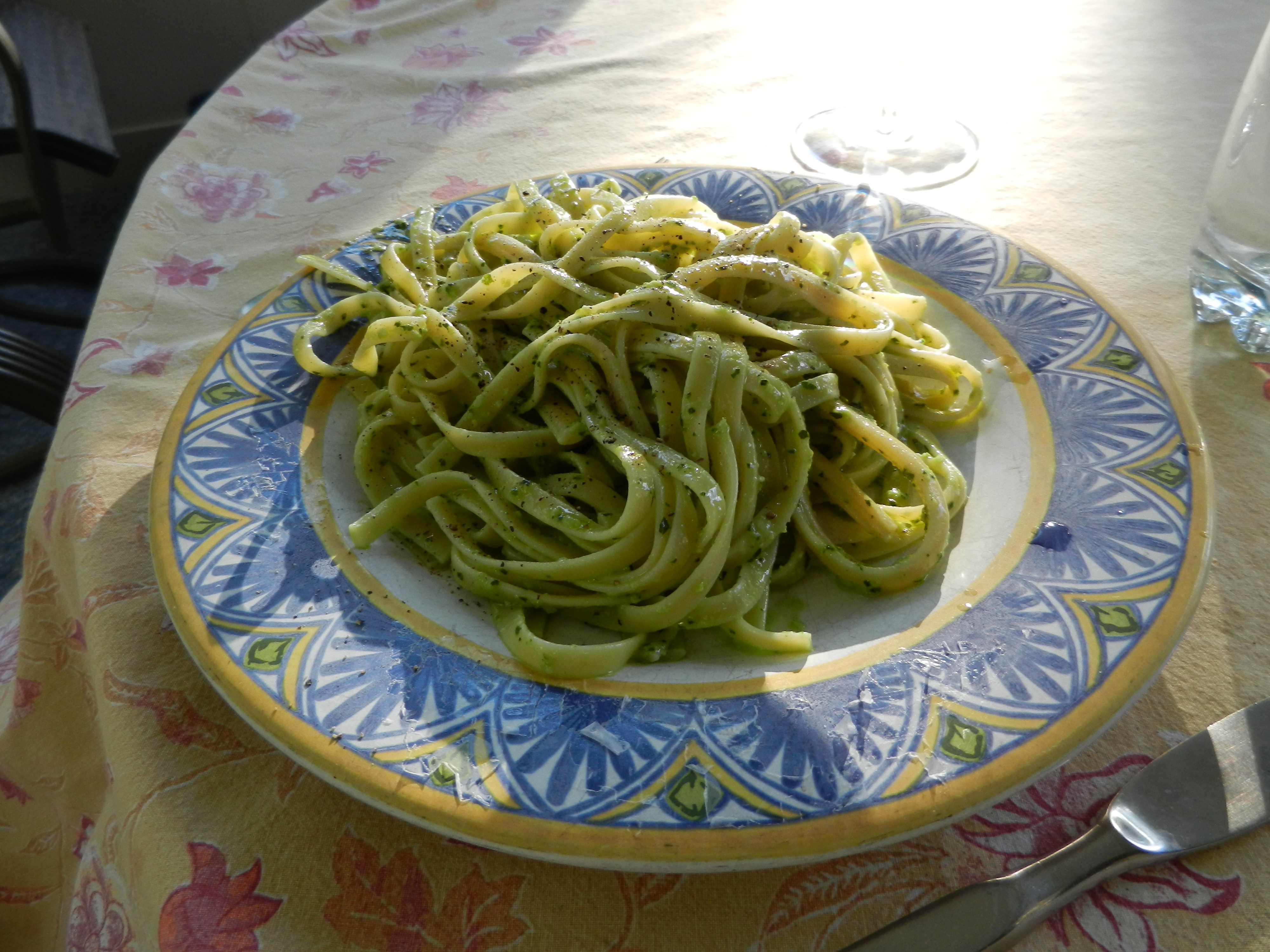
PestoWe had about as perfect a day as we ever get here in the Berkshires. Not too hot, not too cold, not humid, not windy, lots of sunshine and birdsong, and to top it all off, my little herb garden was yielding the first crop of basil. Welcome summer!

I have made more than my share of pesto in a variety of ways, and they all taste pretty great. The key is fresh basil and good olive oil and cheese.

Here’s my basic recipe, which works with a pound of pasta. I have used many different pasta shapes. My favorite is fettuccine, which I have learned is traditional in Genoa, where pesto originates (they call it trenette there).

Recipe:

2 cups basil leaves, the bigger ones torn in pieces

1/2 cup of extra virgin olive oil

2 TBS pine nuts

1-2 cloves of peeled and lightly crushed garlic (according to taste)

Salt to taste

1/2 cup freshly grated Parmigiano Reggiano cheese

3 TBS freshly grated Pecorino Romano cheese

1 LB pasta of your choice


Bring a large pot of water to boil, add salt and cook your pasta al dente

Meanwhile, put the first 5 ingredients in the food processor and  puree them.

Pour them into a large bowl and add the two grated cheeses, blending them with a wooden spoon.

As you cook the pasta save a few TBS of the cooking water and use it to thin out the pesto. Toss it all together and grind some black pepper on it. If you want to get fancy throw  1 or 2 TBS of softened butter into it just before you serve it.

Any crisp dry white wine will taste great with it. We had an Argentinian Sauvignon Blanc with it tonight, because that was what was in the fridge. Enjoy!

(Photo: R. L. Floyd )

Unknown's avatar

“What do you know about being God?” Reflections on Job

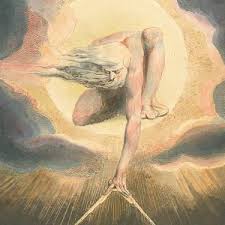
Blake“Where were you when I laid the foundation of the earth?” – Job 38:4

My friend Andy and I had just finished a prayer for the needs of the world when we started lamenting how endless those needs always are.

“If I were God . . .” Andy said, and stopped himself. “Always be suspicious,” he said, “of any sentence that begins, ‘If I were God!'”

We were not the first people to question the troubling gap between what we believe about our God and the immense suffering in our world. The Bible is full of just such questions.

Some of the very best of these questions are found in the Book of Job, which is the story of a good man enduring unbearable suffering. Job desperately wants to know why? His three “friends” offer him their pious answers, which are variants of “You had it coming!”

Their view that suffering is always deserved lingers: “What goes around comes around.”

But what if it isn’t true? What if the divine mystery is more complex than that? What if bad things do happen to good people? What if the punishment doesn’t always fit the crime? Read more. (From my Daily Devotional for today)

Unknown's avatar

“The Church of the Troubled Hearts”

heart3I have seen congregations named “The Church of the Redeemer” and “The Church of the Good Shepherd” and “The Church of All Souls,” but I have never seen a church named “The Church of the Troubled Hearts.” It might not attract a big following, but it would name who we are. Because our hearts are troubled, troubled about our future, our finances, our children, our health, our relationships, our congregations and our faith.

(from my Daily Devotional for today) Read more


Unknown's avatar

The Shepherd Window: “Lost and Found”

church-window4-224x300

When I was growing up my family went to the Church of the Holy Communion in Norwood, New Jersey. It was a little church, built in the neo-Gothic style so beloved by Episcopalians. It had a cloister that connected the church with the parish house. Years later, when I had sabbaticals at Oxford and Cambridge, I felt right at home among the grand stone piles.

When I was in second grade a classmate of mine died in a sledding accident, and his family donated a memorial window to the church in his memory. That window helped shape both my faith and my theology.

Here is a piece I wrote about it for today for the United Church of Christ’s Still Speaking Daily Devotional:


“Lost and Found”

By Richard L. Floyd

“Which one of you, having a hundred sheep and losing one of them, does not leave the ninety-nine in the wilderness, and go after the one who has been lost until he finds it? When he has found it he lays it upon his shoulders and rejoices.” – Luke 15:4,5

When I was in the second grade a boy in my Sunday school class named Kim was killed when he overshot the mark on his sled, went into the road, and was hit by a car. Nobody I knew had ever died before and his death left quite an impression on me. I remember my mother and father sitting me down and telling me the sad news.” Read more

Unknown's avatar

“Words to Live By” The King James Bible and its Legacy to the English Language

JamesThe story I want to tell is the story of the creation of the King James Bible, and its enormous influence on the English language. For over 400 years this was the Bible for the English-speaking world, the best selling book of all time, and still the most frequently purchased translation.

It lasting legacy to English is incalculable. It is the Bible that Abraham Lincoln learned to read with, and its sounds and rhythms can be heard in his Gettysburg Address and Second Inaugural Address, as it can in Melville’s Moby Dick, the poetry of Walt Whitman, and the speeches of Martin Luther King, Jr.

How did we get this extraordinary work of literary art that has made such a place in the story of English? It was published in 1611, but there is considerable backstory that needs to be shared before we get there, and so we need to go way back. The English still refer to it as the Authorised Version (AV), but I will use the more popular American title, the King James Version and its abbreviation (KJV.)  Continue reading

Unknown's avatar

“The Cross and Forgiveness”

Lent 2014As we enter Holy Week and look ahead to Easter I would like to reflect on some of the threads of our Lenten study these past few weeks in the light of the cross and resurrection.

You will recall that forgiveness means a wiping away from memory of the offense, so that it is as if it never happened, leading to restoration of the relationship.

At the very first meeting we reflected on how extraordinary the idea of forgiveness is, since the human impulse for retribution and revenge runs very deep.

So if forgiveness is such a hard thing for us, what explains the amazing stories we saw and heard, first about Desmond Tutu and the South African Truth and Reconciliation Committees, and then the story of Louis Zamperini forgiving his Japanese captors decades after his imprisonment? (As told in Laura Hillenbrand’s best-selling book Unbroken). Continue reading