

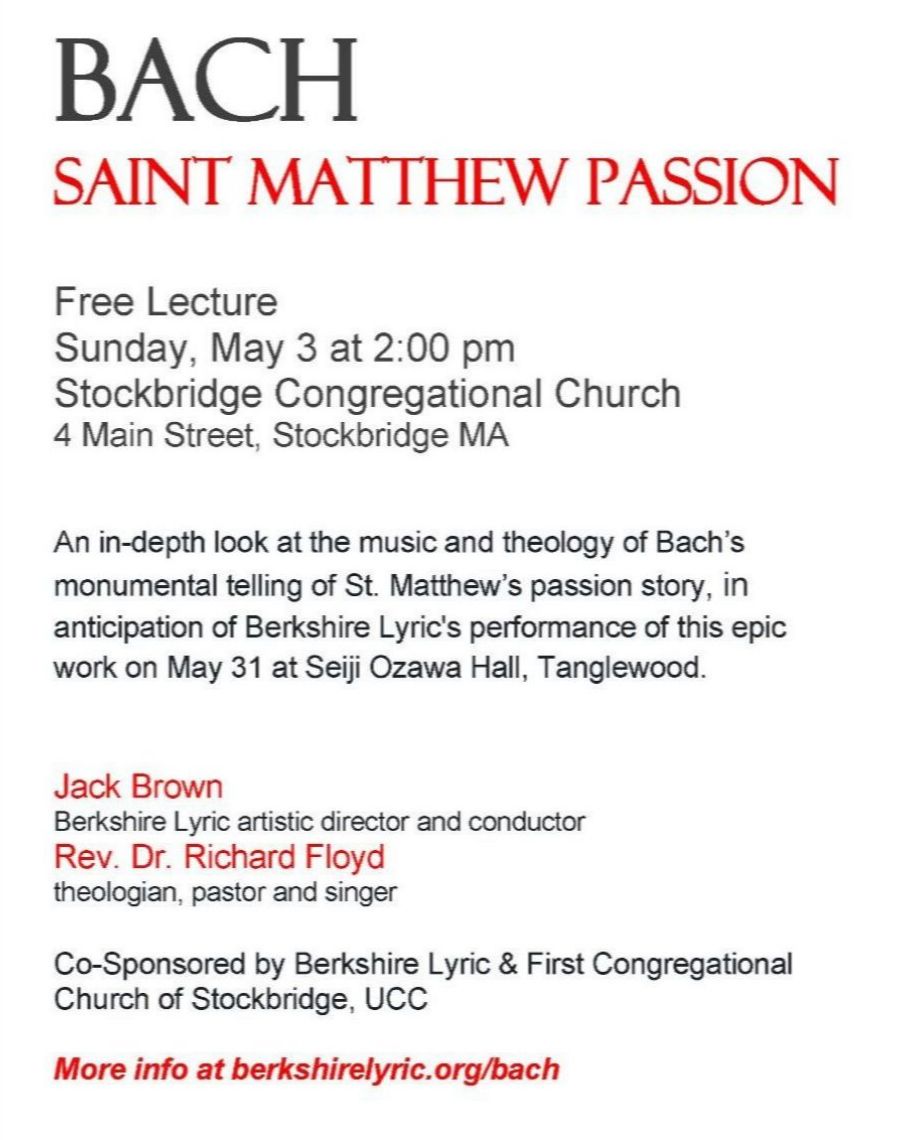
I participated in this public lecture with Berkshire Lyric Music Director Jack Brown and Bass Soloist Doug Williams. What follows are my remarks.
- Who was St. Matthew? As we focus on J.S. Bach’s St Matthew Passion, the question comes to mind, “What makes this Oratorio so great?
We are going to spend some time exploring Bach himself, but there are other elements and influences that are foundational for the work that we want to examine, namely the Gospel of St. Matthew itself, and the Reformation theology of Martin Luther that was so important to Bach’s theology and faith.
We will start with Matthew. “Who was St. Matthew? And what is his Gospel about?”
Matthew’s Gospel is called “The First Gospel” because it is the first of the four gospels in the New Testament canon. But, despite that title, it was not the first one written: that would be Mark, who invented the genre of gospel, which means “good news.”
Matthew knew Mark’s Gospel, but enlarges and extends the scope of Mark’s narrative both at the beginning, with a genealogy and a birth narrative, and at the end, with post-resurrection appearances by Jesus to his disciples.
Without Matthew’s additions to Mark, we would know nothing of the Magi meeting Herod and going home by another way, or the Great Commission to the disciples on the mountain in Galilee, to name just a few.
Matthew’s Gospel is sometimes referred to as the Ecclesiastical Gospel because it contains so much admonition to the church on how to be the church.
Indeed, it is fair to say that the purpose of the Gospel is not so much about giving an account of the historical Jesus, as it written for the church in Matthew’s time and for all time, including ours.
And when was Matthew’s time? Certainly, it was within the last third of the First Century. A.D. And how do we know this? Because in 70 A.D. the Romans under Titus attacked Jerusalem and destroyed the Second Temple, something Matthew knew about.
So, his time may have been in the 80’s or 90’s of the first century, some 50 to 60 years after the events he is writing about.
What Matthew has done is in essence collapsing time, so that the events of his passion narrative feel contemporaneous to his generation of Christians. The historical Jesus of Nazareth and the Risen Christ become conflated.
We had a good example of that recently in our Zoom Bible study. In Chapter 18 of Matthew, Jesus is giving admonition on how to deal with conflict in the church. Jesus tells Peter that forgiveness is inexhaustible. “Forgive 77 times, or 7 times 70!” Then he says “where 2 or 3 are gathered in my name, there I am in the midst of them.” See what Matthew has done there? Clearly, the earthly Jesus of Nazareth who was soon to die on a Roman cross was not going to always be there, but the Risen Christ of Easter, which hasn’t taken place yet in the narrative will be.
Matthew is addressing his congregation, which we think was a group of Jewish Christians that had been expelled from their synagogue. As a Jewish Christian leader Matthew is keen to underscore that God the Father of Jesus Christ and the God of Israel are one and the same God, and the story of Jesus is in continuity with the Promise to Israel and is the completion of the covenant. That is why Matthew’s Gospel is choc-a-bloc with quotations and prophecies from the Hebrew Bible.
So, Matthew is writing for his own congregation in his own time, but also writing for all the ages, including ours.
I like this notion of collapsing time to make the story contemporaneous, so that it not just a story from long ago, but in some way our story, the story of the church and its Risen Savior, Jesus Christ.
And I think Bach has done this as well in his St Matthew Passion, collapsing time, so that we become witnesses to the Passion and Crucifixion. That what makes this masterpiece so existentially compelling and so moving to each generation of listeners, even to secular folks in the Netherlands.
2. The theology of Martin Luther which Informs Bach’s St. Matthew Passion
For us to understand the theology that informs Bach’s St Matthew Passion we must turn to the Protestant Reformation of the sixteenth century, and especially to its most important figure, Martin Luther. Bach was a faithful, orthodox Lutheran, deeply steeped in both the Lutheran theology and the Lutheran musical heritage.
Who was Martin Luther? He was born in 1483. His father wanted him to be a lawyer and he started the study of law but soon abandoned it. After some personal crisis, some say he was caught in a lightning storm and vowed that if God spared him, he would become a monk. Others say it was the death of a close friend. In either case, Luther did become a monk, and dedicated himself to the Augustinian order, devoting himself to fasting, long hours in prayer, pilgrimage, and frequent, perhaps too frequent, confession.
He was ordained to the priesthood in 1507 and started teaching at the University of Wittenberg, where he stayed as Professor of Old Testament for his whole career. From 1510 to 1520, Luther lectured on the Psalms, and on the books of Hebrews, Romans, and Galatians. As he studied these portions of the Bible, partly with Desiderius Erasmus’ new annotated translation directly from the original Hebrew and Greek, Luther became critical of Catholic doctrines supported by the Latin Vulgate translation of the Bible. He began to view the use of terms such as “penance” and “righteousness” in new ways. He became convinced that the church had become corrupted in both doctrine and practice, and had lost sight of what he saw as several of the central truths of Christianity.
In 1516, Johann Tetzel, a Dominican friar, was sent to Germany by the Roman Catholic Church to sell indulgences to raise money in order to rebuild St. Peter’s Basilica in Rome. The next year Luther sent a strongly-worded letter to his bishop protesting the sale of indulgences. He enclosed in his letter a copy of his “Disputation on the Power and Efficacy of Indulgences”, which came to be known as the Ninety-five Theses.
Indulgences offered full forgiveness of one’s sins in return for a monetary payment. Luther objected to a saying attributed to Tetzel that, “As soon as the coin in the coffer rings, the soul from purgatory also springs.” Luther insisted that, since forgiveness was God’s alone to grant, those who claimed that indulgences absolved buyers from all punishments and granted them salvation were in error. Christians, he said, must not slacken in following Christ on account of such false assurances.
Luther continued his protestations and refused to renounce all his writings, and in 1521 he was excommunicated by Pope Leo the Third. Eventually the Emperor declared Luther an outlaw and demanded his arrest.
But Luther had the local prince, Frederick III on his side, and Luther was able to avoid arrest. Luther’s disappearance during his return to Wittenberg was planned. Frederick had him intercepted on his way home in the forest near Wittenberg by masked horsemen impersonating highway robbers. They escorted Luther to the security of the Wartburg Castle at Eisenach. During his stay at Wartburg, Luther translated the New Testament from Greek into German and poured out a torrent of doctrinal and polemical writings.
This break with Rome thrust Luther into the role of principle architect of what became known as the Protestant Reformation.
As we reflect upon Luther’s theology’s influence on Bach, it is helpful to know what shaped it. Remember, Luther was an Augustinian friar, and St. Augustine was profoundly influenced by the letters of St. Paul, especially Paul’s Letters to the Romans and the Galatians, which speak of “freedom from the law.” The law in Paul’s time was the Jewish Torah, but Luther equated the Roman Catholic teachings on indulgences and other doctrines with Paul’s critique of “works of the law.”
Luther has a robust atonement theology, and you will see this theology of the cross manifest in Bach’s St Matthew Passion, with its powerful images of Jesus as “the lamb of God, slain for the sins of the whole world.”
Luther neatly summarizes his theology in a paragraph in the Smalcald Articles, one of the Lutheran Confessions. He wrote:
“The first and chief article is this: Jesus Christ, our God and Lord, died for our sins and was raised again for our justification (Romans 3:24–25). He alone is the Lamb of God who takes away the sins of the world (John 1:29), and God has laid on Him the iniquity of us all (Isaiah 53:6). All have sinned and are justified freely, without their own works and merits, by His grace, through the redemption that is in Christ Jesus, in His blood (Romans 3:23–25). This is necessary to believe. This cannot be otherwise acquired or grasped by any work, law, or merit. Therefore, it is clear and certain that this faith alone justifies us … Nothing of this article can be yielded or surrendered, even though heaven and earth and everything else falls (Mark 13:31).”
By the time of Bach’s St. Matthew Passion in 1827, the Protestant Reformation was a vital religious movement two centuries old, and Lutheranism was deeply established. Luther’s German translation of the Bible had consolidated the German language. In 1455 Johannes Gutenberg had printed a complete Latin Bible using his new movable-type printing press, and the Bible was universally available in German by Bach’s time.
Luther was also a musician and wrote dozens of hymns that were part of the theology and spirituality of Lutheranism. Bach knew them well. Although he served in secular posts, and as a musician in a Calvinist court, where music was not as important, his heart was as a Lutheran church musician, and from the time of his appointment to St. Thomas Church in Leipzig, he never looked back.
So, Bach’s St Matthew Passion is deeply infused with both the theology and piety of Lutheranism. This choral masterpiece interprets two chapters of Matthew’s Gospel (26 and 27) using Luther’s German translation, through this lens. Both the libretto and the extraordinary music function to collapse time and make us, and every generation who hears it, eye-witnesses to the events of the Passion of Christ and to his crucifixion. The genius of Luther and the genius of Bach combine to bring us this gift.
3. The Faith of J. S. Bach
In Bach’s day the old Christian verities were being challenged by the rise of Enlightenment Science and Philosophy, but Bach held on to the Lutheran faith, not only in doctrine but also in his personal piety. This deep piety infuses his St Matthew Passion with a genuine pathos and a wide appeal, that engages people, even those who do not share his Christian faith.
One of the keys to his faith is in his biography. Bach’s life was full of loss, grief and suffering. Both his parents died six months apart when he was ten, and he went to live with his oldest brother Johan Christian Bach.
Thomas Hobbes famously described life in the Seventeenth Century as “Nasty, brutish and short.” Life expectancy was around 35 or 40 because of high infant and child mortality. Bach’s first wife, Maria Barbara, had seven children, three of whom died in infancy. She herself, died suddenly thirteen years into their marriage. His second wife, Anna Magdalena had thirteen children, only six of whom survived to adulthood.
Despite all this, there is nothing melancholy about Bach’s music, which is frequently triumphant and celebratory. He loved and enjoyed his family. And he loved his music.
Following Martin Luther’s theology, he believed all Christians were called to their several vocations or callings. He understood his music to be a divine calling and dedicated his life and music to the glory of God. He often signed his compositions with the initials “S.D.G.” (Soli Deo Gloria – To God Alone the Glory). Since he believed music was a divine calling meant for the “refreshment of the spirit” and to glorify God, he applied this to both his sacred and secular works.
The root word of passion is the Latin verb pati, which means “to suffer,” “to endure,” or “to undergo”. It entered English through the Old French passion and Latin passio (suffering), originally referring to the crucifixion of Jesus Christ before evolving to mean intense emotion or desire.
Bach’s St Matthew Passion is a story of redemption by the suffering and death of Jesus. Like any good Lutheran of his time, Bach would have believed that humans without God are in a state of sin, a problem that we cannot rectify by ourselves. At the end of part 1 of St Matthew Passion Bach employed “O man, bewail thy grievous sin” a famous Lutheran Passion hymn written by Sebald Heyden in 1530.
“O man, thy grievous sin bemoan,
Whence, from His Father’s bosom flown,
To earth came Christ, our Savior;
Of virgin mother, undefiled,
For us was born the holy Child,
To be our Mediator.
Unto the dead new life He gave,
The sick from ev’ry ill He saved,
Until His hour of anguish,
When He would be our sacrifice,
Pay for our sins the awful price,
Yea, on the cross would languish.”
This is standard Christian orthodoxy. The Creed says “for us humans and for our salvation, Jesus Christ came down from heaven, and by the Holy Spirit was incarnate of the Virgin Mary, and became human. For our sake he was crucified under Pontius Pilate, he suffered death and was buried, and rose again on the third day in accordance with the Scriptures.”
That act of suffering love and sacrifice “does for us that which we cannot do for ourselves.” But unlike other major doctrines no church council ever declared the “how” of Christ’s atoning sacrifice. For centuries the church believed that Christians access the saving act of Christ through the sacrament of the mass, where the sacrifice is literally re-enacted on the altar by the priest.
Luther and all the other Reformers rejected this doctrine of transubstantiation. With the Bible in Greek and Hebrew newly in his hands, Luther believed that Christ’s atoning sacrifice on the cross was “once and for all time” and could not be re-enacted. Bach would have believed this. It is often noted that there is no resurrection in the St Matthew Passion. Bach, good Lutheran that he was, didn’t need to put it in since the cross was “a finished work” that itself brought satisfaction and justification to the sinner. The resurrection was merely God’s Amen to the saving work of Christ.
Jesus goes voluntarily to his death out of love. Bach’s faith is on display the way he juxtaposes the crowds “Let him be crucified” with the soprano recitative “He has done well for us all” and the soprano aria “In love my Savior Now is Dying.” “It is out of love that my Savior intends to die, Although of sin and guilt He knows nothing, So that my soul should not have to bear, Everlasting damnation, and the penalty of divine justice.”
Bach knew his share of suffering, but he drew consolation, comfort and hope from his faith in his Savior Jesus Christ. It is this faith, devotion and piety that has given us this splendid masterpiece.
4. “Then and Now” A Reflection on the Gap between Bach’s Time and Ours
The Age of Enlightenment was breaking out in Bach’s time, but he was more a creature of Pre-Enlightenment times. His influences were Martin Luther and the Gospels rather than Voltaire and Isaac Newton.
Bach’s worldview is far from our own. There is an important book by the late Yale theologian, Hans Frei, titled The Eclipse of Biblical Narrative. Frei’s thesis is that there has been a radical change in the way people have understood the Bible since the Enlightenment.
Prior to the Enlightenment, Christians, most of them illiterate, understood the world of the Bible as continuous with their world. In other words, they understood the Biblical story to be their story. They were in it! They knew the story from statues and stained-glass windows in Gothic cathedrals. They knew the story from catechisms and creeds, from Passion Plays and religious festivals. If they owned one book, it was the Bible.
With the coming of the Enlightenment and the rise of science a new worldview developed. Empiricism meant that all things were scrutinized, held at arm’s length for observation, if you will. Frei contends that post-Enlightenment Christians, even if they claim the Christian story as their own story, can never be in the story in the same way that Bach was.
The reactions to this eclipse of biblical narrative have varied. Fundamentalists deny modernity and resort to a claimed literalism. Modernists accommodate the Bible to fit modern assumptions of what can be real. I’m thinking, for example, of Thomas Jefferson’s taking scissors to the Bible, cutting out all the parts he couldn’t believe in, such as the miracles of Jesus.
Our worldview is shaped by our time and our experience of it. Bach’s world was a world of ignorance and superstition. Christians believed that God controlled the weather. They believed in witches and demons, and in a literal hell from which God alone could save them.
So, as Post Enlightenment people, when we approach a biblical text, we instinctively ask, “Did this happen? Is it factual?” That is the Enlightenment question. But it wasn’t Bach’s question.
As some of you know, I lead a weekly Zoom Bible study. In that class I often remind them of the relationship of text to context. The text never changes, but the context is always changing. The Gospel of St. Matthew is the same today as it was in Bach’s time, although he read it in German, and we read it in English, if we read it at all.
But the context is very much different. As I said previously, in Bach’s time life was short, infant and child mortality was high. There were periodic famines. Germany had suffered the Thirty Years War (1618-1648) a generation before Bach was born. That war was still in the memory of Bach’s elders. How bad was that war that raged across Europe for three decades? In that bloody war an estimated 4.5 to 8 million soldiers and civilians died from the effects of battle, famine, or disease, with parts of Germany reporting population declines of over 50%.
No wonder that many of the Lutheran chorales, such as the ones Bach employed in the St Matthew Passion, are preoccupied with suffering and death and the sweet consolations of heaven. Death was the context, the lens if you will, with which Bach and his contemporaries viewed biblical texts.
In the academic study of scripture, we refer to the theory of interpretation as hermeneutics, which gets its name from the Greek god Hermes, the herald or messenger of the gods. He’s the guy with wings on his helmet. He is Mercury in the Roman mythology. He’s the guy who flies from here to there, to bring messages from the gods to humanity.
So, Hermeneutics is the study of interpretation, of how we get from here to there; how we get from an ancient text to a contemporary meaning. How do we get from a fixed text to interpret it in a new context.
An example of this interplay between text and context I often share with my class is what happened to me after September 11, 2001. I preached from a three-year lectionary of prescribed scripture texts, and in 2001 I’d been preaching for 25 years, which meant the same texts had been before me 8 times. In the fall of 2001, the Old Testament readings were from the books of Jeremiah and Lamentations and were pretty ghastly laments about the destruction of Jerusalem by the Babylonians in 587 BC. Here’s a sample:
“My joy is gone; grief is upon me;
my heart is sick.
Listen! The cry of the daughter of my people
from far and wide in the land:
“Is the Lord not in Zion?
Is her King not in her?”
(“Why have they provoked me to anger with their images,
with their foreign idols?”)
“The harvest is past, the summer is ended,
and we are not saved.”
For the brokenness of the daughter of my people I am broken,
I mourn, and horror has seized me.
Is there no balm in Gilead?
Is there no physician there?
Why then has the health of the daughter of my people
not been restored?
O that my head were a spring of water
and my eyes a fountain of tears,
so that I might weep day and night
for the slain of the daughter of my people!” (Jeremiah 8: 18)
They referred to “the burning city.” The previous 8 times I had read them, I thought, what in God’s name could I possibly I say about these gruesome texts? So, I chose other ones. Now, in 2001, with the world trade center burning and falling, a new context brought new life to old texts.
My point, and I do have one, is that we read and hear St. Matthew with very different eyes and ears then the people in Bach’s time. Having said that, the beauty and artistry of St Matthew Passion still invite people in. Invite even secular people in, as we noted about the popularity of the annual Passion in the Netherlands, one of the most secular countries on earth.
So, even if Bach’s world and ours are so very far apart, his musical masterpiece keeps finding and reaching new audiences. A piece of music written in 1727 still engages and thrills us, as you will discover if you are in Ozawa Hall on May 31.
5. Conclusion: What Makes Bach’s St Matthew’s Passion Great? A Reflection on A Work that Transcends its Time
Jack says that many musicians claim Bach as the best musician ever, and that the St Matthew Passion is his most brilliant work. That can be debated, of course. For example, the great Swiss Reformed theologian of the 20th Century, Karl Barth, claimed that when God was in His heavenly court, He listened to Bach, but when He retired to his private chamber, he listened to Mozart. But I think we can all agree that Bach was a musical genius and St Matthew Passion is a great masterpiece. What makes it great?
Let’s start by asking why Bach is great. Here’s the composer who wrote the B Minor Mass, the Brandenburg Concerti, the Six solo Cello Suites and the Goldberg Variations, to name but a few of his masterpieces.
I have a theory. In 2008, the Canadian author, Malcolm Gladwell, wrote a bestselling book called Outliers. Gladwell examines the factors that contribute to high levels of success. To support his thesis, he examines why the majority of Canadian ice hockey players are born in the first few months of the calendar year, how Microsoft co-founder Bill Gates achieved his extreme wealth, how the Beatles became one of the most successful musical acts in human history.
Throughout the book, Gladwell repeatedly mentions the “10,000-Hour Rule”, claiming that the key to achieving world-class expertise in any skill, is, to a large extent, a matter of practicing the correct way, for a total of around 10,000 hours.
So, the Canadian ice hockey players born in the first months of the year got more ice time than those born later. Bill Gates grew up in Palo Alto, California and had access to a Stanford University mainframe computer for many years, and the Beatles were the house band, first in Liverpool, and then in Hamburg, Germany before becoming an international “overnight” sensation.
You get the idea. Now let’s look at J. S. Bach through the lens of the Gladwell thesis. Sebastian, as they called him, was born into a multi-generational musical family. The Bach family had already produced several composers when Sebastian was born in Eisenach, the youngest child of the city musician Johann Ambrosius Bach.
His family, particularly his uncles, were all professional musicians who worked as church organists, court chamber musicians, and composers. Bach’s father presumably taught him the violin, his own primary instrument, along with basic music theory principles.
As I mentioned, Bach’s parents died when he was 10 and Sebastian moved in with his eldest brother, Johann Christoph Bach, the organist at St. Michael’s Church in Ohrdruf. There he studied, performed, and copied music, including his brother’s, despite being forbidden to do so. He also received instruction on the clavichord from his brother. Johann Christoph exposed him to the works of composers of the day, including South Germans such as Johann Caspar Kerll, Johann Jakob Froberger, and Johann Pachelbel (under whom Johann Christoph had studied); North Germans such as Georg Böhm, Johann Reincken and Friedrich Nicolaus Bruhns from Hamburg, and Dieterich Buxtehude; Frenchmen such as Jean-Baptiste Lully, Louis Marchand, and Marin Marais; and the Italian Girolamo Frescobaldi. Sebastian studied theology, Latin, and Greek at the local gymnasium, but he never earned a university degree, something that vexed him throughout his life.
So, even before he had his first post as a musician, he had been exposed to many styles and some of the finest composers in Europe at the time.
By the time he composed St Matthew Passion in 1725 he was forty years old and had put in his 10,000 hours of music. That and his musical genes and exposure to the Bach family business make him an outlier.
Now I must turn to the first half of Jack’s Credo:
“Anything of real value
happens in community, (the solitary agent is overrated)
does not usually happen quickly,
involves steady work and patience,
must have one foot in tradition,
must be nurtured with a bias towards steady positive forward action,
involves mastering some detailed complexity before you get to the brain float,
must be done with love (different than niceness, but crucially includes kindness)”
Bach had put in the work: steady work and patience, and he had one foot in tradition. Tradition for Sebastian was not just his conservative musical tradition, but his deeply held Lutheran faith. We post-Enlightenment people make a distinction between secular and sacred. Sebastian would have made no such distinction. For example, when he was at the court of Leopold of Anhalt-Köthen he composed very little sacred music, since Leopold was a Calvinist and they didn’t employ much music. Still, Bach signed each composition “to God be the glory.” And as one in the Calvinist tradition, I want to go on record that we got it wrong about music and the Lutherans got it right!
A final reason Bach is great is his character. He was a principled man. There is often a fine line between principled and stubborn. We have already seen this in Martin Luther, whose stubbornness kept him from backing down from his principles even when the weight of both church and state were pressuring him to renounce his writings.
Bach could also be stubborn. He sometimes engaged in petty quarrels over principles with the Leipzig town council, who often treated him quite badly. This stubbornness also served his dogged pursuit of perfection in his art. By the time he composed St Matthew Passion he had had years of writing weekly cantatas for the liturgical year. He had absorbed all there was to be learned from the best composers and musicians in Europe, including Vivaldi, who was a big influence on him.
So, St Matthew Passion was composed at the height of his powers. Like a painter with a full palette, he created a masterpiece that transcends its own time. He was the final flower of the Baroque. He was the best and last of the Baroque, much like Jonathan Edwards was the best and last Puritan.
We are blessed to be able to hear (and sing) this timeless masterpiece.
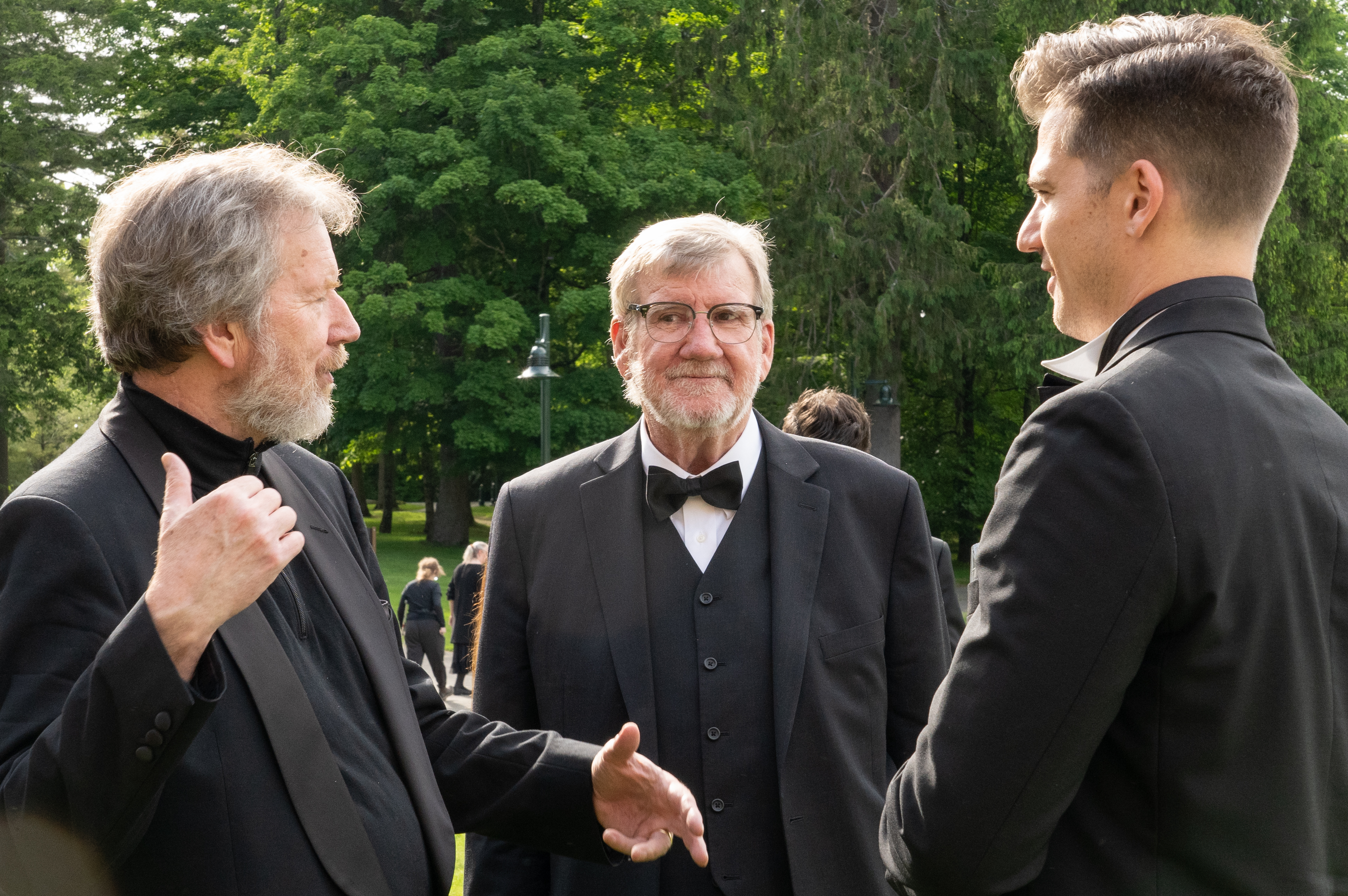
(Photo: Berkshire Lyric Music Director Jack Brown (left) Me, and Bass Soloist Doug Williams at Ozawa Hall, Tanglewood, Lenox, Massachusetts. 2024.)




 When I Survey . . .