

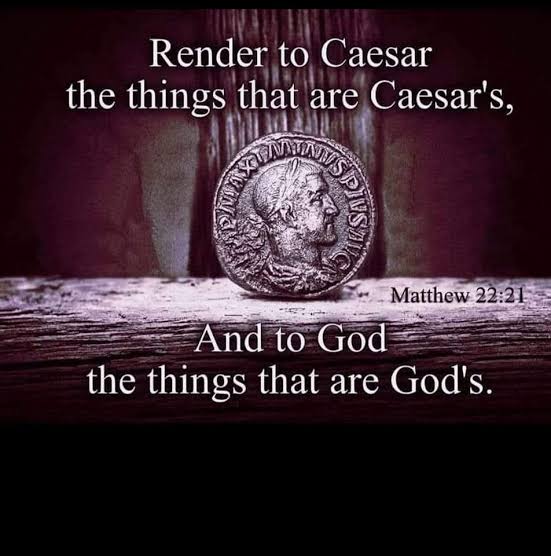
When the Pharisees trap Jesus by asking him if it is lawful to pay taxes to Caesar, they are asking him about the limits of the law. Law tells you only what you must do, or face a penalty. Jesus raises the stakes on their question, by asking an even more important question of them, “To whom do you belong?”
“Show me a coin,” he says, which in and of itself would have embarrassed the Pharisees, as they fumbled in their purses for a denarius. These hated Roman coins were considered objects of blasphemy. “Whose image is on it?” Jesus asks them. “Caesar’s!” they reply. “Ok,” Jesus says, “if it has Caesar’s image on it, it must belong to Caesar, so give it to him. But give to God that which belongs to God.”
The Pharisees would not have missed his meaning. While the money was made in the image of Caesar, they were made in the image of God, and it was to God that they belonged. When Jesus is put to the challenge, he often ends up being the challenger. And in this story Jesus challenges us.
Like the Pharisees, we look for the limits of our responsibilities, the boundaries of the allowable. “What can I get away with” is as far as many people go when it comes to framing their relationship to the rest of society. And some understand their faith as a matter of doing the minimum they must do for God.
The state has claims on the Christian. We follow the laws, we pay taxes, we vote, we do jury duty, we may be called to serve in the armed forces in times of war. These are the responsibilities of citizenship. The Christian is a citizen, and as such, follows the laws of the state. Even when Christians intentionally break the law out of conscience, as some tax resisters, non-violent demonstrators, and conscientious objectors do, they acknowledge the right of the state to exact punishment according to its laws.
Honoring the claims of the state, however, is hardly enough to give life meaning. If I ask you where you look for identity and meaning in your life, I doubt that you would answer that you find it by not going through red lights and by paying the IRS on time. No, you would look elsewhere: to the things you hold dear, to higher loyalties, to commitments and promises you have made, to people you love and who love you.
So Jesus doesn’t deny the claims of Caesar, but he refuses to get caught in the trap that has been laid for him. If he had said don’t pay taxes to Caesar, he would have pacified the Pharisees, but the Romans would have arrested him. If he had merely said, “Pay Caesar!” he would have appeased the Romans, but alienated the crowd, who resented and hated Rome. Jesus knew well that these pious Pharisees believed the doctrine that human beings were made in the image of God. By equating the image of God that people bear with the image of Caesar that Roman money bore, Jesus contrasted a lesser and a greater loyalty. In effect, Jesus is saying, “The money may belong to Caesar, but you belong to God.”
You belong to God. What does that mean? It means that the mystery that is your life is a gift of God. That the air you breathe, the earth you walk upon, the people God has given you to love and be loved by, are all a gift. One of the root causes of so much human agony is that people are trying to find themselves apart from God. St. Augustine said to God, “You have made us for yourself, and we find no rest until we rest in you.”
To be made in the image of God is a wonderful gift, but many people have never opened it, and it sits on the table all wrapped up in ribbons with a card. If they would only open the card it says, “I love you!” “For God so loved the world, that he gave his only Son” and whatever humankind knew before about their identity, they now know something else: that the image of God that they bear looks like Jesus. That is what God has provided for us: a name and a face to help us know our true identity. Jesus is the human face of God, a face we can now see in countless human faces every day.
You belong to God. And the claims of God on you are not the claims of law but the claims of love. The Christian is driven, not by the desire to find the minimum that is required of us, but by gratitude. The claims of God are the claims of a lover. They are not the things we must do to escape penalty, but the things we want to do after we say “Yes” to God.
The claims of God are the claims of gratitude and grace. When you say, “Yes!” to God, and acknowledge his incarnate Son, you know not only that you belong to God; you belong to others who also bear the image of God. And others belong to you; you cannot live your life alone, but are part of a human network of love. All around you are people who bear the image and likeness of God, and your destiny and theirs are inter-related. “No man is an island,” said John Donne, and he is right.
To see the human face of God in Jesus Christ and to learn to recognize it in those around you is one of the tasks of the Christian, and also one of the keys to finding the true meaning of your life. It also pretty well defines the mission of the church. When you inventory the activities and programs of this congregation that reach out to others, like “Eat for Heat,” Christian Center luncheons, Habitat for Humanity, and Stephen Ministry, you see a basic pattern. Heat, food, lodging, and personal care-giving: these are gestures of connectedness and compassion given by one human being to another, who share a common identity as those who bear the image of God.
So, the Christian faith is truly subversive not in that it challenges the claims of the state. No, as I said, the Christian is a citizen. And often a better citizen than one who feels no responsibility to the state, who doesn’t vote and ducks jury duty because it is inconvenient, and turns a blind eye to the law. And often a better citizen than the unthinking patriot with the “my country right or wrong” bumper sticker.
A Christian patriotism may include dissent to the policies of the state. Someone needs to tell the President that expressing dissent is not giving comfort to the enemy, but one of the responsibilities of the conscientious citizen.
But the real subversive aspect of Christian faith is not dissent. It is the belief that we do not live for ourselves, that we do not get meaning from the things we acquire and possess, that we do not find happiness by running our own lives in blissful autonomy, or believing that we belong to ourselves.
We belong to God, body and soul. That is good news to those who can hear it, but it calls into serious question our rampant consumerism, our conspicuous consumption, our reliance on violence and control to get our way, our ignoring of the invisible poor and dispossessed, and our national arrogance toward the rest of the world. Because we belong to God, and we belong to each other. So yes, by all means, “Give to Caesar the things that belong to Caesar, but give to God the things that belonged to God.”
That’s what Jesus said! “When the Pharisees heard this, they were amazed, and left him and went away.” Amen.
(I preached this sermon on October 20, 2002 at First Church of Christ in Pittsfield, Congregational in Pittsfield, Massachusetts)

