Unknown's avatar

Where I Ruminate on My First Trip to Scotland Twenty Years Ago and My Introduction to Single Malt Whisky

Twenty years ago this summer, after spending a term in Oxford reading P. T. Forsyth, my family and I headed north to Scotland for a two week vacation, or a fortnight holiday as we had learned to say back then. My children were seven and five at the time, so we visited many battlefields (Bannockburn, Glencoe, Cullodan) and castles (Inverallochy, Urquhart, Craigievar, Eileen Donan) and, of course, Loch Ness, where the children had their picture taken in front of the replica of Nessie, a photo I recall captioning “3 monsters” (we had been in the car quite a bit!) That night we stayed in a family room at a youth hostel on the shore of Loch Ness and I recall awakening in the night and seeing the waters of the loch reflecting the full moon. I stared very long minutes, half expecting to see Nessie, but, although it would be a better story if I did, I didn’t.

We made the mandatory pilgrimage to Iona, which was a highlight of the trip. We crossed “over the sea to Skye” before the new bridge was put in, and we drove around Wester Ross, which was lovely the few times that the mists cleared enough for us to see anything but the road. From Inverness we drove East on our way to visit Aberdeen, “the Granite City,” and do the proper Forsyth hagiographic tour there of his hometown.

As we headed East from Inverness I spotted a signpost for something called the Whisky Trail, which piqued my interest. Finding about it in the guidebooks we resolved to visit at least one distillery before we left Scotland. The first one we came upon was Glenfarclas, a venerable Speyside firm, that’s been in the Grant family since 1865. I later discovered that several Grant families make whisky, but this is a different family and an independent distillery unconnected to any chain.

We had a tour of the distillery, and the customary wee dram in the tasting room, and such was my introduction to single malt whisky. Now today such whiskies are a commonplace in any respectably stocked bar, but 20 years ago considerably less so. You might have found a bottle of the widely distributed brands Glenlivet or Glenfiddich here and there, but single malt scotch was still pretty esoteric in the US. The Glenfarclas was smooth and rich, dark in color and full-bodied. It was delicious.

I was hooked. The next day we toured Glenfiddich, after which my seven year old said, “Daddy, do we have to go to any more distilleries, I know how they make whisky now?” At Glenfiddich I asked the tour guide to tell me his favorite whisky, and he said Balvenie, which was made by them just next door. So I bought a bottle in a distinctive brandy shaped flagon, and gently brought it back on the plane in the pre-9/11 days. I nursed that bottle of Balvenie for many a month as a reminder of the tastes and experiences of our time in Scotland.

Six years later we came back to Scotland to live in St Andrews, where I continued my research on the atonement and wrote my little book “When I Survey the Wondrous Cross: Reflections on the Atonement.” We had a lovely flat on Queens Gardens with a garden that abutted the grounds of St Mary’s College. We had neither a TV nor a radio, and it was a cold and damp spring, so the four of us would huddle around the electric fire and read. I had been reading all day of course, so often my evening reading would be Michael Jackson’s Malt Whisky Companion (1995). The late Michael Jackson (no relation to the one-gloved entertainer) wrote authoritative guidebooks to both whisky and beer. Single malt whisky is expensive so one must make a little bit go a long way. I discovered that my local drinks store had a wide variety of whiskies in miniature bottles, and so I worked my way through Jackson’s book tasting whisky and reading the tasting notes.

Over the years in my many trips to Britain, both to live and to vacation, I have shared a number of enjoyable evenings with friends tasting and talking about whisky. Often several bottles will be produced after dinner with various amounts remaining in them, and these will be shared and compared. And if you can get talking about theology, well that’s even better. I can’t afford to buy much single malt, but my children, who I am glad to say have grown up to be fine adults, often give me a bottle for Christmas or my birthday.

Who but the Scots could take a few of their simple resources, good water, peat for the fires for malting, and barley on ground that can’t grow much else, and turn it into a luxury item sought throughout the world? I raise a glass to them.

Unknown's avatar

“Heaven, a World of Love”

For those whose only exposure to the sermons of Jonathan Edwards (1703-1758) is his infamous “Sinners in the Hands of an Angry God” I recommend his brilliant and moving sermon, “Heaven, A World of Love.”

Reading it today we can see that the Puritan had more weapons in his homiletical arsenal than merely frightening his congregation with images of a fiery future. In “Heaven, a World of Love” his exquisite portrait of heaven, and the way people interact with one another there, might have made the faithful squirm every bit as much as his image of the spider over the flame in “Sinners in the Hands of an Angry God”

Notice the image of community as a musical ensemble, praising God together. What might we in the church on earth learn from this? Here’s an excerpt:

“And oh! what joy will there be, springing up in the hearts of the saints, after they have passed through their wearisome pilgrimage, to be brought to such a paradise as this! Here is joy unspeakable indeed, and full of glory – joy that is humble, holy, enrapturing, and divine in its perfection! Love is always a sweet principle; and especially divine love. This, even on earth, is a spring of sweetness; but in heaven it shall become a stream, a river, an ocean! All shall stand about the God of glory, who is the great fountain of love, opening, as it were, their very souls to be filled with those effusions of love that are poured forth from his fullness, just as the flowers on the earth, in the bright and joyous days of spring, open their bosoms to the sun, to be filled with his light and warmth, and to flourish in beauty and fragrancy under his cheering rays. Every saint in heaven is as a flower in that garden of God, and holy love is the fragrance and sweet odor that they all send forth, and with which they fill the bowers of that paradise above. Every soul there, is as a note in some concert of delightful music, that sweetly harmonizes with every other note, and all together blend in the most rapturous strains in praising God and the Lamb forever. And so all help each other, to their utmost, to express the love of the whole society to its glorious Father and Head, and to pour back love into the great fountain of love whence they are supplied and filled with love, and blessedness, and glory. And thus they will love, and reign in love, and in that godlike joy that is its blessed fruit, such as eye hath not seen, nor ear heard, nor hath ever entered into the heart of man in this world to conceive; and thus in the full sunlight of the throne, enraptured with joys that are forever increasing, and yet forever full, they shall live and reign with God and Christ forever and ever!”

Unknown's avatar

Bicycle Touring in the Berkshires

It’s that time of year again when the ice is off the road, the bikes come out of the garage and we pull on our cycling shorts to find that once again they have shrunk over the winter. Here in the Berkshire Hills we have an active cycling club called the Berkshire Cycling Association, which organizes and sponsors a number of events, from road and mountain bike races to time trials.

For those who prefer not to go so fast there is a also series of weekly touring rides beginning this week and continuing into September. The oldest of these rides is the venerable Thursday Night Ride, which has helped many a new rider to learn how to ride in a group. Ably led by Shaun Weigand the ride attracts 20 to 35 riders on any given Thursday night. The rides begin in different locations and over the course of the season cover most of Berkshire County, with an occasional foray into adjacent Vermont, New York, or Connecticut.

A newer and smaller touring ride that meets during the day is the Wednesday Morning Ride, which regularly attracts about 15 riders. This ride, which I help to found four years ago and led for three years, is now led by Margie Safran.

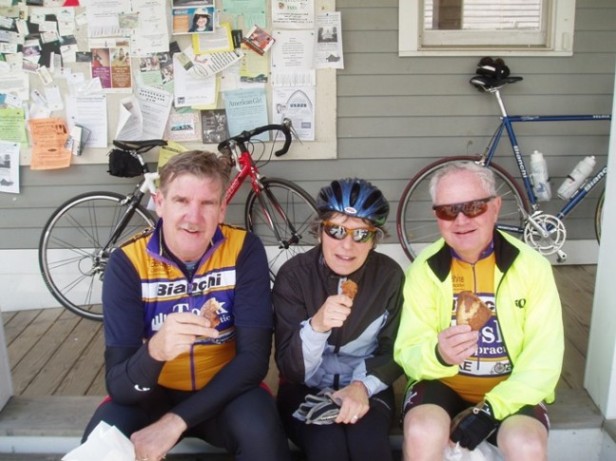
Both rides are pretty leisurely, with friendly, helpful people. One needs a safe working bike, a helmet (always!), and knowledge of how your bike works, the highway laws, and how to ride safely on the road. (Photo above from left: R.Floyd, Marge Cohan, and John Yuill in front of the Monterey Genreral Store)

Unknown's avatar

Spring Comes Slowly to the Berkshire Hills

I believe that spring will finally come to my corner of the world because two weeks ago I was down in Princeton (about three hours south of here) and saw green lawns, apple blossoms, and tulips. To use the language of Christian eschatology, I wait in hope for the future to break into the present.

Here in the Berkshires we must wait until early May for real spring to arrive. Later in the summer when the city dwellers descend on us for our cool nights and lovely days we are thankful for our geography, but this time of year we experience first hand T. S. Eliot’s observation that “April is the cruelest month.” (The Wasteland, 1922)

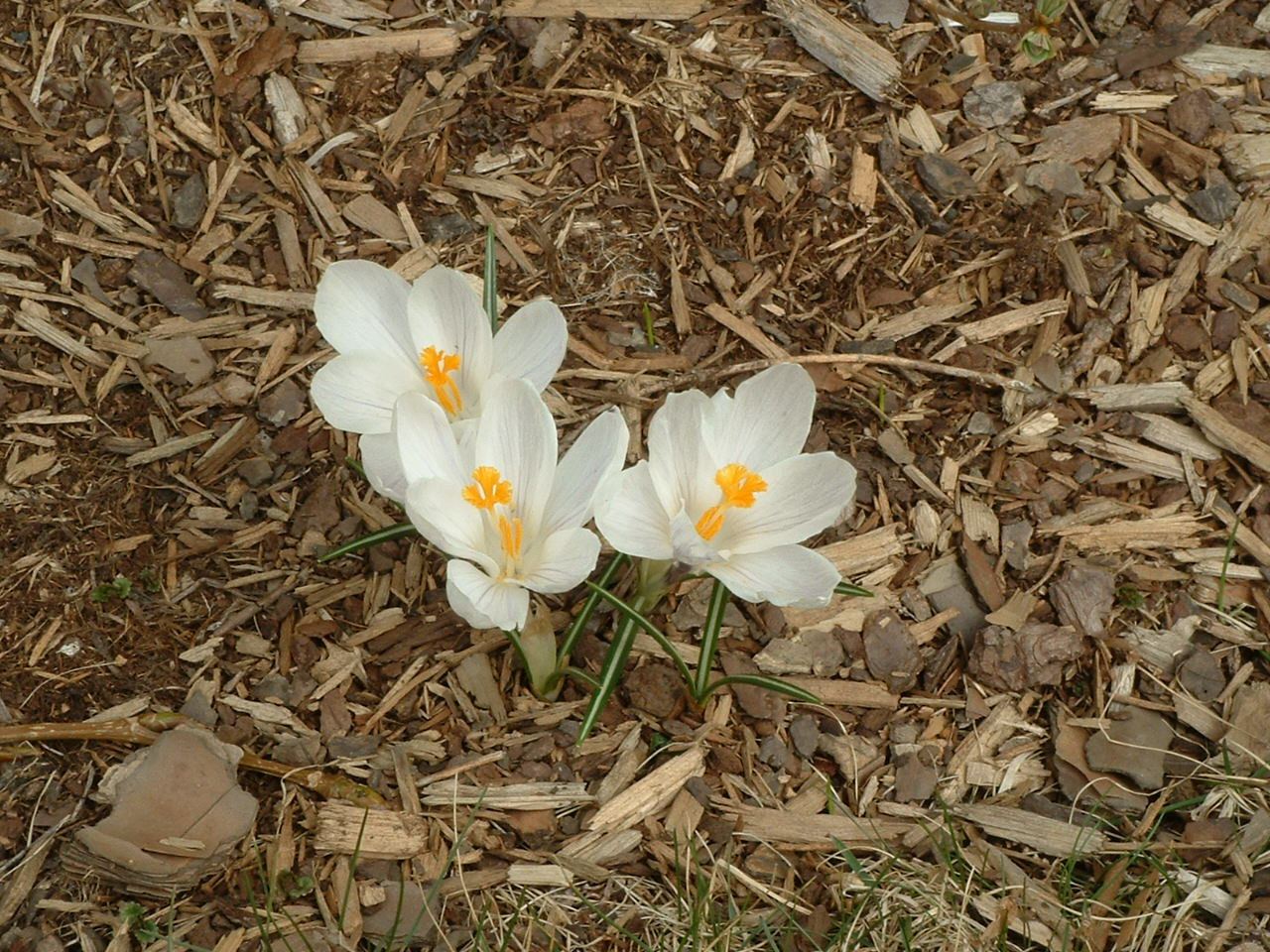
But here and there I spy glimpses of things to come. I have some crocuses (croci?) popping up around the edges of my house, and my lawn shows hints of green and begs to be raked. The days grow longer and each one, if closely observed, yields signs and portents. I recently read the children’s classic The Secret Garden by Frances Hodgson Burnett, and though it was the dead of winter, shared in her rich descriptions of the garden’s daily changes.

So on a warmer sunny day this week I climbed on my bike for the first time in 2009 and hit the Ashuwilticook Rail Trail. I had to take the snowshoes out of my trunk to make room for my bike bag and floor pump, surely another sign of the changing season. It was a bit chilly alongside Cheshire Lake, but after all, the ice has been out of the lake for only a few weeks. There was no ice on the trail, but still a few stubborn chunks clinging to the shady cliffs alongside the Hoosic River at Cheshire Harbor, and some remaining big sandy piles of snow in the parking lot of the Berkshire Mall near the head of the trail.

The Canadian geese were in abundance, some lazy ones now never migrate and have become pests and foul the trail. We had one white swan for a few days several weeks ago but he or she is gone now.

Over the years of riding the trail I have seen a black bear, deer, snapping turtles as big as a lawn mower, and numerous other animals and birds. This week, though, I didn’t see much besides the geese and ducks.

 The buds are getting red, and here and there some begin to show the gold that precedes the green, reminding me of Robert Frost’s little poem, Nothing Gold Can Stay

Nature’s first green is gold,
Her hardest hue to hold.
Her early leaf’s a flower;
But only so an hour.
Then leaf subsides to leaf.
So Eden sank to grief,
So dawn goes down to day.
Nothing gold can stay.

It’s been a long, cold winter here with lots of snow. But spring is slowly coming to the Berkshire and soon we can share in Solomon’s song:

“For, lo, the winter is past, the rain is over and gone;
The flowers appear on the earth:
The time of the singing of birds is come,
And the voice of the turtle-dove is heard in our land.”
(Song of Solomon< 2)

Unknown's avatar

Abraham Kuyper on Glorifying God with your Intellect


In one of threads on our Confessing Christ internet conversation we recently discussed the role of emotion versus intellect in Christian faith. It was agreed that these are not mutually exclusive domains, but that different figures have put more emphasis on one or the other.

Under the influence of my friend and fellow Confessing Christ blogger Clifford Anderson of the Princeton Theological Seminary Library I’ve started reading Abraham Kuyper (1837-1920). A fascinating figure, Kuyper was a Dutch pastor, theologian, author, editor and politician, who served from 1901 to 1905 as Prime Minister of the Netherlands. He also founded the Free Univeristy of Amsterdam.

Last night I was reading his 1898 Stone Lectures at Princeton, published as Lectures on Calvinism, and I was struck by this passage:

“If everything that is, exists for the sake of God, then it follows that the whole creation must give glory to God. The sun, moon, and stars in the firmament, the birds of the air, the whole of Nature around us, but, above all man himself, who, priestlike, must concentrate to God the whole of creation, and all life thriving in it. And although sin has deadened a large part of creation to the glory of God, the demand,—the ideal, remains unchangeable, that every creature must be immersed in the stream of religion, and end by lying as a religious offering on the altar of the Almighty. A religion confined to feeling or will is therefore unthinkable to the Calvinist. The sacred anointing of the priest of creation must reach down to his beard and to the hem of his garment. His whole being, including all his abilities and powers, must be pervaded by the sensus divinitatis, and how then could he exclude his rational consciousness,— the λογος which is in him, the light of thought which comes from God Himself to irradiate him? To possess his God for the underground world of his feelings, and in the outworks of the exertion of his will, but not in his inner self, in the very center of his consciousness, and thought: to have fixed starting –points for the study of nature and axiomatic strongholds for the practical life, but to have no fixed support in his thoughts about the Creator Himself,—all of this was, for the Calvinist, the very denying of the Eternal Logos.” Lectures on Calvinism, P. 52. Eerdmans, 1931

Unknown's avatar

Some Fun for the Pastor’s Family after Easter

Friend and theological humorist Chris Anderson put me on to this hilarious spoof of Willie Nelson’s Mamas Don’t Let Your Babies Grow Up to Be Cowboys.It’s called Mamas Don’t Let Your Babies Grow Up to Be Pastors. It was produced by a church in Orlando, FL.I showed it to my daughter, who will be starting seminary in the fall, and she particularly was amused by the the little girl baptizing her dolly in the bathtub. If you are a pastor, pastor’s spouse or a PK, you may find some of this a little close to home. But still really funny.

Unknown's avatar

Where I Ruminate on why a Blog is like Sourdough Starter: A Parable

After about a month of blogging it has occurred to me that keeping a blog is like maintaining sourdough starter. Let me explain. Thirty years ago in our newlywed Maine days our friend Alison gave us a small batch of sourdough starter, which is a fermented batter of flour and water. This particular starter, Alison told us with reverence, was reputedly more than a hundred years old. The starter is used, in lieu of other yeast, to make sourdough bread.

Martha and I were young and countercultural and this sounded very cool, and it was kinda cool for a time, but there was a problem. You have to feed the starter! If you don’t feed the starter it gets funkier and sourer by the week and eventually turns dark brown and poisons your refrigerator (did I mention it takes up room there?)

You have to feed the starter every week. First you drain off the alcoholic liquid that has accumulated on the top (it’s called, appropriately enough, “hooch.”) Then you put in some flour for the living colony of organisms that is your starter to munch on.

So as time goes on the thing in the refrigerator grows, which is fine if you are a professional baker or an avid amateur that makes bread several times a week. But we were neither.

We made sourdough bread a couple times, and found the feeding to be a chore, but still somehow felt loyalty to this heirloom starter in the fridge, so it just took up residence there.

The starter wasn’t really useful to us anymore, but we had been feeding it for so long we were invested in its survival.

Finally, two things happened that led us to abandon the starter. First, we had a child, who actually really needed to be fed regularly, which took away some of the starter’s leverage. And, secondly, we each admitted to the other that we didn’t really like sourdough bread. “Those who have ears let them hear.”

Unknown's avatar

On Easter Day: A Hymn for Easter Sunday

On Easter Day, on Easter Day
The angel rolled the stone away.
Let all good Christians sing and pray
On Easter Day.

On Easter Day, on Easter Day
A new creation came to stay
To take the sting of death away
On Easter Day.

On Easter Day, on Easter Day
Christ came among them, so they say,
And shared his story on the Way
On Easter Day.

On Easter Day, this Easter Day,
We come to worship, sing and pray,
And share his presence, come what may
On Easter Day.

Suggested tune: Victory (Palestrina)

©Richard L. Floyd, 2004

Unknown's avatar

Thoughts for Good Friday II

Mary C. Boys, Professor of Practical Theology at Union Theological Seminary, wrote, “Like all symbols, the cross evokes more than one can explain. It condenses life and death into one symbol. It enfolds some of the deepest fears of humanity—vulnerability, betrayal, pain, forsakenness—and transfigures them into expressions of hope. When Christians proclaim the power of the cross, they are voicing their confidence that death is not the end, that the grip of evil has been broken, and that the powers and principalities who seem to control this world have been banished. When Christians proclaim the power of the cross, they are declaring, albeit often with tremulous voice, that at times one must simply endure suffering, that certain things in life must be borne. And they are declaring that in the passion of Jesus we find a model for our fidelity.The cross is a symbol Christians have been given to image their hope that God is with them even in pain and tragedy and ambiguity. It is a symbol of the longing to give themselves over to a project larger than their own self-interest, and of the faith that pouring out one’s life for the sake of another brings new life. It is a symbol that enables Christians to name the hard things of their lives, to express anguish rather than to repress it. . . .”With the very ambiguous history of the interpretation of the cross in mind Boys concludes, “Just as a church building that has been profaned by a violent or blasphemous deed needs rededication, so too, the symbol the church carries must be purified by its people’s repentance. Only then can the cross embody the power of reconciliation for which Jesus lived and died.” (Cross Currents, Spring 1994. . p 22-23)

Unknown's avatar

Thoughts for Good Friday I

Dietrich Bonhoeffer once wrote, “Either I determine the place in which I will find God, or I allow God to determine the place where he will be found. If it is I who say where God will be, I will always find there a God who in some way corresponds to me, is agreeable to me, fits in with my nature. But if it is God who says where He will be, then that will truly be a place which at first is not agreeable at all, which does not fit so well with me. That place is the cross of Christ.” (Meditating on the Word, p 44–45).