Unknown's avatar

Hold the Water: Where I Ruminate about the Continued Popularity of Watered-downed Christian Apologists

I like my Christian faith the same way I like my whisky: neat. So don’t water it down by explaining away the empty tomb or the virginal conception. Don’t tell me the cross is icky. Of course it is. Don’t tell me that it was just a west wind over the sea of reeds and not the mighty work of God that opened the waters for Moses and the children of Israel. Don’t tell me that the “eye of the needle” in Jesus’ parable was really the name of a narrow gate in Jerusalem that was hard to get a camel through.

Such distancing from the story reminds me of the Congregational minister in John Irving’s A Prayer for Owen Meany (who turns out to be Owen’s father) who had lost his faith, and makes me wonder if sometimes losing your faith is more blessed than having one not worth keeping.

I was in seminary when Rudolf Bultmann’s de-mythologizing project still had some juice to it, and we were trained to take texts apart so there were just pieces and parts on the table at the end of the process. I remember a little jingle about Bultmann: “Hark the herald angels sing, ‘Bultmann is the latest thing!’ At least they would if he had not, de-mythologized the lot.”

I remember telling that to the organist in my first congregation in rural Maine while we were choosing Christmas hymns to demonstrate my wit, and her eyes got wide as if I had uttered an oath in church. Because I had, so to speak. So if my theological education stripped more and more of the things of my childhood faith away from me, thirty years in the parish gave more and more of them back to me. I came to realize, as Forsyth once said, that the historical critical method is a good servant but a bad master. I believe it all now.

It was not always so. For years I served sophisticated, educated people. They read books and listened to NPR. For years whenever the devil came up in a passage I felt duty bound to say, by way of apology, “Now of course we don’t believe in a literal devil with horns and a tail,” and then one day I realized I was selling the congregation short as people of imagination as well as faith. So I stopped doing it. Let the story be told, and let the Spirit work, and let the people listen and imagine and dream. Those who have ears let them hear.

So I am perplexed by the continuing popularity of Christian apologists who water things down to make them more palatable for contemporary folks. I would rather read Dawkins and Hitchens than Borg and Spong (actually that’s not true, now that I think about it! But you know what I mean.)

At the same time I have had really exemplary Christian lay folks tell me they love these guys. A man I really admire told me in the supermarket that Borg helped him finally make sense of Christian faith (I wanted to tell him it’s not supposed to make sense, but that would have been uncharitable.) Another terrific friend told me Spong had saved his faith. There’s a testimony to the power of the Holy Spirit for you.

Another friend who shares my view on this was driving by a Lutheran Church where the sign-board said, “The resurrection is not a metaphor!” He liked that. I like that. So I told him the great story about the time Flannery O’Connor was at a dinner party with the novelist Mary McCarthy, and since O’Connor was a famous Roman Catholic the conversation turned to the eucharist, and McCarthy said something about Holy Communion being so symbolic, and Flannery O’Connor replied, “If it’s symbolic, I say the Hell with it.” No water for her.

Unknown's avatar

“Mystic Sweet Communion”

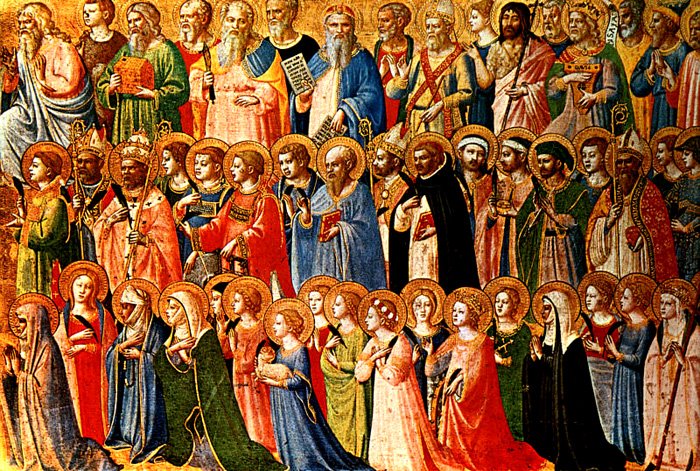
There are a lot of us here tonight: organists, choristers and choir members, family of the singers, parishioners, visitors. We make a grand congregation! But as impressive as we are, there is another important group involved with us in our worship that we shouldn’t overlook. The church from its beginning has pictured its life and mission, and especially its worship, as taking place in the unseen but very real presence of our ancestors in the faith. Our liturgies nod to it. We pray phrases such as “with the church on earth and the saints in heaven” or “ with angels and archangels and all the company of heaven.”

So how might we picture the presence of the communion of saints with us? “We are surrounded by so great a cloud of witnesses . . .” says the writer of Hebrews. The image is drawn from the stadium where the athletic games were held. The cloud of witnesses is the huge throng of spectators cheering on the competitors, who are admonished to “lay aside every weight and the sin that clings so closely” just as a bicycle racer will try to have the lightest materials possible. This one is a foot race, though, and here Jesus is pictured as the lead runner, the pacesetter, “the pioneer and perfecter of our faith.”

“We are surrounded by so great a cloud of witnesses. . .” In 1980, when I was a number of years younger and many pounds lighter, I ran in my one and only marathon road race, the Paul Bunyan Marathon in Bangor, Maine.This 26-mile race began at the Paul Bunyan statue in Bangor and meandered through adjoining towns until it ended on the oval of the football stadium at the University of Maine in Orono. I will never forget the ending of that race.

You have heard about the “loneliness of the long distance runner.” There’s truth in that phrase, for even when you are physically prepared for these long races there is a mental and emotional side that is quite daunting. The first half of my race was fun and at about mile ten or twelve I was euphoric, but around mile twenty I began to run out of gas and I had to struggle to keep on running. A solitary debate began in my mind:“Can I finish?” “Should I quit?” “Will this cramp go away, this ache subside, this tiredness abate?” By the time I hit that oval track in the stadium at Orono I was just glad to be finishing. And then a strange thing happened. I was pulled out of my reverie by the sound of cheering, and, since I knew that my wife and her parents were the only ones present at the race who knew me, I wondered who the cheering was for.I looked ahead and saw that there was no one else on the track. What’s more, many of the cheers were naming me by name, “Way to go, Rick!”“You can do it, Rick!” which puzzled me still more.

What it was, of course, was the cheering of the other runners who had finished ahead of me. With my race time of three hours and forty–seven minutes there were scores of other runners ahead of me and there were many other spectators and they all had a program sheet with the names and numbers of the runners and I had my number pinned to my shirt. Those cheers were wonderful for my morale, and I straightened my shoulders a bit and quickened my step and put on a little burst of speed for that last lap.

I carry that image in my mind as the very image that the writer of Hebrews wants to evoke here. The communion of saints are the ones who have finished the race before us. They are in the stadium seats watching us, they have finished the course, and now “from their labors rest.” We in the church militant are engaged in the same task as they were and they cheer us on, encourage us, support us, and call us by name. They are the great cloud of witnesses.

The word “witness” has a nice double meaning. It can mean merely spectators, which carries through the athletic metaphor of the passage. But witnesses here are more than passive spectators. They are those who bear witness to the truth they have known. Keep in mind that the Greek word we have translated as “witness” is martyr. During the early generations of the church so many witnesses sacrificed their lives for their faith that in time the word “martyr” took on that additional meaning.

So these witness who surround us are not idle spectators. Do any of you remember the comedian Flip Wilson of “The Church of What’s Happening Now!”? He once said, “I’m a Jehovah’s Bystander.They asked me to be a Witness, but I didn’t want to get involved.” So the cloud of witnesses not only supports us by their presence, they bear witness to the truth of God they have known.

This is such an important way to think about the church. In this century we have been learning to think of the church ecumenically; to consider the breadth of the church across denominational lines and national boundaries. But how quickly we forget the length of the church, its trans–temporal reality across the generations.That is where the role of tradition comes to play in the church, the place where the communion of saints gets their say. As Chesterton put it, “Tradition is only democracy extended through time.” Jaroslav Pelikan’s famous epigram rightly distinguishes between, tradition, “the living faith of the dead,” and “traditionalism, the dead faith of the living.” Too often, traditionalism has given tradition a bad name.

But a church that forgets what the saints have learned from generation to generation will hardly be equipped to be the church in its own generation.So the church rightly remembers the communion of saints, and even more than that, claims that in Christ, we share with them in the divine life.

Let me change the metaphor so that we might imagine the communion of saints as a choir;a large choir, like one of those Welsh men’s choirs made up of a thousand voices. When I was in high school our choir would go to county–wide and state–wide choral events with thousands of voices.Do they do that any more?

So let us imagine that as we sing tonight we sing together along with the voices of the great cloud of witnesses. Let us take quite seriously the claim of our various liturgies that when we sing we join our voices “with all the faithful in every time and place.”

There is a wonderful sermon by Jonathan Edwards on 1 Corinthians 13: 8-10, called Heaven is a World of Love in which Edwards explores the metaphor of the communion of saints as a heavenly choir. First he beautifully describes heaven and all its social arrangements, and in so doing puts forth a protest against the social arrangements that we know so well on earth, for in Edward’s heaven there is no pride or jealously, there is decency and wisdom, and an equal prosperity among all. He says that “love (poured out from God) resides and reigns in every heart there.” And then he says: “Every saint there is as a note in a concert of music which sweetly harmonizes with every other note, and all together employed wholly in praising God.”

Heaven is a world of love, and here below the church with all its imperfections witnesses by word and deed to the truth of that love. “We feebly struggle, they in glory shine.” So we are not alone. We carry out the mission and work of the church by sharing in the very life of God, and we are surrounded as well by so great a cloud of witnesses who cheer us on.

When I was a small boy I thought that God dwelled somewhere above the chancel of my local church, not exclusively, but especially there. And as I came to hear about the communion of saints I pictured them surrounding God, as one might see in medieval paintings, a big crowd of folks in white robes. Most of the people I had known in my short life were still living, so the crowd was for the most part an abstraction. My father’s parents, who had died before I was born were there, I was sure, and the little boy from my Sunday School class who had been run over by a car when his sled went into the road.Kim was his name.Kim was there, I knew.

The Puritans had a saying that, “The commonwealth of heaven becomes more dear with each loss below.” As I have grown older and have known many more people who have died I have returned to something very like that childhood picture I thought I had outgrown. I invite you to do so as well. In the eye of your imagination you will no doubt picture different saints than I picture. You will picture people you have known among the crowd of witnesses, a Sunday School teacher, a parent or a grandparent, a neighbor, perhaps even an organist or a minister. These were people who showed you what love is by loving, what service is by serving, what witness is by witnessing to what they had seen and known and believed. In our mind’s eye, too, there will need to be ones we have not known but have only known about. Those whose lives and art, whose words and deeds have cheered us on as we have run the race and tried to be the church. It is the great cloud of witnesses. It is the church, in heaven with all its glory, and on earth with all its brokenness and folly. It is like a great choir and its song goes on, on a grand night like this and wherever two or three gather in the Lord’s name. “Yet she on earth has union with God, the Three in One, and mystic sweet communion with those whose rest is won. O happy Ones and holy, Lord give us grace that we, like them the meek and lowly, on high may dwell with thee.”Amen.

(I delivered this sermon to the opening worship of the New England Regional Convention of the American Guild of Organists on June 22, 1997 at the First Church of Christ in Pittsfield, Massachusetts where I was then pastor.)

Unknown's avatar

The Tools of a Learned Ministry

Kim Fabricus’s letter commenting on the books on Richard Bauckham’s bookshelves inspired me to dig up this piece I wrote about my books for Colleague in 2000 called The Tools of a Learned Ministry:

I love books. I come by it honestly since I am the child of librarians. My mother had a library degree from Columbia and over the years worked successively at the New York Public Library, the General Theological Seminary, and the Wandell Middle School in Saddle River, New Jersey. My father, who was somewhat of a vocational dilettante, also had a library degree from Columbia and worked for a time at the General Theological Seminary. My mother’s 89 year old sister Grace, whom we call Aunt Tia, is also a librarian and just recently retired from running the library at her retirement community in Sun City, Arizona. My big sister has a library degree from Rutgers and is an archivist at the John F. Kennedy library in Boston. I like to say that I am the black sheep in the family, because I went into the ministry.

I grew up around books. Other families had wallpaper, we had shelves of books covering our walls.In the summers I spent countless hours at my mother’s school library in the stacks, finding treasures to read. I thought every family went to the public library on Saturday mornings to get their books for the week.

As a young adult I came back to the Christian faith largely through books. I met several of my guides and mentors only through books:Thomas Merton, C.S. Lewis, Dorothy Day, Abraham Heschel, Reinhold Niebuhr, Karl Barth, P.T. Forsyth, Flannery O’Connor, Graham Greene, Frederick Buechner, to name but a few. In the pages of their books it seemed that God was real and alive, and so he became for me.They sent me back to the Book where the story behind all their stories is told.

When I am in a discussion I usually have a book to recommend, and, consequently, I have been accused of holding to a belief in “salvation by bibliography.” I plead, at least in part, guilty.

When I entered ministry I was delighted to be in a profession among whose tools were books. I recall going into pastor’s studies and just staring at the books.Look at all the books! Shelves of commentaries, big reference works, multi-volume works of theology. I couldn’t believe anybody could be so blessed as to work in a room surrounded by all those books. Not just to read, but to touch and look at, for books have a kind of talismanic power just by their presence in a room.

In seminary we young theologs used to love to visit pastors and admire and covet their books. Was it too much to hope that someday we would have books like that? Well,it has taken twenty-five years, but now I am one of those pastors. I have a whole roomful of books. Fred Buechner calls his library “The Magic Kingdom,” and that is how I feel about mine.I have accumulated my many books over the years, writing my name and the year of purchase in the flyleaf, and so they are a record of my interests over time. They tell a story. For example, at some point I stopped buying ministerial “how to” books because I guess I felt I knew “how to.” I went through a Henry Nouwen stage and then suddenly in the 80’s,it stopped. I have a stack of books on the arms race from the late seventies. I have at least one commentary on every book of the Bible. I have old books from the eighteenth and nineteenth and twentieth centuries. I have a Shaker Bible given to me by an antique dealer in my first church.I have an antique copy of Foxe’s Book of Martyrs that belonged to a friend’s grandfather, a minister of the Free Church of Scotland in the 19th century. I have books of poetry and prayers, dictionaries, handbooks, worshipbooks and novels.

These books are my tools and my friends. Some I use all the time; others I haven’t opened in years. Some are like youthful infatuations, purchased with high hopes, but the pretty cover promised more than could be delivered and disappointment soon set in. There are some I will never read. Others I read again and again. I have over a dozen books by P.T. Forsyth, most of them out of print,that I have collected at used bookstores and through the mail. Sometimes I will pull one of these off the shelf and read just a few pages

I’ve noticed a strange thing over the last few years. During that time I have been privileged to know and work with a number of young clergy and seminarians, men and women. Most of them are gifted, hard–working, dedicated and capable. There is a lot to like about them. But one thing is noticeably missing.They don’t love my books.They don’t stare at them, or touch them, or covet them.They don’t even notice them when they come into my study. They are more likely to notice and comment on my computer.

This worries me. Can the church maintain a “learned clergy” without instilling a love of books? Is it possible that books are really passé as some say? That in the future the digital age will restrict if not eliminate their use? I hope not. Because books are more than mere information. Throughout my life they have always been my companions and friends. They can invoke wonder and create mystery. They can witness to faith. They are grist for my sermonic mill. But they are more than that. They fuel not just my work but my imagination. I wouldn’t be the minister I am without them. I wouldn’t be who I am without them.

Unknown's avatar

Is Digital the New Normal?

That is the question Jason Byassee asks on his Duke blog Call and Response.  Here’s an excerpt: “The simulcast sermons are no big deal,” he said. This would be a surprise to my editors at Christian Century, whom I’d sold on a story about an innovative megachurch called Lifechurch.tv. At this multi-site campus, one preacher preaches in Oklahoma, and 26,000 members in fourteen campuses in five states (plus many more online) watch via satellite. The pastor I was talking to, Ken Behr, pastors a church in Tennessee, with the preaching pumped in from some 700 miles away.

“People often fixate on the virtual thing, but churches are used to watching the screen. Been to an NFL game lately? You watch the jumbotron.” Then here’s the part that got me: “When I finish my master’s degree I’m sure it’ll be online. I’m not moving.”

Most theological institutions I respect have stayed away from online learning. This is for good reason: Christian faith is intrinsically an embodied thing. We can learn things in a limited way online, just as we could previously via radio, television, or even written correspondence. This is why Faith & Leadership features videos, and may offer online educational opportunities down the road. They can be useful in small doses—but to become a master (whence the “M” in M.Div: magister), and therefore a teacher, of theology is too much weight for the web to bear. It’s no accident more sacramental traditions have no Lifechurch.tv—and don’t hold your breath for the Catholics to jump on board. It’s awfully hard to consecrate the host in the webosphere. I heard an Anglican faculty member at another institution having this debate say wisely, “I refuse to teach embodied theology online.”  Read more at Call and Response.

Unknown's avatar

“What is on your bookshelf?”

Here’s a fun blog ( Faith and Theology: On Richard Bauckham’s books) with lots of pithy comments on two of my favorites:

Richard Bauckham, who was my sabbatical advisor at St Andrews in 1995 when I wrote When I Survey the Wondrous Cross:  Reflection on the Atonement, and

Marilynne Robinson, whose Gilead and Home I hungrily devoured, and whose Death of Adam is one of the best things ever written on Calvin.

Pastors take note: on the Great Day you will be judged by the novels on your bookshelf, or lack thereof.  Go to the blog:  Faith and Theology: On Richard Bauckham’s books.

Unknown's avatar

Karl Barth on Calvin


I’ve been sitting on my back porch on this lovely June day reading Karl Barth’s 1922 lectures on John Calvin’s 1536 Institutes of the Christian Religion, Chapter 9, on “Christian Liberty.” I am preparing for The 25th Karl Barth Summer Session for Pastors sponsored by the Massachusetts Convention of Congregational Ministers, an organization founded in 1692. Calvin was chosen this year to commemorate his 500th anniversary.

I haven’t been to all 25 of them, but I’ve been to a great many, and have some wonderful memories of rich theological conversations with pastor theologians and visiting Barth scholars. Some of those scholars I have heard and talked with over the years have included Hans Frei, George Hunsinger, and Alexander (Sandy) McElway, just to name a few. This year’s leader is Dr. Clifford Anderson, curator of Reformed Research Collections, Princeton Theological Seminary. Cliff, my friend and fellow Confessing Christ blogger, was also the leader in 2006.

The format of the two-day sessions is a morning dedicated to the Barth readings, and an afternoon dedicated to a practical issue, contemporary or historical. In the case of this year we will ponder Nathaniel Ward’s Body of Civil Liberties. Ward was a Puritan minister, writer, and attorney, who compiled this code of statutes for the Commonwealth in 1641.

There are gems galore in Barth’s rich appreciation of Calvin. Here’s a small sample: “We must not view Calvin’s church of holiness as a catholicizing confusion of divine and human commands, at least not as far as Calvin himself was concerned, no matter what misunderstandings might have arisen among his successors. Calvin himself clearly saw the possibility of such a confusion. Under the pressure of the order and holiness that he found in God, he realized that order and holiness are incommensurable. They cannot be imitated on this side of the human sphere that is not to be confused with the other world, in the little city of Geneva that even at the pinnacle of his success he never truly regarded as a Jerusalem. With a certain resigned wisdom and grim humor, if we might put it thus, he spoke only of honoring God by bonds of humanity so far as this is possible seeing that we live on earth. Calvin did not fall victim to the illusion that gripped the Middle Ages and that has gained force again in the modern age, the illusion that there is a continuous path that leads step by step from an earthly city of God to the kingdom of heaven. For him the divine was always divine and the human always human.” (The Theology of John Calvin, by Karl Barth. Translated by Geoffrey Bromily. Wm. B. Eerdmans Co., 1995. P 201)

Unknown's avatar

The Cross and Violence: Is the Word of the Cross Good News, or is it Bad News?


A Paper delivered at the 25th Craigville Colloquy, July 2008
by Richard L. Floyd

This evening I want to address the question of whether the cross of Jesus Christ is implicated in the violence of our world. More specifically, does the church’s theology of the cross, expressed in its various views of atonement, contribute to fostering violence?

It is a question that arises out of my own experience in the church. In 1995 when I was living in St Andrew’s, Scotland, and working on what would later become my book on the atonement, “When I Survey The Wondrous Cross:” Reflections on the Atonement, I wrote an essay on some of the objections to the idea of substitutionary atonement. At the end of the chapter I made note that there were some critics who felt that the cross itself was an emblem of violence, but I didn’t really address this view in depth, because frankly, I thought it was a fringe view without much merit. I still do.

But the view that the cross is an emblem of violence has been gaining traction in the last decade or so. There have been a spate of books addressing the issue, and in recent years I am hearing ordinands and new ministers repeating these views to the effect that the cross is not good news, but bad news.

Let me share some anecdotes. The first was at an ecclesiastical council a few years ago. The candidate told us that she didn’t believe in substitutionary atonement. “Fair enough,” I replied, since there have been some dubious ideas under that banner. “ But what do you then make of the death of Christ? “Christ’s death,” she said, “was the price he paid at the hands of the powerful for his advocacy of an inclusive community.” Admitting that it is at least that, I asked, “Then does the cross have any meaning for salvation?” “No!” was the answer.

The second was in a seminar on the atonement I gave a couple years ago to United Church of Christ (USA) ministers. During the Q and A in became clear to me that many of the ministers were uncomfortable with talk of the cross, and some found it offensive. One young man, a bright newly-minted UCC minister said, with some passion, “No good thing came from the cross.”

Finally, one Sunday in a UCC congregation I attended, the pastor announced that he had considered removing one of the hymns for the day because it suggested a substitutionary atonement, and that is an idea, he said, “that I reject and the church doesn’t need.” The hymn was “What wondrous love is this?”

There have always been critics of the cross. Paul writes the Corinthians: “We proclaim Christ crucified, a stumbling-block to Jews and foolishness to Gentiles, but to those who are the called, both Jews and Greeks, Christ the power of God and the wisdom of God.” (1 Corinthian 1:23)

What is troubling to me is that the attacks on the cross of recent years come from within the church. It comes from seminary professors, and increasingly from pastors. This should concern us, as such teaching and preaching against the cross confuses the faithful and saps the church of the vital nerve center of the faith that is so needed to meet the challenges of our age, including the problem of violence. I am convinced that this deep alienation from the core of our tradition is a symptom of a larger historical process profoundly described by Charles Taylor in his important book A Secular Age. But that makes it no less disturbing.

That violence has been done in the name of the cross cannot be denied. But the argument hinges on the distinction between whether the cross, in and of itself, is a cause of violence, or whether when violence is done in the name of the cross, it is a betrayal of the cross’s true meaning. I will be arguing for the latter, that where the cross is used to justify or induce violence it is a betrayal of the cross, which is the very soteriological center of God’s story of redeeming love to humankind.

It is an irony that I find myself defending the cross from the critics who say it causes violence, because it was a reaction to violence that profoundly influenced me to return to the Christian faith of my childhood as a young adult in the late 1960’s. I had been in Air Force ROTC in college for two years, and had qualified for pilot training, when the US started bombing Cambodia. At the age of twenty I went through an agonizing crisis of conscience, at the end of which I withdrew from ROTC.

In December of my junior year, in 1969, I dropped out of college, moved to New York City, got a job as a copyboy at Time-Life, and soon applied for Conscientious Objector status, with the help of some sympathetic Quakers.

Those were years of great violence in America, in urban centers and on college campuses, and I was stricken by the assassinations of Robert Kennedy and Martin Luther King, and by the continuing violence of the Vietnam War. The summer after my first year in college I had worked and lived at a funeral home, and we hosted the young soldiers who came as escorts with the bodies of the war dead from Vietnam.

This was the context in which I rediscovered Christian faith, with a cross at its center, as the only compelling story in which I could understand these events. A few years later, while I was in seminary, Jurgen Moltmann’s The Crucified God was published. I still remember a line from the Introduction, which asked the question, “What does it mean to recall the God who was crucified in a society whose official creed is optimism, and which is knee deep in blood?” (Moltmann)

Jesus’ crucifixion itself is, of course, a horrific act of violence, but Christian faith, from its early days, has interpreted it as a divine act of reconciliation. My own view, influenced by my St Andrew’s tutor Richard Bauckham, is that the first Christians understood Jesus’ death from the beginning as an atoning, sacrificial death, and that was expressed in a pre-Markan kerygma that then shaped the Gospels. This view runs counter to the received liberal line that Paul created a soteriology missing from the earliest kerygma. Bauckham claims that the earliest Christology was the highest Christology.

I argued in my atonement book that ideas of sacrifice and substitution are both biblical and necessary to fully express the radical nature of this divine act of love. Now in the Evangelical camp this is widely accepted, and when I give my dog and pony show on the atonement in those circles, during the Q and A someone invariably says something like, “Yes! So!” Now there are various nuanced and sophisticated discussions in that world about the precise nature of the atonement. But I don’t have a horse in that race, because my more focused mission has been as a witness to the cross to the mainline, where the soteriological center of the Christian story is in danger of being lost. Gabe Fackre has taught us that we need to keep the whole story in view when we look at any part of it, and I think that is one of the problems that some of the critics of the cross have, in that they focus on the cross wrenched out of its larger narrative.

So while I am interested in theories of atonement, and want stronger rather than weaker arguments around the “what” of the cross, I want always to view it within the larger Christian story. So Jesus Christ who died on the cross “for us and for all humanity,” must be seen as the One who is “the same, yesterday, today and tomorrow,” and who, as the divine Word, was at the beginning of creation, and will be at the end, on the Day he comes to judge the living and the dead.

But let us be clear that the cross is not just any part of the Christian story, but the very center and climax. And by the cross I mean more than just Golgotha, but, like Paul, I use “the cross” as a kind of theological shorthand to describe the whole soteriological center of the story as shown in the life, passion, death and resurrection of Jesus.

In that story I see an act of God, who does for us what we cannot do for ourselves, saving us from sin and death. Therefore, my view is that the work of Christ on the cross is constitutive for salvation and not merely illustrative of it. And it is this high view, with its lineage back to St. Anselm, which is particularly under attack from the critics of the cross.

So the shape of my paper will be to look at the views of those who consider the cross bad news, to tell you why they are wrong, and then to tell you why the word of the cross is good news indeed.

WHY SOME CRITICS CONSIDER THE WORD OF THE CROSS TO BE BAD NEWS.

The chief criticism is that the cross is an act of violence against Jesus by God. Professor Dolores Williams of Union Theological Seminary, for example, wants to replace the cross with the mustard seed as the primary Christian symbol, because she views the cross as a symbol of violence, especially against woman and children.

Anabaptist theologian Denny Weaver sums it up it like this: “The motif of Jesus as the substitute object of punishment, which assumes the principle of retribution, is the particular image that feminists and womanists have found very offensive. It portrays God as the chief exacter of retribution. God punishes — abuses — one of God’s children for the sake of the others. And the Jesus of this motif models passive submission to innocent and unjust suffering for the sake of others.” (Weaver, Violence)

Some feminist and womanist writers also object to the passivity and submission of Jesus as encouraging the acceptance of violence to women by men.

Again Weaver says: “It is an unhealthy model for a woman abused by her husband or a child violated by her father, and constitutes double jeopardy when attached to hierarchical theology that asserts male headship. A model of passive, innocent suffering poses an obstacle for people who encounter conditions of systemic injustice, or an unjust status quo produced by the power structure. Examples might be the legally segregated south prior to the civil rights movement, or de facto housing segregation that still exists in many places; military-backed occupation, under which land is confiscated and indigenous residents crowded into enclosed territories, called “reservations” in North America and “bantustans” in South Africa and “autonomous areas” in Palestine. For people in such situations of an unjust status quo, the idea of “being like Jesus” as modeled by satisfaction atonement means to submit passively and to endure that systemic
injustice. ”

“James Cone linked substitutionary atonement specifically to defenses of slavery and colonial oppression. Delores Williams calls the Jesus of substitutionary atonement, the “ultimate surrogate figure.” After depicting numerous ways in which black women were forced into a variety of surrogacy roles for white men and women and black men, Williams says that to accept satisfaction or substitutionary atonement and the image of Jesus that it supplies is to validate all the unjust surrogacy to which black women have been and still are submitted. ”

Weaver concludes “Such examples show that atonement theology that models innocent, passive suffering does have specific negative impact in the contemporary context.” (Weaver, Violence)

WHY THEY ARE WRONG.

These views seem to me to say more about the hermeneutic of suspicion of the writers than the actual biblical narrative and the atonement theories that are their conceptual representations. After all, if you are looking in the wrong end of the telescope everything will look small.

I have come to believe that the church’s communal language in creed, doctrine and liturgy, and especially Scripture, from which the others are derived, is irreducible and must be taken on its own terms. Hans Frei was describing Karl Barth’s position when he said: “There can be no systematic ‘pre–understanding,’ no single, specific, consistently used conceptual scheme, no independent or semi–independent anthropology, hermeneutic, ontology or whatever, in terms of which Christian language and Christian claims must be cast to be meaningful.” (Frei, p 156). Which is to say that in the end it is the texts that judge us rather than the other way around.

So what is needed is a theological interpretation of the cross that takes seriously the thickness of the scriptures. To do that there are some features that are necessary that I find missing or inadequate in the views of the critics of the cross.

1. Many of the critics do not have what George Hunsinger called “a robust view of sin.” It was human sin that caused Jesus’ death and Jesus himself “became sin” to save us from sin. That is, he who was sinless died a sinner’s death by the law of his own people, for “cursed be the one who hangs from a tree.”

So it was human sin that killed Jesus, the same sin that we all know in our own lives. Condemned by the twin pillars of civilization, Roman law and Jewish religion, Jesus was crucified by humanity, not at its worst, but at its best, which is a reminder of the pernicious nature of sin. So the crucifixion wasn’t an aberration, but the kind of event that happens in our fallen sinful world. So when the fingers get pointed at who killed Jesus, the Lenten chorale Herzleibster Jesu has it right, “I it was denied thee, I crucified thee.”

Lest you think this is a gloomy view let me be quick to say that I believe that God’s grace is greater than our sin, but that is no excuse to pretend that sin is not real or powerful. Many pastors have had to defend the prayer of confession in their liturgy against those who say, “I don’t feel I am a sinner.” Toward the end of my ministry I started replying, well, then the Gospel is a solution for a problem you don’t believe you have. Likewise, many of the critics of the cross see only evil structures and systems, but not the human sin in all of us that is complicit in them. God’s act of redeeming love on the cross to save us from sin and death is a solution to a problem they don’t recognize.

2. The critics often conflate violence with evil. A good deal of the world’s violence is evil, and I think it would be a better world if we tried non-violent solutions to most problems. I ceased to be a pacifist many years ago, but I still have what I call “a preferential option for the non-violent.”

But as Reinhold Neibuhr taught us, there are times and places when only force will stay the hand of evil against the innocent victim. For example, in 1995 if the 400 armed Dutch UN peacekeepers in the so called “safe zone” at Srebrenica had been authorized to use force against the Serb ethnic cleansers, the genocidal murder of 8000 Bosnian men and boys might well have been prevented. Sometimes non-violence can be complicit with evil.

3. Many of the critics of the cross romanticize non-violence. Denny Weaver puts non-violence in such an exalted place in his theology that it becomes, in Willis Elliott’s phrase, “Salvation by non-violence.” Here the principle of non-violence is used to judge even God’s behavior, so that the violence of Jesus’ cross rules it out as a loving act of God.

This romanticism of non-violence is utopian. It doesn’t take account of the facts on the ground, which is the power of sin and death. God’s victory doesn’t come cheap. God defeated sin and death on the cross at great cost to himself. The horrific violence of Jesus’ cross reflects the real world we live in. In a utopian world, a letter to The New York Times might have fixed it. But in our world, it took considerably more.

4. The critics don’t take Jesus’ Jewishness seriously enough. When we look at the cross theologically we must keep before us that it is Christ who died for our sins, not just any man, but the Jewish messiah. The pre-Markan kerygma behind the New Testament is a thoroughly Jewish interpretation of the death and resurrection of Jesus. That is why the New Testament has so many echoes from the Old Testament.

Crucifixions were a commonplace in the ancient Roman world, but the significance of this particular cross was the claim that it was God’s anointed who suffered and died. It was their own traditions that allowed these Jews to understand Jesus’ death as an atoning sacrificial death. For example, one of our earliest pericopes is 1 Cor. 15: 3ff where Paul rehearses the gospel that had been handed down to him that “Christ died for our sins in accordance with the scriptures.” And the reason it could be understood thus was because the scriptures contained stories such as the binding of Isaac in Gen. 22, the description of a suffering servant in the Servant Psalms in Isaiah, especially Isaiah 53, and passages like Psalm 22, which has Jesus’ words from the cross, “My God, my God, why has thou forsaken me? Without this Jewish context the cross is hard to understand properly.

5. The critics don’t take the Trinity seriously. Hans Frei’s definition of doctrines as “conceptual redescriptions of the biblical narrative” well describes the later Trinitarian understanding of the whole Christ event and its emphasis on the inter–dependence of the divine persons. Jesus’ experience of being abandoned by God, in which he endures the condition of the sinner before God, can be viewed as arising from a Trinitarian act in history, an act to which the Father intentionally sent him and which in obedience Jesus accepted. The cross is, therefore, a Trinitarian act of mutual consent in love between the Father and the Son in the Holy Spirit.

This goes a long way to countering the charge that the cross is a symbol of violence, exploitation or even child abuse. A unitarian God who requires the sacrifice of the human Jesus is problematic, to say the least, but if we understand the obedient death of the Son as in some real sense a loving act in which it is God who dies for us, we move away from many problems.

The critics also say that substitutionary atonement means God is punishing Jesus. P. T. Forsyth made an important distinction here. He says the cross is penal, in that Jesus, though innocent, voluntarily takes on the sentence that we deserve. But though the cross is penal, it is not punishment, since Jesus is innocent. For what would the Father punish him? And how could the Father punish the Son, with whom he is always well pleased.”? (Forsyth)

Princeton theologian George Hunsinger, whose commitment to non-violence is well known, said this about the critics of the cross in an interview: “They’re bringing an alien framework of judgment to bear upon this. No one in the patristic period ever understood the cross as sanctioning violence and abuse. Nor did poor Anselm in the middle ages, who often has to take it in the neck for these things. I think that there are some fundamental problems in the way Anselm went about this question in Why God Became Human, but they’re not at this level. You actually put the question a bit wrongly, I think, as far as these recent critics are concerned. It’s an innocent human being that is tortured to death by a vindictive father in heaven. There is no Trinitarian frame for this, but there is certainly a Trinitarian frame in Anselm. This whole transaction occurs for him with inner Trinitarian consent. This is divine suffering for the sake of a larger good. The Father suffers as much as the Son in the power of the Spirit in Anselm, if we read him fairly and in the spirit of what he is offering. God’s redemptive suffering is undergone in love for the sake of the world.”(PTR Interview)

6. The critics have too limited a canon. Like Marcion, the second century heretic who made up his own canon, Luke is their favorite Gospel. Marcion had one Gospel and ten letters of Paul and no Old Testament. The critics of the cross share his love for Luke, but not for Paul, who (after God the Father) is their chief villain, for his cross-centered Gospel. We all have favorite Gospels, and I love Luke as much as the next person, but the thickness of the biblical story is partly a result of the richness and complexity of the canon.

7. Finally, the critics have an inadequate eschatology of the cross. Again we must understand the cross within the framework of Second Temple Jewish monotheism, with its energetic eschatological expectations. The God of Israel was expected to act in the future. Second Isaiah, for example, expects a new exodus, which will show decisively God’s identity as creator and ruler of all things. The first Christians, who had experienced this new exodus in Jesus, understood that God was continuing the story, and “a new narrative of God’s acts becomes definitive for his identity.” (Bauckham, p 71.) The God who acted in the Exodus had now acted again in the cross and resurrection of Jesus.

When the church included Jesus, a human being, humiliated and exalted, into the identity of God, they were saying something radically new about the identity of God. In the dying and rising of Jesus, God had done a new thing that could only be adequately described in the language of Old Testament eschatology. It was the restoration from exile, the new creation, the healing of the rift between God and Israel and more. The titulus that Pilate put over Jesus’ head on the cross read, “King of the Jews.” Who could the king of the Jews be other than the messiah of God? Meant by Pilate as irony, the church could see the truth of it in light of their new faith that in Jesus Christ God had once again acted decisively as expected.

WHY THE CROSS IS GOOD NEWS.

1. The cross is the death of ideology. The cross provides the critical principle which de–centers our preoccupation with both individual and corporate concerns. It calls into question any ideology that would use the Gospel to further its own ends. Anthony Thiselton has written: “The cross is a scandalous reversal of human expectations and values . . .. In the theology of the Fathers, as in that of Paul, the message of the cross challenged the corporate constructs, expectations, and wish fulfillments of communities or of individuals as a scandalous reversal of human expectations and values. Far from reflecting pre–existing social horizons, the cross and the resurrection gave birth to new horizons, which in turn effected a cross–contextual liberating critique and individual and social transformation. This is a far cry from the notion that communities can only project their own images onto texts, thereby to construct their meanings.” (Thiselton, p. 7)

The cross provides the church with a anti-ideological bias that protects the Gospel from being blown about by any number of contemporary cultural winds or co–opted by any number of alternative faiths, religious and secular. The cross also protects the church from both utopianism and cynicism, because it keeps in view that the resurrected one remains the crucified one.

Likewise, the cross helps the church to understand its life and discipleship in other ways than by the canons of success and power that the world so values. It teaches the church to recognize its true hope in the God who raised the dead from the illusory hopes the world holds out for both individuals in the face of death and for human history in the face of futility. I once heard William Sloane Coffin tell a group of pastors, “If you don’t want to be so disillusioned, don’t have so many illusions.” Christian faith which deemphasizes the cross is prone to just such disillusionment about its projects and hopes. But the cross functions as the critical principle that separates illusory hopes from the true hope that rests in trust in the God who raises the dead.

So the church is able to live in real hope only because the cross has taught it where properly to look for hope. Christian hope lies beyond all human endeavors and accomplishments and beyond all possibilities inherent in the natural world. Christians love the world God made and for which his Son gave his life, and we work and pray to make it more like the kingdom to come. At the same time, we know that our true hope lies only in the God who raised the crucified, who is the God who raises the dead. Such hope transcends both personal death and cosmic futility. From the cross the crucified God reigns over the future, and his suffering love will overcome all things.

2. The cross shows God’s solidarity with all human suffering including suffering caused by human violence. On the cross Jesus suffers an agonizing death, but perhaps more than his physical suffering was the anguish he experienced by the total abandonment of the One he called Father, which he expresses when he cries out from the cross, “My God, my God, why have you forsaken me.” (Psalm 22:1, Matthew 27:46))

In this experience of abandonment Jesus knows solidarity with all human suffering, and if we take his divine nature seriously then God knows this, too, and in some sense experienced it on our behalf, and by doing so redeemed it, which we can only see in Easter hindsight. So not only did Jesus suffer (which is what passion means) but his suffering and death are not incidental to the glorious story of divine atonement and human redemption but quite literally crucial.

Now some of the critics charge that the cross exalts human suffering, and encourages people to accept it. We must admit that suffering, in and of itself, is not redemptive, and so we should be careful not to romanticize suffering. But suffering is such a universal feature of the human condition that surely it must be good news to know that our God understands our suffering, and in Jesus, was himself “a man of sorrows and acquainted with grief.” (Isaiah 53)

3. The cross models forgiveness. From the cross Jesus prays, “Father forgive them, they know not what they do,” and in doing so embodies the loving mercy of God. Archbishop of Canterbury Rowan Williams has written, “Without that (the cross of Jesus), we cannot begin to understand the forgiveness of sins. Jesus crucified is God crucified, so we believe. Jesus is the total and final embodiment in history of God’s loving mercy; and so this cross is a unique, terrible, extreme act of violence—a summary of all sin. It represents the human rejection of love. And not even that can destroy God: with the wounds of the cross still disfiguring his body, he returns out of hell to his disciples and wishes them peace.” (Jersak, p 216.)

This radical forgiveness is the only power that can break the cycles of revenge and retribution that fuel so much of our world’s violence. One of the most powerful moments of Christian witness in my lifetime was when Pope John Paul the Second forgave the man who had shot him, Mehmet Ali Agca. The Pope was shot and seriously wounded in 1981. In 1983 he visited his assailant in prison and spoke privately with him for about 20 minutes. He later said, “What we talked about will have to remain a secret between him and me. I spoke to him as a brother whom I have pardoned and who has my complete trust.”

How ironic it seems to me that the word of the cross is being accused of causing violence, when its message judges and condemns violence. Graham Toulmin has written, “The word of the cross is unique in the modern or postmodern world, as a discourse or metanarrative unlike any other. It will not allow Christians to impose their faith forcibly on others, instead waiting patiently for its truth to be recognized, suffering misunderstanding and disdain before it will retaliate or compel. It is a metanarrative, a Truth with a capital “T/’ but a humble, patient one. In a world justifiably nervous that absolute truths are inherently violent and oppressive, a cross-centered Christianity offers an absolute Truth which by its very nature denies coercion as a way to assert itself. Instead, it offers and forms a community dedicated to learning ways of love for enemies, forgiveness and hospitality to the “other” which promises a way forward for a fragmented and frightened world. ” (Toulmin)

4. The cross is all about God’s love. When I began I mentioned the hymn “What wondrous love is this?” That rhetorical question gets to the heart of the matter. Pope Benedict XVI first encyclical is called God is Love, which comes from 1 John 4:8. In it the Pope describes God’s love as an active love. He writes: “When Jesus speaks in his parables of the shepherd who goes after the lost sheep, of the woman who looks for the lost coin, of the father who goes to meet and embrace his prodigal son, these are no mere words: they constitute an explanation of his very being and activity. His death on the Cross is the culmination of that turning of God against himself in which he gives himself in order to raise man up and save him. This is love in its most radical form.”

When we look at the passages in Scripture that speak of God’s love, they more often than not reference the cross as the chief evidence. For example, John 3:16: “For God so loved the world, that he gave his only begotten Son, that whosoever believeth in him should not perish, but have everlasting life.” Or Romans 5:8: “God demonstrates His own love toward us, in that while we were yet sinners, Christ died for us.” Or Romans 8:31, 32: “If God is for us, who can be against us? He who did not spare his own Son, but gave him up for us all—how will he not also, along with him, graciously give us all things?”

And not just in Scripture, but in our traditions, too, we see a cross-centered understanding of God’s love. So the Heidelberg Catechisms beloved first question, “What is your only comfort in life and death?” is answered thus: “That I belong– body and soul, in life and in death—not to myself, but to my faithful Savior, who at the cost of his own blood has fully paid for all my sins…so that everything must fit his purpose for my salvation… he also assures me of eternal life….”

“What wondrous love is this?” Far from being the cause of violence the word of the cross is God’s love at work, and only that love offers healing and wholeness to our broken world.

It is true that the word of the cross is not a word everyone will hear. As Paul wrote the Corinthians: “For the message about the cross is foolishness to those who are perishing, but to us who are being saved it is the power of God . . . For Jews demand signs and Greeks desire wisdom, but we proclaim Christ crucified, a stumbling-block to Jews and foolishness to Gentiles, but to those who are the called, both Jews and Greeks, Christ the power of God and the wisdom of God. For God’s foolishness is wiser than human wisdom, and God’s weakness is stronger than human strength.” (1 Cor. 1:23ff)

BIBLIOGRAPHY

St. Anselm of Canterbury. Cur Deus Homo. E. T. by E. R. Fairweather, in A Scholastic Miscellany: Anselm to Ockham. Library of Christian Classics X. London: SCM Press, 1956.

Karl Barth. Church Dogmatics, Vol. IV.1. Edinburgh: T.& T. Clark, 1956.

Mary C. Boys. “The Cross: Should a Symbol Betrayed Be Reclaimed?” Cross Currents, Spring 1994.

Bauckham, Richard. God Crucified: Monotheism and Christology in the New Testament. Grand Rapids: Eerdmans, 1999.

Dalferth, Ingolf U. “The Eschatological Roots of the Doctrine of the Trinity” in Trinitarian Theology Today. Ed. Christoph Schwöbel. Edinburgh: T&T Clark, 1995.

Floyd, Richard L. When I Survey the Wondrous Cross: Reflections on the Atonement. San Jose: Pickwick Press, 2000.

Floyd, Richard L. “Review of God Crucified: Monotheism and Christology in the New Testament” by Richard Bauckham. Theology Today. Vol. 58, No. 1, April 2001

Floyd, Richard L. “The Cross as an Eschatological Act of God.” In Hope for the Future: Theological Voices from The Pastorate. William H. Lazareth, Editor, Grand Rapids: Eerdmans, 2002.

P. T. Forsyth. The Work of Christ. London: Hodder and Stoughton, 1910.

Frei, Hans. Types of Christian Theology. George Hunsinger and William C. Placher, eds. New Haven: Yale University Press, 1992.

Gowan, Donald E. Eschatology in the Old Testament. Edinburgh: T&T Clark, 1987.

Colin Gunton. The Actuality of Atonement: A Study of Metaphor, Rationality and the Christian Tradition. Edinburgh: T. & T. Clark, 1988

Hunsinger, George. “The Mediator of Communion: Karl Barth’s Doctrine of the Holy Spirit” in Disruptive Grace: Studies in the Theology of Karl Barth. Grand Rapids: Eerdmans, 2000.

Jersak, Bard and Hardin, Michael, Editors. Stricken by God: Non-Violent Identification and the Victory of Christ. Grand Rapids: Eerdmans, 2007.

Moltmann, Jürgen. The Crucified God. Philadelphia: Fortress, 1974.

Newbigin, Leslie. The Gospel in a Pluralist Society. Grand Rapids: Eerdmans, 1989.

Thiselton, Anthony. New Horizons in Hermeneutics. Grand Rapids: Zondervan, 1992.

Taylor, Charles. A Secular Age. Cambridge: Belknap Press. 2007.

Toulmin, Graham. “The Uniqueness of Christ’s Suffering and Death on the Cross” in Christ the One and Only: a Global affirmation of the Uniqueness of Christ, Sung Wook Chung, editor Paternoster and Baker Academic, 2005.

Van Buren, Paul M. According to the Scriptures: The Origins of the Gospel and of the Church’s Old Testament. Grand Rapids: Eerdmans, 1998.

Weaver, J. Denny. The Non-Violent Atonement, Grand Rapids: Eerdmans, 2001.

Weaver, J. Denny. “Violence in Christian Theology” Cross Currents. Summer 2001, Vol. 51, No 2.

Weder, Hans. “Hope and Creation.” John Polkinghorne and Michael Welker, eds. The End of the World and the Ends of God, Science and Theology on Eschatology. Harrisburg: Trinity Press International, 2000.

Unknown's avatar

Churches with Adjectives


I’m against churches with adjectives. Years ago, when I was a pastor in Maine, I would sometimes drive by a church with a big sign announcing the church to be a “Bible-believing, fundamentalist, conservative, born again church.” I supposed they subscribed to the notion of truth in advertising, but that sign always bothered me. It wasn’t just the coded message that here was a church different from my own. The sectarian specifics of that sign offended my sense of the catholicity of the church. Why not just be the church without all the adjectives?

We are no better in the United Church of Christ. We have Peace and Justice churches and Open and Affirming churches. I am against these on principle, though I cannot imagine a church of Jesus Christ that isn’t for peace and justice, and who are we not to be welcoming to someone for whom Christ died? I remember when General Synod declared the UCC a Just Peace church. I thought at the time, what could this possibly mean? We clearly were not one of the historic peace churches, like the Society of Friends and the Mennonites. My father was a Quaker, and I know what being a peace church has meant, so what would Reinhold Neibuhr or Roger Shinn think of their beloved UCC saying it is a peace church? Perhaps it depends upon what “is” means.

There are other problems with adjectives for churches. I worry that declaring such adjectives betrays self-righteousness or pride, and offers a way to distinguish ourselves from other Christians, much as the Maine church with the big sign did. And the votes are suspect. Some congregations I know voted unanimously to be “Open and Affirming”, but the truth is, that the dissenters either quietly left the congregation or kept their doubts to themselves for fear of being called homophobes. Unanimous votes always make me nervous.

Shouldn’t the church be the one place where people who bitterly disagree can come together? I remember Will Campbell serving the Lord’s Supper to the Ku Klux Klan during the Civil Rights struggle, because he believed Jesus’ table was big enough for even them. I know that their sin and mine are only different in degree and not in kind, and the blood of Christ’s cross can cleanse us both. Flannery O’Connor has a short story in which her vision of the judgment shows the good people of the church coming up the aisle and even their virtue is burned away. Is it possible that our adjectives will need to be purged before we can all join the great congregation? We’ll be in line right behind those folks from Maine waiting for our adjectives to burn away with theirs.

So I’ve assiduously kept the adjectives away from the church where I have been pastor for nearly two decades. “United” is hard enough to live up to, but it is the “of Christ” that I have tried to have as the prevailing and controlling modifier for our life and mission. So here comes my mission chair with an enthusiastic proposal from the UCC that we become a Jubilee 2000 church. He wants to take it to the annual meeting. I’m between a rock and a hard place, because I think Jubilee 2000, a proposal to forgive third-world debt, is just the kind of thing the church should be for, and my mission chair is a great guy with faithful enthusiasm for mission which I don’t want to dampen in any way. So I sputter through all the above objections to a church with adjectives. “Can’t we just be the church?” I say. “Such resolutions don’t cost us anything,” I say. “They lead to resolutionary Christianity instead of revolutionary Christianity,” I say.

He sees my point, but at annual meeting we vote anyway and it passes, you guessed it, unanimously. So now we are a Jubilee 2000 church. Oh, and while we’re at it, we are also a Habitat for Humanity covenant church, and a Stephen Ministry congregation. We’re pretty proud of it, actually.

Lord, have mercy.

(This first appeared in Colleague,Vol. XXI, No. 3, May, 2000)

Unknown's avatar

“ . . . and to the Son”


The Gloria Patri and Inclusive Language
by Richard L. Floyd

The basic question before us is whether it is any longer acceptable to use the name of “the Father, the Son, and the Holy Spirit” in Christian discourse, and, more specifically, in Christian worship. That this is more than an academic concern is apparent by the fact that my denomination, the United Church of Christ, in its Book of Worship, 1986, decided that it would not use that formulation in its liturgies, except in the baptismal formula (for ecumenical reasons), and, inexplicably, in the “Brief Order for the Service of Word and Sacrament” (p. 79).

As the first denomination to accept such a thorough-going agenda to eliminate masculine language about God, the UCC will be judged by history either to have been a bold pioneer blazing the trail for others to follow, or to have been merely the most zealous in acting out the persistent death-wish of mainline Protestantism by cutting its moorings to scripture, tradition, theology and ecumenism.

The issue is often cast in the terms of a feminist critique versus traditional articulations of Christianity, but the playing field is a far larger one than that. This discussion is a symptom of a major epistemological struggle taking place in the Post-Enlightenment world of which we are by necessity a part. The real issue here is whether God named as “Father, Son and Holy Spirit” or by any other trinitarian euphemisms has any place in the “plausibility structure” (to use Peter Berger’s category) of the humanistic, scientific, and secular “world” which dominates cosmopolitan life in the West, including (I would say particularly) in the academy.

I contend that God so named has been deemed to have no place, and, therefore, attempts are taking place to find a God more in line with the plausibility structure. In the academic world from which our seminaries and bureaucratic elites derive their ethos, those attempts have been going on with vigor for decades. That this “plausibility structure” is itself a faith, an alternative faith I would contend, is seldom understood, but no less dangerous for being so.

I have been asked to examine the issue of trinitarian language in our liturgies with special attention given to the second person. I would like to focus particularly on the use of “the Son” in the Gloria Patri and compare its theological meaning with that of one of the major revisionist alternatives, “the Christ” as used now in the Gloria of the United Church of Christ Book of Worship. Clearly such an analysis cannot be undertaken apart from some reference to “the Father” and to a lesser extent also to “the Holy Spirit.”

The most often employed way to duck naming the first person of the Trinity “Father” is by substituting the word “Creator.” This substitution satisfies not only the feminist critics, but also others whose plausibility structure finds a nature-God more congenial than the God of the Bible. There are any number of problems that arise from this substitution, not the least of which is that “Creator” can aptly be used to describe the work of not only the first person but of all three persons since creation is a work of the Godhead, and not of any one person of the Trinity, as a quick look at Genesis 1 and John 1 will show.
This substitution of “the Creator” for “the Father” is used in what Geoffrey Wainwright has suggested is probably the most favored among the alternatives currently being used in North America: “Creator, Redeemer, and Sustainer.” This particular formulation risks the ancient heresy of Sabellius who saw in the three persons three aspects or phases of the activity of the Godhead toward the world. (“The Doctrine of the Trinity” Interpretation, April 1991, p. 121)

But for our discussion “Creator” is principally flawed as a substitute for Father because it in no way represents the intimate relationship between the first and second person signified by Father and Son, a relationship critical for understanding the dynamics at work within the Trinity and for any adequate soteriology which might be understood to arise from that relationship. The constellation of meanings around the notion of “inheritance” is also lost when we cease to speak of the relationship of the Father to the Son, meanings also critical for soteriology. The doctrine of the Trinity has profound soteriological implications, which have often been lost in liberal Protestantism’s reductionism, even before it started to muddle the language; witness Schleiermacher who was practically unitarian and never developed much of a place for the Atonement in his system except as the apotheosis of human sacrifice.

In discourse about the Trinity, theologians distinguish between the immanent or essential Trinity, what God is in God’s own being, and the economic Trinity, what God does in the world. The alternatives to “Father, Son, and Holy Spirit” suggested by the revisionists invariably substitute economic language for immanent language as a way to avoid naming God with the offensive masculine language, but what they do not accomplish is to name the Trinity at all. For example, “Creator, Redeemer, Sustainer” doesn’t name the Trinity, but merely describes three economic terms, all of which involve all the persons of the Trinity. They say what God does, but not what God is.

John Wesley anticipated the inadequacy of such economic formulas as substitutes for the trinitarian name when he wrote in a letter in 1771: “The quaint device of styling them three offices rather than persons gives up the whole doctrine.” (Wainwright, p. 121) He understood that the name “Father, Son, and Holy Spirit” expresses essential internal relations within the Godhead, which are evidenced in the biblical narrative; relations of personal communion and cooperation among the persons of the Trinity that are not expressed by the functionalism of the alternatives.

Let us look at the Gloria Patri, the most widely used canticle in the church, as one of the principle liturgical expressions of the Trinity. The Gloria Patri is known as the Lesser Doxology to distinguish it from the Gloria in excelsis, or Greater Doxology. This ancient canticle of the church is an ascription of praise to the Trinity. The first part, “Glory be to the Father, and to the Son, and to the Holy Spirit,” is based on the dominical great commission found in Matthew 28:19. It may have come into use as early as the second century in both the Eastern and Western church. Its use at the end of the Psalms to give them a trinitarian character is attested from the fourth century, which is also when its second half was added, “as it was in the beginning, is now, and ever shall be . . . ” which was intended to counter Arianism by affirming that the Triune God of the New Testament is the same divine being as in the Old Testament, something the Arians denied.

Now let us look at what the UCC has done to the Gloria Patri, or Gloria as it now must be called since there is no father to be referred to even under the cloak of Latin. The Gloria from Book of Worship is:

Glory to God the Creator,
and to the Christ,
and to the Holy Spirit:
as it was in the beginning,
is now,
and will be for ever.
Amen.

In the UCC Gloria we have now begun to speak of the Trinity in code, known only to those who know that “Father, Son, and Holy Spirit” are what we mean when we say “Creator, Christ, and Holy Spirit.” But when those of us who know the old code have gone, will new generations of Christians be able to speak intelligibly about the Trinity? One wonders.

Besides, the code is fraught with theological dangers. Perhaps most significantly, “Creator, Christ and Spirit” are even more susceptible than “Creator, Redeemer, Sustainer” to the Arian tendency to view Christ and the Spirit as mere creatures. This carries with it, to use Wainwright’s words: “the unfortunate possibility of divine authentication for a natural order in its fallen state. Without a christological and pneumatological qualification (i.e., without the redemptive work focused in the Son and the transformative work focused in the Holy Spirit, the three persons being in divine communion), the ‘Creator’ now becomes responsible for creation in its disordered condition . . . a danger when the notion is cut off from the full biblical narrative on the basis of which a properly trinitarian God was seen by the church to be a saving necessity—now graciously self-revealed.” (Wainwright, p 122) A “Creator” thus detached from the trinitarian substance, so carefully articulated by tradition to capture the nuances of the biblical narrative, leaves us in the precarious situation of having a Gospel for which we have no need. Most religions claim God as Creator, but the trinitarian faith has some very particular claims to make about God and creation that are in danger of being obscured (and, in fact, are obscured in some of the newer “Creation Theologies” of which the writings of Matthew Fox seem to be the most popular example.) Some of the Eastern religions might well accept a “Creator” deity with an anointed “Christ” as having some special divine status, as an avatar perhaps, but this hardly represents the particular claims of Christian faith about the relations between the first and second persons of the Trinity.

In light of these dangers to the integrity of Christian theology and liturgical expression I consider the present time to be an “Athanasian” moment. What is at stake is nothing more nor less than our doctrine of God. “Creator” and “Christ” will not carry the theological freight. Economic terms are not adequate substitutes for immanent terms, for in Christian theology what we know about creation follows rather than precedes what we know about the nature of God. As Athanasius said, “It is more pious and more accurate to signify God from the Son and call him Father, than to name him from his works and call him Unoriginate.” Thomas Torrance puts it like this:

“To know God in any precise way we must know him in accordance with his nature, as he has revealed himself—that is, in Jesus Christ his incarnate Son in whom he has communicated not just something about himself but his very Self. Jesus Christ does not reveal the Father by being Father but by being Son of the Father, and it is through Christ in the one Spirit whom he mediates that we are given access to God as he really is in himself. In contrast with Judaism and its stress on the unnameability of God, the Christian Faith is concerned with God as he has named himself in Jesus Christ, and incarnated in him his own Word, as Father, Son, and Holy Spirit. Jesus Christ is the arche, the Origin or Principle, of all our knowledge of God, and of what he has done and continues to do in the universe, so that it is in terms of the relation of Jesus the incarnate Son to the Father, that we have to work out a Christian understanding of the creation. It is the Fatherhood of God, revealed in the Son, that determines how we are to understand God as Almighty Creator, and not the other way round. It was through thinking out the inner relation of the incarnation to the creation that early Christian theology so transformed the foundations of Greek philosophy, science and culture, that it laid the original basis on which the great enterprise of empirico-theoretical science now rests.” (The Trinitarian Faith, p. 7)

Given Torrance’s observations about the name of the Trinity it is interesting to me that Phyllis Trible’s article on the “Nature of God in the Old Testament” (in the Supplementery Volume to the Interpreter’s Dictionary of the Bible) is cited in Book of Worship as a principal source for the decision to eliminate masculine language about God. Her point about the need to expand the vocabulary of images with which we talk about God to include female imagery is surely well taken, but there is no precedent in scripture or tradition where God is named using female names, and to do so, as Book of Worship has, is to embark on a radically new enterprise.

To add Mother to the name of the first person of the Trinity, as both the Inclusive Language Lectionary and Book of Worship have done is a curious decision, given the identification of mother language with Canaanite fertility religion in the Old Testament, and the place of Mary, the Mother of God, in the New Testament and subsequent Christian tradition. Elizabeth Achtemeier has repeatedly raised the charge that a “Mother/Father” God makes hash of the role of Mary as portrayed in scripture and tradition. We might do well to recall that the title Theotokos for Mary was primarily a christological affirmation of the unity of Christ’s person and only secondarily to promote the veneration of Mary. That its formulation in the fourth and fifth centuries roughly coincided with the trinitarian and christological formulations of Nicaea/Chalcedon that we have been considering in Confessing One Faith is suggestive that these issues should not be separated.

We could probably all agree that it is just and right and highly desirable to expand the metaphorical base of our speech about God, especially the lost traditions now being recovered from the scriptures, but that is not the issue here. What is at issue is which God will we be using our expanded metaphorical base to describe? Is that God named in ways that are consistent with the Word of God as attested in scripture and maintained by the great tradition of the ecumenical church? At those key moments when the church names God, especially at moments of praise and during eucharistic prayers and at baptism the church names the Triune God, Father, Son and Holy Spirit, as our ancestors have for nearly two millennia, not to describe God’s attributes, God’s works and deeds, but to confess which God it is we are worshiping.

The difference between describing God and naming God is critical for a proper understanding of these issues. There is, to take one example, an important distinction to be made between the descriptive use of the term “father” to show God’s compassionate care for humankind (as in Psalm 103:13) and Jesus’ use of the name “Father” as an address for God. “Father” in the former sense could as easily have been “mother”, and sometimes is in scripture. Some confusion exists in cases like this when all biblical images are reduced to the great grab bag of the category of metaphor. (See, for example, Sally McFague, Metaphorical Theology, 1982 or, much better, Janet Martin Soskice, Metaphor and Religious Language, 1985) Clearly in the example above, the “father” who pitieth his children functions quite differently from the “Father” of our Lord Jesus Christ. The former is a metaphor, the latter, while metaphorical, is the name which Jesus chose to call God and taught us to do so as well, and, therefore, might correctly be put under the heading of “the scandal of particularity.”

Let me be quite clear about what I am not saying. I am not saying that God is male; Christian discourse about God and liturgical speech to God has been sufficiently apophatic in its adjectives (“infinite,” “eternal,” “immeasurable,” “incomprehensible,” etc.) to guard against the idolatry of ascribing sex or gender to the Godhead. To Mary Daly’s aphorism “if God is male, the male is god” Wainwright says that the decisive retort is to deny the conditional clause. God is not male. (Wainwright, p. 118.) I am also not saying that excessively masculine and patriarchal language in liturgy is not a problem for contemporary listeners, nor am I saying we shouldn’t make language regarding people inclusive where that was clearly the intent of the author. The New Revised Standard Version of the Bible has done well with this, in my opinion.

In the liturgies and proclamation of the congregation where I am Pastor we minimize the use of masculine pronouns referring to God and seek to find a wide variety of biblical images to speak about God. The battle about people language is over, I believe, and the church has reached a consensus that language about people must be brought up to conformity with the changes that have taken place in English. Accordingly, my congregation has amended its covenant to change “brotherhood,” “mankind” and other formally generic words that no longer are inclusive to their acceptable equivalents. This is a problem of English, as we recognize that no language ever stops changing. But the issue of the trinitarian name of God is not a translation problem, or a problem with the English language. That this issue of translation and language about people and the issue of “Father and Son” language in the Trinity are seen as identical has led to much of the current confusion.

The inclusive language issue is viewed by many as a simple issue of justice, and accordingly very frequently takes place without theological issues being raised at all. Let me cite a few personal anecdotes. When a colleague balked at the retaining of “Father, Son, and Holy Spirit” in the baptismal service of Book of Worship, and I suggested that it had been an ecumenical necessity which avoided otherwise dire consequences the reply was, “That is why I hate ecumenism. Why should we have to refrain from doing what we believe to be right because of other churches?” Another colleague suggested that we depersonalize all language about or referring to God along the lines suggested by some process theology. I said that I thought an impersonal God would do little justice to the biblical narrative and would lead inevitably to Unitarianism. The answer was “What is wrong with that?”

A certain “political correctness” around this issue has seeped into denominational enterprises. Certain official publications of the United Church of Christ have taken to putting “sic” after masculine personal pronouns referring to God within quotations from historic figures such as Reinhold Niebuhr, St. Augustine and John Calvin. Seminaries that abandoned doctrinal policies generations ago embrace “language policies” with no sense of irony. A nationally respected scholar was dismissed as a possible preacher for a denominational conclave when someone said, “We can’t invite her. She doesn’t use inclusive language!” (more specifically, she still speaks of “the Father, the Son, and the Holy Spirit.”) It is difficult for me to imagine someone being barred in the same manner for having an inadequate trinitarian theology.

As a former seminary chaplain and chair of a Church and Ministry Committee I have witnessed repeatedly the conflict that results when seminarians trained by their professors to see these issues as paramount take their places in churches where their first order of business is to change the “sexist” Gloria Patri and Doxology. Congregations characteristically resist such attempts to tamper with the sacred things of their faith. Church history is replete with examples of the faithful people of God resisting changes in liturgy, especially of the parts of the liturgy that are theirs, that they either say or sing. Horace Allen has brought it to my attention that this is why we have little indigestible nuggets of older liturgies in the liturgies that replaced them; the people of God won’t give them up. Thus we have a Greek “Kyrie” in a Latin Mass, Latin words, like Gloria Patri in Protestant English liturgies, and an Elizabethan “Lord’s Prayer” in an otherwise modern language liturgy. In worse cases the seminarian or newly-minted ordinand sees only an intransigent congregation and they soon become her or his enemy, which is bad for congregations and ministers alike (although sometimes it does satisfy the well-developed appetite some ministers have for martyrdom.)

Given all this it should come as no surprise that we have spawned a reactionary organization. The Biblical Witness Fellowship, a conservative renewal movement within the United Church of Christ, has recently laid a charge of “apostasy” at the door of the national leadership for a long list of perceived failures in upholding the faith, among them the acceptance of the radical inclusive language agenda. That this is not good for the church goes without saying, but the vehemence of the charge and the defensiveness and lack of understanding from the leadership convinces me of a widening gap between the plausibility structures of denominational hierarchies and many people at the grass roots.

In my own congregation we have just looked at the issue of the Gloria Patri since our Minister of Music has written a new tune, and the question was raised whether we should use the opportunity to begin using the Gloria from Book of Worship. After much soul-searching on the issue we decided that since the church did not yet know its own mind on the subject we would retain the status quo, which does at least have nearly two millennia of Christian liturgical practice behind it.

The National Conference of Catholic Bishops in their Criteria for the Evaluation of the Inclusive Language Translations of Scriptural Texts Proposed for Liturgical Use (November 15, 1990) offers this guideline: “In fidelity to the inspired Word of God, the traditional biblical usage for naming the persons of the Trinity as Father, Son, and Holy Spirit is to be retained.”

That seems right to me.

An address given to the Massachusetts Commission on Christian Unity on March 3, 1992 at Pope John the XXIII National Catholic Seminary at Weston, Massachusetts. This also appeared in Prism ,Volume 7, Number 2, Fall, 1992.

Unknown's avatar

Dorothy Sayers on Dogma and Creed


The English writer Dorothy Sayers (1893-1957) is best known for her Lord Peter Whimsy mysteries, with her proto-feminist sleuth Harriet Vane. Sayers was also a scholar, poet, and translator (she translated Dante’s Commedia) She wrote a series of feminist essays entitled Are Women Human? She also wrote theology, and good theology at that. Her The Mind of The Maker, 1941, has some intriguing ideas about the Holy Trinity.

I was reminded of her lately while reading several right-minded but wrongheaded appeals to rethink the Christian story and re-imagine the Christian God to get away from all those troublesome dogmas and creeds.

Sayers would be having none of that. She once said, “The proper question to be asked of any creed is not, ‘Is it pleasant?’ but, ‘Is it true?’” She believed that the failure of Christianity is not that it has too much dogma, but that it has either neglected or watered down what it does have. She decried the sentimental Jesus of popular piety: “We cannot blink the fact that gentle Jesus, meek and mild, was so stiff in His opinions and so inflammatory in His language, that He was thrown out of church, stoned, hunted from place to place, and finally gibbetted as a firebrand and a public danger.” “. . . We have very efficiently pared the claws of the Lion of Judah,” turning Jesus “into a household pet for pale curates and pious old ladies.”