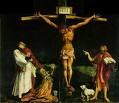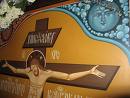
Dietrich Bonhoeffer once wrote, “Either I determine the place in which I will find God, or I allow God to determine the place where he will be found. If it is I who say where God will be, I will always find there a God who in some way corresponds to me, is agreeable to me, fits in with my nature. But if it is God who says where He will be, then that will truly be a place which at first is not agreeable at all, which does not fit so well with me. That place is the cross of Christ.” (Meditating on the Word, p 44–45).
Tom Wright Answers the Caricatures of the Cross
One of my persistent vocations is answering the critics of the cross. See for example, my The Cross and Violence, Is the Word of the Cross Good News, or is it Bad News?, a paper I gave at last summer’s Craigville Colloquy on Cape Cod.
So I was gratified to find this piece by N.T Wright, Bishop of Durham, in Fulcrum, from 2007, The Cross and the Caricatures.
Here’s a sample:“We must of course grant that many Christians have spoken, in effect, of the angry God upstairs and the suffering Jesus placating him. Spoken? They’ve painted it: many a mediaeval altarpiece, many a devotional artwork, have sketched exactly that. And of course for some late mediaeval theologians this was the point of the Mass: God was angry, but by performing this propitiatory sacrifice once more, the priest could make it all right. And it was at least in part in reaction against this understanding of the Eucharist that the Reformers rightly insisted that what happened on the cross happened once for all. They did not invent, they merely adapted and relocated, the idea of the propitiation of God’s wrath through the death of Jesus.
We must of course acknowledge that many, alas, have since then offered more caricatures of the biblical doctrine. It is all too possible to take elements from the biblical witness and present them within a controlling narrative gleaned from somewhere else, like a child doing a follow-the-dots puzzle without paying attention to the numbers and producing a dog instead of a rabbit.This is what happens when people present over-simple stories with an angry God and a loving Jesus, with a God who demands blood and doesn’t much mind whose it is as long as it’s innocent. You’d have thought people would notice that this flies in the face of John’s and Paul’s deep-rooted theology of the love of the triune God: not ‘God was so angry with the world that he gave us his son’ but ‘God so loved the world that he gave us his son’.”
Where I Ruminate on the Perils of a Palm Sunday Faith in a Good Friday World
There is a kind of decaffeinated Christianity that wants to quickly slide by Good Friday and get right to Easter, as if Good Friday is a morbid and somewhat unfortunate episode that is dwelt upon only by the morbid and masochistic. Or to put it another way, we are tempted to have a Palm Sunday faith, a faith based on a misunderstanding of who Jesus is.
Like the crowd at the first Palm Sunday we are tempted to see Jesus not as he is, but as a projection of our own hopes and desires. We can do this in a number of ways. We can turn Jesus into the supporter of our personal goals, or the upholder of our national ambitions, or our politics, or other ways where he becomes who we want him to be instead of who he really is. “Palm Sunday faith” is when we want a Jesus without a cross so we can have a faith without a cross, a faith without challenge or sacrifice, a faith without testing or struggle. When we do that we turn God into a kind of talisman or lucky charm to bless our projects and our aspirations, when in fact the God of the Bible is a God with his own sovereign purposes.
The problem with a Palm Sunday faith is that we live in a Good Friday world.I believe that Christian faith is essentially a joyful enterprise, but it is a joyful enterprise that doesn’t turn or flinch from the hard truths of the world’s harsh brutalities. So Christian faith without a cross does not show God’s full power to deal with human sin and death. And a faith without a cross will be found feeble and wimpy when the chips are really down.
What do I mean when I say it is a Good Friday world? There is a certain heartbreaking aspect of living that comes to us all. Often we only see it from a distance, as in the war in Iraq, where we have seen pictures both of dead and injured civilians and dead servicemen and women. But to the families of those individuals that heartbreak has come “up close and personal.” And some heartbreak comes to every human life sooner or later.
It is not just in wartime that the powers of sin and death do their heartbreaking work. Which is why there is so much comfort for us in worshipping a God who himself “became a man of sorrows and acquainted with grief.”
And that is exactly it. Our God knows the whole truth about human life. Knows not just the Sunday veneer and the masks of propriety but the dark and sad parts of it all. Knows that life is not a bowl of cherries. And this God not only knows the worst the world has to offer, but he has done something about it. His love is not sentimental love; it is holy love, a love that moves and acts to deal with love’s enemies.
A God who merely comforted the afflicted and bound up the wounded would not be a God who takes on the power of sin and death and evil. That is what the cross of Jesus is all about. God himself confronting human life at is very worst, at its most irredeemable, at a pitiful state execution, where the most powerful forces in the world humiliated and destroyed this humble innocent man.
He took it all on himself, the whole weight of the world’s hate and violence, its guilt and shame, all of it there on the hill at Golgotha. For us: you and me, and not just for us, but for everyone, across the ages. And not just for humans, but for himself, because his own holiness could not tolerate the world’s sin without atonement. And so he made it, not with the blood of rams at the temple, but making the sacrifice himself, spilling his own life out.
And why? Because that is what love does. By its very nature love spills itself out. In the letter to the Philippians Paul says that Jesus even gave up his own rightful claim to divinity, emptying himself, taking the form of a slave, for the cross was a slave’s death.And because of this humble obedience the Father has highly exalted him, and has given him God’s own name. Because “Lord” is the name Israel gave to their God, and to no one else.
But now Jesus is called “Lord.”When we call Jesus “Lord” and take the full measure of his love we will be moving toward a faith that can meet life’s darkest hours and toughest spots. A faith that is able to stand at the foot of the cross. And the world desperately needs people like that with faith like that: faith in Jesus, and in the power of his cross.

“Jesus was not Crucified in a Cathedral between Two Candles”
George Macleod, the founder of the Iona Community, once wrote,
“I simply argue that the cross be raised again at the center of the marketplace as well as on the steeple of the church. I am recovering the claim that Jesus was not crucified in a cathedral between two candles, but on a cross between two thieves; on the town garbage heap; at a crossroads so cosmopolitan that they had to write his title in Hebrew and in Latin and in Greek . . . at the kind of place where cynics talk smut and thieves curse, and soldiers gamble. Because that is where he died. And that is what he died about.”
Confessing Christ
The other place I blog is the Web Site of Confessing Christ. Here is A Brief history of Confessing Christ by Pastor Frederick R. Trost: “In August of 1993,a Convening Committee for Confessing Christ was on the phone, composed of pastors and teachers of the Church and a graduate student in American Church history.Might there be a way of gathering others in the United Church of Christ who love the Church and are devoted to its ministry, to talk about our “life together” for the sake of our mission as Christians and our commitment to social justice, liturgy, and pastoral care? From the beginning there was agreement on the necessity for solid, joyous, theological work in the Church, for Biblical study and conversation with our varied, rich, and living theological heritage in the United Church of Christ. We took as our theme the words of the First Article of the Barmen Declaration:
- with joyful seriousness,
- not as a kind of hobby,
- not with any desire to settle down in the sixteenth century
but to honor our baptism, to see how dialogue with one another and with those who believed before we were born, can reform the life of the Church for the sake of its vocation in the world.
There are times when we have to face the fragile state of our life together. We believe this is one of those times. There are moments when the question “What is truth?” won’t go away. This is one of those moments. There are hours when the ancient query “What think ye of Christ?” cannot be avoided. We believe this is one of those hours.
“He Died Upon the Lonely Tree” A Passion Hymn
“He Died Upon the Lonely Tree”
C. M.
He died upon the lonely tree
forsaken by his God.
And yet his death means all to me
and saves me by his blood.
The world will never know his worth,
the wise will never see,
But those forsaken, broken, bowed,
will recognize that tree.
And know that there God’s love does reign,
and conquers sin and death;
Thwarts hate and evil, comforts pain,
gives hope while there is breath.
The nations grasp at wealth and power,
while wars like tempests toss,
But finally in God’s good hour,
they’ll know him in his cross.
Then wars will cease and weapons fall,
and fear will melt away.
For Christ will be their all in all,
from day to endless day.
Suggested tune: Bangor
© 2001 Richard L. Floyd
Gabriel Fackre on The Life Everlasting
On Gabriel Fackre’s blog he has been doing a series on Hope. The most recent one is on The Life Everlasting. Here’s some of it:
do with the bold Christian affirmation of “everlasting life.”
The portrayal in Scripture —yes through a glass darkly—of this final state is rich and varied. Sometimes it is described in cosmic terms as “a new heaven and a new earth.”(Rev.21:1) At other times it is visualized politically and socially as the Kingdom of God come to earth (Matt 6:10). And yet other times, the focus is on persons and their fulfillment. And in every case it is clear that the alienations that mark our fallen world of Now are overcome with a reconciliation of all the broken and separation parties to God’s purposes. Thus what God finally wills and achieves is the very reflection of who God is: an everlasting life together that mirrors the eternal Life Together.
At the very center of Things to Come is the Person through whom the triune God will make such possible.”Book Review of “Who Do You Say That I Am?”
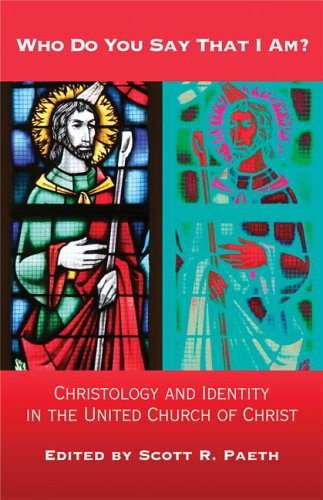
Who do you say that I am?”: Christology and Identity in the United Church of Christ, edited by Scott R. Paeth. United Church Press, Cleveland. 2006. Paper. 221 pages. (This book review is from Joy in the Word, Spring 2008) A few weeks after my ordination back in 1975, I heard Robert Moss, then president of the United Church of Christ, preach a sermon in which he told a humorous anecdote about Kenneth Teegarden, the president of the Christian Church (Disciples of Christ), who upon his retirement opened his morning Indianapolis Star to read this headline: “Disciples of Christ seek leader!” And we thought we had an identity crisis in the United Church of Christ! But even though we confess that “Jesus Christ is the sole head of the church” (Preamble to the UCC Constitution) it does not mean we have settled the questions of who Jesus Christ is, and what it means to be the church of which he is the head.
These are the big questions addressed in Who do you say that I am?” Christology and Identity in the United Church of Christ. This is an ambitious undertaking, given the dizzying diversity of views in our church, and the multiplicity of heritages in our history. Lee Barrett, sums up the challenge succinctly when he writes, “At times this variety may seem more like a curse than a blessing, leading to the suspicion that “Jesus Christ” has become nothing more than a blank screen upon which the proudly autonomous individual can project anything that tickles one’s fancy. Frequently, it seems that the Christ who was supposed to be center of the United Church has become the “wax nose” feared by Luther that could be twisted any way one wants, leaving the denomination centerless.” (p.
42-43)Or as editor Scott Paeth puts it in his introduction: “Talking about Christology in the United Church of Christ is akin to wrestling an octopus.” (p. 9) He describes the purpose of the book as making a contribution to “the task of interpreting Jesus Christ in the United Church of Christ.” (p. 16)
Colin Gunton on Language for the Trinity
The late British Reformed Theologian Colin Gunton (1941-2003) wrote brilliantly about a variety of theological subjects, including the Trinity, which he called “the Church’s primary resource against idolatry.” Here he wrote about the language of the Trinity in a review of David Cunningham’s These Three Are One in the Scottish Journal of Theology:
Where I Ruminate on Preaching to Folks Who Don’t Know Their Bible
In my thirty years as a preacher I often had the feeling, when confronted by the fact that even the most committted churchmen in my congregation had scant knowledge of the Bible, that I had just missed some golden age when the pews were chockablock with folks who read their Bible daily. But listen to this from P.T. Forsyth’s Yale Beecher Lectures from 1907, published as Positive Preaching and the Modern Mind:
“The Bible may be his (the preacher’s) text book, but it has ceased to be the text book of his audience. The Bible is not read by the Christian, or even by the churchgoing public, as a means of grace greater even than churchgoing. Our people, as a rule, do not read the Bible, in any sense which makes its language more familiar and dear to them than the language of the novel or the press. And I will go so far as to confess that one of the chief miscalculations I have made in the course of my own ministerial career has been to speak to congregations as if they did know and use the Bible. I was bred where it was well known and loved, and I have spent my ministerial life where it is less so. And it has taken me so long to realize the fact that I still find it difficult to adjust myself to it. I am long accustomed to being called obscure by many whose mental habits and interests are only literary, who have felt but a languid interest in the final questions of the soul as the New Testament stirs them, who treat sin as but lapse, God’s grace as if it were but love, and His love as if it were but paternal kindness.”
Does that strike a chord with any of you preachers?