Unknown's avatar

A Rumination on Loss


A therapist friend of mine believes that most of us, most of the time, given the choice, will choose to feel guilty rather than powerless, since guilt implies that we might have done something different and, thereby, had a different outcome, giving us the impression of some control.

I’ve experienced my share of both, but it is powerlessness that is my theme today.  A little before 9 am on Thursday last, I was preparing to go snowshoeing.  There I was sitting in my pajamas in my living room when I heard a distinct sound like “glub glub,” the dreaded noise that tells you it is time to call your sewer guy to clean out your line.

Martha was down in Boston to be with her sister who had just had knee surgery, so I picked up the phone and called her to get the name of our sewer company.  While I was talking to her I heard with rising panic the loud sound of fast running water, and I ran downstairs to see what was up.  A heavy flow of sewage was pouring out of the downstairs toilet into my living quarters.

Still holding the phone I asked my wife how to turn off the water, and I did that but to no avail.  Then I turned off the toilet, but still the deluge continued.  I stood there barefoot in raw sewage powerless, watching as my den and library filled up with dirty water.

What to do? I called 911. ( I was reminded of the old Smothers’ Brothers bit when Tommy fell in a vat of chocolate, and he yelled “fire,” figuring no one would come to rescue him if he yelled “chocolate”!)

The fire department came in about ten minutes (that was the last call I could make as the water shorted out the phone. I searched for my little-used cell phone.)

Meanwhile, I watched dirty water rising into my living space, darkening the wall-to-wall carpet.  We have a raised-ranch, so there is no basement.  Soon the carpets were all covered.  The heavy flow then went over the threshold into the garage, and then, when the garage was covered, out into the driveway.  This went on for over an hour.

Eventually the DPW came and found the sewer clog in the street and it stopped flowing, and I was faced with the dismal aftermath.  Being a Calvinist I have never liked the nihilistic metaphor “Shit happens,” but it seemed apt now in a quite literal way.

I called a cleaning service and soon they drove by my house to a neighbors and I chased them down.  “We’ll be down soon, they said”  Later they arrived, and the first thing the guy said was, “Your house is trashed!”  (He was obviously on loan from the Diplomatic Corp.)

What had to be done?  The rooms must all be gutted and sanitized.  Everything paper, cloth, leather, or porous that was touched by the 4 to 6 inches of raw sewage must go.  The door frames must go.  The sheet rock up to six inches above the water line must go.

These rooms contained the ephemera of my life.  My beloved books were in these rooms, Bible commentaries, most everything by Karl Barth, everything by P.T. Forsyth.   Lots of novels and poetry.  Most of these have been boxed and moved to high ground.  How they fare from the days of humidity and odor only time will tell.

Into the dumpster go my Harvard blue books; old term papers (“Antiochene versus Alexandrian Exegesis” for Gerald Cragg); a friend’s dissertation (sorry Jason); high school basketball and cross country clippings (“Floyd leads strong harrier field!”); papers and articles from my radical anti-Vietnam days.

My children’s pictures were in these rooms, as were Christmas ornaments from 35 years of family Christmases (recently packed away so carefully).

Into the dumpster go my first stereo speakers, KLH, from1972.  They were still sounding great.

The dumpster is covered with today’s snowfall and today it is a repository of my life’s momentos.  I understand that they are not the life itself.

And as losses go, this is a relatively small one. Nobody died.  It is only stuff.  I could be living in a tent on a medium strip in Haiti.

Still, every loss resonates with old losses.   And my litany of old losses is a long one:  my mother died when I was 18, the same year the city took our home to build a school.   Some best friends from childhood, college and seminary were all gone by the time I was thirty.  Then ten years ago I lost my health, and six years ago I lost my vocation.  Lots of losses.

Loss, powerlessness, and vulnerability remain my unseen companions.  Since my bike accident ten years ago I have lost the illusion that the world is a safe place.  I don’t feel safe in a car.  I don’t feel safe in my own home.  I feel the world is a dangerous place.  The world is a dangerous place.

But I remain one who stands under the word of God, and so I turn to the Psalms, especially the Psalms of Lament.  They have a formal structure that simply put goes something like this: “complain, complain, complain, complain, praise.”

Psalm Six is a good example.  Here the poor Psalmist is crying all night and day over his troubles.  His bones ache.  His soul is in anguish. He’s got enemies (the usual stuff).  He’s had a bad day. He argues with God that if God lets him die he will no longer be able to praise him (a sort of pre-death Kubler-Ross bargaining.)  In the end he is satisfied that the LORD hears and receives his prayer.

Sometimes that’s all you get, but it is enough.

Unknown's avatar

My Ten Guidelines for Oversharers


Our little family was on one of those cool Hebridean car ferries, traveling from Oban to Mull on our way to Iona, when I first ruminated on the American national trait to share way too much information with total strangers.  My five-year old daughter (this was 1989) had just commented, “Duddy, there are lots of Americans on this boat!”  I was reminding her that, although we had lived in Britain for several months, we were, in fact, ourselves Americans, when we were set upon by two very friendly Mid-Western American women who had overheard our conversation.

Within minutes we knew where they were from and the names of their children, their children’s spouses, and their grandchildren.  And when they discovered I was a minister, they felt compelled to tell me all about their church, their pastor, and all their activities in the congregation.

Perhaps none of this would have struck me as particularly strange if I hadn’t been a foreigner in Britain, but the contrast was evident to me.   Everybody in England had been quite pleasant to us during our stay, but with few exceptions maintained a certain reserve that I actually came to appreciate.

When we left Oxford that summer, I said my goodbyes to college dons and staff, and several remarked,  “But you’ve only just arrived!  We will miss you.”  While I believe they were sincere, I was amused by their heartfelt goodbyes in that they had barely given me the time of day.

I liked it in Britain, but I must confess that I’m an American oversharer, and that I come from a family of oversharers. I was one even before my brain injury, which adjusted my social filters to, shall we say, a more porous setting.

I come by it honestly.  My Dad, of blessed memory, was at times an oversharer.  One Thanksgiving dinner he launched his own campaign of “shock and awe” (shock to the grownups and awe to us kids).  My Uncle Dick was expertly carving the turkey with an electric carving knife (remember those?).  My Dad felt the need to share that a former secretary of his had committed suicide using such an implement, but his telling was not nearly as discreet as mine here.  I suspect that there were lots of leftovers from that meal.

The Internet was made for oversharers.  Blogging or updating one’s status on Facebook  offer hourly temptations.  So in yet another of my high-minded public service offerings, here are my ten guidelines to avoid oversharing:

  1. Never post on the Internet when you are intoxicated.  Trust me on this.  You may wake up to see that cute little red flag with lots of numbers in it on your Facebook page, and smile and wonder, “Which of my carefully crafted witty status updates are all my ‘friends’ responding to?”  Moments later you are mortified to suddenly remember that last post you made right before bed, which seemed like a good idea at the time.  It wasn’t.
  2. Remember the old adage about the difference between major and minor surgery?  “Major surgery is surgery on me, and minor surgery is surgery on someone else.”  The same is true for the difference between interesting surgery, and boring surgery.  And no surgical scars please.  Remember LBJ?   Nobody wants to see your scar.
  3. If you have an interesting story to tell about your friends the Andersons, and you ask your friends the Smiths if they know the Andersons, and the Smiths say, “No,” don’t tell the story.
  4. If your child or grandchild just learned to use the potty that is a grand thing but don’t share it.  Same thing for cute pictures in the tub.  Cute now, but the kid might not appreciate it when he’s 13 and the class bully finds it on the Net.
  5. Your Irritable Bowel Syndrome may well be very preoccupying to you, but it is not of general interest.  In my thirty years of pastoral ministry I patiently listened to people’s accounts of their bodily ailments.  We call it an “organ recital.”  You can and should share such concerns with your pastor and your doctor, but not with the world, and not on the Internet.
  6. Pastors are notorious for telling cute stories about their children from the pulpit.  Everybody loves this, right?  Well, no, actually.  The children usually don’t.  I would ask for permission.  Same policy for posting. Children and other family members have a right to privacy.  I have sometimes observed this rule in the breach, as my children have noted.
  7. When I go on vacation I take lots of pictures, and love to look at them again and again to relive the experience.  This is something that you want to share with all your friends and dinner guests, right?  No.  Pictures of other people’s vacations are not everybody’s idea of a good time.
  8. We live in an age of scientific miracles, and have medications available that can make us feel younger, happier, healthier and, just better.  Nobody wants to hear which ones you are on.
  9. Have a new hobby?  Yoga or origami?  Just because it excites you doesn’t mean it will excite others.  Same for religion.  If someone asks you what you believe, don’t lay out your systematic theology.  Say, “I’m a Methodist.” Or, “I affirm the Nicene Creed.”   A balance between talking and listening is a good anditote against oversharing.  Remember Bette Midler’s character in Beaches?  She says, “But enough about me, let’s talk about you, what do You think about me?”  Don’t be her.
  10. Tighten up you privacy settings.  Not just on Facebook, but in real life.  All of us experience ups and downs in our lives.  Most of us are battered and worn one way or another.  Some of us have had really traumatic events that have left us permanently scarred.  How and when (and whether) we share these parts of our story is something each of us must discern in our own way.  But such sharing implies some level of trust and intimacy, and although the Internet may sometimes give the appearance of allowing that, it is a risky medium for such sharing.   Be careful with yourself and others.

But I’ve shared too much.

(And yes, I know “oversharers” isn’t a recognized word, but it will be.  Just watch!)

Unknown's avatar

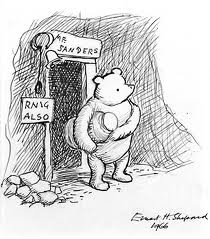
Ridiculous and sublime: Richard Bauckham’s “The Pooh Community”


More and more I am finding satire the proper vehicle to address some of the more foolish antics of both the church and the academy.  So I was delighted to come across Richard Bauckham’s delicious deadpan savaging of his own guild in his lecture “The Pooh Community,”  in which he employs some of the methods of contemporary New Testament scholarship to analyze A.A. Milne’s “Winnie the Pooh.”
His careful sifting leads him to posit the existence of several “communities” behind the final redaction of the text.  Here’s a sample:

“The very distinctive nature of the Pooh community can be further appreciated when we compare it with other children’s literature of the period, such as the Noddy books or the Narnia books (though it may be debatable whether these were already written at the time when the traditions of the Pooh community were taking shape). Words and concepts very familiar from other children’s literature never appear in the Pooh books: the word school, e.g., is completely absent, as is the word toys, even though the books are ostensibly about precisely toys. Conversely, the Pooh books have their own special vocabulary and imagery: e.g. the image of honey, which is extremely rare in other children’s literature (not at all to be found in the Narnia books, e.g., according to the computer-generated analysis by Delaware and Babcock), constantly recurs in the literature of the Pooh community, which clearly must have used the image of honey as one of the key buildingblocks in their imaginative construction of the world.

The stories afford us a fairly accurate view of some of the rivalries and disputes within the community. The stories are told very much from the perspective of Pooh and Piglet, who evidently represent the dominant group in the community – from which presumably the bulk of the literature originated, though here and there we may detect the hand of an author less favourable to the Pooh and Piglet group. The Pooh and Piglet group saw itself as central to the life of the community (remember that Piglet’s house is located in the very centre of the forest), and the groups represented by other characters are accordingly marginalized. The figure of Owl, for example, surely represents the group of children who prided themselves on their intellectual achievements and aspired to status in the community on this basis. But the other children, certainly the Pooh and Piglet group, ridiculed them as swots. So throughout the stories the figure of Owl, with his pretentious learning and atrocious spelling, is portrayed as a figure of fun. Probably the Owl group, the swots, in their turn ridiculed the Pooh and Piglet group as ignorant and stupid: they used terms of mockery such as ‘bear of very little brain.’ Stories like the hunt for the Woozle, in which Pooh and Piglet appear at their silliest and most gullible, probably originated in the Owl group, which used them to lampoon the stupidity of the Pooh and Piglet group. But the final redactor, who favours the Pooh and Piglet group, has managed very skilfully to refunction all this material which was originally detrimental to the Pooh and Piglet group so that in the final form of the collection of stories it serves to portray Pooh and Piglet as oafishly lovable. In a paradoxical reversal of values, stupidity is elevated as deserving the community’s admiration. We can still see thepoint where an anti-Pooh story has been transformed in this way into an extravagantly pro-Pooh story at the end of the story of the hunt for the Woozle. Pooh and Piglet, you remember, have managed to frighten themselves silly by walking round and round in circles and mistaking their own paw-prints for those of a steadily increasing number of unknown animals of Hostile Intent. Realizing his mistake, Pooh declares: ‘I have been Foolish and Deluded, and I am a Bear of No Brain at All.’ The original anti-Pooh story, told by the Owl faction, must have ended at that point. But the pro-Pooh narrator has added – we can easily see that it is an addition to the original story by the fact that it comes as a complete non sequitur – the following comment by Christopher Robin: “‘You’re the Best Bear in All the World,” said Christopher Robin soothingly.’ Extravagant praise from the community’s major authority-figure.”

To see the entire lecture go here.

Richard Bauckham is a theologian and biblical scholar who was Professor of New Testament at the University of St Andrews in Scotland.   His web site is here.

Unknown's avatar

Epiphany Ruminations on the Mystery of Baptism

I have been schooled to consider baptism with a theologian’s precision, what it is and what it isn’t, what happens and how, the various forms and their respective pitfalls. Nonetheless, baptism continues to possess much the same air of unfathomable mystery for me that my marriage does, that there is more going on here than can be properly named or known.

My own infant baptism, however inadequate (as my Anabaptist friends may regard it), held a strange hold over me during my growing up years.  I have been accused of having high-church inclinations for a Reformed pastor, and surely my baptism at St. John the Divine in New York, the world’s largest Gothic cathedral, got me started down that path.  My godfather, Bill Warren, was an Episcopal priest, a lovely man who served in remote parishes in Alaska and Arizona.  He was a Jungian analyst who was fascinated by Native American spirituality.  A bit of a mystic, his baptismal present to me was a red Morocco leather-bound copy of The Imitation of Christ.

It sat unused until I found it pristine in its dusty box on my bookshelf when I was about 19.  My mother had recently died, it was the late sixties, and I was something of a lost soul at the time.  I carried that little book around in my knapsack while hitchhiking across America in the summer of 1969, and it had an importance to me far beyond its content, which I found kind of creepy, to tell the truth.   It had become for me a talisman of a lost home and family, and of some connection to the boy I had once been in church, singing in the choir and loved by the congregation.  Later, when I read about Martin Luther’s “I am baptized” in the midst of his battles with the devil I resonated with that.

Now mystics, talismans and incantations to ward off evil are pretty far afield for a Reformed pastor-theologian to travel.  It’s a long journey from Thomas A Kempis to Karl Barth.   But still, six decades after I received that sacrament in the cathedral, baptism remains an inextricable (shall I say indelible) stamp on who I am, for better or worse.

I started ruminating on all this today because my daughter was baptized by my hand on this day, Epiphany, twenty-six years ago, and she is now discerning a call to serve in leadership in Christ’s Church. She is halfway through divinity school preparing for ordained ministry.  I couldn’t have imagined that when I was a child, as there were no ordained women in my church when I was growing up.  This is just one of a great many surprises that have taken place throughout my journey.  So many changes, and so much of what I once took for granted is lost or long-gone.  But baptism remains, full of promise and hope and heavy with many mysteries, connecting the journey of one generation of those who share Christ to that of another.

Some of my other posts on baptism:
Ruminations on Baptism
George Hunsinger:  Answer to a Question about Baptism

Unknown's avatar

My Most Popular Blogposts of 2010

The year past marks the first full year of Retired Pastor Ruminates and once again I turn to Google analytics to have fun with the numbers.  The site had 14,234 visits, with 21,648 pageviews and 9,744 visitors. You came from 104 countries, in this order:  United States, Canada, New Zealand, Australia, India, Germany, Philippines, South Africa.   The US visitors came from all 50 states and two territories.

If there was a theme for the year it would have to be the poor morale of mainline clergy and the peculiar pressures on that noble vocation these days.  The most popular post by far was my “Ten Highly Effective Strategies for Crushing Your Pastor’s Morale,” a snarky piece of satire that seemed to strike a nerve.  It was especially popular with Episcopalians and made its way to Episcopal Cafe.  Whether this means that Episcopalians have worse morale than other clergy is anybody’s guess.

My second popular post was a jokey piece on Nebraska football that got posted on something called Huskerpedia (I’m not making this up) and went viral.  For a time I considered putting “Nebraska football” in the title of all my posts (ie.: “Eschatology in late Barth and Nebraska football”) but decided that it would be wrong.

As usual, the interface between theology and ministry (my preoccupation) was the topic of many of the popular posts. Several of them deal with clergy burnout, and a couple others poke fun at some of the antics of my denomination, the United Church of Christ. There is more satire this year than last, as I find myself drawn less to the jeremiad and more and more to the “modest proposal.” Whether this is a sign of wisdom is an open question.

My post “Pastor’s Aren’t Prophets” got picked up and, in a much edited form, reposted on Duke’s Faith and Leadership blog.  One of my own favorites that didn’t make the top ten list is my satirical take on the New York Times Op Ed pages:  “Your Opinions Stink.”

I recently read a fitting quote from Samuel Johnson, “No man but a blockhead ever wrote, except for money.”   So there you have it.

I am glad you have found your way here.  Thank you for visiting and I hope you come again from time to time in 2011.
Here’s the whole top ten list:
Unknown's avatar

Gone to Look for America


When my wife’s position fell to the sickle of the Great Recession we decided to seize the moment and go on a road trip to Arizona to see our son who is in law school there.

So we spent all of October and the first couple of weeks of November on an excellent adventure across America, receiving the hospitality of family and friends, with some nights in Best Westerns to fill in the gaps.  Every town in America worthy of the name has a Best Western and a Subway, and I imagined the archaeologists of the future deciding these were the hallmarks of American civilization in the early Twenty-First century, much as a stoa was in the Hellenistic culture of the ancient world.

Subway is important, too, because you can split a foot-long “Veggie Delite” for 5 bucks and cheaply get enough fresh vegetables to avoid scurvy.

Our trip took 43 days; we drove 7,601 miles and visited 27 different states. The sun was shining all but two days.  No car trouble.  One oil change.

Some highlights:

  • The Frank Lloyd Wright house “Falling Waters” in Western PA
  • A stay at Potawatomi Inn in Pokagon State Park in Indiana
  • My Coe College Reunion where I sung in the alumni choir with my former director, Dr. Allan Kellar
  • Seeing my first newly shot bison carcass outside Pierre, SD with “Roger from the Prairie”
  • Badlands National Park in SD
  • The Black Hills National Park and Mount Rushmore in SD
  • Devil’s Tower in Wyoming
  • A few days in a friend’s cozy cabin outside Rocky Mountain National Park in CO
  • Taking the waters in Glenwood Springs, CO
  • Arches National Park in Utah
  • Driving through Monument Valley on the border of Utah and Arizona
  • The sun on the red rocks in Sedona, AZ
  • The Calexico concert at the Rialto in Tucson
  • Hiking Bear Canyon outside Tucson
  • Eating Texas barbecue in El Paso, TX
  • Eating a chicken fried steak in Ozona, TX
  • The Riverwalk in San Antonio, TX
  • Seeing the Alamo after all these years since my Davy Crocket cap
  • Eating the best Tex-Mex food on an outdoor patio (in November!) in San Antonio, TX
  • Seeing my first bayou
  • Eating blackened redfish and seafood gumbo in New Orleans, LA
  • Seeing how beautiful the Old South is in the fall, with yellow leaves still on the trees.

The autumn of 2010 was a season fraught with fear and anger, with a highly divided electorate during a nasty campaign season.  We saw evidence of that on billboards.

Still, the countryside abides and rolling through the miles one is struck by its vastness and the diversity of its scenic beauty.

Here’s what I noticed about Americans:

  • They don’t use their blinkers.
  • The obesity epidemic is not a fiction of the media
  • “Beef: It’s what’s for dinner!” is not a marketing slogan, but a way of life
  • They like to drive big trucks

Here’s what I noticed about America:

  • Texas is really big
  • The Interstate Highway System is an impressive piece of infrastructure
  • Our National Parks are stunning
  • There are many sections of many towns and cities that could be anywhere in America
  • You can get the same Subway sandwich made exactly the same way in all 27 states that we visited, except no provolone in Mississippi
  • Many cities in the South still look prosperous (perhaps they won the Civil War after all)

Many thanks to all the wonderful folks who hosted us.

(Photos from top:  Rocky Mountain National Park, Arches National Park, Mount Rushmore, The Alamo)

Unknown's avatar

Let’s Get Keith Richards to General Synod!


The United Church of Christ’s “Let’s Get a Celebrity” Sub-Committee” in Cleveland has recently been promoting getting Ellen De Generes to come to our next General Synod, but I think Keith Richards would be a better idea, and here’s why:

I know Ellen is a big gay icon and all, and I like her as much as the next person, but Keith is a way bigger celebrity, and let’s face it, he’s hipper, too.

Sure, there are other hot celebrities right now, but their minuses outweigh their pluses.  For example, take Lil Wayne.  He’s a person of color, which is a plus. He wears a cross around his neck, and has a couple cross prison tats, which are pluses.  But he is in jail on weapons charges and might be too dangerous even for Synod.  See what I mean.

Or take Bristol Palin.  She’s young and she’s a Christian, and she been on Dancing with the Stars, which are all pluses.  But she’s not our kind of Christian and she’s too Republican, which are deal breakers.

I could go on and on, but I think it has got to be Keith. He has a new autobiography out, and he is on the cover of the current Rolling Stone, so this is definitely a Keith Richards moment.

He has some minuses it’s true.  First of all, there has been some unsavory behavior in the past, but who are we to judge, especially a big celebrity like Keith.  Secondly, there is no evidence he is a Christian.  But, hey, I haven’t heard anything about Ellen being a Christian either.  And years ago we had Carl Sagan as the keynoter for the big-church Orlando Conference.  When someone asked him if he believed in God, he said, “No.”  That wasn’t a deal breaker then, why now?  And Keith once sang in an Anglican junior choir. That’s good enough for me.

So I say. Let’s get Keith Richards to Synod!

Unknown's avatar

“God Gives the Growth:” A Retirement Sermon

“I planted, Apollos watered, but it is God who gives the growth.”

I am honored that Dick asked me to preach on this special day. He has been my friend and colleague, mentor and frequent conversation partner for many years. I give thanks to God for him.

Dick has been a faithful minister of the Word of God among you for over two decades and now he and you come to the end of that ministry as he retires.  I have just gone through this myself, so I speak from experience when I say it is a time fraught with meaning. Like a trapeze artist who lets go of one trapeze but hasn’t quite grabbed a hold of the next, the transition from ministry to retirement can be at the same time exhilarating and frightening. And I daresay the analogy holds true for a congregation saying goodbye to their pastor and wondering about the future without him.

As we give thanks for Dick’s ministry, it might be profitable for us to consider what Christian ministry is all about. What is a minister? A minister is, quite simply, one who acts on behalf of another. We see this usage in European politics, where governments have a foreign minister or a minister of finance, for example. Such ministers represent and speak on behalf of their governments.  Their authority derives from those they represent. It is not their own.

In much the same way our ministry belongs to Jesus Christ and we represent him as his ministers. Our ministry isn’t a possession that belongs to us, but a call we obey, a service we carry out for another. It is easy to forget this, especially when one has been around as long as Dick and I have been. In our weaker moments we pastors can take on a King Louis XIV sense of self-importance. Recall how Louis said, “Après moi, le deluge: After me, the flood.” I shared with Dick some advice that your former area Minister Richard Sparrow gave me one time when I was worrying about what would happen after I left my pastorate of 22 years. He said, “Rick, it was Christ’s church when you got there, and it will be Christ’s church after you leave.”   Which was to remind me that ministry always builds on the work of others. As Paul told the Corinthians, “I planted, Apollos watered, but it is God who gives the growth.”

Paul was addressing divisions in the Corinthian church. Although the Greek word for “divisions” is schismata, from which we get our English word “schism,” schismata does not really mean factions or parties. More precisely it means a “tear” as in a fabric, or like a run in a stocking. It seems the Corinthians have broken into quarrelling factions around their various leaders.

Paul admonishes them to overcome their differences and become united. The Greek word translated as “united” means literally to be “knit together,” the very same word found in Mark’s Gospel (1:19) when he is describing the mending of fishing nets. So we have a vivid image here that we miss in translation, the image of the church as a torn fabric that needs to be mended.

But the disunity of the Corinthian church is more the symptom of the disease rather than the disease itself. The actual disease is their false understanding of what the church is, and what the ministry is.

Paul gets a little sarcastic toward these followers of different leaders: “Has Christ been divided?”  He asks them. “Was Paul crucified for you? Or were you baptized in the name of Paul?”

You see the problem? Have you ever known people who join a minister rather than a congregation? It happens! People join a minister because the minister is a spellbinding preacher or a compassionate pastor or an attractive personality. The problem is that when the minister in time shows the inevitable feet of clay they become disenchanted. Or when the minister moves on or retires their ties to the church are flimsy, because they have joined the leader and not the church.

That is what has happened in Corinth. Some have joined Apollos, a teacher who came after Paul in Corinth. Some have joined Peter. Some even regard Christ as their leader, as if he were just another human leader.

Some Corinthians have a magical understanding of their baptism, so that they have come to believe that the minister performing their baptism bestows more or less power depending how wise and spiritual he is. It is like someone here in Acton saying “I was baptized by Dick and not by Gail, so my baptism is better (or worse).” Or even more absurdly, somehow by baptism they would say, “I belong to Dick.” So Paul asks sarcastically, “Were you baptized in the name of Paul?”

And what is it that the Corinthians believe makes one leader better then another? The criterion seems to be the capacity to speak “eloquent words of wisdom.”  Paul founded the church in Corinth by preaching the simple good news of God’s love and mercy in Jesus Christ, the message of the cross, the message of the forgiveness of sins. Paul’s message was not Paul himself, nor was it Paul’s wisdom or Paul’s rhetorical eloquence. His message was Jesus Christ and him crucified.

But the Corinthians have mistaken their leaders for the traveling sages of the time who were known for the beauty and cleverness of their speech. Paul wants to distance himself from these wise men, and he wants the Corinthians to know, by contrast, who he is, which is a minister of Jesus Christ.

“I am merely a messenger,” he says. “Don’t mistake the messenger for the message.” Don’t look to Paul’s eloquence or Paul’s wisdom, but to the Gospel. For the power of the cross is a power made perfect in weakness, a power that might be obscured by eloquence and human wisdom, but one that is brought to light by the miracle of being shown as powerful even in the weakness of the messenger, just as God displayed his awesome power in the weakness of the crucified one, who died on the cross for us.

There are still all manner of attractive and eloquent purveyors of religion and philosophy around. You only need a TV remote to find good examples. And truth to tell, even in the church we are tempted to run after the wisdom of the age.

But if the church of Jesus Christ is to have vitality, integrity, and unity it will come out of its own life, not from the wisdom of the age, but from the power of the message God has given to us. And you and I and others like us in local congregations, in all our weakness, will be the bearers of that message and the living embodiment of its power. That is what a congregation is, for better or worse, the living embodiment of the Gospel.

Many people, perhaps all of us on some level, come to church to be taken care of, to be told what to do: by the Bible or the bishop or the pope or the newest book, somebody. If only the right leader would come along. But we see in the scriptures today that even the Apostle Paul struggled to get it across that it isn’t the messenger– it is the message, and it isn’t the leader– it is the church, the body of Christ, where the power of God resides through grace and the gifts of the Spirit. Paul had every right to be proud of the Corinthian church. After all he was the founding pastor. When he says, “I planted,” he means just that. But that is not all he says. He says, “I planted, Apollos watered, but it is God who gives the growth.”  He knew the power was God’s power through the Gospel and not Paul’s power through personality, talents or training.

That has been one of the gifts you have been given in Dick Olmsted, a gifted leader who has never forgot for a minute that it isn’t his Yale Ph.D. or his keen intelligence or any other human attributes or endowments that have made him a good minister of the Word of God.

As today’s political consultants would say, he has stayed on message. And Dick is well aware that the message applies to him as well as to you. To understand means to “stand under”, and Dick had stood under the Word of God, and preached to you as one forgiven sinner to another. He never forgot the great Reformation insight that we are at the same time sinners and justified before God, which is why he ministered to each and all of you without fear or favor. Because he knows that he is a minister, one who represents another, and a messenger, one who brings good news, and a witness, one who is always pointing beyond himself.

In 1995 my family and I traveled to Colmar, France to see Matthias Grünwald’s painting of the crucifixion in the famous Isenheim altarpiece triptych. A reproduction of this masterpiece hung over Karl Barth’s desk as he wrote his Church Dogmatics. One hangs over my desk, and one hangs over Dick’s desk. I chose it as the cover of my little book on the cross and atonement. It is not a pretty picture, but it is a powerful one.

In the painting John the Baptist points at the crucified Christ. Now this is not realism or historical accuracy, as we know that John had lost his head long before Good Friday. But Grünwald is trying to convey a deeper truth than the facts. He is depicting John as the witness to Jesus Christ. John’s pointing finger is strangely elongated, to draw your eyes to it and then to where it points.

Grünwald shows John as the representative Christian, the one who always points beyond himself or herself to Christ. And the Christ he points to is not Christ the teacher, Christ the prophet, or Christ the moral example, but the crucified Christ. For whatever else we might say about Jesus Christ, the one thing we must say is that he was crucified for us, and was raised on the third day as a divine vindication of the power of his weakness. Christ’s atoning death does for us what we cannot do for ourselves, freeing us from sin and death. To be a witness to the crucified Christ is to insist that God’s love is stronger than human hate, and God’s grace is greater than human sin.  That truth remains a scandal now as it was then, because it challenges the wisdom of this age as to what constitutes real power and authority.

Because in the topsy-turvy values of the Gospel the first shall be last and the last first, the exalted will be humbled, and the humble exalted, the poor will be filled and the rich sent empty away. In God’s economy power is made perfect in weakness, and for all our accomplishments, in the end we have nothing to offer to God but our sins. These are not the values of Donald Trump’s Apprentice, to say the least. And neither is it the wisdom of the age, but it is the message of the gospel, the message that a minister of the Word of God is called to deliver.

So you can see that this ministry of witness to Christ can be very frustrating in human terms. Which is why I took up cooking years ago as a hobby, because when you cook you see results right away. The meal either comes out or it doesn’t.  When people enjoy it you feel satisfaction and you get compliments. But being a minister of the Word of God isn’t like this. This pointing to Christ doesn’t usually manifest in immediate results. It’s more like being a gardener, a matter of planting and watering, and letting God use what you have done for his purposes, which remain mysterious. For you never know what seeds you sow, or who is ready to hear what word and when, a word that might even change their life.

In Stephen Ministry we teach that ministry is process-oriented and not results-oriented, and at first this really frustrates the Stephen ministers. Because we Americans are not good at waiting for God to give the growth. We want dominion and power and control. We want to force our will on things. The wisdom of this age demands results, and even ministers give up and give in and talk about our congregation’s attendance, or our budgets, or our additions, or our programs, or our new members. And don’t get me wrong, I am always grateful for any visible signs of vitality in Christ’s church.

But the truth about the church is that we can have the most beautiful building, and the biggest endowment, and the most eloquent preacher with a string of degrees after his name, and we can be so friendly we will melt the snow right off the roof, but if the message of Jesus Christ and him crucified, the message that God loves and forgives us, isn’t preached and heard and lived it all counts for nothing.  “For the message about the cross is foolishness to those who are perishing, but to us who are being saved it is the power of God.”

And in each generation, God raises up witnesses, messengers, ministers, like Dick Olmsted, for which we give thanks. Some will plant, others will water, but it is God who gives the growth.  Amen.

(The Reverend Dr. Richard L. Floyd, Pastor Emeritus of First Church of Christ in Pittsfield, Congregational, Pittsfield, Massachusetts, on June 19, 2005 at the Acton Congregational Church, on the occasion of the retirement of the Reverend Dr. Richard Olmsted.)

Unknown's avatar

Tell us something we don’t know! Pew poll discovers that Americans are ignorant about religion


In an article in today’s New York Times, “Basic Religion Test Stumps Many Americans,” Laurie Goodstein reports that Americans scored poorly in a test of basic knowledge about religion, according to a new Pew poll.  This will not be news to any clergy, although she writes, “Clergy members who are concerned that their congregants know little about the essentials of their own faith will no doubt be appalled by some of these findings:

  • Fifty-three percent of Protestants could not identify Martin Luther as the man who started the Protestant Reformation.
  • Forty-five percent of Catholics did not know that their church teaches that the consecrated bread and wine in holy communion are not merely symbols, but actually become the body and blood of Christ.
  • Forty-three percent of Jews did not know that Maimonides, one of the foremost rabbinical authorities and philosophers, was Jewish.”

Appalled, yes, surprised, no!  I can’t imagine any members of the clergy who aren’t well aware of the ignorance of most people about religion. One of the biggest perennial tasks of local religious leaders is teaching their congregants about the basic tenets of their own faith, not even to mention other’s.

And preachers are well aware that they have to fill in a great deal of background for their listeners to have a context to understand even the most well-known biblical stories.

This lack of knowledge is not just a feature of the uneducated. I have known very intelligent professional people with Ivy League educations who were biblically and theologically illiterate.

The reasons for this are complex pieces of large cultural changes, but signal a pervasive secularism that shapes even religious people.

My own passion for what I call “remedial catechesis for adults” led to my writing A Course in Basic Christianity. You can learn what it is about and how to get it here.