Unknown's avatar

Commandment takes beating in Tampa: “Lies, Damn Lies, and Republican Convention Rhetoric”

Mitt Romney is a Mormon and Paul Ryan is a Roman Catholic so they will differ on how to number the Ten Commandments, but they both violated the one that says, “Thou shall not bear false witness against thy neighbor.”

Ryan went first with these obvious lies:

1. He claimed the President had “More debt than any other president before him, and more than all the troubled governments of Europe combined.” It just isn’t true. When he took office the national debt was 10.6 trillion dollars, and is now about 15 trillion. How much of that is his?  President Bush increased the debt by more than 5 trillion dollars during his two terms. President Obama has increased the debt by less than 1 trillion. The two Republican wars have been expensive, but the Bush tax cuts have been more so.

2. Ryan blamed the president for the credit downgrade last August, even though the ratings agency that made the downgrade blamed Republicans for refusing to accept any tax increases as part of a deal.

3. Ryan blamed the president for the failure of the Bowles-Simpson compromise plan, when in fact it was Ryan who persuaded other House Republicans to scuttle the plan.

4. Ryan blamed the president for the closing of a General Motors plant in his hometown of Janesville, Wisconsin, but the plant shut down in December 2008, before Obama even took office.

5.  Ryan claims that “$716 billion, (was) funneled out of Medicare by President Obama,” a deliberate distortion of the Affordable Health Care Act savings by eliminating inefficiencies, when Ryan’s own plan for Medicare includes these same savings.

6. Ryan, an admirer of Ayn Rand, the high priestess of self-reliance and contempt for the poor and weak, said in his speech: “The greatest of all responsibilities is that of the strong to protect the weak,” and “The truest measure of any society is how it treats those who cannot defend or care for themselves.” Yet his budget has Draconian cuts in social programs for the poor and unwell. At the same time Ryan would give richest citizens and corporations $3 trillion in tax breaks.

Governor Romney is not as big a liar as Congressman Ryan, but that is damning with faint praise. He started his speech with one of the biggest whoppers in political history (what Andrew Sullivan called the big lie):

Four years ago, I know that many Americans felt a fresh excitement about the possibilities of a new president. That president was not the choice of our party but Americans always come together after elections. We are a good and generous people who are united by so much more than divides us.

Now anybody who has picked up a newspaper or watched a legitimate TV news source (which eliminates Fox) knows that the President was met by a partisan wall of Republican non-cooperation from his first week in office. The GOP decided that they would put making the President look bad above the good of the country.  And they didn’t even bother to hide their contempt for him, as when Mitch McConnell pronounced that his party’s  primary goal was the President’s defeat: “The single most important thing we want to achieve is for President Obama to be a one-term president.”

I don’t ever remember such open contempt for a sitting President, which I ascribe (at least partly) to racism, I am sad to say.

So Governor Romney’s rewritten narrative that “Americans always come together after elections” is an egregious lie.

But there were other lies in his speech, including these

  •  “Unlike President Obama, I will not raise taxes on the middle class.” This isn’t true, but according to the nonpartisan Tax Policy Center, Romney’s own tax plan would increase the tax burden on middle- and low-income Americans if it is to be revenue neutral, as Romney promises.
  •  “His trillion-dollar cuts to our military will eliminate hundreds of thousands of jobs, and also put our security at greater risk.” These cuts are hardly “his” (President Obama’s) as they result from an agreement between House Democrats and Republicans unless they can agree on other ways to cut spending.
  •  “His $716 billion cut to Medicare to finance Obamacare will both hurt today’s seniors, and depress innovation – and jobs – in medicine.” These “cuts” are actually reductions in future Medicare spending, and they are to providers, not Medicare recipients. They also extend the life of the Medicare program, which is perhaps why Paul Ryan has included them in his own budget plan.
  •  “Today more Americans wake up in poverty than ever before.” This one is factually true, but misleading. The poverty rate, a far fairer gauge of poverty under the president, was 15.1 percent in 2010. That’s the highest since 1993, and it’s nothing to be proud of. But it’s 7.3 percentage points lower than the 1959 poverty rate.
  •  “The centerpiece of the President’s entire re-election campaign is attacking success.” This is a reference to the President’s now famous “You didn’t build that” speech, which was taken out of context, his point being that you need help to be successful.  (Source: CBS News fact check)

Both Ryan and Romney know they are not telling the truth about the president. Where there are political differences let there be vigorous debate, but let the lying stop. Daniel Patrick Moynihan once said, “Everyone is entitled to his own opinion, but not his own facts.” And God said, “Thou shalt not bear false witness against your neighbor.”

Unknown's avatar

The 27th Massachusetts Convention of Congregational Ministers Barth Session for Pastors

The 27th Massachusetts Convention of Congregational Ministers Karl Barth Study Session for Pastors will gather Monday, June 11 and Tuesday June 12 at the First Church and Parish in Dedham.

We will read in Church Dogmatics IV/I, Chapter XIII “The Subject Matter and Problems of the Doctrine of Reconciliation” Section 57: “The Work of God the Reconciler” #2 “The covenant as the Presupposition of the Doctrine of Reconciliation” (Pg 22-66 small print 54-66, 22-34)

Our leader will be the Professor Karlfried Froehlich, retired from Princeton Theological Seminary.  His is a church historian who studied with and was examined by Barth in Basel.  Prof. Froelich has an interest in Coccejus a Reformed theologian of the Federal Theology basic to the New England Way. Being a Lutheran, he will not be putting new labels on the same old stuff.

Our afternoon sessions will take up issues Christians now face in the Middle East.

In hopes of avoiding traffic we will begin at 9:30 am. Lunch will be provided at noon. The afternoon sessions will conclude at 2 pm. You are cordially invited to dinner at the Dedham Parsonage. We gather at 5:00 pm and feast at 6.

Thanks to the Massachusetts Evangelical Missionary Society the cost for these two days remains at $50.  Maximum Participation is 15 participants.

Register by sending your contact information to The Rev. Rali M. Weaver, 670 High Street, Dedham, MA 02026. Or by emailing raliweaver@dedhamuu.org

Questions may be asked by calling 617 459 5979

Unknown's avatar

The Use and Misuse of Faith in Politics

On Tuesday I wrote this on my Facebook wall:  “I want all my Facebook friends to know that as a committed Christian I deplore the political hijacking of my faith by ignorant, intolerant, racist and misogynistic extremists.”

As of this morning I have received 34 “likes” and about a dozen approving comments.  But I was uneasy about it.  Those of you who know me know that though I rant pretty easily about this and that I do my best to avoid self-righteousness.  And part of what I deplore these days is the tone of political discourse, and I worried that my frank cry of the heart was yet another ideology-driven screed.

I am no happier when liberal Christians become “the left wing of the Democratic party at prayer” than I do when evangelicals become “the right wing of the Republican Party at prayer.”

I was also pleased to see that some of my “likes” came from conservative evangelical friends.  And many of them came from young adults in my children’s generation.  That is heartening.

My sister-in-law Annette, a faithful Roman Catholic, wrote this comment:

I gather that you love the sinners but hate the sins of willful ignorance, intolerance, racism and misogyny. But do we really love these sinners? And what do we do, as faithful, for or with these sins? We are sinners, too, by other measures. I’m feeling confused. It’s Lent and I’m breaking this down for my daughter with an intellectual disability and some things don’t add up when I look at the fundamentals.

She got right to my uneasiness, because I know myself to be a sinner as well, and not only by other measures, but even by the very sins I deplore in “the extremists.”

“Love the sinner, but hate the sin” is the proper Christian admonition, but here Annette is savvy, too, as she knows how hard this is to do with any consistency.

To keep such self-awareness from becoming a counsel of despair I find comfort in the Reformation insight simul justus et peccator, that we are at the same time sinners and justified by God. “Redeemed sinners” is the way I like to think of it.

And something I had to learn in three decades of pastoral ministry is that there are some people who are just plain unlovable, so you have to turn them over to God who does love them.

But where I come down in the end is that just because we know we are sinners too, and perhaps share in some of the same sins, we are not exempt from speaking out about the things we deplore.

And I would assert that intolerence, racism and misogyny should be deplored by all people of good will, religious or otherwise, liberal or conservative, Republican or Democrat.  And the use of these sins to raise fears for political gain is a double sin.

Unknown's avatar

Happy St. David’s Day: Cymru am byth!

Like many Americans whose families have been around for generations I am of mixed national ancestry.  But my surname, Floyd, is Welsh. It is the same name as Lloyd, which is a variation of the Welsh word llwyd or clwyd, which means “grey.” The double-L represents “the voiceless alveolar lateral fricative of Welsh,” and was sometimes also represented as fl, yielding the name Floyd. It is not a sound you can make in English.  It sounds something like a soft cough or gently clearing your throat.

Did you know that?  Now you do, and since we are talking about Wales let me wish you a happy St. David’s Day with one of St. David’s graceful admonitions:

“Be joyful, and keep your faith and your creed. Do the little things that you have seen me do and heard about. I will walk the path that our fathers have trod before us.”

St. David was a sixth century Welsh bishop who became the patron saint of Wales.  I have been to the charming cathedral named for him in St. David’s, Pembrokeshire.  It was built in a hollow near the sea so the Vikings couldn’t see its spire from their ships.

Tonight I will raise a glass to St. David and that estimable Welshman Rowan Williams, the Archbishop of Canterbury, and one of our best contemporary theologians.  The Welsh do make a single malt, Penderyn, but since I have none I will be raising Scotch.

Unknown's avatar

The Curious Protestantism of Rick Santorum

The other night I watched the Republican Primary debate from Arizona and was struck by the incongruity of two Roman Catholics and a Mormon fighting to be the standard bearer for what has become the party of American conservative evangelicalism.  Even a cursory knowledge of American history will remind you that one of the (nasty) features of American Protestantism right up to the late 20th century was a virulent anti-Catholocism.  And in the 19th century Mormons were run and burned out of town in Illinois (and elsewhere) by Protestant mobs. Well, if that particular form of bigotry has changed all for the good.

But the more I listen to Rick Santorum, the more Protestant he sounds, and perhaps this is his appeal to conservative Protestants.  So I was pleased to find in today’s on-line New Yorker a knowledgeable exegesis of Rick Santorum’s remarks the other day about President Obama’s “theology.”

The article, called “Senator Santorum’s Planet,” is by James Wood.  He writes, “If Rick Santorum is so staunch a Catholic, why does he often sound such a Protestant, not to say puritanical, note?” You can tell Wood has some pew-sitting in his past (he admits as much), and he clearly understands the subtle nuances of biblical and theological talk.  He says,

“I know the theological weight of that word, “steward.” When I was a boy, my mother, in the grip of her Scottish evangelical Protestantism, used to chide me for my untidy bedroom, adding that, as a Christian, it was an example of “poor stewardship.” Everything is the Lord’s, and our brief role on earth is merely to husband it in a right way, a way that gives the Lord His due.”

Wood sees in Santorum an apocalyptical ascetism more obviously associated with Protestantism than Roman Catholicism and I think that is just right.  Santorum may be a conservative Catholic, but his theology has heavy overtones that come not out othe native soil of his own faith, but from a particular brand of American evangelicalism.  This is at the heart of his objection to the President’s “theology,” which he identifies with an extreme form of environmentalism that the President’s critics on the left must find confounding.

Wood concludes:

When Santorum says that we must be good stewards of the earth, there is religious zealotry behind the sweet words. He is proposing, in effect, that the earth is dispensable but that our souls are not; that we will all outlive the earth, whether in heaven or hell. The point is not that he is elevating man above the earth; it is that he is separating man and earth. If President Obama really does elevate earth over man (accepting Santorum’s absurd premise for a moment), then at least he believes in keeping man and earth together. Santorum’s brand of elevation involves severing man from man’s earthly existence, which is why it is coherent only within a theological eschatology (a theology of the last days). And he may well believe that man cannot actually destroy the earth through such violence as global warming, for the perfectly orthodox theological reason that the earth will come to an end (or be renewed) only when Christ comes again to judge the living and the dead. In other words, global warming can’t exist because it is not in God’s providential plan: the Lord will decide when the earth expires. This is Santorum’s “theology,” phony or otherwise.

The great irony in all this is that  among the viable contenders in the coming election the only actual Protestant in the race is President Obama.

Unknown's avatar

My Most Popular Blogposts of 2011

This was a big year for my blog.  First of all I changed the name from “Retired Pastor Ruminates” to “When I Survey . . .” This better describes the eclectic nature of this blog, and reflects my new belief that I am not retired but merely self-unemployed.

Most of my surveying takes place out the back porch (or back windows in cold weather) and I change the header picture to reflect what it is I see as I look out over the marsh behind my house.

This year I also purchased the domain name “richardlfloyd.com” and made the change from Blogger to WordPress with help from my antipodean friend Jason Goroncy who came to visit in June.  Thanks Jason.

Alas, it took awhile for folks and search engines to find the new site and name and I fell off of most of the blogrolls I was on.  The redirect to the new site only sends you to the home page, so it was harder for people to find specific posts from the past.  Time will take care of this.

One of the highlights of the year was an eight-week series of guest blogs on hope I did for Darkwood Brew, which describes itself as “a renegade exploration of Christian faith for the modern world which blends ancient contemplative practices with cutting-edge interactive web technology, world-class music, arts, biblical scholarship, and special guests from around the globe via Skype.”)  Some of these posts on hope were among the most popular of the year.

So here are the most popular posts of the year:

  1. The Future of Newspapers:  The Third Annual Martin Langeveld Interview
  2. Chicken Little Theology
  3. Meeting an on-line friend in the flesh: My travels with Jason
  4. I am not optimistic, but I am hopeful
  5. Hope and the Spirit
  6. Rejoice! Rejoice!  A Sermon for the Third Sunday in Advent
  7. Be careful what you write for
  8. Reflections on the New Century Hymnal
  9. Ruminations on hermeneutics for adult Christian Education
  10. Ruminations about the the end of the world on May21: Howard Camping and William Miller

On the all-time list and among the most visited this year are my two cris de coeur on clergy burnout and abuse, The Ministry and its Discontents:  Pastors in Peril, and Ten Highly Effective Strategies for Crushing your Pastor’s Morale.

Thanks for visiting and drop by again from time to time in 2012.

Unknown's avatar

Hope and the Spirit

“The wind blows wherever it pleases,” Jesus once said to Nicodemus, “You hear its sound, but you cannot tell where it comes from or where it is going.”  (John 3:8  NIV)

As I am writing this I look out the window and watch the last of the lovely New England leaves falling down in the face of a stiff wind along with the occasional batch of snow flurries. I cannot see the wind, but I can see the trees swaying from its power and the leaves coming down.

By analogy (and not a pristine one, I admit) we cannot see God’s Spirit, but we can (and do) see the effects of it in our lives and our world.

Both the Hebrew word and the Greek word for “spirit” also mean “wind” and “breath,” all very real but unseen.  Like the wind God’s free activity is real but unseen.  But unlike the wind, God’s activity is not impersonal.

It is a temptation to imagine the Spirit of God as impersonal, something like “the Force” in Star Wars, but that would be a misrepresentation of God, at least of the Christian God revealed in Jesus Christ.

If we stay with the wind analogy we can see that God’s Spirit acts on both us, and our world, in unseen but real ways from outside ourselves.  So we cannot possess the Spirit of God, which presents a real problem for contemporary Americans because we are so very much into possessing.

We have even turned the word “spiritual” (a word that should be approached with great caution) into a human attribute, something we possess.  But if we think of God’s Spirit as like the wind, the truly spiritual person would be the one not possessing some intrinsic attribute, but the one most open to being moved by the unseen but real activity of God.

We might call this openness to the unseen activity of God “faith.”  If we project this openness into the future we might call it “hope.”  And this is where I think that the Spirit is a resource for hope.

Going back to my first post on hope eight weeks ago I named a faithless attitude “functional atheism,” which refers to the belief that it all depends on us.  I wrote that this attitude is even alive and well in the church.  Of course, you can go too far in the other direction.

Which is what I like about imagining the Spirit’s activity to be “wind-like;” we are not pressed into a kind of determinism that robs us of our freedom.  The opposite of “functional atheism” might be ideas of God that understand us to be mere marionettes that God moves around at will as if by strings.  A God of holy love does not coerce us!

When I am hopeless about the future it is often because I am projecting the way things are (in myself, in my society, and in the world) into an imagined future that is more or less the same (or worse!)

But openness to God’s Spirit means that the future is not just the present projected into the future.  The unseen but very real personal activity of the living God is working in us and around us to insure a far different future than we could ever imagine from looking at our present.

Faith is not just passively waiting for that future to appear, but to be actively working (as best we know how) for it to come about.  This is why Christians pray, “Thy will be done, on earth as it is in heaven.”

Who knows where the fresh winds of God’s Spirit will be made manifest?  That gives me hope.

(This is the eighth and final guest post I am blogging for an eight-week series called: “Hope-A Pessimist’s Guide” on Darkwood Brew, which describes itself as “a renegade exploration of Christian faith for the modern world which blends ancient contemplative practices with cutting-edge interactive web technology, world-class music, arts, biblical scholarship, and special guests from around the globe via Skype.”)

Unknown's avatar

Beauty and Time

Scott Russell Sanders tells a charming story about his daughter’s wedding.  He is in the vestibule of the church with the wedding party. “Clumsy in my rented finery—patent leather shoes that are a size too small and starched shirt and stiff black tuxedo—I stand among these gorgeous women like a crow among doves. I realize that they are not gorgeous because they carry bouquets or wear silk dresses, but because the festival of marriage has slowed time down until any fool can see their glory.”  (Hunting for Hope, p 140)

Time doesn’t really slow down, of course, but we all know what he means. New Testament Greek is better at this than English since it has two words for time.  There is chronos, which is sequential time, “clock time” we might say, and kairos, which is special time, “the fullness of time.”  Chronos is quantitative and kairos is qualitative.

Sanders’ perception of the beauty of the wedding party is a moment of kairos, and his image of time slowing down is wonderfully descriptive of how kairos feels.

It is also apt that Sanders links this imagined slowing down of time with beauty, because the New Testament Greek word for beautiful derives from the word for hour.  To be beautiful was to be “in one’s hour.”  Ripe fruit was considered beautiful, and a young person trying to appear older or an older person trying to appear younger was an offense against beauty,

Another place where time can seem to slow down is in worship, when the distance between time and eternity is collapsed, and we get a sense of being part of a great company of saints living and dead across the span of time and space: the “mystic sweet communion with those whose rest is won.”

These moments of kairos, whether at a marriage or at a church service or eating a ripe peach, are gifts of insight that help us make sense of the rest of our time, the quotidian chronos of living.

Christians have long imagined themselves as participants in God’s greater story, with its trajectory through time from Creation to Consummation.  Along the way there are wonderful moments of kairos, such as the coming of Christ, described beautfully here in the first verse of Carl Daw’s Advent/Christmas hymn:

When God’s time had ripened,
Mary’s womb bore fruit,
scion of the Godhead,
sprung from Jesse’s root:
so the True Vine branches
from the lily’s stem,
the Rose without blemish
blooms in Bethlehem.

(This is the seventh guest post I am blogging for an eight-week series called: “Hope-A Pessimist’s Guide” on Darkwood Brew, which describes itself as “a renegade exploration of Christian faith for the modern world which blends ancient contemplative practices with cutting-edge interactive web technology, world-class music, arts, biblical scholarship, and special guests from around the globe via Skype.”)

Unknown's avatar

‘Tis the gift to be simple

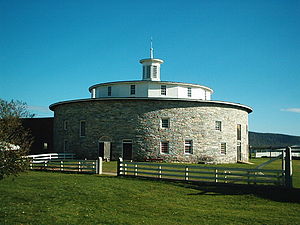
Just down the road from my home in Pittsfield, Massachusetts is the Hancock Shaker Village, a living history museum on the site of a former Shaker community.  It is a beautiful spot, with oft-photographed buildings such as this Round Stone Barn.  Both my children worked there during their teen years, and my son was a costumed interpreter for a couple summers.

The Shakers who once lived here at Hancock were part of a 19th Century utopian community.  They practiced racial and gender equality, pacifism, celibacy (which was their undoing), and what they called “simplicity.”  Simplicity meant placing a higher value on people’s spiritual life than on their possessions or achievements.

This attitude is beautifully expressed in their best-known song, “Simple Gifts,” written in 1848 by Shaker Elder Joseph and put to music by Joseph Brackett:

‘Tis the gift to be simple, ’tis the gift to be free
‘Tis the gift to come down where we ought to be,
And when we find ourselves in the place just right,
‘Twill be in the valley of love and delight.
When true simplicity is gain’d,
To bow and to bend we shan’t be asham’d,
To turn, turn will be our delight,
Till by turning, turning we come ’round right.

The turning refers to movements in a dance, for the Shakers were known for their use of dance in worship.

The lyric begins ‘Tis the gift to be simple, ‘this the gift to be free . . .” and there is a deep truth in these words.  In a consumer society such as ours it becomes far too easy for us to derive our identities from our possessions.  The irony is that in giving so much value to our possessions we let them possess us.

The Shakers put more emphasis on being than on having.  One of their axioms was “hands to work, and hearts to God.”

They understood there was something deeply spiritual about simplicity.  That less is sometimes more.  That quality is more important than quantity.

Can we learn from the Shakers ways of living and acting in simplicity that are, in today’s jargon, sustainable?   In this regard the Shakers were ahead of their time, in knowing how to live simply in ways that were kind to the planet and help to insure a hopeful future for it and it’s citizens.

(This is the sixth guest post I am blogging for an eight-week series called: “Hope-A Pessimist’s Guide” on Darkwood Brew, which describes itself as “a renegade exploration of Christian faith for the modern world which blends ancient contemplative practices with cutting-edge interactive web technology, world-class music, arts, biblical scholarship, and special guests from around the globe via Skype.”)

Unknown's avatar

Is there room in our hope for justice?

I try to imagine the prophet Amos at a fancy cocktail party.  He would be that guy, who seeing your new Mercedes in the driveway, would be compelled to go into detail about global warming from greenhouse gases, then move on without a breath to discuss the appalling inequalities of wealth between the richest and the poorest.

As you try to escape his conversational grip to enjoy that first sip of your martini, he would remind you of how much grain goes into making spirits that could be used to feed the hungry.

Such imaginings are pure fancy, of course, since people like Amos, obsessed with justice and injustice, never get invited anywhere because they are too depressing to be around.

And his hard words seem even more dire when you realize that Amos’ warnings aren’t merely grumpy pronouncements, but were understood as the Word of God delivered by the prophet.

So listen to what God says about religious practices:

I hate, I despise your religious festivals;
your assemblies are a stench to me.
Even though you bring me burnt offerings and grain offerings, I will not accept them.
Though you bring choice fellowship offerings,
I will have no regard for them.
Away with the noise of your songs!
I will not listen to the music of your harps.
But let justice roll on like a river,
righteousness like a never-failing stream!

If we picture the twin pillars of Jesus’ summary of the law, love of God and love of neighbor, as the vertical dimension and the horizontal dimension, why is it that our conceptions of Christian hope are almost exclusively focused on the vertical?

How many of our questions about the future are about our individual relationship with God? “What happens to me after I die?”  “Will I be saved?”

Do not passages such as this one from Amos remind us that God is very much concerned not only with what we might call our religion or spirituality, but also with justice and righteousness; not only about the health of the individual soul, but also about the health of the shared life in community?

And so our imaginings about Christian hope would be more biblical and faithful if they included a social dimension, as we think about both here and hereafter.

There is plenty of rich imaginative material in the Bible to work with.  For example, in Revelation 21 the future in the end time is a city, a New Jerusalem, described like this:

Look! God’s dwelling place is now among the people, and he will dwell with them. They will be his people, and God himself will be with them and be their God.  ‘He will wipe every tear from their eyes. There will be no more death’ or mourning or crying or pain, for the old order of things has passed away.

It is a vision of a community with God at the center, where God’s love has overcome all that afflicts our world including injustice.  And one interesting feature of this new community is that there is no temple in it.  That’s right, no need for religion, which apparently is God’s provisional strategy to get us from here to there.

So in the meantime, we need to ask ourselves as we imagine the future of our world, “Is there room in our hope for justice?”

(This is the fifth guest post I am blogging for an eight-week series called: “Hope-A Pessimist’s Guide” on Darkwood Brew, which describes itself as “a renegade exploration of Christian faith for the modern world which blends ancient contemplative practices with cutting-edge interactive web technology, world-class music, arts, biblical scholarship, and special guests from around the globe via Skype.”)

Photo: R.L. Floyd