Unknown's avatar

More reflections on worry: “The Peace of Wild Things”

Berry Pond

I recently posted “Are you choking? A reflection on worry” and a friend sent me this poem by Wendell Berry called “The Peace of Wild Things.” As always Berry is deeply insightful about the ways of the world and the human soul.

“The despair of the world” is great these days with wars and rumors of wars and it easy to let fear run away with us. We fear, as Berry puts it, “of what my life and my children’s lives may be.” We worry about the Middle East and Ukraine,  about Ebola outbreaks in Africa, about the tragedy of children on our borders fleeing violence. We worry about the stock market, rising income inequality, and the loss of jobs that cast a shadow over our children’s futures. With the 24/7 news cycle and the relentless posts on social media the fodder for worry is inexhaustible.

One of the features of our humanity is an awareness of the past and an anticipation of the future. It is a mixed blessing, for the cause of much of our anxiety is rooted in what Berry calls “forethought of grief.” We know that we will suffer and one day die, or as the basketball player/philosopher Charles Barkley aptly put it, “Father Time is still undefeated.”

When Jesus admonished his listeners to “be not anxious,” he told them to consider the birds of the air and the lilies of the field. This is “the peace of wild things” that Berry suggests can free us from our anxiety for a time and let us be.

The Peace of Wild Things

When despair for the world grows in me
and I wake in the night at the least sound
in fear of what my life and my children’s lives may be,
I go and lie down where the wood drake
rests in his beauty on the water, and the great heron
feeds.

I come into the peace of wild things
who do not tax their lives with forethought
of grief. I come into the presence of still water.
And I feel above me the day-blind stars
waiting with their light. For a time
I rest in the grace of the world, and am free.
– Wendell Berry

(Photo by R.L. Floyd. Berry Pond at the Pittsfield State Forest, Pittsfield, Massachusetts)

Unknown's avatar

Grace among the bedpans

Pastors spend a lot of time in hospitals. There they meet their congregants in trying moments, ill or hurt, facing or recovering from procedures that frighten and confuse. The most formidable lay pope, the one who thwarted your every dream at the last trustee’s meeting, now looks diminished in a “johnny” gown. Even in the best of hospitals the smell of mortality is ambient.

Which is why hospitals are such fertile spaces for grace to make an appearance, and why ministers do well to be present there as often as they can. Most people get better and come back into the life and flow of the congregation, but they will not forget that in one of life’s delicate moments you were there, and through you, their congregation was there, and through you, by grace, God was there.

Once again my late friend Arnold Kenseth, a Congregational minister who died in 2003, captures the truth of this in another of his exquisite poems:

In the Hospitals

In the hospitals trussed up to blood;
Or heaving breath so that the pulse can count,
The heart re-beat; or leaving the damp food
Untouched; or stuffed into the oxygen tent:
The sick, sexless as death, are fondled by
Machines, are stroked, pummeled, impaled, and Oh!
Ecstasies in the valley of the shadow,
The morphine murmur under the lost sigh!

And I think how we may die down down down
In the needle haze, in the white mercy
Of nurses, after the seance of x-ray,
Our souls stringed, buttocked in the bleak nightgown;
How dignity, dreaming, passion, faith, all
Will need God to retrieve them as we fall.

Arnold Kenseth (Seasons and Sceneries, Windover Press, 2002)

Unknown's avatar

Is God’s Love Fair? Ruminations on The Prodigal Son Story


My late aunt never had children, but she doted on her nephews and niece, and one of her principles was fairness.  If she gave something to one of us, she would make sure she gave something equivalent to all of us.  We always all got the same birthday check.  She was fair.

There is a lot to be commended about fairness. We taught it to our children, and children learn to spot unfairness pretty quickly. “That’s not fair!” can be heard on any playground, and rightfully so, since fairness is an important part of what makes any society workable, be it the small society of a school playground or the large one of a nation.  Laws should be fair.  Fairness is akin to justice, and the world would be a better place if there were more of it.  We all want our fair share, and resent it if our neighbor is getting more than his.

In my first congregation I once preached on the story of the rich man and the beggar, also called Dives and Lazarus, which is also (and only) in Luke (16:19-31).  My church treasurer, a hard working Maine Yankee, got me trapped at the door and said, why didn’t Lazarus (the beggar) just go out and get a job?  Why should Dives have to help him?  “It isn’t fair!”

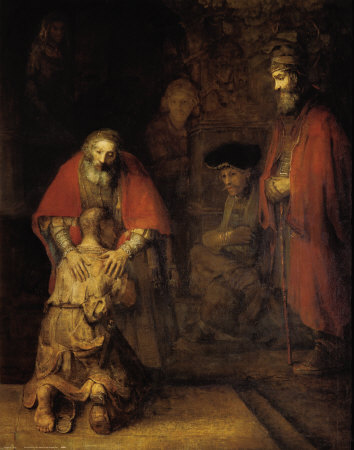
Which is one of the reasons this week’s Gospel (Luke 15:11-32) is such a scandal to us.  It isn’t fair.  The older son played by the rules, and the prodigal didn’t.  Yet the Father loves them both, even if their deserving is unequal.

Remember the parable of the workers in the vineyard?  Jesus says the ones who come late will get paid the same as the ones who worked all day.  “That’s not fair!”  Try explaining that policy to either union or management.

But in the divine economy it is all grace, which by definition is unfair because the recipient is undeserving.  “While we were still sinners Christ died for us.”  “That’s unfair!”  You bet it is, and it’s a good thing, too, because without that grace, who among us could stand?

There are many rich and insightful ways to approach this wonderful story.  But to me the best one is to see it as the Christian doctrine of atonement in miniature.

Gabriel Fackre’s writes,

“Jesus’ tale of the father’s welcome of the errant son is an anticipation of the Father’s embrace of the sinner on Calvary.  Neither the rigor of the earthly Semitic father nor the holiness of the heavenly Father can indulge the self-centered flight of the son/sinner. But the wrath over wasted substance does not descend on either prodigal. Where did it go? “There is a cross in the heart of God‘ said Charles Dinsmore. The broken heart of God is when the divine love absorbs the divine wrath (Luther) with its consequences, the suffering of God on the cross for the sins of the world. So too only the suffering love of the earthly father, mercy taking judgment into itself, can account for the rush forward to greet the returning prodigal.

What triggered the father’s response?  The Son’s return, of course.  But the father’s act was not evoked by a moral calculus- “he’s back because he’s sorry!“-for the father’s run and reach began without knowledge of the return’s rationale, while the son was “still far off.” Forgiveness is not dependent on good works here, no more than on the cross; agape is unconditional.

In both cases some human event is inextricable from the release of suffering love toward the sinner: a prodigal son in the human story, an obedient Son in the divine story. There is no proclamation of how the compassionate God came among us without the account of Jesus on the cross, any more than there is a story of the father’s embrace without the travel home of the prodigal. Finally, we are left with the narrative itself rather than a fully satisfying theory about it.” (Gabriel Fackre, Foreword to When I Survey the Wondrous Cross: Reflections of the Atonement.  Richard L. Floyd, Pickwick, 2000, Wipf and Stock 2010)


So even the laborers in the vineyard who show up late do need to show up to get their pay, even if they have little work to show for it.

And the prodigal son, who has taken his inheritance (which in those times was like telling your father to “drop dead!) and wasted it, still has to return.

We all come before God with empty hands, with nothing to show but our sins, and still God the heavenly Father, like the earthly father in the parable, has been waiting and watching for us all along.

Keep in mind that those who heard Jesus tell this story fell into two groups, the Pharisees (the older brother types) who knew they deserved God’s love, and the sinners, mostly  tax-collectors and prostitutes, (the younger brother types, like the prodigal son), who knew they didn’t.

Neither understood the amazing grace of Jesus’ story, and the radical invitation to come home.  As Herb Davis said this week in his sermon notes, “There is something worse than being dead, and that is being lost.”  Only those who have been lost really understand this.  The prodigal son understood, for he had hit bottom.

For most of the rest of us, whose lostness is less obvious, the story remains a scandal, as indeed, the whole Gospel is, especially the part about the cross.  Because “It’s just not fair!” No it isn’t.  It’s grace.  God’s love isn’t fair.

(Photo:  Rembrandt:  The Return of the Prodigal)

Unknown's avatar

Ashes and Snow: The Quotidian Graces of my Ash Wednesday


I woke up early this morning.  Too early, in fact, to stir without waking my sleeping wife, whose alarm goes off at 6:00 a.m.  So I put on my headphones and turned on my iPod.  At bedtime it had been set to Rachmaninoff’s beautiful Liturgy of St. John Chrysostom, for I am boldly attempting to sing it with a local choral group in May.  But for some reason my iPod was now playing my entire library on shuffle, and I didn’t want to have the little but bright iPod screen light go on and disturb my wife, so I listened to an eclectic assortment of tunes, starting with Traffic’s “Freedom Rider,” then the Greatful Dead’s “Trucking,” and ending with something lovely by Mary Chapin Carpenter, with some Christmas music thrown in the middle for good measure.

The alarm promptly sounded its daily vigil, and as my wife prepared for work I got up to see if there was an early Ash Wednesday service I could attend, since I wanted to go snowshoeing, as we got a fresh new mantle last night, the first in quite awhile.  I know snow has been wreaking havoc south of here, but we have had, not a snow-less winter, but an atypical one for the Berkshires, and I have been hiking in just boots and Yaktrax every day, so I was pumped to get on my snowshoes.

My denomination, the United Church of Christ in the U.S., is a rich mix of traditions, but the majority of them have Reformed roots, so Ash Wednesday has never been big for most of us.   And especially here in New England, where the Congregational churches that sit in the center of every village and town have evolved from the Puritan settlers.  The Puritans, who in so many ways got it right (but not always), historically took a dim view of such suspect accretions to the faith as Ash Wednesday services (they outlawed the celebration of Christmas for generations to give you some idea of where they were coming from.)  In the UCC and other Reformed churches we are coming around, thanks to the cross-fertilization of the Twentieth Century ecumenical movement, so now you can find such services in our churches, but they are usually at night.

But I was raised an Episcopalian (as was my wife), and as a young person I used to go to the early Ash Wednesday Service with my Mom, who died when I was eighteen, and so I have many poignant memories of such services.  I am very familiar and comfortable with the liturgy from the Book of Common Prayer, and fully accept the imposition of ashes, and so I tamp down my more Puritan impulses on such occasions.

Consequently, I looked on-line for the services at the local Episcopal Church, where I have a long history, as it is near the congregation I served for 22 years, and where my wife and I attend every once in a while.  I was hoping for early, but be careful what you wish for, since the service was at 7:00 a.m., and it was already 6:40 and I was still in my PJs, and the church is a ten minute drive.

Now those of you who know me know that I am somewhat old school (I suspect my children might say to the point of fussiness), and don’t feel quite like myself in church without a coat and tie and proper shoes, but there was no time even for a shower (now occupied by the one who actually works). So I washed as best I could, and tried to disguise my bed-head, put on my hiking clothes and went to divine worship.

I arrived at the front door at 6:55 and it was locked.   Hmm, I thought.  This is clearly not a UCC church, for “extravagant welcome” is one of our principle articles of faith.  But I knew there was a side door that led to the chapel, so off I went and arrived in time to see a few other souls ready to enter.  The rector, who is a friendly and gracious priest, came sweeping in, welcomed us and beckoned us to the chapel.

The familiar liturgy really moved me, and, since my own sense of sin may well be my keenest spiritual faculty, I found myself very emotionally involved in the  service.  And, not to put too fine a point on it in a public blog, I have of late been even less where I would like to be in my long and sometimes stormy relationship with God than usual, so I was feeling properly penitent and truly glad to hear the good news of God’s forgiveness in Jesus Christ.

The rector nicely explained Ash Wednesday, and how they had, on the previous evening, made the ashes for the service from the Palms from last year’s Palm Sunday. Then we went forward to get our ashes and I dutifully fell in line with the faithful.  When my turn came the priest put ashes on my forehead and said “Rick, remember that you are dust, and to dust you shall return.”  Then she said to me, “Will you do me?”  She handed me the little bowl, I dipped my finger in it, and repeated the words she had said to me, while I made the sign of the cross on her forehead.

I have been very involved in the ecumenical movement for most of the thirty-five years I have been ordained.  It has fallen on hard times of late, sad to say.  But I was profoundly moved by my colleague’s recognition of me as a fellow minister of Jesus Christ.  Another priest friend of mine, Jane, did this years ago, so I have imposed ashes exactly twice in my life.  Both times the gesture was humbling and wonderful.   God can use such small acts of grace to strengthen the unity of his church, a unity that we have already been given in Christ, but that we cannot see because of our sin.

Then I went snowshoeing.  But first I e-mailed and called every retired and unemployed outdoor type I knew, but as in one of our Lord’s parables, they all had other plans.

So I went alone, which I never do, since I have a brain injury and sometimes fall, although I have poles so usually it’s just my pride that gets hurt.  But I decided to do it anyway today, and I had my cell-phone if I needed help. So I headed up the glorious white hill at the Pittsfield State Forest and broke fresh snow on one of my favorite trails.  It was beautiful there.

I had labored about half an hour, and suddenly there appeared two relatively new friends of mine out of the blue. The last person I had called before I left was my neighbor, who couldn’t go with me because of an appointment.  I had told her that I didn’t hike alone, but was going to try it today.  She mentioned that these same two good friends of hers might be at the State Forest today and I should look for them.  But, in truth, they had found me only because she had called them after I talked to her, and they were all looking out for me.  We had a vigorous hike uphill and back down and a most pleasant conversation.  It was lovely.

Such were the quotidian graces of my Ash Wednesday, for which I am most grateful.