Unknown's avatar

The Calling of Disciples: A Sermon on Vocation

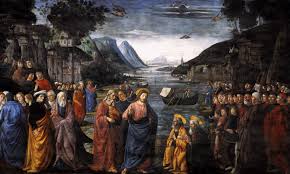
Ghirlandaio

John 1:29-42

 What is vocation? We typically think of vocation as our job or profession, but the idea is much larger and richer than that, so let’s take a look at it, starting with a little word study.

Vox is the Latin word for “voice,” as in Vox Populi, the “voice of people.” The Latin verb “to call” is vocare, as it still is in Italian. The noun form is vocatio.

There is a whole cluster of English words that have these Latin words as their root, words that refer to voice, to speaking and calling. For example, when we “speak out” we are being “vocal.” The whole collection of words we use to speak is our “vocabulary.” And, of course, a person’s calling is his or her “vocation.”

In Christianity (and its mother Judaism) our God is a God who has a voice, a God who speaks and calls.

But God’s speaking is different than our human speaking in an important way. We make a distinction between human speech and action.

But for God there is no such distinction: the Word of God doesn’t just say something, it does something. So, for example, in Genesis 1, God creates the worlds with a word. Recall how God said, “Let, there be light! And there was light.”

And recall also how God says in Isaiah 55, “My word will not return to me empty, but will accomplish that which I purpose.” Isaiah himself is an example of a prophet, a person called by God to speak for Him, so that when the prophet speaks, his words are heard by the people as the Word of God.

Likewise in John’s Gospel, we see that Jesus is called “the Word of God.”  John 1: “In the beginning was the Word” intentionally mirrors Genesis 1, “In the beginning God created the heavens and the earth.”

But to say that Jesus is “the Word of God” is to say more than that he speaks the Word of God, as Isaiah did or the other prophets did.

No, in Jesus, we see this intimate connection between speech and act, between word and deed. Because Jesus is both the one who speaks the Word of God, and he is also the one who accomplishes it, by his life death, and resurrection.

And so we see in today’s Gospel from John, at the very beginning of Jesus’ ministry, the calling of the first disciples, which sets in motion the drama of the rest of the Gospel.

Why does Jesus call disciples? To answer that we need some background on what Jesus’ ministry was all about. First of all, Jesus comes into a time and place where God was expected. The people had been waiting, longing, hoping for the coming of God’s reign in the form of his anointed one, which is the word “messiah” in Hebrew, and “Christ” in Greek.

The role of John the Baptist in the story is important because many at the time thought that John the Baptist was a figure like Elijah. Elijah was often thought to be the one who would come before the messiah, a forerunner figure.

Many people saw John the Baptist in this same light, and his appearance in the wilderness raised expectations for the coming of the Messiah. When Jesus shows up preaching and teaching many thought he was the expected One.

In our reading today the evangelist describes Andrew and Peter as disciples of John the Baptist, who leave him to follow Jesus.

So Jesus calls disciples for a very particular reason, which is hinted at by his calling twelve of them. This mirrors the twelve tribes of Israel. This is just one of many indications that Jesus understood himself to be the carrier of God’s special calling of Israel.

And what was Israel’s special calling? We get an inkling of it in our Old Testament reading today, where God says to Israel, “I will give you as a light to the nations, that my salvation may reach to the end of the earth.” (Isaiah 49:1-7)

In theological terms we refer to this special calling as “election.” In the Bible election is never for itself. No, election is always to accomplish the purposes of God.

The “chosen people,” whether we are referring to Israel or the church or both, are not called because they are better than others, but because God has use for them. And if we pay careful attention to the stories of the people God calls in scripture, it becomes quite clear that God doesn’t call the qualified, but rather qualifies the called. Think of Abraham and Sarah, well past their prime, Jacob, the liar and thief, Moses, the murderer, and Mary the poor teenage unwed mother. These are people like us and people we know.

So once again, you may be thinking, “Well, that’s really interesting Rick, and we’re glad you got to use your high school Latin, but what’s all this got to do with us?”

And the answer to that is that it has everything to do with our identity as a congregation and our understanding of our mission. In other words, our vocation informs both “who we are” and “what we do.”

I am talking about our vocation as church. We don’t just come to church, we are called to be the church. There’s a difference.

Here’s a hint about our calling. In the Call to Worship for this morning I referenced the UCC Statement of Faith several times. Twice it refers to God’s call. The first call is in the beginning: “God calls the worlds into being.” There’s Genesis 1 again.

The second call from God is through Jesus, “He calls us into his church to accept the cost and joy of discipleship.”

So the church is called as an instrument of God’s purposes, and those purposes are the same as in the original creation.

To begin to think about ourselves that way, as being called for God’s purposes, will change both our identity and mission. We are not merely a voluntary association of individuals with a benevolent and spiritual focus, although we are that.

But we are more than that, we are called, we have a vocation.

This concept of vocation was very important to our Puritan forbearers here in New England. We talked about this in our Men’s Book Group on Wednesday. Before the Reformation vocation was understood to be only for the religious life, for the monk, nun, or priest.

The Reformers changed that. Luther and Calvin believed that there was a general calling to repentance and a godly life for all Christians, and there were particular callings to life’s several vocations, as we understand them today.

So calling was no longer just for the clergy, and it still isn’t. Calling is for us all, and what are we called to be? Disciples of Jesus. And what is a disciple? A disciple is quite simply a follower or a student. One who hears the call of Jesus.

Jesus called those first disciples by asking them, “What are you looking for?” And later he invites them to “Come and see!”

And they might not have known what they were looking for, as many of us do not, but they knew it when they saw it. And they said, “We have seen the Messiah.”

They heard the call and answered it.

I want to talk now about the power of words as it relates to our callings, and I can think of no better example than Martin Luther King, who was a very important influence on me, and on my own call to ministry.

I was fourteen when Dr. King gave his “I Have a Dream Speech” in Washington, D.C. at the Lincoln Memorial. I was there last month and felt as if I was standing on holy ground.

I had grown up in the church, but in Dr. King’s speech I heard a new power in some familiar words. Dr. King’s father was a minister, and Martin grew up in the thought-world and language-world of the church.

The African-American church had retained the moral grammar of the faith that had been largely lost in the mainline church, the language of justice and righteousness, and in the civil rights movement Dr. King and others gave it back to the whole country as a gift in their words.

When I first heard Dr. King’s words they rang true. They had behind them such moral force. His use of familiar scripture, such a Isaiah 40, “Every valley shall be exalted,” and of shared national language such as the words of “My Country ‘tis of Thee” re-awakened the moral imagination of much of the country.

In Dr. King’s speech fifty years ago I became awakened to the power of words to shape the life of individuals and societies, and years later I discerned a call, there’s that word again, a call to the ordained ministry.

And throughout my long ministry I have often pondered the power of words, to heal or hurt, to inspire or dampen the spirit, to free or repress. And I believe that a society that de-values words is at risk, because it ceases to know when it is lying to itself, and can’t recognize truth when it hears it.

But the right word at the right time can change a life or change a society.

I invite you to recall such moments in your own life. Perhaps you were listening to a sermon, or the words to a hymn, or a scripture reading, and suddenly those words were not something you were just overhearing, but words that were addressed to you.

And it is in such moments that “vocation” takes place; when you hear the voice of God calling. And when that happens there is no turning back, because the Word of God has a life of its own in your life.

You know how Brent (our pastor) often begins worship with the words “No matter who you are, or where you are on life’s journey, you’re welcome here.” This language is part of what we in the United Church of Christ call “the extravagant welcome of our God.”

These are good words. The purpose of this welcoming language is to create no barriers that will keep people away from our life together here, and several people have told me how reassuring it is to them.

But, in the interest of full disclosure, I need to tell you there is danger in all this extravagant welcome, and it should come with a warning label.

Because once you say to yourself, “I feel welcome here. This could be my church,” a new thing may happen. You are very likely to have one of those moments I just described, when the words you hear become the Word of God that feel as if they were directly addressed to you. Then you hear the call of God and recognize your vocation. Then you move from attendance to discipleship, from observing Jesus to following him. Then you accept “the cost and joy of discipleship.”

Those moments will change your life.

So what is God calling you to do? Who is God calling you to be?

What is God calling us to do? Who is God calling us to be?

And let the people say: Amen.

I preached this sermon at my home congregation, the First Congregational Church (UCC) in Stockbridge, Massachusetts on January 19, 2014.

(Picture: The Calling of the Apostles by Ghirlandaio)
Unknown's avatar

An Ordination Sermon: The Secret Sauce of Ministry. A Recipe in Two Parts

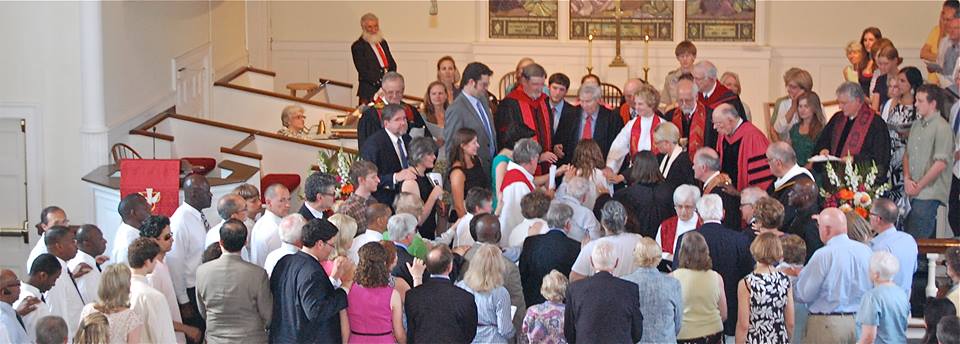
Laying on of hands

The Secret Sauce of Ministry
A Recipe in Two Parts

Hebrews 12:1-2
Philippians 2:1-11

As some of you know I like to cook. This time of year, when the weather gets fine, I fire up my grill and do some grilling and barbecuing. And I love to sit on my back porch near the grill with a cold beverage and read cookbooks, of which I have many, or as Martha would say, “too many.”

Many of these grilling and barbecuing books contain recipes for a “secret sauce.” I have been noticing lately that the term “secret sauce” has migrated from its culinary context and is now being employed as a metaphor for that special something that makes things work properly.

For example, I recently heard a journalist talking about “the secret sauce” that would create “a grand bargain” to overcome the Congressional budget impasse. Good luck with that.

So I started to wonder, “ What’s the secret sauce of ministry?”  If I had to come up with a simple recipe for what makes ministry faithful and effective what would it be?

So here’s my recipe, which comes in two parts, which I hope you will take away with you today for your own ministry, whether lay or ordained.

1. The first part of the secret sauce is this: You can’t do it alone. Rebecca couldn’t have come to this day alone, and she can’t do her ministry alone. No one does it alone.

How does one come to know God? And to love God? And to want to serve God?

When I look out at this congregation I see so many here today who have helped to shape and influence Rebecca. I am reminded of the scripture from Hebrews we just heard that says we are “surrounded by a great cloud of witnesses.” The image is from the ancient stadium where the races were held, and the cloud of witnesses are the spectators who cheer the racers on.

This great crowd includes both the living and the dead, “the church militant” and “the church triumphant.”

So among the crowd present in the congregation today are many members of Rebecca’s family, let’s call them “the crowd of the proud.”

In addition to Martha and myself, are Rebecca’s brother Andrew and his wife, Jessica. Rebecca’s maternal grandparents, Art and Marianne Talis, are here. As are several assorted aunties, an uncle, and a cousin.

These family members represent a great line going back through generations of Talises and Beers, Floyds and Laffoons, and, let me tell you, there is a lot of church in these families.

We represent a great ecumenical melting pot, from the Greek Orthodox faith of Rebecca’s grandfather’s forbears, to the German Protestantism of her grandmother.

My mother’s father, Bill Laffoon, a descendant of French Huguenots, was a deacon at his Congregational Church in Wichita, Kansas. His schooling ended with the 6th grade, but saw to it that his two daughters went to college during the height of the Depression.

Granddaddy read his Bible every day, and his speech was sprinkled with scripture verses.

So when I was growing up my mother also had a scripture for every occasion, I thought she was so wise, she’d say, “Sufficient unto the day is the evil thereof.” And, “Do not cast your pearls before swine.” When I went to seminary I discovered that they weren’t original with my mother, but came from Jesus in the Sermon on the Mount.

Years later, Rebecca had the same experience at Yale when she learned where all my wise sayings came from.

On the other side of the family, I think today also of Martha’s grandmother, Marta Beer, which in our family is a family name and not a beverage. My Martha is named after her. She raised three daughters by herself in wartime Germany, and was another great churchwoman.  How proud she would be.

This rich ecclesiastical family DNA has helped to shape and form Rebecca into a minister. They are all part of this congregation today, a part of the cloud of witnesses.

But there’s more. For as grand as Rebecca’s family legacy of ministry is, and as important as family support and nurture is, family alone cannot make a minister.

And so I look around this room and I see many people from Rebecca’s past, a number of the good people of the First Church of Christ in Pittsfield, where Rebecca was baptized and confirmed. I see some of her Sunday School teachers, youth group leaders, mentors and supporters, who have made the trip down here today from the Berkshires.

And when I look around today I also see many other friends, Pittsfield neighbors, UCC and ecumenical colleagues, and folks from the Berkshire Association, who have been part of Rebecca’s life.

I see some of her Wellesley College roommates up in the balcony. I see Yale classmates and New Haven friends, and, of course, all of you from Green’s Farms Church, members and staff, who have so warmly embraced Rebecca in your community, and are now such an important part of this most recent chapter in her life.

There are others, too, I must mention, who are neither related to Rebecca nor have ever met her, who she knows from the books she loves and the scriptures she studies. Those many other witness, men and women of the church:  prophets, apostles, martyrs, evangelists, theologians, reformers, writers and thinkers down through the ages. They are part of this great crowd, too. They were all witnesses to God, and to God’s vast love for us in Jesus Christ.

So all of you here, and all the unseen but present, make up the great cloud of witnesses, who cheer us all on as we go about our several ministries, and especially cheer Rebecca on today. I thank God, for you and for them.

So to take nothing away from Rebecca, who as you know, is a remarkable young woman and certainly gets much of the credit for us being here today, she hasn’t done it alone. Because this ministry business is a team sport, and I have just described to you just how really big the team is.

Nobody gets to ministry alone, and nobody does ministry alone, because you can’t do it alone.

So that’s the first part of the recipe for the secret sauce of ministry.

2. The second part of the recipe for the secret sauce of ministry is this: It’s not about you. To do ministry in the name of Jesus Christ you have to get out of your own way.

What does this mean? Recall how Jesus was always confusing the disciples by saying things like “the one who would gain his life must lose it.” And “The one who exalts herself will be humbled, but the one who humbles herself will be exalted.”

And the disciples never quite understood what he was trying to teach them until after Easter. Their hopes had been dashed on Good Friday as they fled from him and his cross. But after Easter all those things he said made sense. He was showing them a way, a way of selflessness, of servant-hood, a way to be a person for others.

And recall also how our brother Paul kept writing to churches that were fighting, and saying in one form or another, “It’s not about you!”

To the Corinthians he wrote, “What we preach is not ourselves, but Jesus Christ as Lord and ourselves as your servants for Jesus’ sake (2 Cor. 4,5). And a couple of lines later in that same letter he wrote them, “We have this treasure in earthen vessels to show that the transcendent power belongs to God and not to us.” (2 Cor. 4:7).

What was he trying to tell them about ministry? That “it’s not about you.” To be a minister you have to get out of your own way. And the reason that you have to get out of your own way is first to make space for God to work in and through you. And you have to get out of your own way, secondly, to make space for the other, the ones you minister to.

I was with Mary Luti at a meeting the week before last and I told her how excited I was that she would be laying holy hands on Rebecca and doing the prayer of ordination today. I said to Mary, “It is so fitting because it was under your ministry that Rebecca started discerning her call.”

And Mary demurred and said, “I really didn’t do that much.” And I thought she was just being humble. But as I started pondering the recipe for the secret sauce of ministry, I realized she was quite right.

And you know why she was right? Because it wasn’t Mary who called Rebecca into the ministry. Mary was just doing her job, which is how ministry works. Rebecca was a questioning young woman in a pew in Cambridge, and Mary was doing her job, which was to share the God she knows and loves. And Rebecca was in the right time and the right place with the right person, and God’s Holy Spirit works like that, in what seems mundane, but can at the same time be quite marvelous.

Our society cultivates a cult of personality, a cult of celebrity, but ministry is not about that. There are celebrity ministers, but the good ones, the faithful ones, know it is not about them.

The word minister actually means one who represents another. The Europeans use it this way in describing their government officials: the minister for finance, or the foreign minister. These are the ones who represent the government in their particular area of expertise

Likewise, a Christian minister is one who represents Jesus Christ. And representing Jesus Christ means taking the form of a servant. Jesus once told his disciples, “Whoever would be great among you must be your servant, and whoever would be first among you must be your slave; even as the Son of man came not to be served, but to serve, and to give his life as a ransom for many.” (Mt 20:25-28.)

Not to be ministered to, but to minister. Not to be served but to serve.

This is counter-cultural in our self-obsessed society. To tell people to get out of their own way for God and for others is not a particularly popular philosophy today. When I peruse the magazines at the super-market checkout there are titles such as Self, Us, People (meaning famous self-absorbed people) but I don’t see Servant or Ministry magazine.

There was a fascinating interview with director Sofia Coppola in last Sunday’s New York Times about her new movie, The Bling Ring. The movie is based on a true story about five teenagers from the San Fernando Valley in California, who were so obsessed with the culture of personality and the trappings of celebrity that they started breaking into celebrity’s homes and stealing stuff.

They would often just walk in through an unlocked front door, or climb in an open window. They robbed people like Lindsay Lohan and Paris Hilton.

In the course of a nine-month spree they looted more than 3 million dollars worth of jewelry and designer clothes. I found the story shocking, but part of it got me chuckling to myself. Apparently they broke into Paris Hilton’s home six times before she even noticed. “She had so much stuff that it took awhile for her to realize someone had broken in.”

Have you seen the bumper sticker that says, “The one who dies with the most stuff wins?” A better, truer one would say, “The one who dies with the most stuff dies.”

Sofia Coppola said she chose this subject for her movie because she has two small daughters, and she fears for them growing up in this glittery world of celebrity culture, a culture that sends the message that it really is all about you and your stuff. She describes hearing some of her daughter’s 6 year-old friends talking about what they wanted to be when they grew up, and a couple of them said, “I want to be famous.” She asks, “Where does that come from?” I don’t think we knew about that when we were six years old.”

And that is a challenge for ministry these days. I am particularly thinking of parents and youth ministers. How do we raise our children in a society that tells them it really is all about us?

When we were driving through the countryside in France we would sometimes see vast fields of sunflowers as far as the eye could see. The sunflowers would be facing East toward the rising sun in the morning, and as the sun moved through the sky the sunflowers would turn toward it, so that at dusk they would have turned completely toward the West. In fact the French world for sunflower is tournesol, which literally means “turn to the sun.”

Sunflowers do this because they are heliotropic; they need the sun to live. By analogy, we are theotropic, we need God to live, and we are made to bend our love toward God and others. But we too often bend our love toward ourselves, and that is where we get in trouble, for instead of living for God and others we try to love ourselves and control things as if we were God.

And that is what is so beautiful about our second reading today from Philippians; it turns the equation entirely upside down. God in Christ bends toward us, and shows us what love looks like.

The late British theologian Colin Gunton said,

 Sin is for the creature to think and act as if it were the creator. But here in Philippians 2 Jesus is godlike precisely in going the other way.

Here Jesus empties himself even of his divinity to become a servant, “a man for others” as Dietrich Bonheoffer described him.

And it is this humility, this self-emptying, this relinquishing of privilege, that Paul wants the church in Philippi to emulate. He writes them to “let the same mind be among you that was in Christ Jesus.”

The church in Philippi was having one of those squabbles that have been known to happen in congregations, even in our own time. Paul admonishes them to get out of their own way, and have the very same mindset as Jesus, the mindset that led him to empty himself, and in humility take the form of a servant, the mindset that ultimately led to his death on the cross.

But it’s not so easy to have the same mindset as Jesus. Remember those WWJD bracelets, that stood for “what would Jesus do?” Some people criticized those WWJD bracelets for being overly simplistic. Because asking, “What would Jesus do? doesn’t really solve the problem. It usually isn’t that hard to know what Jesus would do. People talk about the hard passages in the Bible, and there are some, but the parts that really challenge and convict me aren’t the parts I don’t understand, but the parts I do. “Love your enemies.” “Feed the hungry.” “Welcome the stranger.”  “Share your possessions.” “Turn the other cheek.” “Take up your cross and follow me.” Just to name a few.

So the hard part, after you figure out what Jesus would do, is doing it.

To “practice what we preach,” to “walk the walk as well as talk the talk” is where we pretty consistently fail, and why we need grace and forgiveness to keep trying. And the good news is that is exactly what we get from our God, grace and forgiveness.

In the cross of Jesus Christ, God does for us what we cannot do for ourselves, and saves us from ourselves, among other things, such as sin and death.

All ministers, you and me, lay or ordained, even Rebecca, fail at being consistently Christ-like. But the wisest ministers know that our ministry is at its most faithful when we realize that it is not about us, when we get out of our own way, as Jesus did, to be a servant, as he was a servant, to serve as he served, to love as he loved, and to be a person for others.

And here’s the beautiful thing: if you follow this recipe you don’t really lose yourself at all, you will actually find yourself. Only the empty can be filled with the new life God wants for us. Jesus said, “I came that you might have life, and have it in abundance.” (John 10:10)

Because this self- emptying doesn’t mean we lose our personalities or our personal identities. On the contrary, when our love bends toward God and others, as those sunflowers bend toward the sun, when we lose ourselves in service, when we live for others, we are most ourselves, our own true best selves as God intended us to be.

Just as Jesus’ exalted lordship is ultimately revealed in his humble servant-hood.

Let us listen to it again:

“Let the same mind be in you that was in Christ Jesus,

who, though he was in the form of God,

did not regard equality with God

as something to be exploited,

but emptied himself,

taking the form of a servant

being born in human likeness.

And being found in human form,

he humbled himself

and became obedient to the point of death—

even death on a cross.

Therefore God also highly exalted him

and gave him the name

that is above every name,

so that at the name of Jesus

every knee should bend,

in heaven and on earth and under the earth,

and every tongue should confess

that Jesus Christ is Lord,

to the glory of God the Father.”

And let the people say: Amen.

I preached this sermon at the Ordination of my daughter, Rebecca Megan Floyd, on June 9, 2013, at the Green’s Farms Congregational Church, UCC, in Westport, Connecticut.

Unknown's avatar

Dietrich Bonhoeffer on living in the “Middle of the Village”


Dietrich Bonhoeffer (1906-1945)  wrote this to his friend Eberhard Bethge from prison the year before he was executed by the Nazis:

“I find all this talk about human limits questionable. (Can even death, since people hardly fear it now, or sin, which people hardly even comprehend now, still be called genuine “limits?”) I always have the feeling we are merely fearfully trying to save room for God; I would rather speak of God at the center than at the limits, in strength rather than in weakness, and thus in human life and goodness rather than in death and guilt.

As far as limits are concerned, I think it best simply to remain silent and to leave the unresolvable unresolved. The belief in resurrection is not the “solution’ to the problem of death. The “beyond” of God is not the “beyond” of our cognitive capacity. Epistemological transcendence has nothing to do with God’s transcendence. God is “beyond” our lives. The church is found not where human capacity fails, at the limits, but rather in the middle of the village. This is the sense of the Old Testament, and we still do not read the New Testament enough from the perspective of the Old Testament.

(Dietrich Bonhoeffer to Eberhard Bethge Tegel prison, April 30,1944)

I read this as a call for the church to be fully engaged in the life around it, and not be a conventicle that separates itself from the “world.”  Certainly Bonhoeffer himself engaged his times and society, and gave his life for doing so.  But it is so hard to be “in the world and not of it.”