Unknown's avatar

I finally got to hear my new baptismal hymn!

BaptismI wrote the baptismal hymn text “Come here by the waters” early last year, and though several pastors have told me they have used it in worship, I had never heard it sung by a congregation until this morning.

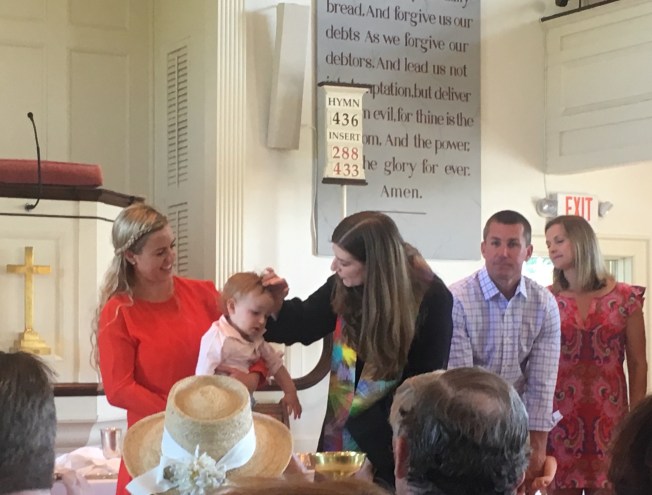
We worshipped this morning at the church in RI where my daughter, Rebecca, is pastor. She administered five baptisms, and they sang my hymn. She has chosen it before, but never when I was present.

She made a clever move with it that I hadn’t thought of. She divided the first two verses and the final two, singing the former before the baptisms and the latter right after. This makes sense because the first two are invitational (“come bring us your child) and the latter two are blessings (Bless us with your presence, your Word, and your power) and doxologies. Here are the words.

Come Here by the Waters

Come here by the waters, come bring us your child.
We’ll call on God’s Spirit, so loving and wild.
These people and parents will speak their firm vow.
This child full of blessing belongs to Christ now.

Your promise enduring will follow her* days,
And lead to a life filled with service and praise.
You’ll bless her** and keep her** and always be there,
Through life’s many changes you’ll watch her with care.

Bless us with your presence, your Word, and your power,
That we may be faithful in every new hour.
Let church be a place that is brimming with love,
And bless these dear children with grace from above.

We praise you and thank you for all you provide,
For blessings and graces that reach far and wide.
Praise Father, praise Son, and the Spirit divine,
Both now and forever, and far beyond time.

(*or his, or their) (** or him, or them)

Tune: Cradle Song 11.11.11.11.

© Richard L. Floyd, 2015

(To learn more about this hymn, and for both accompaniment and melody line reproducible music go here. Photo: R.L. Floyd, 2016)


Unknown's avatar

“Her name was Grace” Is God’s Love Unfair?

Jacob_Willemsz._de_Wet_d._Ä._002

“But God proves his love for us in that while we still were sinners Christ died for us.” —Romans 5:8

My Mom’s older sister outlived her by forty years. She never had children, but she doted on my brother and sister and me.

One of her abiding principles was fairness. If she gave something to one of us, she would make sure she gave something equivalent to all of us. She was fair.

Children learn to spot unfairness pretty quickly. “That’s not fair!” can be heard on any playground, and rightfully so, since fairness is an important part of what makes any society workable, be it the small society of a school playground or the large one of a nation.

So it was that many who heard Jesus’s teachings were scandalized by his assertion that the divine economy works on another principle. It is all about grace, which by definition is unfair, because the recipients of the gift are undeserving.

Recall his parable of the workers in the vineyard? Jesus says the ones who came late will get paid the same as the ones who worked all day. “That’s not fair!” Try explaining that policy to either union or management.

The waiting father runs out to greet his prodigal son and throws him a big party. “That’s not fair!”

Paul wrote to the Romans, “While we still were sinners Christ died for us.” So is God’s love unfair? You bet it is, and it’s a good thing too, for who among us deserves such love? Even my aunt understood this good news. After all, her name was Grace.

Prayer: Loving God, we thank you that you run to greet us even when we have run away from you.

(This is my United Church of Christ Daily Devotional for June 4, 2016. To see the original go here. To subscribe to the Daily Devotional and receive it every day by e-mail go here. Photo: “The Laborers in the Vineyard” by Jacob Willemsz.)

Unknown's avatar

“Known knowns, known unknowns,” and the New Testament

scholar-696x371

The good folks over at the Babylon Bee, a Christian satirical site, posted a gem of a fake article today called “Historical-Critical Scholar Doubts Authorship Of Paper He Wrote,” which comically captures some of the dubious certainties that sometimes come out of the New Testament studies combine.

The article quotes the fictitious Dr. Gunther Burg of Yale questioning the authenticity of an article he himself had written. Continue reading

Unknown's avatar

“Out of the Mouths of Babes” A Daily Devotional on Psalm 8:2

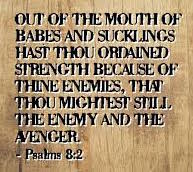
“Out of the mouths of babes and infants you have founded a bulwark because of your foes, to silence the enemy and the avenger. -—Psalm 8:2

BabesIn our family “out of the mouths of babes” was proverbial, expressed when any wisdom or insight, even unintentional, came from one of the youngest members. Here’s an example: A married couple, bickering in the kitchen, was astonished when their young child walked in on them and said, “You should get counseling.” Out of the mouths of babes.

When my own children were very young our mealtime often had the feeling of a manic improvisational comedy troupe. Beverages were spilled with alarming regularity. One time my son turned to his little sister, and asked, “How do you know everything?” She quickly answered, “I don’t know!” Out of the mouths of babes. Continue reading

Unknown's avatar

“And in a supporting role . . .” Hulda the Prophet

Hulda 2“Hilkiah (the high priest) and those the king had sent with him went to speak to the prophet Huldah, who was the wife of Shallum son of Tokhath, the son of Hasrah, keeper of the wardrobe.” —2 Chronicles 34:22

The prophet Hulda gets a scant 9 lines in the Bible, and in them we learn more about her husband than we do about her.

Nonetheless, she must have been impressive, for when King Josiah needed a prophet to authenticate the Word of God, it was to Hulda that he turned. Continue reading

Unknown's avatar

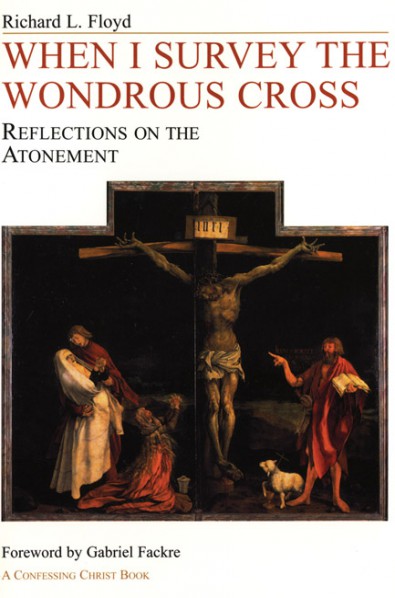
My Book on the Atonement

CoverThe Christian doctrine of Atonement has long been a theological preoccupation of mine, which may seem strange since I didn’t come out of an Evangelical background, where this is a central concern.

I was blessed to have sabbaticals from the pastorate at three iconic British universities, Oxford, St Andrews, and Cambridge, where I read and wrote about this subject.

Out of those experiences came a number of journal articles and this book of essays. I have been heavily influenced by the thought of the British theologian P.T. Forsyth, and many of the chapters in this book focus on his theology.

The book was published in 2000 by Pickwick Press, which later became part of Wipf and Stock Publishers, who re-issued the book in 201o, for which I am grateful.  It is a humble little book that traces my attempt to come to grips with this vexing doctrine. It has an extraordinary foreword  by the estimable Gabriel Fackre, which I think alone makes the book worth having.

Wipf and Stock is currently having a 40% off sale until May 1, so if you are interested in obtaining this book, now is the time. You can go to the link here.

Unknown's avatar

“Prone to Wander”

“All we like sheep have gone astray; we have all turned to our own way.” —Isaiah 53:6

church-window4-224x300There is a magnificent chorus in Handel’s Messiah based on this text from Isaiah. Near the end of it there is a long series of intricate fugues among the several voices that keep repeating the line “We have turned.” The effect is striking, as the music describes in sound everyone turning and turning (like sheep) in new and different directions (but always astray).

One of the earliest and most abiding Christian insights about human nature is that we were made for God, but keep turning away. Just as flowers are “heliotropic”, designed to turn toward the sun, so we humans are “theotropic,” designed to turn toward God.

But somehow our natural theotropism has become faulty and broken. We are more likely to go astray, to turn to our own way, than to turn toward God.

But the Good News is we have a still-seeking God who does not give up on us. It is true that we are “prone to wander.” The phrase comes from Robert Robinson’s powerful hymn “Come, Thou fount of every blessing.”

In that hymn Robinson also wrote this: “Jesus sought me when a stranger, wandering from the fold of God.” He knew that though we turn to our own way again and again, God keeps bringing us back.

Prayer: Seek us and find us, Still Seeking God, and turn us back to you, the source of our life.

(This is my United Church of Christ Daily Devotional for April 19, 2016. To see the original go here. To subscribe to the Daily Devotional and receive it every day by e-mail go here. The photo is of the Lyons memorial window at the Church of the Holy Communion, Norwood, NJ. For more about this window see my post here.)


Unknown's avatar

“Finding the Perfect Church”

No perfect church“But we have this treasure in clay jars, so that it may be made clear that this extraordinary power belongs to God and does not come from us.” —2 Corinthians 4:7

After I retired from active pastoral ministry my wife and I were ecclesiastically homeless for a few years. We went to church, but we couldn’t commit to one.

We sometimes felt like Goldilocks at the Bears’ residence. One congregation had good preaching, but not so great music. Another had terrific music, but the sermons were on the light side.

This period was an unhappy time in our lives, for we are serious “church nerds” and needed a church home. We knew there was something unfaithful about “church shopping” and being, to use Eugene Peterson’s phrase, “tourists and not pilgrims.”

The problem was there was no perfect church. Thomas More coined the word Utopia in 1516 to describe a perfect society on a fictional island in the Atlantic Ocean. Utopia in Greek means “not a place.”

There has never been and there never will be Utopia. There is no perfect congregation, just the ones we’ve got, full of imperfect people that God loves and calls to be the church. And we knew ourselves well enough to realize that if we ever found the perfect church, as soon as we joined it, it wouldn’t be perfect anymore.

Prayer: Holy One, bless us all in your church with your extraordinary power, that through your imperfect people, your perfection may shine brightly for the world to see.

(This is my United Church of Christ Daily Devotional for April 9, 2016. To see the original go here. Meme is used courtesy of the UCC.)

Unknown's avatar

Can we know enough about God from observing the creation? Ruminations on a General Revelation

DriftwoodI was preparing this morning to lead Romans using the new small group study book that Mike Bennett and I wrote for the UCC’s “Listen Up!” Bible Study Series.

I came across that vexing section of Romans 1, no not that one, this one: “For what can be known about God is plain to them, because God has shown it to them. Ever since the creation of the world his eternal power and divine nature, invisible though they are, have been understood and seen through the things he has made.” (Romans 1: 19-20).

These verses have often been employed to put forth one or another versions of the idea of General Revelation, so I paid attention when a short while later, while I was wasting time on Twitter, I came upon a thoughtful blog post by J. Scott Jackson entitled Got General Revelation? Well, Isn’t that Special! Continue reading

Unknown's avatar

A Tribute to Meredith Brook “Jerry” Handspicker 1932-2016

Jerry(We had a beautiful and moving Service of Celebration and Thanksgiving for the life of Jerry Handspicker this afternoon at the Second Congregational Church, UCC, of Bennington, Vermont. The Pastor, the Reverend Mary H. Lee-Clark, presided and delivered a fine homily. Jerry was Professor of Practical Theology at Andover Newton Theological School for 36 years, my former teacher, colleague and a family friend. I was asked to give one of the remembrances. Here are my remarks:)

I’m Rick Floyd. Jerry was my teacher, my colleague and my friend. I knew Jerry for 45 years through many ups and downs and changing experiences of life.

I met him when I arrived at Andover Newton in 1971. That very first week I applied for a field education position, running a coffee house (that dates me!), at the Newton Highlands Congregational Church. There were two token youths on the search committee, Amy Handspicker and her best-friend Martha Talis. By Amy’s telling they judged I was hip enough for the job, and convinced the skeptical grown-ups that I was their man.

Thus began a long association with that congregation, where Jerry was the associate pastor, and with the Handspicker family. Jerry and Dee embodied what today we would call “radical hospitality,” and I had many a dinner with them and Amy, Jed and Nathan. I once briefly lived in their attic! (And I wasn’t the only one.) Continue reading