To talk of “the work of Christ” in the theology of P.T.Forsyth is not to refer to merely a section of his systematic theology, but to point to the heart of his theology. Forsyth’s entire theological project looks to the cross of Christ as the decisive act of the Holy God. It mattered little what subject Forsyth approached in his writings, be it marriage, the arts, war and peace. He always returned again and again to the cross as his fixed point, his north star, his magnetic north. He used this navigational image himself: “The church must always adjust its compass at the cross.” (The Atonement in Modern Religious Thought, 62)
The term “the cross” functions as theological shorthand for Forsyth, as it did for Paul, to mean the whole dramatic activity of Christ culminating at Calvary and vindicated by Easter. “I desire to keep in view the Cross, the organic crisis of Christ’s whole life, earthly and eternal, as God’s one kerugma, as the burthen, key, consummation and purpose of Christ’s whole person and mission . . .” (The Preaching of Jesus and the Gospel of Christ, 83)
The cross for Forsyth is never merely an emblem of who God is, it is something God does, an act of the Holy God. It is constitutive for salvation rather than illustrative. It is the instrument that puts into effect God’s holy love rather than a symbol that only shows God’s love. Christ’s death on the cross is nothing less than God acting:
He (Christ) was God, therefore, and His death was God in action. He was not simply the witness of God’s grace, He was its fact, its incarnation. His death was not merely a seal to His work; it was His consummate work. It gathered up His whole person. It was more than a confirmatory pledge, it was the effective sacrament of the gracious God, with His real presence at its core. Something was done there once for all, and the subject doer of it was God. The real acting person in the cross was God.” (Positive Preaching and the Modern Mind, 358)
We can see here that Forsyth’s theology focuses on God as a personality, as one who acts, who is best understood not for who he is but rather for what he does, therefore not in metaphysical but moral categories.
And in the same way Forsyth’s Christology focuses on what Christ does rather than who Christ is; his person is known in his work, which is the work of God. Soteriology controls Christology. It is only Christ in his cross that does justice to New Testament Christianity; his teachings alone do not make him an object of faith and worthy of worship. Forsyth inists that:
Faith is an attitude we can take only to God. God is the only correlate of faith, if we use words with any conscience. Faith in Christ involves the Godhead of Christ. Faith in Christ, in the positive Christian sense, means much more than a relation to God to which Christ supremely helps us. It is a communion possible not through, but only in Christ and Him crucified. It means that to be in Christ is to be in God. It means that the experience that the action of Christ with us is God’s action, that Christ does for us and in us what holy God alone can do, and that meeting with Christ we meet with God.” (Person and Place of Jesus Christ, 6)
So in Forsyth’s theology a two–nature Christology is replaced by a two–act Christology, with an act from the divine side and a corresponding one from the human side. The divine kenosis, or self-emptying, coincides with the plerosis, or self-fulfillment, of Christ.
But if Forsyth holds to a kenotic theory it is a kenotic theory with a difference. It is construed in moral rather than in metaphysical language; it is dramatic and active rather than static, in keeping with its object, the free God who acts in the man Jesus Christ. The term kenosis is derived from the Greek heuton ekenõsen, “he emptied himself,” which the King James Bible of Philippians 2:7 renders “he made himself of no reputation.’ As a substantive it is used, in the technical sense, of the Christological theory which sets out “to show how the Second Person of the Trinity could so enter into human life as that there resulted the genuinely human experience which is described by the evangelists.” (H.R. Macintosh, New Bible Dictionary; See also N.T. Wright, The Climax of the Covenant, for a comprehensive rehearsal of the history of the interpretation of Philippians 2.)
In the late nineteenth century Kenotic theories of the atonement had been popular among German Lutherans (ie. Gottried Thomasius, W.F. Gess, F.H.R. von Frank) and with some British Anglicans, notably Charles Gore who gave the Bampton Lectures at Oxford in 1889. Kenotic views of Incarnation or Atonement put forth the idea in one way or another that, in Christ, God relinguished some aspect of his divinity.
The kenotic approach was criticized for a number of reasons: that it was pantheistic, blurring the line between God and humanity; that it undermined the doctrine of divine immutability; that it jeopardized the Trinity, for a humanized Son empty of divine attributes could be no part of the Trinitarian life; that it failed to recognize the proper relationship between divine existence, divine attributes and divine essence when it claimed the former can be separated from the latter; and, finally, that the kenotic Christ is neither God nor Man and therefore doesn’t solve the problem it sets out to solve. The popularity of the kenotic approach was already waning by Forsyth’s day. This he no doubt knew, as well as the criticisms and difficulties. “Many difficulties arise readily in one’s own mind” he wrote, “It is a choice of difficulties.” (The Person and Place of Jesus Christ, 294) He takes pains in places to separate himself from some of the more vulnerable of the kenoticist’s views.
Nevertheless, he does not shy away from the kenotic language as long as it is in his distinctive moral vocabulary. Although Forsyth’s full treatment of kenosis will wait until 1909 with The Person and Place of Jesus Christ we see a kenotic emphasis already by 1895 in a sermon on Philippians 2: 5-8 entitled “The Divine Self–Emptying” (later to appear in the anthology God the Holy Father) In that earlier treatment Forsyth already has in outline the the two–act Christology which will be spelled out in the kenosis/plerosis scheme of The Person and Place of Jesus Christ. Where the critics of kenotic theories worry about loss of divinity Forsyth wants to view kenosis as constitutive of Christ’s divinity. He understands Christ’s self–emptying as the very act which makes him Lord. It is only because of his Godhead that Christ can empty himself and in so doing He fufills his Godhead. So in this case limitation is understood as a power rather than a defect: “Well, notice here that Christ’s emptying of Himself is not regarded as the loss of His true Godhead, but the condition of it. Godhead is what we worship. Christ’s emptying of Himself has placed him at the centre of human worship. Therefore He is of Godhead. We worship Him as the crucified—through the cross, not in spite of the cross.” (God the Holy Father, 32)
One of the traditional objections to a kenotic theory is that if the divine nature is given up how can the subsequent human act be an act of God and therefore a saving act, since only God can save? But Forsyth’s view of kenosis doesn’t involve the loss of divinity so much as its self–retraction or self–reduction. This is language about a free personality who chooses to act and is known by his acts, rather than language about a deity known by his attributes.
From Kant Forsyth acquired a metaphysical agnosticism; this keeps him away from using the language of two natures to understand how the human Jesus relates to his Godhead. Rather than thinking about Christ in the language of two natures, Forsyth wants more active categories. He refers at times to “two modes of being” and elsewhere to “two moral movements:”
Let us cease speaking of a nature as if it were an entity; of two natures as two independent entities; and let us think and speak of two modes of being, like quantitative and qualitative, or physical and moral. Instead of speaking of certainattributes as renounced may we not speak of a new mode of their being? The Son, by an act of love’s omnipotence, set aside the style of God, and took the style of a servant, the mental manner of a man, and the mode of moral action that mark’s human nature.” (The Person and Place of Jesus Christ, 307)
This “setting aside” is the language one would use of a personal subject, and this is what Forsyth presses for, a move away from the terms of entities and their substance to the terms of personalities and their freely chosen moral acts. So:
As the union of wills we have in Christ, therefore, the union of two moral movements or directions, and not merely their confluence, their mutual living involution and not simply their inert conjunction. Much that may seem obscure would vanish if we could but cease to think in terms of material substance or force, however fine, and learn to think in terms of personal subjects and their kind in union; if our minds gave up handling quantities in these high matters and took up kinds. It is the long and engrained habit of thinking in masses or entities that makes so unfamiliar and dark the higher habit of thinking in acts.” (The Person and Place of Jesus Christ, 346)
Forsyth believes that construing the act of God in Christ in dramatic and moral terms is truer to the witness of the New Testament than the metaphysical language of Greek Philosophy and the Fathers of the early centuries. It is also truer, he is convinced, to the Christian experience of an atoning, saving Christ. There is a decidedly experiential dimension to Forsyth’s understanding of Christian authority: “It is the evangelical experience of every saved soul that is the real foundation of Christological belief anywhere. For Christ was not the epiphany of an idea, nor the epitome of a race, nor the incarnation, the precipitate, of a metaphysic—whatever metaphysic he may imply.” (The Person and Place of Jesus Christ, 9)
Kenosis is a moral necessity for the God who is holy love. The holiness of God requires the divine intervention of the atoning cross against human sin. For Forsyth God’s holiness is his defining attribute, God’s very nature. He writes:
The holy law is not the creation of God but His nature, and it cannot be treated as less than inviolate and eternal, it cannot be denied or simply annulled unless He seems false to Himself. If a play on words be permitted is such a connection, the self-denial of Christ was there because God could not deny himself.” (The Atonement in Modern Religious Thought, 79)
Here again we can see how Forsyth’s understanding of God in moral rather than in metaphysical terms leads him to the logic of the cross. Human sin requires a real atonement. For Forsyth the wrath of God is not some arbitrary anger, but the response of the holy God to the very antithesis of holiness, which is sin. Divine holiness reacts to human sin with wrath and judgement. Forsyth’s theology takes sin and evil with utmost seriousness. God can not tolerate sin. It threatens his very being:
God is fundamentally affected by sin. He is stung and to the core. It does not simply try Him. It challenges His whole place in the moral world. It puts Him on His trial as God. It is, in its nature, an assault on His life. Its vital object is to unseat Him. It has no part whatever in His purpose. It hates and kills Him.” (Positive Preaching and the Modern Mind, 366)
So God is not just love, but holy love at war with sin. Liberal theology knows only a benign mercy that overlooks sin without overcoming it. That is why it can do without an atoning cross. But a theology that takes God’s holiness seriously must also take sin and evil seriously too andrealize that they are at war. God must not only forgive sin, but destroy it by an atonement. During the First World War Forsyth wrote these words to describe the holiness of God and the power of His holy cross:
The great Word of the Gospel is not God is love. That is too stationary, too little energetic. It produces a religion unable to cope with crises. But the Word is this—Love is omnipotent for ever because it is holy. That is the voice of Christ—raised from the midst of time, and its chaos, and its convulsions, yet coming from the depths of eternity, where the Son dwells in the bosom of the Father, the Son to whom all power is given in heaven and on earth because He overcame the world in a cross holier than love itself, more tragic, more solemn, more dynamic than all earth’s wars. The key to history is the historic Christ above history and in command of it, and there is no other. (The Justification of God, 227)
The Necessity of the Pre-existence of Christ
The phrase “the historic Christ above history” points to Forsyth’s high Christology. If Christ truly shares in the Godhead, then he cannot have been created or arrived in time, but must have been God from before the beginning. The idea of a pre–existent Christ is, of course, seen here and there in the New Testament, most notably in John 1 and in Colossians 1:15ff, and portrayed in the art and hymnody of the church, as in this verse from a hymn:
Low within a manger lies
He who built the starry skies
He who throned in height sublime
Reigns above the cherubim. (McGrath, Christian Theology, 293)
Forsyth’s Christology requires such a pre–existent Christ if the atoning cross is to truly be an act of the God who in the beginning created the heavens and the earth. Against the claim of “the history of religions school” that such passages reflect Gnostic influences Forsyth wants to argue that the earthly career of Christ requires that he has been part of the Godhead from before the beginning:
He could never be king of the eternal future if he was not king from the eternal past. No human being was capable of such will. It was Godhead that willed and won that victory in Him. If it was God loving when he loved it was God willing as He overcame. The cross was the reflection (or say rather the historic pole) of an act within Godhead. The historic victory was the index and the correlate of a choice and a conquest in Godhead itself. (The Person and Place of Jesus Christ, 270)
The Gospel requires a pre–existent Christ and Christian experience confirms it. For example he suggsts that Paul’s affirmation of the pre-existence of Christ came from his experience, that he “worked back from the faith that all things were made for Christ to the conviction that, as the end was in the beginning, all things were made by Christ; and by a Christ as personal as the Christ who was their goal. (The Person and Place of Jesus Christ, 269)
So Christ’s kenosis is not just an act in time but an act that was established from beyond time:
Christ’s earthly humiliation had to have its foundation laid in heaven, and to be believed but as the working out of a renunciation before the world was.” (The Person and Place of Jesus Christ, 270) His emergence on earth was at is were the swelling in of heaven. His sacrifice began before He came into the world, and his cross was that of a lamb slain before the world’s foundation. There was a Calvary above which was the mother of it all.” (The Person and Place of Jesus Christ, 271)
What does the kenosis involve? What is given up? Forsyth speaks of the self-reduction of God’s attributes rather than their destruction, they go from being actual to potential. It is not so much limitation as concentration. They are drawn in. He says that God’s attributes, such as omniscience, are not destroyed but are reduced from the actual to the potential. “They are only concentrated. The self-reduction, or self-retraction, of God might be a better phrase than the self-emptying.” (The Person and Place of Jesus Christ, 308)
He gives a series of examples of how a personality might freely choose to limit himself: a wise vizier to a foolish young sultan who voluntarily takes a cup of poison meant for his master and dies a prolonged and debilitating death; a musical genius in Russia who knowingly chooses to dedicate himself to political associations that cause him to be deported to a life in Siberia where he can never play the violin again; a university student brilliant in philosophical pursuits who, upon the death of his father, gives up his career to take over the leadership of the family business. (The Person and Place of Jesus Christ, 296–298) In each case a conscious choice, motivated by love, is made which limits the personality. In each case, something precious is lost, but more is gained, and love is the motivation of each choice.
In Christ’s case the free obedient act of the cross is not just love, but holy love concentrated at one point. Forsyth argues that since holy love is the supreme category of the Almighty, and the object for which His omnipotence exists, how could His omnipotence be imperilled by its own supreme act? “The freedom that limits itself to create freedom is true omnipotence, as the love that can humble itself to save is truly almighty.” (The Person and Place of Jesus Christ, 314) Far from imperiling the Godhead of Christ, the kenosis of incarnation culminating in the cross is the most powerful act of Godhead, even more powerful than the creation of the world:
To appear and act as Redeemer, to be born, suffer, and die, was a mightier act of Godhead than lay in all creation, preservation, and blessing of the world. It was only in the exercise of a perfect divine fullness (and therefore power) that Christ could empty and humble himself to the servant he became. As the humiliation grew so grew the exaltation of the power and person that achieved it. It was an act of such might that it was bound to break through the servant form, and take at last for all men’s worship the lordly name.” (Person and Place, 315)
So it is fitting that “at the name of Jesus every knee should bend, in heaven and on earth, and under the earth, and every tongue confess the Jesus Christ is Lord, to the glory of God the Father.” (Philippians 2:10,11 NRSV) Here in praise and confession are represented the whole of creation according to the cosmology of the day.
So kenosis leads to plerosis, self-emptying to self-fulfillment, and not just at the final vindication but as a process throughout the life of Christ. Kenosis by itself is inadequate Forsyth says:
What we have chiefly in view is the sort of uniqueness in the man Jesus which is required for the final and personal gift of Godhead in him. Now for such a purpose a Christ merely kenotic is inadequate. We have already seen that all revelation is God’s self-determination. For any real revelation we must have a loving self-determination of God with a view to His self-determination and self-communication; and this self-determination must take effect in some manner of self-divestment. We have examined the kenotic, or self-emptying theories of such an act, and we have found them either more helpful or less. But whether we take a kenotic theory or not, we must have some doctrine of God’s self-divestment, or His reduction to our human case. Yet, if we go no farther than that, it only carries us half-way, it only leads us to the spectacle of a humbled God, and not to the experience of a redeeming and royal God. For redemption we need something more positive. It is a defect in kenotic theories, however sound, that they turn only on one side of the experience of Christ, viz., his descent and humiliation. It is a defect because that renunciatory element is negative after all; and to dwell on it, as modern views of Christ do, is to end in a Christian ethic somewhat weak, and tending to ascetic and self-occupied piety.” (The Person and Place of Jesus Christ, 328-9)
If kenosis by itself is inadequate what must be the corresponding plerosis? The question that Forsyth wants to address in his two–act Christology is how is the humanity of Jesus related to his Godhead? Forsyth want to take seriously both the historic Christ and his Godhead. He turns aside the liberal view that Christ is the apex of the spiritual evolution that emerges into a divine height in humanity, the divine blossom of thee race, or its “heaven–kissing hill.” (The Person and Place of Jesus Christ, 33)
No, the historic Christ comes to save humanity and not to exhibit humanity’s salvation. “The King makes the Kingdom, and not the Kingdom the King.” (The Person and Place of Jesus Christ, 334) It is an invasion not an evolution. “Man does not simply unfold to God but God descends and enters man.” (The Person and Place of Jesus Christ, 334)
It is not that divinity and humanity share in being, rather they meet in action. There are two movements, God to man and man to God:
God and man meet in humanity, not as two entities or natures which coexist, but as two movements in mutual interplay, mutual struggle and reciprocal communion. On the one hand we have an initiative, creative, productive action, clear and sure, on the part of the eternal and absolute God; on the other we have the seeking, receptive, appropriative action of groping, erring, growing man. God finds a man who did not find Him, man finds a God who did find Him.” (The Person and Place of Jesus Christ, 336, The capital “h” on the last word is either a misprint or, more likely, Forsyth’s subtle way of saying that God finds man only in Christ.)
Christ embodies these two movements in which God and humanity meet. Forsyth says that in Christ we have two things: we have the action of the Godhead concentrated through one hypostasis (or mode of being) within it, and we have the growing moral appropriation by man’s soul moving Godward of that action as its own. This is the two–act Christology which is the heart of Forsyth’s project. It has God entering our world: “We have that divine Son, by whose agency the world of souls was made, not know creating another soul, but himself becoming such a soul.” (The Person and Place of Jesus Christ, 338) And he enters it to bring man to God as Christ acts in his humanity to be obedient to the will of the Father. Christ never ceases to be what he has always been, but grows in consciousness of his divinity through the unfolding moral crisis which he enters in the world:
. . .the history of Christ’s growth is then a history, by gradual moral conquest, of the mode of being from which, by a tremendous moral act, he came. It is reconquest. He learned the taste of an acquired divinity who had eternally known itas a possession. He won by duty what was his own by right.” (The Person and Place of Jesus Christ, 308)
Christ in his humanity shares the human reality of growth. Human life does not begin as a finished article. “It begins with certain possibilities, with a destiny engrained in the protoplast; but it only passes from a destiny into a perfection through a career.” (The Person and Place of Jesus Christ, 345) So Christ grows by moral struggle. He is tempted, but without sin. Again and again he must freely choose the way to go. Throughout his life he grows in his consciousness of what he was, although not in Godhead itself, which he always had. Here Forsyth is able to speak of a progressive incarnation, although in very qualified language:
We may speak of a progressive incarnation within his life, if we give it a kenotic basis. He grew in the grace in which he always was, and in the knowledge of it. As his personal history enlarged and ripened by every experience, and as he was always found equal to each moral crisis, the latent Godhead became more and more mighty as his life’s interior, and asserted itself with the more power as the personality grew in depth and scope. Every step he victoriously took into the dark and hostile land was an ascending movement also of the Godhead which was its base. This ascent into Hell went on, from His temptation to His tomb, in gathering power. Alongside his growing humiliation to the conditions of evil moved his growing exaltation to holy power. Alongside the Kenosis and its negations there went a corresponding Plerosis, without which the Kenosis is a one-sided idea.” (The Person and Place of Jesus Christ. 349)
Kenosis and Plerosis together constitute two movements of a single act of God. The more Christ laid down his personal life the more he gained his divine soul. “He lives out a moral plerosis by the very completeness of his kenosis; and he achieves the plerosis in resurrection and ascension.” (The Person and Place of Jesus Christ, 300)“
The moral struggle that Christ was involved in was the struggle to be obedient to the Father’s will. It is the struggle to become a servant. What does Christ’s becoming a servant mean? It means that he took on a state of subjugation in which he was called upon to render obedience. What Christ becomes by his kenosis is a servant, and it is the free moral act involved in his obedience to the Father’s will that is decisive for his Lordship.
It is not his suffering, but his obedience, that makes him Lord. Forsyth rejects the idea that what is satisfied in the atonement is God’s wounded honor or God’s justice:
We have further left behind that the satisfaction of Christ was made either to God’s wounded honour or to His punitive justice. And we see with growing and united clearness that it was made by obedience rather than suffering. There is a vast difference between suffering as a condition of Atonement and suffering as the thing of positive worth in it, what gives it its value.” (The Atonement in Modern Religious Thought, 67)
But although Christ takes on full humanity there is a limit. He remains without sin, and must for only the sinles one can acomnplish the work of the Holy God against sin. Forsyth counters the argument that this somehow makes him less than human. He argues that Christ was indeed tempted in every way that humans are, and that his struggles were real. “Because Christ was true man he could be truly tempted; because he was true God he could not truly sin; but he was not less true man for that.” (The Person and Place of Jesus Christ, 302)
What if kenosis involved the limitation of his knowledge of the impossibility of sinning? Clearly his struggles as recorded in the Gospels pursuede us that he took the possiblilty of sin seriously. In the Garden of Gethsemene Christ struggles with whether the cross is truly the Father’s will. Forsyth says that he chose not to knowthat for him sinning was impossible, and in doing so, shared the full human experience of temptation:
. . . to his own experience the moral conflict was entirely real, because his self–emptying included an oblivion of that impossibility of sin. As consciousness arose he was unwittingly protected from those deflections incident to inexperience which would have damaged his moral judgement and development when maturity came. And this was only possible if he had, to begin with, a unique, central, and powerful relation to the being of God apart from his own earthly decisions. So that his growth was growth in what he was, and not simply to what he might be. It was not acquiring what he had not, but appropriating and realising what he had. It was coming to his own unique self. I have already said that I am alive to the criticism to which such a position has been exposed, in that it seems to take him out of a real moral conflict like our own. And the answer, you have noted, is three-fold. First, that our redeemer must save us by his difference from us, however the salvation get home by his parity with us. He saves because he is God and not man. Second, the reality of his conflict is secured by his kenotic ignorance of his inability to sin. And third, his unique relationship to God was a relation to a free God and not to a mechanical or physical fate, or to an invincible bias to good.” (The Person and Place of Jesus Christ, 342)
For Forsyth the death of Christ is really a sacrifice, but it is not to a sacrifice made to God as much as a sacrifice made by God. “Atonement to God must be made, and it was only possible from God.” (Positive Preaching and the Modern Mind, 365) Christ became sin for us, and took the penalty for that sin on himself. So the cross is penal but God doesn’t punish Christ:
He was made sin. God did not punish Christ, but Christ entered the dark shadow of God’s penalty on sin. We must press the results of God’s holy love in completely identifying Himself with us. Holiness is not holiness till it go out in love, seek the sinner in grace, and react on his sin by judging it. But love is not divine identification with us until it become sacrifice. Nor is the identification with us complete till the sacrifice become judgement, till our Saviour share our self–condemnation, our fatal judgement of ourselves on Christ’s name. The priest, in his grace, becomes the victim, and completes his confession of God’s holiness by meeting its acting as judgement. To forgive sin he must bear sin.” (Positive Preaching and the Modern Mind, 362)
This makes for a priestly Christ, a priestly religion and a priestly church. (See my “The Cross and the Church: The Soteriology and Ecclesiology of P.T. Forsyth” ):
New Testament Christianity is a priestly religion or it is nothing. It gathers around a priestly cross on earth and a Great High Priest Eternal in the heavens. It also means the equal priesthood of each believer. But it means much more. That by itself is ruinous individualism. It means the collective priesthood of the Church as one. the greatest function of the Church in full communion with Him is priestly. It is to confess, to sacrifice, to intercede for the whole human race in Him.” (The Person and Place of Jesus Christ, 12)
The atonement did not procure grace, it flowed from grace.” (The Cruciality of the Cross, 41)
Atonement is substitutionary, else it is none. Let us not denounce or renounce such words, but interpret them. they came into existence to meet a spiritual necessity, and to seep them away is spiritual wastefulness, to say no worse. We may replace the word substitution by representation or identification, but the thing remains. Christ not only represents God to man but man to God. Is it possible for nay to represent man before Holy God without identifying himself in some guiltless way with human sin, without receiving in some way the judgment of sin? Couldthe second Adam be utterly untouched by the second death? Yet if the Sinless was judged it was not His own judgment He bore, but ours. It was not simply on our behalf, but in our stead . . . .” (The Atonement in Modern Religious Thought, 83)
The atonement is penal but not penitential. The punishment of sin fell on Him:
The suffering was penal in that it was due in the moral order to sin. It was penal to Christ’s personality, to His consciousness, but not to His conscience. It was not penitential. There was no self–accusation in it. He never felt that God was punishing Him, though it was penalty, sin’s Nemesis that He bore. It was the consequence of sin, though not of His sin.” (The Atonement in Modern Religious Thought, 85)
Forsyth offers this illustration:
Schamyl was the great religious and military leader of the Caucasus who for thirty years baffled the advance of Russia in that region, and, after the most adventurous of lives, died in 1871. At one time bribery and corruption had become so prevalent about him, that he was driven to severe measures, and he announced that in every case discovered the punishment would be one hundred lashes. Before long a culprit was discovered. It was his own mother. He shut himself up in his tent for two days without food or water, sunk in prayer. On the third day he gathered the people, and pale as a corpse, commanded the executioner to inflict the punishment, which was done. But at the fifth stroke he called, “Halt!” had his mother removed, bared his own back, and ordered the official to lay on him the other ninety-five, with the severest threats if he did not give him the weight of each blow.
How would we assess Forsyth’s kenosis/plerosis proposal? Its purpose is twofold: 1. to safeguard the full humanity of Christ against a docetic view, and 2. to assert against liberal theology the full participation of Christ in the Godhead. If doctrine is the conceptual redefinitions of the biblical narrative than Forsyth has tried to keep scripture clearly in view. He depicts Christ as one engaged in a mighty moral struggle, freely acting finally in obedience to the Father’s will at the expense of his own life. The human struggle is not passed over lightly, yet the whole action is seen as an act of God.
Forsyth is right to insist that any theology that does justice to the New Testament must involve some sort of kenosis, for the Gospel is quite clear that God does enter our world to engage sin and evil. As Donald M. MacKinnon has rightly noted:
If the atonement shows God himself profoundly engaged with human evil, it is an engagement (even when its authenticity is affirmed by Jesus’ resurrection) that leaves many questions unanswered. And this most certainly Forsyth acknowledged through his insistence on the reality of the divine kenosis. Jesus enters on the climactic stage of his via dolorosa, suddenly and traumatically unsure that this is the way for him. If, unlike the Anglican kenoticists, who were his contemporaries, Forsyth in an indifference to metaphysics interprets the divine self–emptying in dramatic terms, at this point he rejoins those for whom the incarnate’s limitedhuman knowledge was a central theological concern. For the most part, his Kantian metaphysical agnosticism enabled him to avert from ontological exploration, and emphasize the cruciality of dramatic action. But the realities of Gethsemene refuse to allow him to neglect the extent to which the passion was suffused by a kind of terrible uncertainty. (Hart, Justice the True and Only Mercy, 108)
Forsyth’s captures this uncertainty and the powerful moral drama that is the passion. There is great rhetorical power to Forsyth’s theology as he addresses issue after issue returning always to the cross as the center.
Forsyth speaks of the subordination of Christ to the Father, risking subordinationism, although his other statements make it clear he does not believe by this in the Son’s generation from the Father. Again Forsyth is more concerned with the describing the flow of God’s activity in the biblical narrative than with metaphysical assertions, and by the standards of Nicene orthodoxy, even the New Testament itself is subordinationist in tendency.
If “doctrine is the conceptual redefinition of the biblical narrative” (Frei) then has Forsyth done justice to the biblical narrative? Here, too, Forsyth has been successful for he has successfully kept Scripture clearly in view throughout. He deals with both the high Christology of John and the epistles and the human Jesus of the Synoptics, the one who went through the full experience of the pas-sion. Donald MacKinnon wrote that “the realities of Gethsemane refuse to allow him (Forsyth) to neglect the extent to which the passion was suffused by a kind of terrible uncertainty” (Hart, Justice the True and Only Mercy, p. 108). Forsyth’s captures that “terrible uncertainty” and the powerful moral drama that is the passion.
There is great rhetorical power to Forsyth’s theology as he addresses issue after issue returning always to the cross as the center. In The Person and Place of Jesus Christ he offers a highly nuanced theological interpretation that tries to make sense of the meaning of the cross. His kenotic Christology attempts to explain the mystery of the incarna-tion and the inner workings of the atonement without using the metaphysical language of which he was so suspicious.
Both Donald MacKinnon and Colin Gunton have criticized Forsyth for eschewing metaphysical language, particularly ontological language, and for his too easy dismissal of the truths of Chalcedon. I have to agree in part with Colin Gunton’s charge that Forsyth imported a metaphysic through the back door; after all, when you talk about “modes of being” you are pretty close to metaphysics if not already there. Gunton is right when he says: “Forsyth’s kenotic the-ory of the incarnation . . . . is essentially an attempt to make logical sense of the incarnation conceived as something that really happened in human history. It thus belies his pro-claimed lack of interest in metaphysical theories” (see Gunton’s critique of Forsyth in Yesterday and Today, pp. 168- 173).
Having acknowledged the charge, let me say that I think Forsyth’s attempt to articulate a Christology outside the usual metaphysical framework is part of what gives his writings such rhetorical punch and dramatic power. He is a good theologian, but he never stops being a preacher, which may account for his continued popularity with preachers.
In some respects he anticipates the various canonical and narrative approaches that are associated with the “Yale theology” of Hans Frei, George Lindbeck, and their students. Like them (and like Karl Barth) Forsyth’s theology is thoroughly exegetical and takes the final form of the canon as the decisive text. He doesn’t eschew historical criticism, but recognizes that it is “a good servant but a dangerous master.”
Yet, unlike at least some interpretations of the Yale School, he insists that the Gospel is more than a cultural-linguistic narrative which sets norms for a community, the church. For Forsyth it is also God’s truth for the whole world. In this he remains decidedly evangelical, and his hermeneutic has an important experiential dimension.
But this is not just any experience! Forsyth would have under-stood “experience” more along the lines of Jonathan Ed-wards’ view of Christian experience than that of those to- day for whom autonomous personal or group experience is authoritative. He would have had little use for the idea of “re-imagining” God in light of our experience. “See to the Gospel,” he said, “and experience will take care of itself.” For Forsyth it is not human religiosity that matters. Rather, the primary actor in the drama of human redemption is al- ways God in Christ, known chiefly by his great act on the cross.
Let me conclude with a Forsythian doxology:
Trevor Hart, Editor, Justice the True and Only Mercy. Edinburgh: T&;T Clark, 1995
The Cruciality of the Cross. London: Independant Press, 1948.God the Holy Father. London: Independent Press, 1957.The Person and Place of Jesus Christ. London: Independent Press, 1948.The Preaching of Jesus and the Gospel of Christ. Blackwood, South Australia: New Creation Publications, 1987.
The Work of Christ. London: Hodder and Stoughton, 1910.
Who’s afraid of the big bad cross? The bloodless theology of the mainline church. Thoughts on 2 Corinthians 5:16-21.
If you were to worship in an American conservative evangelical church that hasn’t yet sold its soul to the prosperity Gospel, there is a good chance you may soon hear a sermon about the cross.
Not so in many Mainline churches. I have been ruminating about why this is, given the cross’ important place in the New Testament, especially in Paul’s writings, of which the Epistle Lesson appointed for tomorrow, 2 Corinthians 5:16-2, is a prime example.
This passage is clearly about the atonement, which was a word invented by Tyndale (“at-one-ment”) to translate the same Greek word that is also translated as “reconciliation.”
I expect there will be many sermons preached from it in “our” pulpits on how we need to be ambassadors of reconciliation, which is an important message and one I have preached myself.
But what you are less likely to hear is why we Christians are to be ambassadors of reconciliation. And that reason is clearly because “God was in Christ reconciling the world to himself,” which goes right to the heart of the Gospel, the act of God in Christ that became known as the atonement.
I have stopped using the term “liberal,” because it’s practically useless as a identifier, and its new substitute “progressive” carries political baggage that I find unhelpful. I realize “mainline” has its own problems, but at least it covers a wider range of both theological and political positions.
So why do “we” (by whatever name) generally like the idea of reconciliation, yet not like the idea of atonement, even though they mean the same thing?
I have some thoughts. One reason is some bad teaching in some of our seminaries, based on a view (false, in my view) that the cross is a bad business that perpetuates violence, which I have addressed elsewhere. There is a current cottage industry making the rounds with this view, and many of our newer ministers, indoctrinated by it, are just uncomfortable or downright hostile to any atonement theology, however nuanced.
Another reason is that many folks who end up with our denominations are refugees from various traditions that have had excessive or morbid preoccupations with “the power of the blood,” and/or who have been subject to formulaic atonement theories that make God into a monster that needs blood sacrifice. I have addressed that as well, in my book, When I Survey the Wondrous Cross: Reflections on the Atonement.
I realize that some atonement theories can be monstrous, and I am aware of Stanley Hauerwas’s typically biting comment that if “you need a theory to worship Christ, go worship your theory.”
Nevertheless, what the word atonement connotes is at the crux (which is Latin for cross ) of our Gospel and proclamation if we are still to be called Christians.
And “the power of the blood,” however it has been misused, is just theological shorthand for Christ dying on our behalf, an act of the triune God, that does for us what we cannot do for ourselves, namely reconciling us to God and to one another. This is why Paul says we are now ambassadors of reconciliation.
Yesterday I sent out a Passion hymn text to a number of my colleagues, thinking they might want to use it on Passion/Palm Sunday or during Holy Week. Most thanked me, some said they would use it, but several said they had a problem with the” blood“ in it.
The first verse is:
“He died upon the lonely tree
forsaken by his God.
And yet his death means all to me
and saves me by his blood.”
If you want to see the rest of the hymn it can be found here.
As Passiontide and Good Friday loom, “we” might do well to ask ourselves just what it is we are going to preach about if “the work of Christ” and its symbolic language is off limits?
“When I Survey the Wondrous Cross: Reflections on the Atonement” is now available at Wipf and Stock Publishers
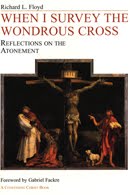
Some of you have asked me how to get a copy of my little book on the atonement, When I Survey the Wondrous Cross: Reflections on the Atonement. The book was a Confessing Christ book, and published in 2000 by Pickwick Publications, which Wipf and Stock Publishers acquired in 2004.
This is good news for us theologs, since Wipf and Stock, like Pickwick before it, has made many useful and significant books available that would otherwise not be published for lack of a sizable market.
Confessing Christwants to support Wipf and Stock in this important mission, and so we now have an agreement with them to carry the book. It has been selling at Amazon.com for $14.00. Now you can get it at Wipf and Stock for $11.20. It is in paperback with a thoughtful foreword by Gabriel Fackre, Abbot Professor Emeritus at Andover Newton Theological School, with a striking cover designed by James R. Gorman.
Alan P. F. Sell, Professor of Christian Doctrine and Philosophy of Religion, Aberystwyth, Wales, writes on the back jacket: “I warmly recommend this book to all who wish to reflect earnestly and joyfully on the heart of the Christian Gospel. May the Cross of the crucified and risen Savior ever be at the center of our worship, service, evangelism, and ecumenism.”
If we sell out our limited stock Wipf and Stock will make a new printing available, but I’m guessing without the beautiful cover, so get yours now here. Some of you Barthians may recognize the cover picture, as Karl Barth had a reproduction of it over his desk when he wrote his monumental Church Dogmatics.
Confessing Christ owns the copyright, so profits beyond what Wipf and Stock gets will support their good work of encouraging “joyful and serious theological conversation.”
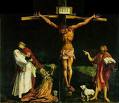
(Cover: Crucifixion by Matthias Grunewald from the Isenheim Altarpiece, Musee d’Underlinden, Colmar, France. Copyright Giraudon.)
“The Lord Will Provide:” A Sermon on Genesis 22
Nevertheless, Abraham believes God’s word of promise and the promise is kept. Sarah becomes pregnant and bears a son, whom they name Isaac, which means laughter, for Sarah laughs when God tells her she will have a son. Young Isaac is now the bearer of the promise, but in today’s story the promise is threatened.
As with many biblical stories, we know more than the characters do. We know that God is testing Abraham, but Abraham doesn’t know this. God commands him to take his son, his only son whom he loves, to the land of Moriah to sacrifice him. The form of the command from God echoes the original promise to Abraham. So the God who made the promise seems to be putting the promise in jeopardy. Abraham hears God’s command. He has already lost his first-born son, Ishmael, whom he sent away into the desert with his mother Hagar, so the loss of Isaac will be the end of Abraham’s family, as well as the end of the promise.
So Abraham does as God has commanded him. He prepares for the sacrifice, takes Isaac and heads out to the land of Moriah on a three-day’s journey. After three days Abraham looks up and sees the place from far away. Father and son climb the hill and Isaac asks Abraham, “Where is the lamb for a burnt offering?” Abraham answers “God himself will provide the lamb for a burnt offering, my son.”
And God does provide. He produces a ram. Abraham passes the test. He is prepared to sacrifice his son, and with him Abraham’s own prospects as the carrier of the promise. But God doesn’t require the sacrifice of Isaac.
It is a disturbing story. It raises any number of troubling questions, and from the beginning interpreters have tried to figure out its implications, from the ancient rabbis to Soren Kierkegaard’s Fear and Trembling. In our own time a psycholoanalyst has suggested that the story is a story of child abuse, and has burdened our religious heritage with a climate in which abuse is tolerated (see Alice Miller, The Untouched Key: Tracing Childhood Trauma in Creativity and Destructiveness (New York: Doubleday, 1990, p 139). A tradition can be misused, of course, but let us leave the psychological and philosophical interpretations aside today and look at this story within the larger Biblical story of the promise.
In its own context within Genesis this episode is the climax of the larger story of the promise. It is a story about human faith, but above all, about divine providence, about the way God keeps his promise from generation to generation in the lives of these ordinary people.
Notice how few details we are told about God. In this story there is no burning bush, no ladder to heaven, just the simple command of God. Does Abraham see God? Does the command come in a dream, in a voice, in a cloud? We don’t know. Although God is the chief actor in the drama of promise and fulfillment, he remains in the background, speaking from mystery, his intentions not fully known.
In comparing this story with the Odyssey of Homer, literary critic Eric Auerbach notices that, unlike the Greek god Zeus, who is comprehensible in his presence, the God of the Bible is not; “It is always ‘something of him’ that appears, he always extends into depths.” The Greek narratives with their gods take place in the foreground, while the biblical narrative with its God remains mysterious and is ‘fraught with background.’ Here in Genesis we are not told everything as Homer would tell us, we are only what we need to know. Homer’s poem is almost photographic in its detail, but here we have few details. We don’t know what Abraham was thinking, what Isaac looked like, what kind of day it was. We are not told of inner states of mind. The narrative is spare. And it is not Abraham’s character, courage or pride that is decisive for the story, but his previous history, as the one to whom God has made the promise. (Eric Auerbach, Mimesis, p 12)
The story keeps us off balance. Its outcome is not predictable. And the spareness of the biblical narrative means we have to look for clues to discern what is going on. One of the clues here is the idea of seeing. Throughout the Genesis story there is the motif of seeing, the human characters seeing, and God seeing. For example when Hagar is told by an angel of the Lord that she will give birth to Ishmael. She says, “Have I really seen God and remained alive after seeing him?”
The human characters see, but only now and then, little bit by bit. Seeing is never complete. They see, to use Paul’s phrase “through a glass darkly.” The characters see only part of the way. But seeing seems to be essential for faith. The characters need to see, at least in part, what God is up to. They need to see how the promise is fulfilled. They won’t see completely, they must act in faith, and perhaps it is faith that lets them see as much as they do.
So Abraham travels for three days and looks up and sees the place for the sacrifice. And when he is about to sacrifice Isaac he looks up and sees the ram. Was the ram already there? Had God prepared for the sacrifice in advance? Could Abraham only see the ram when he trusted the Lord and met the test? We don’t know.
In any case “God says, ‘Do not lay your hand on the boy or do anything to him; for now I know that you fear God, since you have not withheld your son, your only son from me.’ And Abraham looked up and saw a ram, caught in a thicket by the horns. Abraham went and took the ram, and offered it up as a burnt offering instead of his son. So Abraham called that place ‘The Lord will provide.’” The Hebrew means “The Lord will see.”
So God also sees! But this Hebrew verb “to see” is a “warm verb,” so God is not merely a passive seer, but an active doer in response to what he sees. Providence means not just that the Lord sees, but that he “sees to it.” In the Latin, “to see:” Pro video. God will see to it!
So Question 27 of The Heidelberg Catechism:
“What does thou understand by the providence of God? Answer: The almighty and present power of God by which he still upholds and therefore rules as with His hand heaven and earth and every creature, and that leaves and grass, rain and drought, fruitful and unfruitful years, food and drink, health and sickness, riches and poverty and all other things do not come by accident but from his fatherly hand.”
The Lord will provide. He both sees and “sees to it.” Divine providence has often been understood as foreseeing, but that is only half of it. So Karl Barth writes:
“. . . The God who so wonderfully foresees and provides is not a mere supreme being but the God who, in this happening in which Abraham was to spare his son, acted as the Lord of the covenant of grace that Abraham was promised and given his successor Isaac, that he had then (as a prophecy of the One who was to come) to separate and bring him as an offering to God, but that he had not to die but to live as a type of the One who was to come and give life through His real death, a substitute being found for him in the form of a ram.” (Karl Barth, CD 3.3,35)
I am convinced that the earliest Christians were prepared to interpret the death of Jesus as an atoning, sacrificial act by God because they knew this story of Abraham and Isaac. As good Jews they trusted the identity of God as the One who both sees and “sees to it,” and so the crucifixion and resurrection were seen as the ultimate act of divine providence, doing for us what we could not and can not do for ourselves, saving us from sin and death.
A son climbs a holy hill with wood on his back for a sacrifice. They recognized that story! They knew it was a terrible story. But they were able to see in faith that God sees, and in Easter light, they saw with the clarity of 20/20 hindsight, that God did provide the sacrifice, that the promise was kept and the story continues.
(I preached this sermon at the Tabernacle at Craigville, Massachusetts, on Cape Cod, on June 27, 1999. It is also a chapter in my book When I Survey the Wondrous Cross: Reflections on the Atonement, Pickwick, 2000).
Ambassadors of Reconciliation
And still the mark of Cain can be seen in the human family, as Tsutsi’s and Hutus, Irish Protestants and Catholics, Muslims and Hindus, Arabs and Jews, Bosnians and Serbs murder each other each day. In our own land great rifts remain between blacks and whites, hostility to aliens grows daily and guns seem to be the problem–solving method of choice for many.
We are increasingly a tribal culture: each of us preferring the enclaves of those who share our ideas, our class, our skin color, our ethnic heritage, our prejudices. In the business community, downsizing produces a culture of survivors, a bunker mentality that fractures community, creativity and innovation. In politics the infighting and rhetoric of abuse so dominates that the final victor is unable to govern effectively. Even in the church we are a fractured people, separated by walls of our own making, walls of race and sex, of creed and ideology. We meet in our small caucuses and interests groups and label those unlike ourselves, building ever higher and more complex walls to keep us apart from each other.
The biblical word for all this is sin, which means separation from God and one another. It would seem that from a human point of view there is no reconciliation. Yet it is into this broken and estranged world that the Word of God breaks forth with the message of reconciliation. “Hear the good news!” God declares. “While we were yet sinners Christ died for us!” What we cannot do for ourselves God has done for us.
The Christian story is a story of reconciliation and its very center is the cross of Christ, where God’s reconciling work is accomplished. In fact, the Greek word we translate as reconciliation also means atonement, at-one-ment, the bringing together of that which was separated. The biblical story is quite clear that the basic rift is between God and us and that our inhumanity to each other is a symptom rather than a cause. That rift is not something we can overcome by ourselves, but God could and did. On Calvary all the hatred and enmity of the world were nailed to the bloody cross with Jesus, and in that saving event Jesus represented us to God and represented God to us in a freely chosen act of obedience which is an atonement for the sins of the whole world. As John the Baptist said of Jesus at his baptism, “Behold the lamb of God who takes away the sins of the world.”
The Easter faith we profess is that God has come among us in Jesus Christ, and has died and been raised for us so that we may now live a new kind of life. “If anyone is in Christ,” Paul says, “there is a new creation: everything old has past away; see everything has become new! All this is from God, who reconciled us to himself through Christ, and has given us the ministry of reconciliation; that is, in Christ God was reconciling the world to himself. Not counting their trespasses against them, and entrusting the message of reconciliation to us. So we are ambassadors for Christ, since God is making his appeal through us; we entreat you on behalf of Christ, be reconciled to God. For our sake he made him to be sin who knew no sin, so that in him we might become the righteousness of God.”
This reconciliation was no abstraction for the church in the first century. A church comprised of Jews and Gentiles struggled to be reconciled against the weight of hundreds of years of custom and tradition reinforced by numerous religious laws. The potential for division was enormous and we can see the working out of it throughout the New Testament where the issues get joined. Must Gentile converts to Christianity be circumcised? Do they have to observe the dietary laws of Judaism? We see the separation of rich and poor in 1st Corinthians, where the rich come and eat the supper for the communion before the poor can arrive.
Which is to say that it has never been easy to be the church, the community of reconciliation.. Reconciliation means hanging in there with those you would just as soon write off, but can’t because they belong to Christ as you belong to Christ and so they are your brothers and sisters in Christ. The church is to model for the rest of the world the reconciliation that God intends for the whole world. That is why it is such a scandal when the church itself is divided.
I believe our own United Church of Christ is in for a very difficult struggle for the next generation. We are no longer a homogeneous church but exhibit a dizzying variety of folks, many who come from other religious traditions. The United Church of Christ means many different things to different people. There are many issues in contention among us at this time, including such core questions as what theology is appropriate for our church and what language shall we use to express our faith in liturgy and hymnody. Feelings about these issues are very strong. There seems little room for compromise between the opponents. Who will be the winners and the losers? A friend of mine who is a historian at Harvard tells me that the German Reformed Church, one of the predecessor bodies in the United Church of Christ, endured fierce debate over their liturgy in the 19th century, but somehow they stayed together. Can we stay together in covenant?
From a human point of view, it seems doubtful. And yet, how can we be a voice and witness to reconciliation in our society, to schools and businesses, to our decaying cities and streets of wrath, to marriages and families in turmoil and children at risk if we cannot live among ourselves? How are we to be ambassadors of reconciliation if our own household is at enmity?
The challenge before us for the days ahead and for a long time to come is to be the church, to live in such a way that we are a living witness to the message of reconciliation that has been given to us. This means tolerating a fairly high level of conflict for a long time. It will test our faith. We will need the gifts that God’s Spirit sends to the faithful. It will require that we tell the truth in love. It will require soul–searching and the capacity to give and accept forgiveness. In other words, it will mean being the church, which was never easy and isn’t easy now.
Formerly we may have regarded some people as our enemies and opponents, and perhaps they are as the world sees it. But from now on we are to regard no one from a human point of view, because if we believe our own gospel then “by God” there is a new creation, the old has passed away, behold the new has come. So we entreat you, my brothers and sisters in Christ, by the power God gives you “be reconciled to God” and be the church, the community of the reconciled. And be the church as hard as that is and as long as it takes, which may be a long long time. Which is perhaps why, before Jesus left the disciples, he promised to be with us even to the end of the age. Amen.
(A sermon to the Berkshire Association, United Church of Christ, Annual Meeting on April 21, 1996, meeting at First Church of Christ (UCC) in Pittsfield, Massachusetts, where I was, at the time, the Pastor.)
Where I Ruminate on the Cross and Christian Stewardship

I recently received notice that the theme for my state Conference’s annual meeting this fall will be “Generosity as a way of life.” A cynic might wonder if this is just another attempt to shore up the sagging finances that plague all the mainline denominations.
But the cynic should note that the theme of generosity is thoroughly biblical. This week’s epistle, for example, is from Second Corinthians, Chapter 8, which is a sort of proto-stewardship letter from the Apostle Paul.
The particular project Paul is raising funds for is a collection for the benefit of the church in Jerusalem. He has been traveling around Greece and Asia Minor visiting churches, many of which he founded, inviting them to give to this project. In this letter to the church in Corinth he describes to them the generosity of the Macedonians so as to shame and inspire them. Apparently Paul’s sometime traveling companion Titus has already been there and begun the collection among them, but perhaps with less than satisfactory results, given the need for this letter.
But Paul doesn’t only shame them into giving. He also encourages them with some flattery: “Now as you excel in everything—in faith, in speech, in knowledge, in utmost eagerness, and in our love for you—so we want you to excel also in this generous undertaking.” (2 Corinthians 8: 7) Paul knows what every wise parent or teacher knows, that encouragement often gets better results than shaming.
But neither shame nor flattery provides Paul’s best motivation for the Corinthians to be generous. What he wants to say that the Christian life by its very nature is a generous life and that generosity is rooted and grounded in gratitude for the gracious generosity of God in Jesus Christ. He writes them: “For you know the generous act of our Lord Jesus Christ, that though he was rich, yet for your sakes he became poor, so that by his poverty you might become rich.” (2 Cor. 8 9)
Many years ago a member of my congregation came to me puzzled about this passage. “Is it true Jesus was rich?” Wasn’t he a humble carpenter?” I answered him that he was right that Jesus was not a rich man economically. But Paul is speaking metaphorically. When he says that Jesus was rich but became poor for us, he is referring to Jesus giving everything up on the cross. The language reminds us of Philippians 2: 5-11 where Jesus is depicted as emptying himself of his divine prerogatives and taking the form of a servant, humbling himself even to the point of death. That is “the generous act” Paul refers to. The word in Greek means “grace,” and earlier translations said, “You know the grace of our Lord Jesus Christ.”
I find it ironic that at the same time the mainline churches are admonishing generosity, a cottage industry debunking the cross is flourishing within their precincts. (see, for example, my The Cross and Violence: Is the Word of the Cross Good News, or is it Bad News?) I have read far too many ordination papers lately apologizing for the cross, and wonder if such a cross-less Gospel will make people feel generous?
Let me boldly suggest that a robust cross-centered Gospel may be the most efficient stewardship tool. Generosity doesn’t grow on its own, because it is a fruit, and not a root. The root is gratitude.
Isaac Watts’ hymn “When I survey the wondrous cross” captures this sense of gratitude and its fruits in the last verse: “Were the whole realm of nature mine, that were a present far too small; love so amazing, so divine, demands my soul, my life, my all.”
Can you imagine the nominating committee vetting stewardship callers by asking them about their doctrine of the atonement? I can’t either, but the thought amuses me.
The Cross and Violence: Is the Word of the Cross Good News, or is it Bad News?

A Paper delivered at the 25th Craigville Colloquy, July 2008
by Richard L. Floyd
This evening I want to address the question of whether the cross of Jesus Christ is implicated in the violence of our world. More specifically, does the church’s theology of the cross, expressed in its various views of atonement, contribute to fostering violence?
It is a question that arises out of my own experience in the church. In 1995 when I was living in St Andrew’s, Scotland, and working on what would later become my book on the atonement, “When I Survey The Wondrous Cross:” Reflections on the Atonement, I wrote an essay on some of the objections to the idea of substitutionary atonement. At the end of the chapter I made note that there were some critics who felt that the cross itself was an emblem of violence, but I didn’t really address this view in depth, because frankly, I thought it was a fringe view without much merit. I still do.
But the view that the cross is an emblem of violence has been gaining traction in the last decade or so. There have been a spate of books addressing the issue, and in recent years I am hearing ordinands and new ministers repeating these views to the effect that the cross is not good news, but bad news.
Let me share some anecdotes. The first was at an ecclesiastical council a few years ago. The candidate told us that she didn’t believe in substitutionary atonement. “Fair enough,” I replied, since there have been some dubious ideas under that banner. “ But what do you then make of the death of Christ? “Christ’s death,” she said, “was the price he paid at the hands of the powerful for his advocacy of an inclusive community.” Admitting that it is at least that, I asked, “Then does the cross have any meaning for salvation?” “No!” was the answer.
The second was in a seminar on the atonement I gave a couple years ago to United Church of Christ (USA) ministers. During the Q and A in became clear to me that many of the ministers were uncomfortable with talk of the cross, and some found it offensive. One young man, a bright newly-minted UCC minister said, with some passion, “No good thing came from the cross.”
Finally, one Sunday in a UCC congregation I attended, the pastor announced that he had considered removing one of the hymns for the day because it suggested a substitutionary atonement, and that is an idea, he said, “that I reject and the church doesn’t need.” The hymn was “What wondrous love is this?”
There have always been critics of the cross. Paul writes the Corinthians: “We proclaim Christ crucified, a stumbling-block to Jews and foolishness to Gentiles, but to those who are the called, both Jews and Greeks, Christ the power of God and the wisdom of God.” (1 Corinthian 1:23)
What is troubling to me is that the attacks on the cross of recent years come from within the church. It comes from seminary professors, and increasingly from pastors. This should concern us, as such teaching and preaching against the cross confuses the faithful and saps the church of the vital nerve center of the faith that is so needed to meet the challenges of our age, including the problem of violence. I am convinced that this deep alienation from the core of our tradition is a symptom of a larger historical process profoundly described by Charles Taylor in his important book A Secular Age. But that makes it no less disturbing.
That violence has been done in the name of the cross cannot be denied. But the argument hinges on the distinction between whether the cross, in and of itself, is a cause of violence, or whether when violence is done in the name of the cross, it is a betrayal of the cross’s true meaning. I will be arguing for the latter, that where the cross is used to justify or induce violence it is a betrayal of the cross, which is the very soteriological center of God’s story of redeeming love to humankind.
It is an irony that I find myself defending the cross from the critics who say it causes violence, because it was a reaction to violence that profoundly influenced me to return to the Christian faith of my childhood as a young adult in the late 1960’s. I had been in Air Force ROTC in college for two years, and had qualified for pilot training, when the US started bombing Cambodia. At the age of twenty I went through an agonizing crisis of conscience, at the end of which I withdrew from ROTC.
In December of my junior year, in 1969, I dropped out of college, moved to New York City, got a job as a copyboy at Time-Life, and soon applied for Conscientious Objector status, with the help of some sympathetic Quakers.
Those were years of great violence in America, in urban centers and on college campuses, and I was stricken by the assassinations of Robert Kennedy and Martin Luther King, and by the continuing violence of the Vietnam War. The summer after my first year in college I had worked and lived at a funeral home, and we hosted the young soldiers who came as escorts with the bodies of the war dead from Vietnam.
This was the context in which I rediscovered Christian faith, with a cross at its center, as the only compelling story in which I could understand these events. A few years later, while I was in seminary, Jurgen Moltmann’s The Crucified God was published. I still remember a line from the Introduction, which asked the question, “What does it mean to recall the God who was crucified in a society whose official creed is optimism, and which is knee deep in blood?” (Moltmann)
Jesus’ crucifixion itself is, of course, a horrific act of violence, but Christian faith, from its early days, has interpreted it as a divine act of reconciliation. My own view, influenced by my St Andrew’s tutor Richard Bauckham, is that the first Christians understood Jesus’ death from the beginning as an atoning, sacrificial death, and that was expressed in a pre-Markan kerygma that then shaped the Gospels. This view runs counter to the received liberal line that Paul created a soteriology missing from the earliest kerygma. Bauckham claims that the earliest Christology was the highest Christology.
I argued in my atonement book that ideas of sacrifice and substitution are both biblical and necessary to fully express the radical nature of this divine act of love. Now in the Evangelical camp this is widely accepted, and when I give my dog and pony show on the atonement in those circles, during the Q and A someone invariably says something like, “Yes! So!” Now there are various nuanced and sophisticated discussions in that world about the precise nature of the atonement. But I don’t have a horse in that race, because my more focused mission has been as a witness to the cross to the mainline, where the soteriological center of the Christian story is in danger of being lost. Gabe Fackre has taught us that we need to keep the whole story in view when we look at any part of it, and I think that is one of the problems that some of the critics of the cross have, in that they focus on the cross wrenched out of its larger narrative.
So while I am interested in theories of atonement, and want stronger rather than weaker arguments around the “what” of the cross, I want always to view it within the larger Christian story. So Jesus Christ who died on the cross “for us and for all humanity,” must be seen as the One who is “the same, yesterday, today and tomorrow,” and who, as the divine Word, was at the beginning of creation, and will be at the end, on the Day he comes to judge the living and the dead.
But let us be clear that the cross is not just any part of the Christian story, but the very center and climax. And by the cross I mean more than just Golgotha, but, like Paul, I use “the cross” as a kind of theological shorthand to describe the whole soteriological center of the story as shown in the life, passion, death and resurrection of Jesus.
In that story I see an act of God, who does for us what we cannot do for ourselves, saving us from sin and death. Therefore, my view is that the work of Christ on the cross is constitutive for salvation and not merely illustrative of it. And it is this high view, with its lineage back to St. Anselm, which is particularly under attack from the critics of the cross.
So the shape of my paper will be to look at the views of those who consider the cross bad news, to tell you why they are wrong, and then to tell you why the word of the cross is good news indeed.
WHY SOME CRITICS CONSIDER THE WORD OF THE CROSS TO BE BAD NEWS.
The chief criticism is that the cross is an act of violence against Jesus by God. Professor Dolores Williams of Union Theological Seminary, for example, wants to replace the cross with the mustard seed as the primary Christian symbol, because she views the cross as a symbol of violence, especially against woman and children.
Anabaptist theologian Denny Weaver sums it up it like this: “The motif of Jesus as the substitute object of punishment, which assumes the principle of retribution, is the particular image that feminists and womanists have found very offensive. It portrays God as the chief exacter of retribution. God punishes — abuses — one of God’s children for the sake of the others. And the Jesus of this motif models passive submission to innocent and unjust suffering for the sake of others.” (Weaver, Violence)
Some feminist and womanist writers also object to the passivity and submission of Jesus as encouraging the acceptance of violence to women by men.
Again Weaver says: “It is an unhealthy model for a woman abused by her husband or a child violated by her father, and constitutes double jeopardy when attached to hierarchical theology that asserts male headship. A model of passive, innocent suffering poses an obstacle for people who encounter conditions of systemic injustice, or an unjust status quo produced by the power structure. Examples might be the legally segregated south prior to the civil rights movement, or de facto housing segregation that still exists in many places; military-backed occupation, under which land is confiscated and indigenous residents crowded into enclosed territories, called “reservations” in North America and “bantustans” in South Africa and “autonomous areas” in Palestine. For people in such situations of an unjust status quo, the idea of “being like Jesus” as modeled by satisfaction atonement means to submit passively and to endure that systemic
injustice. ”
“James Cone linked substitutionary atonement specifically to defenses of slavery and colonial oppression. Delores Williams calls the Jesus of substitutionary atonement, the “ultimate surrogate figure.” After depicting numerous ways in which black women were forced into a variety of surrogacy roles for white men and women and black men, Williams says that to accept satisfaction or substitutionary atonement and the image of Jesus that it supplies is to validate all the unjust surrogacy to which black women have been and still are submitted. ”
Weaver concludes “Such examples show that atonement theology that models innocent, passive suffering does have specific negative impact in the contemporary context.” (Weaver, Violence)
WHY THEY ARE WRONG.
These views seem to me to say more about the hermeneutic of suspicion of the writers than the actual biblical narrative and the atonement theories that are their conceptual representations. After all, if you are looking in the wrong end of the telescope everything will look small.
I have come to believe that the church’s communal language in creed, doctrine and liturgy, and especially Scripture, from which the others are derived, is irreducible and must be taken on its own terms. Hans Frei was describing Karl Barth’s position when he said: “There can be no systematic ‘pre–understanding,’ no single, specific, consistently used conceptual scheme, no independent or semi–independent anthropology, hermeneutic, ontology or whatever, in terms of which Christian language and Christian claims must be cast to be meaningful.” (Frei, p 156). Which is to say that in the end it is the texts that judge us rather than the other way around.
So what is needed is a theological interpretation of the cross that takes seriously the thickness of the scriptures. To do that there are some features that are necessary that I find missing or inadequate in the views of the critics of the cross.
1. Many of the critics do not have what George Hunsinger called “a robust view of sin.” It was human sin that caused Jesus’ death and Jesus himself “became sin” to save us from sin. That is, he who was sinless died a sinner’s death by the law of his own people, for “cursed be the one who hangs from a tree.”
So it was human sin that killed Jesus, the same sin that we all know in our own lives. Condemned by the twin pillars of civilization, Roman law and Jewish religion, Jesus was crucified by humanity, not at its worst, but at its best, which is a reminder of the pernicious nature of sin. So the crucifixion wasn’t an aberration, but the kind of event that happens in our fallen sinful world. So when the fingers get pointed at who killed Jesus, the Lenten chorale Herzleibster Jesu has it right, “I it was denied thee, I crucified thee.”
Lest you think this is a gloomy view let me be quick to say that I believe that God’s grace is greater than our sin, but that is no excuse to pretend that sin is not real or powerful. Many pastors have had to defend the prayer of confession in their liturgy against those who say, “I don’t feel I am a sinner.” Toward the end of my ministry I started replying, well, then the Gospel is a solution for a problem you don’t believe you have. Likewise, many of the critics of the cross see only evil structures and systems, but not the human sin in all of us that is complicit in them. God’s act of redeeming love on the cross to save us from sin and death is a solution to a problem they don’t recognize.
2. The critics often conflate violence with evil. A good deal of the world’s violence is evil, and I think it would be a better world if we tried non-violent solutions to most problems. I ceased to be a pacifist many years ago, but I still have what I call “a preferential option for the non-violent.”
But as Reinhold Neibuhr taught us, there are times and places when only force will stay the hand of evil against the innocent victim. For example, in 1995 if the 400 armed Dutch UN peacekeepers in the so called “safe zone” at Srebrenica had been authorized to use force against the Serb ethnic cleansers, the genocidal murder of 8000 Bosnian men and boys might well have been prevented. Sometimes non-violence can be complicit with evil.
3. Many of the critics of the cross romanticize non-violence. Denny Weaver puts non-violence in such an exalted place in his theology that it becomes, in Willis Elliott’s phrase, “Salvation by non-violence.” Here the principle of non-violence is used to judge even God’s behavior, so that the violence of Jesus’ cross rules it out as a loving act of God.
This romanticism of non-violence is utopian. It doesn’t take account of the facts on the ground, which is the power of sin and death. God’s victory doesn’t come cheap. God defeated sin and death on the cross at great cost to himself. The horrific violence of Jesus’ cross reflects the real world we live in. In a utopian world, a letter to The New York Times might have fixed it. But in our world, it took considerably more.
4. The critics don’t take Jesus’ Jewishness seriously enough. When we look at the cross theologically we must keep before us that it is Christ who died for our sins, not just any man, but the Jewish messiah. The pre-Markan kerygma behind the New Testament is a thoroughly Jewish interpretation of the death and resurrection of Jesus. That is why the New Testament has so many echoes from the Old Testament.
Crucifixions were a commonplace in the ancient Roman world, but the significance of this particular cross was the claim that it was God’s anointed who suffered and died. It was their own traditions that allowed these Jews to understand Jesus’ death as an atoning sacrificial death. For example, one of our earliest pericopes is 1 Cor. 15: 3ff where Paul rehearses the gospel that had been handed down to him that “Christ died for our sins in accordance with the scriptures.” And the reason it could be understood thus was because the scriptures contained stories such as the binding of Isaac in Gen. 22, the description of a suffering servant in the Servant Psalms in Isaiah, especially Isaiah 53, and passages like Psalm 22, which has Jesus’ words from the cross, “My God, my God, why has thou forsaken me? Without this Jewish context the cross is hard to understand properly.
5. The critics don’t take the Trinity seriously. Hans Frei’s definition of doctrines as “conceptual redescriptions of the biblical narrative” well describes the later Trinitarian understanding of the whole Christ event and its emphasis on the inter–dependence of the divine persons. Jesus’ experience of being abandoned by God, in which he endures the condition of the sinner before God, can be viewed as arising from a Trinitarian act in history, an act to which the Father intentionally sent him and which in obedience Jesus accepted. The cross is, therefore, a Trinitarian act of mutual consent in love between the Father and the Son in the Holy Spirit.
This goes a long way to countering the charge that the cross is a symbol of violence, exploitation or even child abuse. A unitarian God who requires the sacrifice of the human Jesus is problematic, to say the least, but if we understand the obedient death of the Son as in some real sense a loving act in which it is God who dies for us, we move away from many problems.
The critics also say that substitutionary atonement means God is punishing Jesus. P. T. Forsyth made an important distinction here. He says the cross is penal, in that Jesus, though innocent, voluntarily takes on the sentence that we deserve. But though the cross is penal, it is not punishment, since Jesus is innocent. For what would the Father punish him? And how could the Father punish the Son, with whom he is always well pleased.”? (Forsyth)
Princeton theologian George Hunsinger, whose commitment to non-violence is well known, said this about the critics of the cross in an interview: “They’re bringing an alien framework of judgment to bear upon this. No one in the patristic period ever understood the cross as sanctioning violence and abuse. Nor did poor Anselm in the middle ages, who often has to take it in the neck for these things. I think that there are some fundamental problems in the way Anselm went about this question in Why God Became Human, but they’re not at this level. You actually put the question a bit wrongly, I think, as far as these recent critics are concerned. It’s an innocent human being that is tortured to death by a vindictive father in heaven. There is no Trinitarian frame for this, but there is certainly a Trinitarian frame in Anselm. This whole transaction occurs for him with inner Trinitarian consent. This is divine suffering for the sake of a larger good. The Father suffers as much as the Son in the power of the Spirit in Anselm, if we read him fairly and in the spirit of what he is offering. God’s redemptive suffering is undergone in love for the sake of the world.”(PTR Interview)
6. The critics have too limited a canon. Like Marcion, the second century heretic who made up his own canon, Luke is their favorite Gospel. Marcion had one Gospel and ten letters of Paul and no Old Testament. The critics of the cross share his love for Luke, but not for Paul, who (after God the Father) is their chief villain, for his cross-centered Gospel. We all have favorite Gospels, and I love Luke as much as the next person, but the thickness of the biblical story is partly a result of the richness and complexity of the canon.
7. Finally, the critics have an inadequate eschatology of the cross. Again we must understand the cross within the framework of Second Temple Jewish monotheism, with its energetic eschatological expectations. The God of Israel was expected to act in the future. Second Isaiah, for example, expects a new exodus, which will show decisively God’s identity as creator and ruler of all things. The first Christians, who had experienced this new exodus in Jesus, understood that God was continuing the story, and “a new narrative of God’s acts becomes definitive for his identity.” (Bauckham, p 71.) The God who acted in the Exodus had now acted again in the cross and resurrection of Jesus.
When the church included Jesus, a human being, humiliated and exalted, into the identity of God, they were saying something radically new about the identity of God. In the dying and rising of Jesus, God had done a new thing that could only be adequately described in the language of Old Testament eschatology. It was the restoration from exile, the new creation, the healing of the rift between God and Israel and more. The titulus that Pilate put over Jesus’ head on the cross read, “King of the Jews.” Who could the king of the Jews be other than the messiah of God? Meant by Pilate as irony, the church could see the truth of it in light of their new faith that in Jesus Christ God had once again acted decisively as expected.
WHY THE CROSS IS GOOD NEWS.
1. The cross is the death of ideology. The cross provides the critical principle which de–centers our preoccupation with both individual and corporate concerns. It calls into question any ideology that would use the Gospel to further its own ends. Anthony Thiselton has written: “The cross is a scandalous reversal of human expectations and values . . .. In the theology of the Fathers, as in that of Paul, the message of the cross challenged the corporate constructs, expectations, and wish fulfillments of communities or of individuals as a scandalous reversal of human expectations and values. Far from reflecting pre–existing social horizons, the cross and the resurrection gave birth to new horizons, which in turn effected a cross–contextual liberating critique and individual and social transformation. This is a far cry from the notion that communities can only project their own images onto texts, thereby to construct their meanings.” (Thiselton, p. 7)
The cross provides the church with a anti-ideological bias that protects the Gospel from being blown about by any number of contemporary cultural winds or co–opted by any number of alternative faiths, religious and secular. The cross also protects the church from both utopianism and cynicism, because it keeps in view that the resurrected one remains the crucified one.
Likewise, the cross helps the church to understand its life and discipleship in other ways than by the canons of success and power that the world so values. It teaches the church to recognize its true hope in the God who raised the dead from the illusory hopes the world holds out for both individuals in the face of death and for human history in the face of futility. I once heard William Sloane Coffin tell a group of pastors, “If you don’t want to be so disillusioned, don’t have so many illusions.” Christian faith which deemphasizes the cross is prone to just such disillusionment about its projects and hopes. But the cross functions as the critical principle that separates illusory hopes from the true hope that rests in trust in the God who raises the dead.
So the church is able to live in real hope only because the cross has taught it where properly to look for hope. Christian hope lies beyond all human endeavors and accomplishments and beyond all possibilities inherent in the natural world. Christians love the world God made and for which his Son gave his life, and we work and pray to make it more like the kingdom to come. At the same time, we know that our true hope lies only in the God who raised the crucified, who is the God who raises the dead. Such hope transcends both personal death and cosmic futility. From the cross the crucified God reigns over the future, and his suffering love will overcome all things.
2. The cross shows God’s solidarity with all human suffering including suffering caused by human violence. On the cross Jesus suffers an agonizing death, but perhaps more than his physical suffering was the anguish he experienced by the total abandonment of the One he called Father, which he expresses when he cries out from the cross, “My God, my God, why have you forsaken me.” (Psalm 22:1, Matthew 27:46))
In this experience of abandonment Jesus knows solidarity with all human suffering, and if we take his divine nature seriously then God knows this, too, and in some sense experienced it on our behalf, and by doing so redeemed it, which we can only see in Easter hindsight. So not only did Jesus suffer (which is what passion means) but his suffering and death are not incidental to the glorious story of divine atonement and human redemption but quite literally crucial.
Now some of the critics charge that the cross exalts human suffering, and encourages people to accept it. We must admit that suffering, in and of itself, is not redemptive, and so we should be careful not to romanticize suffering. But suffering is such a universal feature of the human condition that surely it must be good news to know that our God understands our suffering, and in Jesus, was himself “a man of sorrows and acquainted with grief.” (Isaiah 53)
3. The cross models forgiveness. From the cross Jesus prays, “Father forgive them, they know not what they do,” and in doing so embodies the loving mercy of God. Archbishop of Canterbury Rowan Williams has written, “Without that (the cross of Jesus), we cannot begin to understand the forgiveness of sins. Jesus crucified is God crucified, so we believe. Jesus is the total and final embodiment in history of God’s loving mercy; and so this cross is a unique, terrible, extreme act of violence—a summary of all sin. It represents the human rejection of love. And not even that can destroy God: with the wounds of the cross still disfiguring his body, he returns out of hell to his disciples and wishes them peace.” (Jersak, p 216.)
This radical forgiveness is the only power that can break the cycles of revenge and retribution that fuel so much of our world’s violence. One of the most powerful moments of Christian witness in my lifetime was when Pope John Paul the Second forgave the man who had shot him, Mehmet Ali Agca. The Pope was shot and seriously wounded in 1981. In 1983 he visited his assailant in prison and spoke privately with him for about 20 minutes. He later said, “What we talked about will have to remain a secret between him and me. I spoke to him as a brother whom I have pardoned and who has my complete trust.”
How ironic it seems to me that the word of the cross is being accused of causing violence, when its message judges and condemns violence. Graham Toulmin has written, “The word of the cross is unique in the modern or postmodern world, as a discourse or metanarrative unlike any other. It will not allow Christians to impose their faith forcibly on others, instead waiting patiently for its truth to be recognized, suffering misunderstanding and disdain before it will retaliate or compel. It is a metanarrative, a Truth with a capital “T/’ but a humble, patient one. In a world justifiably nervous that absolute truths are inherently violent and oppressive, a cross-centered Christianity offers an absolute Truth which by its very nature denies coercion as a way to assert itself. Instead, it offers and forms a community dedicated to learning ways of love for enemies, forgiveness and hospitality to the “other” which promises a way forward for a fragmented and frightened world. ” (Toulmin)
4. The cross is all about God’s love. When I began I mentioned the hymn “What wondrous love is this?” That rhetorical question gets to the heart of the matter. Pope Benedict XVI first encyclical is called God is Love, which comes from 1 John 4:8. In it the Pope describes God’s love as an active love. He writes: “When Jesus speaks in his parables of the shepherd who goes after the lost sheep, of the woman who looks for the lost coin, of the father who goes to meet and embrace his prodigal son, these are no mere words: they constitute an explanation of his very being and activity. His death on the Cross is the culmination of that turning of God against himself in which he gives himself in order to raise man up and save him. This is love in its most radical form.”
When we look at the passages in Scripture that speak of God’s love, they more often than not reference the cross as the chief evidence. For example, John 3:16: “For God so loved the world, that he gave his only begotten Son, that whosoever believeth in him should not perish, but have everlasting life.” Or Romans 5:8: “God demonstrates His own love toward us, in that while we were yet sinners, Christ died for us.” Or Romans 8:31, 32: “If God is for us, who can be against us? He who did not spare his own Son, but gave him up for us all—how will he not also, along with him, graciously give us all things?”
And not just in Scripture, but in our traditions, too, we see a cross-centered understanding of God’s love. So the Heidelberg Catechisms beloved first question, “What is your only comfort in life and death?” is answered thus: “That I belong– body and soul, in life and in death—not to myself, but to my faithful Savior, who at the cost of his own blood has fully paid for all my sins…so that everything must fit his purpose for my salvation… he also assures me of eternal life….”
“What wondrous love is this?” Far from being the cause of violence the word of the cross is God’s love at work, and only that love offers healing and wholeness to our broken world.
It is true that the word of the cross is not a word everyone will hear. As Paul wrote the Corinthians: “For the message about the cross is foolishness to those who are perishing, but to us who are being saved it is the power of God . . . For Jews demand signs and Greeks desire wisdom, but we proclaim Christ crucified, a stumbling-block to Jews and foolishness to Gentiles, but to those who are the called, both Jews and Greeks, Christ the power of God and the wisdom of God. For God’s foolishness is wiser than human wisdom, and God’s weakness is stronger than human strength.” (1 Cor. 1:23ff)
BIBLIOGRAPHY
St. Anselm of Canterbury. Cur Deus Homo. E. T. by E. R. Fairweather, in A Scholastic Miscellany: Anselm to Ockham. Library of Christian Classics X. London: SCM Press, 1956.
Karl Barth. Church Dogmatics, Vol. IV.1. Edinburgh: T.& T. Clark, 1956.
Mary C. Boys. “The Cross: Should a Symbol Betrayed Be Reclaimed?” Cross Currents, Spring 1994.
Bauckham, Richard. God Crucified: Monotheism and Christology in the New Testament. Grand Rapids: Eerdmans, 1999.
Dalferth, Ingolf U. “The Eschatological Roots of the Doctrine of the Trinity” in Trinitarian Theology Today. Ed. Christoph Schwöbel. Edinburgh: T&T Clark, 1995.
Floyd, Richard L. When I Survey the Wondrous Cross: Reflections on the Atonement. San Jose: Pickwick Press, 2000.
Floyd, Richard L. “Review of God Crucified: Monotheism and Christology in the New Testament” by Richard Bauckham. Theology Today. Vol. 58, No. 1, April 2001
Floyd, Richard L. “The Cross as an Eschatological Act of God.” In Hope for the Future: Theological Voices from The Pastorate. William H. Lazareth, Editor, Grand Rapids: Eerdmans, 2002.
P. T. Forsyth. The Work of Christ. London: Hodder and Stoughton, 1910.
Frei, Hans. Types of Christian Theology. George Hunsinger and William C. Placher, eds. New Haven: Yale University Press, 1992.
Gowan, Donald E. Eschatology in the Old Testament. Edinburgh: T&T Clark, 1987.
Colin Gunton. The Actuality of Atonement: A Study of Metaphor, Rationality and the Christian Tradition. Edinburgh: T. & T. Clark, 1988
Hunsinger, George. “The Mediator of Communion: Karl Barth’s Doctrine of the Holy Spirit” in Disruptive Grace: Studies in the Theology of Karl Barth. Grand Rapids: Eerdmans, 2000.
Jersak, Bard and Hardin, Michael, Editors. Stricken by God: Non-Violent Identification and the Victory of Christ. Grand Rapids: Eerdmans, 2007.
Moltmann, Jürgen. The Crucified God. Philadelphia: Fortress, 1974.
Newbigin, Leslie. The Gospel in a Pluralist Society. Grand Rapids: Eerdmans, 1989.
Thiselton, Anthony. New Horizons in Hermeneutics. Grand Rapids: Zondervan, 1992.
Taylor, Charles. A Secular Age. Cambridge: Belknap Press. 2007.
Toulmin, Graham. “The Uniqueness of Christ’s Suffering and Death on the Cross” in Christ the One and Only: a Global affirmation of the Uniqueness of Christ, Sung Wook Chung, editor Paternoster and Baker Academic, 2005.
Van Buren, Paul M. According to the Scriptures: The Origins of the Gospel and of the Church’s Old Testament. Grand Rapids: Eerdmans, 1998.
Weaver, J. Denny. The Non-Violent Atonement, Grand Rapids: Eerdmans, 2001.
Weaver, J. Denny. “Violence in Christian Theology” Cross Currents. Summer 2001, Vol. 51, No 2.
Weder, Hans. “Hope and Creation.” John Polkinghorne and Michael Welker, eds. The End of the World and the Ends of God, Science and Theology on Eschatology. Harrisburg: Trinity Press International, 2000.

Book Review of “God Crucified: Monotheism and Christology in the New Testament” by Richard Bauckham
God Crucified: Monotheism and Christology in the New Testament
By Richard Bauckham
Grand Rapids, Eerdmans, 1999. 79 pp. $12.00.
Richard Bauckham, professor of New Testament studies at the University of St. Andrews, Scotland, is perhaps best known for his studies of the book of Revelation and for his commentaries on Jude and 2 Peter. He is also a thoughtful theologian who has written an introduction to the theology of Jirgen Moltmann. God Crucified displays the craft of both a careful exegete and a deft theologian as Bauckham explores the riddle of how the radically monotheistic Jews who composed the earliest church could have come to call Jesus “Lord.”
His argument turns much of mainstream christology, which has often assumed that a high christology is both a later development and incompatible with Jewish monotheism, on its head. According to Bauckham, “the earliest Christology was already the highest Christology,” a theology of divine identity that focuses on “who God is” rather than on what “divinity” is. In the Jewish monotheism of the Second Temple, the identity of God was understood by analogy with human identity, which includes both character and personal story. This unique identity had two key features: (1) God as the creator of all things and (2) God as the sovereign ruler over all things. God is also identified by God’s acts in Israel’s history, especially in the
exodus, and by the character description God gives to Moses: “merciful and gracious, slow to anger and abounding in steadfast love and faithfulness” (Exod 34:6). The acts of God and the character of God together identify God as the one who acts graciously towards his people.
This God, then, by his very identity, was expected to act in the future. For example, Second Isaiah, an important source for early Christians, expects a new exodus, which will show decisively God’s identity as creator and ruler of all things. So the first Christians, who had experienced this new exodus in Jesus, understood that God was continuing the story, and “a new narrative of God’s acts becomes definitive for his identity.” The God who acted in the exodus had now acted again in the cross and resurrection of Jesus.
When the church included Jesus, a human being humiliated and exalted, into the identity of God, they were saying something radically new about God’s identity. Nevertheless, the novelty of God crucified did not betray the identity of the God of Israel. On the contrary, as the early church examined the Scriptures it could find consistency in the novelty. It found the God of Israel and the God of Jesus Christ to be one and the same God.
Bauckham helps us understand early Jewish monotheism as the context for New Testament christology. On one hand, he takes issue with “strict” approaches, which claim that only a radical break with Jewish monotheism could allow for the attribution of divinity to Jesus. On the other hand, he rejects “revisionist” approaches, which focus on intermediary figures– principal angels, exalted humans, and the like-as models by which to understand the divinity attributed to Jesus. Bauckham also maintains a strict view of monotheism but argues that a high christology was possible precisely within a strict monotheism by identifying Jesus directly with the God of Israel. Bauckham rejects the second view as being unimportant for the study of christology, for the intermediary figures were never worshipped. He understands the presence of divine attributes such as word and wisdom as expressions of God’s identity and not separate creatures. They demonstrate, he believes, that Second Temple Judaism does not find distinctions in the divine identity inconceivable or threatening to divine uniqueness.
Such a christology of divine identity helpfully moves us beyond functional and ontic understandings. A functional christology, in which Jesus exercises the functions of lordship without being ontically divine, would have been problematic for Jewish monotheism, since the unique sovereignty of God was not something God could delegate to someone else. The ontological approach has often assumed that while early Jewish monotheists could speak of divine functions when speaking of Jesus, they shied away from speaking of divine nature, something that only later patristic development spelled out. Against this view, Bauckham shows that throughout the New Testament there are clear and deliberate uses of the unique, divine identity to include Jesus. Bauckham’s christology of divine identity offers a proper way to understand the New Testament within its Jewish monotheistic context by including Jesus, cross and all, within the unique identity of Israel’s God.
Richard L. Floyd.
(This review first appeared in Theology Today in April 2001, in a slightly edited form that eliminated my masculine personal pronouns for deity, an editorial practice I find stylistically awkward, theologically problematic, and troublesome to free speech. This is closer to what I originally wrote.)
Tom Wright Answers the Caricatures of the Cross
One of my persistent vocations is answering the critics of the cross. See for example, my The Cross and Violence, Is the Word of the Cross Good News, or is it Bad News?, a paper I gave at last summer’s Craigville Colloquy on Cape Cod.
So I was gratified to find this piece by N.T Wright, Bishop of Durham, in Fulcrum, from 2007, The Cross and the Caricatures.
Here’s a sample:“We must of course grant that many Christians have spoken, in effect, of the angry God upstairs and the suffering Jesus placating him. Spoken? They’ve painted it: many a mediaeval altarpiece, many a devotional artwork, have sketched exactly that. And of course for some late mediaeval theologians this was the point of the Mass: God was angry, but by performing this propitiatory sacrifice once more, the priest could make it all right. And it was at least in part in reaction against this understanding of the Eucharist that the Reformers rightly insisted that what happened on the cross happened once for all. They did not invent, they merely adapted and relocated, the idea of the propitiation of God’s wrath through the death of Jesus.
We must of course acknowledge that many, alas, have since then offered more caricatures of the biblical doctrine. It is all too possible to take elements from the biblical witness and present them within a controlling narrative gleaned from somewhere else, like a child doing a follow-the-dots puzzle without paying attention to the numbers and producing a dog instead of a rabbit.This is what happens when people present over-simple stories with an angry God and a loving Jesus, with a God who demands blood and doesn’t much mind whose it is as long as it’s innocent. You’d have thought people would notice that this flies in the face of John’s and Paul’s deep-rooted theology of the love of the triune God: not ‘God was so angry with the world that he gave us his son’ but ‘God so loved the world that he gave us his son’.”
Where I Ruminate on the Perils of a Palm Sunday Faith in a Good Friday World
There is a kind of decaffeinated Christianity that wants to quickly slide by Good Friday and get right to Easter, as if Good Friday is a morbid and somewhat unfortunate episode that is dwelt upon only by the morbid and masochistic. Or to put it another way, we are tempted to have a Palm Sunday faith, a faith based on a misunderstanding of who Jesus is.
Like the crowd at the first Palm Sunday we are tempted to see Jesus not as he is, but as a projection of our own hopes and desires. We can do this in a number of ways. We can turn Jesus into the supporter of our personal goals, or the upholder of our national ambitions, or our politics, or other ways where he becomes who we want him to be instead of who he really is. “Palm Sunday faith” is when we want a Jesus without a cross so we can have a faith without a cross, a faith without challenge or sacrifice, a faith without testing or struggle. When we do that we turn God into a kind of talisman or lucky charm to bless our projects and our aspirations, when in fact the God of the Bible is a God with his own sovereign purposes.
The problem with a Palm Sunday faith is that we live in a Good Friday world.I believe that Christian faith is essentially a joyful enterprise, but it is a joyful enterprise that doesn’t turn or flinch from the hard truths of the world’s harsh brutalities. So Christian faith without a cross does not show God’s full power to deal with human sin and death. And a faith without a cross will be found feeble and wimpy when the chips are really down.
What do I mean when I say it is a Good Friday world? There is a certain heartbreaking aspect of living that comes to us all. Often we only see it from a distance, as in the war in Iraq, where we have seen pictures both of dead and injured civilians and dead servicemen and women. But to the families of those individuals that heartbreak has come “up close and personal.” And some heartbreak comes to every human life sooner or later.
It is not just in wartime that the powers of sin and death do their heartbreaking work. Which is why there is so much comfort for us in worshipping a God who himself “became a man of sorrows and acquainted with grief.”
And that is exactly it. Our God knows the whole truth about human life. Knows not just the Sunday veneer and the masks of propriety but the dark and sad parts of it all. Knows that life is not a bowl of cherries. And this God not only knows the worst the world has to offer, but he has done something about it. His love is not sentimental love; it is holy love, a love that moves and acts to deal with love’s enemies.
A God who merely comforted the afflicted and bound up the wounded would not be a God who takes on the power of sin and death and evil. That is what the cross of Jesus is all about. God himself confronting human life at is very worst, at its most irredeemable, at a pitiful state execution, where the most powerful forces in the world humiliated and destroyed this humble innocent man.
He took it all on himself, the whole weight of the world’s hate and violence, its guilt and shame, all of it there on the hill at Golgotha. For us: you and me, and not just for us, but for everyone, across the ages. And not just for humans, but for himself, because his own holiness could not tolerate the world’s sin without atonement. And so he made it, not with the blood of rams at the temple, but making the sacrifice himself, spilling his own life out.
And why? Because that is what love does. By its very nature love spills itself out. In the letter to the Philippians Paul says that Jesus even gave up his own rightful claim to divinity, emptying himself, taking the form of a slave, for the cross was a slave’s death.And because of this humble obedience the Father has highly exalted him, and has given him God’s own name. Because “Lord” is the name Israel gave to their God, and to no one else.
But now Jesus is called “Lord.”When we call Jesus “Lord” and take the full measure of his love we will be moving toward a faith that can meet life’s darkest hours and toughest spots. A faith that is able to stand at the foot of the cross. And the world desperately needs people like that with faith like that: faith in Jesus, and in the power of his cross.