Unknown's avatar

“Hearing God’s Word from Unexpected Places”

Celtic cross

 But the Lord said to me: Do not say ‘I am only a boy; for you shall go to all whom I send you, and you shall speak whatever I command you.’  Jeremiah I.7

It is good to be back with you. I so enjoyed being here on Epiphany Sunday for Pastor Mike’s installation. It was cold then. It is not cold today. I have a small confession to make. Mike e-mailed me “We don’t wear robes in the summer.” And I e-mailed him back, “Can I wear one. I’m kind of a robe guy.” So I brought a robe and a stole up here to Dover, but then I realized I was preaching about opening oneself to new experiences and insights, so I’ve decided not to wear one. You know, to walk the walk as well as to talk the talk. I am also wearing a blue shirt for the first time in forty years, because I’m kind of a white shirt guy, too. So I’m really being daring today.

Will you pray with me:

Gracious God, through the written word, and through the spoken word, may we behold the Living Word, even your Son our Lord, Jesus Christ. Amen

I was just twenty-six years old when I graduated from seminary and became the pastor of the Congregational Churches of West Newfield and Limerick, Maine, just over the border and up the road about an hour from here. That was nearly forty years ago.

I grew a beard to look older and wiser than my years, but I’m pretty sure it didn’t fool anyone. I’ve learned a thing or two about the ways of the world and the church and myself, but when it comes to the ways of God I still stand in awe before the mystery of it all as much as I did back then.

But I will tell you one thing I have learned. You have to be open to hearing the voice of God from unlikely people and in unexpected situations. This is a humbling truth, and there is a kind of Socratic inversion about it. Remember how Socrates said of himself: “I am the wisest man alive, for I know one thing, and that is that I know nothing.”

Likewise, the people who think they always know what God is saying tend to be the ones least open to hearing from God, and are therefore the least knowledgeable.

Because if we decide in advance where and when and through whom God will speak, we severely limit our capacity to hear from God.

There are many reasons we close our minds and hearts to those through whom God speaks.

Perhaps we think someone is too young to speak for God. In our Old Testament reading today, Jeremiah tells God just that, that he is too young to be a prophet. God rebukes him, saying: “Do not say ‘I am only a boy; for you shall go to all whom I send you, and you shall speak whatever I command you.’” Jeremiah I.7

I remember when I was young being frustrated that older people often found it hard to see me as someone with something to say because of my age. Now that I am not so young, I have to resist the impulse to dismiss the insights and wisdom of the young, and to tell the truth, I find myself more and more learning from those who are younger, which is an ever-expanding group.

My twenty-nine year old daughter, Rebecca, was just ordained to the ministry in June. I have heard her preach several times now, and, if I do say so myself, she is pretty good. But sometimes when I am listening to her, my mind is saying, “How can this be? Is this my daughter? I remember the day she was born as if it were yesterday.”

And you have a daughter of this church being ordained soon, Emily Goodnow, a schoolmate of my daughter’s from Yale Divinity School. And perhaps some of you who watched her grow up in this congregation wonder, “How can this be? I remember when she was just a girl in Sunday school.”

Recall when Jesus went to his home synagogue to preach his hearers said, “Isn’t this the carpenter? Isn’t this Mary’s son and the brother of James, Joseph, Judas and Simon? Aren’t his sisters here with us?” And they took offense at him.” (Mark 6:3)

His youth and their familiarity with him kept them from hearing him.

What else keeps us from hearing God speak to us? It wasn’t so very long ago that the conventional wisdom in the church was that preaching the Word of God was a man’s vocation. There are still Christians that believe that.

When I was growing up there were no women ministers in my church or in my experience. When I was at Andover Newton one of my teachers, Emily Hewitt, was one of the first 11 women ordained in the Episcopal Church. It caused quite a stir at the time.

As I was preparing this sermon I wondered what she was doing. So I Googled her, and I discovered that she later went to Harvard Law School, became a lawyer, and is now the Chief Judge of the United States Court of Federal Claims. Why would the church want to deprive itself of the talent of someone like her?

But for a long time we did keep women from using their gifts and talents. It was a widely accepted convention.

For example, and I am really dating myself now, but when I started my ministry in Maine, there were only male deacons, who served communion. The women, called deaconesses, set up the communion and cleaned up after. That was the way it had always been and it was accepted. But we went through a change. We saw the basic unjustness of this arrangement, and we changed it.

And so we changed our ideas about who could preach the Word of God, and now women ministers, and very talented ones like Rebecca and Emily, are a commonplace in our churches.

When John Robinson, the pastor of the Pilgrims in Leyden, addressed them before they shipped off to the New World, he preached a sermon to them. And in that sermon he said, “God hath yet more light and truth to break forth from his Holy Word.”

This openness to new light and truth is very biblical. Our God was always doing the unexpected. Even the people God chose to speak on his behalf or to carry out his plans were seldom what one would expect.

Think about some of them with me: Jacob was a liar, a cheat, and general scoundrel. He tricked his father, stole his brother’s birthright, and had to leave town in the dark of night. Yet he became the Father of a Nation and was given the name Israel.

Moses, God’s spokesman, said, “Not me, Lord, I’m not a good speaker. God said, “I’ll send your brother Aaron with you. He can do the talking.”

The prophet Jeremiah, who we heard about today, said, “I’m just a boy.”

And Mary, the mother of our savior, was a humble unmarried teenage mom.

These instruments of God go against our human expectations, but God uses all sorts and conditions of men and women to speak and act on his behalf.

And so we have had to expand the circle of those who preach, bringing in women within the lifetimes of many of us in this room.

And we are continuing to expand the circle. For example, in the church where I worship our pastor is gay. And he is married. And he and his husband just last week adopted a baby boy.

And that is new to me. And because of that it have been a bit of a challenge for me to get my mind around, because even a decade ago a gay, married pastor with a child was not part of my experience, or the experience of many for that matter.

Last year, during our interim period, I was praying for God to send us a faithful pastor and preacher. And God did, because this pastor is a rock-solid Christian, born and raised in the church, and I never hear a sermon of his without hearing something of the voice of God in it.

The world around us changes. The contexts in which we preach and hear changes. I am reminded of the story about Will Campbell, the white civil rights leader who marched with Martin Luther King. He was a Southern Baptist, and he was asked if he believed in infant baptism. “Believe in it? I’ve even seen one!”

So once again we have had to expand our thinking about who we think we might hear God’s Word from. We have had to expand the circle.

Because God calls a variety of men and women to speak on his behalf, and they come in a variety of shapes and sizes, races, tongues, and sexual orientations. And the truth is we need to hear from them all.

Because the Word of God doesn’t just drop from the sky. The Christian faith is a mediated faith, coming to us through the words of others. We have the words of the Bible, and the Word of God can be discerned in them, but they themselves are not the Word of God. No, to hear the Word of God we need human interpreters, which is one of the tasks of the church.

One way of thinking about this that has helped me was put forth by the great Swiss theologian, Karl Barth. He wrote about the threefold understanding of the Word of God.  First, there are the written words of the Bible, then there are the spoken words of the preacher, and finally, and most importantly, there is the living Word, Jesus Christ.

This living Word is mediated through both the written words and the spoken words. The prayer I began my sermon with is based on this idea: “Through the written word, and the spoken word, may we behold the living Word, even Jesus Christ our Lord.”

So we need people in the church to mediate the Word of God to us, to make it real for us. And this happens in community and in relationships with real people living real lives, with real talents and struggles. We need all kinds of people, so that you can even hear a sermon from someone like me with a brain injury.

Those of you who were here for Mike Bennett’s installation in January will remember that I preached a sermon called “Ministry is not a Commodity and Ministers are not Appliances.” And in that sermon I said this: “Mike embodies what the great preacher Gardner Taylor was after when he advised preachers “to look beyond the peripheral signs of preaching greatness to the real source of pastoral insight–the common bond with one’s hearers provided by suffering.” And I would expand Taylor’s words to include not only suffering, but all manner of shared life-experience, the kind that happens in community, the kind that happens day to day in the church.

And I said this to you: “If you let him, Mike will share your lives, will rejoice when you rejoice and weep when you weep, and will become your pastor.”

And by all indications it seems that, nearly a year into your relationship together, you are finding that to be true.

But the very best preacher in the world does not make the Word of God alive by himself or herself. For that you also need good hearers, ones open to hearing things that they may not have heard before, that may challenge them, prod them, even make them unhappy or angry.

But by being open to the unexpected, hearers may well hear things that please and delight them, things that make them wiser and stronger and more faithful. And may open them to larger truths, to new wonders, and, above all, to the amazing grace and the vast love of God for us in Jesus Christ our Lord. Amen.

I preached this sermon on August 25, 2013 at the First Parish Church, Congregational (UCC) in Dover, New Hampshire.

Unknown's avatar

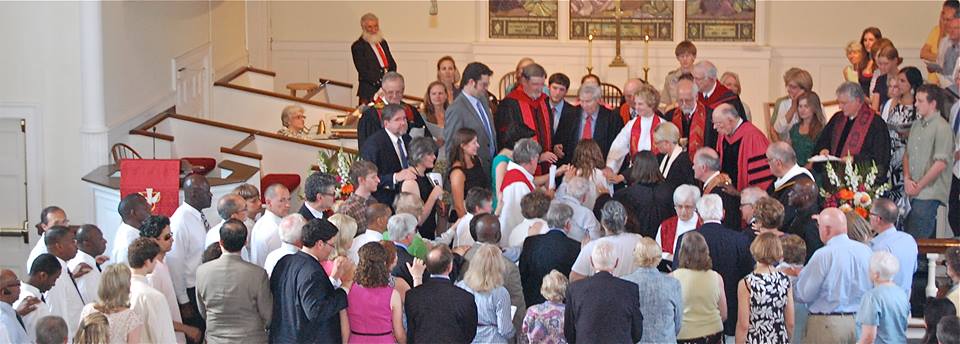
An Ordination Sermon: The Secret Sauce of Ministry. A Recipe in Two Parts

Laying on of hands

The Secret Sauce of Ministry
A Recipe in Two Parts

Hebrews 12:1-2
Philippians 2:1-11

As some of you know I like to cook. This time of year, when the weather gets fine, I fire up my grill and do some grilling and barbecuing. And I love to sit on my back porch near the grill with a cold beverage and read cookbooks, of which I have many, or as Martha would say, “too many.”

Many of these grilling and barbecuing books contain recipes for a “secret sauce.” I have been noticing lately that the term “secret sauce” has migrated from its culinary context and is now being employed as a metaphor for that special something that makes things work properly.

For example, I recently heard a journalist talking about “the secret sauce” that would create “a grand bargain” to overcome the Congressional budget impasse. Good luck with that.

So I started to wonder, “ What’s the secret sauce of ministry?”  If I had to come up with a simple recipe for what makes ministry faithful and effective what would it be?

So here’s my recipe, which comes in two parts, which I hope you will take away with you today for your own ministry, whether lay or ordained.

1. The first part of the secret sauce is this: You can’t do it alone. Rebecca couldn’t have come to this day alone, and she can’t do her ministry alone. No one does it alone.

How does one come to know God? And to love God? And to want to serve God?

When I look out at this congregation I see so many here today who have helped to shape and influence Rebecca. I am reminded of the scripture from Hebrews we just heard that says we are “surrounded by a great cloud of witnesses.” The image is from the ancient stadium where the races were held, and the cloud of witnesses are the spectators who cheer the racers on.

This great crowd includes both the living and the dead, “the church militant” and “the church triumphant.”

So among the crowd present in the congregation today are many members of Rebecca’s family, let’s call them “the crowd of the proud.”

In addition to Martha and myself, are Rebecca’s brother Andrew and his wife, Jessica. Rebecca’s maternal grandparents, Art and Marianne Talis, are here. As are several assorted aunties, an uncle, and a cousin.

These family members represent a great line going back through generations of Talises and Beers, Floyds and Laffoons, and, let me tell you, there is a lot of church in these families.

We represent a great ecumenical melting pot, from the Greek Orthodox faith of Rebecca’s grandfather’s forbears, to the German Protestantism of her grandmother.

My mother’s father, Bill Laffoon, a descendant of French Huguenots, was a deacon at his Congregational Church in Wichita, Kansas. His schooling ended with the 6th grade, but saw to it that his two daughters went to college during the height of the Depression.

Granddaddy read his Bible every day, and his speech was sprinkled with scripture verses.

So when I was growing up my mother also had a scripture for every occasion, I thought she was so wise, she’d say, “Sufficient unto the day is the evil thereof.” And, “Do not cast your pearls before swine.” When I went to seminary I discovered that they weren’t original with my mother, but came from Jesus in the Sermon on the Mount.

Years later, Rebecca had the same experience at Yale when she learned where all my wise sayings came from.

On the other side of the family, I think today also of Martha’s grandmother, Marta Beer, which in our family is a family name and not a beverage. My Martha is named after her. She raised three daughters by herself in wartime Germany, and was another great churchwoman.  How proud she would be.

This rich ecclesiastical family DNA has helped to shape and form Rebecca into a minister. They are all part of this congregation today, a part of the cloud of witnesses.

But there’s more. For as grand as Rebecca’s family legacy of ministry is, and as important as family support and nurture is, family alone cannot make a minister.

And so I look around this room and I see many people from Rebecca’s past, a number of the good people of the First Church of Christ in Pittsfield, where Rebecca was baptized and confirmed. I see some of her Sunday School teachers, youth group leaders, mentors and supporters, who have made the trip down here today from the Berkshires.

And when I look around today I also see many other friends, Pittsfield neighbors, UCC and ecumenical colleagues, and folks from the Berkshire Association, who have been part of Rebecca’s life.

I see some of her Wellesley College roommates up in the balcony. I see Yale classmates and New Haven friends, and, of course, all of you from Green’s Farms Church, members and staff, who have so warmly embraced Rebecca in your community, and are now such an important part of this most recent chapter in her life.

There are others, too, I must mention, who are neither related to Rebecca nor have ever met her, who she knows from the books she loves and the scriptures she studies. Those many other witness, men and women of the church:  prophets, apostles, martyrs, evangelists, theologians, reformers, writers and thinkers down through the ages. They are part of this great crowd, too. They were all witnesses to God, and to God’s vast love for us in Jesus Christ.

So all of you here, and all the unseen but present, make up the great cloud of witnesses, who cheer us all on as we go about our several ministries, and especially cheer Rebecca on today. I thank God, for you and for them.

So to take nothing away from Rebecca, who as you know, is a remarkable young woman and certainly gets much of the credit for us being here today, she hasn’t done it alone. Because this ministry business is a team sport, and I have just described to you just how really big the team is.

Nobody gets to ministry alone, and nobody does ministry alone, because you can’t do it alone.

So that’s the first part of the recipe for the secret sauce of ministry.

2. The second part of the recipe for the secret sauce of ministry is this: It’s not about you. To do ministry in the name of Jesus Christ you have to get out of your own way.

What does this mean? Recall how Jesus was always confusing the disciples by saying things like “the one who would gain his life must lose it.” And “The one who exalts herself will be humbled, but the one who humbles herself will be exalted.”

And the disciples never quite understood what he was trying to teach them until after Easter. Their hopes had been dashed on Good Friday as they fled from him and his cross. But after Easter all those things he said made sense. He was showing them a way, a way of selflessness, of servant-hood, a way to be a person for others.

And recall also how our brother Paul kept writing to churches that were fighting, and saying in one form or another, “It’s not about you!”

To the Corinthians he wrote, “What we preach is not ourselves, but Jesus Christ as Lord and ourselves as your servants for Jesus’ sake (2 Cor. 4,5). And a couple of lines later in that same letter he wrote them, “We have this treasure in earthen vessels to show that the transcendent power belongs to God and not to us.” (2 Cor. 4:7).

What was he trying to tell them about ministry? That “it’s not about you.” To be a minister you have to get out of your own way. And the reason that you have to get out of your own way is first to make space for God to work in and through you. And you have to get out of your own way, secondly, to make space for the other, the ones you minister to.

I was with Mary Luti at a meeting the week before last and I told her how excited I was that she would be laying holy hands on Rebecca and doing the prayer of ordination today. I said to Mary, “It is so fitting because it was under your ministry that Rebecca started discerning her call.”

And Mary demurred and said, “I really didn’t do that much.” And I thought she was just being humble. But as I started pondering the recipe for the secret sauce of ministry, I realized she was quite right.

And you know why she was right? Because it wasn’t Mary who called Rebecca into the ministry. Mary was just doing her job, which is how ministry works. Rebecca was a questioning young woman in a pew in Cambridge, and Mary was doing her job, which was to share the God she knows and loves. And Rebecca was in the right time and the right place with the right person, and God’s Holy Spirit works like that, in what seems mundane, but can at the same time be quite marvelous.

Our society cultivates a cult of personality, a cult of celebrity, but ministry is not about that. There are celebrity ministers, but the good ones, the faithful ones, know it is not about them.

The word minister actually means one who represents another. The Europeans use it this way in describing their government officials: the minister for finance, or the foreign minister. These are the ones who represent the government in their particular area of expertise

Likewise, a Christian minister is one who represents Jesus Christ. And representing Jesus Christ means taking the form of a servant. Jesus once told his disciples, “Whoever would be great among you must be your servant, and whoever would be first among you must be your slave; even as the Son of man came not to be served, but to serve, and to give his life as a ransom for many.” (Mt 20:25-28.)

Not to be ministered to, but to minister. Not to be served but to serve.

This is counter-cultural in our self-obsessed society. To tell people to get out of their own way for God and for others is not a particularly popular philosophy today. When I peruse the magazines at the super-market checkout there are titles such as Self, Us, People (meaning famous self-absorbed people) but I don’t see Servant or Ministry magazine.

There was a fascinating interview with director Sofia Coppola in last Sunday’s New York Times about her new movie, The Bling Ring. The movie is based on a true story about five teenagers from the San Fernando Valley in California, who were so obsessed with the culture of personality and the trappings of celebrity that they started breaking into celebrity’s homes and stealing stuff.

They would often just walk in through an unlocked front door, or climb in an open window. They robbed people like Lindsay Lohan and Paris Hilton.

In the course of a nine-month spree they looted more than 3 million dollars worth of jewelry and designer clothes. I found the story shocking, but part of it got me chuckling to myself. Apparently they broke into Paris Hilton’s home six times before she even noticed. “She had so much stuff that it took awhile for her to realize someone had broken in.”

Have you seen the bumper sticker that says, “The one who dies with the most stuff wins?” A better, truer one would say, “The one who dies with the most stuff dies.”

Sofia Coppola said she chose this subject for her movie because she has two small daughters, and she fears for them growing up in this glittery world of celebrity culture, a culture that sends the message that it really is all about you and your stuff. She describes hearing some of her daughter’s 6 year-old friends talking about what they wanted to be when they grew up, and a couple of them said, “I want to be famous.” She asks, “Where does that come from?” I don’t think we knew about that when we were six years old.”

And that is a challenge for ministry these days. I am particularly thinking of parents and youth ministers. How do we raise our children in a society that tells them it really is all about us?

When we were driving through the countryside in France we would sometimes see vast fields of sunflowers as far as the eye could see. The sunflowers would be facing East toward the rising sun in the morning, and as the sun moved through the sky the sunflowers would turn toward it, so that at dusk they would have turned completely toward the West. In fact the French world for sunflower is tournesol, which literally means “turn to the sun.”

Sunflowers do this because they are heliotropic; they need the sun to live. By analogy, we are theotropic, we need God to live, and we are made to bend our love toward God and others. But we too often bend our love toward ourselves, and that is where we get in trouble, for instead of living for God and others we try to love ourselves and control things as if we were God.

And that is what is so beautiful about our second reading today from Philippians; it turns the equation entirely upside down. God in Christ bends toward us, and shows us what love looks like.

The late British theologian Colin Gunton said,

 Sin is for the creature to think and act as if it were the creator. But here in Philippians 2 Jesus is godlike precisely in going the other way.

Here Jesus empties himself even of his divinity to become a servant, “a man for others” as Dietrich Bonheoffer described him.

And it is this humility, this self-emptying, this relinquishing of privilege, that Paul wants the church in Philippi to emulate. He writes them to “let the same mind be among you that was in Christ Jesus.”

The church in Philippi was having one of those squabbles that have been known to happen in congregations, even in our own time. Paul admonishes them to get out of their own way, and have the very same mindset as Jesus, the mindset that led him to empty himself, and in humility take the form of a servant, the mindset that ultimately led to his death on the cross.

But it’s not so easy to have the same mindset as Jesus. Remember those WWJD bracelets, that stood for “what would Jesus do?” Some people criticized those WWJD bracelets for being overly simplistic. Because asking, “What would Jesus do? doesn’t really solve the problem. It usually isn’t that hard to know what Jesus would do. People talk about the hard passages in the Bible, and there are some, but the parts that really challenge and convict me aren’t the parts I don’t understand, but the parts I do. “Love your enemies.” “Feed the hungry.” “Welcome the stranger.”  “Share your possessions.” “Turn the other cheek.” “Take up your cross and follow me.” Just to name a few.

So the hard part, after you figure out what Jesus would do, is doing it.

To “practice what we preach,” to “walk the walk as well as talk the talk” is where we pretty consistently fail, and why we need grace and forgiveness to keep trying. And the good news is that is exactly what we get from our God, grace and forgiveness.

In the cross of Jesus Christ, God does for us what we cannot do for ourselves, and saves us from ourselves, among other things, such as sin and death.

All ministers, you and me, lay or ordained, even Rebecca, fail at being consistently Christ-like. But the wisest ministers know that our ministry is at its most faithful when we realize that it is not about us, when we get out of our own way, as Jesus did, to be a servant, as he was a servant, to serve as he served, to love as he loved, and to be a person for others.

And here’s the beautiful thing: if you follow this recipe you don’t really lose yourself at all, you will actually find yourself. Only the empty can be filled with the new life God wants for us. Jesus said, “I came that you might have life, and have it in abundance.” (John 10:10)

Because this self- emptying doesn’t mean we lose our personalities or our personal identities. On the contrary, when our love bends toward God and others, as those sunflowers bend toward the sun, when we lose ourselves in service, when we live for others, we are most ourselves, our own true best selves as God intended us to be.

Just as Jesus’ exalted lordship is ultimately revealed in his humble servant-hood.

Let us listen to it again:

“Let the same mind be in you that was in Christ Jesus,

who, though he was in the form of God,

did not regard equality with God

as something to be exploited,

but emptied himself,

taking the form of a servant

being born in human likeness.

And being found in human form,

he humbled himself

and became obedient to the point of death—

even death on a cross.

Therefore God also highly exalted him

and gave him the name

that is above every name,

so that at the name of Jesus

every knee should bend,

in heaven and on earth and under the earth,

and every tongue should confess

that Jesus Christ is Lord,

to the glory of God the Father.”

And let the people say: Amen.

I preached this sermon at the Ordination of my daughter, Rebecca Megan Floyd, on June 9, 2013, at the Green’s Farms Congregational Church, UCC, in Westport, Connecticut.

Unknown's avatar

Roast Pork Loin a la Nottingham Drive

Pork roast


So my local grocery store had a sale on whole and half pork loins, and I thought what a great item for the rotisserie on my grill for Memorial Day weekend. But then the weather got weird, so I roasted this one inside in the oven, and I commend it to you.

I used convection roast, and if you have that capability I recommend it, but this will work fine in a conventional oven.

Recipe

For the rub:

2 tsp. ground thyme or thyme leaves

1 tsp. allspice

1 tsp. ground cloves

1 tsp. cinnamon

1 tsp. nutmeg

1 tsp.paprika

Salt and pepper to taste.

The meat:

1 3-4 lb. boneless or 4-5 lb. bone-in pork loin roast.

How to do it:

Mix the spices together, and rub generously over the roast. Preheat oven to 425 degrees. Place the roast fat side up on a broiling pan (you are not going to broil it, but the broiling pan will keep the juices and fat from splattering better than an open roasting pan) Score the top of the roast with a sharp knife with shallow 1/2 inch diagonal cuts.

Place the roast in the oven (if using convection roast on the bottom rack, if not in the bottom third of the oven). Cook at 425 for 15 minutes, and then reset the oven to 325 degrees. Cook to an internal temperature of 145 (if you like some pink) to 150 degrees (if you don’t) and let sit for 10 minutes before carving. Cut in straight thin slices like a jelly roll.

Serve with baked beans and applesauce. We had a lovely Portuguese Dao with it, but any light red will do.

Enjoy.


Unknown's avatar

Clergy evaluation committees and why they are a bad idea

multiple fingers pointing blame at man

Every relationship needs thoughtful reflection and mutual careful feedback, and the relationship between a clergy person and a congregation is no different from any other in this respect. But stand-alone committees formed only for the purpose of evaluating clergy are a bad idea. I call such a committee a posse, by analogy with those hastily gathered bands of citizens that helped the sheriff look for the fleeing miscreants in old Westerns.

Most clergy have existing structures within which mutual conversation and evaluation can take place. They may be parish councils, diaconates, elders, vestries, consistories, or whatever depending on one’s denomination and its polity. The one thing that separates these from the clergy evaluation committee is that they have other work they do, and collaborate with the clergy person in doing it. Around that work mutual trust is formed, and so the evaluative function is just one of many and not the sole focus of the committee.

I have written elsewhere about the commodification of ministry, and the poor models for ministry that come more and more out of the corporate world with little theological undergirding or even much thought.

It is true that the relationship between the ordained leader of a congregation and that congregation partakes of some of the same dynamics as a business relationship, accountability, transparency, trust, but at its best is more like a marriage than a job. As in a marriage there is an “us-ness” about the enterprise, the old word is covenant, and the relationship is characterized by mutuality, forgiveness, affection, and grace. You don’t work for each other but with each other.

So the clergy evaluation committee, the posse, invites trouble because it has no other function than to criticize the clergy person, and, as we all know, an “idle mind is the Devil’s playground.”

If there is nothing for them to do things will find them. In any congregation there are disgruntled people, and a constant stream of criticism is corrosive to clergy morale and not helpful in assessing what is really going on in the congregation. Thus begins what I call “death by a thousand cuts.” The posse is a bad model. It just is.

By way of illustration, try setting up an evaluation committee for your spouse and let me know how that works out for you.

A better model is to let the appropriate body, which shouldn’t be too big, have regular mutual conversations about what each party needs more or less of to make the congregation and its leader flourish. Then the focus is off real and imagined wrongs and shortcomings, and on the task of assessing the mission and ministry of the congregation.

The very worst model is when the posse gets formed to address “a crisis” with the clergy person. This is usually the beginning of the end of the relationship, and often signals that they want you gone, but are too ashamed of their part in the dysfunction to tell you the truth. The signs of this are demands for micro-bookkeeping, and regular “progress” reports. It is akin to getting to the marriage counselor so late that the only task left is amicable divorce.

If you see this beginning to happen to you, a new committee forming to “help” you, please protest right away and find a better model. Because (Floyd’s axiom): Once the posse gets formed, you will never outrun them.

Unknown's avatar

Problems Facing the Idea of Substitutionary Atonement

Anselm(On St Anselm of Canterbury’s feast day I thought I would honor him by addressing some of the issues that have troubled people about various “theories” of substitutionary atonement. Anselm himself is often blamed for views he never held. This article is excerpted from an essay which was later included, in an edited form, in my book on atonement, When I Survey the Wondrous Cross: Reflections on the Atonement. Wipf and Stock, 2010}

Even if one accepts that the interpretation of Christ’s death as a substitutionary atonement is thoroughly biblical, there remain any number of problems and objections to understanding it this way, especially if one is putting forth a view that claims for the cross both objective divine activity and universal implications for human salvation. I turn to the following works which lay out some of the criticisms of substitutionary atonement theories:  Vernon White, Atonement and Incarnation: An Essay in Universalism and Particularity, (Cambridge: Cambridge University Press, 1991) Gerald O’Collins, The Calvary Christ (London:  SCM Press, 1977), especially Chapter VI, Atonement for All, and Richard Bauckham, “Criticisms of Penal Substitution”(unpublished paper, no date).

A theology that claims that universal reconciliation came about through an historically particular event  or person faces many difficulties from outside as well as from within the Christian faith.  The expanded view of the universe in the Twentieth Century makes the universal claims of the Christ event incredible to many people. Widespread travel and world-wide communications make religious pluralism a fact of modern life and put a human face on the previously abstract “unsaved heathen” (now our neighbors) of former centuries.  In addition, the conceptual difficulties of ideas like atonement and incarnation puts pressure from within theology to abandon its traditional claims. The tendency in much recent theology is to solve these problems and objections by giving ground on both objectivity and universality. These theologies counter the outside pressures facing atonement by proposing that atonement is merely illustrative of rather than constitutive for salvation, and that salvation is particular and limited rather than universal in scope.  White summarizes from Maurice Wiles The Remaking of Christian Doctrine to give a typical example of a theology that has  responded to these pressures:

 (Wiles) proposes that there need be no more to the meaning of the passion of Christ than the following: first, a revelation of the character of God; secondly, an historical phenomenon effective in the transformation of people’s lives.  Thus he has no wish to deny that it concerns only the comparatively small proportion of mankind which has heard of and responded to the preaching of the cross; to claim anything more would be “chasing a will o’the whisp”. (White, p 3)

White himself offers an atonement theory that attempts to preserve objectivity  on God’s part and the universal implications of God’s act by using the language of recreation  rather than retribution. White wants to answer the modern objection to a theology that claims universal implications from a particular event.  He phrases the question he wants to answer thus:  “What is it about any particular act that could constitute possibilities for the effectiveness of every other act the agent untertakes in relation to other agents throughout time and space?” He rightly notes that such a form safeguards both the universality of divine action and the uniqueness of the particular event.  (p 52)  As White’s title implies, it is an incarnational Christology that provides the locus for divine activity with universal human implications. To support his view he points to Paul’s soteriology, expressed in terms such as “one , in “one spirit”, “Christ’s” and “in Christ”, referring to E.P. Sanders recent work on participation in Pauline atonement theory. (p 58)

White draws attention also to C.F.D. Moule’s writings on corporate personality  and to the Patristic idea of recapitulation as articulated by Irenaeus, where Christ is understood to be the representative of the whole human race. (p  `59) White’s soteriology here hangs on his Christology: “It requires that the man Jesus and the eternal God share a common personal identity, as subject of the same incarnational experiences.” He sees that “the life, death and resurrection of Jesus Christ constitute a particular experience for God which is then offered throughout all time and space with the potential to “save” all peoples. (p 87) The cross then, as here construed,  is primarily an event in God’s “life” and only secondarily an act in history. That lack of historical grounding shows elsewhere in White’s essay, as for example, in the implications of his theory for personal faith and for the church, which seem strangely irrelevant. Since his position needs no human agency (such as the church) to witness to the Christ event, which seems to have accomplished all that is necessary  in eternity, he avoids any charge of religious imperialism in the face of the world religions. To his credit he holds fast to the two elements that one wants in an atonement  doctrine, objectivity and universalism, and tries to deal with the pressures facing atonement from the modern world.

But these more general pressures on theology from the corrosive effects of the “acids of modernity” are not the only  objections faced by an atonement doctrine. There are objections from within theology as well.  There are any number of ways to organize these.  Gerald O’Collins, for example, summarizes these objections in three categories:  (1) God misrepresented,  (2) Christ misrepresented, (3) mankind misrepresented.  Let us look at each in turn: (1)  O’Collins wants to distance himself from atonement views in which God’s character or nature is misrepresented. For example, some articulations of the atonement  can too easily  speak of God as a vindictive punisher. For O’Collins, Christ death on the cross is better understood as retributive suffering freely undertaken for others rather than punishment imposed by God as a substitute for guilty humanity. (2)  Similarly, O’Collins thinks Christ is misrepresented by substitution language which inclines toward the impersonal and lacks the intentionality of the language of “representation.”

Representation implies conscious acceptance by free moral agents on both sides. He also wants to carefully limit the way we talk of sacrifice, avoiding talk of an expiatory sacrifice that propitiates the anger of God and wins forgiveness for humankind. He admits that Paul uses sacrificial language (as in 1 Cor. 5:7;11:25; Romans 3:24f) but  claims that Paul doesn’t make much of it as either an expiatory sacrifice or as a sacrifice that brings a new covenant with God. The reason for this reluctance is because Paul see God as the initiator of the Christ event. It was God who “put forward” his Son to expiate human sins and usher in the “new covenant.” Once we see the crucifixion as an act of God toward mankind, we can hardly turn round and speak of God sacrificing to himself.  Likewise, any stress on Calvary’s consequences “for us” tends to exclude the theme if its consequences “for God” and hence its sacrificial quality.  Paul knows the cross to be an effect of God’s saving will,  not  its cause.  And that belief restrains the apostle’s readiness to proclaim Good Friday as an atoning sacrifice which establishes a new relationship between God and Man.. (O’Collins, p 108) Paul’s understanding of Christ’s role in the crucifixion  includes both obedience to the Father and suffering undertaken for humankind.  In two senses, then, he acted as our representative, becoming obedient unto death (Philippians 2:8) and dying for us (Galatians 3:13). (p 108-109) (3) Finally, O’Collins wants to avoid articulations of the atonement  in which mankind is misrepresented in regard to human involvement.  He asks, “Does belief in atonement (i) fail to produce a sense of commitment and (ii) suggest a world that smells of masochism?” (p 109)  These are in fact opposite problems. In the first, believers in atonement reverently refer to amends made in the past by Christ and become complacent about the world around them, and in the second case, a neurotic preoccupation with self-inflicted suffering is fostered.  This latter is similar to the criticisms of the cross offered by some feminists, that it fosters a victim mentality among those already prone to victimization.  While admitting that atonement theories can go wildly astray, O’Collins concludes that

. . . a healthy atonement theology invites well-founded action and acceptance.  Just as the reconciliation and liberation brought by Christ impels believers to act in genuinely reconciling and liberating ways, so the atonement he made on our behalf should alert us to our responsibility for the good state of the moral order.  (p 109)

While O’Collins’ caveat about the language of substitution is a good one in the light of the many impersonal and mechanical atonement theories that have been proposed, and his highlighting of the language of representation reminds us of important and often neglected dimensions of Christ’s solidarity and identification with us and his freely-chosen way of obedience, I am not persuaded that we can dispense with substitution language altogether. Christ’s death is a death for us and does for us what we cannot do for ourselves. That is substitution. Representation adds some important notes, but it cannot carry the whole melody.

Likewise, O’Collins’ warnings about expiation are helpful in protecting against a notion that Jesus was sacrificed to the Father in some way , yet again I think expiation language is biblical and retains a place in any doctrine of atonement as  long as we keep in view O’Collins’ reminder that God is the initiator and not the vindictive punisher whose anger gets assuaged by the act. I wonder too about O’Collins’ statement, “Paul knows the cross to be an effect of God’s saving will and not its cause.” On one hand, that is right, that the cross can be seen in retrospect to be entirely consistent with God’s nature and character as seen throughout the biblical narrative to that point. On the other hand, to speak of the cross as an “effect” of God’s saving will could be construed to support an illustrative soteriology rather than one in which the cross is understood as constitutive for salvation. Richard Bauckham’s paper outlines the four classical criticisms of the doctrine of penal substitutionary atonement as put forward by Socinus (Fausto Sozzini, 1539-1604), who was criticising the logic of the Reformers. The four criticisms are (1) Satisfaction and forgiveness are incompatible, (2)  Substitution is unjust, (3) Christ’s sufferings are not equivalent to the punishment that sinners deserve, (4) Substitution fosters antinomianism.

Bauckham notes that Socinus makes his criticisms apart from the context of the Reformer’s theologies and that he neglects two significant aspects of the Reformers views of the atonement, (a) that the work of Christ is not the activity of a third party, but rather the divine Son of God become man, who has come into the world to do the Father’s will for human salvation, and (b) that the purpose of the atonement was not merely to save sinners, but to reconcile them to God.  He then discusses each criticism in reverse order. (4)  Substitution ought to lead to antinomianism.

Bauckham notes that this charge ignores (b) above, that the atonement puts sinners into relationship with God, thereby not leaving them unchanged. Such criticisms stem from a moralistic misunderstanding of Christianity. We do not first need to be good, we need first to be in a right relationship with God. (3) Christ’s sufferings are not equivalent to the punishment required.  Bauckham concedes that this charge is unanswerable, that attempts to answer it have failed in the past, and that if anything like penal substitution is to be retained it must be shown that this quantifying of amounts of punishment is unnecessary. (2)  Substitution is unjust. Socinus says that substitution is doubly unjust in that the guilty party goes unpunished, and an innocent party is punished undeservedly. Socinus did not believe in the incarnation, but according to it, it is not that God spares sinners and inflicts their penalty on an innocent third party, but rather in Christ, God himself takes on the suffering instead of inflicting it on sinful humanity. This answers Socinus’ charge about punishing the innocent, but leaves the charge that the guilty go unpunished. Some sort of articulation of Christ’s identification or solidarity with the sinner goes part way to meeting this objection and most atonement theories have elements of this in them, but by the standards of human law courts to which Socinus refers, these motifs of identification cannot be strong enough to fully overcome his criticism.

Bauckham refers to  Wolfhart Pannenburg’s defence of this criticism where he charges Socinus with excessive ethical individualism. Bauckham goes on to illustrate this point by drawing an analogy from human courts of law. We can see in the criminal justice system, for example, how the punishment of an individual in some very real way punishes their family. In some cases this shared suffering, through active sympathy, might even be considered a kind of vicarious suffering of punishment that we could consider to not be unjust. This is outside the competence of the courts, of course, where “each person must bear the penalty he deserves” is the proper ideal for administering justice. But in real life the interdependence of humanity is such that the innocent do as a matter of fact suffer for the crimes of others. Though sometimes we see this as evil and seek to prevent it as far as possible, in other cases we applaud it. The cases in which we applaud it are those of voluntary fellow-suffering in love. We recognise at this point that love goes beyond the ethical individualism in which the courts must largely deal, and that the vicarious suffering of love may and can go beyond the ethical individualism of the courts because it corresponds more fully to the reality of human life and relationships than the justice of the courts is able to do. (p 8) To speak of Christ bearing our punishment is only possible because God in Christ goes beyond the justice of human law courts. Since Socinus’ criticism stays within the analogy of human courts, those theories of atonement that have accepted that framework are most vulnerable to his criticism. But if God’s justice in the cross transcends the justice of human law courts than the criticism is avoided.

Bauckham says that he has hinted at how this happens by his description of what he has called “the voluntary fellow-suffering of love.” “God’s love in Christ enables him to accomplish what, as a judge in a human law court, he could not accomplish.” (p 10)  To do this means going beyond the merely retributive understanding of justice which both Socinus and his opponents shared. (1)  Satisfaction and forgiveness are incompatible. Socinus uses the analogy of a debt, where if the debt is paid, the creditor is obliged to renounce any claim on the debtor. Neither mercy nor forgiveness come into play. Again, Socinus takes no account of the incarnation. Since it is not a third party but God himself who pays the debt, he balances the books, so to speak, by paying himself off, at a cost to himself. For Socinus, God is free to do as he wills in response to human sin: justice and mercy are seen as alternatives. Penal substitutionary theory, however, makes two points against this view of God’s freedom:  (a) God is not free without cost to himself, and (b) The cost is necessary because God does not set aside justice when he exercises mercy; rather he forgives in such a way as to satisfy justice. Justice and mercy are not alternatives, and in the cross, God administers both without contradiction.

To sum up, the problems and objections to a substitutionary atonement theory come from both  the outside world of modernity, and from within the theological circle. The former seem either to be conceptual, such as how the particular can impact the universal, or socio-political, such as the “imperialism ” of universal religious claims or the negative impact of such views on victims or on people’s mental health. These outside pressures need to be addressed in formulating an adequate atonement theory, but, in my view, they are not decicisive and must not be allowed to pre-empt the discussion. The modern theologies that have  responded to these external pressures by giving ground on important features of traditional soteriology are uniformly unsatisfactory  and in the end raise as many questions as they answer.

More  challenging, I think, are the criticisms from within the theological circle.  An attempt to make a credible case for an atonement theory that does justice to both the nuances of the biblical narrative and the experience of real people is difficult at best.  Some of the pitfalls we have reviewed are as follows: views of God which are morally offensive, that see him as a vindictive punisher (or, on the other hand, failing to deal with sin and evil, which we did not mention); views which emphasize retributive justice at the expense of other elements; views which emphasize sacrifice so as to imply that  Christ died to propitiate God’s anger;  views which separate God’s justice from God’s mercy; views that are moralistic or legalistic; views in which substitution language is used mechanically and impersonally, neglecting the intentionality of the cross and the dimensions of Christ’s obedience; views which either emphasize the finished nature of atonement so strongly that they invite human moral complacency, or, conversely, views which develop a morbid preoccupation with self-inflicted suffering.   To read this list is to quickly realize that there are partial truths imbedded within all these various misconceptions and distortions.  The complexity of the biblical materials insures that no one theory will be comprehensive.  But  awareness of the problems prepares us for the important task of asking which elements are profitable for a credible atonement theory and which should be avoided.

Unknown's avatar

Advice to Preachers: One Sermon at a Time Please!

pulpit

Has this ever happened to you when you are captive in a pew?

I was at a house of worship not long ago, where the preacher is a long-time friend of mine. I was looking forward to hearing him preach, and I when he started I was pleased with his voice and his manner. He said some wise things and I could feel that he was wrapping up, but then . . . he started on a new tack. He did this three times, and each time I thought he was done. It was a very long sermon; in fact it was three long sermons.

The next day I was at a seminar with a bunch of pastors and I mentioned  the experience to my friend Scott, who provided me with one of my favorite axioms: “If you don’t know what you are doing, you don’t know when you have done it.”

Unknown's avatar

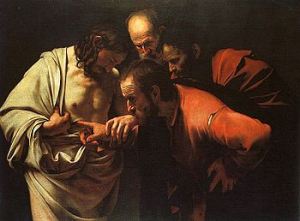
“Behind Locked Doors” A sermon on John 20:24-29

caravaggio_-_the_incredulity_of_saint_thomasThe Second Sunday of Easter, traditionally called “Low Sunday,”  is a tough Sunday for a preacher for a number of reasons.  First of all, the context of our preaching can be a bit discouraging. We have fewer than half the people we had last week, and I always preach better for some reason when there are more people present. It must have something to do with group dynamics. Easter is always a high holy day in the church, a bright and festive day, and though the church in theory believes that Easter lasts for the Great Fifty Days, the second Sunday is, well you know, Low Sunday.  Plus I am always exhausted and worn thin after Easter.  But having said all that let me make a confession: I like low Sunday.

 I like it for two reasons. First, the folks who come on Low Sunday tend to be the faithful core of the congregation and I feel I don’t have to explain so much of the Gospel to you. To use Eugene Peterson’s helpful distinction, on Low Sunday there are more pilgrims and fewer tourists. I say that not to disparage religious tourists, God knows we have all been that at one time or another. God meets us where we are and even spiritual tourists need God’s mercy and love. My point is just that hardly anyone feels a pressing social or cultural need to get up and come to church on Low Sunday, so those who are here tend to be serious about what we are doing here, and I appreciate that, since I am serious about what we are doing here.

But the second and more important reason I like Low Sunday is that it speaks deep truths about how the risen Christ comes to us. Low Sunday is sort of a down and out Sunday, and the Lord Jesus seems to appear especially to the down and out. If you read the stories of the resurrection appearances it is startling that without exception the disciples are doing nothing especially religious when Jesus appears to them. They aren’t praying or worshipping. In Luke they are walking on the road lamenting what had happened, or they are fishing, having given up their discipleship to return to their day job. Here in John’s Gospel on Easter night the disciples are in a locked room, hiding in fear.

And it occurs to me that is the church’s natural state: a bunch of scared people locking out the world. You might argue that the disciples are not yet the church, until Jesus comes to them and gives them the Holy Spirit (John’s version of Pentecost) and you would be right.  The church without the risen Christ and the Holy Spirit is just a bunch of quite literally dispirited people hiding in fear from real and imagined enemies.

And that is one of the reasons I like Low Sunday. The disciples are so obviously failures at being disciples and so they share that in common with us. It’s Easter and they don’t even know it. They have nothing to offer as the church, no vision, no energy, no courage, no conviction. They are hiding. They are afraid. As far as they know Jesus is dead and done. The shepherd has been struck down and the sheep have scattered.

They should have believed the witnesses. Peter and the beloved disciple have been to the empty tomb. They have told the disciples what they have seen. Mary has told them she has seen the Lord. They should have believed, but they didn’t, and yet Jesus still comes to them.

So this isn’t a story about the disciples or doubting Thomas so much as it is a story about Jesus. We always want Jesus to meet us at our best, to help us to improve us, but instead he meets us at our worst, and he doesn’t care about improving us. He comes not to offer improvement, but resurrection. He comes not to bring the world as it is, only “better oiled,” but a new heaven and a new earth.

And so he comes to these dispirited disciples hiding behind locked doors, and he comes to us hiding among our manifold fears and anxieties. He comes among us and finds us worrying about our money and our health and our future, worrying about our image and our reputations. He finds us ready to hide behind locked doors to keep the world out.

He finds us afraid that we will be found out, that it will become known that we are not as courageous, virtuous and committed as we have led people to believe. If people really knew how self-centered and selfish we are; if they only knew that we can be stinkers and schemers, can act dishonorably and shamefully, childishly stubbornly. If they only knew.

But Jesus does know and still he comes among us and stands there with his wounded side and those dreadful broken hands and says “Peace be with you.”  And if that isn’t good news, I don’t know what is.

And then he says something most astonishing: “As the Father has sent me, so I send you.” There must be some mistake. He can’t mean us. We are hiding in fear behind locked doors. But there is no mistake. And this is the beauty of the church. We are the ones he sends, not the virtuous, the strong, the wise, the courageous. No, he wants us, sends us, foolish men and women, and slow of heart to believe.

And Thomas missed it and can’t buy it, can’t believe it. They said, “We have seen the Lord.” But he said to them, “Unless I see the mark of the nails in his hands, and put my finger in  the mark of the nails and my hand in his side, I will not believe.” So there!

And Thomas is the church, too. Practical, not given to flights of fancy or imagination. Thomas is the church in all its stubborn, hard–headed practicality. He had been a disciple, sure, but look what happened to Jesus. It was time to get back to reality, back to basics, back to practicalities. Show me or I won’t believe. And once again the good news of Low Sunday is Jesus comes to Thomas, comes to the church in all shortsightedness, in all its stingy fearfulness, all its ingratitude. Jesus comes and says, you want to see, see, you want to touch, touch.

That’s the beauty of Low Sunday, the real Easter story is not so much last week among the lilies as it is here among the few of us who have gathered to hear how the church began with these fearful disciples.

And if we can dare to believe that God raised Jesus from the dead, can we not dare to believe that he can raise us too, not just when we die or at the resurrection of the last day, but now, raise up a church, a people who on their own are dead or as good as dead, afraid and hiding, but who when he comes among them are raised to life, raised to become the church. To love as he loves, to forgive as he forgives.

On Wednesday I dragged myself to come to church to two committees meetings that met at the same time.  When I came in there was one person at the first meeting, and when I went down the hall there was only one at the other.  There were some important things to be done by each committee, but it was not to be done that night. On the way home I was complaining a little bit to the Lord, and I thought, well, people are busy, and they are volunteers, and its Easter, and finally I said, Lord, if you want something to happen here, you better do it, because we are not up to it on our own. And then I had my sermon. Of course we’re not up to it on our own. What was I thinking? We never have been and we never will be. But still he comes among us, still he sends us, still he calls us to be the church.

And then I had two funerals, one Friday and one yesterday, and at those funerals I saw the faces of the people as I told them the good news of the Resurrection, the good news of the Gospel, the Good news of Easter, and I thought, yes, this is the church. This is why we’re here, this is what we are here to do. To be witnesses to the risen Christ. To tell people he lives, and we can live too with him.

So I may feel a little low this Sunday, and you may feel a little low this Sunday, and this Sunday may feel a little low this Sunday, but the Risen Christ comes to meet us when we’re low, in fact, more likely than when we’re  not, and when he comes he bids us peace and send us out in the power of his resurrection. We’re coming out of our locked doors. We don’t need to hide. There is nothing to fear. Because it may be Low Sunday, but its still Easter.  Amen.

(I preached this sermon on April 30, 2000 at First Church of Christ, Congregational, in Pittsfield, Massachusetts)

(Painting: Caravaggio)

Unknown's avatar

“The Day after Easter”

Easter lamb

 The Day after Easter

Today the tomb is empty, the fridge full:

Rare lamb, green beans, potatoes in plastic bags,

The remains of yesterday’s moveable feast.

When a gathered family, pilgrims and exiles,

Weary from work and travel and churchgoing,

Held hands, gave thanks, tucked into the meal:

Meat and mint jelly, fine red wine, a homemade torte,

And flaky baklava from the St George’s Greek pastry sale.

Glad to be alive, glad to be together,

Glad to celebrate the promise of new life,

And the hope of other such days and such feasts.

Richard L. Floyd, 2013

Unknown's avatar

One of my favorites: “Easter” by Arnold Kenseth

Sunrise

An Easter offering by my late friend and colleague Arnold Kenseth:

“Easter”

On Easter the great tower of me falls.
I had built it well; my mind had planned it
After being schooled; my will had special wit
To dig me deep foundations, solid walls,
Blocks of moral toughness, windows to see
The enemy, the friend; large rooms, I thought
For light; and storey upon storey me
I raised, and famously my fame I sought.
So driven to prove the world with my estate.
I had not heard Christ on Good Friday die,
His body crooked, broke, and all friends fled.
I had not wept his cause in my carouse.
But now bold bells scatter against the sky,
And Christ is shattering my death, my pride;
As walls, blocks, windows, rooms, my silly penthouse
Spill into the dust I am, my narrow fate.
At last set free from virtue, knowledge, strife,
I mourn, then praise my God, and enter life.

(“Easter” by Arnold Kenseth

The Ritual Year, Amherst Writers and Artists Press, 1993)

(Photo by Rebecca M. Floyd)

Unknown's avatar

“I Crucified Thee!” A Sermon for Palm/Passion Sunday

Crucifixion(As we prepare for Holy Week I offer this sermon of mine from 2004, my last year (as it turned out) as pastor at First Church in Pittsfield. Mel Gibson’s controversial film Passion of the Christ had brought the issues of the cross into the public view, and provided an opportunity to address this (quite literally) “crucial” subject.)

“This year  more than other years, there has been interest in the meaning of the passion of Christ because of the new Mel Gibson movie. I am not going to talk about the movie very much since I haven’t seen it. Seth Rogovoy from the Berkshire Eagle asked me to see it and be on a panel, but I said I wasn’t going to see it. But I had read the book!

I haven’t seen it for two reasons. The first is the same reason I have never seen Schindler’s List or Saving Private Ryan. I’m a wimp. I experience film as a powerful medium, and I am emotionally effected by movie violence. Somehow I can deal with battles between hobbits and orcs, but the depiction of historical violence I find very disturbing.

The second reason I haven’t seen it is subtler, and perhaps harder to understand. It is my feeling that there are some things that shouldn’t be put on film, and I personally feel that the death of Jesus is one of them. That may seem hypocritical since I have a reproduction of Matthias Grünwald’s Crucifixion on the wall of my study. Artists have always depicted biblical events. Why not film artists? For me, it is the appearance of reality about film, that “You Were There” quality that makes it so powerful.

I know people who have loved this movie and people who have hated it, people who have felt their life changed by it and people who have walked out of it. I have spoken to people who felt the movie was anti-Semitic and people who didn’t. It seems the movie for some people has served as a kind of cinematic Rorschach test for beliefs people already hold.

However accurate the film is, there is at least one sense in which the movie is not quite biblical, and that is in its detailed depiction of the event. None of the Gospels really describe the crucifixion. There is a restraint about the Gospel accounts, a kind of modesty before the obscenity and horror of the event. Of course, the harsh truth is that none of the Evangelists needed to be told what a crucifixion was like. Whether they wanted to or not most of them had seen crucified slaves along the roads. Tens of thousands of the enemies of Rome, real or perceived, were crucified in the first century AD, so Jesus’ crucifixion was just another one of those.

When the movie came out the cover of Newsweek asked in boldface type: “Who really killed Jesus?” That question arises out of a long and shameful history of Christian anti-Semitism. The foundation of this anti-Semitism has been the attempt to attach historical blame for the crucifixion to the Jews. For centuries in Christian Europe violence toward Jews frequently took place on Good Friday.

We must acknowledge the sad truth that for Jews the cross has been an emblem of persecution just as for Islam it has been an emblem of the Crusades. To admit this is not to apologize for the cross, but it is to apologize for the reprehensible acts that have been done in its name.

The truth is that the responsibility for Jesus’ death lies at the feet of all humankind. That the characters in the Gospel accounts of the Passion were Romans or Jews is incidental to the significance of the cross. We must never forget that Jesus and all his followers were Jewish. Let us remember, too, that “Second Temple Judaism” was not monolithic, but had parties and factions, and some of them were hostile to Jesus.

We do know that crucifixion was never a Jewish method of execution; that would have been death by stoning. A cross was a Roman device, and his executioners were Roman soldiers. So from a strictly historical point of view it must be said that Jesus was the victim of a Roman state execution.

But to the question, “Who killed Jesus? The better answer must be, “I didYou didWe did.”  Which is to say that it was human sin that killed Jesus. He not only died for our sins, he died because of our sins. That is expressed in the second verse of the hymn “Ah, holy Jesus,” which asks:

“Who was the guilty? Who brought this upon thee?

Alas, my treason, Jesus, hath undone thee!

Twas I, Lord Jesus, I it was denied thee;

I crucified thee.”

And the second station of the cross in the Roman Catholic Church prays: “My Jesus, this cross should be mine, not Thine; my sins crucified Thee.”

How can this be? How can a man who died two thousand years ago in Jerusalem have anything to do with me? How can I be guilty? In much the same way church members have sometimes told me that they don’t feel like the confession of sin in our service relates to them. They don’t feel as if they have done any of the things we confess, such as being unjust to their neighbors, or fouling the environment, or what have you.

I try to explain to them that a general confession is just that, general. The prayer speaks for a broader constituency that any of us, or even all of us within the congregation. For when we come before God we don’t come merely as individuals, we come as part of the human family. And as part of the human family we participate in vast social, political and economic networks, many of them unjust and even evil.

Which is to say, that to some extent, we all have blood on our hands, although none of us likes to think about it. In Dostoevsky’s profound novel The Brothers Karamazov, he tells the story of “The Grand Inquisitor.” Christ comes back again to earth, and who he is and what he stands for are too threatening to the status quo for him to be allowed to live. The question is asked, “If Christ walked among us again, would we kill him again?”

John Thomas has written, “Our fingerprints on the nails are easy to overlook, but they are there. Holy Week presses us to see that we too, are violators. Some years ago,” he writes, “I watched a documentary on the Holocaust, titled “Shoah,” which included expected scenes of horror. But for me, the most disturbing portrait of evil was the benign face of an elderly man who had worked for the German state railroad. His job was to issue tickets to Jews forced into cattle cars for transport to the gas chambers. This bewildered-looking man couldn’t comprehend that his bureaucratic job had anything to do with the horror of the Holocaust. He didn’t shoot Jews or toss them in the ovens. He just issued tickets.”  Thomas concludes, “You and I don’t flay the skin off Jesus. But we do issue tickets. Our complicity in evil is real and often profoundly undramatic. Until we face that reality, the Passion is little more than a tragic movie, and we will miss the truth of our own profound need for the redemption of Easter.” (United Church News, April 2004)

But at the foot of the cross we can be set free to recognize ourselves among the guilty. We can identify ourselves among the crowd, both on Palm Sunday when they cried, “Blessed is he who comes in the name of the Lord,” and on Good Friday, when they shouted “Crucify him.” A disappointed angry mob is dangerous, probably not all that different from the crowd that mutilated the bodies of the slain American workers in Fallujah in Iraq this week. Such shameful acts of violence and horror take place all the time, not just in the past, not just “in history.” At the foot of the cross can we acknowledge that even the very best of us bears some resemblance to the worst of us? Can we recognize ourselves as sinners in need of redemption?

Can we put aside the tendency to blame “the other” for human sin and evil? Can we leave behind the need to point an accusing finger at those who are not like us, whether they are poor, or black, or Muslim or Jewish, so that we don’t have to confront our own sin?

This sounds like a grim exercise, but it is a necessary one. Because the Gospel is often bad news before it is able to be Good News. God’s judgment and mercy are two sides of the same coin. And so when we admit our sin, and the sin of the human family of which we are a part, we can then receive the forgiveness God wants for us. At the foot of the cross we can see that Jesus died not only because of our sins, but also for our sins, to take them away and free us for new life with him and for each other.

And this is only possible because Jesus’ death is not just any death. No, the incredible claim we make is that “In Christ, God was reconciling the world to himself.” If Jesus had been just another man, even a very good man, then he is, at best, an example to us of the power of sacrifice, and, at worst, just another martyr to human violence. Then his death is merely a tragedy. Because suffering is never, in and of itself, redemptive. Just ask anyone who suffers. To believe otherwise is masochism.

But why is his death redemptive? Why is Jesus’ death different from all the other tragic deaths in history? Why is his death different from all the other men who ended up on Roman crosses? The answer is not that he suffered more. Others have suffered more, even at the hand of Christians.

So what is it that makes his death different, and makes his cross not a symbol of shame, but a symbol of faith? The full story will be told next Sunday on Easter. It is the resurrection that makes the difference. It is the resurrection that transforms the cross from an emblem of horror into an emblem of God’s wondrous love.

To the eyes of Easter faith the bitter cross is viewed as an act of Israel’s God, consistent with who God had been in the past, a God who rescues and saves, who liberates and reconciles. So the cross is transformed into an atoning, redeeming, reconciling divine act of grace. God in Jesus Christ gives up his life in humble obedience. He takes our sin and the judgment that goes with it and puts it to death on the cross with himself. That is how the cross becomes the symbol of Christian faith, not as a way to blame others for sin, but to admit our own sin and marvel at the lengths that God will go to take it away.

If you want to know what God is like, look to Jesus, and him crucified! There you will see the very nature of God. As C. S. Dinsmore once wrote, “There was a cross in the heart of God before there was one planted on the green hill outside Jerusalem.”

The cross tells us that God’s grace is bigger than our sin. The extent of that love should humble us. As Isaac Watts penned, “When I survey the wondrous cross, on which the prince of glory died, my richest gain, I count but loss, and pour contempt on all my pride.”

That is what the cross stands for, the vast love of God, and our humble contrition before it when we consider the weight of our now-forgiven sins. To turn the cross into a symbol of Christian triumphalism, or of a Crusade, or of persecution is to betray its meaning. To make the cross an emblem of hate like the twisted crosses of Nazism or the Ku Klux Klan is to crucify Christ all over again.

But to admit “I crucified Thee” is not an empty pious gesture. Nor is it mere breast-beating. It is an honest admission of our need to have our sins forgiven, and not only ours but the sins of the whole world, our need to be reconciled to God and to our neighbors. The Good News that we preach is that God has already accomplished this for us through the cross. We need only take what he gives us, and we will find that when we turn to him, he is already coming to meet us.

So let us come to his table today in humility and contrition as those who need forgiveness, as those who need God’s grace.  And let us find in him, whose body was broken for us, and whose blood was shed for us, both bread for the journey and food for eternal life.  Amen.

(I preached this sermon on Palm/Passion Sunday, April 4, 2004 at First Church of Christ, Congregational in Pittsfield, Massachusetts)

(Painting: “Crucifixion” by Matthias Grunewald)