Unknown's avatar

“He will come like child.” Rowan Williams’ “Advent Calendar”

Last fall's leaf

I have long been an admirer of the estimable Rowan Williams, the 104th archbishop of Canterbury, since the time I saw him give an awkward, brilliant, and humble paper in 1989 in Oxford. Since then I have read with profit his thoughtful theological books and essays. But I just learned that he also has written poetry. I came across this fine Advent poem today. It is from his first collection of poems: After Silent Centuries (Oxford, 1994), and is now available in The Poems of Rowan Williams’ (Oxford, 2002 and Grand Rapids MI, 2004).

Advent Calendar

He will come like last leaf’s fall.
One night when the November wind
has flayed the trees to the bone, and earth
wakes choking on the mould,
the soft shroud’s folding.

He will come like frost.
One morning when the shrinking earth
opens on mist, to find itself
arrested in the net
of alien, sword-set beauty.

He will come like dark.
One evening when the bursting red
December sun draws up the sheet
and penny-masks its eye to yield
the star-snowed fields of sky.

He will come, will come,
will come like crying in the night,
like blood, like breaking,
as the earth writhes to toss him free.
He will come like child.

© Rowan Williams

(Photo by R. L. Floyd, 2015, “Autumn leaf after the rainstorm,” Ashuwillticook  Rail Trail, Lanesborough, MA.)

Unknown's avatar

“Lost in Wonder, Love, and Praise”

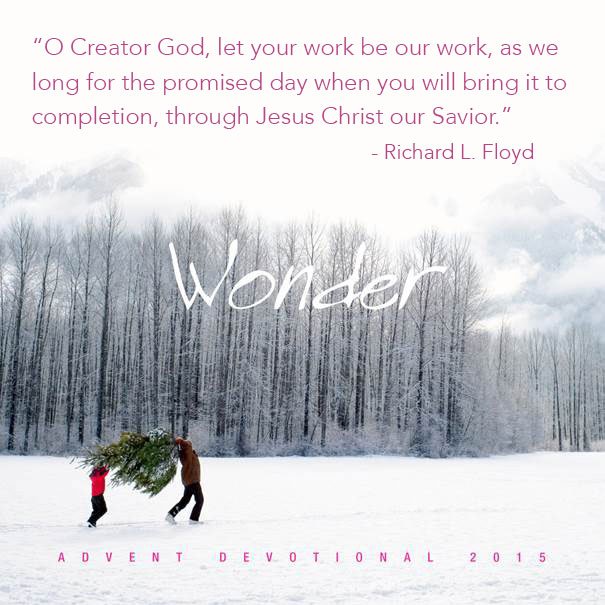
Wonder

“Finish, then, Thy new creation!”

“We know that the whole creation has been groaning in labor pains until now; and not only the creation, but we ourselves, who have the first fruits of the Spirit, groan inwardly while we wait for adoption, the redemption of our bodies.”— Romans 8: 22-23

The Advent hope recognizes that there is something unfinished about God’s creation. In today’s passage Paul employs the metaphor of childbirth, the “whole creation groaning in labor pains,” to describe the ongoing process of creation.

Our United Church of Christ Statement of Faith testifies to the two calls of God, the original creation (‘God calls the worlds into being”), and the new creation in Jesus Christ (“God calls us into the church”).

It is humbling to imagine that we have some part to play in the completion of God’s work, in our lives, in our communities, and on this earth we share with all God’s other creatures.

The Advent hope invites us to actively share in the reconciling, restoring, healing and saving activity of the living God. Such hope points to a promised future when the whole creation will finally be completed, a vision captured by the last verse of the great Charles Wesley hymn, “Love Divine, All Loves Excelling:”

“Finish, then, Thy new creation;

Pure and spotless let us be.

Let us see Thy great salvation

Perfectly restored in Thee;

Changed from glory into glory,

Till in Heav’n we take our place,

Till we cast our crowns before Thee,

Lost in wonder, love, and praise.”

Prayer: O Creator God, let your work be our work, as we long for the promised day when you will bring it to completion, through Jesus Christ our Savior. Amen.

(This is my devotional for today from “Wonder” the 2015 Advent Devotional from the United Church of Christ’s Stillspeaking Writers’ Group. Photo: The Pilgrim Press, 2015)


Unknown's avatar

Ruminations on Advent

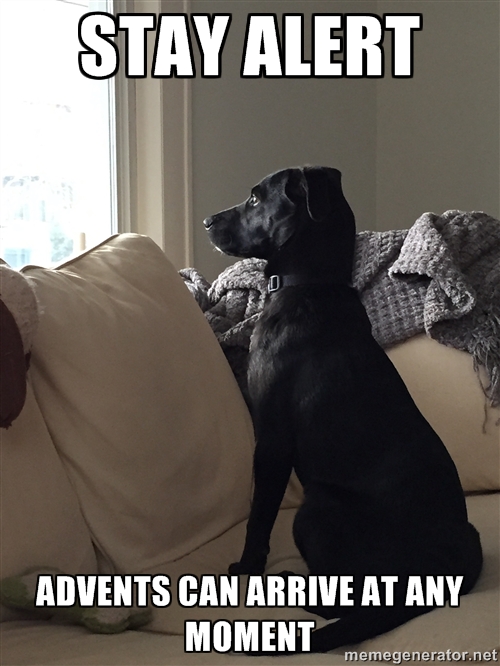
Advent dog

“There is something beautiful and mysterious about Advent, but there is, at the same time, something unsettling, darkly anxious, almost threatening about it. The Advent mood is hard to put into words. It is often captured better by its hymns, which are often dark and brooding, sung in a minor key.

The scripture lessons for Advent set the tone with their continued prophetic calls for repentance, the dire warnings to “wait and watch,” the urgency of preparation for what is coming. We hear about those who are unprepared for God, tenants who are surprised by the sudden appearance of their long-absent landlord, sleepy bridesmaids waiting with their empty oil-lamps for the bridegroom to come.” (Excerpt from “Rejoice! Rejoice! A Sermon for the Third Sunday of Advent”)

Over the years I have posted many of my Advent rumination and reflections. I have gathered up some of them here:

The Christmas Tree in the Passing Lane

“A Chorus of Trees” (Video)

Anticipation: A Sermon for the First Sunday of Advent

Rejoice! Rejoice! A Sermon for the Third Sunday of Advent

“God With Us” A Sermon for the Fourth Sunday of Advent

And here is the hymn I wrote for Advent in 2000, after 9/11:

“In Such Sad Times We Look Ahead” A Hymn for Advent

(Photo by R.L. Floyd, 2014. The dog is Onyx, our grand-dog.)

Unknown's avatar

“A Chorus of Trees”

“Then shall all the trees of the forest sing for joy before the Lord; for he is coming” –Psalm 96: 12, 13.

“What are these excitable trees singing and clapping about? They are celebrating the coming of God, a coming worth getting excited about, full of promise for the restoration, judging, cleansing and healing of all things. And this coming will not be only for people and nations, but for all that belongs to the Creator, “the whole earth and everything in it. Which means that our Advent hope for the coming of God is not a private “spiritual” matter, but a hope of quite cosmic proportions.” (From “Tear Open the Heavens” Advent Devotion 2014. The United Church of Christ)

This devotional of mine for December 22  from the UCC Advent Devotionals was made into a very moving YOUTUBE video. Thanks to Katherine Schofield for this. I tried to put the eschatology back into Advent, and I think she captured it.

Unknown's avatar

The Christmas Tree in the Passing Lane: A Reflection on Advent

winter scene 3

On Saturday we drove home from my brother’s house in Maine where we had celebrated Thanksgiving with our family, or at least the part of it that could make it this year.

It was a calm and friendly few days. We ate some turkey and tucked into various lovely pies. There were numerous board games that lasted into the wee hours, and, yes (I won’t deny it) we watched a football game or two.

It had snowed enough during Wednesday’s storm that we were able to do some good snowshoeing on Friday at a local forest preserve. All in all, it was a good Thanksgiving.

I was especially aware that this year we had much to be thankful for. Somehow “the simple fact of being together made the time holy.” (From my Daily Devotional for Thanksgiving, to read it all go here.)

I often find the season from Thanksgiving to the New Year to be a wistful and bittersweet time. When I was a young minister I became aware what a sad time it was for many of my older congregants, who remembered happier, healthier times, when they and their families were young.

I understand that better now, as my own children are grown, and many of the original participants in my early holiday memories are gone.

The church is often wiser than we are in how it marks the time. A good example of this is the season of Advent, which captures the mood of the darkening days with its texts of waiting and hoping and its hymns in minor keys.

The expectation that the holidays will be better and brighter than our ordinary time can be a burden that weighs us down. I think some of the excessive consumerism we see this time of year is our attempt to keep the long dark days at bay. But there are some things money can’t buy, even at full price, such as health and wholeness, faith, hope and love.

On the way home the day was sunny with a high blue sky, and the traffic on the Maine Turnpike wasn’t nearly as heavy as on the way up in the storm.

As we crossed the river into New Hampshire, there was a freshly cut Christmas tree in the middle of the left-hand lane that had fallen off the roof of someone’s car. It made me suddenly sad, December sad. It must be time for Advent, I thought, and the next day it was.

Good, I thought, I need a little Advent.


(Photo by R. L. Floyd. “Black Brook Preserve, Windham Maine Land Trust.”)

Unknown's avatar

“Rejoice! Rejoice!” A Sermon for the Third Sunday of Advent

There is something beautiful and mysterious about Advent, but there is, at the same time, something unsettling, darkly anxious, almost threatening about it. The Advent mood is hard to put into words. It is often captured better by its hymns, which are often dark and brooding, sung in a minor key.

The scripture lessons for Advent set the tone with their continued prophetic calls for repentance, the dire warnings to “wait and watch,” the urgency of preparation for what is coming. We hear about those who are unprepared for God, tenants who are surprised by the sudden appearance of their long-absent landlord, sleepy bridesmaids waiting with their empty oil-lamps for the bridegroom to come.

In short, it’s an expectant season, a season of being primed and pumped, and there is a nervous edge to the waiting. Lauren Winner, in her charming book Girl Meets God says of Advent, “The waiting is meant to be a little anxious. I picture Jane Austen heroines. They never are quite sure that their intended will come.”

But the Advent mood undergoes a dramatic change today, on this Third Sunday of Advent. The lessons lose their menace and begin to dance a bit. Suddenly, the warnings turn into promises. We hear of deserts blossoming, the seas exulting, and the trees of the field clapping their hands, so that if there were one word to capture the new mood it would have to be joy!

Traditionally this Third Sunday of Advent is called Gaudete Sunday, from the Latin for joy, and it is a day for rejoicing.

But perhaps some of you don’t feel like rejoicing. Perhaps your own mood is more like the rest of Advent, darker, more anxious, somewhat unsettled, for any number of reasons, not least of which might be the state of the world.

The news of the world is always a distressed word, a word full of sadness and anger, a word tinged with fear and heavy with regret. Perhaps that is why the darker mood of the Advent season speaks to us at times more authentically than its more joyous mood. Because the news of the world in which we live is so often itself such a dark unsettled word.

Whether we recognize it or not we come to church to hear a counter-Word. We come burdened by our occupations and pre-occupations, weighed down by both the demands of daily living and the larger societal and global worries that clamor for our attention. We often think we have things pretty much figured out, but there are nagging areas of uncertainty about our fate and future.

We come perhaps unsure how reliable even the words we hear in church might be. The New Yorker last week had a cartoon in which a man is shaking hands with a minister at the door of a church.  “Good sermon, Reverend,” he says, “but that God stuff is pretty far-fetched.”

Yes, it is. To the ears of the world the Good News often sounds like too-good-to be-true news. And a weekly hour’s religious interlude away from the world’s worries may not be enough to get us ready for rejoicing.

Nevertheless, on this Third Sunday in Advent we are admonished to rejoice. And in its wisdom the church has placed this rejoicing season in the midst of the heavier Advent mood, has placed today’s major key joyfulness amid the plaintive longing of the rest of the season, whose words are not words of hope and promise so much as words of warning, dire words that leave us judged.

And you can see the transition in today’s Old Testament lesson, which starts out in the usual Advent minor key in the first chapters.

But then listen to these words from Chapter three:
“Sing aloud, O daughter Zion;

“Shout, O Israel!
“Rejoice and exult with all your heart,

O daughter Jerusalem!

The Lord has taken away the judgments against you . . .

“The Lord your God is in your midst,

“He will rejoice over you with gladness

“He will renew you in his love;

“He will exult over you with loud singing as on a day of festival.”

So how does the story get from Chapter 1 to Chapter 3, from judgment to mercy; from wrath to tender forgiveness; from fear to rejoicing, from death to life?

The answer is that the God who comes to be our judge is the same God who comes to be our Savior. This is what holds the waiting and rejoicing moods of Advent together.

God has taken the sentence that we deserve and has taken it upon himself. In Christ our judgment has been removed and the enemy has been turned away at the gates. We can rejoice as prisoners who have received a stay of execution. The Good News is like a governor’s pardon that arrives by the last post.

Such a reprieve is cause for rejoicing. Those who would have been given over to death by the word of the law are now brought to life by the life-giving word of the Gospel. God turns our death into life, our shame into praise. No wonder St. Paul commands us to rejoice!

But the rejoicing is not just on our part. We are not the only ones rejoicing this Advent. God rejoices along with those whose sentence he has overturned. Even God sings,

Because God is a lover and invites us to love him in return. The Christian story is above all a love story. It is not about something called religion, but it is all about the love God has for us. God wants us for himself. He wants us as lovers. This is the God who heals and saves, the God who gives meaning and hope to the downcast and new life to the dead. This is God, the Father of our Lord Jesus Christ and our Father, the God worth waiting for, and working for, and praying to and rejoicing with.

This is the God that our ancestors have worshipped in this building since 1853 and in two previous meetinghouses on this site going back to 1764. This is the God we pray will bring many to himself in this place in the years to come, so that in this place 150 years from now people, will hear the Good News of his love.

And so we rejoice and sing.

The Reverend Dr. Richard L. Floyd.
A sermon given at First Church of Christ in Pittsfield, Massachusetts on
December 14, 2003.