Unknown's avatar

What if we had to choose a former Red Sox Pitcher to be our Senator?

In yesterday’s post I gave the definitive reasons why Curt Schilling will not be Senator from Massachusetts. But it got me thinking. What if our next United States Senator had to come from the ranks of former Red Sox pitchers?

To start you can just eliminate some guys. There are certain Sox pitchers, mostly relievers, that just have no chance with the electorate: B.K. Kim, Calvin Schiraldi, Mike Torrez (remember Bucky Dent? I do, I was there!), Curtis Leskanic, “Heathcliff” Slocum are just a few of the many that spring to mind. There are just too many painful memories there.

And when I think back on the starters it doesn’t get much better, because the Red Sox management in my early years of fandom believed you could win pennants by stacking the line-up with hitters and pretty much let the pitching take care of itself. They were wrong. So there are guys from that era that did a pretty good job, but just don’t have that much name-recognition anymore like Dave Morehead, Dick Drago, Reggie Cleveland, Rick Wise, “Oil Can Boyd,” Roger Moret, and Bruce Hurst.

And we can’t count pitchers who came to us late in their careers, but made their reputations in other towns. Tom Seaver is a Met, Frank Tanana is an Angel, Bret Saberhagen is a Royal, Mike Boddicker is an Oriole, and Frank Viola is a Twin. They may have played for the Red Sox, but it’s just not their team.

So who else is there? Let us think big. When you think of iconic Red Sox pitchers the first name that comes to mind is Cy Young. He has great name recognition, with the eponymous award and all, but he died in 1955, and nobody except Strom Thurmond ever served in the Senate when he was dead, and Thurmond was alive when he was first elected, so that rules out Cy Young. Same thing for Babe Ruth; sorry Babe, most folks don’t even remember that you were once a pitcher, and a good one at that. Actually, most people don’t remember that you ever played for the Red Sox, but we don’t want to get into that.

There are some other high name-recognition guys, but they all have fatal flaws. Jim Lonborg, the star of the 1967 Series (although we lost) is probably not remembered by the younger generation. Besides, he went to Tufts Dental School and became a dentist after retiring, and why be a Senator when you can be a dentist; the pay is better.

Roger Clemens was once very popular with the voters, I mean fans, but now is universally scorned in New England for committing the unpardonable sin, and I don’t mean the doping. And he is so from Texas.

Pedro Martinez was about as good as it gets for several years with the Sox. The dominant (and Dominican) was 117-37 (not a missprint) for his career with them, although marred by the infamous Grady Little 100 pitch non-decision. The non-citizen thing might be a problem, plus going to New York (even if it was to the Mets).

The next name that comes to mind is Luis Tiant, who for many years of my fandom was the only decent Red Sox pitcher we had. In 1966 he pitched four straight shut-out victories, one of only five pitchers to do that. “El Tiante” has some valuable gifts for the Senate. For one thing he can look one way and pitch the other.

Tiant is personable, wise, and colorful, although sometimes I have trouble understanding what he is saying, but that shouldn’t really be a problem in the Senate. Besides, he has a new documentary about him just out called Lost Son of Havana, which would give him a quick media bump. He actually lives in Massachusetts, and I think he is a citizen, which is a plus. If not, he was born in Havana in 1940 (more or less) before the revolution, and we pretty much owned Cuba then, so I’m sure with a little paperwork from the State Department it could be worked out. People here love him. So he’s a possibility.

guy that would probably make a good senator is Bill Lee. The former left-handed pitcher, nicknamed “Spaceman,” is articulate and has outspoken views on most subjects. He once said

his marijuana use allowed him to jog to work at Fenway Park without being bothered by the bus fumes. He also said that since the right hemisphere of the brain controls the left side of the body, and the left hemisphere of the brain controls the right side of the body, only left-handed people are in their right minds. Sounds good to me, but I’m right-handed, so what do I know. But the downside for Bill is that he isn’t a resident of Massachusetts (he has a lumber company in Vermont), and his appearances on Charlie Moore’s NESN fishing show looking like the Unabomber might scare away some voters.

So that leaves me with the last, best, obvious choice. Yes, you guessed it, Dennis Eckersley! Hall of Famer Eck had two smoking seasons with the Red Sox in 1978 (20 wins) and 1979 (17 wins), but then, frankly, he was pretty bad until he left in 1984 when he was traded for Bill Buckner (Oh, the irony!).

Eck never really had it again as a starter, but in 1987 he got traded to the Oakland Athletics and Manager Tony La Russa used him as a long reliever. When closer Jay Howell became injured Eck filled in and never looked back. He won the AL Cy Young award as a reliever in 1992 as well as the MVP. He ended his career with 390 saves and went straight to the Hall of Fame. Most Sox fans forget how bad he was here toward the end, and those like me who remember have forgiven him long ago. So we can all feel good about this extraordinary Red Sox reliever who is in the Hall of Fame, even though he wasn’t a reliever for the Red Sox. Eckersley is the final proof that F. Scott Fitzgerald was wrong when he said, “There are no second acts in American lives.”

Today as a commentator for NESN Eck is extremely popular with the fans, and he even lives in Massachusetts (although he is such a California dude). He is smart, funny and articulate. He does have his own unique lingo and likes to coin new words or use old ones in new ways. He coined the term “walk-off home run” after Kirk Gibson victimized him in the 1988 World Series.

I can imagine him in the Senate kibitzing with Al Franken, saying something like, “Wow, that new Senate Environmental Bill is hard cheese with hair on it!” It’s true that he might not want the job, or move to Washington, since it would cut into his golf time, but it never hurts to ask. People should approach him and see if he is interested.

If we have to have a Former Red Sox pitcher for United States Senator I vote for Eck.

Unknown's avatar

Senator Curt Schilling? I Don’t Think So.

Former Red Sox pitcher Curt Schilling told the New England Cable Network that he had been contacted by people seeking to recruit him to enter the race to fill the vacant Massachusetts senate seat to succeed the late Senator Edward Kennedy, and that he hadn’t ruled out the possibility.

Now I truly admire Curt Schilling, and will never forget his performance in game 6 of the 2004 ALCS against the New York Yankees, when his victory forced a game 7, allowing the Red Sox to become the first team in history to come back from a 0-3 deficit, and go to their first World Series since 1986. This was the first “bloody sock” game; the second was in game 2 of the World Series, which Schilling also won, and the Red Sox went on to win their first World Series since 1918. So Schilling is much beloved by Red Sox fans here in New England, and much admired for his charity work, but he will never be senator and here’s why:

  1. He has no political experience. Now one might argue the case that this is an asset, but one would be wrong.
  2. He isn’t really from Masschusetts. He was born in Alaska, and grew up in Arizona, where he attended college. He considers the Pittsburgh area to be home. There have been other carpetbaggers with state flags of convenience; Robert Kennedy and Hillary Clinton both became senator in New York on slender evidence of residency, but this isn’t New York.
  3. He doesn’t have a college degree. In Massachusetts that matters.
  4. He is known for being something of a hothead and shooting off his mouth, which can be entertaining from an entertainer, but disastrous for a politician. He admitted as much yesterday, saying, “That is probably another one of the reasons why I wouldn’t make a good political candidate right now is that there is an enormous amount of house cleaning that has to be done and I don’t have a really good filter,” Schilling said. “My first press conference could be my last.”
  5. He has spent much of his public career sparring with the press. The war of words has been fun to follow, but journalists have long memories. He has publicly called Boston Globe sports columnist Dan Shaughnessy a “tool,” a “hack” and an “idiot.” And these are just the ones I can print in a family blog like this. I’m actually not a big Shaughnesssy fan myself, so I find these amusing, but they won’t help Curt run for office. The Boston media would have a field day with him in the run-up to an election.
  6. There is still some resentment against him among some fans for his last year with the Red Sox in 2008 when he squabbled with management, and never threw a pitch.
  7. His views are pretty conservative. Ours aren’t.
  8. He can’t legally run as a Republican. He says he’s registered as an Independent. In Massachussetts law one must be registerd in the party for 90 days before the November 3 deadline. He doesn’t have 90 days. He would have to run as an Independent.
It’s just not going to happen.
Unknown's avatar

September Signals a New Chapter

Something about the beginning of September makes me feel like starting a new chapter. Perhaps it’s all those years of getting a new blank notebook to begin the school year. It’s been many a year since I went back to school, but old habits die hard.

The weather here in New England changed this past week. We’ve had a miserable summer, rainy and humid, by turns too cold and too hot, but always damp and sticky. Now the air is dry and the sky is high and blue, and it is cool enough to work outdoors without losing your weight in sweat. I trimmed my hedges today and hardly worked up a sweat. Perhaps the change in the weather sets off some internal clock, like a migrating bird, that says it’s time for a new chapter.

For me September is the real beginning of a new year. It marks the end of summer and the approaching Fall. It marks time like a turning hinge, from then to now, and from now to what now?

This cool weather reminds me of a September day twenty-seven years ago in 1982. We lived in Maine, 20 minutes outside of Bangor on a 100-acre farm. We had a new baby, born July 22, our first child, Andrew, and we were in transition. I was about to take a new job and we would soon be moving to a new state. I had accepted a call from a search committee, but hadn’t been voted on by the congregation yet. That would take place on September 12 down in Massachusetts. These votes usually work out, but New England Congregationalists take their prerogatives pretty seriously, so it was by no means pro forma. I was still working at my old job, although I can’t say my heart was fully in it.

It was Labor Day weekend, and my Dad and his wife Virginia (my mother died in 1967) had come up from New York City to see the new grandchild (my Dad’s second, but first in almost a decade. His first one was Adam and he asked me dryly, as only Larry Floyd could, if the family was working their way alphabetically through a Biblical Concordance).

The weather was bright and cool like it is today. We were all having a good time, still in summer vacation mode, and a new baby is a great distraction from whatever else might be vexing you. We went down the road to the next small town to eat, nothing fancy, but good Maine summer fare: steamers, lobster, sugar and butter corn, blueberry pie.

Driving home in the dark I noticed a spectacular display of the Northern Lights, so when we arrived we took our flashlights and some lawn-chairs, and went out behind the barn (to escape the inevitable big rural floodlight our landlord had on the front of the barn.)

We sat silently in the dark and watched this extraordinary display of God’s grandeur. I have never seen anything like it, before or since. Martha quietly nursed our new baby. I took it all in, the sky, my family, my wife and new son, my Dad and his wonderful wife. Life was good if a bit uncertain. There was a new ministry ahead, a new town, a new house, a new chapter.

That day was a hinge time. God is good to us to let us live and enjoy the moments we have. This was one of them, and the change in the September weather always reminds me of it.

It was my Dad’s last September for he died the next July. These rare moments we are given when life seems especially good are to be embraced and remembered. Like this great September weather they only last so long.

Unknown's avatar

Chef Hats off to Julie and Julia!

If you haven’t seen the film Julie and Julia yet you must.By now you probably know that it is based on two books, My Life in France (which I have read) by Julia Child and her nephew, and Julie/Julia (which I have not), by Julie Powell that grew out of a blog by Powell in 2002, in which she attempted to cook every recipe in Child’s iconic Mastering the Art of French Cooking in a year.Both books are getting a bump from the movie and are on the NYTimes best seller list.

The film interweaves the two stories, and although some critics have a point that the Childs’ sections overshadow the Powell sections, the result is engaging and lots of fun.The incomparable Meryll Streep once again demonstrates her powers as a conjurer by becoming Julia Child, the lilting voice, the stoop ofa too-tall woman, the goofy charm, it’s all there and it is something to behold.Stanley Tucci is wonderful as her husband Paul, and the chemistry between these two is terrific to watch.Would that any of us could have that much fun together

Of course, the real star of this movie is the food, as you see Julia and Paul eat their way through France, and Julie (played capably by charming Amy Adams), cooking her way through Mastering the Art of French Cooking in her upstairs apartment over a pizza parlor. The movie gets a little overly mystical for my tastes about Julie’s imagined bond with Julia, but after a year of cooking her recipes Julie is entitled to be a little off balanced.

So this one goes on my list of other favorite foodie movies with Eat, Drink, Man, Woman; Like Water for Chocolate; Babette’s Feast; and Tampopo. Foodie friends tell me I must see Big Night and it’s on my list.

Yesterday I pulled my copy of Mastering the Art of French Cooking off the cookbook bookcase and noticed it is a first edition. It was given to me by my late Aunt Tia (Grace Louise Forster, aka Brownie Boghosian). It is a Book Club edition, so I am pretty sure she got it from The Book of the Month Club.I have both volumes with their dust jackets and they are in pretty good shape, since Tia didn’t cook very much and was pretty neat when she did (like my mom she was a librarian.) I, on the other hand, who also take good care of my books but give cookbooks a big exemption, have left pinot noir stains on both the Boeuf Bourguignon and the Coq au Vin (photo below) pages.

In addition to these two provincial classics, I have made Julia’s Cassoulet, and all three of these dishes are delicious, labor intensive, time consuming, and laden with butter. The Cassoulet takes several days to digest,

Julia’s later book, The Way to Cook, has simplified recipes, but loses some of the joi de vivre (along with the butter) of the original.I have made her “Zinfandel of Beef,” an updated and simplified Boeuf Bourguignon, and it is delicious, but not nearly as sumptious as the original, in which you braise onions and mushrooms separately and add them to the final dish at the end.

In today’s NYTimes Book Review Mastering the Art of French Cooking is now number one on the Hardcover Advice and How-To List, which means it will be taking up space on many a kitchen bookshelf for years to come.For those who actually open it and try to cook from it be warned. It is a great cookbook and deserves its reputation, but Julia was not fooling around.

The movie makes Julie’s attempt to cook all the recipes seem pretty grueling, but I suspect the reality was even more daunting.These recipes take time, thought, care, attention, good ingredients and love.There are no shortcuts.They yield wonderful results.

And in many ways Mastering is an artifact from another age.It is not only French cooking made accessible for Americans, it is French cooking from 1960. A lot has changed since then, and even the French don’t cook this way much anymore.

But it is still wonderful, so hats off to Julia for being Julia, and also to Julie for sparking a new interest for another generation in this great cuisine and the oversized personality that brought it to America.

(all photos: R.L. Floyd)

Unknown's avatar

Where I Ruminate on My Experience of the British National Health Service

One of the many inflammatory charges that frequently gets tossed into the current health care reform conversation is how bad nationalized health care systems are.

I have recently read an interview with David Sedaris (very funny, of course) about having kidney stone attacks in New York and Paris and comparing the two experiences (and costs.) And author Sara Paretsky, creator of fictional detective V.I. Warshawski, had a piece in the New York Times Magazine about taking her husband to the emergency room in France with chest pains. Both Sedaris and Paretsky agree that the French hospital experience is bureaucratic, but also effective, and above all, cheap.

“I can’t speak to the subject, since I have always been healthy when in France (I suspect it’s all the wine and cheese), but I have been ill while in Britain, and have first-hand (although somewhat dated) experience with the British National Health Service

My family and I have lived in Britain for extended periods of time on three occasions during sabbaticals. My first one was in Oxford, and my children were almost 5 and almost 7 when we got there. Our doctor was Dr. Shakespeare (I’m not making this up) in Summertown, and he ran a clean efficient surgery that adequately took care of our medical needs for the months we were there. Medications, such as antibiotics for a child’s earache, came from the neighborhood chemist. Both the visit and the prescriptions were free, thanks to the NHS. We were resident aliens, but we received care with no questions asked. Sometimes we had to wait, a situation not unknown in America.

On one of the children’s mid-term holidays, we left Oxford and traveled, along with Martha’s sister Andrea, to the Cornwall coast. We stayed in the charming fishing village of Mousehole (pronounced Mowz-uhl) at a guesthouse called “The Lobster Pot.”

I awoke one morning with a sore throat and a slight temperature. We were slated to go down the coast to see St. Michaels Mount, a part-time island with a picturesque priory on it that sits just off the coast in the English Channel. I decide to tough it out, but inquired from our host where I might get medical care if I needed it. She told me that there was a medical group in the village of Marazion, on the mainland, just across from the island.

By the time we got to Marazion I was feeling pretty feverish, so I had Martha drop me off at the medical group while the rest of the party went to see the island. I waited for about a half hour for my turn to go to the window. The friendly receptionist asked me my address, and I explained that I lived in Oxford, but was on holiday in Cornwall. “Where are you staying?” she inquired. I told her I was at “The Lobster Pot” in Mousehole, and she said, “Then you must go to Penzance for care, you are not in our district.” I don’t know if it was the fever or the reference to Penzance, but the conversation did seem to have a Gilbert and Sullivan feel about it.

So, having been denied, I left and walked across the causeway to the Island (you can only do this at low tide) found my family, and spent several hours huddled on a stone bench in a shady spot burning with fever. In due time we found the doctor’s office in Penzance, waited a reasonable amount of time, and I saw the doctor, who, now that I think about, it looked a lot like Hugh Laurie, the British actor who plays Dr. House, in the TV show “House”.He asked me where I was from, and I told him Oxford. “Ah,” he said, “the city of dreaming spires.” He looked in my ears and throat, listened to my chest, took my temperature and sent me to the chemist next door to get some antibiotics, which did the trick in a day or two. All at no cost.

So I draw no big conclusions from my tale except to say I always felt welcome as a visitor in Britain, and it always felt like the right thing to do to provide health care for everybody.I’ll let the experts work out the details, but I am really hoping we can do that here.

Unknown's avatar

Eugene Peterson on Spirituality

I always gain some insight when I read Eugene Peterson, the pastor scholar who created The Message, a fresh contemporary paraphrase of the Bible. Peterson’s own immersion in the Biblical texts makes him refreshingly immune to the seductions of the culture, and I find him telling hard and graceful truths that both evangelicals and mainliners seldom hear because of their mutual commitment to the fratricidal Christian culture wars. Peterson is not ashamed to call himself an evangelical, yet he served as pastor to a mainline Presbyterian Church for many years. In a 2005 interview with Mark Galli for Christianity Today (“Spirituality for all the Wrong Reasons”), Peterson challenges the American tendency to see spirituality chiefly in terms of personal growth and relational intimacy.

Galli queried him on this: “Yet evangelicals rightly tell people they can have a ‘personal relationship with God.’ That suggests a certain type of spiritual intimacy.”

Peterson responded: “All these words get so screwed up in our society. If intimacy means being open and honest and authentic, so I don’t have veils, or I don’t have to be defensive or in denial of who I am, that’s wonderful. But in our culture, intimacy usually has sexual connotations, with some kind of completion. So I want intimacy because I want more out of life. Very seldom does it have the sense of sacrifice or giving or being vulnerable. Those are two different ways of being intimate. And in our American vocabulary intimacy usually has to do with getting something from the other. That just screws the whole thing up. It’s very dangerous to use the language of the culture to interpret the gospel. Our vocabulary has to be chastened and tested by revelation, by the Scriptures. We’ve got a pretty good vocabulary and syntax, and we’d better start paying attention to it because the way we grab words here and there to appeal to unbelievers is not very good.”

I’ve been watching Mad Men, a TV show about Madison Avenue advertising men in 1960. It is a very cynical show, but captures some of the manufactured quality of American culture, which relies on superficial images to sell products. Part of the climate for this to be effective is what might be called historical amnesia for what has come before. It is always change that is sold (even, perhaps especially, in politics). As Peterson wisely points out, the church has “a pretty good vocabulary and syntax” rooted in Scripture and long generations of rich tradition. Sadly, we in the church too often jettison this grammar for the grammar of the culture, which is typically ephemeral.

I think that one of the reasons Martin Luther King was so compelling was the way he employed the sacred vocabulary during the civil rights movement to speak to a great public moral issue. Folks in the black churches in America were acquainted with this vocabulary, because it had been preserved in their churches. But suddenly it spoke to us all with great power.

We have rich traditions of spirituality in the church, but we tend to ignore them and look elsewhere for wisdom about it, often to a faux Eastern spirituality made for America. What Peterson articulates so well is that when spirituality becomes unmoored from the grammar of faith it becomes vacuous, just another consumer product sold to us to enhance our quality of life. As he puts it: “It’s very dangerous to use the language of the culture to interpret the gospel.”

Unknown's avatar

Where I Ruminate on the Joy of a Good Witty Quote


I am a collector of witty and pithy quotes, epigrams, aphorisms, and one-liners. This hobby is an occupational hazard for a preacher, but I took to it long before I ever went to seminary. Being theologically educated gave me a huge stock of quotes from sacred Scripture, only to discover, as my Dad once said about Shakespeare’s plays, “It’s just a bunch of well-known sayings strung together.

For fun I sometimes browse through one of my several editions of Bartlett’s Familiar Quotations.

One of my early influences may have been Yankee catcher Yogi Berra, whose penchant for unintended (or is it?) paradox makes him a master of this genre.Some of my favorite Yogisms: “If you come to a fork in the road, take it,”“You can observe a lot by watching, ” and “Nobody goes there anymore; it’s too crowded.”Of course, like Samuel Johnson, Mark Twain, and the prolific Anonymous, Yogi may be credited with things he actually never said.Or as he, himself, once admitted, “I didn’t really say everything I said.”

Yogi learned from Casey Stengel, the long-time manager of the Yankees, who had some pretty quotable lines himself, such as “Don’t cut my throat, I may want to do that later myself,” and the immortal, “Being with a woman all night never hurt no professional baseball player. It’s staying up all night looking for a woman that does him in.”

Sometimes a phrase captures the humor or irony in a situation better than a full-blown description.When I started my first ministry in a city after being a country parson, I had several seasons of being taken advantage of by various professional indigents before I learned how to screen them properly. If one of them caught me in a generous mood, I could count on seeing three of his colleagues the next day with equally pressing needs. I came home one night, and my wife inquired about my day and my ministry, and I said,in frustration, “No good deed goes unpunished.”I just Googled that to find that it is attributed to Clare Booth Luce, but like many of these, it was floating around in the ether.

Here are some other favorites of mine:

Oscar Wilde, “I can resist anything but temptation,” and “America is the only country that went from barbarism to decadence without civilization in between.”

Dorothy Parker:“If you want to know what God thinks about money, just look at the people he gave it to,” and “Brevity is the soul of lingerie.”

Mark Twain, “A banker is a fellow who lends you his umbrella when the sun is shining, but wants it back when it begins to rain,” and “Wagner’s music is better than it sounds.”

James Thurber, “Why do you have to be a nonconformist like everybody else,” and “He knows all about art, but he doesn’t know what he likes.”

Woody Allen: “Not only is there no God, but try getting a plumber on weekends,” and “I was thrown out of college for cheating on my metaphysics exam; I looked into the soul of the boy sitting next to me.”

Groucho Marx, “Outside of a dog, a book is a man’s best friend. Inside of a dog it’s too dark to read,” and “I don’t want to belong to a club that will accept me as a member.”

Steven Wright:“You can’t have everything.Besides, where would you put it?” and “Everywhere is within walking distance if you have the time.”

Well, I could, and usually do, go on, but I’ll end with one from the ever-quotable Dr. Samuel Johnson, who once wrote, “Every quotation contributes something to the stability or enlargement of the language.”

Unknown's avatar

On Hearing John Updike’s “Voice” for the First Time

I get my copy of the New Yorker magazine second-hand from a friend, so I receive a pile of them at a time, and work my way through them. This means there is sometimes a lag of a month or more between when they come out and when I get them, and some of the matters being explored therein have lost their sheen. I actually like this since it provides a filter for the ephemeral, and reminds me how much of what passes for information is really just entertainment.

So it was that I came to read a review of a book about writer John Cheever, one of my favorites, by John Updike, another of my favorites. The review was published on March 9, but Updike had died on January 27, and it occurred to me that this might be the last time I would hear Updike’s voice from the pages of the New Yorker, where a good many, perhaps most, of his short stories were first published.

Updike’s voice and I go way back. There are writers who seem to have always been part of one’s life, but I can pinpoint exactly when I read my first Updike. It was the summer of 1966, just about this time of year in the dog days of August. “The Summer of Love” was still a year away, but it was my summer of love, in that I was seventeen-years old and had my first real girlfriend. It was an exhilarating as well as a painfully troubled time in my life, for in addition to all the usual struggles of adolescence my mother was dying of cancer, which provided the emotional backdrop for this heady summer.

My girlfriend’s family was moving to California in September, and they were slated to go on a two-week vacation in August on their boat, which was a 42-foot Hatteras power yacht. Believing (mistakenly, it turned out) that she couldn’t live without me for two weeks, she persuaded her parents to invite me to join the family on their vacation, and I persuaded my parents to let me go. I think they thought it might be a break from the emotional heavy-lifting going on at home.

So I got to go on this amazing trip. We launched from the boat’s dock on the Hudson, and went into the East River by the Spuyten Duyvil, and eventually into Long Island Sound toward New England. We docked the first night in Old Saybrook, Connecticut, later to Watch Hill, Rhode Island, and eventually we made our way to the island of Nantucket, my first time in Massachusetts, where I have lived for the better part of my life (mostly at the other end, in the Berkshires). I daily saw beautiful sights on land and sea.

My parents were culturally rich, but financially, not so much. My mother was a school librarian, and my father was trying to keep his small business from failing. This meant that the family had a somewhat tenuous finger-hold on the middle class, and vacations on a yacht didn’t feature in the family profile

This, then, was quite an opportunity for me, but the high life became short-lived when a confusing combination of youthful indiscretion and parental misunderstanding led to the decision that I was to be sent home

So I found myself on the dock of the White Elephant Yacht Club in Nantucket on the phone to home. My parents were not at home, but my younger brother Bill, then twelve, was, and I delivered him the message that I was flying in from Nantucket to La Guardia Airport and needed to be picked up. I told him the flight number and my time of arrival, said my goodbyes to the stormy vacationers, and left by cab for the Nantucket Airport. From there I experienced my first airplane flight, a rather bumpy short ride in a prop plane.

I arrived in New York, and waited in the terminal to be picked-up. It takes over an hour from where we lived in Bergen County, New Jersey, to get to La Guardia, so I was prepared to wait for awhile.

So there I was, a seventeen year-old kid from the suburbs, sitting in a busy New York airport, full of turbulent thoughts and emotions. I had just been on this dream vacation, and it was suddenly over. I had been voted off the boat, and now would have to explain that to my parents, who had enough to worry about without worrying about me. My girlfriend was moving away, and I would probably never see her again. My mother was sick and dying. I was starting my senior year and had no idea what I wanted to do, or where or whether I wanted to go to college. And it was beginning to seem like I had been in the airport a really long time. I tried calling home again, but this time there was no answer, so I figured maybe they were on their way (can you remember before cell phones?).

I left my reverie, found a bathroom, and noticed a store in the terminal. This was in the days before elaborate airport bookstores, but along with the candy and magazines was a circular wire rack display of paperback trade books. I perused the possible selections, and decided on two. One was a selection of short crime fiction by Eric Ambler, the name of which I have forgotten long ago, and the other was The Same Door by John Updike, the first collection of his short stories.

I don’t know why I chose Updike. I’m guessing I sized it up as serious, and God knows I wanted some of that in my life right then. I think I started with an Ambler story. Then I moved on to the Updike, and heard that voice for the first time.

How would I describe that voice? There was a fluency in his words that immediately brought you into a world so richly described that you could inhabit it for a time. His people weren’t heroic or engaged in grand escapades, but like me, were worried and sad and preoccupied with the scuffles of life, with sex and death and religion and all the other challenges of living.

I think I read them all. In any case I called home again and this time got through to discover that my brother’s message that I was coming home had been lacking in specificity, and so I waited another hour, maybe five or six in all, until my Dad came and got me. He didn’t seem particularly upset or even that interested in my story, which was a relief.

The summer ended, my life moved on, my girlfriend moved away, I went off to college, and my mother died. A decade later I was a pastor in rural Maine, and a friend (a different one) started bringing me his castaway New Yorkers. I have been regularly hearing that Updike voice all these years, through the novels and reviews, the poetry and the stories, above all, the stories. It became for me the voice of a particularly intelligent and insightful friend. I am going to miss it.

Unknown's avatar

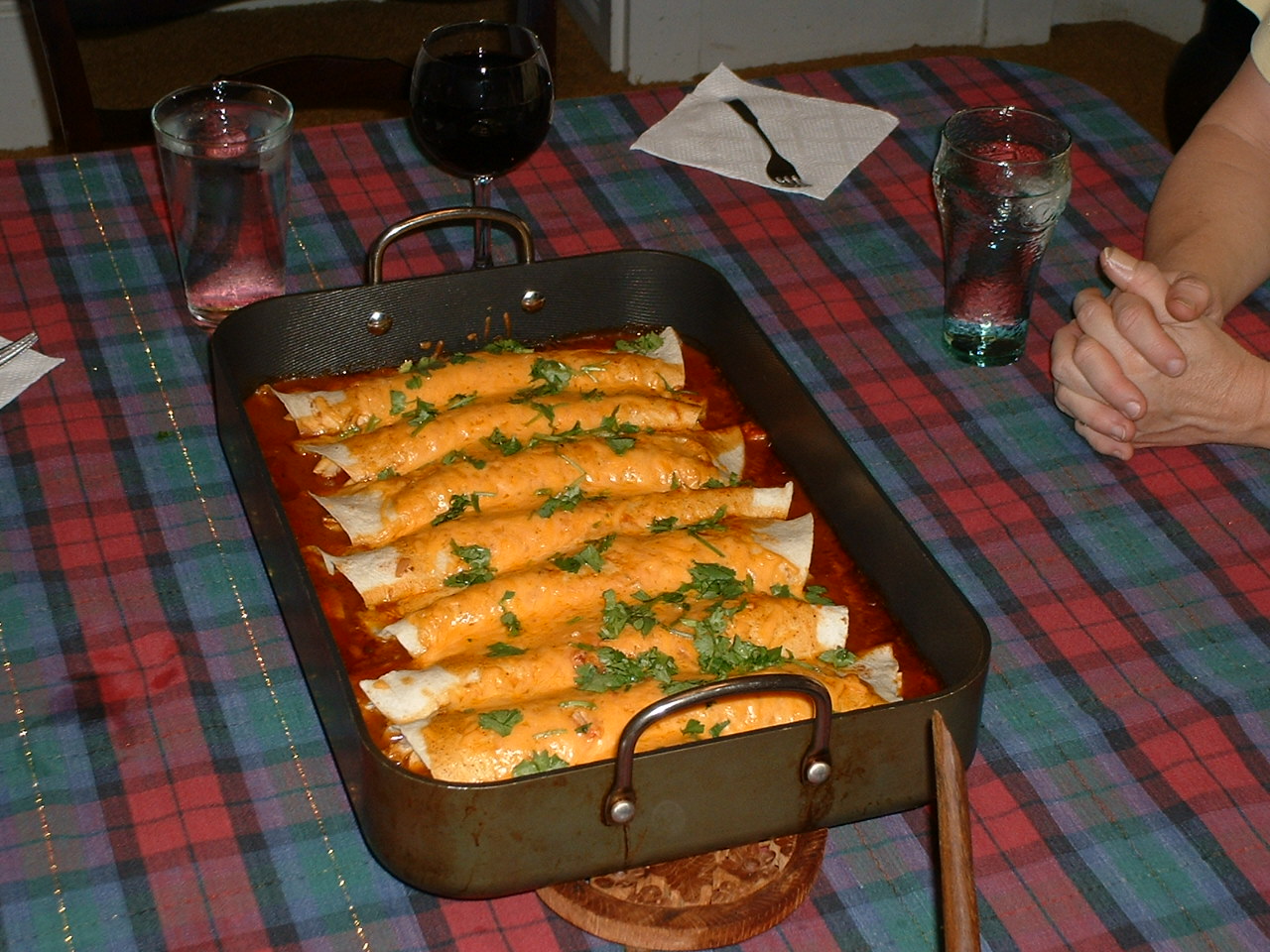
Rick’s Gooey Inauthentic Chicken Enchiladas Recipe

These are a family favorite, but they have no claim to any regional authenticity. For one thing, I use flour rather than corn tortillas, and for another I load them with sauce, and to add further insult, they are also much bigger than usual since I use burrito-size tortillas.

For shortcuts you can use leftover chicken (or turkey) or buy a rotisserie chicken and chop it up. For the salsa you could use good jarred salsa. I use 2-cup packages of Mexican-blend grated cheese, but you can grate Cheddar (not sharp) or Monterey Jack. Be alerted that you will need a really big baking pan to get these big boys all in. I use my roasting pan. You could do it in two pans if you need to. Feeds eight normal people (or four Floyds)

Ingredients

For the filling:

8 Burrito-size flour tortillas

2 cups chopped cooked chicken

1 large chopped white onion

12 oz homemade or jarred salsa

1 cup of grated cheese (Mexican blend, cheddar, or Monterey jack)

Salt and pepper to taste

For the sauce:

4 Tbsp vegetable oil

4 cups chicken broth

3 Tbsp chili powder

1 Tbsp ground cumin (cominos)

1Tbsp chopped canned chipotle peppers in adobo (optional, makes it pretty hot)

1 14.5 oz can diced tomatoes with their juice

2 garlic gloves chopped

2 tsp dried oregano

1 cup grated cheese

chopped fresh cilantro for garnish

chopped Romaine or Iceberg lettuce

To make the sauce:Make the sauce first, because it needs to cook down a bit.In a two-quart heavy-bottomed saucepan, heat the oil over medium heat and stir in the garlic and oregano for a few seconds being careful not to burn it.Add the chili powder and cumin and stir constantly for about a minute until you get a thick paste.Then slowly drizzle in the stock while stirring.You want to incorporate the other-ingredients into the stock.Stir in the tomatoes and the chipotles and bring the pot to a boil, then turn your heat down to get a good simmer.Let the sauce simmer and cook down while you assemble the enchiladas.It will not thicken too much, but don’t worry since it will spend another half hour in the oven.

To assemble the enchiladas:In a large mixing bowl mix chicken, onion, salsa, and 1 cup cheese. Salt and pepper to taste. Pour 1 cup of the sauce into the bottom of a large baking pan. Put a tortilla on a plate and fill with one-eighth of the filling, rolling each of them one at a time, and placing each of them into the baking pan with the seam side down to hold them together.

To cook.Pre-heat the oven to 350 degrees. Pour the remaining sauce on top of the enchiladas so that it moistens the tops of all the tortillas.Sprinkle 1 cup grated cheese over the top of the enchiladas, and put the pan uncovered into the oven for 30 minutes.Remove the enchiladas from the oven and let them sit for 5 minutes.With a spatula put an enchilada on each plate, put chopped lettuce on either side of it, and sprinkle with fresh chopped cilantro.

(Photos: R.L. Floyd)

Unknown's avatar

Where I Ruminate on My Long Love Affair with Food

I love food. I love to cook it, and I love to eat it, especially my own.

Mom and Dad both cooked. It wasn’t haut cuisine, but it was pretty healthy and had variety. I was born in 1949 so my earliest days in memory are in the fifties, not a heyday for American cookery. We had our share of frozen potpies and TV dinners and Mrs. Paul’s fish-sticks, but more often it was a home-cooked meal. My mother was a Midwesterner, so it was pretty simple with not a lot of seasoning. But she did have a well-worn copy of M.F.K. Fisher’s “How to Cook a Wolf” on her shelf, which was pretty avant-garde in those days. Fisher, Elizabeth David, and, of course, the incomparable Julia Child, were bringing back dispatches from the front about such exotica as olive oil and fresh garlic.

My favorite food was my mother’s friend chicken, which was a company dish. I remember fat pork roasts you couldn’t buy today for love nor money, with an inch of fat on the outside, and cooked ‘til it was gray for fear of trichinosis. The Sunday roast appeared mysteriously throughout the week in various guises and disguises. My Mom’s pork roast would supply the main ingredient for my Dad’s Pork Chop Suey or Chow Mein. That was exotica in the days before Szechuan and Hunan restaurants, when all American Chinese food was faux Cantonese. We had mac and cheese and ham steaks and haddock (frozen) that Mom would roll in corn meal and fry.

We seldom went out because it was expensive. When we did it was for pizza at an Italian bar called the Antlers (this was North Jersey) or to Westwood to the Cantonese place, where my Dad would always silently issue a “winner take all” challenge to the poor waiter with the water pitcher. Or for a real treat we might get the clam strip roll at Howard Johnson.In those days, at least in my house, there was no extra virgin (or any) olive oil, no kosher salt, no pepper mill (that came ground from Durkees), no fresh garlic, no cilantro, no jalapeno peppers, no garam masala, or Hungarian paprika. Cheese was typically Longhorn cheddar. Steak was chuck and cooked gray. Pasta was spaghetti with red sauce from a jar, with some browned ground beef in it.

My parents didn’t drink when we were growing up, so the first wine I recall having was the sweet Portugese rose, Mateus, that was the rage when I was in college.I started cooking when I was a young adult in the years before I married. It started with a simple spaghetti sauce or chili con carne. I added a spinach loaf that was mainly frozen spinach and crumbled Saltines.

When Martha and I were married our friends the Handspicker’s gave us a copy of Fannie Farmer’s Cook Book as a wedding present. That was my first cookbook, and I made my way through it and added more dishes to my repertoire: sauerbraten, shish kabob, and variety of soups, chowders, and stews. Martha gave me Joy of Cooking in our early days and I added still more. We moved to Bangor in 1979 and they didn’t have a decent Chinese rerstaurant, so I went to the Bangor Public Library and found Joyce Chen’s Cookbook and taught myself rudimentary Chinese cooking. There was a little Vietnamese place with a small market, and I found tree ears and tiger lily blossoms to make hot and sour soup.

I discovered other cookbook authors: Julia Child, James Beard, Craig Claiborne, Madhar Jaffrey, and Marion Cunningham. I made tandoori chicken and turkey enchiladas, paella and ratatouille. I discovered wine can be tasty. I still remember Arthur and Anne Perkins coming to dinner and bringing a bottle of Cabernet from Rutherford, and it was a revelation. In 1980 Martha and I went to Sonoma County to visit my college friend John Kwitkor, who worked for winemaker David Stare at Dry Creek Vineyards. John took us up and down the county, tasting and eating and having a ball.When our children arrived on the scene a few years later they landed in a culinary household far different from the one I grew up in. They ate tofu with scallions in oyster sauce regularly, and curries with raita, which Rebecca called “cucumber white.” When they were four and six we dragged them off to Oxford, England, for a term, and they ate pakoras and samosas, Scotch eggs and Cornish pasties, scones with jam and cucumber sandwiches with no crusts.
On a plane ride back in the days of airline food the flight attendant asked the woman next to my son Andrew, then about age five, which entrée she would like, one of the choices being coq au vin. “What is that?” she asked. “It’s chicken, Mam,” my little guy answered. When my daughter returned from Oxford she started in kindergarten again here in the states, and early in the year the children were all asked to name their favorite food. There was lots of pizza, pasta, and hamburgers represented, but the teacher got a big charge out of Rebecca’s choice: tandoori chicken.

This little culinary autobiography was prompted by Michael Pollan’s piece in the New York Times Magazine last week about food, where he writes about how we are becoming spectators of food rather than makers of it.

I still make food. Every day. I don’t do it to be virtuous, but because I enjoy it. I enjoy making it for others and sharing it with them. As a pastor for thirty years I know the joy of celebrating the sacraments with a community. There is a near-sacramental quality about a meal well-prepared and presented and enjoyed with family and friends. I often take pictures of the foods I make for a “cookbook” that maybe someday will be Christmas presents for my family (the pictures in this blog are all of things I have made).

My parents didn’t make fancy food, but they made good food, and from them I learned the joy of the table, about taking your time, and enjoying your food and the company and the conversation. We all know we need food to live, but I believe we also have a deep hunger for this larger communal experience of which food is just one part, albeit an important one. To me food takes time, thought, and creativity so it becomes something to celebrate and not just to eat.
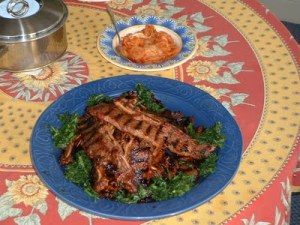
(Photos from top: Grilled shrimp with uncooked basil tomato sauced pasta; Littleneck clams with black bean sauce; Portuguese Cataplana; Korean BBQ’d Flanken Beef Short Ribs. Photos by R.L. Floyd)