Unknown's avatar

Is the story really about Conan vs. Jay? Or is it about the inevitable death of network TV?


NBC has provided lots of drama about their late night line-up for a week or so, and as a long-time insomniac I have watched with interest. I have always loved the Tonight Show, and I am old enough to remember Jack Paar. Johnny Carson was always a favorite of mine. Over the years I developed a slight preference for the goofy David Letterman over the more mainstream Jay Leno, but I watched them both now and again.

And I was pleased when Conan O’Brien, who I always thought was very funny, was given the Tonight Show last fall, bringing his edgy manic physical comedy to the show, and we stayed up to watch the monologues fairly regularly for the first week or so.

I wondered what would happen when NBC gave Jay Leno a 10 o’clock show. It didn’t seem like a great idea to me, and to tell you the truth, we never watched it. So I wasn’t suprised when a number of NBC affiliates started complaining that Leno was killing their ratings (which lead into their 11 o’clock news shows, which advertisers still like).

Then NBC responded by trying to insert Jay back at 11:35 and move Conan to 12:05. Then Conan balked at the move, saying it wouldn’t be the Tonight Show after 12 (true), and the drama heightened.  I thought Conan got a raw deal, and both he and Leno made comedic hay out of the situation. As Letterman said the other night, “Haven’t you all had enough of this whole NBC late night drama thing?” and then answered his own question: “Neither have I.”

But when I mentioned the kurfuffle to my twenty-seven year old son, he blithely remarked that it really doesn’t matter what happens because network television is in its last days.  “It’s over,” he said, “they just haven’t got the memo.”

And I got to ruminating about it and I think he may be right. I have thought about the future of newspapers a lot (see my interview with Martin Langeveld), but not so much about television.  But as I thought more about it I realized that the Leno-O’Brien late-night contest is akin to two fine musicians fighting over who is to be the next bandleader on the Titanic.

The reason is simple: fewer viewers with no end in sight to the decline. And then I realized that even though I was interested in the story, I had followed most of it on my laptop, reading on-line accounts and watching clips on YouTube.  If lots of people are doing this it drains away viewers.

So the trend is easy to spot as the proliferation of entertainment options fragments the viewing audience. When Johnny Carson was king of late night the Tonight Show was a destination for  many viewers. Now they have lots of other places to go. There was no cable to offer hundreds of options. There was no PayPerView or NetFlicks. You didn’t have massive multi-player on-line role playing games (MMORPGs) like World of Warcraft (which alone has something like 12 million paid subscribers.)

In Carson’s day people weren’t reading (or writing) blogs, or checking their Facebook or My Space page, or tweeting on Twitter. They weren’t listening to their personal radio stations on Pandora.  They weren’t watching videos on their IPods or cell phones.

And things are going to get worse for the networks because the options are only going to expand.  The next generation of e-books like Kindle will be able to have color for graphics to view magazines, so people can subscribe and get them wirelessly, like they already can on their computer. And many of the new BluRay players already allow you to get streaming video on demand from your wireless connection to your television. And Tivo and DVR recorders already allow you to watch your programs without commercials anytime you want. So more and more people watch what they want to watch when they want to watch it.

I look at my twenty-something kids and realize that they don’t really watch TV, except NFL football (in my son’s case), or to watch DVD rentals (in my daughter’s). If this is typical of their generation then advertisers will want less and less to throw big money at network broadcasting that fewer and fewer people are watching.

So the fall of late night is not the fault of Jay and Conan, who are both talented and funny men. It is the result of a changing world and the way people access media. NBC hasn’t helped themselves any with some questionable moves, but they are fighting a war of attrition that they can’t win.  Game over.

Unknown's avatar

Dispatch from Massachusetts: Political Stakes High in Tuesday’s Special Election


I got a call from Barack Obama yesterday afternoon, so I knew something was up. True, it was a robo-call, and every other Democrat in Massachusetts most likely got one. Still, it was a rare occurance, because usually nobody is interested in my vote unless it is a primary or a local election.

Here in the Bay State, where even the dogs and cats are Democrats, our votes are taken for granted. It is true that we had several moderate Republican governors before our current Democratic one, Deval Patrick, was elected. I have always thought that was because even Democrats know that there is a high rascal factor in our state politics, and a moderate Republican governor reassured us that the henhouse wasn’t entirely under the watch of the foxes.

Then last night I got a call from an old dear high school friend from New Jersey imploring me and my family to be sure to vote in Tuesday’s special election to fill the Senate seat left vacant by the death of Edward Kennedy last year.

I voted in the special Democratic primary awhile back, and had assumed that the winner, state Attorney General Martha Coakley (photo: above left), was the heir presumptive, this being Massachusetts. That was “the conventional wisdom.” But apparently too many people, perhaps including the candidate, thought this, and now it looks like her opponent, State Senator Scott Brown, has closed the gap and the polls are saying the race is too close to call.

This is a dramatic development and has Democrats in a state of high anxiety. Bill Clinton is already here campaigning for Coakley, and the President is coming tomorrow (after earlier saying he wasn’t.)

The stakes are pretty high for Democrats, not just here in the Bay State (we call it that so we don’t have to keep typing in Massachusetts, which nobody really knows how to spell.) First of all, Scott Brown is not a moderate Republican like former governors Bill Weld or Jane Swift, or even Mitt Romney, who didn’t get in touch with his conservative inner child until he ran for President.

Brown is an unabashed conservative, pro-life, anti-taxes, and, most decisively for national politics, anti-health care reform. He has vowed to vote down the current health care bill, and, if he wins, he takes away the Democrats’ 60 votes they need to pass the thing. Now the bill will be far from perfect, but it is better than nothing, and nothing would be a blow for the country and a real defeat for the Obama administration. It is possible that the failure of this bill would mean we’d go another generation with our immoral and inefficient health care system, which would be, quite literally, a shame.

A Brown win could also be interpreted as a changing of the political winds, putting the fear into some of the wavering Democrats that aren’t too excited by the health care bill anyway, and maybe encouraging other vulnerable Democrats in unsafe seats to retire.

The great irony of it all is that if Brown wins and Coakley loses, the seat of Ted Kennedy, the iconic “Lion of the Senate” will become the vote that brings down health care reform.  That would be sad.

Special elections are funny things. With nothing else on the ballot they have low turn-outs and can be swung by the zealous and the angry. Brown has channeled populist anger at the banking bailouts, and has galvanized a coalition made up of the few remaining reasonable Republican party loyalists with an assortment of Tea Partiers and other “were mad as hell and we’re not going to take it anymore” types, all fired up by Rush Limbaugh, Glenn Beck and talk radio. It’s not pretty.

So it all depends on who turns out to vote on Tuesday. Coakley should beat Brown in Massachusetts, but then again, the New England Patriots were supposed to beat the Ravens in Foxboro last weekend in the playoffs. So stay tuned.

Unknown's avatar

The Riddle of “Smokehead” Single Malt Whisky

My son gave me a bottle of single malt Scotch for Christmas, as is his custom.  This year it was a mysterious bottle called Smokehead that he had picked up at Heathrow on a trip from London.

Smokehead is an independently bottled whisky from one of the eight Islay distilleries, but Smokehead is coy about saying which one.  Islay (pronounced Eye- la) is a small island off the west coast of Scotland about the size of Martha’s Vineyard.  Their malt whiskies are famous (or to some notorious) for their highly smokey character.

My son made me guess which one of the Islay malts was in the bottle (the clerk at Heathrow had told him that a friend of his knew which one it was).   The pressure was on.

I tried my first taste on Christmas night.  It was clearly an Islay malt, lots of peat, big smoky nose, and that briny quality that comes from aging in porous oak casks near the sea.

I was pretty sure it wasn’t Laphroaig (not smoky enough) or Lagavullen (not complex enough and too young), which have such unmistakable tastes. They are also the ones I know best.

It seemed a youngish malt (with no age statement). I guessed Ardbeg (my second guess was Caol Ila), and my son told me that Ardbeg was what the clerk told him it was.

A trip to the internet whisky sites confirms that Ardbeg is the most popular guess, but there are vehement dissenters.  It’s a lovely malt, but then they all are, really.

Smokeheadjust released an eighteen-year old in December that I have yet to try.  Maybe next Christmas!

Unknown's avatar

“The Glory of the Lord shall be revealed:” A Homily for Epiphany


When I was a small boy I thought that if you were able to go back in time to meet Jesus and the apostles they would have had visible haloes around them, as they did in the pictures I saw in books.  I later learned that this was an artist’s depiction of something called “glory.”

Glory meant a person’s honor and reputation. The glory of the Lord was understood to be visible, a kind of radiance that surrounded God and was reflected in God’s messengers the angels, and even in those who came close to God, so for example Moses was surrounded by a glow when he came down from Mt. Sinai.  Jesus himself is referred to as the glory of God as in the verse from Hebrews where it says that, “He is the reflection of God’s glory and the exact imprint of God’s very being.” (Hebrews 1:3)

But there is more to glory than the visible; glory is a power that makes things happen.  In John’s Gospel glory means both the “radiant brightness” of God and the “powerful activity” of God.  So how do the disciples see Jesus’ glory in the miracle at Cana and come to believe in him?

In John’s Gospel we see a distinct pattern in which Jesus shows by actions and words that he is the fulfillment and replacement of Jewish institutions and views. So now Jesus is the real Temple; the Spirit he gives will replace the necessity of worshipping at Jerusalem; his teaching and his flesh and blood will give life in a way that the manna associated with the Exodus did not; at the Feast of Tabernacles, no longer the rain–making ceremony but Jesus himself supplies the living water; not the illumination in the temple court but Jesus himself is now the real light; on the Feast of the Dedication, not the temple altar but Jesus himself is consecrated by God.” (See Raymond F. Brown, John, p 104)

In each of these cases, Jesus himself replaces the former practices.  And not only replaces them in an adequate manner but in an abundant manner.  But what about the wedding feast of Cana, where Jesus performs his first miracle, one of the three traditional Epiphany events (along with the Magi and the Baptism of Jesus)?  What institution is Jesus replacing in the miracle of turning the water into wine?  Recall that the water that Jesus turned into the finest wine was there for the purification rites.  The miracle is a sign of that Jesus is the one sent by the Father who is now the only way to the Father.  Not just the purification rites but all previous religious institutions, customs and feasts lose their meaning in Jesus’ presence.

The disciples would have recognized some of the rich symbolism in the episode.  First of all, it was a wedding, which in the Old Testament was often used as a symbol of the messianic days. And Jesus himself frequently used both the wedding and the banquet to talk about himself and the kingdom of God.  Indeed, Jesus often spoke of himself as “the bridegroom.”

The disciples would have had understood the miracle of the wine as a sign of the end time, for the Old Testament employed the figure of abundant wine as a symbol of the final days. We see this in Amos, Hosea and Jeremiah.  And in Second Baruch we find a lavish description of this abundance: the earth shall yield its fruit ten-thousandfold; each vine shall have a thousand branches; each branch a thousand clusters; and each grape about 120 gallons of wine. It is an oenophile’s idea of heaven.

The disciples then would have seen this miracle as a sign of the messianic times and the new dispensation.  The disciples knew that when the messiah came, he would reveal his glory.  They would have been well-acquainted with verses such as Psalm 102:16 which says, “For the Lord will build up Zion; he will appear in his glory” and Psalm 97:6 which says, “The heavens proclaim his righteousness, and all the people’s behold his glory.”

But John is not only interested in our seeing that Jesus’ first miracle is to be connected to all that will follow; he also wants us to see how it relates to what has come before, chiefly the calling of the disciples and their decision to follow Jesus.  After all, the reason that Jesus’ glory is revealed is that people may believe in him, that they“ may have life and have it in abundance.”

In the previous chapter in John before the story of Cana, two of John the Baptist’s disciples heard John say of Jesus, “Behold, the lamb of God” and they followed him.  And in the story of the calling of Nathanial, Jesus promises Nathanial “You will see greater things than these.”

I think John’s Gospel is particularly helpful to us who live in a time of widespread disbelief, because for John, “seeing” Christ’s glory is by no means a universal event.  John gives us an interesting cast of characters who have trouble with believing: Nicodemus, the Pharisee who comes by night to interview Jesus, the woman at the well, Thomas the empiricist who wants evidence before he will believe, and Mary Magdalene, so caught up in her own grief that she mistakes the risen Christ for the gardener.  These are people like us, men and women for whom belief comes hard.  So in John’s Gospel many people do not see, and even in this story the miracle is not a public event, so that the wine steward clearly regards the miracle as the bridegroom’s social ignorance in serving the good wine after the inferior stuff.

In Luke’s Gospel, which so dominates the Christmas season, the shepherds see the glory of the Lord shining round the angels.  The other evangelists report various transfigurations, glimpses of the divine glory in Jesus before the resurrection, an elevation of Jesus into some heavenly mode of being.  But in John we can only see the glory with the eyes of faith for now.  And why is that?

Because John takes the Incarnation so seriously that the veil of the glory is never removed, and the divine glory of Jesus is never seen except by the eyes of faith.  The direct view of Jesus divine glory, that is, his heavenly brightness, is reserved for the future, to the time when the believer will be there where Jesus has gone before.

Which reminds us that we walk by faith and not by sight, and even Jesus’ glory, so often defined as visible radiance, is seen only by the eyes of faith.   Someday the glory will be visible to all, so much so that it will be the new light which will replace the heavenly lights of sun and moon in the city of God.  So St. John the Divine says:

And the city has no need of sun or moon to shine on it, for the glory of God is its light, and its lamp is the Lamb. The nations will walk by its light, and the kings of the earth will bring their glory into it.  Its gates will never be shut by day —and there will be no night there.  People will bring into it the glory and the honor of the nations. (Rev. 21:23–26)

That’s pretty glorious. “And the glory of the Lord shall be revealed, and all flesh shall see it together.”  I don’t know about you, but I wouldn’t want to miss it! Amen.

(I delivered this homily at the closing Service  of Word and Sacrament for the annual meeting of Confessing Christ in the United Church of Christ, held at First Church of Christ in Pittsfield, Massachusetts on January 8, 1998)

Unknown's avatar

“They sought him by a star:” A Hymn for Epiphany

They sought him by a star

They sought him by a star
they followed from the East.
We know him in his Word
and eucharistic feast.
For those who look to him for bread
will find their souls are daily fed.

The nations need his light
against the darkened hour.
Their hate and fear and might
betray his gentle power.
But those who seek by word and deed
will find he meets them in their need.

We walk on paths unknown
through days of doubt and fear.
We face each day and frown,
we struggle each new year.
But those who follow in his way
will find his light for each new day.

And when he comes at last
his glory will shine forth.
The world that moved so fast
will stop to mark his worth.
And finally see the great “I Am”
and join the Supper of the Lamb.

© 2001 Richard L. Floyd

Suggested tune: Darwall’s 148th.

They Sought Him By A Star

(Photo: R. L. Floyd, “Wise Men from Ecuadorian Creche”)

Unknown's avatar

My Most Popular Blogposts of 2009

As 2009 wanes I took advantage of Google Analytics to find the ten most popular posts of the year.  I learned that Retired Pastor Ruminates, which was launched on March 23, has 10,467 page-views, of which 6,928 were unique page-views, and the average time spent on the page was 3:19. They came from 53 countries, with the US being first, and all but two of its states represented. The other countries with the most visitors are in order of visits: the United Kingdom, New Zealand, Canada, Australia, Brazil, Germany, Netherlands, India, South Africa, Ireland and Singapore.

Here are the most visited posts:

Unknown's avatar

Funny poem: “’Twas the Day after Christmas”

This piece of seasonal light verse comes from the keyboard of Janet Batchler, the creative gal behind the now famous Church History in Four Minutes video.  Janet’s terrific blog is Quoth the Maven (Now sadly gone.)  Her poem, with only slight exaggeration  (we no longer have a dog), describes my house about now.  How about yours?

‘TWAS THE DAY AFTER CHRISTMAS

‘Twas the day after Christmas, and all through the house
All the fam’ly was sleeping, yes, even my spouse.
The stockings were tossed by the chimney with flair
Some turned inside out, to make sure nothing’s there.

The children were nestled all snug in their beds,
Nintendo DSes tucked under their heads;
And I in my bathrobe, MacBook on my lap,
Was happy to know there were no gifts to wrap.

When out from the kitchen there rose such a clatter,
I sprang from the couch to see what was the matter.
I waded my way ‘cross a floor filled with trash
To a kitchen heaped high from our Christmas Eve bash.

The sun through the window, it gave quite a glow:
(Los Angeles Christmas: We never have snow),
It shone on the remains of the Christmas day cheer,
The leftover cheese ball, the dregs of the beer.
The un-put-away brownies as hard as a fossil,
And o’er on the stove, it shone down on the wassail.

I blinked as the sun blasted straight to my eye
And just in time glimpsed a brown streak passing by.
Four-footed and furry and dragging a ham,
Dodging around me and trying to scram.
And as he ran off with a peppermint cluster
I knew in a moment, it was my dog Buster.

More rapid than eagles he streaked ‘cross the floor
Buster grabbed what he wanted, and came back for more:
More cheesecake, more truffles, more bagels and lox,
More chocolate chip cookies, more scotch on the rocks.
He smashed and he scrambled, bumped into the wall,
Then dashed away, dashed away, dashed away all.

“I should have cleaned up when the guests said good-bye,”
I moaned to myself with a pretty big sigh.
After two days of feasting, the kitchen looked grubby
I scrounged in the sink, tried to dig up the scrubby–

I searched quite in vain for a halfway clean towel
When out from the living room came quite a howl.
I set down the saucepan all caked thick with goo,
The glaze for the ham which had now turned to glue.

I skipped to the living room, limber of foot
And inched past the fireplace, dripping with soot.
Unraveling ribbons clung fast to my shin
As I looked round the post-Christmas scene with chagrin.

A mountain of presents all covered the floor
They looked so appealing when bought at the store.
Now gift wrap was ripped and the tissue was crumpled,
The new shoes abandoned, the new tank tops rumpled.

I picked my way round all the presents caloric,
The baskets of chocolate to make me euphoric,
Strange foods so exotic that no one would try it
(And don’t my friends know, New Year’s Day starts the diet?)

And just then I heard from the top of the spruce
The pitiful cry of a dog on the loose
I lifted my eyes from amidst the debris —
Old Buster had climbed to the top of the tree.

The angel crashed down as the Christmas tree swayed,
The ornaments flew in a sparkling cascade–
The puppy leapt on me, I felt his claws rip,
And then right behind, the tree started to tip–

The lights all exploded as down the tree crashed–
The pine needles shredded, the presents were smashed–
And I said as I landed on top of the pup,
“Happy Christmas to all– Someone else can clean up!”

(Janet Batchler, Quoth the Maven, December 26, 2009)

Unknown's avatar

Favorite Christmas Music: My Top Ten lists


‘Tis the season of top ten-ten lists, so I thought I would offer one on my favorite Christmas music. I have way more Christmas music than anybody should rightfully have, and the more stuffy side of me doesn’t quite approve of a lot of it. Nonetheless for most of my adult life I have been collecting it and playing it, changing with the technologies over the years.

The first Christmas album I really knew was Bing Crosby’s White Christmas, still one of the best selling albums of all time. I knew my mom liked Bing Crosby, so one day when I was maybe ten I cajoled my father into buying it during a grocery shopping trip to the Safeway.

That was the only Christmas album my family owned, and I can still sing every song on it from memory, including the exotic ones like “Christmas in Killarney”and “Mele Kalikimaka.” And you’ve got to love the Andrew’s Sisters!

Later my own tastes evolved more to classical, and my personal first album was Handel’s Messiah, on vinyl. The version was by the Robert Shaw Chorale, and it was just selections rather than the whole work. From a lifetime of choral singing I now know every phrase of this grand piece, and Christmas is not complete without listening to the Advent and Christmas portions of it. I have two more great recordings, an early-instrument one with John Eliot Gardner on Philips, also on vinyl, and a CD with George Solti and the Chicago Symphony on the London label with Kiri te Kanawa. I love them all.

I have quite of lot of early and Reniassance Christmas music, with lots of Gabrielli horn concerti.  I have American folk Christmas albums and German Christmas albums.

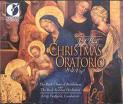
J.S. Bach’s Christmas Oratorio is right up there in the pantheon, and I have a terrific vinyl version on Angel with the King’s College Choir, St Martin’s in the Fields, with Philip Ledger, conducting and a stellar lineup of soloists: Elling Ameling, Janet Baker, Robert Tear, and Dietrich Fischer-Dieskau. That one gets a seasonal hearing, too.

A little later in my ministry I started collecting more popular seasonal music. First there was George Winston’s December for solo piano.  Then, we were given the original A Winter’s Solstice from Windham Hill by good friends, and that was the beginning of a long collection of pretty much everything Windham Hill has come out with, including the haunting Celtic Christmas series. This was also about when I started putting together atmospheric compilations to listen to while sitting by the fire.

But I enjoy choral music as well. I have the normal anglophile’s love for the sound of choristers, and this makes me nostalgic for my time in Oxford and Cambridge. So the choir of King’s College has to be on the list, although St John’s at Cambridge, and the choirs of the colleges at Christ Church, New College and Magdalen at Oxford would do just as well.

So here is my somewhat arbitrary top ten albums and top ten singles:

My Top Ten Albums (in no particular order)

  • Yo Yo Ma, Songs of Joy and Peace
  • Handel’s Messiah
  • J. S. Bach’s Christmas Oratorio
  • Sara McLaughlin, Wintersong
  • Chris Botti, December
  • Emmy Lou Harris, Light of the Stable
  • James Taylor at Christmas
  • Diane Krall, Christmas Songs
  • Choir of King’s College Cambridge, O Come all ye Faithful (This is under-volumned, sadly)
  • Bing Crosby, White Christmas
(Honorable mention, Liz Story, Liona Boyd, George Winston, Paul Hillier, Mary Chapin Carpenter, Amy Grant, Sting)

Top Ten Singles (in no particular order)

  • Bing Crosby, “White Christmas”
  • Sara McLaughlin, “River” ( a great cover of a Joni Mitchell classic.)
  • John Gorka, “I heard the Bells on Christmas Day”
  • Diana Krall, “Count Your Blessings”
  • James Taylor, “Some Children See Him” (an Andy Williams’ favorite from my childhood)
  • Yo-Yo Ma with Alison Kraus, “The Wexford Carol”
  • Turtle Island Band, “Veni Emmanuel”
  • William Ackerman, “Yazala Abanbuti”
  • Liz Story, “Il es ne le divin enfant/Immaculate Mary”
  • George Winston, “Walking in the Air” (from the film “the Snowman” and the album Forest)
Unknown's avatar

“So hallow’d and so gracious is the time.”


“Some say that ever ‘gainst that season comes
Wherein our Saviour’s birth is celebrated,
The bird of dawning singeth all night long:
And then, they say, no spirit dares stir abroad;
The nights are wholesome; then no planets strike,
No fairy takes, nor witch hath power to charm,
So hallow’d and so gracious is the time.”

(William Shakespeare,  Hamlet, Act 1, Scene 1)