Unknown's avatar

“Then, Now, and What’s Next?” Ruminations on Time and Technology


(I delivered this paper to The Monday Evening Club on January 25, 2010. I have slightly revised this version.)

As the first Monday Evening Club paper of a new decade I want to do some looking backward as well as gazing forward. Looking backward is not so hard, since we all have 20/20 hindsight, but gazing forward is more difficult. It was Søren Kierkegaard who once said, “Life must be understood backward, but it must be lived forward.” So let me do the easy part first and look backward, telling a couple of brief stories about two men who were born in the late Nineteenth Century, came of age in the early part of the Twentieth, and lived long lives in which they witnessed technological advances unparalleled in any other period of human history. Then I will briefly try to look forward to take some guesses about “What’s next?”

The first story is one you may have read about in the paper this past year. It is about Henry Allingham, one of the last British soldiers to fight in the First World War. He died last July at the age of 113. He was, for one month of his life, the oldest verifiable living man on earth. Asked about the secret to his longevity he credited “cigarettes, whisky and wild, wild women – and a good sense of humor.”

Originally a Navy man, Allingham was first assigned as a mechanic, and later a spotter, to a unit that carried out anti-submarine air patrols for the newly formed RAF. Keep in mind that the Wright brothers’ first flight had been launched as recently as 1903, so airplanes were just a decade old when the Great War broke out, and this would be the first significant use of them in war. The Sopwith Schneider seaplane that Henry’s unit flew to look for German U-boats and other ships was really nothing more than a big box kite with an engine. It had to be lifted by cranes in and out of the water from a ship every time it went on a mission. The plane carried no parachute, no navigational instruments, save a map and a compass, no radio, only a carrier pigeon. To us it sounds primitive, yet at the time air flight was so new that it was cutting-edge technology. Today those fliers needn’t have risked their lives in reconnaissance missions. They could rely on satellites.

The second man whose story I want to tell is my maternal grandfather, William Ira Laffoon. I only knew “Granddaddy Bill” when he was an old man, for he turned seventy the year that I was born. He was born on October 8, 1881, and when he was a boy of eight he traveled with his family from Missouri (“Missour-ah” is how he always said it) to Indian Territory on a Conestoga wagon to participate in the Oklahoma Land Rush of 1889. The Land Rush offered 2 million acres of free public land for homesteading on a first come first served basis. The rush, or “run” as it is more properly called, began at high noon on April 22, but many of the participants had already picked out choice parcels and hid on them until the official time. These were the “Sooners.” The ones who played by the rules and went when the cannon was fired were called “Boomers.” Unlike Rome, Oklahoma City, was built in a day, for there were over 10,000 inhabitants by late afternoon of the first day of the run. My grandfather and his family were the opposite of the “Sooners,” and waited until the next day to quietly go in to stake their claim, which is how my mother came to be born in Oklahoma City.
Granddaddy Bill outlived both my mother and grandmother, and was still living on July 20, 1969, when he watched on his television set as Neil Armstrong of the Apollo 11 crew stepped onto the surface of the moon, exactly 80 years after the Oklahoma land rush. My grandfather died the following year at the age of 89.

As a boy he could scarcely have dreamed of the changes that he would see in his lifetime, especially in technology. And it is hard to imagine anyone in previous human history experiencing in the span of one lifetime such technological development as he and others such as Henry Allingham did in the Twentieth Century.

Yet, today we all live such lives, and increasingly so, as the time increments between world-changing inventions and innovations gets increasingly smaller and smaller, as if the world were somehow speeding up.

Just think of the changes that have taken place in the generation since my grandfather died forty years ago. We are prone to think of the moon landing as the apogee of human achievement, but in terms of the history of technology it is from a time gone by. This was dramatically brought home to me when I watched that great 1995 Ron Howard movie “Apollo 13,” in which we see the space engineers in Houston making calculations on slide rules to bring the troubled ship home from the moon. When we watched it my children didn’t know what a slide rule was, since the pocket calculator, once a luxury item that now sells for next to nothing, had replaced it. And those big room-filling mainframe computers that sent the Apollo missions to the moon and back had less memory and file space than your laptop computer, or, for that matter, many iPods and cell-phones. We all live in a brave new world of dizzying technological innovation unthinkable even a generation ago.

My ruminations on time and technology require pinning down what exactly is meant by “technology,” that big word with such a slippery meaning? The ancient Greek word, techne, is often translated as “craft or art.” Another Greek word, logos, is often translated as “word,” or “something said,” and by implication, “a subject of study.” Together they provide the roots for the word “technology,” literally “the study of craft,” to mean the knowledge and use of tools and crafts. It is this knowledge of the art of making and using tools that best defines technology.

So in the span of human history technology begins with our ancestors’ use of simple tools, sticks and stones really, and continues through the developments of the ensuing centuries. Today our understanding of what constitutes “tools” has broadened to include all manner of using human knowledge to manipulate our environments, so that the term technology can be rightly used to describe work in genetics, medicine, biology, physics, and the like. I was reading yesterday in the Economist about the huge 15 billion dollar underground supercollider in Switzerland, which is expected to unlock some of the secrets of how our universe works to the physicists. It is a long way from stone tools to a supercollider but both are examples of humans using knowledge and tools to influence our environments, and so both are technology.

One of the features of technological innovation is its reliance on what has gone before. One could use evolutionary theory in biology as a rough metaphor for the way technology develops. The invention or innovation that is more useful or efficient replaces what was used before, and seldom does a new breakthrough come about in isolation from the work of predecessors.

For example, my grandfather’s family’s Conestoga wagon itself was the result of generations of accrued technological advance. Carpenters in Conestoga County, Pennsylvania, invented the clever tapered design that kept the thing from tipping over. Metallurgists had learned to fashion iron into the bands that covered the wheels. The wheels themselves were the result of an innovation first made in Mesopotamia in about the fifth millennium BCE, most likely for making pottery. The horses that moved the wagon were the result of the domestication of the wild horse around the same period. The horse and wheel together revolutionized the way people could move from place to place, including conquests by traveling armies. As people traveled they learned new techniques and practices from those with whom they interacted, and a kind of technological cross-fertilization took place, to borrow another metaphor from biology.

We take travel for granted, but for most of human history most people lived and moved and had there being within a few miles of where they were born. Changes in transportation technology changed all that. For example, Granddaddy Bill was born in Missouri, but at least according to family lore, his father Stephen was from Kentucky, and his people had been Huguenots, French Protestant refugees who had come to this country on sailing ships fleeing bloody religious persecution under Louis XIV.

In 1889 the Laffoon family was on the move again. But how did they, and the other tens of thousands of Sooners and Boomers like them who headed West, even know about the Oklahoma Land Rush?

Most likely from a newspaper, that now threatened technology. But how did the newspaper in Missouri find out about the Land Rush in Oklahoma? Most likely by a telegram, which was the result of the invention of the electric telegraph, developed by Samuel F.B. Morse in 1837. The invention of the telegraph is a good example of a new technology driving out an older one, for in 1861, when the wires for telegraphy were finally in place from coast to coast, the Pony Express, heralded just two years before as the great new advance in continental communication and mail delivery, was shut down for good.

And so it goes. The story of one technological innovation supplanting another is not new, but what once took centuries, decades or years now can happen in a very brief time, as a quick look at some of the newest innovations that didn’t even exist at the turn of the millennium will show.

As we have been seeing the story of technology has been going on for a very long time. What is new is the pace of its change, so much so that the technology of the last hundred years or so constitutes one of the great revolutions in human history.  This rapidly accelerating pace of technological change in practically every aspect of our lives means that things we never dreamed of are now commonplace.

To give some personal examples let me look at the way technological advances have impacted my own life. When I became the minister of First Church in 1982 I was only the eighteenth person to hold that position, parson Thomas Allen being the first in 1764. The basics of the job haven’t changed all that much, prepare and deliver sermons, preside at worship, oversee the workings of the institution, be a presence for the good in the community, visit the congregation, marry and bury and the like.

Now I am not what is called an “early adopter,” the person that has to acquire the newest gadget as soon as it is available. I am more of a “that looks like a fun and useful thing and the price has come down” kind of guy. So I didn’t get my first personal computer until 1991, a Mac classic with 4 MB of memory, and only then because I enrolled in a doctoral program that required me to have one. So I am hardly a cutting edge technophile.

Nonetheless, by virtue of my 22-year pastorate, which encompasses multiple generations of technological advance, I marked a number of firsts among the ministers of First Church.

I was the first to use a word processor, a personal computer, a Palm Pilot, a cellular phone, a scanner, E-mail, a Power Point presentation, or an e-ticket to board an airplane to name a few.

I was the first to have an MRI, orthotics in my shoes, a CD player, a VHS video recorder, a DVD player, a BluRay player, a digital camera, hearing aids with handless Bluetooth wireless capability to hear phone signals and music, a Global Positioning System in my car, an iPod, a video game, a digital picture frame, side airbags in my car, a Fast-Lane account. The list could go on and on, but you get the point.

In my first ministry after ordination, in 1975, I served two small rural churches in Maine. There was no secretary so I ran off the Sunday bulletin on an ancient hand-cranked Liberator 500 mimeo machine. I would type the copy onto a flimsy blue stencil sheet with my manual Olivetti Typewriter, ink up the drum on the machine, attach the stencil, and then turn the crank as each copy came out. If I tore the stencil I had to start all over again, or try to repair it with a glue-like substance. I hated doing it and it often went undone ’til late Saturday night.

In those days I wrote out my all sermons in longhand on 4 by 6 cards, later switching to 8 ½ by 11 inch sheets of Corraseable Bond paper made by the Shaeffer Eaton Paper Company in Pittsfield, long before I had ever arrived Pittsfield. That product was wonderful, allowing you to eliminated errors with a pencil eraser. But, to illustrate my earlier point, it was driven off the market by the advent of word processors and personal computers.

By contrast I wote this paper on my 15 inch Apple MacBook Pro laptop using Microsoft Word. My first computer twenty years ago had 4 MB, this one has 2 GB, not even that muscular by today’s standards. I ran this paper off on my Hewlett Packer OfficeJet 6500 Three-in-One Printer/Scanner/Copier. Tomorrow I will send it to Martin as a file attachment in an e-mail, and he will post it on the Monday Evening Club blog.

Which leads me to the next first for a minister of First Church of Christ in Pittsfield. I blog. Blogging is so new my spell-check underlines it every time I use it in a Word document. The term, short for Weblog, was only coined in 1997. Ten years later, the blog search engine Technorati tracked more than 112,000,000 blogs. There are certainly many more now. I have three. This one, my main one, “Retired Pastor Ruminates,” was started last March and is nearing the nine thousand visitors mark.

I am also on Facebook, a social networking site that was launched on February 4, 2004 by a Harvard sophomore, and in that short six years is now approaching 400 million users. Through Facebook I have reconnected with old friends from high school and college, some of whom I have met face to face for the first time in decades. Through Facebook I have also found out about world and national breaking news events in real time, in addition to finding out quickly about a variety of personal news from friends, such as illness or death in the family.

The widespread use of cell-phones with text-messaging capabilities is also changing the way the world works. Twitter, the microblogging and social networking service, was only launched in 2006. It limits users text-based posts, known as “tweets,” to 140 characters. Most tweets are mundane comments about what people are doing, but the social implications of such interconnectivity are breathtaking, and the immediacy of Twitter has made it a useful up to the minute communication tool. One study claims that blogs, maps, photo sites and instant messaging systems like Twitter do a better job of getting information out during emergencies than either the traditional news media or government emergency services. The study  cites as an example, that Twitter, during the wildfires in California in 2007 kept their followers, often friends and neighbors, informed of their whereabouts and of the location of various fires on a minute by minute basis.

Another example of the usefulness of Twitter is the 2008 Mumbai bombing attacks. Eyewitnesses sent out an estimated 80 tweets every five seconds, enabling the creation of lists of dead and wounded, giving out emergency phone numbers and the location of hospitals giving blood.

Just a year ago, when US Airways Flight 1549 had engine failure from bird strikes and had to ditch in the Hudson River, a passenger took a photo of the downed plane with her cell-phone and sent it to Twitpic while people were still evacuating the plane and long before any media arrived at the scene. It was the first picture we all saw.

Also last year NASA astronauts gave real-time reporting on Twitter of the Hubble Space Telescope repair mission.  And the most recent example of a new use for text-based communication is the quick raising of tens of millions of dollars for Haitian earthquake relief using cell-phones.

All this illustrates the power of the new information and communication technologies, and I think this is where the most stunning of the technological advances are right now and will be in the future.

When Granddaddy Bill was born in 1881 he came into a world transitioning from an agrarian to an industrial economy and society. In the years he lived we had been gradually transitioning from the Industrial Age to the Information Age. Today we are squarely in the post-industrial Information Age, especially here in the West, but also in countries that are industrializing at the same time, such as China and India where cell-phones are proliferating exponentially.

If you think about the list of my gadgets many of them had to do with information and communication. And since my grandfather’s death in 1970 we have seen the rise of the Internet, email, the personal computer, the World Wide Web, the laptop, multi player on-line games, cell-phones, MP3 players like the iPod, web-cams, digital television, broadband, wireless networking, wireless headphones, GPS, Satellite radio, podcasts, Bluetooth, Digital Audio Players, Digital Video Recorders, smart-phones like the IPhone, and e-books like Kindle. [Note: Two days after I delivered this paper Steve Jobs unveiled the Apple iPad.]

And there is a new dynamic at work in the Information Age. In the past, it was defense and the massive government spending that goes into research and development that often drove the technological innovation that eventually trickled down to consumers. A good example is the Internet, which began with researchers and the military. And the space program was a great hothouse for technological innovation. The now common GPS came out of such defense and space programs, although I have it on good authority that the ones we can buy are calibrated just inaccurately enough to make them ineffective for a terrorist to use as a guidance system for a SAM missile.

But today, in a turn about, civilian technology is often being used by the military at a fraction of the cost it would take to develop it. The US Air Force recently bought hundreds of Sony PlayStation gaming platforms with the plan to link them together and make a supercomputer. And US snipers in Afghanistan are using an inexpensive iPhone application that aids in sighting targets, even calculating for the “Coriolis Effect” that allows for the earths rotation.

This blurring of the lines between civilian and military uses for technology brings up another point for rumination about the way humans utilize the knowledge and tools they develop. We have already noted that the domestication of the horse was quickly utilized for military purposes, to carry chariots and cavalry. The satellites that circle our globe and make our GPS work are used as well by farmers in France to monitor sunlight and weather to improve crop yields. But they also are used in the kind of military surveillance Henry Allingham’s unit did in a seaplane, and today they help guide the Predator drones that target and kill terrorists (and sometimes civilians) in Afghanistan and Yemen. It is no accident that the Air Force ads aimed at potential young recruits look like video games.

In the early Twentieth Century it was suggested by Hannah Arendt and Max Scheler that we might more properly be called Homo Faber, “Man the Maker,” than Homo Sapiens, “Man the Wise,” since it was our control of the environment through the use of tools that best characterizes us as a species. The term Homo Faber is from antiquity; the Roman Appius Claudius Caecus wrote; “Homo faber suae quisque fortunae” (“Every person is the fabricator of his or her own destiny”).

The philospher Henri Bergson also referred to Homo Faber in his book, The Creative Evolution (1907), where he defines intelligence as the “faculty to create artificial objects, in particular tools to make tools, and to indefinitely variate its makings.”

So are we merely advanced toolmakers, or is there something more required of us as humans? Along with techne, the ancients valued sapientia, “wisdom,” from which our species gets its biological name, but our ruminations so far raise the question, “Has our wisdom been progressing along with our knowledge?”

Would Homo Faber be a more accurate name for us than Homo Sapiens? Our knowledge, as we have seen, is vast and ever increasing, but what about the wisdom to use it in a manner that enhances human dignity and freedom and the well-being of the created order?

Which also raises the question of the difference between knowledge and wisdom. The difference between knowledge and wisdom has been expressed by the axiom: “It is knowledge to know that a tomato is a fruit, but it is wisdom to not put one in a fruit salad.” I would suggest that, like our technologies, human wisdom never reaches some kind of ultimate perfection. Our reach always exceeds our grasp, which should, but often does not, make us humble. Reinhold Niebuhr once wrote about this tragic quality of human striving, “Original sin is that thing about man which makes him capable of conceiving of his own perfection and incapable of achieving it.”

So I must leave it as an open question whether we have the wisdom to properly use our knowledge. But it is not a new question. The Tower of Babel story in Genesis suggests that the works of our hands can become idols when they seek to replace God as the highest good.

So our technological feats, impressive in themselves, need to be understood within a loftier perspective. In my sojourns through Europe I have seen dozen of glorious cathedrals; great works of art crafted over generations by skilled workmen. These beautiful piles are not glorious by accident but by design. They were dedicated to the greater glory of God, their lofty spires pointing heavenward. They reminded those who saw them that the works of our hands take their place under larger and transcendent purposes.

I wonder what check on human pride and vainglory holds today in a secular society entranced by its own inventions? These inventions, as we have seen, are marvels of human ingenuity and have enhanced the quality of human life for many, indeed most, of the peoples of the earth.

But they come with a price. Granddaddy Bill grew up before the internal combustion engine and the widespread use of carbon-based energy sources. The automobile was one of the great technological advances in Twentieth Century life that he knew, but what he didn’t know, and we do, is that carbon gas emissions are threatening the well being, perhaps even the existence, of our planet, or at least our species.

This threat represents the unintended consequences of technology. The hope is that we will develop new knowledge and tools to alleviate the problems we have created, and along with them, the wisdom to use them wisely. But we have seen that the will to deal with such concerns often lags behind short-term economic and political preoccupations.

I don’t want to leave you with a dystopian dyspepsia after such a lovely dinner. I started with the stories of two old men who had seen so much impressive technological change in their lifetimes. Both were wise in their old age. Henry Allingham, the war hero, spread a message of peace, visiting graveyards in France. He confessed in his latter years that he did not realize what war meant when he signed up. He lamented the incredible and wasteful loss of life his war. He once told the BBC: “War’s stupid. Nobody wins. You might as well talk first, you have to talk last anyway.”

My Granddaddy Bill was a kind and gentle man with a dry sense of humor. A pious Midwestern Protestant he read his Bible every day, and riddled his conversation with biblical references. I never heard him exhibit any prejudice toward anyone, although like all of us, he must have had some. He was a learned man who loved books, although he had never gone to college. But both his daughters did, a rare thing for women in the 1930’s, and both went on to get Master’s degrees.

Did age make these old men wise? I don’t know, but it is people like them who help me to remain ever hopeful for the future.

At the beginning of this paper, I promised a look forward and here goes. What is in store for us? I am aware of the dangers, for predictions of the future are notoriously off the mark, from Edward Bellamy’s Looking Backward, Jules Verne’s futuristic fantasies, George Orwell’s 1984, Aldous Huxley’s Brave New World, and, of course, the Jetsons.

Nonetheless, let me take the chance. In truth, I’ve already played my hand, for I see the same kind of serial innovation that has characterized the recent past continue unabated. But I see it speeding up, because of the interconnectivity of the information age. Global cooperation will speed the development of new products. My Apple computer, an American product, was manufactured in China with parts from Japan and other countries. There will be more and more of this, so that innovation now isn’t just collaboration with the past, but with a thoroughly connected global community. This will speed up innovation and also break down, but not eliminate, national boundaries and interests.  It will also raise concerns about human rights and freedoms, the treatment of workers, and standards for environmental responsibility, as part of the cost of doing business globally.

New technologies will continue to replace old ones. It is impossible to imagine all these changes, but I’m guessing that newspapers and network television are two that will not be around for long in their present form. I expect wireless technologies to increase, and I expect more and more information to be stored in and accessed from “clouds,” remote giant servers, rather than on personal computers, making limitations of file space and memory obsolete.

I expect a revolution in biotechnology, one that is already taking place, with microbes that eat industrial waste and pollution. I see continued advances in agricultural technology that will help feed a hungry world, and in epidemiology and disease prevention and control, leading to the elimination of certain diseases. The mapping of the Human Genome will lead to many medical discoveries, and both diagnostic and surgical procedures will become less invasive and safer.

I see information technology harnessed to create smart homes, cities and highways that lower energy cost and use. Green technologies in transportation and housing will save fuel use. Electronic highway passes (like EasyPass and Fastlane) will become mandatory for all drivers here from coast to coast within a couple of years, with a chip planted in your driver’s license.

China, whose economy will surpass Japan’s this year as the second largest in the world, and ours in the not too distant future, will be the great engine of technological change in this century and beyond as it brings its millions into modernity.

Along with these innovations will come challenges. One I have already mentioned, global warming. Will we have the knowledge and wisdom to fix the problems our own technologies have created?

Another is the threat of terrorism, where advanced technology puts in the hands of the angry few the power to destroy the lives of millions. Here again, the cooperation of states is critical, as well as continual attempts by the global community and all people of good will to foster a world that leaves fewer and fewer people behind economically.

And finally there remains the danger that technology will create new classes of “haves and have-nots,” as those without the access to these new technologies and the information that comes with it will be left behind.

You would be surprised, I know, if I didn’t end by saying that religious faith will play a significant role in what happens next, and whether our technology ultimately helps us or harms us. The question for religious faith is whether it will be a toxic faith that fosters hate of the other, or a large-hearted faith respectful of the other, and committed to a path that leads to human dignity and freedom, and the well-being of the created order. Time will tell.

I remain hopeful, but not Utopian.  So I must close with one of my favorite quotes, also by our former neighbor, Stockbridge resident Reinhold Niebuhr:

“Nothing that is worth doing can be achieved in a lifetime; therefore we must be saved by hope. Nothing we do, however virtuous, can be accomplished alone; therefore we are saved by love. Nothing which is true or beautiful or good makes complete sense in any immediate context of history; therefore we must be saved by faith.”

© 2010, Richard L. Floyd
Unknown's avatar

Birthday Special: The Top Songs when I was Sixteen in 1965


Today is my sixty-first birthday (I know it is hard to believe since I look so freakishly youthful; just kidding.)  My good friend Larry from High School sent me a compilation of some of the top singles (from the Cashbox chart ending February 6, 1965) from when I turned sixteen.  They read like one of those oldies collections not available in stores that you see on the infomercials when you can’t sleep, but there are some classics here too.  

The themes are the ones you would expect from the big Boomer demographic, love found and lost and lots of sexual tension, but Sam Cooke’s A Change is Gonna Come signals that there might have been more going on in America than teen angst.

So I’ve been sitting here listening to them and getting in touch with my inner sixteen year old, when I was “cute in my mohair suit” (whatever that is).

So here they are:

1. You’ve Lost that Lovin’ Feelin’ by the Righteous Brothers (which got some new legs from the movie Top Gun)
2.Downtown by Petula Clark
3.The Name Game by Shirley Ellis
4.This Diamond Ring by Gary Lewis and the Playboys
5.Love Potion #9 by The Searchers
7. All Day and All Night by The Kinks
8.Keep Searchin’ by Del Shannon
9.Shake by Sam Cooke
10.My Girl by the Temptations
11.Let’s Lock the Door by Jay and the Americans.
12.How Sweet it is to be Loved by You by Marvin Gaye
13.I Go to Pieces by Peter and Gordon
14.Come See about Me by the Supremes
15.Give Him a Great Kiss by the Shangi-Las
17.Heart of Stone by the Rolling Stones
18.Bye, Bye Baby by Frankie Valli and the Four Seasons
20.Look of Love by Leslie Gore
21.Boy from New York City by the Ad Libs
23.Tell Her No by the Zombies
24.The In Crowd by Dobie Gray (later covered by the Mamas and Papas)
25.I Feel Fine by the Beatles
26.Laugh, Laugh by the Beu Brummels
36.You’re Nobody ’til Somebody Loves You  by Dean Martin
40.King of the Road by Roger Miller
54.The Birds and the Bees by Jewel Akens
59.Goldfinger by Shirley Bassey (“The name’s Bond, James Bond”)
63.Willow Weep for Me by Chad and Jeremy
69.Ferry Cross the Mersey by Gerry and the Pacemakers
76.A Change is Gonna Come by Sam Cooke (Cooke’s haunting prophetic anthem)
77.Can’t You Hear My Heartbeat by Herman’s Hermits

Long ago in a galaxy far away.

Unknown's avatar

Nebraska Football and a Parable of Sports and Priorities

I am a big sports fan, but I often feel guilty about it (so it’s OK). I recognize in NFL football or the fever of Red Sox Nation some of the same scary crowd impulses that are present in big nationalistic rallies (think Leni Riefenstahl’s movie Triumph of the Will, with a difference to be sure.)

I recall Karl Barth’s critique of big sports under the term chthonic, relating to the earth deities of ancient Greece whose cults often practiced ritual sacrifice.  And as a guy with a head injury, I am especially alert to the dangers placed on the NFL gladiators we send out week to week to do battle for us to enjoy vicariously.

For many, sports takes the place of church, in some cases quite literally.  The church management guru of a generation ago, Lyle Schaller, once commented in my presence that in America, NFL football was a significant problem for attracting men to Sunday worship, especially on the West Coast, where the 1:00 Eastern Time game was shown at 10:00 Pacific Time there.

Still, I have always been an athlete and continue to enjoy watching talented men and woman engage in competitive sports.  Can one take this too far?  Sure, and nothing sums up an outsized passion for sports better that a joke I read on Facebook this morning from my old friend Jerry, a former student of mine from 30 years ago when I was a seminary chaplain.

Jerry, as anybody who knows him knows, is from Nebraska, a graduate of the University of Nebraska, and a huge fan of their football team, the Huskers (from Cornhuskers. ) Recently, in one of those silly Facebook apps that asks you your favorite five sports teams, he put Nebraska football with three names (Nebraska football, Huskers, “Big Red”) as his first three, and then, since he now plies his ministerial trade here in the more civilized confines of New England, he put the Boston Red Sox and New England Patriots as fourth and fifth.

Jerry is also a bit of a character and will exchange banter with the best of them. So when he put up a new profile picture wearing a Nebraska cap, I couldn’t resist commenting, “Nice picture, Jerry, what’s the N for, New Mexico?”

That started a flurry of comments about his love for Nebraska football that ended in him sharing this joke which I offer to you as a parable about sports and priorities. It is an all-purpose sports joke and, mutatis mutandis, could well be told about the Red Sox, Patriots, Packers, U of Michigan, or Manchester United, for that matter, if they have season’s tickets there:

A man had tickets for the Nebraska-Texas game. As he sits down, another man comes down and asks if anyone is sitting in the seat next to him. “No,” he says, “The seat is empty.”

“This is incredible,” said the other man. “Who in their right mind would have a seat like this for the Nebraska – Texas game, the biggest sporting event in the world, and not use it?”

He said, “Well, actually, the seat belongs to me. I was supposed to come with my wife, but she passed away. This is the first Nebraska-Texas game we haven’t been to together since we got married in 1957.”

“Oh . . . I’m sorry to hear that. . . That’s terrible. But couldn’t you find someone else – a friend or relative, or even a neighbor to take the seat?”

The man shakes his head. “No. They’re all at the funeral.”

Thanks Jerry.  Go Big Red!

Unknown's avatar

Some really useful recent theology posts


It’s true, there is a lot of chaff in the various theology blogs I follow, and I am sure my own blog has its share, but there are also many engaging and useful posts.  So here are three of the recent ones in the “wheat” category from my blogroll:

At Australian Ben Myers substantive blog, Faith and Theology my former teacher and friend George Hunsinger has a guest post, a terrific letter which addresses the perennial question, “Are The Gospels Reliable? A Letter to a Young Inquirer.”

Speaking of reliable, on his reliably thoughtful blog, “What’s John Thinking,” my friend and fellow ruminating retired pastor, John McFadden  talks about the problem of well-meaning folks trying to help in tough situations like Haiti, and why it is always more complicated than we might think, in his post “Good Intentions are not Always Enough.”

And finally, Halden Doerge at Inhabitio Dei has put into words better than I could one of my biggest problems with the thought of the always intriguing and equally exasperating Stanley Hauerwas.  I have for a long time thought that Hauerwas’s hybrid Methodist/Catholic/Mennonite sensibility was essentially sectarian.   Halden lays it out in “Why Can’t Hauerwas just be a Witness?

So keep an eye on my blogroll.  There is often good stuff there.

Unknown's avatar

Don’t blame me, I’m from Berkshire County!

Some of you may be old enough to remember 1972, when Richard Nixon took every state in the union except Massachusetts against George McGovern, and many of us proudly (and somewhat self-righteously) displayed bumper stickers declaring “Don’t blame me, I’m from Massachusetts!”

Well, you can all blame us now for the election of Scott Brown if you want to because it happened here yesterday, and we’ll see if it is the end of the Republic, the death of health care reform, the downfall of the Obama administration, and various other apocalyptic political predictions. Just what it means is unclear, although I doubt it will be good.

Ah, but there is a symbolic silver lining. My local newspaper the Berkshire Eagle, is reporting that my own Berkshire County, the lovely strip of land on the far western side of Massachusetts, went solidly for Martha Coakley. In a high turnout special election she carried 31 of our 32 towns (all but Otis).  Here in Pittsfield she beat Brown with 8,900 votes to his 3,803 with more than a 45% voter turnout.

None of this is too surprising since she is a native daughter of our fair county. She grew up in North Adams and graduated from Williams College. So we are now the bluest of counties in a now purple state.

So all you graphic designers fire up your computers.  I want to see t-shirts and bumper stickers (although I won’t put one on my car.)  You heard it here first: “Don’t blame me, I’m from Berkshire County.”

Unknown's avatar

“Elections Matter!” What happened in Massachusetts?


Last night I turned the television off after CNN called the special Senate election for the Republican Scott Brown over Democrat Martha Coakley, with Brown getting 52% of the vote to Coakley’s 47%.

This morning I am trying to get my head around what happened. In this traditionally bluest of blue states Republicans are not supposed to be elected senator. The last Republican United States senator from Massachusetts was Edward Brooke, who left the senate in 1979. But Brooke was unlike any Republican you will find today. He was a moderate Republican, who co-authored the 1968 Fair Housing Act. He was staunchly bi-partisan and was the first Republican senator to ask for President Richard Nixon’s resignation after the post-Watergate “Saturday Night Massacre.”

Brooke was also the first African-American to be elected to the Senate since Reconstruction, and the only African-American in the Senate in the Twentieth Century until Carol Mosely Braun was elected in 1993. To younger Americans living in the Obama era, it is hard to conceive of the symbolic significance of Brooke’s active presence in the Senate in those days, and Massachusetts’ voters re-elected him by 62% to 34% in 1972, and he served until 1979.

We haven’t had a Republican senator since. My grown children haven’t known one in their lifetimes. But they have one now, Scott Brown, who is not a moderate, but a pro-life, anti-tax, anti-immigration politician who opposes health care reform among other things. He fills the seat left vacant by the death of Edward Kennedy, and he gets two years before he has to run for re-election. That’s right, Ted Kennedy, the “Lion of the Senate,” who championed health care reform his entire career, is now replaced by someone who has vowed to vote against the current bill. His election deprives the Democrats of their 60 votes in the Senate that preclude a filibuster.

So what happened? There is already a lot of finger pointing, but there is plenty of blame to go around the Democratic Party.  And Brown gets credit for running an energetic campaign. Coakley had a nearly 30% lead in an early poll, and as late as last week was still predicted to have a double-digit lead.

Here’s my take on it. First of all, as President Obama’s political guru, David Axelrod, said last night on the eve of the defeat, “Elections matter.” That’s why we have them, just like why we play the games to see who wins rather than relying on the predictions.

There was a perception by many that Martha Coakley and the Democrats were arrogant and entitled. In one of the debates Coakly said something about Kennedy’s seat and Brown retorted, “It is not Kennedy’s seat, it’s the people’s seat.” That moment crystallized a populist resentment toward the establishment. As things were sinking fast Coakley brought in Presidents Clinton and Obama to campaign. That may only have reinforced the view that the elites were behind her. Brown, on the other hand, has popular sports figures like Doug Flutie (of the Miami miracle pass), and Curt Schilling, the Boston Red Sox pitcher (of “bloody sock” fame.) To me, nothing sums up this election more than that contrast, the smart attorney general supported by two Presidents versus the truck-driving state senator supported by sports icons.

So Brown tapped into class resentments against the powers that be in this scary economic time. Ironic that many of those who voted for Brown were suburbanites, a usually well-off and typically liberal crowd, but who now seem to fear that the American Dream may be slipping from their grasp. Many have lost jobs, or fear they will. Some have lost their homes or their mortgages are now bigger than the worth of their home. These concerns are real and some of the anger about these things seems to have accrued to the President and those in office.

Others have interpreted the vote as a referendum on the Health Care Bill, but that is too simplistic. For one thing, Massachusetts has a near universal health care system already. What the vote more likely signals is a fear of big government spending, as people watch dizzying deficits being piled up in Washington. It is, of course, unfair to hang that on President Obama, since it was actually George W. Bush and Henry Paulson who launched the early big bailouts to keep the whole financial system from crashing in the fall of 2008, but many people have short memories.

And on the other side many liberal Democrats think the health care bill is so compromised that it is not worth passing, especially with the elimination of the public option. So did they stay away from the polls yesterday? If they did it is yet another example of the perfect being the enemy of the good.

So the perfect storm that nobody predicted took place. Coakley ran a safe and lackluster campaign designed not to lose. Brown ran to win and captured something that is in the air. I happen to think that a good deal of what is in the air is pretty ugly. I don’t want to hang this on Scott Brown.  I wish him well, and hope he can appeal to “the better angels of our nature.”

But to do so he will need to distance himself from some of the rhetoric of his supporters, especially the hate-mongers on the airways. Some of what I have seen in on-line and TV discussions, and heard on the radio, is truly scary. Some of it, sad to say, is clearly sexist and racist. There is a strong anti-immigrant impulse along with a derisive attitude toward the poor and disadvantaged. We have seen this before in American history when economic times were tough, but it doesn’t bode well for us, especially coming so soon after Barack Obama’s large-hearted campaign rhetoric and historic electoral victory that inspired so many people, many of them young and voting for the first time. It was just a year ago, but things move quickly in politics, and in Massachusetts yesterday the audacity of hope lost out to the resentment of fear.

Unknown's avatar

Is the story really about Conan vs. Jay? Or is it about the inevitable death of network TV?


NBC has provided lots of drama about their late night line-up for a week or so, and as a long-time insomniac I have watched with interest. I have always loved the Tonight Show, and I am old enough to remember Jack Paar. Johnny Carson was always a favorite of mine. Over the years I developed a slight preference for the goofy David Letterman over the more mainstream Jay Leno, but I watched them both now and again.

And I was pleased when Conan O’Brien, who I always thought was very funny, was given the Tonight Show last fall, bringing his edgy manic physical comedy to the show, and we stayed up to watch the monologues fairly regularly for the first week or so.

I wondered what would happen when NBC gave Jay Leno a 10 o’clock show. It didn’t seem like a great idea to me, and to tell you the truth, we never watched it. So I wasn’t suprised when a number of NBC affiliates started complaining that Leno was killing their ratings (which lead into their 11 o’clock news shows, which advertisers still like).

Then NBC responded by trying to insert Jay back at 11:35 and move Conan to 12:05. Then Conan balked at the move, saying it wouldn’t be the Tonight Show after 12 (true), and the drama heightened.  I thought Conan got a raw deal, and both he and Leno made comedic hay out of the situation. As Letterman said the other night, “Haven’t you all had enough of this whole NBC late night drama thing?” and then answered his own question: “Neither have I.”

But when I mentioned the kurfuffle to my twenty-seven year old son, he blithely remarked that it really doesn’t matter what happens because network television is in its last days.  “It’s over,” he said, “they just haven’t got the memo.”

And I got to ruminating about it and I think he may be right. I have thought about the future of newspapers a lot (see my interview with Martin Langeveld), but not so much about television.  But as I thought more about it I realized that the Leno-O’Brien late-night contest is akin to two fine musicians fighting over who is to be the next bandleader on the Titanic.

The reason is simple: fewer viewers with no end in sight to the decline. And then I realized that even though I was interested in the story, I had followed most of it on my laptop, reading on-line accounts and watching clips on YouTube.  If lots of people are doing this it drains away viewers.

So the trend is easy to spot as the proliferation of entertainment options fragments the viewing audience. When Johnny Carson was king of late night the Tonight Show was a destination for  many viewers. Now they have lots of other places to go. There was no cable to offer hundreds of options. There was no PayPerView or NetFlicks. You didn’t have massive multi-player on-line role playing games (MMORPGs) like World of Warcraft (which alone has something like 12 million paid subscribers.)

In Carson’s day people weren’t reading (or writing) blogs, or checking their Facebook or My Space page, or tweeting on Twitter. They weren’t listening to their personal radio stations on Pandora.  They weren’t watching videos on their IPods or cell phones.

And things are going to get worse for the networks because the options are only going to expand.  The next generation of e-books like Kindle will be able to have color for graphics to view magazines, so people can subscribe and get them wirelessly, like they already can on their computer. And many of the new BluRay players already allow you to get streaming video on demand from your wireless connection to your television. And Tivo and DVR recorders already allow you to watch your programs without commercials anytime you want. So more and more people watch what they want to watch when they want to watch it.

I look at my twenty-something kids and realize that they don’t really watch TV, except NFL football (in my son’s case), or to watch DVD rentals (in my daughter’s). If this is typical of their generation then advertisers will want less and less to throw big money at network broadcasting that fewer and fewer people are watching.

So the fall of late night is not the fault of Jay and Conan, who are both talented and funny men. It is the result of a changing world and the way people access media. NBC hasn’t helped themselves any with some questionable moves, but they are fighting a war of attrition that they can’t win.  Game over.

Unknown's avatar

Dispatch from Massachusetts: Political Stakes High in Tuesday’s Special Election


I got a call from Barack Obama yesterday afternoon, so I knew something was up. True, it was a robo-call, and every other Democrat in Massachusetts most likely got one. Still, it was a rare occurance, because usually nobody is interested in my vote unless it is a primary or a local election.

Here in the Bay State, where even the dogs and cats are Democrats, our votes are taken for granted. It is true that we had several moderate Republican governors before our current Democratic one, Deval Patrick, was elected. I have always thought that was because even Democrats know that there is a high rascal factor in our state politics, and a moderate Republican governor reassured us that the henhouse wasn’t entirely under the watch of the foxes.

Then last night I got a call from an old dear high school friend from New Jersey imploring me and my family to be sure to vote in Tuesday’s special election to fill the Senate seat left vacant by the death of Edward Kennedy last year.

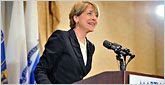
I voted in the special Democratic primary awhile back, and had assumed that the winner, state Attorney General Martha Coakley (photo: above left), was the heir presumptive, this being Massachusetts. That was “the conventional wisdom.” But apparently too many people, perhaps including the candidate, thought this, and now it looks like her opponent, State Senator Scott Brown, has closed the gap and the polls are saying the race is too close to call.

This is a dramatic development and has Democrats in a state of high anxiety. Bill Clinton is already here campaigning for Coakley, and the President is coming tomorrow (after earlier saying he wasn’t.)

The stakes are pretty high for Democrats, not just here in the Bay State (we call it that so we don’t have to keep typing in Massachusetts, which nobody really knows how to spell.) First of all, Scott Brown is not a moderate Republican like former governors Bill Weld or Jane Swift, or even Mitt Romney, who didn’t get in touch with his conservative inner child until he ran for President.

Brown is an unabashed conservative, pro-life, anti-taxes, and, most decisively for national politics, anti-health care reform. He has vowed to vote down the current health care bill, and, if he wins, he takes away the Democrats’ 60 votes they need to pass the thing. Now the bill will be far from perfect, but it is better than nothing, and nothing would be a blow for the country and a real defeat for the Obama administration. It is possible that the failure of this bill would mean we’d go another generation with our immoral and inefficient health care system, which would be, quite literally, a shame.

A Brown win could also be interpreted as a changing of the political winds, putting the fear into some of the wavering Democrats that aren’t too excited by the health care bill anyway, and maybe encouraging other vulnerable Democrats in unsafe seats to retire.

The great irony of it all is that if Brown wins and Coakley loses, the seat of Ted Kennedy, the iconic “Lion of the Senate” will become the vote that brings down health care reform.  That would be sad.

Special elections are funny things. With nothing else on the ballot they have low turn-outs and can be swung by the zealous and the angry. Brown has channeled populist anger at the banking bailouts, and has galvanized a coalition made up of the few remaining reasonable Republican party loyalists with an assortment of Tea Partiers and other “were mad as hell and we’re not going to take it anymore” types, all fired up by Rush Limbaugh, Glenn Beck and talk radio. It’s not pretty.

So it all depends on who turns out to vote on Tuesday. Coakley should beat Brown in Massachusetts, but then again, the New England Patriots were supposed to beat the Ravens in Foxboro last weekend in the playoffs. So stay tuned.

Unknown's avatar

The Riddle of “Smokehead” Single Malt Whisky

My son gave me a bottle of single malt Scotch for Christmas, as is his custom.  This year it was a mysterious bottle called Smokehead that he had picked up at Heathrow on a trip from London.

Smokehead is an independently bottled whisky from one of the eight Islay distilleries, but Smokehead is coy about saying which one.  Islay (pronounced Eye- la) is a small island off the west coast of Scotland about the size of Martha’s Vineyard.  Their malt whiskies are famous (or to some notorious) for their highly smokey character.

My son made me guess which one of the Islay malts was in the bottle (the clerk at Heathrow had told him that a friend of his knew which one it was).   The pressure was on.

I tried my first taste on Christmas night.  It was clearly an Islay malt, lots of peat, big smoky nose, and that briny quality that comes from aging in porous oak casks near the sea.

I was pretty sure it wasn’t Laphroaig (not smoky enough) or Lagavullen (not complex enough and too young), which have such unmistakable tastes. They are also the ones I know best.

It seemed a youngish malt (with no age statement). I guessed Ardbeg (my second guess was Caol Ila), and my son told me that Ardbeg was what the clerk told him it was.

A trip to the internet whisky sites confirms that Ardbeg is the most popular guess, but there are vehement dissenters.  It’s a lovely malt, but then they all are, really.

Smokeheadjust released an eighteen-year old in December that I have yet to try.  Maybe next Christmas!

Unknown's avatar

“The Glory of the Lord shall be revealed:” A Homily for Epiphany


When I was a small boy I thought that if you were able to go back in time to meet Jesus and the apostles they would have had visible haloes around them, as they did in the pictures I saw in books.  I later learned that this was an artist’s depiction of something called “glory.”

Glory meant a person’s honor and reputation. The glory of the Lord was understood to be visible, a kind of radiance that surrounded God and was reflected in God’s messengers the angels, and even in those who came close to God, so for example Moses was surrounded by a glow when he came down from Mt. Sinai.  Jesus himself is referred to as the glory of God as in the verse from Hebrews where it says that, “He is the reflection of God’s glory and the exact imprint of God’s very being.” (Hebrews 1:3)

But there is more to glory than the visible; glory is a power that makes things happen.  In John’s Gospel glory means both the “radiant brightness” of God and the “powerful activity” of God.  So how do the disciples see Jesus’ glory in the miracle at Cana and come to believe in him?

In John’s Gospel we see a distinct pattern in which Jesus shows by actions and words that he is the fulfillment and replacement of Jewish institutions and views. So now Jesus is the real Temple; the Spirit he gives will replace the necessity of worshipping at Jerusalem; his teaching and his flesh and blood will give life in a way that the manna associated with the Exodus did not; at the Feast of Tabernacles, no longer the rain–making ceremony but Jesus himself supplies the living water; not the illumination in the temple court but Jesus himself is now the real light; on the Feast of the Dedication, not the temple altar but Jesus himself is consecrated by God.” (See Raymond F. Brown, John, p 104)

In each of these cases, Jesus himself replaces the former practices.  And not only replaces them in an adequate manner but in an abundant manner.  But what about the wedding feast of Cana, where Jesus performs his first miracle, one of the three traditional Epiphany events (along with the Magi and the Baptism of Jesus)?  What institution is Jesus replacing in the miracle of turning the water into wine?  Recall that the water that Jesus turned into the finest wine was there for the purification rites.  The miracle is a sign of that Jesus is the one sent by the Father who is now the only way to the Father.  Not just the purification rites but all previous religious institutions, customs and feasts lose their meaning in Jesus’ presence.

The disciples would have recognized some of the rich symbolism in the episode.  First of all, it was a wedding, which in the Old Testament was often used as a symbol of the messianic days. And Jesus himself frequently used both the wedding and the banquet to talk about himself and the kingdom of God.  Indeed, Jesus often spoke of himself as “the bridegroom.”

The disciples would have had understood the miracle of the wine as a sign of the end time, for the Old Testament employed the figure of abundant wine as a symbol of the final days. We see this in Amos, Hosea and Jeremiah.  And in Second Baruch we find a lavish description of this abundance: the earth shall yield its fruit ten-thousandfold; each vine shall have a thousand branches; each branch a thousand clusters; and each grape about 120 gallons of wine. It is an oenophile’s idea of heaven.

The disciples then would have seen this miracle as a sign of the messianic times and the new dispensation.  The disciples knew that when the messiah came, he would reveal his glory.  They would have been well-acquainted with verses such as Psalm 102:16 which says, “For the Lord will build up Zion; he will appear in his glory” and Psalm 97:6 which says, “The heavens proclaim his righteousness, and all the people’s behold his glory.”

But John is not only interested in our seeing that Jesus’ first miracle is to be connected to all that will follow; he also wants us to see how it relates to what has come before, chiefly the calling of the disciples and their decision to follow Jesus.  After all, the reason that Jesus’ glory is revealed is that people may believe in him, that they“ may have life and have it in abundance.”

In the previous chapter in John before the story of Cana, two of John the Baptist’s disciples heard John say of Jesus, “Behold, the lamb of God” and they followed him.  And in the story of the calling of Nathanial, Jesus promises Nathanial “You will see greater things than these.”

I think John’s Gospel is particularly helpful to us who live in a time of widespread disbelief, because for John, “seeing” Christ’s glory is by no means a universal event.  John gives us an interesting cast of characters who have trouble with believing: Nicodemus, the Pharisee who comes by night to interview Jesus, the woman at the well, Thomas the empiricist who wants evidence before he will believe, and Mary Magdalene, so caught up in her own grief that she mistakes the risen Christ for the gardener.  These are people like us, men and women for whom belief comes hard.  So in John’s Gospel many people do not see, and even in this story the miracle is not a public event, so that the wine steward clearly regards the miracle as the bridegroom’s social ignorance in serving the good wine after the inferior stuff.

In Luke’s Gospel, which so dominates the Christmas season, the shepherds see the glory of the Lord shining round the angels.  The other evangelists report various transfigurations, glimpses of the divine glory in Jesus before the resurrection, an elevation of Jesus into some heavenly mode of being.  But in John we can only see the glory with the eyes of faith for now.  And why is that?

Because John takes the Incarnation so seriously that the veil of the glory is never removed, and the divine glory of Jesus is never seen except by the eyes of faith.  The direct view of Jesus divine glory, that is, his heavenly brightness, is reserved for the future, to the time when the believer will be there where Jesus has gone before.

Which reminds us that we walk by faith and not by sight, and even Jesus’ glory, so often defined as visible radiance, is seen only by the eyes of faith.   Someday the glory will be visible to all, so much so that it will be the new light which will replace the heavenly lights of sun and moon in the city of God.  So St. John the Divine says:

And the city has no need of sun or moon to shine on it, for the glory of God is its light, and its lamp is the Lamb. The nations will walk by its light, and the kings of the earth will bring their glory into it.  Its gates will never be shut by day —and there will be no night there.  People will bring into it the glory and the honor of the nations. (Rev. 21:23–26)

That’s pretty glorious. “And the glory of the Lord shall be revealed, and all flesh shall see it together.”  I don’t know about you, but I wouldn’t want to miss it! Amen.

(I delivered this homily at the closing Service  of Word and Sacrament for the annual meeting of Confessing Christ in the United Church of Christ, held at First Church of Christ in Pittsfield, Massachusetts on January 8, 1998)