Unknown's avatar

A Prayer for Lent by Henri Nouwen


In the early days of my ministry, in the mid 1970’s, I went through a big Henri Nouwen stage, where I read everything that came from his pen. Nouwen (1932–96) was a Dutch Roman Catholic priest, writer, lecturer, and spiritual director. He taught for a time at Yale Divinity School, and introduced many Protestant clergy to previously unfamiliar spiritual disciplines from his tradition. Later in his life he was a leader at the L’Arche Daybreak Community for people with mental and physical disabilities.

I was given his book The Wounded Healer as an ordination gift by my pastor and mentor Dudne Breeze.  That book is still worth revisiting.

Here is something else by him which speaks to me this season, a good prayer for these early days of Lent:

How often have I lived through these weeks without paying much attention to penance, fasting, and prayer? How often have I missed the spiritual fruits of the season without even being aware of it? But how can I ever really celebrate Easter without observing Lent? How can I rejoice fully in your Resurrection when I have avoided participating in your death? Yes, Lord, I have to die—with you, through you, and in you—and thus become ready to recognize you when you appear to me in your Resurrection. There is so much in me that needs to die: false attachments, greed and anger, impatience and stinginess…. I see clearly now how little I have died with you, really gone your way and been faithful to it. O Lord, make this Lenten season different from the other ones. Let me find you again. Amen.   (From A Cry for Mercy: Prayers from the Genesee, Orbis)

(Photo:  “Parker Brook in Winter,” Pittsfield State Forest, by R.L. Floyd)

Unknown's avatar

Is Cyberspace Evil? Thoughts Toward A Christian Ethic of Blogging


Sometimes a topic is just suddenly “in the air,” and the one that is currently preoccupying me is how people behave in Cyperspace. The medium of blogging is now old enough for us all to see fairly consistent patterns emerging, and one of them, sadly, is the pervasiveness of bad manners, boorishness, and a general tendency toward a reflexive mean-spiritedness.

This really shouldn’t surprise any of us who have an adequately robust view of human sin, for after all, Cyberspace is just a reflection of the “real world,” where the wheat and the tares grow together. Over the years I have had some really disturbing comments on my blogs. There are remedies one can take for this. One can choose to moderate comments (I don’t), or delete them (I usually don’t), but still it can be unsettling to have someone you don’t know flame you, call you nasty names, impugn your faith, or blaspheme your God. It happens all the time.

Lately some thoughtful people have been calling it out. First, Tom Wright, someone I once briefly studied with thirty years ago and greatly respect, had rather pointedly addressed the issue in a recent book, from which an excerpt was posted on Theology Forum, a thoughtful theo-blog. Wright said,

“It really is high time we developed a Christian ethic of blogging. Bad temper is bad temper even in the apparent privacy of your own hard drive, and harsh and unjust words, when released into the wild, rampage around and do real damage. And as for the practice of saying mean and untrue things while hiding behind a pseudonym – well if I get a letter like that it goes straight in the bin … I have a pastoral concern for such people. (And, for that matter, a pastoral concern for anyone who spends more than a few minutes a day taking part in blogsite discussions, especially when they all use code names: was it for this that the creator of God made human beings?” (Justification [2009], 27)

This was the beginning on that site of a lively discussion on the issue, and another post, focused mostly on the practice of anonymous commenting, which I find to be a dubious practice.

Then my friend David Anderegg, a noted child psychologist and professor at Bennington College, wrote a blogpost for Psychology Today, describing how he was repeatedly flamed and castigated on his blog after the New York Times, in a brief article about his new book Nerds, quoted him as saying that terms like nerds and geeks should be banned. The free speech crowd ate him alive, without bothering to read the book, or attend to the context of his comment, which was that such terms of derogation are keeping talented boys from pursuing studies in math and science at a critical time in their development because of the stigma of such terms.

In response to this unpleasant experience he wrote a subsequent wonderfully cranky blogpost entitled “How I Learned to Hate Cyberspace: I Thought I Had a Good Idea until it Hit The Internet.”

David hasn’t given up his blog, but some have gone as far as to say that Cyberspace is intrinsically evil, and should be avoided by Christians, and maybe by everyone.  Even Tom Wright, in the quote above, questions whether any of us should be spending more than a few minutes in blogsite discussions.  I am guilty as charged.

So should we just avoid Cyberspace?  Is it evil?  My response to that, which I posted as a comment on Theology Forum is:

The whole discussion of whether blogging is an appropriate vehicle for Christian expression is one that must take place, but missing in much of what I read is the whole notion of moderation. I enjoy and learn from blogs like this one and others of its ilk, of which there are many. Do I do other things? Yes. Do I interface with actual people in real life? Yes.

Some of the overheated talk against blogging reminds me of some of the arguments I have heard against the use of alcohol. True, some people should never touch it. But many others are able to partake of it in a healthy and profitable way. It is not evil.

So I cannot accept the argument that this new medium is intrinsically harmful. When Christians start labeling things evil, they often would do better to examine their own hearts and souls, where the problem often is located.

Now I am generally a defender of blogging, and I find the access to information and to far-flung colleagues that one wouldn’t otherwise have as interlocutors invaluable. But I have been on blogs and list-serv conversations for years and recognize that there are genuine problems.

So I am all in favor of an ongoing discussion that helps us be kinder and more civil to each other on-line. Here are some random thoughts about it:
My own first rule on-line is to try to remember that there is a real person at the other end of the communication, and to write as if one was speaking in person, that is face to face. That won’t entirely eliminate the bad behavior, to be sure, but it is a start.  I have witnessed rude, mean-spirited interactions in universities in both Britain and America, some of the worst ones by theologians (and certain ethicists.) My teacher James Luther Adams once said to me, “The average divinity faculty makes the average congregation look like the communion of saints!” I was young then and took him at his word, but after being ordained for thirty-five years ( and serving in both contexts) I suspect he was just more familiar with the former.
One of the roughest interchanges I ever witnessed was at a 1989 Society for the Study of Theology lecture at Exeter College, Oxford, where the young paper presenter, who remained gracious and calm throughout, was subject to a grueling Q and A that slipped outside the bounds of propriety. That speaker is now the Archbishop of Canterbury, so perhaps that was good training for the vitriol that he is now routinely subject to. But we should all do better than that, both in person and on-line.

One of the ugly truths about blogging is that controversy gets you viewers, and one of the temptations for us bloggers is to intentionally get a kerfuffle going to attract eyeballs to our sites. To succumb to this temptation is not tending to “the better angels of our nature,” and is, as we Christians like to say, the work of the devil.

I speak from experience, for I confess that I have a fairly high snark factor in both my speech and my writing, and need to constantly keep it in check. I admonish my brothers and sisters to do likewise. But there is a fine line between hurtful snarkiness and dry humor, and one needs to be aware that we can’t see each other’s faces to catch the nuances, so some care with our words is in order.  Remember that people who don’t know you, don’t know you!  Your friends may get you, but don’t expect that unknown others will.  This suggests comments be kept brief and to the point, and as free of horns and teeth as you can possibly make them.The Christian practices that keep order in actual (as opposed to virtual) communities should be in place on-line as well. “Tell the truth in love,” “do unto others as you would them do unto you,” “be not conformed to this world,” are just a few that leap to mind.  And gentleness and kindness are included in everybody’s list of gifts of the Spirit.

One of the practices that my Confessing Christ open forum conversation has is a sort of quiet shunning. If someone is consistently provocative and trying to pick a fight we just don’t respond, a kind of Cyber turning the other cheek. In this way we don’t embarrass the person, and typically he or she (usually he, for some reason) just gets bored and goes away, or repents and gets back in the flow.

Just some thoughts.  I’d be interested in yours about this, as long as you are nice about it.

Unknown's avatar

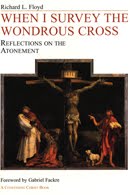
“When I Survey the Wondrous Cross: Reflections on the Atonement” is now available at Wipf and Stock Publishers


Some of you have asked me how to get a copy of my little book on the atonement, When I Survey the Wondrous Cross:  Reflections on the Atonement.  The book was a Confessing Christ book, and published in 2000 by Pickwick Publications, which Wipf and Stock Publishers acquired in 2004.

This is good news for us theologs, since Wipf and Stock, like Pickwick before it, has made many useful and significant books available that would otherwise not be published for lack of a sizable market.

Confessing Christwants to support Wipf and Stock in this important mission, and so we now have an agreement with them to carry the book.  It has been selling at Amazon.com for $14.00.  Now you can get it at Wipf and Stock for $11.20.  It is in paperback with a thoughtful foreword by Gabriel Fackre, Abbot Professor Emeritus at Andover Newton Theological School, with a striking cover designed by James R. Gorman.

Alan P. F. Sell, Professor of Christian Doctrine and Philosophy of Religion, Aberystwyth, Wales, writes on the back jacket: “I warmly recommend this book to all who wish to reflect earnestly and joyfully on the heart of the Christian Gospel. May the Cross of the crucified and risen Savior ever be at the center of our worship, service, evangelism, and ecumenism.”

If we sell out our limited stock Wipf and Stock will make a new printing available, but I’m guessing without the beautiful cover, so get yours now here.  Some of you Barthians may recognize the cover picture, as Karl Barth had a reproduction of it over his desk when he wrote his monumental Church Dogmatics.

Confessing Christ owns the copyright, so profits beyond what Wipf and Stock gets will support their good work of encouraging “joyful and serious theological conversation.”

(Cover: Crucifixion by Matthias Grunewald from the Isenheim Altarpiece, Musee d’Underlinden, Colmar, France.  Copyright Giraudon.)

Unknown's avatar

Ashes and Snow: The Quotidian Graces of my Ash Wednesday


I woke up early this morning.  Too early, in fact, to stir without waking my sleeping wife, whose alarm goes off at 6:00 a.m.  So I put on my headphones and turned on my iPod.  At bedtime it had been set to Rachmaninoff’s beautiful Liturgy of St. John Chrysostom, for I am boldly attempting to sing it with a local choral group in May.  But for some reason my iPod was now playing my entire library on shuffle, and I didn’t want to have the little but bright iPod screen light go on and disturb my wife, so I listened to an eclectic assortment of tunes, starting with Traffic’s “Freedom Rider,” then the Greatful Dead’s “Trucking,” and ending with something lovely by Mary Chapin Carpenter, with some Christmas music thrown in the middle for good measure.

The alarm promptly sounded its daily vigil, and as my wife prepared for work I got up to see if there was an early Ash Wednesday service I could attend, since I wanted to go snowshoeing, as we got a fresh new mantle last night, the first in quite awhile.  I know snow has been wreaking havoc south of here, but we have had, not a snow-less winter, but an atypical one for the Berkshires, and I have been hiking in just boots and Yaktrax every day, so I was pumped to get on my snowshoes.

My denomination, the United Church of Christ in the U.S., is a rich mix of traditions, but the majority of them have Reformed roots, so Ash Wednesday has never been big for most of us.   And especially here in New England, where the Congregational churches that sit in the center of every village and town have evolved from the Puritan settlers.  The Puritans, who in so many ways got it right (but not always), historically took a dim view of such suspect accretions to the faith as Ash Wednesday services (they outlawed the celebration of Christmas for generations to give you some idea of where they were coming from.)  In the UCC and other Reformed churches we are coming around, thanks to the cross-fertilization of the Twentieth Century ecumenical movement, so now you can find such services in our churches, but they are usually at night.

But I was raised an Episcopalian (as was my wife), and as a young person I used to go to the early Ash Wednesday Service with my Mom, who died when I was eighteen, and so I have many poignant memories of such services.  I am very familiar and comfortable with the liturgy from the Book of Common Prayer, and fully accept the imposition of ashes, and so I tamp down my more Puritan impulses on such occasions.

Consequently, I looked on-line for the services at the local Episcopal Church, where I have a long history, as it is near the congregation I served for 22 years, and where my wife and I attend every once in a while.  I was hoping for early, but be careful what you wish for, since the service was at 7:00 a.m., and it was already 6:40 and I was still in my PJs, and the church is a ten minute drive.

Now those of you who know me know that I am somewhat old school (I suspect my children might say to the point of fussiness), and don’t feel quite like myself in church without a coat and tie and proper shoes, but there was no time even for a shower (now occupied by the one who actually works). So I washed as best I could, and tried to disguise my bed-head, put on my hiking clothes and went to divine worship.

I arrived at the front door at 6:55 and it was locked.   Hmm, I thought.  This is clearly not a UCC church, for “extravagant welcome” is one of our principle articles of faith.  But I knew there was a side door that led to the chapel, so off I went and arrived in time to see a few other souls ready to enter.  The rector, who is a friendly and gracious priest, came sweeping in, welcomed us and beckoned us to the chapel.

The familiar liturgy really moved me, and, since my own sense of sin may well be my keenest spiritual faculty, I found myself very emotionally involved in the  service.  And, not to put too fine a point on it in a public blog, I have of late been even less where I would like to be in my long and sometimes stormy relationship with God than usual, so I was feeling properly penitent and truly glad to hear the good news of God’s forgiveness in Jesus Christ.

The rector nicely explained Ash Wednesday, and how they had, on the previous evening, made the ashes for the service from the Palms from last year’s Palm Sunday. Then we went forward to get our ashes and I dutifully fell in line with the faithful.  When my turn came the priest put ashes on my forehead and said “Rick, remember that you are dust, and to dust you shall return.”  Then she said to me, “Will you do me?”  She handed me the little bowl, I dipped my finger in it, and repeated the words she had said to me, while I made the sign of the cross on her forehead.

I have been very involved in the ecumenical movement for most of the thirty-five years I have been ordained.  It has fallen on hard times of late, sad to say.  But I was profoundly moved by my colleague’s recognition of me as a fellow minister of Jesus Christ.  Another priest friend of mine, Jane, did this years ago, so I have imposed ashes exactly twice in my life.  Both times the gesture was humbling and wonderful.   God can use such small acts of grace to strengthen the unity of his church, a unity that we have already been given in Christ, but that we cannot see because of our sin.

Then I went snowshoeing.  But first I e-mailed and called every retired and unemployed outdoor type I knew, but as in one of our Lord’s parables, they all had other plans.

So I went alone, which I never do, since I have a brain injury and sometimes fall, although I have poles so usually it’s just my pride that gets hurt.  But I decided to do it anyway today, and I had my cell-phone if I needed help. So I headed up the glorious white hill at the Pittsfield State Forest and broke fresh snow on one of my favorite trails.  It was beautiful there.

I had labored about half an hour, and suddenly there appeared two relatively new friends of mine out of the blue. The last person I had called before I left was my neighbor, who couldn’t go with me because of an appointment.  I had told her that I didn’t hike alone, but was going to try it today.  She mentioned that these same two good friends of hers might be at the State Forest today and I should look for them.  But, in truth, they had found me only because she had called them after I talked to her, and they were all looking out for me.  We had a vigorous hike uphill and back down and a most pleasant conversation.  It was lovely.

Such were the quotidian graces of my Ash Wednesday, for which I am most grateful.

Unknown's avatar

A Hundred Lesser Duties: The Marginalization of Preaching

pulpitThe great British theologian P.T. Forsyth often complained that the church was guilty of the “sin of bustle,” by running errands for the culture at the expense of its own unique vocation. Perhaps preachers are the guiltiest of them all when it comes to this, when they avoid attending properly to their high calling of preaching.

Here’s Richard Lischer’s cogent take on what too often happens to preaching today:

Most ministers were “set apart for the gospel”, as Paul says of himself … The preacher’s vocation was once a kind of circle that began and ended in the word. Whatever it was that made you a minister was aimed at its eventual public expression. The minister’s whole existence was concentrated to a point of declaration. Today, however, the circle has been broken.

Our culture devalues proclamation while elevating other associated forms of ministry such as counseling or community work . . .

But the proclamation of the word cannot be professionalized. It has no functional equivalents in secular culture. It cannot be camouflaged among socially useful or acceptable activities. Its passions are utterly nontransferable. The kerygmatic pitch, as Abraham Heschel said of the prophet’s voice, is usually about an octave too high for the rest of society. If you are filling out a job application, see how far it gets you to put under related skills: “I can preach”.

When ministers allow the word of God to be marginalized, they continue to speak, of course, and make generally helpful comments on a variety of issues, but they do so from no center of authority and with no heart of passion. We do our best to meet people’s needs, but without the divine word we can never know enough or be enough, because consumer need is infinite. We are simply there as members of a helping profession. We annex to our ministry the latest thinking in the social sciences and preface our proclamations with phrases like ‘modern psychology tells us,’ forgetting that the word ‘modern’ in such contexts usually indicates that what follows will be approximately one-hundred years out of date. What we lack in specialized knowledge we can only offset in time by making ourselves compulsively available to anyone in need.

I am convinced that no seminarian or candidate sets out to minister with such reduced expectations, and not everyone succumbs to this scenario, but ultimately the marginalization of the word of God fractions it into a hundred lesser duties’.

Richard Lischer, The End of Words: The Language of Reconciliation in a Culture of Violence (Grand Rapids / Cambridge, U.K., 2005), pp. 22-24. (I got this from two of my favorite theo-bloggers: Kim and Jason.)

Unknown's avatar

“You Won’t Despise a Broken Heart” A Hymn for Lent

Icy Brook

“You won’t despise a broken heart”
C.M

You won’t despise a broken heart
or spirits made contrite.
You lift the downcast, stay the proud,
and ancient wrongs make right.

The humble look to you for strength,
for comfort and for peace.
They know you’ll go to any length,
to give their souls release

Through times of hard temptation,
of testing and of trial,
You always go before us,
You’re present all the while.

When danger comes in any hour,
no matter what the test.
You come in presence and in power
to those who seek you best.

On dark Golgotha’s lonely hill,
our hearts were filled with dread.
Bright Easter turns our dread to thrill,
Christ’s risen from the dead!

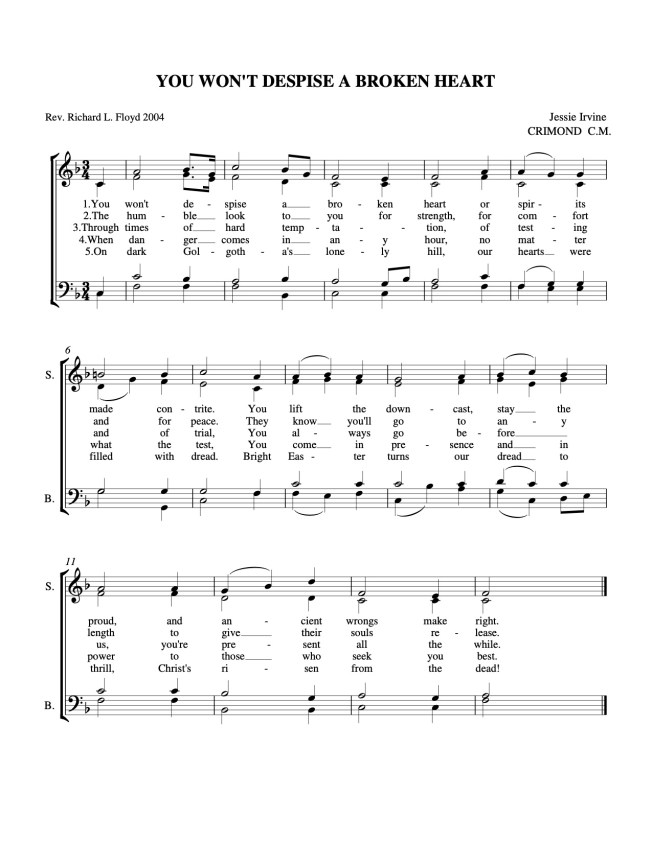
Recommended tune: Crimond.

©2004 Richard L. Floyd

Here is an engraving of the hymn with the tune Crimond:

YOU_WON'T_DESPISE_A_BROKEN_HEART_crimond copy


Unknown's avatar

The Green Religion of the Blue People: The Faith of Avatar

(Spoiler alert: If you are one of the few moviegoers who hasn’t seen Avatar you may want to wait to read this until after you’ve seen it, as it gives away plot lines.)

James Cameron’s Avatar is quite literally spectacular, and if you are a film buff, you will want to see it just because it is quite unlike anything that has gone before, and it will no doubt put its stamp on the way Hollywood movies are made for years to come.

I see very few movies at the theater, since I find them too stimulating for my brain, but I wanted to see this one in 3D, and I hadn’t been to Pittsfield’s new Beacon Theater, so off we went on a date last night.

I’d seen 3D films before, like the 1986 Michael Jackson movie, Captain Eo, at Disney World, directed by Francis Ford Coppola.  But the 3D films I’d seen before always used the 3D as an obvious gimmick that you just couldn’t forget was there, with things flying around the room and jumping out at you. Not true this time: I forgot about the 3D very quickly while watching Avatar. It is part of what makes the film so visually stunning, of course, but Cameron deftly uses it to advance the look of the film and not just to show off.

As has been noted by critics the plot doesn’t measure up to the film’s amazing visual effects, and it is true. You keep getting the feeling you may have seen this film before, maybe multiple times. It has been compared to Ferngully, Pocohontas, and, especially to Dances with Wolves, where a protagonist goes among noble aliens and is captivated by their ways, unsuccessfully trying to intercede on their behalf to stay the disaster approaching them. The young clerk at my local Blockbuster told me I should definitely see it, but called it “Dancing with Smurfs,” since the local folks on Pandora, the earth-like moon where it all takes place, the Na’vi (hmm, awfully close to the Hebrew word for prophet) are a race of ten-foot blue skinned humanoids (but in a good way.)

What struck me most about the film were the numerous religious motifs running through it. There is a powerful scene of laying on of hands, which evoked my own ordination, when the celebrant invited the whole congregation to come join the gathered clergy to lay hands on me (we’re Congregationalists.) There is a faith healing scene that would have done Oral Roberts proud, with an incantation that sounded very much like glossalalia, although I don’t speak the Na’vi’s tongue, so the priestess could have been reciting Luther’s Small Catechism for all I know.

But I doubt it, for the Na’vi’s God is Eywa, a mother goddess who seems to be the aggregate of all living things on Pandora. This essentially pantheistic deity later seems to undergo a decidedly Western monotheistic personality change when she takes sides and helps the Na’vi repel the nasty humans that are trying to despoil her turf, with the aid of the human protagonist Jake Sully, a former marine, now in a Na’vi body (it’s complicated).

Jake prays to Eywa to help him stop the humans, whom he has come to see as the enemy. Netiri, Jake’s fetching Na’vi love interest, tells him that Eywa doesn’t take sides, just seeks the balance of all things in nature. Well, apparently this time is different, since the out-gunned Na’vi defeat the human military with the help of everything on Pandora that crawls, runs, swims, or flies, with Jake banding together the scattered tribes in solidarity against the rapacious humans.

Jake becomes the unifying leader, a sort of Messiah figure to the Na’vi, only instead of an atoning sacrifice, he just blows everybody out of the water like Rambo or a blue Clint Eastwood.  One of the morals of the film is don’t mess with a blue Marine!

There are deaths, but not atoning ones, to some of the main characters, mostly women I noted, as the head scientist, Dr. Grace Augustine, head of the Avatar program, (played nicely by Ripley, I mean Sigourney Weaver) and Trudy, a spunky pilot (played by Michelle Rodriguez, and arguable the most interesting character in the movie) don’t live to see the closing credits roll. Trudy does get the best line in the movie, “I was hoping for a mission that doesn’t involve martyrdom.” She doesn’t get one.

To be fair, this is James Cameron and not Karl Barth, and a Hollywood movie is not required to uphold standards of religious orthodoxy, unless it’s by Mel Gibson, but that opens up another whole set of sticky issues. But by any measure the faith here is not remotely Christian, or Jewish for that matter. For one thing, the whole idea of the Avatar project hinges on a mind/body separation that is more Neo-Platonic dualism than biblical. As one of my Old Testament teachers like to say, “You don’t have a body, you are a body.” But Jake Sully has two! And although Christians and Jews share an affinity with the whole created order by virtue of our shared Creator, and are given responsibility to be good stewards of creation, we transcend creation as well as being part of it. We may enjoy the rocks and trees, but we are not at one with them the way the Na’vi are, and we certainly don’t worship the creation, but the Creator who made them as well as us.

But hey, it’s only a movie, although at times it slips into propaganda, and so deserves some scrutiny. It is also extremely violent, which underminds the whole “respect for all life” beliefs of the Na’vi, who turn out in the end to be pretty badass in a fight, even if they only have bows and arrows against gunships.  Of course in the real world the aboriginal people never beat the invaders who have better technology, but Pandora is most dramatically portrayed as anything but the real world.  Perhaps it gives us some comfort to imagine a world where such turnabouts could happen.

Cameron throws everything but the kitchen sink in here, but some themes emerge. The scientists, like anthropologist Grace Augustine (who smokes to show her humanity), are good, if wooly-headed and overly idealistic. The military (basically paid mercenaries) are bad. But the most evil is the boss of the corporation RDA, which is basically there to make money from mining unobtanium (apparently named that because it is unobtainable without despoiling the Na’vi’s world.)

The noble savages are, well, noble, and their way of life is very attractive, and above all green. Cameron has admitted an implicit critique of the war in Iraq (fair enough) and there is mention of “shock and awe” as the humans get ready to wipe out the locals.

So imperialism, colonialism, militarism, capitalism, corporations, and environmental irresponsibility all get sent up, giving us lots to cheer about. But it has not been lost on the critics that it is a “white guy” who has to come along to save the wise but backward Na’vi. The action takes place in 2154, and apparently earth is a dying, lifeless, and very non-green dystopia, whereas Pandora is teeming with biodiversity. Eden in 3D.

And the religious faith of Avatar? It is a hodgpodge to be sure, but essentially it is the old pagan mother-earth goddess worship, as old as Ishtar in ancient Assyria and Babylonia. Ross Douthat of The New York Times wrote that Avatar is “Cameron’s long apologia for pantheism . . . Hollywood’s religion of choice for a generation now.” I think he’s spot on.

Nevertheless, go see Avatar, wear the silly 3D glasses, and enjoy the spectacle.  But don’t buy the half-baked faith that is proffered.  For the real deal get yourself into a pew.

Unknown's avatar

Was Scott Brown telling the truth about Health Care? Not really! Part 1


My new United States Senator Scott Brown is all sworn in, and rolling up his sleeves to get to work.  Only twelve days after his stunning upset victory over Martha Coakley in the Massachusetts special senate election Brown made the rounds of the Sunday talk shows last week.
How did he do? On the January 31 edition of This Week with Barbara Walters he encouraged President Obama to put a freeze on federal position hires and raises because, he said, “as you know, federal employees are making twice as much as their private counterparts.”
This just doesn’t sound right to me, and it didn’t sound right to the Web site PolitiFact.  Here’s what they had to say:

PolitiFact | In PolitiFact debut, Brown says federal jobs pay twice as much as private sector jobs

Posted using ShareThis

Unknown's avatar

Was Scott Brown telling the truth about Health Care? Not really! Part 2


Then later (on her show last week)Barbara Walters asked Senator Scott Brown, “Why isn’t what’s good for Massachusetts good for the whole country?” Brown responded, “In Massachusetts, the free market, the free enterprise has taken control, and they’re offering a wide range of plans. I’ve never ever said that people should not get health insurance. It’s just a question of if we’re going to take a one-size-fits-all government plan or we’re going to do something where the individual states can tailor their plans as we’ve done.” 

When Walters asked him, “Do you think the whole plan should be scrapped?” Brown said, “Yes.” 
“The whole plan?” Walters pushed him on it.

“Yes,” Brown said again.
In the Roundtable discussion afterwards liberal New York Times columnist Paul Krugman expressed incredulity at Brown’s statement, claiming that the Massachusetts health care bill, which as you may recall, was pushed through by Republican Governor Mitt Romney with Brown voting for it in the Massachusetts senate, is nearly identical to the Senate bill.
Was Krugman right? PolitiFact says he was, that the differences in the bills are few and in the small print.  Here’s what they had to say:

PolitiFact | Krugman calls Senate health care bill similar to law in Massachusetts
Posted using ShareThis

So Brown is off to a bit of a rough start in his relationship to the facts, not an entirely unknown flaw in a politician.  But he’s in the big leagues now, so he better do his homework before he talks on national network TV, or else Tina Fey might be impersonating him on Saturday Night Live sometime soon. People loved his populist truck driving image on the campaign trail, and his fiery rhetoric about the rascals in Washington. But now he’s in Washington, and people do actually pay attention to what you say there.

Unknown's avatar

Rick’s Oven-Braised Straccato (Pot Roast) over Polenta


1 Tb. olive oil
1 3 lb. chuck roast, tied with twine ( I like Black Angus)
1 medium onion chopped
2 carrots chopped
1 celery stalk chopped
4 garlic cloves, peeled
2 sprigs of fresh parsley (optional)
1 cup hearty dry red wine
2 cups beef stock plus more if needed.
1 14.5 oz. can of diced tomatoes
1 tsp dried sage leaves
1 tsp dried oregano
Kosher salt and pepper

This is basically a pot roast.  Eliminate the tomatoes and garlic, substitute dried thyme for the sage, add a bay leaf, and you have my basic pot roast recipe. That one I would serve over mashed potatoes, but this one I like over polenta. A straccato is a regional Italian pot roast, and this is my take on it. Let’s call it a North Jersey pot roast!

This is easy but takes a bit of time, which is what braising is all about.  I cook it all in my cast iron Dutch Oven, but you could do it in any fireproof pot that can go from the range to the oven. You can also cook the whole thing on the range top, but I like the even heat of the oven. I made this yesterday, put it in the oven at 4 p.m., went and had my daily nap, and it was all ready to eat by 6:45 (it needs to sit for a bit). Even better make it the day before, slice the cooled meat, heat up the sauce, and you are ready to go.

Pre-heat oven to 325 degrees F.  Heat the oil over medium high heat and swirl it around until it covers the bottom. Dry off your roast with paper towels (it won’t brown if it’s damp) and sprinkle it liberally with Kosher salt and freshly ground pepper. Then using tongs, or two wooden spoons, put it in the pot and brown it on all sides (don’t use a fork, because it will release the juices and you want them in there,). Depending on your heat this will take between ten and twenty minutes, but the trick is to get it a very dark brown without burning it, so pay attention (which is what good cooking is all about).

When the roast is nice and brown, take it out and put it aside on a plate, and reduce your heat to medium.  Put in your chopped onion, carrot and celery, and stir with a wooden spoon now and again until the veggies are also nice and brown (but not burnt!), about ten minutes.

Add the garlic cloves and cook for another minute or so, then add you wine, beef stock, herbs and tomatoes and bring to a boil. Then lower heat to a simmer and, stirring occasionally, let it cook for about ten minutes.

Then lower the meat on top of the veggies.  The braising liquid should come about half way up the meat.  If it doesn’t add more stock, but don’t put too much liquid in, because you want to braise it and not boil it.

Bring it back to a good boil, put the lid on it, and put it in the oven.  A 325 degree oven will typically keep a simmer just about right for braising, though you may need to adjust your heat according to variations in your oven temperature.

You want to cook this for about 2 and 1/2 hours total.  After about an hour, check the pot, lower or raise the oven temperature if needed and flip the meat over. If the liquid is low top it off with some more stock.


After two and one half hours, check the meat. It should be nice and tender but still firm enough to cut.  Put it on a platter, tent it with foil, and let it sit for fifteen minutes. While the meat is cooling, put your braising liquid on the range top and simmer it to reduce the sauce a bit, stirring now and again. Remove the parsley sprigs, taste and season for salt and pepper.

Slice your meat against the grain and plate it over the polenta or mashed potatoes, then ladle the sauce generously and enjoy.  We had this with steamed brussel sprouts last night for a hearty winter meal, but a green salad would work fine.  A dry red wine will be just right. We drank a Masciarelli, a nice inexpensive Montepulciano d’Abruzzo, that is our current house red. This makes a nice, pretty easy, meal on a cold winter night that will be a crowd pleaser.

(Photos: R.L. Floyd)