Unknown's avatar

Gone to Look for America


When my wife’s position fell to the sickle of the Great Recession we decided to seize the moment and go on a road trip to Arizona to see our son who is in law school there.

So we spent all of October and the first couple of weeks of November on an excellent adventure across America, receiving the hospitality of family and friends, with some nights in Best Westerns to fill in the gaps.  Every town in America worthy of the name has a Best Western and a Subway, and I imagined the archaeologists of the future deciding these were the hallmarks of American civilization in the early Twenty-First century, much as a stoa was in the Hellenistic culture of the ancient world.

Subway is important, too, because you can split a foot-long “Veggie Delite” for 5 bucks and cheaply get enough fresh vegetables to avoid scurvy.

Our trip took 43 days; we drove 7,601 miles and visited 27 different states. The sun was shining all but two days.  No car trouble.  One oil change.

Some highlights:

  • The Frank Lloyd Wright house “Falling Waters” in Western PA
  • A stay at Potawatomi Inn in Pokagon State Park in Indiana
  • My Coe College Reunion where I sung in the alumni choir with my former director, Dr. Allan Kellar
  • Seeing my first newly shot bison carcass outside Pierre, SD with “Roger from the Prairie”
  • Badlands National Park in SD
  • The Black Hills National Park and Mount Rushmore in SD
  • Devil’s Tower in Wyoming
  • A few days in a friend’s cozy cabin outside Rocky Mountain National Park in CO
  • Taking the waters in Glenwood Springs, CO
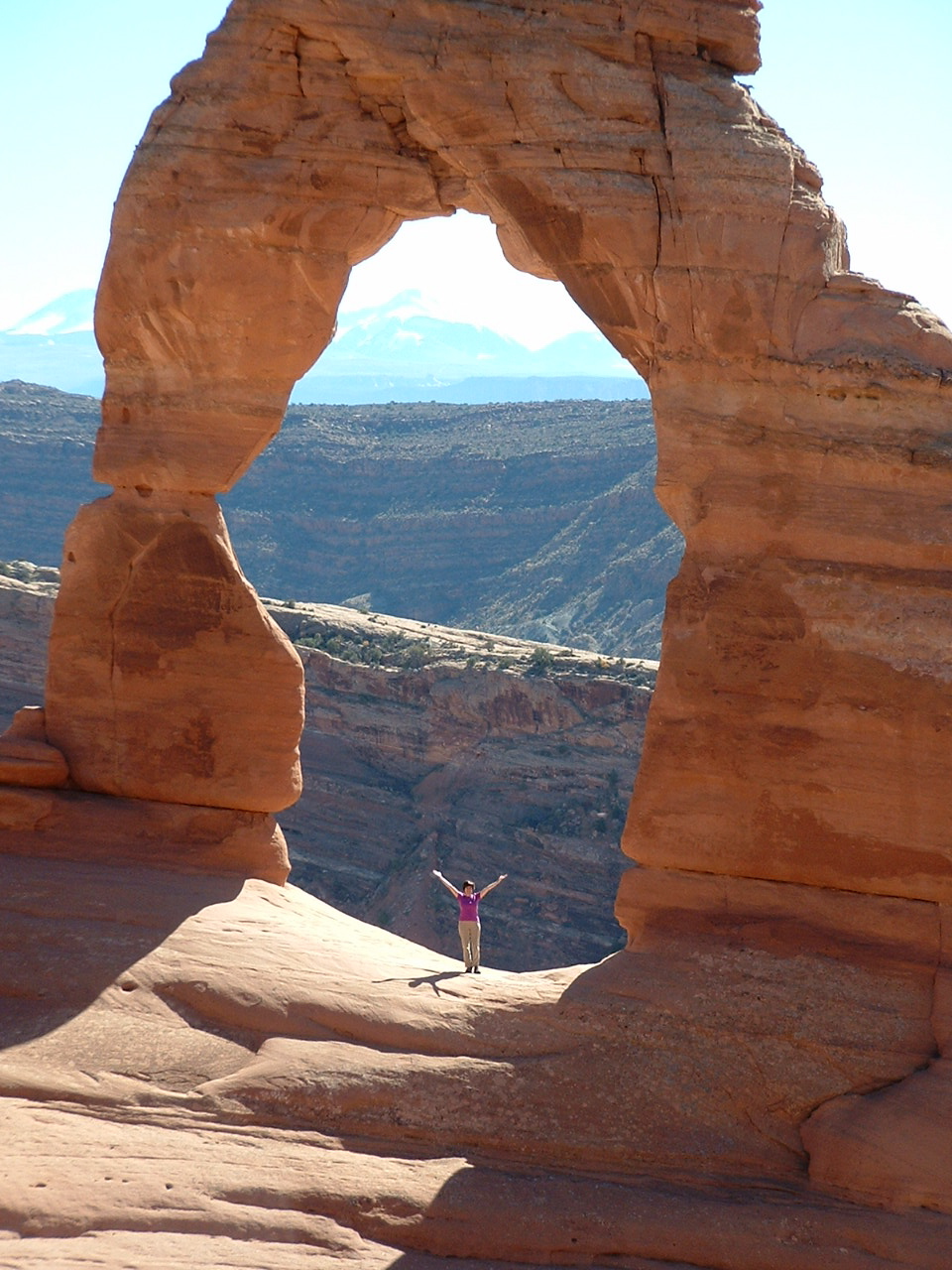
  • Arches National Park in Utah
  • Driving through Monument Valley on the border of Utah and Arizona
  • The sun on the red rocks in Sedona, AZ
  • The Calexico concert at the Rialto in Tucson
  • Hiking Bear Canyon outside Tucson
  • Eating Texas barbecue in El Paso, TX
  • Eating a chicken fried steak in Ozona, TX
  • The Riverwalk in San Antonio, TX
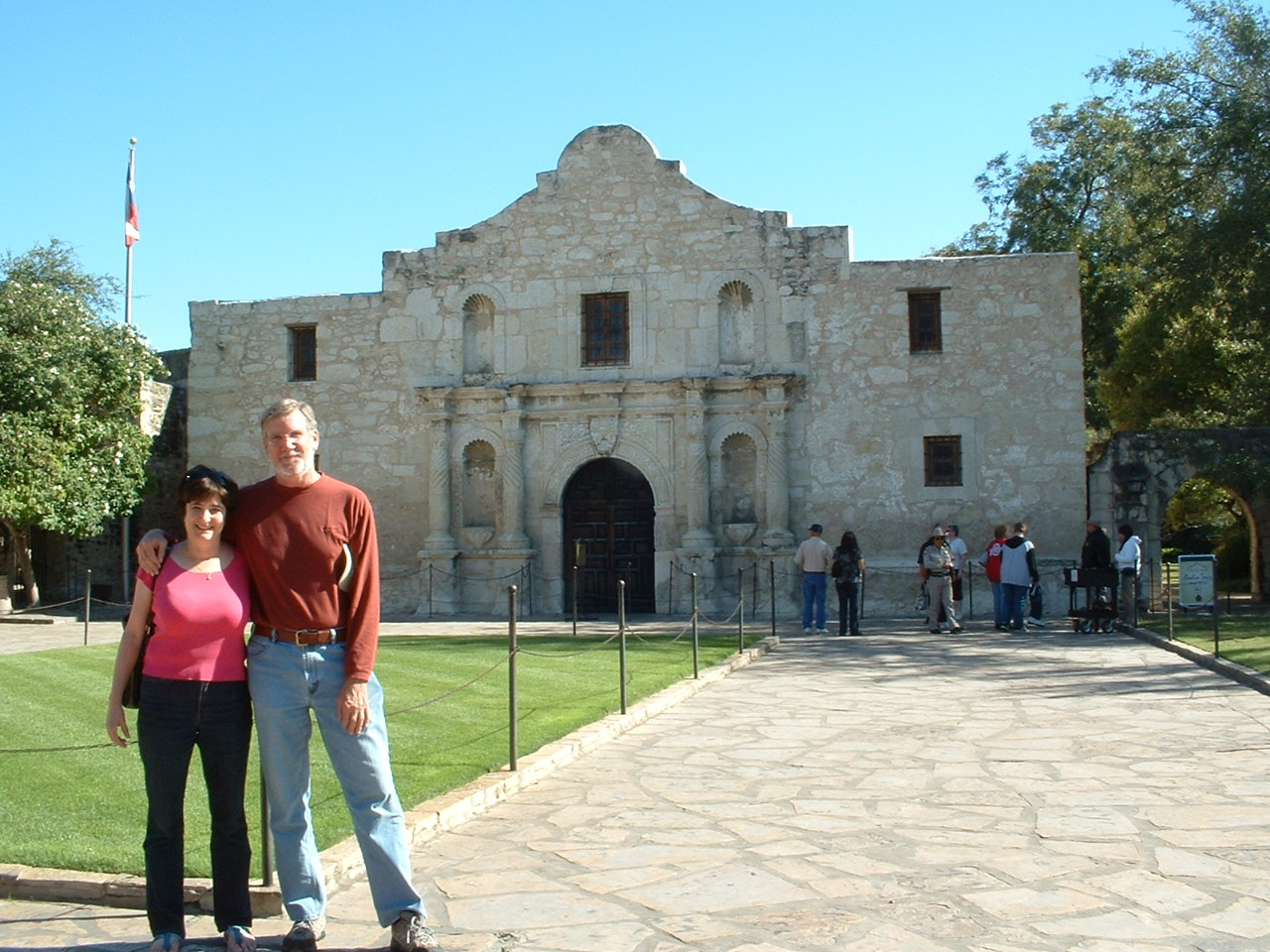
  • Seeing the Alamo after all these years since my Davy Crocket cap
  • Eating the best Tex-Mex food on an outdoor patio (in November!) in San Antonio, TX
  • Seeing my first bayou
  • Eating blackened redfish and seafood gumbo in New Orleans, LA
  • Seeing how beautiful the Old South is in the fall, with yellow leaves still on the trees.

The autumn of 2010 was a season fraught with fear and anger, with a highly divided electorate during a nasty campaign season.  We saw evidence of that on billboards.

Still, the countryside abides and rolling through the miles one is struck by its vastness and the diversity of its scenic beauty.

Here’s what I noticed about Americans:

  • They don’t use their blinkers.
  • The obesity epidemic is not a fiction of the media
  • “Beef: It’s what’s for dinner!” is not a marketing slogan, but a way of life
  • They like to drive big trucks

Here’s what I noticed about America:

  • Texas is really big
  • The Interstate Highway System is an impressive piece of infrastructure
  • Our National Parks are stunning
  • There are many sections of many towns and cities that could be anywhere in America
  • You can get the same Subway sandwich made exactly the same way in all 27 states that we visited, except no provolone in Mississippi
  • Many cities in the South still look prosperous (perhaps they won the Civil War after all)

Many thanks to all the wonderful folks who hosted us.

(Photos from top:  Rocky Mountain National Park, Arches National Park, Mount Rushmore, The Alamo)

Unknown's avatar

New poll: One out of Four Americans is not paying attention!


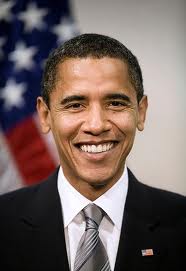
Against all the facts, 25 % of Americans believe that President Obama is a Muslim, according to a new poll. It is hard for me to find the words to express how discouraging that piece of information is.

I have it on good authority from reliable personal contacts that President Obama and his family were members and regular attenders at Trinity United Church of Christ in Chicago, which happens to be the largest congregation in my denomination, the United Church of Christ.  Yes, that is a Christian Church.  The members of such churches are Christians.

The Obamas would probably still be members there if Jeremiah Wright, the former pastor, hadn’t got off his talking points and scared many of the electorate during the campaign.

That the Obamas have not found a church home in Washington, D.C. may be a result of the painful memories of the Wright incident, when the 24/7 news media scoured Wright’s sermons for evidence against the candidate. That some of the phrases they took out of context sounded very much like the kind of thing that many of us preachers have often said from the pulpit made them sound no less scary when played back on Fox “News” (sic).

Like Supreme Court nominees who do best to have no record to derail their nomination it may be prudent for a president of the Untied States to detach himself from church membership to avoid defending every jot and tiddle spoken from the pulpit of his church.

The irony now is that the Obama campaign nearly got derailed when the media portrayed his Christian pastor as being a loose cannon, but apparently a good 25% percent of the electorate never even heard about it. Or maybe they forgot, which is even more discouraging. So I don’t know, I must conclude that one in four Americans is just not paying attention.

But one thing I do know for sure, the right wing demagogues, and the benighted citizens who pay attention to them can’t have it both ways. President Obama can’t be BOTH a Christian with a dangerously unstable former pastor and be a Muslim. He just can’t.

Unknown's avatar

A visit to Olana, home of Frederic Edwin Church


I have lived in the Berkshires since 1982, but had never visited Olana, the spectacular home of landscape painter Frederic Edwin Church, until yesterday, despite it being only an hour away by car. We live just a few miles from the border of New York State, but for some reason it acts as some sort of invisible force field so that we go in that direction to see the sights far less frequently than those here in Massachusetts.

But I knew about Olana, because a few years ago I had heard an interesting paper given about it at the Monday Evening Club by Ron Trabulsi.  When the members came to comment on his paper I think I was the only one in the room who hadn’t been there, so I resolved to go.

And I’m glad I did, because Olana is well worth a visit. It is a fascinating place with a fascinating story.  Frederic Church (1826-1900) was a New Englander who came to the Hudson River Valley when he was eighteen to study with Thomas Cole, the English-born American artist who is generally considered the founder of the influential Hudson River School of landscape painters.

Church was able to be a painter because he came from a prosperous family. His father was a silversmith and watchmaker in Hartford, and his grandfather had founded the first paper mill in the Berkshire town of Lee, about ten miles south of where I write this.

Like Cole, Church painted lush atmospheric landscapes of the American frontier. These suggested something mystical about the young country’s land and water and air, and they were very popular. After a trip to South America Church painted a landscape of a scene in Ecuador he called “The Heart of the Andes” (1859, now in the Metropolitan Museum of Art in New York.) He took this painting on tour and sold tickets to see it. Eventually he sold it for $10,000.00, the highest price for an American painting at that time.

But these big spiritual landscapes were in time to fall out of fashion to the, you guessed it, Impressionists, and Church put more and more of his attention to the development of Olana, which is itself a work of art.
He had the time, the talent and the money to make his home into a life project.

He knew the site for he had sketched from the place that was to be Olana back in 1845, when he was studying with Cole. In 1860, just prior to his marriage to Isabel Carnes, he purchased the 126 acre farm near the town of Hudson and overlooking the Hudson River. He built a cottage, laid out an orchard and gardens, and dredged a lake out of a marsh. In 1869 he purchased a wood lot on the top of the hill, and this is where he would build Olana, an eclectic villa incorporating several styles of architecture.

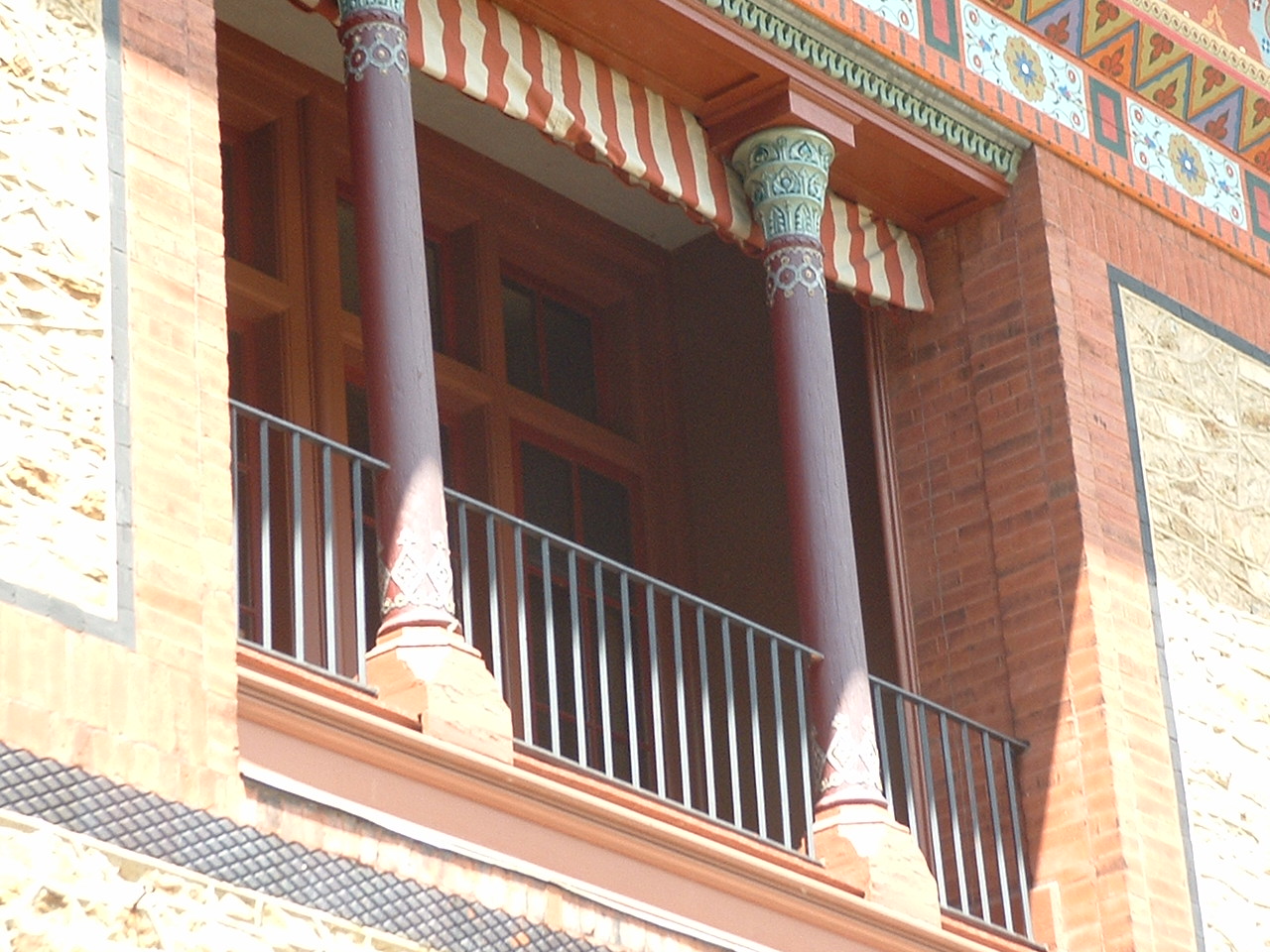
Olana is a unique blend of Victorian architectural features with Italianate influences and Moorish decorative motifs. When Church would travel his painterly eye would be attracted to some design feature that would later make it’s way to Olana.   He traveled to Mexico later in life, and brought ideas he had seen there into the decorations.

Olana is hard to describe because it is so eclectic (even eccentric).  The thing that holds it all together is Church’s own painterly vision and decorative sensibility.

Olana is now run by the New York State Office of Parks, Recreation, and Historic Preservation.   They have a good web site to describe how to visit.  You can only see the inside of the main house on a tour, which you should do. Several of Church’s paintings can be seen, as well as some by Cole.

The grounds are also lovely, as Church shaped them by his own designs. Take a picnic and sit by the lake. There is an extensive system of trails and carriage paths, so bring your walking shoes.  The whole visit was an experience of a day gone by.

(Photos by R. L. Floyd)
Unknown's avatar

Volcanoes and ash plumes: Ruminations on global interconnectedness


The most recent news from Iceland is mixed: new tremors in the volcano, but a lower ash cloud. That should help free up air travel and help thousands of stranded passengers get to their destinations. Most of us know somebody who got grounded, and was trying in vain to get home from a business trip, or to fly to Boston from Europe for the fabled marathon there today.

The situation reminds us that we do live on a small planet where all our lives are interconnected.

Jim Gordan, who blogs from the UK at Living Wittily, reflects thoughtfully on this in his post “when the global becomes local and the international becomes personal.” Here is an excerpt:

Ease and safety of travel has become such an integral part of what we take for granted as normality, that this past week has created a new level of awareness of just how vulnerable technology is to the elemental physical forces that drive and shape our planet.

Easy now to slip into apocalyptic scenarion; but just as easy to assume that once the direction of the wind changes the situation will revert to normal. Somewhere between apocalyptic meltdown and complacent unconcern is the harder reality of having created a world dependent on air flight, air freight and air defence systems. And for the first time total shut-down has simply negated that assumption. The unprecedented now has precedent. In a world where risk assessment, risk management and rehearsed emergency scenarios have become standard activities of corporate bodies, it seems this particular combination of circumstances escaped the risk assessors and the Hollywood script writers.

Jim continues to write about the upcoming British elections, which may or may not be of interest to you depending on where you live, but he concludes his post with a call for prayer for the manifold needs of our world, and that is a message all can heed.

Unknown's avatar

Extravagant Love and the Smells of Passion: Reflections on John 12:1-8

Mary of Bethany pours out a whole pound of expensive perfume on Jesus’ feet. This is an extravagant, seemingly wasteful and impulsive act. And why would she pour it on his feet and not on his head, as would have been the normal act of hospitality for anointing? Because, although you would anoint a living man on the head, this is how you would begin to prepare a corpse for burial.

The house immediately fills up with the smell of perfume. I once ordered my wife two bottles of her perfume on-line, since it is hard to find in stores. I ripped opened the paper package and handed it to her, and she went to pull one of the bottles out of the package, but it had one of those decorative plastic tops that pull off. The top held the bottle just long enough to let it be pulled out of the package and then it let go and we had a smashed bottle of perfume on our bathroom floor. I can assure you that the smell of it quickly filled up the room, and this was just a few ounces, not a pound.

So Lazarus’ house, where his sisters live, is now smelling really good. Here’s an interesting connection: remember how in the story of the raising of Lazarus when Jesus approached the tomb, Martha had warned him that there would be a stench, because Lazarus had been dead for four days. (John 11:39)

This time Mary has filled the house with the fragrance of devotion to overcome the stench of death. Fragrance is often used in the Bible as a metaphor for a sacrificial offering. In 2 Corinthians 2:14-16, Paul refers to Christians themselves as a fragrance that spreads the knowledge of God. He writes, “But thanks be to God, who in Christ always leads us in triumphal procession, and through us spreads in every place the fragrance that comes from knowing him.”

So Mary’s act was fragrant as well as flagrant! Then she began to wipe Jesus’ feet with her hair. What is the significance of this? Jewish women of the time usually wore their hair tied up in public. There would have been only two occasions when their hair would have been loose like this, when undressing for a husband, or as a sign of distraction in mourning. So Mary plays the role of both unabashed lover and soon to be mourner as she wipes Jesus’ feet with her hair.

But Judas, the treasurer of the disciples, has different thoughts. You might say, “He caused a stink!” Judas criticizes Mary. He says, “What a waste! That perfume was worth a year’s wages. Surely it could have been put to better use. Could it have not been sold and the proceeds given to the poor?” In this case Judas’ condemnation of Mary serves as a reminder that any act of faith will always have someone to criticize it and complain about it.

It is interesting that Judas is a character both at this dinner and at the Last Supper. The Greek word for “dinner” is used in John’s Gospel only in two places: here and at the Last Supper. There is another interesting connection with the Last Supper: the word used to describe Mary’s “wiping” with her hair is the same word used to describe Jesus wiping the disciples feet. There is clearly a close connection between this supper and the Last Supper. What do they share? They are both preparatory to Jesus death. At this dinner, Mary knows that Jesus is about to die and anoints him. At the Last supper, Jesus tries to interpret his coming death to the disciples with a ritual meal.

Judas’s role here is interesting, too. Not only is he in both stories, he lays a similar role. He is described as a thief here, kleptes in the Greek, which is the same word used earlier in John’s Gospel to describe the unreliable hired hand who threatens the flock. Judas is a like the dishonest hireling, a thief and a betrayer. There is a word here for the church, too. When Judas betrays Jesus, he betrays the flock as well. Which is to say that if Mary is the model of the faithful disciple, then Judas is the model of the unfaithful disciple.

But Jesus doesn’t accept Judas’ complaint. He says to Judas, “Leave her alone. She bought it (the perfume) so that she might keep it for the day of my burial. You always have the poor with you, but you do not always have me.” The word “leave” here is the same word in Greek as “forgive” in the Lord’s Prayer. It means let it go.

“Let it go, Judas. Mary is right and you are wrong!” That is what Jesus is saying. That Mary is devoted and true, and Judas is dishonest and false. And it is interesting that in this story, the virtues Jesus praises are the seemingly wasteful and extravagant act of Mary.

What are we to make of this? A few thoughts:

• First, I think we need to be careful not to extract this story out of its context and make a general principle out of extravagance. Jesus is saying, “There’s a time and a place. My time is short, Mary’s devotion to me at the brink of my death is a better thing than business as usual.”

• Secondly, Mary has truly understood both the trajectory of Jesus’ special vocation and the very nature of God. The extravagance of her act mirrors the extravagance of God’s love. We got a glimpse of that extravagance last week in the story of the Prodigal Son. We see it again today. Here is a God who does not know when to stop. Whose love knows no limits. The pouring out of Jesus’ own life later that same week for the sins of the whole world will also be an extravagant act of love. What kind of love is this? This is the love that pours itself out.

• Thirdly, this story is not a repudiation of the church’s ministry to the poor. Yes, the poor are still always with us, but Martha, ever the activist, is not wrong in acting like a good deacon and trying to feed the empty mouths around her. That is the church’s vocation in every generation. But a frenetic activism will soon burn itself out if it doesn’t fathom the extravagant generosity and love of God. The world, not to mention the church, would have a hard time running itself without any Marthas, but without the flagrant and fragrant offering of the Marys, the church runs the risk of understanding God as just the distributor of a calculated justice rather than as the extravagant lover he is. As we saw last week, for Jesus it is all about grace, not about bookkeeping.

So it is no accident that Jesus offers love of God as the first and greatest commandment, and love of neighbor as the one that follows. For it is only when we have known ourselves to be the recipients of divine generosity that we are really able to see the neighbor in need, not as an object of pity or charity, but as a fellow sinner, forgiven and loved by God, and thereby worthy of our compassion.

As we prepare to observe Christ’s coming passion and death, we might ask ourselves “what kinds of service God requires of us?” Where have we been stingy where God has been extravagant? How do we use what God has so generously given us in ways that are truly acts of devotion as well as service. Have we worried too much about holding on to the things that are precious to us? Have we withheld those gifts that might have given both God and us true pleasure in the giving?

And how we might make of ourselves a flagrant and fragrant offering to God?

C. S. Lewis once wrote, “ The allegorical sense of Mary’s great action dawned on me the other day. The precious alabaster box which one must break over the Holy feet is one’s heart. Easier said than done. And the contents become perfume only when it is broken. While they are safe inside, they are more like sewage.”

Sewage comes up in this week’s epistle as well (a better translation of the Greek word that Paul uses than “rubbish”). Paul wrote, “For Christ’s sake I have suffered the loss of all things, and I regard them as rubbish, in order that I may gain Christ and be found in him, not having a righteousness of my own that comes from the law, but one that comes through faith in Christ, the righteousness from God based on faith.”

Sewage! Rubbish! More strong smells. What is it that made these people of faith believe that it is only in extravagant giving that the things we cling to can be transformed into a pleasing fragrant offering to God? Did they recognize that the death of this man, this Jesus, this costly outpouring of life and love, is worth far more than the things we think of as precious.

In these final Lenten days, may we take in the extravagance of that precious love poured out for us by Jesus. “Walk in love, as Christ loved us and gave himself for us, a fragrant offering and sacrifice to God.”

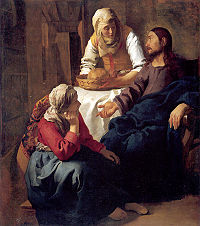
(Picture:  Christ in the House of Mary and Martha, Johannes Vermeer, National Gallery of Scotland)
Unknown's avatar

“There is nothing to be afraid of!” A sermon on Psalm 27:1-2

When my daughter was a little girl she went through a fearful period when she would wake in the night, and come into our bedroom and stand quietly quivering next to our bed, typically on my wife’s side, where there was considerably more sympathy to be had, and where she was sometimes invited to stay under our covers until she fell back asleep.

It was actually kind of eerie. She would just stand there like an apparition until one or both of us awoke, and we would ask her what was the matter, and she would say in a little trembling voice, “I’m scared.”

And I would invariably say in a big Dad voice, “There is nothing to be afraid of, go back to bed.” It happened frequently enough for long enough to become a family story.

I was reminded of this last September, for during her very first week at Yale Divinity School, there was a well-publicized murder of a young woman in a Yale lab on what was supposed to be her wedding day.

My daughter’s new apartment is not far from the lab, where the victim’s body was eventually found hidden inside a wall, and the night her body was found, the dean at Yale e-mailed all the students warning them to be extra vigilant, as there might be a dangerous person in the vicinity. It turned out that the murder suspect was a colleague of the victim’s from work, and that allayed some of our fears that a random serial killer might be rampaging through the streets of New Haven.

But before we knew that, and on the night she received the e-mail from the dean, my now very confident 25 year-old daughter, who is tall and imposing, and graduated from Wellesley, where they teach the women that they can conquer the world and many of them do, called me on the phone, and her first words, in that same trembling little voice from long ago, were, “I’m scared.”

And I, of course, said, “There’s nothing to be afraid of,” and she started giggling. Then I told the truth and said, “I’m scared, too,” for I had indeed been worrying about her.

And, in fact, when she was a little girl, my reassurance that there was nothing to be afraid of was only a half-truth, the kind we parents must tell our children for a time. It was true that she was safe and sound in our big parsonage, with all the doors securely locked and with us present, and that is all I was trying to convey to her.

But the larger truth that you don’t tell a small child is that there is plenty to be afraid of in our world, and all of us learn that sooner or later.

And not too much later in her young life, we had some very real events to make a child, or an adult for that matter, afraid. First, we had an arsonist setting fires on people’s back porches while they were sleeping, right in our immediate neighborhood, and I worked patrolling shifts for our newly formed neighborhood watch organization.

Then we actually had a serial killer who kidnapped and eventually murdered several children, one of whom played in Little League with the son of some good friends of ours. The man was eventually caught when he tried to snatch a girl off the main street of Pittsfield just a few hundred feet from the church where I served. She wisely wriggled out of her back-pack and ran away, and an alert driver behind them wrote down his license plate.

So not long ago she reminded me of all these things and said, “Dad, no wonder I was a fearful child, there were dangerous people in our neighborhood. I should have been afraid.”

Our world has plenty to be afraid of, no only from disturbed people, but from earthquakes like the ones in Chile and Haiti, and hurricanes like Katrina, and droughts and famines and other natural disaster, as well “the evil men do to one another.”

But it is also a wonderful world, as Louis Armstrong sang long ago, and I love to hike in it and bike in it and watch its sunsets and listen to its birdsong.

It is, in the larger Christian story, a world made good by God, but fallen. And fear is part of its fallen-ness.

In one of the darker chapters of human history, the poet W. H. Auden captured our plight the way that sometimes only a poet can. In his poem September 1, 1939, as the Nazi tanks rolled into the Low Countries to begin the war that would engulf the world in flames and blood, he sat at a bar in New York City, and described the human condition thus. We are, he wrote:

“Lost in a haunted wood,
Children afraid of the night
Who have never been happy or good.”

The story we will be hearing again in the next weeks is the story of God’s rescue mission to this fallen and fearful world through the work of the man Jesus of Nazareth. It is itself a fearful story, even for those of us who know the glorious outcome, but we have miles to go before we get there.

Psalm 27 talks about fear. Here the Psalmist, who from now on I will call “David,” moves back and forth from declarations of great confidence like the opening to lists of all the many things he has every right to be afraid of.

And I really like this, because I believe that faith lives in the midst of our fears.

John Calvin writes about this passage: “When David declares, “My heart shall not fear,’ this does not imply that he would be entirely devoid of fear, — for that would have been more worthy of the name of insensibility than of virtue.”

In other words, David had every right be afraid of the army encamped about him. Imagine it. He sees their campfires every night, he can hear their trumpets, and he knows they can attack him at any time. I’d be afraid, too.

And Calvin goes on to say: “Under the terms, camps and armies, [David] includes whatever is most formidable in the world.”

So though the names and faces of the powerful who hold the world in thrall will change, the truth of the Psalm remains: “Although all men should conspire for my destruction, I will disregard their violence, because the power of God, which I know is on my side, is far above theirs.”

The Good News here is that the principalities and powers of this age, and any age, are ultimately subordinate to the power of God, though as the rest of Psalm 27 amply shows, they manage through their subordinates (in this case “the army encamped about David”) to give both David and, with the necessary changes, us, plenty about which to be afraid, at least in the short run.

This faith in the power of God, as Calvin writes, is not the complete absence of fear, as in a more Eastern religious calm through meditation and detachment. No, the fears are quite real.

So faith always lives in the midst of our fears, but it is that same faith that knows “when the trial comes, our faith will prove invincible, because it relies on the power of God.”

And the final power of God will finally be made manifest in weakness, on a Roman cross. This Jesus knows, and this is why he must go to Jerusalem.

So there are two kinds of fears, and they are quite different, though it is often hard to distinguish between them, because they get all wrapped up in each other.

First, there are the real fears, as when David has an enemy encamped around him, or when we had an arsonist, and then a serial killer in our neighborhood. Or when someone ties to blow up the airplane you are on with explosives in his jockey shorts. These are real fears.

But there is also a kind of fear that is not real. It holds some kind of power over us, and it is not attached to a specific threat. This kind of generalized fear is not good for us. It makes us less than who God wants us to be. It robs us of dignity and courage, and makes us act in ways that are not worthy of us.

And I am convinced that some of the nastiness in our public discourse right now is based on exactly that kind of fear.

The Great Recession we are in, or have just gone through, depending on who you believe, is something that most of us have never known in our lifetime. It has stirred up a lot of the second kind of fear, the unnamed and unknown fears about our future, and the future of our country. It is true that there are real things to fear from it, like losing our jobs or our homes or our pensions. That is real fear,

But the second kind is different; the general pervasive kind of fear that takes on a larger life of its own. It begins to eat us up, and attaches itself to every part of life. I call it 4 o’clock in the morning fear.

Do you know what I am talking about? Do you know that kind of fear? I suspect you do.

I know I do. I know it all too well. And there is just enough reality in our fears to give them some credibility, but their power over us is larger than they deserve.

And I know that these are the kind of fears that can debilitate one’s life, and in some real way, they are the very opposite of faith, and so they must be dealt with.

So here we are in Lent, the season of self-examination and repentance.

My Lenten admonition to you all, both as individuals and as a congregation, is to figure out those fears that keep you from being who God has made you to be. Identify them, name them, and call their bluff, because they really have no actual power over you that you don’t give them.

That is the Good News on which we can stand secure. Because in that final trip to Jerusalem that Jesus was waiting to make, and ultimately did make, he defeated the powers that threaten us, including our unreal fears, along with some other big things “that go bump in the night,” like death and sin.

Oh, we still sin, and we still die, and we will still be afraid, but the power has gone out of them. Because Jesus took them all to the cross with him, and there they died with him. And believing that is a good part of what makes us Christians.

For the real power in the world is the power of the living God, that we are called to live out of day by day, even in those fearful times when we can’t see it or feel it.

So as I used to say my daughter, “There is nothing to be afraid of.” And this time I really mean it.

“The LORD is my light and my salvation, whom shall I fear?
The LORD is the stronghold of my life;
of whom shall I be afraid?” Amen.

(This is excerpted from a sermon entitled “Whom Shall I Fear?” that I preached at Charlemont Federated Church, Charlemont, MA, on February 27, 2010)

Unknown's avatar

On the Writing of Hymn Texts: “Always Trust Your Ears!”


This morning I preached for the first time in 2010 to the little Berkshire hill-town congregation at the Federated Church of Charlemont, while their pastor was on a mission trip to Nicaragua. It was a gracious experience in so many ways, and a homecoming of sorts, since it was my seventh visit there as a guest preacher since 2007.

It was also there that I led my very first worship service after my sudden retirement from disability in 2004, which was a deeply moving experience.  I have a warm spot in my heart for country churches. I started my ministry back in 1975 in two little village churches in rural Maine, and I always feel at home in churches like them, especially this one.

For a country church Charlemont has extraordinary music. The gifted organist and choir director, Esther Haskell, who is a school librarian at her day job, does a masterful job, and sometimes it seems like nearly half of the congregation is in the choir. The composer and arranger Alice Parker, who needs no introduction to many of you, also worships in that congregation, and has worked closely with Esther to make congregational singing an important part of their worship.

For some weird reason, soon after my brain injury in 2000, I suddenly started writing hymn texts. I can’t recall ever writing a poem in my life before, and I have certainly never had any training, but these texts started tumbling out of me in the early morning hours after many a sleepless night, often complete and in meter needing few if any changes. I’ve told this to various of my neurology specialists, and they have no explanation for it, and it might just be a coincidence, but I don’t think so. Maybe Olive Sacks would be interested!  The human brain is a marvel and a mystery. Take good care of yours.

So on this February 13, I posted a Lenten hymn text that I wrote back in 2004, not long before I had to pull the plug on my 22 year pastorate. It is called “You Won’t Despise a Broken Heart.”

The text is very much in the spirit of Lent, but the last verse ends on an Easter note, based on the church’s practice of counting the Sundays as being “in” Lent, but not “of” Lent, which is why the forty days don’t add up, if you’ve ever wondered about that.  And the closing Easter note in the text is also appropriate because every Sunday of the year, even in Lent, is a celebration of the Resurrection.

So far, so good.  But when I went to post it,  I counted all the syllables to make sure it was truly in Common Meter (C.M.), which is 8.6.8.6.  To my dismay I discovered that a couple of the lines in one of the verses didn’t add up. I liked the hymn the way it was, but I wanted it to be metrically correct, so I added a couple of words to make the numbers come out right before I posted it. But the changes definitely took something away from the poetry, and I never liked them.

When I spoke by phone with Esther earlier in the week she had suggested that it might be an appropriate hymn to sing today for this Second Sunday in Lent,  which pleased me.  But she gently suggested that a few minor changes be made in one of the verses to make it more singable, and I knew what she was going to say before she said it.

The changes she suggested were, of course,  to eliminate the “corrections” that I had made, and I told her so, and about my worry that the lines wouldn’t have the right number of syllables. She has been an English teacher in Amherst and taught poetry there for many years.

“Always trust your ears,” she told me. I ask her how one shows that when it is just a written text without music. She said, “I’ll ask Alice!” And she did. The answer was simple. Just write it out, and when it is sung (if you have trusted your ears) the music will tell the congregation how to sing it. (If the music and text are shown together, as in a hymnal, then you divide the words up with special hyphen-like marks that probably have a name, but I don’t know what it is.)

Unlike some of my other hymn texts, this one has never had an original tune written for it, and since I left the pastorate shortly after it was written, I had never heard it sung.

But this morning I did!  Esther and Alice suggested the lovely Scottish tune “Crimond” for the music, and that is what we sang, and I really loved it. So I have gone back to my post of February 13 and restored the text to its original form, and the recommended tune is now “Crimond.”  You can find the hymn text here.  And it is not (yet) commercially copyrighted (nobody gets paid, in other words), so if you want to use it this Lent in worship, be my guest.

And so it was that I learned an important lesson about writing hymn texts: “Always trust your ears!”

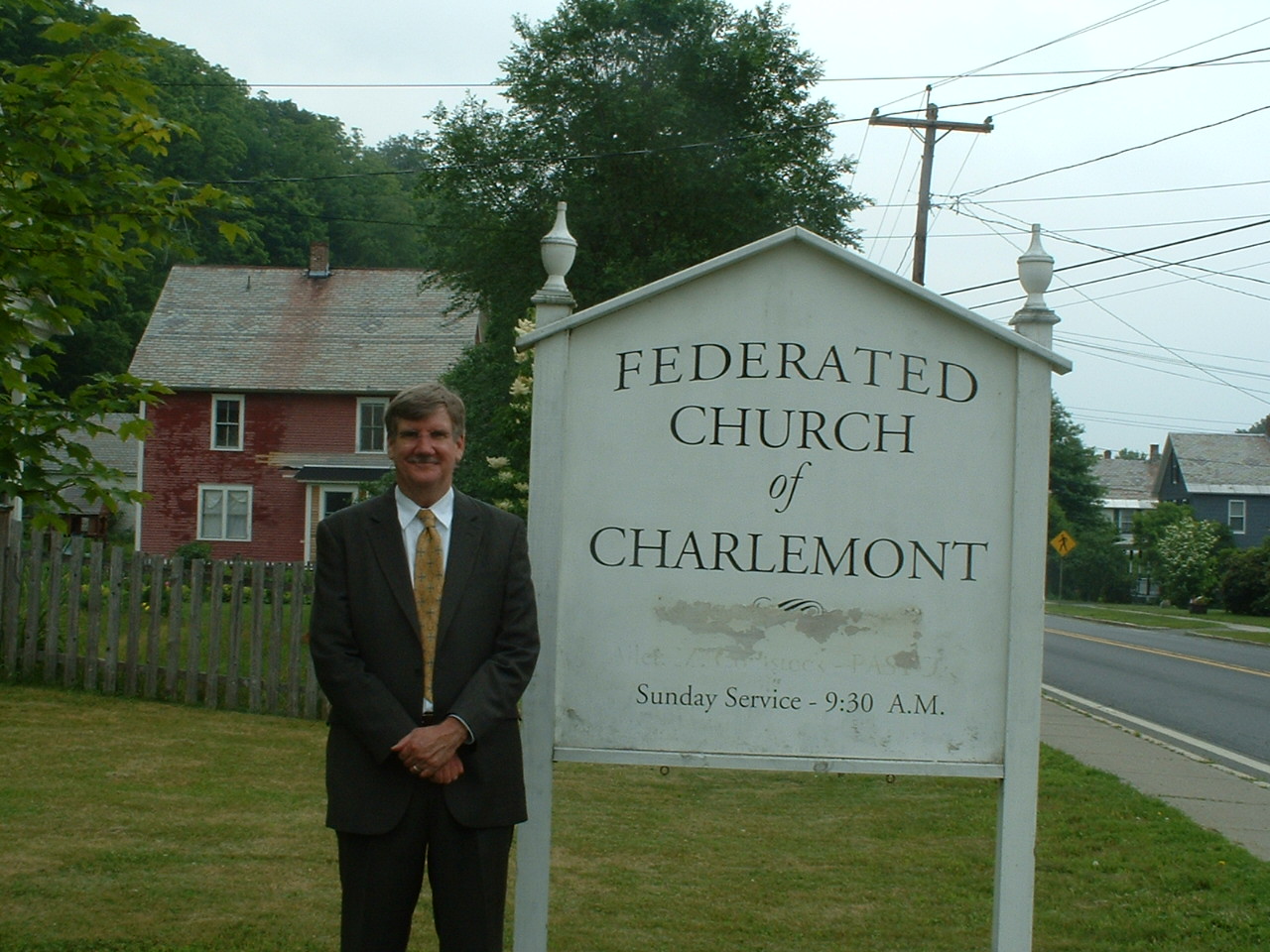
(Photo by M. T. Floyd of R. L. Floyd, Charlemont, MA, Lent 2007)

Unknown's avatar

Birthday Special: The Top Songs when I was Sixteen in 1965


Today is my sixty-first birthday (I know it is hard to believe since I look so freakishly youthful; just kidding.)  My good friend Larry from High School sent me a compilation of some of the top singles (from the Cashbox chart ending February 6, 1965) from when I turned sixteen.  They read like one of those oldies collections not available in stores that you see on the infomercials when you can’t sleep, but there are some classics here too.  

The themes are the ones you would expect from the big Boomer demographic, love found and lost and lots of sexual tension, but Sam Cooke’s A Change is Gonna Come signals that there might have been more going on in America than teen angst.

So I’ve been sitting here listening to them and getting in touch with my inner sixteen year old, when I was “cute in my mohair suit” (whatever that is).

So here they are:

1. You’ve Lost that Lovin’ Feelin’ by the Righteous Brothers (which got some new legs from the movie Top Gun)
2.Downtown by Petula Clark
3.The Name Game by Shirley Ellis
4.This Diamond Ring by Gary Lewis and the Playboys
5.Love Potion #9 by The Searchers
7. All Day and All Night by The Kinks
8.Keep Searchin’ by Del Shannon
9.Shake by Sam Cooke
10.My Girl by the Temptations
11.Let’s Lock the Door by Jay and the Americans.
12.How Sweet it is to be Loved by You by Marvin Gaye
13.I Go to Pieces by Peter and Gordon
14.Come See about Me by the Supremes
15.Give Him a Great Kiss by the Shangi-Las
17.Heart of Stone by the Rolling Stones
18.Bye, Bye Baby by Frankie Valli and the Four Seasons
20.Look of Love by Leslie Gore
21.Boy from New York City by the Ad Libs
23.Tell Her No by the Zombies
24.The In Crowd by Dobie Gray (later covered by the Mamas and Papas)
25.I Feel Fine by the Beatles
26.Laugh, Laugh by the Beu Brummels
36.You’re Nobody ’til Somebody Loves You  by Dean Martin
40.King of the Road by Roger Miller
54.The Birds and the Bees by Jewel Akens
59.Goldfinger by Shirley Bassey (“The name’s Bond, James Bond”)
63.Willow Weep for Me by Chad and Jeremy
69.Ferry Cross the Mersey by Gerry and the Pacemakers
76.A Change is Gonna Come by Sam Cooke (Cooke’s haunting prophetic anthem)
77.Can’t You Hear My Heartbeat by Herman’s Hermits

Long ago in a galaxy far away.

Unknown's avatar

“Elections Matter!” What happened in Massachusetts?


Last night I turned the television off after CNN called the special Senate election for the Republican Scott Brown over Democrat Martha Coakley, with Brown getting 52% of the vote to Coakley’s 47%.

This morning I am trying to get my head around what happened. In this traditionally bluest of blue states Republicans are not supposed to be elected senator. The last Republican United States senator from Massachusetts was Edward Brooke, who left the senate in 1979. But Brooke was unlike any Republican you will find today. He was a moderate Republican, who co-authored the 1968 Fair Housing Act. He was staunchly bi-partisan and was the first Republican senator to ask for President Richard Nixon’s resignation after the post-Watergate “Saturday Night Massacre.”

Brooke was also the first African-American to be elected to the Senate since Reconstruction, and the only African-American in the Senate in the Twentieth Century until Carol Mosely Braun was elected in 1993. To younger Americans living in the Obama era, it is hard to conceive of the symbolic significance of Brooke’s active presence in the Senate in those days, and Massachusetts’ voters re-elected him by 62% to 34% in 1972, and he served until 1979.

We haven’t had a Republican senator since. My grown children haven’t known one in their lifetimes. But they have one now, Scott Brown, who is not a moderate, but a pro-life, anti-tax, anti-immigration politician who opposes health care reform among other things. He fills the seat left vacant by the death of Edward Kennedy, and he gets two years before he has to run for re-election. That’s right, Ted Kennedy, the “Lion of the Senate,” who championed health care reform his entire career, is now replaced by someone who has vowed to vote against the current bill. His election deprives the Democrats of their 60 votes in the Senate that preclude a filibuster.

So what happened? There is already a lot of finger pointing, but there is plenty of blame to go around the Democratic Party.  And Brown gets credit for running an energetic campaign. Coakley had a nearly 30% lead in an early poll, and as late as last week was still predicted to have a double-digit lead.

Here’s my take on it. First of all, as President Obama’s political guru, David Axelrod, said last night on the eve of the defeat, “Elections matter.” That’s why we have them, just like why we play the games to see who wins rather than relying on the predictions.

There was a perception by many that Martha Coakley and the Democrats were arrogant and entitled. In one of the debates Coakly said something about Kennedy’s seat and Brown retorted, “It is not Kennedy’s seat, it’s the people’s seat.” That moment crystallized a populist resentment toward the establishment. As things were sinking fast Coakley brought in Presidents Clinton and Obama to campaign. That may only have reinforced the view that the elites were behind her. Brown, on the other hand, has popular sports figures like Doug Flutie (of the Miami miracle pass), and Curt Schilling, the Boston Red Sox pitcher (of “bloody sock” fame.) To me, nothing sums up this election more than that contrast, the smart attorney general supported by two Presidents versus the truck-driving state senator supported by sports icons.

So Brown tapped into class resentments against the powers that be in this scary economic time. Ironic that many of those who voted for Brown were suburbanites, a usually well-off and typically liberal crowd, but who now seem to fear that the American Dream may be slipping from their grasp. Many have lost jobs, or fear they will. Some have lost their homes or their mortgages are now bigger than the worth of their home. These concerns are real and some of the anger about these things seems to have accrued to the President and those in office.

Others have interpreted the vote as a referendum on the Health Care Bill, but that is too simplistic. For one thing, Massachusetts has a near universal health care system already. What the vote more likely signals is a fear of big government spending, as people watch dizzying deficits being piled up in Washington. It is, of course, unfair to hang that on President Obama, since it was actually George W. Bush and Henry Paulson who launched the early big bailouts to keep the whole financial system from crashing in the fall of 2008, but many people have short memories.

And on the other side many liberal Democrats think the health care bill is so compromised that it is not worth passing, especially with the elimination of the public option. So did they stay away from the polls yesterday? If they did it is yet another example of the perfect being the enemy of the good.

So the perfect storm that nobody predicted took place. Coakley ran a safe and lackluster campaign designed not to lose. Brown ran to win and captured something that is in the air. I happen to think that a good deal of what is in the air is pretty ugly. I don’t want to hang this on Scott Brown.  I wish him well, and hope he can appeal to “the better angels of our nature.”

But to do so he will need to distance himself from some of the rhetoric of his supporters, especially the hate-mongers on the airways. Some of what I have seen in on-line and TV discussions, and heard on the radio, is truly scary. Some of it, sad to say, is clearly sexist and racist. There is a strong anti-immigrant impulse along with a derisive attitude toward the poor and disadvantaged. We have seen this before in American history when economic times were tough, but it doesn’t bode well for us, especially coming so soon after Barack Obama’s large-hearted campaign rhetoric and historic electoral victory that inspired so many people, many of them young and voting for the first time. It was just a year ago, but things move quickly in politics, and in Massachusetts yesterday the audacity of hope lost out to the resentment of fear.

Unknown's avatar

Is the story really about Conan vs. Jay? Or is it about the inevitable death of network TV?


NBC has provided lots of drama about their late night line-up for a week or so, and as a long-time insomniac I have watched with interest. I have always loved the Tonight Show, and I am old enough to remember Jack Paar. Johnny Carson was always a favorite of mine. Over the years I developed a slight preference for the goofy David Letterman over the more mainstream Jay Leno, but I watched them both now and again.

And I was pleased when Conan O’Brien, who I always thought was very funny, was given the Tonight Show last fall, bringing his edgy manic physical comedy to the show, and we stayed up to watch the monologues fairly regularly for the first week or so.

I wondered what would happen when NBC gave Jay Leno a 10 o’clock show. It didn’t seem like a great idea to me, and to tell you the truth, we never watched it. So I wasn’t suprised when a number of NBC affiliates started complaining that Leno was killing their ratings (which lead into their 11 o’clock news shows, which advertisers still like).

Then NBC responded by trying to insert Jay back at 11:35 and move Conan to 12:05. Then Conan balked at the move, saying it wouldn’t be the Tonight Show after 12 (true), and the drama heightened.  I thought Conan got a raw deal, and both he and Leno made comedic hay out of the situation. As Letterman said the other night, “Haven’t you all had enough of this whole NBC late night drama thing?” and then answered his own question: “Neither have I.”

But when I mentioned the kurfuffle to my twenty-seven year old son, he blithely remarked that it really doesn’t matter what happens because network television is in its last days.  “It’s over,” he said, “they just haven’t got the memo.”

And I got to ruminating about it and I think he may be right. I have thought about the future of newspapers a lot (see my interview with Martin Langeveld), but not so much about television.  But as I thought more about it I realized that the Leno-O’Brien late-night contest is akin to two fine musicians fighting over who is to be the next bandleader on the Titanic.

The reason is simple: fewer viewers with no end in sight to the decline. And then I realized that even though I was interested in the story, I had followed most of it on my laptop, reading on-line accounts and watching clips on YouTube.  If lots of people are doing this it drains away viewers.

So the trend is easy to spot as the proliferation of entertainment options fragments the viewing audience. When Johnny Carson was king of late night the Tonight Show was a destination for  many viewers. Now they have lots of other places to go. There was no cable to offer hundreds of options. There was no PayPerView or NetFlicks. You didn’t have massive multi-player on-line role playing games (MMORPGs) like World of Warcraft (which alone has something like 12 million paid subscribers.)

In Carson’s day people weren’t reading (or writing) blogs, or checking their Facebook or My Space page, or tweeting on Twitter. They weren’t listening to their personal radio stations on Pandora.  They weren’t watching videos on their IPods or cell phones.

And things are going to get worse for the networks because the options are only going to expand.  The next generation of e-books like Kindle will be able to have color for graphics to view magazines, so people can subscribe and get them wirelessly, like they already can on their computer. And many of the new BluRay players already allow you to get streaming video on demand from your wireless connection to your television. And Tivo and DVR recorders already allow you to watch your programs without commercials anytime you want. So more and more people watch what they want to watch when they want to watch it.

I look at my twenty-something kids and realize that they don’t really watch TV, except NFL football (in my son’s case), or to watch DVD rentals (in my daughter’s). If this is typical of their generation then advertisers will want less and less to throw big money at network broadcasting that fewer and fewer people are watching.

So the fall of late night is not the fault of Jay and Conan, who are both talented and funny men. It is the result of a changing world and the way people access media. NBC hasn’t helped themselves any with some questionable moves, but they are fighting a war of attrition that they can’t win.  Game over.