Unknown's avatar

“Helping those who have no helper”

helper“For he delivers the needy when they call, the poor and those who have no helper.”
—Psalm 72: 12

Psalm 72 begins “Give the king your justice, O God.” It implies that justice is a God-given matter, and though in our time we have no king, the seeking of justice remains one of the marks of authentic government. Continue reading

Unknown's avatar

“Turning the World Upside Down”

“When the mob could not find Paul and Silas, they dragged some believers before the city authorities, shouting, ‘These people who have been turning the world upside down have come here also.’” Acts 17:6

WorldPaul and Silas got in big trouble in Thessalonica. Paul preached for several days, explaining that Jesus was the Messiah and that he had to suffer and die. Many listeners were convinced and followed them.

But there was backlash. Luke writes, “They formed a mob and set the city in an uproar.” They said, “These people who have been turning the world upside down have come here also.”

They didn’t mean it as a compliment, but “turning the world upside down” is exactly what the Good News about Jesus did that day. Continue reading

Unknown's avatar

“Rich in Things and Poor in Soul” A Sermon on Luke 12:13-21

self storageI don’t know about you, but I have too much stuff. Eleven years ago we moved from a sixteen-room house (a big old parsonage) to an eight-room house. Before we moved we had a huge yard sale. Still, it was a good two years before we could put both our cars into the two-car garage. This may sound like what my daughter calls a “first world-problem,” and it is!

We Americans have too much stuff, and it is not good for our souls. I grew up in a middle-class American family of five. We had a one-level ranch house with three bedrooms, two of them very small, with small closets. My brother and I shared a bunk bed. We had a one-car garage. Our house was built on a concrete slab, so there was no basement. We had an attic, just a crawl space, and my Dad had to climb up there every year to get the Christmas tree stand. Not much room to store stuff.

How things have changed! Look at the four square feet around you. That is the per-capita share of the American self-storage industry, according to the Self-Storage Association, a trade group. They say that “the country now possesses some 1.875 billion square feet of personal storage. All this space is contained in nearly 40,000 facilities owned and operated by more than 2,000 entrepreneurs, including a handful of publicly traded giants like Public Storage, Storage USA, and Shurgard.” (From Slate, “Self-Storage Nation” by Tom Vanderbilt) Continue reading

Unknown's avatar

“The God of the Far Off” Toward the Ministry of Inclusion

Prodigal sonWhat an extraordinary week this has been for our country! The great Swiss theologian Karl Barth liked to admonish the church that it must read both the Bible and the newspaper, because we Christians live in the world.

And what a week of news it was! There were two historic Supreme Court decisions that will change our national life in significant, and in my opinion, profoundly positive, ways.

On Thursday, by a 6-3 decision, the Court upheld the Affordable Care Act, which makes health care available to all Americans.

And on Friday, by a 5-4 decision, Marriage Equality became the law of the land.

The reason I am here before you instead of our pastor Brent Damrow is that he is in Cleveland at the General Synod of the United Church of Christ, representing the Massachusetts Conference. I am sure he will have stories to tell about the celebrations taking place there, as our national church has been a long and tireless advocate for equal rights for the LGBT community and a supporter  of marriage equality.

I believe that these two historic Supreme Court decisions share a common idea, and that is the idea of “inclusion.”

And a third extraordinary event in our national life also happened on Friday. President Obama climbed into the bully pulpit in Charleston, South Carolina to give the eulogy for the Honorable Reverend Clementa Pinckney, the pastor of the Emmanuel AME Church who, along with eight of his congregants, was murdered by a gunman while attending a Bible study at the church on June 17.

President Obama gave a stirring eulogy for Pastor Pinkney, but he was addressing not only those present, but also the nation. I’d like to share with you some excerpts of his eulogy:

The alleged killer could not imagine how the city of Charleston . . . .the state of South Carolina, how the United States of America would respond — not merely with revulsion at his evil act, but with big-hearted generosity and, more importantly, with a thoughtful introspection and self-examination that we so rarely see in public life.

Blinded by hatred, he (the alleged murderer) failed to comprehend what Reverend Pinckney so well understood — the power of God’s grace . . .

This whole week, I’ve been reflecting on this idea of grace . . .

According to the Christian tradition, grace is not earned. Grace is not merited. It’s not something we deserve. Rather, grace is the free and benevolent favor of God as manifested in the salvation of sinners and the bestowal of blessings. Grace.

As a nation, out of this terrible tragedy, God has visited grace upon us, for he has allowed us to see where we’ve been blind. He has given us the chance, where we’ve been lost, to find our best selves. We may not have earned it, this grace, with our rancor and complacency, and short-sightedness and fear of each other — but we got it all the same. He gave it to us anyway. He’s once more given us grace. But it is up to us now to make the most of it, to receive it with gratitude, and to prove ourselves worthy of this gift.

Martha and I were driving to Onota Lake in Pittsfield for a walk on Friday when the President’s eulogy came on the radio. We got to the parking lot at the boat ramp, but we didn’t get out of the car. We sat in the car until it was over, and when it was over I had tears streaming from my eyes.

The President was addressing the painful facts of racial relations in today’s America. He mentioned that in response to the massacre at the church the Confederate flag had been taken down in the South Carolina capitol and elsewhere. That flag, he said, was a symbol of our nation’s “original sin,” slavery.

The president had both the Bible and the newspaper in mind as he gave this incandescent speech. I don’t know of such a theologically astute presidential address since Abraham Lincoln’s second inaugural.

And once again I would argue that inclusion is the big idea that binds all these events together. Inclusion.

I believe in the power of ideas to shape societies, and, as my teacher, mentor and friend, Max Stackhouse taught me, to examine where they come from and what they mean. So I want to do a little bit of that with you today about the idea of inclusion. Continue reading

Unknown's avatar

Daily Devotional: “Once We Were Strangers”

“Once We Were Strangers”

Richard L. Floyd

“You shall also love the stranger, for you were strangers in the land of Egypt.” —Deuteronomy 10:19

The various summaries of the law in the Bible include strangers as people to be especially cared for. Whether we call them sojourners, immigrants or aliens they need help because they are frequently socially powerless.

So God’s people are commanded to care for these special ones. Our passage today reminds the Israelites that they had once been strangers in the land of Egypt. They knew how it felt to be treated unfairly. This memory was an abiding feature of their identity as a people, and they were admonished never to forget it.

My own family is a microcosm of our nation of immigrants. My forbears fled here to escape persecution or sometimes just to seek a better life. My grandfather’s people, French Huguenots, fled religious violence in the 17th century. My wife’s Greek grandparents escaped “ethnic cleansing” in Turkey. Her Jewish grandfather was a Holocaust survivor, and his family came here after the war. Such refugees were called “displaced persons” or DP’s.

These are our stories, not merely here in America, but throughout the world. There are still many “displaced persons” among the human family. They face unique challenges every day.

God regards them with special care and so should we, for we too were once strangers, far from home.

Prayer: Let us love the strangers among us as you do, O God, and never let us forget that we were once like them.

R.L. FloydAbout the Author 
Richard L. Floyd is Pastor Emeritus of First Church of Christ (UCC) in Pittsfield, Massachusetts, and author of A Course In Basic Christianity and When I Survey the Wondrous Cross: Reflections on the Atonement. He blogs at richardlfloyd.com. This is from the United Church of Christ StillSpeaking electronic Daily Devotional. The original can be found here. To subscribe for free and receive these daily by e-mail go here.

Unknown's avatar

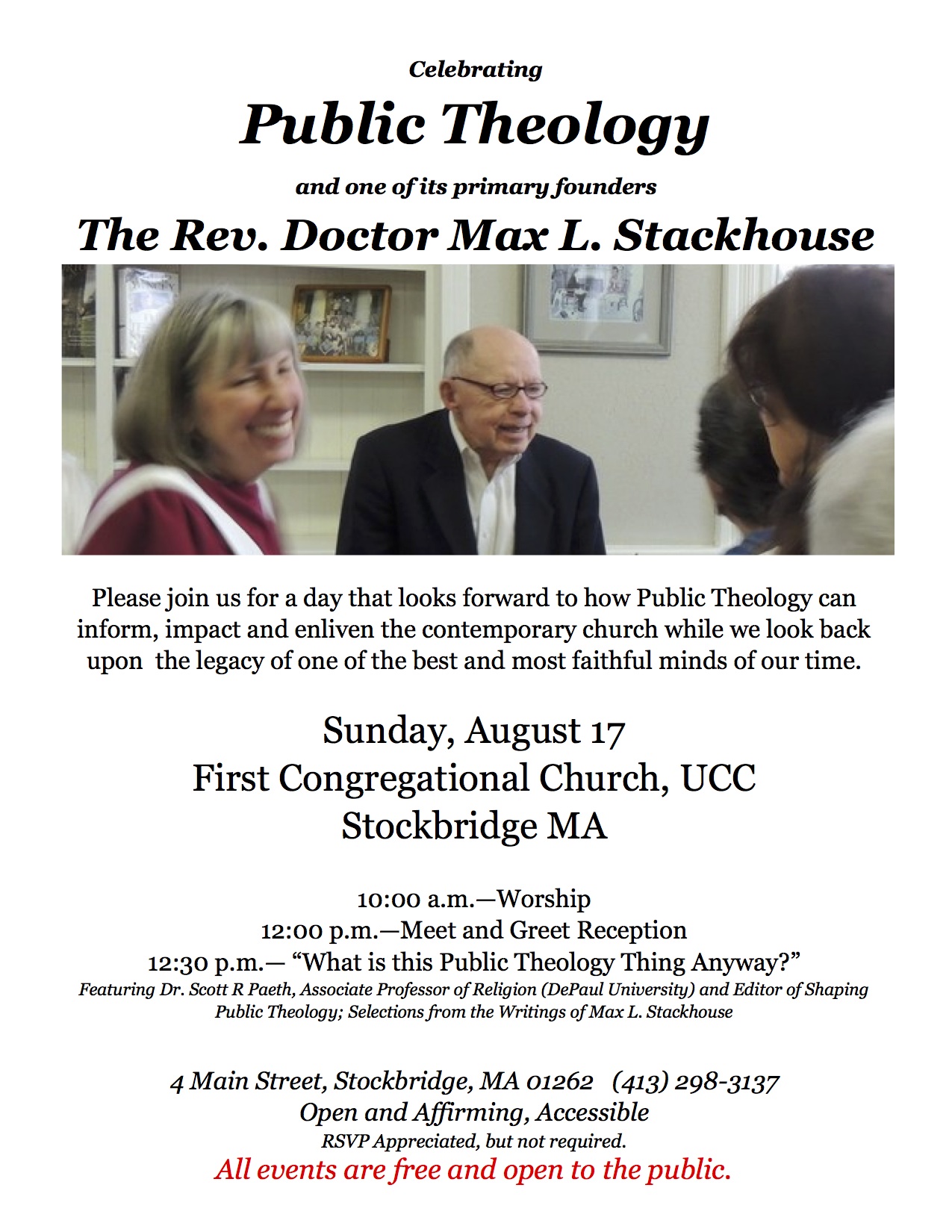
Max L. Stackhouse and Public Theology


Max Stackhouse Flyer

 My teacher, mentor, colleague,  friend and Berkshire neighbor Max Stackhouse, one of the primary founders of Public Theology, will be celebrated at our church in Stockbridge on Sunday. (see flyer below)

Dr. Scott Paeth, one of the editors of a new book of Max’s writings, Shaping Public Theology (Eerdmans, 2014) will give a presentation after morning worship.

Several years ago I posted on Max’s  “God and Globalization.” You can find that here. In Max’s body of writings he has persistently challenged the dominate economic view of society (whether capitalist or socialist) as reductionist.For example, here is an excerpt from a letter he sent us back in 2009:

The economies in each area (of his several travels in the world) have some things in common, such as whether people have little or much, they want more, and in all contexts the laws of supply and demand operate. But, what people want more of and why they want what they want, and what they are able to supply and what they demand for what reasons are quite different. These things differ according to their view of and experiences in family life, political power, legal systems, educational opportunities, medical conditions and technological capabilities. In other words, economics is less an independent cause in social stability or change, than a result of the cultural and civilizational fabric. And, here is the main point, these are all deeply influenced by the dominant religion as shaped by the professional leaders of that religion — the clergy, intellectuals, theologians, and charismatic leaders who appeal to the core of the faith and relate it to the social realities the civilization faces. Under the influence of the secularization hypothesis, religion is a by-product of economic (and psychological) factors. (For the whole letter go here.)


If you are in the area join us for this celebration of Max and his important contributions to Public Theology:


Max Stackhouse Flyer

Unknown's avatar

Are the banks too big for trial? Seems so!

WarrenMy Senator, Elizabeth Warren, wants to protect you and me from fraudulent and criminal practices that hurt consumers. She fought to create the Consumer Financial Protection Bureau, an agency she should have been asked to lead. If she had she wouldn’t have been free to run and win a seat in the Senate, and some of those who feared her might be wishing now that they had let her run the agency, which Congress is trying to cripple into impotence anyway.

Today we can see why Wall Street and the banking industry poured a record number of dollars into Scott Brown’s campaign to try to defeat her. They fear her honesty and tenacity, and that was on display in her questioning of top regulators.

Many have wondered why nobody went to jail for the criminal banking practices that led to the international financial crisis. Now, because of Warren, we know the answer. Because no governemental regulatory agency brought any one to trial.

That was the ‘take away” from Warren’s first hearing of the Banking, Housing and Urban Affairs Committee.

According to Ryan Grim of the Huffington Post:

Warren questioned top regulators from the alphabet soup that is the nation’s financial regulatory structure: the FDIC, SEC, OCC, CFPB, CFTC, Fed and Treasury.

The Democratic senator from Massachusetts had a straightforward question for them: When was the last time you took a Wall Street bank to trial? It was a harder question than it seemed.

One after another regulators obfuscated until Warren finally got them all to admit that they had never brought anybody to trial. She responded by saying,

There are district attorneys and United States attorneys out there every day squeezing ordinary citizens on sometimes very thin grounds and taking them to trial in order to make an example, as they put it. I’m really concerned that ‘too big to fail’ has become ‘too big for trial.’

I applaud Senator Warren for speaking truth to power and getting at the essential unfairness and inequality of our legal system, and for exposing the federal regulators who are supposed to be protecting us. If banks are too big for trial it means they are above the law.

Warren herself summed it up pretty well when she concluded:

‎If they can break the law and drag in billions in profits, and then turn around and settle, paying out of those profits, they don’t have much incentive to follow the law.

Or no incentive at all. Because several days of a trial would bring out to the public their fraudulent and criminal practices and embarrass them.

So what can any of us do about it? Well, for one thing we can vote and support courageous candidates like Warren. And we can put pressure on our representatives for more transparency and action around these issues. We can pressure Congress to strengthen the Consumer Financial Protection Bureau, and confirm director Richard Cordray. And we can use social media to embarrass the banks and the regulators. Because they should be embarrassed. They should be embarrassed that they made huge sums of money at the public’s expense, and got away with it.

Marilynne Robinson writing about the limits of science criticizes our current culture’s lack of ethics or morality, which she sees as part of the loss of religion (and the religious imagination.) She writes: “Science cannot serve in the place of religion because it cannot generate an ethics or a morality. It can give us no reason to prefer a child to a dog, or to choose honorable poverty over fraudulent wealth.” Religious people may want to speculate on how it is that the disparity between rich and poor in our country grew at the very same time that the world financial system came apart? And why nobody faced any consequences. Was it that nobody was at fault? Seems unlikely.

So those who were at fault should be embarrassed. More correctly they should be ashamed. And some of them should go to trial.