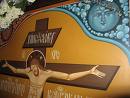
 There is a kind of decaffeinated Christianity that wants to quickly slide by Good Friday and get right to Easter, as if Good Friday is a morbid and somewhat unfortunate episode that is dwelt upon only by the morbid and masochistic. Or to put it another way, we are tempted to have a Palm Sunday faith, a faith based on a misunderstanding of who Jesus is.
Like the crowd at the first Palm Sunday we are tempted to see Jesus not as he is, but as a projection of our own hopes and desires. We can do this in a number of ways. We can turn Jesus into the supporter of our personal goals, or the upholder of our national ambitions, or our politics, or other ways where he becomes who we want him to be instead of who he really is. “Palm Sunday faith” is when we want a Jesus without a cross so we can have a faith without a cross, a faith without challenge or sacrifice, a faith without testing or struggle. When we do that we turn God into a kind of talisman or lucky charm to bless our projects and our aspirations, when in fact the God of the Bible is a God with his own sovereign purposes.
The problem with a Palm Sunday faith is that we live in a Good Friday world.I believe that Christian faith is essentially a joyful enterprise, but it is a joyful enterprise that doesn’t turn or flinch from the hard truths of the world’s harsh brutalities. So Christian faith without a cross does not show God’s full power to deal with human sin and death. And a faith without a cross will be found feeble and wimpy when the chips are really down.
What do I mean when I say it is a Good Friday world? There is a certain heartbreaking aspect of living that comes to us all. Often we only see it from a distance, as in the war in Iraq, where we have seen pictures both of dead and injured civilians and dead servicemen and women. But to the families of those individuals that heartbreak has come “up close and personal.” And some heartbreak comes to every human life sooner or later.
It is not just in wartime that the powers of sin and death do their heartbreaking work. Which is why there is so much comfort for us in worshipping a God who himself “became a man of sorrows and acquainted with grief.”
And that is exactly it. Our God knows the whole truth about human life. Knows not just the Sunday veneer and the masks of propriety but the dark and sad parts of it all. Knows that life is not a bowl of cherries. And this God not only knows the worst the world has to offer, but he has done something about it. His love is not sentimental love; it is holy love, a love that moves and acts to deal with love’s enemies.
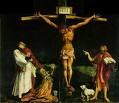
A God who merely comforted the afflicted and bound up the wounded would not be a God who takes on the power of sin and death and evil. That is what the cross of Jesus is all about. God himself confronting human life at is very worst, at its most irredeemable, at a pitiful state execution, where the most powerful forces in the world humiliated and destroyed this humble innocent man.
He took it all on himself, the whole weight of the world’s hate and violence, its guilt and shame, all of it there on the hill at Golgotha. For us: you and me, and not just for us, but for everyone, across the ages. And not just for humans, but for himself, because his own holiness could not tolerate the world’s sin without atonement. And so he made it, not with the blood of rams at the temple, but making the sacrifice himself, spilling his own life out.
And why? Because that is what love does. By its very nature love spills itself out. In the letter to the Philippians Paul says that Jesus even gave up his own rightful claim to divinity, emptying himself, taking the form of a slave, for the cross was a slave’s death.And because of this humble obedience the Father has highly exalted him, and has given him God’s own name. Because “Lord” is the name Israel gave to their God, and to no one else.
But now Jesus is called “Lord.”When we call Jesus “Lord” and take the full measure of his love we will be moving toward a faith that can meet life’s darkest hours and toughest spots. A faith that is able to stand at the foot of the cross. And the world desperately needs people like that with faith like that: faith in Jesus, and in the power of his cross.

 Dietrich Bonhoeffer once wrote, “Either I determine the place in which I will find God, or I allow God to determine the place where he will be found. If it is I who say where God will be, I will always find there a God who in some way corresponds to me, is agreeable to me, fits in with my nature. But if it is God who says where He will be, then that will truly be a place which at first is not agreeable at all, which does not fit so well with me. That place is the cross of Christ.” (Meditating on the Word, p 44–45).



 When I Survey . . .