Unknown's avatar

“Our eyes are on you”

AT

“We do not know what to do; but our eyes are on you.” – 2 Chronicles 20:12

“It took many years in the ministry for me to be able to say, “I don’t know what to do,” but it was something of a turning point for me. . .  There is often a certain kind of functional atheism that creeps into the way we do business in the church. We might open our meeting with a prayer, but we fully expect to take care of business ourselves.” (From today’s Daily Devotional) Read whole post

(Photo: Appalachian Trail in S. Egremont, Massachusetts. By R.L. Floyd)


Unknown's avatar

“The Church of the Troubled Hearts”

heart3I have seen congregations named “The Church of the Redeemer” and “The Church of the Good Shepherd” and “The Church of All Souls,” but I have never seen a church named “The Church of the Troubled Hearts.” It might not attract a big following, but it would name who we are. Because our hearts are troubled, troubled about our future, our finances, our children, our health, our relationships, our congregations and our faith.

(from my Daily Devotional for today) Read more


Unknown's avatar

“From Here to There and Back Again” The Journey from Text to Sermon

On the other hand

“For as the rain and the snow come down from heaven,

   and do not return there until they have watered the earth,

making it bring forth and sprout,

   giving seed to the sower and bread to the eater,

so shall my word be that goes out from my mouth;

   it shall not return to me empty,

but it shall accomplish that which I purpose,

   and succeed in the thing for which I sent it.”  (Isaiah 55:10-11)

The title for today’s gathering was announced as “Getting from There to Here.” As I reflected on it I wondered if perhaps “getting from here to there” might be more apt. “Here” being the text in front of you, to “there, ” the sermon. That works.

But as I thought more about it I saw the wisdom of  “from there to here.” From “there,” “the strange new world of the Bible,” to “here,” the world we live in. And I thought of some of the various locutions we have used over the years to capture this movement from text to sermon, such as “from text to context” or “from Word to world.”

Then I considered the many ways I have approached the writing and preaching of sermons, and I realized this movement from text to sermon was more dialectical and less linear than any of these ways of speaking about it.

As I thought about it, the more I liked the sub-title of The Hobbit, which as you may know is “There and back again.” So perhaps “here to there and back again” is more like it.

From here to there and back again describes a journey that is not just a straight line, but rather more like a journey without a  map or even a predetermined end. And I like this way of thinking, because it captures how I have experienced sermon preparation in my four decades as a preacher.

I start with a Biblical text, and then I live with that text throughout the week on my journey, revisiting it and wrestling with it and worrying it until I begin to hear something of the voice of God in it, and by then the contours of the journey begin to show themselves, as do even the purpose of the journey and it’s destination.

The process seems to take on a life of its own, which is another way of saying that the Word of God is alive. I like today’s Isaiah text where God uses the agricultural metaphor of rain and snow watering the earth and making it produce to describe the way his Word works, “It shall not return to me empty, but it shall accomplish that which I purpose, and succeed in the thing for which I sent it.”

And I want to say a bit about what I mean when I say “the Word of God,” which can mean one thing or another, even sometimes one thing and another, or even three things depending on the context.

One way of thinking about this that has helped me comes from Karl Barth. He wrote about the threefold understanding of the Word of God.  First, there are the written words of the Bible, then there are the spoken words of the preacher, and finally, and most importantly, there is the living Word, Jesus Christ.

This living Word is mediated through both the written words and the spoken words. The prayer I began my sermon with today is based on this idea: “Through the written word, and the spoken word, may we behold the living Word, even Jesus Christ our Lord.”

And that is not to say every text needs to be understood Christologically (although it can be), as in the text we have from Isaiah today. But to say there is a living Word is to say that whenever we hear the Word of God as direct address to us, it is the same Word of the same God, who came to us and for us and became the Word made flesh.

So when I talk about the Word of God in sermon preparation, it may be a reference to the text itself, the words, or to the proclamation in the form of a sermon, the Word preached, or to both, but the goal of the journey is, through the finite human words of the text, and the finite human words of the preacher, to transcend this finitude to hear the living Word of God. And I believe this is the primary task and challenge of preachers, and of the church, for that matter.

Let me say a little bit more about the words of the text and the words of the preacher as the Word of God. I think of them by analogy to the doctrine of the two natures of Christ. Jesus is truly human and truly divine, not half and half or some other percentage.

And in much the same way (although not identically) the words of our Scriptures, the Old Testament and the New Testament, are truly human and truly divine. Human in every way, written (and edited) by human beings, and truly divine through the agency of the Holy Spirit of God who inspired the writers to write them, the same Holy Spirit the church invokes when we read them.

And the same thing can be said about the words of the preacher. A sermon is not written in some special spiritual words, but in the same human words that we use in everyday speech. Since everyone in this room is a preacher I don’t have to belabor the point that we are all human, even all-too human. Yet the Holy Spirit that inspired the writers of Scripture is the same Holy Spirit that inspires the preacher, and the same Holy Spirit that the church invokes and invites as it prepares to hear the Living Word of God from the frail words of scripture and the frail words of the preacher.

This is admittedly a high view of preaching, and some might say it claims too much for the preacher. I would say quite the opposite. It is the views of preaching that put emphasis on the personality and performance of the preacher that claim too much for the preacher.

The claim that the preacher is to be a minister of the Word of God is much like the church’s understanding of the celebrant at the eucharist. The principal was established early in the church during the Donatist controversy. The Donatists were heretics, so the question arose whether the baptisms they performed were valid. And the church agreed that “the efficacy of the sacrament does not depend on the sanctity of the celebrant.” So the preacher may be more or less gifted with the homiletical arts, but it is not those gifts that are decisive. What is decisive for the preacher is that he or she has been set apart to deliver the church’s proclamation, so that the church may hear in it the living Word of God. It is not about the preacher. It is about the church hearing the Word of God.

This is a (nearly) sacramental view of preaching, that the preacher should say what the sacrament shows. And in both cases neither the preacher nor the celebrant has control over the Holy Spirit of God, as if we somehow could control God. No, Christ is not truly present in the sacrament nor truly alive in the preached Word because we invoke his name, but rather because he himself commanded us to do these things and promised to be present with us when we did.

So with this high view before us, and a text in front of us, how do we get from there to here or from here to there and back again?

The first thing I want to say about approaching a text is the expectation that God will speak through it. Which is to say that the high view I propose operates out of trust. I think it was Richard Hayes who wrote about a “hermeneutic of trust.” For decades we have been talking and hearing about “a hermeneutic of suspicion,” and that has had its place as an corrective to the Scriptures being misused as instruments of oppression and injustice, “texts of terror,” as my teacher Phyllis Trible so eloquently called them. But there has been a heavy price to pay for the widespread “hermeneutic of suspicion” that has so pervaded the academy for decades, in that many preachers now reflexively distrust the texts.

And I think it is sometimes necessary and appropriate to distrust a text, but it shouldn’t be where we start. Sometimes distrusting a text along the way will lead you to the Word of God.

So the text is in front of us. Perhaps it is an assigned text from the lectionary. I like that, because I can be a lazy sinner who is inclined to make my favorite texts do tricks for me, but that is just me.

Perhaps the Bible is open on our desk, perhaps it is on our computer screen or smartphone, but there it is. First things first: read the text.

Read it in expectation that God’s Word can be heard in it, but don’t rush to decide what it means or even what it has to say. Texts need time. They need to be listened to. I have always described my sermon preparation as inhabiting a text. Living in it.

Another good way to think about it is to “stand under” the text so as to understand it. And the preacher stands under the text along with the rest of the church.

I am really talking about hermeneutics now more than the homiletical side of things. So you all know the various ways to worry a text into view. Read it in the original languages if you have them. Read it in several translations. Look up any key words or phrases in a Bible Dictionary. Take a stroll through some commentaries. Find out its genre and its original context. In other words do your homework. I once preached a sermon that involved Herod, and added “you remember him from the Christmas story.” My dear friend Luther Pierce, a retired UCC minister, shook my hand at the door and said, “Good sermon, Rick, but you conflated Herod the Great with Herod Antipas. Different Herod.” Oops!

So once you’ve done your due diligence and you have the text in your grasp, reflect on the context. Those of you who were preaching in the weeks after 9/11 may recall that the Common Lectionary texts were from Jeremiah and Lamentations, texts we had all avoided in the past because they are horrible cries of despair for the destruction of Jerusalem. All of a sudden after 9/11 texts about the city of devastation and the burning tower became eerily contemporary.

Which is to say contexts change. The immediate context of any preacher is the life of the congregation, and when I talk of inhabiting a text, I am referring to going about one’s pastoral duties with the text in mind. From here to there and back again.

Then there are the larger contexts of the communities in which we live and the country and world we are a part of. Sometimes contexts demand our attention.

We rarely get the kind of compelling clarity about the relationship between text and context that we got after 9/11, but keeping the text in mind as we think about the multiple contexts will often show us the way to go, the particular context that needs to be addressed by the Word of God.

The dialectic of the journey of text to context and context to text means straddling two worlds with the hope we can find in them the same story.

I had the privilege of preaching my daughter’s ordination sermon back in June, and afterwards Mary Luti said, “I like the way you went back and forth from the story in the scriptures to your story now.” And her comment made me realize that I preach that way because to me it is the same story.

I immediately thought of Hans Frei’s The Eclipse of Biblical Narrative, a wonderful and important book. Frei’s thesis is that prior to the Enlightenment Christians inhabited the Biblical Story. They understood it as their story. They were part of it. The Enlightenment changed that as we held the story at arm’s length like any other observable phenomenon.

The task of the preacher is to repair the breach; to make the Christian Story our story again. I am reminded of Bruno Bettelheim’s book, The Uses of Enchantment, where he argues for the re-enchantment of the world for children through fairy tales.

Letting the words of scripture and the words of the preacher be the Word of God for God’s people requires a similar kind of re-enchantment. It means the church realizing that the Story isn’t just back there, but is still going on and we are characters in it.

Let’s look quickly at our Isaiah text for today to see how this might be done. The text is from Isaiah of the Exile and the context is a people who have no reason to be hopeful, since they have lost the three pillars of their identity, their temple, their land and their nation.

The promises made to their ancestors Abraham, Isaac and Jacob seem null and void. Their prospects seem dim, their possibilities few.

Into this context God speaks through the prophet. “My ways are not your ways, my thoughts are not your thoughts.” “You know that rain and snow we sometimes get in the desert? That is what my word is like. It will not come up empty. It will make happen that which I promised.”

And that is what the Word of God sounds like.

And when we hear this story, can it speak to us, where our prospects seem dim and our possibilities few? Can it speak to a declining church too often eager to call it a day? Can it speak to a nation full of grave injustices and inequalities? Can it speak to a world of death and terror?

When Isaiah speaks the Word of God to the exiles he lets them see what can’t be seen, and makes them believe what they can only know by trust in the one who speaks to them. The Word makes them part of the story again, the story that began at the beginning when God said “light” and there was light, the story that saw their ancestors freed from bondage, the story that seemed to come to an end, but now God says to them, “No, it’s not ending. Not at all. I will lead you through the desert of your journey into my own future.” And what will it be like? It will be like this:

“You shall go out in joy, and be led back in peace; the mountains and the hills before you shall burst into song, and all the trees of the field shall clap their hands. Instead of the thorn shall come up the cypress; instead of the brier shall come up the myrtle; and it shall be to the Lord for a memorial, for an everlasting sign that shall not be cut off.”

And let the people say: Amen.

I preached this sermon at the New England Pastor’s Meeting of Confessing Christ, West Boylston, Massachusetts, on September 26, 2013.

Unknown's avatar

“Hearing God’s Word from Unexpected Places”

Celtic cross

 But the Lord said to me: Do not say ‘I am only a boy; for you shall go to all whom I send you, and you shall speak whatever I command you.’  Jeremiah I.7

It is good to be back with you. I so enjoyed being here on Epiphany Sunday for Pastor Mike’s installation. It was cold then. It is not cold today. I have a small confession to make. Mike e-mailed me “We don’t wear robes in the summer.” And I e-mailed him back, “Can I wear one. I’m kind of a robe guy.” So I brought a robe and a stole up here to Dover, but then I realized I was preaching about opening oneself to new experiences and insights, so I’ve decided not to wear one. You know, to walk the walk as well as to talk the talk. I am also wearing a blue shirt for the first time in forty years, because I’m kind of a white shirt guy, too. So I’m really being daring today.

Will you pray with me:

Gracious God, through the written word, and through the spoken word, may we behold the Living Word, even your Son our Lord, Jesus Christ. Amen

I was just twenty-six years old when I graduated from seminary and became the pastor of the Congregational Churches of West Newfield and Limerick, Maine, just over the border and up the road about an hour from here. That was nearly forty years ago.

I grew a beard to look older and wiser than my years, but I’m pretty sure it didn’t fool anyone. I’ve learned a thing or two about the ways of the world and the church and myself, but when it comes to the ways of God I still stand in awe before the mystery of it all as much as I did back then.

But I will tell you one thing I have learned. You have to be open to hearing the voice of God from unlikely people and in unexpected situations. This is a humbling truth, and there is a kind of Socratic inversion about it. Remember how Socrates said of himself: “I am the wisest man alive, for I know one thing, and that is that I know nothing.”

Likewise, the people who think they always know what God is saying tend to be the ones least open to hearing from God, and are therefore the least knowledgeable.

Because if we decide in advance where and when and through whom God will speak, we severely limit our capacity to hear from God.

There are many reasons we close our minds and hearts to those through whom God speaks.

Perhaps we think someone is too young to speak for God. In our Old Testament reading today, Jeremiah tells God just that, that he is too young to be a prophet. God rebukes him, saying: “Do not say ‘I am only a boy; for you shall go to all whom I send you, and you shall speak whatever I command you.’” Jeremiah I.7

I remember when I was young being frustrated that older people often found it hard to see me as someone with something to say because of my age. Now that I am not so young, I have to resist the impulse to dismiss the insights and wisdom of the young, and to tell the truth, I find myself more and more learning from those who are younger, which is an ever-expanding group.

My twenty-nine year old daughter, Rebecca, was just ordained to the ministry in June. I have heard her preach several times now, and, if I do say so myself, she is pretty good. But sometimes when I am listening to her, my mind is saying, “How can this be? Is this my daughter? I remember the day she was born as if it were yesterday.”

And you have a daughter of this church being ordained soon, Emily Goodnow, a schoolmate of my daughter’s from Yale Divinity School. And perhaps some of you who watched her grow up in this congregation wonder, “How can this be? I remember when she was just a girl in Sunday school.”

Recall when Jesus went to his home synagogue to preach his hearers said, “Isn’t this the carpenter? Isn’t this Mary’s son and the brother of James, Joseph, Judas and Simon? Aren’t his sisters here with us?” And they took offense at him.” (Mark 6:3)

His youth and their familiarity with him kept them from hearing him.

What else keeps us from hearing God speak to us? It wasn’t so very long ago that the conventional wisdom in the church was that preaching the Word of God was a man’s vocation. There are still Christians that believe that.

When I was growing up there were no women ministers in my church or in my experience. When I was at Andover Newton one of my teachers, Emily Hewitt, was one of the first 11 women ordained in the Episcopal Church. It caused quite a stir at the time.

As I was preparing this sermon I wondered what she was doing. So I Googled her, and I discovered that she later went to Harvard Law School, became a lawyer, and is now the Chief Judge of the United States Court of Federal Claims. Why would the church want to deprive itself of the talent of someone like her?

But for a long time we did keep women from using their gifts and talents. It was a widely accepted convention.

For example, and I am really dating myself now, but when I started my ministry in Maine, there were only male deacons, who served communion. The women, called deaconesses, set up the communion and cleaned up after. That was the way it had always been and it was accepted. But we went through a change. We saw the basic unjustness of this arrangement, and we changed it.

And so we changed our ideas about who could preach the Word of God, and now women ministers, and very talented ones like Rebecca and Emily, are a commonplace in our churches.

When John Robinson, the pastor of the Pilgrims in Leyden, addressed them before they shipped off to the New World, he preached a sermon to them. And in that sermon he said, “God hath yet more light and truth to break forth from his Holy Word.”

This openness to new light and truth is very biblical. Our God was always doing the unexpected. Even the people God chose to speak on his behalf or to carry out his plans were seldom what one would expect.

Think about some of them with me: Jacob was a liar, a cheat, and general scoundrel. He tricked his father, stole his brother’s birthright, and had to leave town in the dark of night. Yet he became the Father of a Nation and was given the name Israel.

Moses, God’s spokesman, said, “Not me, Lord, I’m not a good speaker. God said, “I’ll send your brother Aaron with you. He can do the talking.”

The prophet Jeremiah, who we heard about today, said, “I’m just a boy.”

And Mary, the mother of our savior, was a humble unmarried teenage mom.

These instruments of God go against our human expectations, but God uses all sorts and conditions of men and women to speak and act on his behalf.

And so we have had to expand the circle of those who preach, bringing in women within the lifetimes of many of us in this room.

And we are continuing to expand the circle. For example, in the church where I worship our pastor is gay. And he is married. And he and his husband just last week adopted a baby boy.

And that is new to me. And because of that it have been a bit of a challenge for me to get my mind around, because even a decade ago a gay, married pastor with a child was not part of my experience, or the experience of many for that matter.

Last year, during our interim period, I was praying for God to send us a faithful pastor and preacher. And God did, because this pastor is a rock-solid Christian, born and raised in the church, and I never hear a sermon of his without hearing something of the voice of God in it.

The world around us changes. The contexts in which we preach and hear changes. I am reminded of the story about Will Campbell, the white civil rights leader who marched with Martin Luther King. He was a Southern Baptist, and he was asked if he believed in infant baptism. “Believe in it? I’ve even seen one!”

So once again we have had to expand our thinking about who we think we might hear God’s Word from. We have had to expand the circle.

Because God calls a variety of men and women to speak on his behalf, and they come in a variety of shapes and sizes, races, tongues, and sexual orientations. And the truth is we need to hear from them all.

Because the Word of God doesn’t just drop from the sky. The Christian faith is a mediated faith, coming to us through the words of others. We have the words of the Bible, and the Word of God can be discerned in them, but they themselves are not the Word of God. No, to hear the Word of God we need human interpreters, which is one of the tasks of the church.

One way of thinking about this that has helped me was put forth by the great Swiss theologian, Karl Barth. He wrote about the threefold understanding of the Word of God.  First, there are the written words of the Bible, then there are the spoken words of the preacher, and finally, and most importantly, there is the living Word, Jesus Christ.

This living Word is mediated through both the written words and the spoken words. The prayer I began my sermon with is based on this idea: “Through the written word, and the spoken word, may we behold the living Word, even Jesus Christ our Lord.”

So we need people in the church to mediate the Word of God to us, to make it real for us. And this happens in community and in relationships with real people living real lives, with real talents and struggles. We need all kinds of people, so that you can even hear a sermon from someone like me with a brain injury.

Those of you who were here for Mike Bennett’s installation in January will remember that I preached a sermon called “Ministry is not a Commodity and Ministers are not Appliances.” And in that sermon I said this: “Mike embodies what the great preacher Gardner Taylor was after when he advised preachers “to look beyond the peripheral signs of preaching greatness to the real source of pastoral insight–the common bond with one’s hearers provided by suffering.” And I would expand Taylor’s words to include not only suffering, but all manner of shared life-experience, the kind that happens in community, the kind that happens day to day in the church.

And I said this to you: “If you let him, Mike will share your lives, will rejoice when you rejoice and weep when you weep, and will become your pastor.”

And by all indications it seems that, nearly a year into your relationship together, you are finding that to be true.

But the very best preacher in the world does not make the Word of God alive by himself or herself. For that you also need good hearers, ones open to hearing things that they may not have heard before, that may challenge them, prod them, even make them unhappy or angry.

But by being open to the unexpected, hearers may well hear things that please and delight them, things that make them wiser and stronger and more faithful. And may open them to larger truths, to new wonders, and, above all, to the amazing grace and the vast love of God for us in Jesus Christ our Lord. Amen.

I preached this sermon on August 25, 2013 at the First Parish Church, Congregational (UCC) in Dover, New Hampshire.

Unknown's avatar

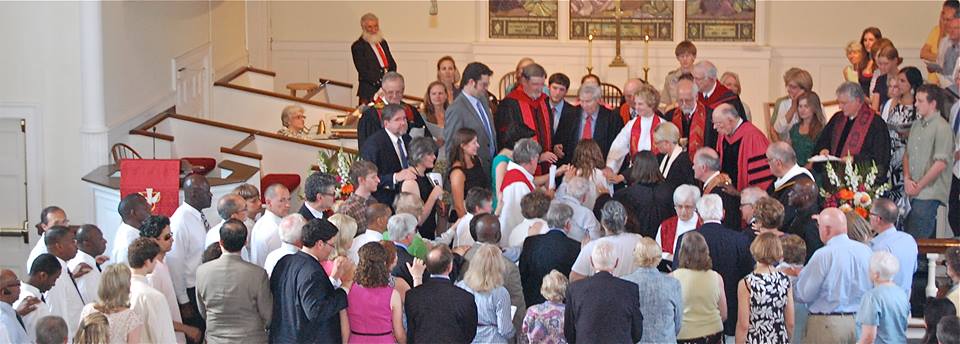
An Ordination Sermon: The Secret Sauce of Ministry. A Recipe in Two Parts

Laying on of hands

The Secret Sauce of Ministry
A Recipe in Two Parts

Hebrews 12:1-2
Philippians 2:1-11

As some of you know I like to cook. This time of year, when the weather gets fine, I fire up my grill and do some grilling and barbecuing. And I love to sit on my back porch near the grill with a cold beverage and read cookbooks, of which I have many, or as Martha would say, “too many.”

Many of these grilling and barbecuing books contain recipes for a “secret sauce.” I have been noticing lately that the term “secret sauce” has migrated from its culinary context and is now being employed as a metaphor for that special something that makes things work properly.

For example, I recently heard a journalist talking about “the secret sauce” that would create “a grand bargain” to overcome the Congressional budget impasse. Good luck with that.

So I started to wonder, “ What’s the secret sauce of ministry?”  If I had to come up with a simple recipe for what makes ministry faithful and effective what would it be?

So here’s my recipe, which comes in two parts, which I hope you will take away with you today for your own ministry, whether lay or ordained.

1. The first part of the secret sauce is this: You can’t do it alone. Rebecca couldn’t have come to this day alone, and she can’t do her ministry alone. No one does it alone.

How does one come to know God? And to love God? And to want to serve God?

When I look out at this congregation I see so many here today who have helped to shape and influence Rebecca. I am reminded of the scripture from Hebrews we just heard that says we are “surrounded by a great cloud of witnesses.” The image is from the ancient stadium where the races were held, and the cloud of witnesses are the spectators who cheer the racers on.

This great crowd includes both the living and the dead, “the church militant” and “the church triumphant.”

So among the crowd present in the congregation today are many members of Rebecca’s family, let’s call them “the crowd of the proud.”

In addition to Martha and myself, are Rebecca’s brother Andrew and his wife, Jessica. Rebecca’s maternal grandparents, Art and Marianne Talis, are here. As are several assorted aunties, an uncle, and a cousin.

These family members represent a great line going back through generations of Talises and Beers, Floyds and Laffoons, and, let me tell you, there is a lot of church in these families.

We represent a great ecumenical melting pot, from the Greek Orthodox faith of Rebecca’s grandfather’s forbears, to the German Protestantism of her grandmother.

My mother’s father, Bill Laffoon, a descendant of French Huguenots, was a deacon at his Congregational Church in Wichita, Kansas. His schooling ended with the 6th grade, but saw to it that his two daughters went to college during the height of the Depression.

Granddaddy read his Bible every day, and his speech was sprinkled with scripture verses.

So when I was growing up my mother also had a scripture for every occasion, I thought she was so wise, she’d say, “Sufficient unto the day is the evil thereof.” And, “Do not cast your pearls before swine.” When I went to seminary I discovered that they weren’t original with my mother, but came from Jesus in the Sermon on the Mount.

Years later, Rebecca had the same experience at Yale when she learned where all my wise sayings came from.

On the other side of the family, I think today also of Martha’s grandmother, Marta Beer, which in our family is a family name and not a beverage. My Martha is named after her. She raised three daughters by herself in wartime Germany, and was another great churchwoman.  How proud she would be.

This rich ecclesiastical family DNA has helped to shape and form Rebecca into a minister. They are all part of this congregation today, a part of the cloud of witnesses.

But there’s more. For as grand as Rebecca’s family legacy of ministry is, and as important as family support and nurture is, family alone cannot make a minister.

And so I look around this room and I see many people from Rebecca’s past, a number of the good people of the First Church of Christ in Pittsfield, where Rebecca was baptized and confirmed. I see some of her Sunday School teachers, youth group leaders, mentors and supporters, who have made the trip down here today from the Berkshires.

And when I look around today I also see many other friends, Pittsfield neighbors, UCC and ecumenical colleagues, and folks from the Berkshire Association, who have been part of Rebecca’s life.

I see some of her Wellesley College roommates up in the balcony. I see Yale classmates and New Haven friends, and, of course, all of you from Green’s Farms Church, members and staff, who have so warmly embraced Rebecca in your community, and are now such an important part of this most recent chapter in her life.

There are others, too, I must mention, who are neither related to Rebecca nor have ever met her, who she knows from the books she loves and the scriptures she studies. Those many other witness, men and women of the church:  prophets, apostles, martyrs, evangelists, theologians, reformers, writers and thinkers down through the ages. They are part of this great crowd, too. They were all witnesses to God, and to God’s vast love for us in Jesus Christ.

So all of you here, and all the unseen but present, make up the great cloud of witnesses, who cheer us all on as we go about our several ministries, and especially cheer Rebecca on today. I thank God, for you and for them.

So to take nothing away from Rebecca, who as you know, is a remarkable young woman and certainly gets much of the credit for us being here today, she hasn’t done it alone. Because this ministry business is a team sport, and I have just described to you just how really big the team is.

Nobody gets to ministry alone, and nobody does ministry alone, because you can’t do it alone.

So that’s the first part of the recipe for the secret sauce of ministry.

2. The second part of the recipe for the secret sauce of ministry is this: It’s not about you. To do ministry in the name of Jesus Christ you have to get out of your own way.

What does this mean? Recall how Jesus was always confusing the disciples by saying things like “the one who would gain his life must lose it.” And “The one who exalts herself will be humbled, but the one who humbles herself will be exalted.”

And the disciples never quite understood what he was trying to teach them until after Easter. Their hopes had been dashed on Good Friday as they fled from him and his cross. But after Easter all those things he said made sense. He was showing them a way, a way of selflessness, of servant-hood, a way to be a person for others.

And recall also how our brother Paul kept writing to churches that were fighting, and saying in one form or another, “It’s not about you!”

To the Corinthians he wrote, “What we preach is not ourselves, but Jesus Christ as Lord and ourselves as your servants for Jesus’ sake (2 Cor. 4,5). And a couple of lines later in that same letter he wrote them, “We have this treasure in earthen vessels to show that the transcendent power belongs to God and not to us.” (2 Cor. 4:7).

What was he trying to tell them about ministry? That “it’s not about you.” To be a minister you have to get out of your own way. And the reason that you have to get out of your own way is first to make space for God to work in and through you. And you have to get out of your own way, secondly, to make space for the other, the ones you minister to.

I was with Mary Luti at a meeting the week before last and I told her how excited I was that she would be laying holy hands on Rebecca and doing the prayer of ordination today. I said to Mary, “It is so fitting because it was under your ministry that Rebecca started discerning her call.”

And Mary demurred and said, “I really didn’t do that much.” And I thought she was just being humble. But as I started pondering the recipe for the secret sauce of ministry, I realized she was quite right.

And you know why she was right? Because it wasn’t Mary who called Rebecca into the ministry. Mary was just doing her job, which is how ministry works. Rebecca was a questioning young woman in a pew in Cambridge, and Mary was doing her job, which was to share the God she knows and loves. And Rebecca was in the right time and the right place with the right person, and God’s Holy Spirit works like that, in what seems mundane, but can at the same time be quite marvelous.

Our society cultivates a cult of personality, a cult of celebrity, but ministry is not about that. There are celebrity ministers, but the good ones, the faithful ones, know it is not about them.

The word minister actually means one who represents another. The Europeans use it this way in describing their government officials: the minister for finance, or the foreign minister. These are the ones who represent the government in their particular area of expertise

Likewise, a Christian minister is one who represents Jesus Christ. And representing Jesus Christ means taking the form of a servant. Jesus once told his disciples, “Whoever would be great among you must be your servant, and whoever would be first among you must be your slave; even as the Son of man came not to be served, but to serve, and to give his life as a ransom for many.” (Mt 20:25-28.)

Not to be ministered to, but to minister. Not to be served but to serve.

This is counter-cultural in our self-obsessed society. To tell people to get out of their own way for God and for others is not a particularly popular philosophy today. When I peruse the magazines at the super-market checkout there are titles such as Self, Us, People (meaning famous self-absorbed people) but I don’t see Servant or Ministry magazine.

There was a fascinating interview with director Sofia Coppola in last Sunday’s New York Times about her new movie, The Bling Ring. The movie is based on a true story about five teenagers from the San Fernando Valley in California, who were so obsessed with the culture of personality and the trappings of celebrity that they started breaking into celebrity’s homes and stealing stuff.

They would often just walk in through an unlocked front door, or climb in an open window. They robbed people like Lindsay Lohan and Paris Hilton.

In the course of a nine-month spree they looted more than 3 million dollars worth of jewelry and designer clothes. I found the story shocking, but part of it got me chuckling to myself. Apparently they broke into Paris Hilton’s home six times before she even noticed. “She had so much stuff that it took awhile for her to realize someone had broken in.”

Have you seen the bumper sticker that says, “The one who dies with the most stuff wins?” A better, truer one would say, “The one who dies with the most stuff dies.”

Sofia Coppola said she chose this subject for her movie because she has two small daughters, and she fears for them growing up in this glittery world of celebrity culture, a culture that sends the message that it really is all about you and your stuff. She describes hearing some of her daughter’s 6 year-old friends talking about what they wanted to be when they grew up, and a couple of them said, “I want to be famous.” She asks, “Where does that come from?” I don’t think we knew about that when we were six years old.”

And that is a challenge for ministry these days. I am particularly thinking of parents and youth ministers. How do we raise our children in a society that tells them it really is all about us?

When we were driving through the countryside in France we would sometimes see vast fields of sunflowers as far as the eye could see. The sunflowers would be facing East toward the rising sun in the morning, and as the sun moved through the sky the sunflowers would turn toward it, so that at dusk they would have turned completely toward the West. In fact the French world for sunflower is tournesol, which literally means “turn to the sun.”

Sunflowers do this because they are heliotropic; they need the sun to live. By analogy, we are theotropic, we need God to live, and we are made to bend our love toward God and others. But we too often bend our love toward ourselves, and that is where we get in trouble, for instead of living for God and others we try to love ourselves and control things as if we were God.

And that is what is so beautiful about our second reading today from Philippians; it turns the equation entirely upside down. God in Christ bends toward us, and shows us what love looks like.

The late British theologian Colin Gunton said,

 Sin is for the creature to think and act as if it were the creator. But here in Philippians 2 Jesus is godlike precisely in going the other way.

Here Jesus empties himself even of his divinity to become a servant, “a man for others” as Dietrich Bonheoffer described him.

And it is this humility, this self-emptying, this relinquishing of privilege, that Paul wants the church in Philippi to emulate. He writes them to “let the same mind be among you that was in Christ Jesus.”

The church in Philippi was having one of those squabbles that have been known to happen in congregations, even in our own time. Paul admonishes them to get out of their own way, and have the very same mindset as Jesus, the mindset that led him to empty himself, and in humility take the form of a servant, the mindset that ultimately led to his death on the cross.

But it’s not so easy to have the same mindset as Jesus. Remember those WWJD bracelets, that stood for “what would Jesus do?” Some people criticized those WWJD bracelets for being overly simplistic. Because asking, “What would Jesus do? doesn’t really solve the problem. It usually isn’t that hard to know what Jesus would do. People talk about the hard passages in the Bible, and there are some, but the parts that really challenge and convict me aren’t the parts I don’t understand, but the parts I do. “Love your enemies.” “Feed the hungry.” “Welcome the stranger.”  “Share your possessions.” “Turn the other cheek.” “Take up your cross and follow me.” Just to name a few.

So the hard part, after you figure out what Jesus would do, is doing it.

To “practice what we preach,” to “walk the walk as well as talk the talk” is where we pretty consistently fail, and why we need grace and forgiveness to keep trying. And the good news is that is exactly what we get from our God, grace and forgiveness.

In the cross of Jesus Christ, God does for us what we cannot do for ourselves, and saves us from ourselves, among other things, such as sin and death.

All ministers, you and me, lay or ordained, even Rebecca, fail at being consistently Christ-like. But the wisest ministers know that our ministry is at its most faithful when we realize that it is not about us, when we get out of our own way, as Jesus did, to be a servant, as he was a servant, to serve as he served, to love as he loved, and to be a person for others.

And here’s the beautiful thing: if you follow this recipe you don’t really lose yourself at all, you will actually find yourself. Only the empty can be filled with the new life God wants for us. Jesus said, “I came that you might have life, and have it in abundance.” (John 10:10)

Because this self- emptying doesn’t mean we lose our personalities or our personal identities. On the contrary, when our love bends toward God and others, as those sunflowers bend toward the sun, when we lose ourselves in service, when we live for others, we are most ourselves, our own true best selves as God intended us to be.

Just as Jesus’ exalted lordship is ultimately revealed in his humble servant-hood.

Let us listen to it again:

“Let the same mind be in you that was in Christ Jesus,

who, though he was in the form of God,

did not regard equality with God

as something to be exploited,

but emptied himself,

taking the form of a servant

being born in human likeness.

And being found in human form,

he humbled himself

and became obedient to the point of death—

even death on a cross.

Therefore God also highly exalted him

and gave him the name

that is above every name,

so that at the name of Jesus

every knee should bend,

in heaven and on earth and under the earth,

and every tongue should confess

that Jesus Christ is Lord,

to the glory of God the Father.”

And let the people say: Amen.

I preached this sermon at the Ordination of my daughter, Rebecca Megan Floyd, on June 9, 2013, at the Green’s Farms Congregational Church, UCC, in Westport, Connecticut.

Unknown's avatar

“Behind Locked Doors” A sermon on John 20:24-29

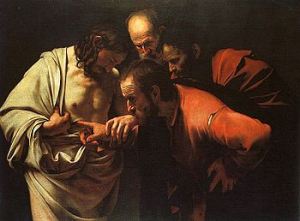
caravaggio_-_the_incredulity_of_saint_thomasThe Second Sunday of Easter, traditionally called “Low Sunday,”  is a tough Sunday for a preacher for a number of reasons.  First of all, the context of our preaching can be a bit discouraging. We have fewer than half the people we had last week, and I always preach better for some reason when there are more people present. It must have something to do with group dynamics. Easter is always a high holy day in the church, a bright and festive day, and though the church in theory believes that Easter lasts for the Great Fifty Days, the second Sunday is, well you know, Low Sunday.  Plus I am always exhausted and worn thin after Easter.  But having said all that let me make a confession: I like low Sunday.

 I like it for two reasons. First, the folks who come on Low Sunday tend to be the faithful core of the congregation and I feel I don’t have to explain so much of the Gospel to you. To use Eugene Peterson’s helpful distinction, on Low Sunday there are more pilgrims and fewer tourists. I say that not to disparage religious tourists, God knows we have all been that at one time or another. God meets us where we are and even spiritual tourists need God’s mercy and love. My point is just that hardly anyone feels a pressing social or cultural need to get up and come to church on Low Sunday, so those who are here tend to be serious about what we are doing here, and I appreciate that, since I am serious about what we are doing here.

But the second and more important reason I like Low Sunday is that it speaks deep truths about how the risen Christ comes to us. Low Sunday is sort of a down and out Sunday, and the Lord Jesus seems to appear especially to the down and out. If you read the stories of the resurrection appearances it is startling that without exception the disciples are doing nothing especially religious when Jesus appears to them. They aren’t praying or worshipping. In Luke they are walking on the road lamenting what had happened, or they are fishing, having given up their discipleship to return to their day job. Here in John’s Gospel on Easter night the disciples are in a locked room, hiding in fear.

And it occurs to me that is the church’s natural state: a bunch of scared people locking out the world. You might argue that the disciples are not yet the church, until Jesus comes to them and gives them the Holy Spirit (John’s version of Pentecost) and you would be right.  The church without the risen Christ and the Holy Spirit is just a bunch of quite literally dispirited people hiding in fear from real and imagined enemies.

And that is one of the reasons I like Low Sunday. The disciples are so obviously failures at being disciples and so they share that in common with us. It’s Easter and they don’t even know it. They have nothing to offer as the church, no vision, no energy, no courage, no conviction. They are hiding. They are afraid. As far as they know Jesus is dead and done. The shepherd has been struck down and the sheep have scattered.

They should have believed the witnesses. Peter and the beloved disciple have been to the empty tomb. They have told the disciples what they have seen. Mary has told them she has seen the Lord. They should have believed, but they didn’t, and yet Jesus still comes to them.

So this isn’t a story about the disciples or doubting Thomas so much as it is a story about Jesus. We always want Jesus to meet us at our best, to help us to improve us, but instead he meets us at our worst, and he doesn’t care about improving us. He comes not to offer improvement, but resurrection. He comes not to bring the world as it is, only “better oiled,” but a new heaven and a new earth.

And so he comes to these dispirited disciples hiding behind locked doors, and he comes to us hiding among our manifold fears and anxieties. He comes among us and finds us worrying about our money and our health and our future, worrying about our image and our reputations. He finds us ready to hide behind locked doors to keep the world out.

He finds us afraid that we will be found out, that it will become known that we are not as courageous, virtuous and committed as we have led people to believe. If people really knew how self-centered and selfish we are; if they only knew that we can be stinkers and schemers, can act dishonorably and shamefully, childishly stubbornly. If they only knew.

But Jesus does know and still he comes among us and stands there with his wounded side and those dreadful broken hands and says “Peace be with you.”  And if that isn’t good news, I don’t know what is.

And then he says something most astonishing: “As the Father has sent me, so I send you.” There must be some mistake. He can’t mean us. We are hiding in fear behind locked doors. But there is no mistake. And this is the beauty of the church. We are the ones he sends, not the virtuous, the strong, the wise, the courageous. No, he wants us, sends us, foolish men and women, and slow of heart to believe.

And Thomas missed it and can’t buy it, can’t believe it. They said, “We have seen the Lord.” But he said to them, “Unless I see the mark of the nails in his hands, and put my finger in  the mark of the nails and my hand in his side, I will not believe.” So there!

And Thomas is the church, too. Practical, not given to flights of fancy or imagination. Thomas is the church in all its stubborn, hard–headed practicality. He had been a disciple, sure, but look what happened to Jesus. It was time to get back to reality, back to basics, back to practicalities. Show me or I won’t believe. And once again the good news of Low Sunday is Jesus comes to Thomas, comes to the church in all shortsightedness, in all its stingy fearfulness, all its ingratitude. Jesus comes and says, you want to see, see, you want to touch, touch.

That’s the beauty of Low Sunday, the real Easter story is not so much last week among the lilies as it is here among the few of us who have gathered to hear how the church began with these fearful disciples.

And if we can dare to believe that God raised Jesus from the dead, can we not dare to believe that he can raise us too, not just when we die or at the resurrection of the last day, but now, raise up a church, a people who on their own are dead or as good as dead, afraid and hiding, but who when he comes among them are raised to life, raised to become the church. To love as he loves, to forgive as he forgives.

On Wednesday I dragged myself to come to church to two committees meetings that met at the same time.  When I came in there was one person at the first meeting, and when I went down the hall there was only one at the other.  There were some important things to be done by each committee, but it was not to be done that night. On the way home I was complaining a little bit to the Lord, and I thought, well, people are busy, and they are volunteers, and its Easter, and finally I said, Lord, if you want something to happen here, you better do it, because we are not up to it on our own. And then I had my sermon. Of course we’re not up to it on our own. What was I thinking? We never have been and we never will be. But still he comes among us, still he sends us, still he calls us to be the church.

And then I had two funerals, one Friday and one yesterday, and at those funerals I saw the faces of the people as I told them the good news of the Resurrection, the good news of the Gospel, the Good news of Easter, and I thought, yes, this is the church. This is why we’re here, this is what we are here to do. To be witnesses to the risen Christ. To tell people he lives, and we can live too with him.

So I may feel a little low this Sunday, and you may feel a little low this Sunday, and this Sunday may feel a little low this Sunday, but the Risen Christ comes to meet us when we’re low, in fact, more likely than when we’re  not, and when he comes he bids us peace and send us out in the power of his resurrection. We’re coming out of our locked doors. We don’t need to hide. There is nothing to fear. Because it may be Low Sunday, but its still Easter.  Amen.

(I preached this sermon on April 30, 2000 at First Church of Christ, Congregational, in Pittsfield, Massachusetts)

(Painting: Caravaggio)

Unknown's avatar

Retired Clergy in the Pews

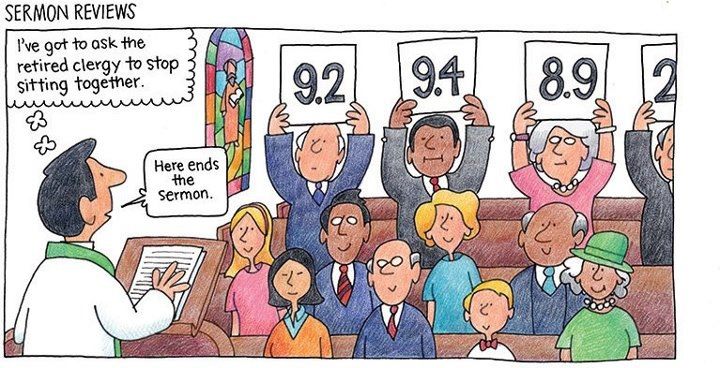
Retired clergyI was blessed during my several pastorates to have  a number of clergy sitting in the pews. Some were retired, some were pastoral counselors, and several were seminary professors from nearby schools. With very few exceptions these colleagues were always encouraging and supportive, and I valued their comments, conversation and friendship.

Now I am a pew sitter myself for the most part, except for the odd pulpit supply invitation. I enjoy hearing a good sermon and have been blessed to hear many in recent years.

But not everyone finds the presence of clergy in the pews a blessing (see cartoon above). I have active colleagues who tell me that some of their retired clergy colleagues can be a burden to them, that they know they will be critical of them and they make them nervous.

When this happens it is a failure of a basic kind of collegiality that should prevail among the ordained clergy, the ministry of encouragement. Our role as pew sitters is to support our pastors. We of all people know the nature of the job. And out of that knowledge should come from us a great measure of appreciation for all they have to do. We should be praying for them regularly. We were once where they are and were blessed with elder teachers, mentors, and friends.

I have learned these past few years that it is a difficult transition to go from being regularly in the pulpit for decades to finding oneself in the new role of congregant. It takes patience and humility.

But the thing we retired clergy have in common with the one who now leads our community in worship is worship itself, and the reality that pastor and people stand under the Word of God, and the grace and love that is proclaimed in it. And there is a blessing in being a worshipper without the responsibility of presiding, a chance to open oneself to God’s presence and power without having to wonder if the absent-minded reader will find the right lesson or whether the kids will be so sugared up that they will hijack your children’s message.

So sit back my friends and let the new kids on the block take their turn. As our brother Paul said to the church in Corinth, “I planted, Apollos watered, but God gives the growth.”

(I would give attribution to the cartoonist if I knew who they were. If you know let me know.)

(Update on the cartoon from Dave Macy:

“The cartoon appeared on a Church Pension Group (Episcopal Church) calendar. The cartoonist is The Rev. Jay Sidebotham. From this year’s calendar: “Fr. Sidebotham serves as rector of Church of the Holy Spirit, Lake Forest, Illinois. Before hearing a call to ordained ministry, he worked in New York in the fields of animation, illustration and advertising. (Some would say he is still working in advertising.) He is grateful not only for the opportunity that parish work affords to continue expressing himself through his drawing, but also for the abundant supply of cartoon material that emerges in parish life.””

Thanks, Dave.)

Unknown's avatar

Unity in the United Church of Christ: A Theological Reflection

UCC(This year marks the twentieth anniversary of my address to the Executive Council of the United Church of Christ, which I gave in Cleveland , Ohio, on October 17, 1993. I was asked by the Executive Council to reflect theologically with them prior to their meeting. The address that follows is the result of that invitation. This address was also published in Papers from the Initial Meetings of Confessing Christ, November-December 1993.  I reprint it here as given with a few small editorial changes.)

Let me begin my reflections by invoking the motto of the great Reformed Pastor Richard Baxter (1615-1691), which can be translated as:  “In essentials, unity; in nonessentials, diversity; in all things charity.”  (He seems to have got it from the German Lutheran theologian Peter Meinerlin). Baxter referred to essentials as “necessary things” and to nonessentials as “doubtful things,” and it seems to me that many of the strains we experience in the UCC are because of the difficulty in distinguishing between what is essential and what is nonessential, what is necessary and what is doubtful, by which Baxter meant what is open for discussion. To make these distinctions in the United Church of Christ will not be easy, but I am convinced that unless we carry out a continuing and wide-ranging debate on what constitutes our essentials, both our unity and diversity will continue to be imperiled. I speak to you as a lover of the church, a local church pastor who has been through the chairs of denominational and ecumenical life.

I worry about the church these days. Any alert church person knows that the church is undergoing profound and far–reaching changes.  The church of tomorrow will not look like the church of today, of that we can be certain. A flurry of books has appeared on the decline of the mainline churches, such as Loren Mead’s The Once and Future Church, Leander Keck’s The Church Confident, and Jackson Carroll and Wade Clark Roof’s Beyond Establishment: Protestant Identity in a Post–Protestant Age, just to name a few of the most recent ones. All describe changes that are taking place, using words like “crisis” and “malaise.” All offer some tentative steps that may help the church to move in fruitful and faithful directions. None can see clearly what the future church will look like.  Mead is convinced that the new church that is being born out of the old mainline will not be seen clearly during our lifetimes and I tend to agree with him. God is doing a new thing, of that we can be sure, but just what it is that God is doing is not so easy to say.

To prepare ourselves and our church for this future requires the debate about which I have spoken, a debate grounded in study and prayer, a debate that clarifies and articulates what it is that constitutes the United Church of Christ, a debate that seeks passionately to discern the essential defining marks of our life about which we need unity; that defines, too, what are the nonessentials that can be left to Christian freedom in a wide-ranging diversity, and how do we recover the charity in all things that  the Apostle Paul said is the greatest gift God gives to those in the body of Christ?   Let me share with you some of the threats to our unity that I see.

Threats to Unity

1.  A Faulty Inclusivity

The first threat to our unity that I want to suggest to you is what I call a faulty inclusivity. I believe that the gospel creates its own diversity, addressing and calling all sorts and conditions of people. But diversity of “races, tongues and nations” or even theological viewpoints is not the same thing as diversity of faith. To paraphrase P. T.  Forsyth, “Diversity is a fruit and not a root.” Our diversity is rooted in the unity we have in Christ, and in that unity let us strive to be as diverse as possible. But in many cases our diversity has been regarded as a creed extended to everyone and everything without adequate account for the essentials that define our community.

The church needs to be both authentically inclusive about some things and carefully exclusive about others, and needs always to pray for wisdom to discern the difference. Listen to what Loren Mead has to say about this:  “At its worst, exclusivity becomes rigid and legalistic, separating the righteous from the unrighteous according to manmade standards . . . But exclusivity is important because it speaks of something more important than these limited boundaries.  Exclusivity states that there must be a place where a decision, a belief, or an action marks the difference between who is ‘in’ and who is ‘out.’ Exclusivity demands that one who identifies with the Christian community stands for something, not for everything. At its best it engages and focuses energy and anchors community life. Inclusivity goes in the other direction. It opens its arms wide to the diversity of the world, inviting the stranger into community without question. At its best it represents hospitality and prevenient grace — acceptance before it is asked or earned.  It points to the acceptance of the unacceptable.  At its worst it degrades the meaning of membership to a ‘laissez faire’ anything goes.”  (Loren Mead, The Once and Future Church, Alban Institute, 1991, p. 48)

Now I would be the first to cry foul if I perceived the UCC to be faced with a crisis of exclusivity: of rigid, arbitrary, and legalistic bars to membership or participation, but that is not our problem. In the culture of the United Church of Christ “exclusive” is considered a bad word, “inclusive” is a good word. A friend of mine who is a UCC pastor and spent some of his formative years within the ranks of conservative evangelicalism says that the word “inclusive” in UCC circles reminds him of nothing so much as the word “inerrant” in evangelical circles. Nobody really defines it, he comments, but we all are supposed to know what it means, and if you aren’t you are in trouble. It’s used as law, not as gospel. Our problem is not in the area of exclusion; our problem is a faulty inclusivity that often fails to distinguish between the authentic need for Christian confession around membership and the desire to be tolerant and nice.

Let me offer a personal anecdote.  A decade ago when I was relatively new to Berkshire County my friend, the local rabbi, made an appointment to see me. He seemed uncharacteristically nervous and it soon became clear why. Two of his congregants had informed him that they were “members” of one of our UCC churches in Southern Berkshire, and that the pastor of that church told them that there was no problem belonging to both the synagogue and the church, because we worship the same God, “and we are open here to people of all religions,” including, I later found out, some who identified themselves as Buddhists, and some who are Hindus. I told the rabbi that I found that interpretation of local church autonomy incomprehensible, and would look into it.

When I mentioned this to a member of the Church and Ministry Committee, I was told that each local church is responsible for forming its own covenants and requirements for membership and that this church was within its rights. I can’t imagine that the founders and framers of the United Church of Christ ever imagined that a local church would or could decide to become a syncretistic religious fellowship across faith boundaries.

When I talk this way about excluding people from membership in our churches who clearly are not practicing Christians, who are honest enough to say they do not confess faith in God and do not consider Christ to be the head of the church, I hear in response that we are not a creedal church. That is true in comparison to the way creeds function in other communions. We do not hold them up like litmus paper to test people’s orthodoxy. They are “testimonies and not tests.” Nevertheless, the United Church of Christ is a Christian Church in the classical Christian tradition.  Our constitution says that we honor “the historic creeds and confessions of the Christian Church.” We are a church, not a sect, and though we provide space and freedom for a wide variety of viewpoints and perspectives we do not make it up as we go along. Essentials such as the Trinity, the headship of Christ over the church, the two sacraments of Baptism and the Lord’s Supper, the authority of the Bible, just to name a few, are not optional items to be embraced or discarded at our whim. They belong to the whole Christian church of which we are a part. Members join our congregations by profession of faith and that faith has content. Which leads me to my second threat to our unity.

2.  Amnesia about the Church’s Traditions

We are forgetting our heritage. Leander Keck says the mainline churches are like people who inherit a grand estate, but instead of moving in and inhabiting it they have camped out in the backyard, “because they neither knew nor cared how to live in the house.”  (Leander Keck, The Church Triumphant, p. 16) We live in an ahistorical culture where memories are short and tradition is not valued, and, unfortunately, the church is not exempt from that amnesia. But those who lose touch with the living theological heritage we share are condemned to be constantly reinventing the wheel. Now there is a kind of traditionalism that resists all adaptation and change and elevates tradition to the place that only scripture should occupy. This is not what I am talking about. Rather, I refer to an authentic appreciation for the rich tradition that is a treasure bequeathed to us from the past. The church historian Jaroslav Pelikan offers us this epigram;  “Tradition is the living faith of the dead:  traditionalism is the dead faith of the living.” (Jaroslav Pelikan, The Vindication of Tradition, p. 65)  Edmund Burke (1729-1797), the British politician and writer, called the social contract a “partnership not only between those who are living, but between those who are living, those who are dead, and those who are to be born.”  That is what tradition is in the church, the place where the communion of saints get their say.  As Chesterton put it, “Tradition is only democracy extended though time.”  (G.K. Chesterton (1874-1936), Orthodoxy, 1908)

We will always need to find ways to tolerate those in the church that like to color outside the lines; Jesus and the prophets did no less. But let us have lines, even if we have to struggle about where they need to be drawn. Let us have lines, not as boundaries that exclude so much as plumb lines that give a true measure. There can be no pristine orthodoxy. Even the so-called Vincentian canon, the notion of orthodoxy defined as that which has been believed always and everywhere, is a fiction, and none of the doctrines of the church quite measure up to it. Doctrine develops, orthodoxy gets redefined. John Henry Newman said that “Authentic orthodoxy has to change in order to remain the same. In a higher world it is otherwise, but here below to live is to change, and to be mature is to have changed often.”  (John Henry Newman, Essay on Development, quoted in Jaroslav Pelikan, The Melody of Theology.  Cambridge:  Harvard University Press, 1988, p. 55)

So when I speak of orthodoxy I do not mean a rigid, unchanging set of dogmas, but rather that collection of articulations and expressions that allow the church to give God “right praise” which is what orthodoxy means. This includes knowing whom it is that we are praising.  I am arguing for what Hans Frei called “a generous orthodoxy.”  “Generosity without orthodoxy is nothing,” he said, “but orthodoxy without generosity is worse than nothing.” Such orthodoxy’s lines are never fixed or rigid, and must always be redefined. It is the responsibility, even the duty, of the church to do this, as the preamble to our constitution exhorts:  “[The United Church of Christ] affirms the responsibility of the church in each generation to make this faith its own in reality of worship, in honesty of thought and expression, and in purity of heart before God.” But it is not just any faith that we must make our own, it is this faith, previously defined as the “faith of the historic church expressed in the ancient creeds and reclaimed in the basic insights of the Protestant Reformers.” So the historic faith in its basic contours must be made our own, not something new of our own making. And when what is essential gets redefined by each generation, the ecumenical church must get its vote across space, and the communion of saints must get its vote across time. So deciding what is essential for the church’s life must not be left to the whim of every local church and pastor or judicatory on an ad hoc basis.

In this regard, I am dismayed by reports of local pastors using ad hoc baptismal formulas in their baptismal liturgies in the name of inclusive language. This is putting enormous strains on our unity both within the United Church of Christ and ecumenically. I have represented The Massachusetts Conference of the United Church of Christ on the Massachusetts Commission on Christian Unity for nearly a decade. Over that time I have had to defend us against the questioning of some of my ecumenical brothers and sisters about whether we are a bit loose and free with some things on which we thought we had agreement, such as baptism by water in the “name of the Father, the Son, and the Holy Spirit.” In the past, when somebody asked me about irregular baptisms in UCC congregations, I always explained the nature of our covenantal model of ecclesiology and indicated the traditional formula as it appears in the Book of Worship. At the commission’s annual meeting last year we were told about a neighboring state where a common ecumenical baptismal certificate had been created as a tangible expression of Christian unity. This had been signed by judicatory leaders representing Eastern Orthodoxy, Roman Catholicism, and every mainline denomination except the United Church of Christ.  The fact of a conference embracing such a policy makes my previous defense seem disingenuous. It takes little imagination to foresee the ecumenical implication of such a move.

The United Church of Christ is struggling mightily and at every level over the issue of language, as you all know from following the debate that rages around the New Century Hymnal. But it is not simply a matter of a correct or an incorrect approach to this vexing subject.  Professor Gabriel Fackre has identified at least nine discrete positions in relation to inclusive language. This taxonomy of the issue may well help us to sort out its complexity and come to wise solutions. One wise elder suggests that the Hymnal will only be successful if everyone is a little offended by it. But can we ever get it just right? Leander Keck suggests what is behind the call for flawless words is “a technological view of language.” He writes, “What makes this view of language so attractive during the eclipse of God and the entropy of religious vitality of the mainline churches is the implication that proper (i.e., “politically correct”) manipulation of metaphors can bring God back and vivify proper religious experience. Indeed, wherever the God-Reality has been collapsed into our language for God, one can scarcely avoid thinking that changing God-language changes God too, making us the creators and shapers of God instead of acknowledging that it is we who are the created and the shaped.” (Keck, p. 54-55)

A related form of amnesia that threatens our unity and the integrity of our mission is our forgetfulness of the language of Zion, the biblical and theological thought-world that is or should be the church’s proper primary language. I have been noticing for some time now how therapeutic, managerial and political language dominates the church’s discourse. Where once the church spoke of sin and grace, covenant and promise, holiness and righteousness, now we are more likely to hear other tongues. Therapeutic language speaks of co-dependence and dysfunction; managerial language speaks of goals and objectives and accountability; political language speaks of victimization and oppression. These are helpful perspectives to be sure, and the church has always adopted and even baptized the language of the culture around it, but always in the past as second languages.  I am struck by how much these foreign tongues completely dominate churchly discourse. Like second-generation exiles we have forgotten our native tongue and no longer know how to speak to one another in it. And since we no longer speak it in the home and less and less in church it is highly unlikely that our children will learn it, except a few nostalgic phrases the way many second generation immigrant families hold on to scraps of language they learned from grandma. Which leads me to my next point.

3.  The Failure of Transmission

Related to historical amnesia is our failure to transmit the faith to the next generation. The reasons for this are complex and far beyond our control. The network of support structures that not so long ago supported Protestant America are, for better or worse, gone.  The culture will not make people Christian, and in a church as heavily identified with culture as the UCC is, the intentional transmission of the faith will be all the more critical as the culture changes and becomes more secular.

I am currently involved in a doctoral project entitled “Christian Literacy:  Remedial Catechesis for Adults” in which I have designed an eight-week adult curriculum entitled A Course in Basic Christianity. There are 29 participants from my local church in the program, which is in its fourth week. Already we have learned some interesting things. This sample of people has few birthright members of the UCC or its predecessor bodies. The majority learned the faith elsewhere. Most have more understanding of the basic contours of the Christian faith than they thought, but they have had little experience of thinking and speaking theologically. They find, however, when they do it is empowering and exciting. They are relearning a forgotten language that once they knew. This was truer for the older members than the younger ones, however.

In the late nineteenth century Horace Bushnell wrote Christian Nurture and challenged the prevailing conversion model of his day. But Christian nurture then had the support of the family, the school and the culture as well as the church. That synthesis is over, and Christian nurture is now a failure everywhere. The Puritans worried about an unregenerate clergy. We should worry about an unnurtured clergy and laity, and muster everything in our power at every level to educate and nurture our people in the basics of the faith.

Likewise we need a renewed emphasis on evangelism. We are doing this in my congregation, having participated for three years with the Evangelism Institutes sponsored by the Board of Homeland Ministries. Transmission of the faith is never merely done by Christian education but also by invitational evangelism. But of course, it is not opinions that one feels compelled to evangelize about, it is good news; if you regard what you believe as a preference rather than the truth, evangelism will wither, as it so often has and does in our churches. Which leads me to my next threat to our unity.

4.  The Loss of Truth as Criterion

Another threat to unity is the increasingly accepted belief that there cannot be any such thing as truth, only personal preference.  “You like chocolate, I like vanilla. You like Hinduism, I like Christianity.” This is not what religious tolerance once meant, but as it is increasingly getting to be understood, tolerance is becoming a subtle faith of its own that believes that all religious claims are private and relative. This especially undermines Christian faith, which is not a philosophical system at all, but rather a claim about God acting in history. Christian faith is, as Leslie Newbigin once said, “Primarily news and only secondarily views.”  (A Faith for this One World.)

This ideology of pluralism states that all opinions are equally valid, and in doing so relativizes all religious truth claims. Many of the baby boomers who are joining our churches do not believe the Christian faith is true over other faiths, they merely have a preference for it, out of historical nostalgia or familiarity.  In his new book, A Generation of Seekers, sociologist Wade Clark Roof finds that baby boomers are generally inclined to like choice, tolerance of different lifestyles, mixing religion and psychology, and doing what works for them. Roof calls this religious consumerism and individualism “transformed narcissism,” and he suggests that it is what much of what America’s religious future will look like. The genuine openness (as well as the faulty inclusivity) of the UCC is very attractive to some of these people. That is the good news. The bad news is that their loyalty to denominations is very low, they pick and choose only the parts of the faith of the church that meets their needs, they are notoriously lousy givers, and if they feel moved to leave for a better deal or just stop being interested they will drop out without a thought. Every pastor knows this crowd. According to Roof, for the boomers tolerance is equated not with respect across religious lines so much as the belief that religion is an individual enterprise and one cannot talk of truth but only of preference. In an increasingly pluralistic society this attitude is highest among the best educated, those who make up one of our core constituencies. How we deal with the question of truth in a pluralistic world then becomes a pressing question for us, and has many implications for our unity and diversity.

To my mind the most eloquent of the recent Christian thinkers on this question is Bishop Lesslie Newbigin, a British theologian who was for forty years a missionary in India.  Newbigin makes a convincing case that the learned spokesmen and spokeswomen of contemporary Christianity who argue against making exclusive claims of truth on behalf of the gospel are in fact not making Christianity more available to their contemporaries, as they often argue, but are embracing an alternative view of history, an alternative faith actually, and in so doing are selling their birthright for a mess of pottage.

To judge the gospel by the prevailing worldview is to betray it, for the gospel itself is a view of history that calls into question every other way at looking at human history and destiny. To take but one example of how this works let us look at the interpretation of a biblical text. According to modern views a text is best understood from some outside perspective, an Archimedean point from which the observer can make sense of it. From this point of view we examine the text but the text doesn’t examine us.

Newbigin uses the now well-known example of Karl Barth “as he sat under his apple tree in Safenwil, when he discovered to his astonishment that the Apostle Paul was not only addressing his contemporaries in Rome but was actually addressing Karl Barth, and an answer was required.”  (Newbigin, The Gospel in a Pluralistic Society. Grand Rapids: Eerdmans, 1989, p. 98)

Newbigin might say that we have tried to understand the gospel from the point of view of the world, when in fact the world must be understood from the point of view of the gospel. He in no way rules out dialogue and discussion with other faiths and points of view, but admonishes us as Christians to be clear that we have a position that makes claims for itself, which cannot be denied by deciding in advance that all views are equally valid. That is of course just what the ideology of pluralism asks of those who come to the discussion.

One of the dogmas of the ideology of pluralism is the refusal to even consider the question of truth; even some Christians are now asking that truth questions be put aside for the sake of some elusive unity.  Newbigin wants to claim that the Christian religion is the truth, not a truth, one among many. This of course flies in the face of modernity, challenging perhaps its most widely held dogma, that in “private” matters like religion there can be no truth.

Newbigin argues for a view of the Bible as universal history, not as merely a sectarian story for a peculiar people, but the story for all people.  He supports this claim by arguing for Israel and the church to be seen in terms of election to fulfill God’s intention for all humanity, and, finally, for Jesus Christ to be understood as the clue to history. In spelling this out he articulates an interpretation of history that does justice to the biblical narrative.

Jesus Christ, “the clue to history,” is the clue as well to the church’s mission.  Since we need not be ashamed of the particularity of God’s way with the world, we can abandon the reductionism that tries to distill Jesus’ ethics out of the particularity of Jesus’ person. With the coming of Jesus the kingdom of God can no longer be understood as a formal concept “into which we are free to pour our own content in accordance with the spirit of the age.  The kingdom of God now has a name and a face: the name and the face of Jesus. When we pray, ‘Your kingdom come,’ we are praying, or ought to be praying, as the early church did, ‘Maranatha: Come, Lord Jesus.’ The fact that liberal Protestantism separated these two, was willing to talk about the coming of the kingdom but not about the coming of Jesus, is a sign of betrayal.”  (Newbigin, p. 134)

Newbigin decries the conflict between those who see the purpose of the church as the preaching of the gospel of salvation and those who see it as the doing of God’s will of righteousness and peace in this world. He says, and I agree, that this conflict is profoundly weakening the church’s witness. He suggests both parties would benefit from renewed focus on the new being in Christ, the “prior reality, the givenness, the ontological priority of the new reality which the work of Christ has brought into being.” (Newbigin, p. 136)

5.  Loss of Charity

The final threat to our unity is not about substance, but about style. I will call it the loss of charity, which is the Christian term, although in secular discourse it is often called loss of civility. Christians are admonished “to tell the truth in love,” but in the current climate of the church it gets harder and harder to do that. By charity I do not mean denying or glossing over differences. It should be sufficiently clear to you by now that I have strong opinions and I am willing to share them. I expect that others will do likewise, and let the opinions stand on their own. But that is getting less and less possible in the church. The insight that all politics are personal has made all discussions personal. Attacks are frequently made ad hominem.

Loren Mead names this in The Once and Future Church, “Much of the bitter anger in the theological and political conflicts in our denominations comes from the depths of persons who have a sense of loss of the church they loved. The conflicts may be about substantial concerns, but often the anger that surrounds them comes from those feelings of loss. I see this anger in bitter debates leading to the firing of some pastors. I see it in the way clergy scapegoat their executives or denomination. I see it in the way clergy talk about their lay people and the way lay people talk about clergy. I see it in the way people at all levels engage in civil wars or try to purge one another for one reason or another. I do not deny the fact that there is often truth behind many of the angers, but our age of change and the loss of the familiar puts a bitter edge to the anger, often violating the spirit of community.” He concludes, “Building a church for the future will take all the sense of community we can get.”  (Mead, p. 62-63)

It‘s a hard time. Angry and bitter words are spoken, and they hurt. People are more and more pigeonholed into groups and positions. I find time with my clergy colleagues to be less and less a time of support and solidarity and more and more a time of nervous defensiveness.

I know you as members of the Executive Council have been the targets of hard and hurtful accusations. The conflict with the Biblical Witness Fellowship was hard to understand from the sidelines. I am not now, nor have I ever been, a member of the Biblical Witness Fellowship, but I think I understand their sense of loss that things they hold sacred are not valued by many in the United Church of Christ. At least in the circles I move they have little or no significance or impact. Nevertheless, I have frequently heard very uncharitable things said about them that would be completely beyond the pale if said about any other group in the United Church of Christ, which makes me wonder aloud whether our church’s cherished sensitivity to and concern for marginalized groups can include them. I have also heard and read invitations for them to leave the United Church of Christ if they can’t get with the program. I think it would be most unfortunate for our church if that came to pass.  P.T. Forsyth once said, “The church is not to be sneered at if it refuses to place itself wholly on one side or the other of a mere economic, social, or political question and stake its Lord’s fortunes there.  It is bad for a Church, and it might be fatal, to be only on one side in a civil war.”  (Forsyth, Socialism, the Church and the Poor.  London:  Hodder and Stoughton, 1908, p. 33)

Our Unity is in Christ

Which is to say that our unity can never be based on like-mindedness, on some political solidarity or shared cultural life, movement or cause.  No, we are admonished to have the same mind among us that was in Christ Jesus, and it is our relationship to Christ, the head of the church, that we find our unity with each other. It seems to me that our polity is the attempt to order our life by the fact of our unity in Christ. When I was a theological consultant to the UCC sub-committee on ecclesiology I remember Reuben Sheares returning again and again to the point that the parts of the church are in relationship with each other because of the fact that they are in relationship to Christ. The key phrase in the constitution is “in mutual Christian concern and in dedication to Jesus Christ, the Head of the Church, the one and the many share in common Christian experience and responsibility.” I recall thinking, “My God, he really means that! ” and thinking as well, “What a radical belief that is.” Its implications are crystal clear: unity cannot reside in offices, whether we have bishops or not, nor in liturgies, or in creeds, or in causes, or in polity procedures. That is why both Book of Worship and Manual on the Ministry are more descriptive rather than they are normative.

What it means is that we live our common life out in dizzying freedom, the freedom in which Christ has set us free. And those of you who have been on Church and Ministry Committees and wrestled with vexing decisions in the life of our church know that because of that freedom our polity is a lot like the proverbial little girl with the little curl: “When its good its very very good, but when its bad its horrid.”

So to state the obvious, but often overlooked fact, the United Church of Christ has its unity in Christ. What does that mean?  It means our unity is something God-given that we do not create or make happen. The Statement of Faith of the United Church of Christ declares: “In Jesus Christ, the man of Nazareth, our crucified and Risen Lord, God has come to us, sharing our common lot.” In Jesus Christ, God has come to us. Our unity is the result of an act of God, and therefore we need always to look to the acts and purposes of God as attested in the scriptures.

This means we must give up modern theology’s inclination to look at the life of Jesus alone, as if we could know him by analyzing his teachings or delving into his personality. To know who Jesus is is to know what he does, and chiefly in his cross where he saved us from sin and death. This is how early Christology developed (see, for example, Marinus de Jonge Christology in Context:  the Earliest Christian Response to Jesus, 1988) and it is still the way Christians come to know Jesus personally, by what he does for us, not by contemplating his nature. As Catherine Mowry LaCugna says, “The mystery of God can be thought of only in terms of the mystery of grace and redemption. We can make true statements about God — particularly when the assertions are about the triune nature of God — only on the basis of the economy, corroborated by God’s self-revelation in Christ and the Spirit. Theological statements are possible not because we have some independent insight into God, or can speak from the standpoint of God, but because God has freely revealed and communicated God’s self, God’s personal existence, God’s infinite mystery. Christians believe that God bestows the fullness of divine life in the person of Jesus Christ, and through the person of Christ and the action of the Holy Spirit we are made intimate partakers of the living God.”  (LaCugna, God For Us ,The Trinity and Christian Life.  San Francisco:  Harper & Collins, 1991, pp 2,3) To know Jesus is to know him as Christ crucified, as Christ within the self-revelation of the triune God. The act of God in the cross of Jesus and the raising of Jesus, the Christ-event, disclosed Jesus’ identity within the activity of God, so that the church’s subsequent reflection and articulation of the person of Christ arise from that event.

We see this throughout the New Testament. So C. H. Dodd writes, “The great thinkers of the New Testament period, while they worked out bold, even daring ways of restating the Gospel, were so possessed by its fundamental convictions that their restatements are true to its first intention. Under all variations of form, they continued to affirm that in the events out of which the Christian Church arose there was a conclusive act of God . . . ” (C.H. Dodd, The Apostolic Preaching and Its Developments, 1936, p. 185)

The same is true for the theological discussions of the early centuries. So, for example, the Christological and Trinitarian controversies were focused around the vexing question of how the “man of Nazareth” who died on the cross for our salvation and the Eternal God were related. In these debates it is what God does that tells us who God is. For example, St. Athanasius dedicated his career to defending the notion that Christ is God, since Christ is our Savior and it is only God who can save. The doctrine of the Trinity, which is the specifically Christian way of speaking about God, guards this critical Christian truth from being lost or diminished, for it summarizes what it means to participate in the life of God through Jesus Christ in the Spirit.

Too much modern theology cares little for the Trinity and has either diminished or let go altogether the central Christian affirmation that “God was in Christ, reconciling the world to himself.”  (2 Corinthian 5:19)  That act of God in Christ centers on the cross, the lost chord in modern theology. Jesus Christ is our crucified as well as our risen Lord, and, it should go without saying, he couldn’t be the latter without having undergone the former. So with Paul, we preach “Christ and him crucified.” Otherwise, we are in danger of losing what Forsyth once called “the cruciality of the cross” and with it the whole sense of the triune God’s cosmic intervention and continuing activity in the world over which God holds sovereignty and exercises providence.

It is from this loss but a short leap to John Hick’s dubious conclusion about the non-exclusivity of the gospel, as if the gospel, which is about what God has done could abandon its central claim so that it might take its place among the religions. It should come as no surprise to us that someone who edited a book entitled The Myth of God Incarnate should follow it with one titled The Myth of Christian Exclusivity.   If one denies the incarnation then it is quite true that Christianity has nothing unique to say to the world.

But Christian faith does have something unique to say to the world, that God acted in a certain way at a certain time in a particular person: “Jesus Christ, the man of Nazareth, our crucified and risen Lord.” The reality of our unity as the United Church of Christ lies not in discounting or neglecting the particularity of the Christian revelation, but rather in the very act of recognizing and acknowledging it as a gift from God who has acted on our behalf.

But if the gospel is particular in form, it has universal implications. The act of God in Christ was for all the world, for every people in every age.  The Holy God who created heaven and earth and the atoning Christ who saves humankind from sin and death mutually indwell one another along with the Holy Spirit who makes Christ our contemporary.. Could there be a scheme more cosmic than that? Need we to look any further than the activity of the Triune God for our mission toward our fellow humans and within the whole created order?

In Colossians Paul speaks of this cosmic Christ, in whom dwells all the fullness of God. The universality of the gospel lies in its discrete particularity: “God with us” in the human Jesus Christ. So that biblical scholar Martin Dibelius is able to say in his commentary on Colossians, “As Paul confirmed the cosmic significance of the faith in Christ, he maintained the exclusiveness of Christianity and saved the Christian Church from becoming just one mystery religion among others and from being submerged and overcome by syncretism.” (M. Dibelius, Handbuch zum Nuen Testament 12, 1953, p. 39)

Does Christianity then make exclusive claims for itself against the other religions? You bet! Certainly we must be open to dialogue and conversation with other religions, and there are many things we can learn from them, and many common causes we can make with them. But since the gospel is about an act of God that defines both God and humankind, we cannot abandon our central claim, nor can we accept that there might be other gods. Paul tells the Corinthians they can eat meat sacrificed to idols since the idols do not exist,  ” . . . even though there may be so–called gods in heaven or on earth — as in fact there are many gods and many lords — yet for us there is one God, the Father, from whom are all things and for whom we exist, and one Lord, Jesus Christ, through whom are all things and through whom we exist.”  (1 Corinthians 8:5,6. NRSV)

Likewise the creeds of the early church insist that there can be but one God and Lord. In the Nicene-Constantinopolitan Creed the church confesses its faith in one Lord Jesus Christ (echoing 1 Corinthians 8:5ff); the Apostle’s Creed uses the Johannine rather than the Pauline formula:  ” . . .his only son our Lord” (echoing John 3:16). Both creeds clearly extend the New Testament faith that there can be but one Lord.

It is a challenge for the church today to remain clear and unapologetic about our faith in Jesus Christ, the one in whom God has acted, as the sufficient revelation of the Holy God, while at the same time remaining tolerant and open to others, and carrying about ourselves a proper Christian humility, befitting those who have been given all things by God through no credit of our own.

Many gods vie for our loyalty today, various cults and sects, New Age spirituality, and the subtle secular God’s of success, power, wealth, war, political ideologies of the right and the left, and other forms of seduction. God has made us worshiping creatures. We will worship someone or something and if it is not the Holy God something else will fill the vacuum.

In the face of these other calls to our allegiance, we are challenged to know Jesus Christ not only as the Lord of history and the savior of the world in whom all the fullness of God dwells, but also as our own personal Lord and Savior. We are challenged by him to take our faith with utmost seriousness. He calls us to decision, to commitment, to conversion, to repentance, to a new way of life with him.

I am convinced that the United Church of Christ from the very outset has been a daring ecclesial experiment in Christian freedom. If we seek our unity elsewhere than in Christ, we have no future together. In Christ, our future is promise.

I would like to end with a prayer by P.T. Forsyth, which some of you may know because it is in the back of the Pilgrim Hymnal.  Let us pray:

A Prayer for the Church

We beseech thee, O Lord, for thy Church throughout the world.  May it grow in the faith of the cross and the power of the resurrection.  May thy spirit minister to it continually the redemption and reconciliation of all things.  Keep it in thy eternal unity, in great humility, in godly fear, and in thine own pure and peaceable wisdom so easy to be entreated.  Make it swift and mighty in the cause of the Kingdom of Heaven.  Cover, establish, and enlighten it, that it may see through all that darkens the time, and move in the shadow of thy wing, with faith, obedience, and sober power.  (P.T. Forsyth, Intercessory Services for Aid in Public Worship.  Manchester, England:  John Heywood, Ltd., 1896, p. 8)

Unknown's avatar

Ten Theses about Interim Ministry

1. The chief purpose of long interim ministries is to provide a regular supply of jobs for ministers who are unwilling or unable to take a settled pastorate.  This is not a good thing.  Although a good interim minister can be a gift to a congregation, he or she is no substitute for a settled pastor.  Interims work to contract, they often don’t live in the communities they serve, and they are not going to stay.  It is a different kind of ministry, and the longer a church has an interim minister the longer it is deprived of the covenantal relationship that comes with having a called and settled minister.

2. During my 40 years in the ministry the length of interim ministries has expanded from a few months to two or three years (or more.) Meanwhile settled ministries are getting shorter, so the only difference seems to be less accountability on the part of the interim minister. Many seem to prefer it that way.

3. Interim ministers were once typically retired experienced pastors who preached, did pastoral care, and kept a light hand on the organization while the congregation sought a new settled pastor.

4. Today, interim ministers lead elaborate congregational self-studies, change the structures, rewrite the by-laws, and generally move the furniture around in ways that were once considered to be the job of a settled leader.

5. The reason that the extended length and the frenetic re-shuffling of interim ministry is justified as necessary is because the leave-taking of a pastor is considered to be such a trauma that only expert interim leadership can help the congregation heal from it and prepare for new leadership. It is true that there are such traumatic situations, such as the death of a pastor, cases of clergy abuse or misconduct, or where there has been profound conflict. These situations may well call for extended interims. But the new model for interim ministry assumes that every transition needs such a long and intense interim. They do not. Why then are all interims expected to be so long? See #1.

6. The model for much interim ministry is a family system model where congregations are seen as dysfunctional systems and the former pastor (actually called the BFP “beloved former pastor” in some interim training) is seen as the problem. Sometimes this is true. Usually it is not, but the one-size-fits all template is demeaning to former pastors who have served faithfully. One must wonder if it can be possible that every pastor’s predecessor was incompetent, lazy, controlling or evil.

7. Long interims frequently dissipate the momentum of many church programs, make the congregation feel adrift, lose the allegiance of many long-term members, and often leave the new settled pastor with a much-diminished congregation. This scorched-earth policy allows for little continuity between pastorates, and means the new pastor often must “re-invent the wheel” in a new setting.

8. Interim ministers have their own networks, and often work outside the existing judicatory processes. They can and often do function as a free-floating class of paladins for hire that raises fundamental questions about the meaning of ordination and the accountability of the ordained.  Ordaining someone to interim ministry is a (new) practice that needs serious scrutiny.

9. Because the models of interim ministry are derived largely from psycho-social systems theory and/or corporate management models they have little regard for the church’s own grammar of how to be church. These interim models are very thin on the ground when it comes to theology. This mirrors a general trend in ministry toward professional identity over the ancient churchly arts of soul-craft and ministry of the Word of God.

10. Lay persons in leadership during a time of pastoral transition are well-advised to carefully query potential interim ministers about their model of interim ministry. Question the assumption that every church needs a two or three year interim. Maybe you do, but ask why? Ask if the interim is planning on doing a lot of restructuring, and if so, why? The congregation should decide what it needs from an interim, and not hire an interim to tell it what it needs from him or her. An interim is just that, an interim who gets you through a period to allow the “search and call” process to take place. The rule of an interim should be like a doctor: “Do no harm.” A good interim will leave a small footprint.

Unknown's avatar

The Ministry and its Discontents: Pastors in Peril

I know a lot of ministers.   That might seem like a statement of the obvious coming from one who has been a minister for over thirty years, but I know even more ministers than you might think. For one thing, I was a seminary chaplain for several years and all my former students are ministers.  And I had three sabbaticals in British universities where ministers were being trained.  And I was in a D.Min. degree program where all my classmates were ministers.  Add it up and it is a lot of ministers!

And since early in my ministry I have been asking them to put me on their church newsletter mailing list, and a number of them have.  Many of those have converted to e-letters lately, but still, I get a pretty steady stream of newsletters from congregations, and it is fun to see what my ministerial friends are up to.

Except when it isn’t fun, and that seems to be happening more and more lately.  I will grab and read a newsletter and immediately start noticing little hints of trouble.  I then typically say to my wife, “Uh oh.  So and so is having a disturbance in the Force in his or her congregation!”

Now I recognize that the ministry has always been a perilous profession.  I recently read George Marsden’s fine biography of Jonathan Edwards, and was reminded that Edwards was handed his walking papers in Northampton before he came over here to the Berkshires.  This is the same Edwards that not too many years before had been the toast of the Reformed world for his participation in and reporting of the awakenings in New England.  So it can happen to even the best and the brightest (and as in Edwards case, the wounds are often at least partly self-inflicted.)

So pastors in peril are nothing new, but I have been noticing a discouraging pattern in my newsletter reading lately.  And I must interject here that I have known lazy and incompetent ministers, and others who were just in over their heads, but that is not what I am talking about here.  Several of my friends who are smart, wise, bright, hard-working and faithful have suddenly found themselves in peril.

Typically it starts with some sort of a parish self-study or pastoral assessment.  That should be harmless enough, right?  Who can be against transparency and accountability?  But my heart sinks when I read in the newsletter about the formation of such a group, because sure enough, when the results come in there are “concerns” about the pastor, and a special committee is created to “address the concerns.”  The newsletters typically report such grave findings in a kind of code, but you don’t have to be a genius to read between the lines

So “steps are put in place” to address the concerns.  The committee may or may not be led by a sympathetic leader but it doesn’t really matter that much because the process itself has a certain trajectory.   If there is a lay “antagonist” in the congregation he or she (or they) will certainly find a way to get involved.

There soon follows what I call “leadership death by a thousand cuts.” The ministry is quantified by every measure, by hours spent, by visits made, by hours in the office.  Careful time logs are kept.  Business expenses are microscopically scrutinized.

At this point the healthy trusting covenantal relationship between pastor and people has been replaced by a suspicious contractual arrangement that will almost inevitably end in mutual blame and bitterness.  Some pastors will buckle under and keep their “job,” others will devise an exit strategy; one of my good friends just left the ministry, to the church’s loss.

Here are some observations and thoughts from my ruminations on this trend.

1. The roles and assumptions behind this scenario betray a flawed understanding of the church and its ministry. First of all, an ordained minister of Word and Sacrament is not an employee of the church.  Ministers work in the church and with the church but not for the church.  Ministers are not hired, they are called, and nothing betrays the flawed ecclesiology behind pastors in peril as much as the contractual language of  the modern corporation that is frequently employed.  “We pay your salary, you work for us.”  And behind that view is the idea that the minister’s “job” is to do the work of the congregation, and the laity’s “job” is to oversee that work, which is quite the reverse of the minister providing leadership to the laity to let them be the church of Christ in their community.

2. When the congregation understands its mission as the maintenance of its own institutional life, the pastor’s role is to be the general factotum who facilitates that life.  The flawed model here is that the church is to be a chapel to the culture, which is a Constantinian model left over from a Christian society.  This is why the place where pastors are most in peril is in “tall steeple” churches that by virtue of their social and economic location have been able to pretend that the Constantinian church is still alive and well.

3. But the truth is that that model of church is not alive and well, and the current recession has hit even prosperous congregations hard enough to expose the institutional weakness of a church that needs big infusions of cash to maintain its place as the chapel to culture.  When the numbers (members and money) slump, than the lay leadership turns to corporate models to remedy decline, ie. change the CEO.  Or at least demand better numbers (“metrics”) soon if the relationship is to continue.

4. To meet the new expectation of better numbers the imperiled pastor must show vigorous signs of improvement that are quantifiable.  More visibilty in the community, more calls and visits, recruitment (not evangelism) to get more members to come and help prop up the sagging finances.  But “what profiteth a man if he gains the numbers and loses his soul?”  By ramping up an already frenetic pace to show results the pastor is depriving himself or herself of what is really needed in the situation, which is holy imagination.  I would argue that more time in the study and at prayer would be better use of the pastor’s time than more energetic involvement in what P.T. Forsyth once called “the sin of bustle.”

5. An ill-conceived pastoral evaluation will almost certainly bring out some discontents among the congregation.  These discontents may be based on the minister’s real or imagined failings or they may result from a variety of mutually exclusive understandings of the pastor’s role.  Clarity about that role, and about  the congregation’s mission, will help avoid such situations.  I once heard Roy Owald of the Alban Institute say a pastor should never be evaluated apart from an evaluation of the congregation.  That sounds wise to me.  And the dreaded congregatonal questionnaire evaluation should be avoided at all costs.  Oswald suggests that both pastor and congregation ask each other, “What do you need more of from me, and what do you need less of?”  This mitigates the adversarial tone of the evaluation processes.

6. The rigors of pastoral evaluations are the final proof that even though pastors may preach salvation by faith they are often held to a standard of salvation by works.  This is yet another triumph of law over Gospel.

7. Finally, the church of Jesus Christ is not a religious club.  Its mission and ministry is Christ’s own, which is the reconciliation of humanity to God and to one another.  Christ has already accomplished that work of holy love in his atoning cross, and so, to quote Forsyth again, it doesn’t have to be “produced so much as introduced.”

Like Christ, his church does not live for itself.  A congregation that understands that will no longer focus on its own institutional life, but reach out of its walls to embody Christ in its community and the world.  The pastor’s role is to help them do that through Word and sacrament and visionary leadership.  The good pastor sows and waters, feeds and encourages.  If the congregation demands that he or she just run errands for them they will dampen the pastor’s morale and distract both the pastor and themselves from their true and glorious vocation to be the church.  And whenever that happens it is a shame, and will please no one but the devil.