Unknown's avatar

“A Chorus of Trees”

“Then shall all the trees of the forest sing for joy before the Lord; for he is coming” –Psalm 96: 12, 13.

“What are these excitable trees singing and clapping about? They are celebrating the coming of God, a coming worth getting excited about, full of promise for the restoration, judging, cleansing and healing of all things. And this coming will not be only for people and nations, but for all that belongs to the Creator, “the whole earth and everything in it. Which means that our Advent hope for the coming of God is not a private “spiritual” matter, but a hope of quite cosmic proportions.” (From “Tear Open the Heavens” Advent Devotion 2014. The United Church of Christ)

This devotional of mine for December 22  from the UCC Advent Devotionals was made into a very moving YOUTUBE video. Thanks to Katherine Schofield for this. I tried to put the eschatology back into Advent, and I think she captured it.

Unknown's avatar

The Christmas Tree in the Passing Lane: A Reflection on Advent

winter scene 3

On Saturday we drove home from my brother’s house in Maine where we had celebrated Thanksgiving with our family, or at least the part of it that could make it this year.

It was a calm and friendly few days. We ate some turkey and tucked into various lovely pies. There were numerous board games that lasted into the wee hours, and, yes (I won’t deny it) we watched a football game or two.

It had snowed enough during Wednesday’s storm that we were able to do some good snowshoeing on Friday at a local forest preserve. All in all, it was a good Thanksgiving.

I was especially aware that this year we had much to be thankful for. Somehow “the simple fact of being together made the time holy.” (From my Daily Devotional for Thanksgiving, to read it all go here.)

I often find the season from Thanksgiving to the New Year to be a wistful and bittersweet time. When I was a young minister I became aware what a sad time it was for many of my older congregants, who remembered happier, healthier times, when they and their families were young.

I understand that better now, as my own children are grown, and many of the original participants in my early holiday memories are gone.

The church is often wiser than we are in how it marks the time. A good example of this is the season of Advent, which captures the mood of the darkening days with its texts of waiting and hoping and its hymns in minor keys.

The expectation that the holidays will be better and brighter than our ordinary time can be a burden that weighs us down. I think some of the excessive consumerism we see this time of year is our attempt to keep the long dark days at bay. But there are some things money can’t buy, even at full price, such as health and wholeness, faith, hope and love.

On the way home the day was sunny with a high blue sky, and the traffic on the Maine Turnpike wasn’t nearly as heavy as on the way up in the storm.

As we crossed the river into New Hampshire, there was a freshly cut Christmas tree in the middle of the left-hand lane that had fallen off the roof of someone’s car. It made me suddenly sad, December sad. It must be time for Advent, I thought, and the next day it was.

Good, I thought, I need a little Advent.


(Photo by R. L. Floyd. “Black Brook Preserve, Windham Maine Land Trust.”)

Unknown's avatar

Remembering Andrew F. Wissemann (1928-2014)

Andrwe F. WissemanMartha and I went down to Springfield on Monday for the funeral of our friend Andrew Wissemann. I had not talked to him recently and so his death caught me very much by surprise. The Service of Thanksgiving at Christ Church Cathedral was quite lovely and would please him.

Before he became bishop he was my colleague next door at St Stephen’s Church in Pittsfield, where he was rector. I came to be the pastor of First Church of Christ, Congregational, in Pittsfield on December 1, 1982. I was taking books out of boxes and putting them on shelves in my new study when a lively bearded gentleman in clericals appeared at my door. He introduced himself and welcomed me and before he left the room we were friends.

We started an ecumenical study group at St Stephen’s that met in the late afternoon on Tuesdays and then we would all go to the chapel for Evening Prayer. We would read the assigned texts from the lectionary and talk about them to prepare for our sermons. I felt such joyful collegiality from that group. There was Fr. Fran the Roman priest, Julie the Methodist, Ed the Lutheran, and Andrew, David and Tom the Episcopalians. We had frank and spirited discussions and then we would pray together. I don’t know how many other churches anywhere had a ecumenical rota of ministers leading Evening Prayer in an Episcopal church but we did over 30 years ago.

Andrew had gravitas, but he also loved to laugh and as he aged the smile lines in his face grew more profound. He was not a big man, more thin and spry, but he had a great big laugh that took over his body.

And he loved to make others laugh. One day we followed him into the chapel and he was standing straight with his back against the wall and his hands folded at his chest as if he were a statue of a saint or an apostle. He had put an offering plate behind his head like a halo. He cracked us up.

In 1983 he was elected bishop, and in 1984 he was consecrated. He called me and asked if I would do him a favor. Would I come forward with the bishops and ask an ecumenical question in addition to the several canonical questions the bishops would be asking? He had secured permission from the Presiding Bishop to have this done. Andrew said the consecration would be in a Roman Catholic Church and it was an important ecumenical sign for there also to be someone there from the Reformed side of the family.

I was honored. And so it came to pass that I lined up with the Presiding Bishop of the Episcopal Church and (was it 5?) other bishops. I, in my black Geneva gown, and they splendidly arrayed in copes and mitres. I felt a crow among peacocks. My wife Martha took communion from Andrew’s hand. She was nine months pregnant, my daughter Rebecca arriving a few days later. It was just thirty years ago in April and Rebecca herself is now an ordained minister.

Andrew was my model of a faithful parish minister, hardworking, diligent, prayerful, and loving. He brought those habits and qualities to his episcopacy. For years we would meet to have lunch in Springfield (at the Student Prince) or in Lee (at the Morgan House.) We talked theology and ministry and shared personal joys and challenges. Since we weren’t in the same franchise he could be more priest and confessor to me than my own leaders.

He was one of the first people to tell me about P.T. Forsyth, for which I am most grateful. He claimed he wasn’t a scholar, just a good reader and he loved to read (and buy) books. He once joked, “of the buying of books there is no end.”

When I had to leave my pastorate for health reasons ten years ago he came to my goodbye service and spoke at the dinner.

Last week my friend and colleague Jane Dunning sent me the news that Andrew had died, and I called her and asked if it was OK for me to vest and process. She said, “Of course.”

So I did. I vested on Monday and processed with the clergy, and I am especially glad I did, because I think I may have been the only one in the procession who wasn’t an Episcopalian. That sense of what Forsyth called the “Great Church” was so important to Andrew, and an essential part of his belief in the life we share in Jesus Christ.

Before we entered the cathedral Bishop Fisher had a prayer with us. He prefaced it by asking us all to speak one word that came to mind about Andrew. Mine was “kind.”

I could have added many others. One is “humble.” He and I once drove to Hartford to hear N.T. Wright, with whom I studied briefly at Oxford years before. After the seminar I wanted to introduce him to Tom Wright, but he demurred.

Another time we were together at an ecumenical banquet for the judicatory heads from Massachusetts, an annual event for the Massachusetts Commission on Christian Unity (MCCU.) I was the United Church of Christ’s representative. We wanted to sit together and he led me to the far end of the table. He looked around at all the clerical dignitaries and said, sotto voce, “When you are invited to a feast, take the lowest place, so that when your host comes, he will say to you, ‘Friend, move up to a better place.” (from Luke 12) He smiled that twinkly smile.

Andrew always wrote these encouraging notes in his fine handwriting. I have a bunch of them which I treasure. Rebecca got one last year at her ordination. His fine hand was still the same.

I am blessed to have many dear friends, but Andrew’s death leaves a certain hole in my life, for he was such an extraordinary person and so good at being a friend. He had such a steady faith that I would dishonor him by only grieving, for he believed, as I do, that “we do not sorrow as those who have no hope.”

So I give thanks to God that he was my friend. I give thanks for him. May he rest in peace, and rise in glory.


Unknown's avatar

Remembering Rubem Alves (1933-2014)

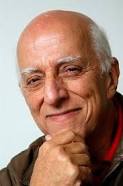
Rubem AlvesRubem Alves, the Brazilian writer and theologian, died last week at the age of 80. I had the privilege to get to know him during one of his visits to the United States in the early 1980’s. He came to Bangor Theological Seminary in Bangor, Maine, where I was the chaplain at the time. One of my unofficial duties was showing hospitality to visiting scholars, and so over the course of a week or so, I shared several meals with him and  drove him around town to see the sights. I remember I took him shopping for his family at T. J. Maxx. He had a shopping list from his wife, and was very methodical about what to bring home to Brazil.

He was one of the most intellectually curious people I have ever met. A professor of philosophy, he was interested in literature, music (he wrote eloquently about Vivaldi), education and psychoanalysis (in which he was trained.) He was such great company, full of ideas and ready to discuss a world of topics. He had a wonderful sense of humor and a great laugh

He loved poetry and his 2002 book, The Poet, the Warrior, the Prophet (SCM Classics) is an important work in the field of theopoetics.  He went on to publish over 40 books on a wide variety of subjects.  A popular lecturer and speaker he was also a columnist for his local newspaper.

He is often credited as one of the founders of liberation theology and his dissertation at Princeton Theological Seminary was later published under the title A Theology of Human Hope (Corpus Books, 1969) with a foreword by Harvey Cox. It was an important early work in English on the subject.

I just learned of his death from a tweet from the World Council of Churches, memorializing his many contributions to the ecumenical movement. The remembrance of him from the WCC can be found here.

I recall him with great affection and give thanks to God for him.

Here is a quote of his:

“Let us plant dates even though those who plant them will never eat them. We must live by the love of what we will never see. . . . Such disciplined love is what has given prophets, revolutionaries, and saints the courage to die for the future they envisaged. They make their own bodies the seed of their highest hope.” (From There is A Season by Joan Chittister)


Unknown's avatar

“The Church of the Troubled Hearts”

heart3I have seen congregations named “The Church of the Redeemer” and “The Church of the Good Shepherd” and “The Church of All Souls,” but I have never seen a church named “The Church of the Troubled Hearts.” It might not attract a big following, but it would name who we are. Because our hearts are troubled, troubled about our future, our finances, our children, our health, our relationships, our congregations and our faith.

(from my Daily Devotional for today) Read more


Unknown's avatar

The Shepherd Window: “Lost and Found”

church-window4-224x300

When I was growing up my family went to the Church of the Holy Communion in Norwood, New Jersey. It was a little church, built in the neo-Gothic style so beloved by Episcopalians. It had a cloister that connected the church with the parish house. Years later, when I had sabbaticals at Oxford and Cambridge, I felt right at home among the grand stone piles.

When I was in second grade a classmate of mine died in a sledding accident, and his family donated a memorial window to the church in his memory. That window helped shape both my faith and my theology.

Here is a piece I wrote about it for today for the United Church of Christ’s Still Speaking Daily Devotional:


“Lost and Found”

By Richard L. Floyd

“Which one of you, having a hundred sheep and losing one of them, does not leave the ninety-nine in the wilderness, and go after the one who has been lost until he finds it? When he has found it he lays it upon his shoulders and rejoices.” – Luke 15:4,5

When I was in the second grade a boy in my Sunday school class named Kim was killed when he overshot the mark on his sled, went into the road, and was hit by a car. Nobody I knew had ever died before and his death left quite an impression on me. I remember my mother and father sitting me down and telling me the sad news.” Read more

Unknown's avatar

The Towers we build? or God our Strong Tower? A Sermon on Psalm 46

strong towerGod is our refuge and strength,

a very present help in trouble.

Therefore we will not fear . . .  (Psalm 46)

 In ancient Israel strong fortifications offered security against the inevitable sweep of vast armies attacking from the North.  For hundreds of years Israel knew a succession of invaders:  Hittites, Assyrians, Babylonians, Persians, Greeks, Romans.  Years or even decades of peace could not erase the memories of long generations who knew what it meant to suffer at the hands of an invading army, or the fear that attends such memories.

Around 700 B.C. King Hezekiah of Judah created an alliance among his fortified cities with the help of Phoenician, Philistine and South Syrians states to stand up to the Assyrian King Sennacherib.  In preparation for the inevitable response Hezekiah beefed up his fortifications and even drilled a tunnel for the stream of Siloam to bring water to Jerusalem in case of a siege.

When Sennacherib did finally come in 701 the coastal cities fell quickly to his powerful army and he was soon able to bring the full power of his wrath to bear on Jerusalem.  This was during the time of the Prophet Isaiah of Jerusalem and you can read about this episode in the first part of the Book of Isaiah and also in the eighteenth and nineteenth chapters of the Book of Kings.

At the worst hour Jerusalem was completely surrounded by the enemy and the people were full of fear. Their official spokesman, standing on the wall talking to the Assyrian emissaries, begged them to speak in Aramaic rather than in the Hebrew that could be understood so as not to demoralize the doomed people within the walls.  It was dawning on many of them that their strong towers had failed to provide the security that had been promised.

But when morning dawned the Assyrian army was gone, vanished, leaving only thousands of their dead at the camp.  How they died remains a mystery.  Somehow, by the grace of God, Jerusalem had been saved just as Isaiah had prophesied.  “God is in the midst of the city; it shall not be moved; God will help it when the morning dawns.” (Psalm 46:5)

This event has traditionally been thought to be the original setting for Psalm 46, although it is always tricky to try to reconstruct a genuine historical setting from a psalm, “as if one could write the history of England on the basis of the Methodist hymn book!” (Brevard S. Childs, Introduction to the Old Testament as Scripture,Philadelphia: Fortress Press, 1979, 509.)

Whatever its original setting this psalm speaks to our perennial human inclination to rely on strong towers of our own making rather than on God, who is “our  refuge and strength, a very present help in trouble.” No one builds a tower without counting the cost, said Jesus, but, O, the cost of these towers we build, from the tower of Babel to the tower of Siloam that fell and killed eighteen men. (Genesis 11:4–5; Luke 14:28; Luke 13:4)  So Hezekiah was neither the first nor the last to attempt to secure himself from harm by fortifying his defenses, as booming gun sales will confirm in our day.

That his provisions failed Israel but that God’s did not, may or may not have been the occasion for Psalm 46, but such an event is typical of Israel’s experience of the living God who provides the only real security they ever knew.  Many Psalms reflect this faith.  Gerhard Van Rad called his work on the Psalms Israel’s Answer to indicate that the Psalter is the community of faith’s response to it’s ongoing relationship to the living God.

The setting of the Psalm is a world turned upside down:

“Therefore we will not fear though the earth should change,

though the mountains shake in the heart of the sea;

though its waters roar and foam,

though the mountains tremble with its tumult.”

This is not just trouble, this is TROUBLE!  The language is the language of cosmic upheaval.  The waters above and the waters below that God pushed back on the third day of creation threaten to flood back in. “Water,” writes Karl Barth,

has a part in all the force of the human world which is hostile to Israel and therefore opposes the interests and glory of Israel’s God, but which is nevertheless ruled and guided and used by Him.”. . . [The existence of the waters of the upper as well as the lower cosmos] “demonstrates that the will of God will be fulfilled in a history which takes place in the sphere of His creation, and that what God does with the waters is no more and no less than a preliminary indication, indeed an anticipation of this history in its character as a divine triumph.” (Church Dogmatics,3.1, 149)

The roaring and foaming waters are more than a storm, they are chaos, a sign of all that threatens God’s order.

Likewise the mountains that shake in the heart of the sea are not just any mountains but the mountains which hold up the world, the foundations which are being shaken.  This mythologized cosmic TROUBLE is of a kind with all the trouble that “flesh is heir to”:  the test reports come back positive; an earthquake or riot shakes your neighborhood; you lose your job, or your spouse, or your faith, or your self–respect; Sennacherib and all his army waits outside your gates.

Trouble is often the beginning of faith in God who is our refuge and strength, for only when we have the “props of self–assertion” (Barth) knocked out from under us are we ready for the Word of God.  The therefore  that comes before “we will not fear” refers to God our refuge and strength.  Our lack of fear is conditional; it is trust in God alone, rather than some easy calm of our own devising.  Hear Calvin on this, in his commentary on Psalm 46:

It is an easy matter to manifest the appearance of great confidence, so long as we are not placed in imminent danger: but if, in the midst of a general crash of the whole world, our minds continue undisturbed and free of trouble, this is an evident proof that we attribute to the power of God the honor which belongs to him.  When the sacred poet says, “We will not fear”, he is not to be understood as meaning that the minds of the godly are exempt from all solicitude or fear, as if they were destitute of feeling, for there is a great difference between insensibility and the confidence of faith. John Calvin, “Commentary on the Book of Psalms, Volume 2”, Calvin’s Commentaries, Volume 5, Grand Rapids: Baker Book House,1979, 196.

This confidence of God is captured in Martin Luther’s marvelous hymn based on Psalm 46: “Ein feste Burg ist unser Gott” which was then put into English by Thomas Carlyle as “A safe stronghold our God is still” and, better known in America, as “A Mighty Fortress is our God” by Frederick Hedge.  In any version of the hymn God the fortress stands in contrast to all strongholds built with hands.

We see in the Psalm another contrast, that between the roaring, tumultuous waters of chaos and the “river whose streams make glad the city of God.”  Where before God restrains the water, here God sends the water for a life–giving purpose.  Like Ezekiel 47:1-12, where a river is described that encircles the temple and gets deeper and deeper, bringing forth trees “whose leaves do not fade nor fruits fail” till finally it reaches the Dead Sea and desalinates it, here in Psalm 46 is a river of life.  These passages “speak of a river of life which first blesses the earthly sanctuary chosen and established by God, and then the whole face of the earth, fructifying it, quenching its thirst, healing its wounds, refreshing and renewing all creation.  This is what has become of the universally destructive chaos–element of water in the second creation saga.  This is what it now attests and signifies.  It is no longer the water averted and restrained but the water summoned forth by God.  It is no longer now the suppressed enemy of man but his most intimate friend.  It is no longer his destruction but his salvation.  It is not a principle of death, but of life.” (Barth, CD 3.1,280)

This river of life is now no longer geographically localized in Jerusalem, just as God’s dwelling place gets unfixed from the earthly Zion.  The statements in the Psalms about the dwelling place or throne of God are made of the place which can not be found on any map.

So where can God, who is our refuge and strength, be found?  In the Old Testament there is, of course, always a dwelling place that can be found on a map, but the freedom of God prohibits a simple equation of God with any place.  This is the point of Jesus’s conversation with the Samaritan woman (John 4:20), when she notes that the Jews worship in Jerusalem and the Samaritans on Mt. Gerizim.   Jesus’s declaration to her that God is to be worshipped “in Spirit and in truth” and that he himself is the expected Messiah who will “tell us all things” shows us where God has now chosen to reside:

“The opposite of Jerusalem and Gerizim and all temples made with hands—and we can apply it and say the opposite of Rome, Wittenberg, Geneva, and Canterbury—is not the universe at large, which is the superficial interpretation of Liberalism, but Jesus.” (Barth, CD, 2.1, 481)

What Israel once looked for in Zion is now found in Jesus Christ, the one Word of God. The God who speaks this Word in the flesh of Jesus is the One who calls back the waters of chaos and calls forth the waters of life; who conquers the forces of evil, the sources of trouble (“one little word shall fell him”, Luther says of the devil”) who “makes wars to cease to the end of the earth”

John the Divine’s vision of the river of life describes it as flowing from the throne of God and the Lamb.  “Then the angel showed me the river of the water of life, bright as crystal, flowing from the throne of God and of the Lamb through the middle of the street of the city.” (Revelation  22:1,2a)

Although the heavenly city can not be strictly identified with any earthly city, those who pray daily, “thy will be done on earth as it is in heaven”  do well to practice its life–giving imperatives in every earthly city, even the contemporary cities of wrath where the enemy lies not without the walls but within.  The one who piles up the weapons for burning (Psalm 46:9) reminds us to “Be still, and know that I an God!  I am exalted among the nations, I am exalted in the earth.”

Commentator J. Clinton McCann, Jr. suggests that “Be still, and know that I am God!” is not a good translation. “Contemporary readers almost inevitably hear it as a call to meditation or relaxation, when it should be heard in light of verse 9 as something like ‘Stop!’ or ‘Throw down your weapons!’ In other words, depend on your God instead of yourselves.”

Depend on God, our refuge and strength, a fortress never failing. A strong tower, God causes the towers built by our hands to fall, as in this Easter poem by Arnold Kenseth:

On Easter the great tower of me falls.

I had built it well; my mind had planned it

After being schooled; my will had special wit

To dig me deep foundations, solid walls,

Blocks of moral toughness, windows to see

The enemy, the friend; large rooms, I thought

For light; and storey upon storey me

I raised, and famously my fame I sought.

So driven to prove the world with my estate.

I had not heard Christ on Good Friday die,

His body crooked, broke, and all friends fled.

I had not wept his cause in my carouse.

But now bold bells scatter against the sky,

And Christ is shattering my death, my pride;

As walls, blocks, windows, rooms, my silly penthouse

Spill into the dust I am, my narrow fate.

At last set free from virtue, knowledge, strife,

I mourn, then praise my God, and enter life.

“Easter” by Arnold Kenseth

The Ritual Year, Amherst Writers and Artists Press, 1993

I preached this on April 8, 1994 at First Church of Christ (UCC) in Pittsfield, Massachusetts 01201.

Unknown's avatar

“What’s the Point?” Reflections on a Christian Eschatology

safe_image.php

In Woody Allen’s movie Annie Hall, there is a great scene (click picture above) in which Alvy Singer, the character played by Woody Allen, flashes back to his childhood in Brooklyn.  His mother takes him to the family Doctor, Dr. Flicker, an avuncular man wearing a stethoscope, and smoking a cigarette. Alvy’s mom tells Dr. Flicker that 9 year-old Alvy is depressed.

Doctor Flicker: Why are you depressed, Alvy?

Alvy’s Mom: Tell Dr. Flicker.

[Alvy sits, his head down, his mother answers for him]

Alvy’s Mom: It’s something he read.

Doctor Flicker: Something he read, huh?

Alvy: [his head still down, quietly] The universe is expanding.

Doctor Flicker: The universe is expanding?

Alvy: Well, the universe is everything, and if it’s expanding, someday it will break apart and that would be the end of everything!

Alvy’s Mom: What is that your business?

[she turns back to the doctor]

Alvy’s Mom: He stopped doing his homework!

Alvy: What’s the point?

Alvy’s Mom: What has the universe got to do with it? You’re here in Brooklyn! Brooklyn is not expanding!

Doctor Flicker: It won’t be expanding for billions of years yet, Alvy. And we’ve gotta try to enjoy ourselves while we’re here!”

I was looking for this quote yesterday, and when I found it I put the Yahoo clip on my FB page. A child psychologist friend of mine, who is also a professor, wrote this comment:

I always refer to it when I teach developmental psychology, and I ask how many students remember feeling this way: “What’s the point in doing anything because the sun is going to go out in several billion years?” Many, many young people remember the precise moment when they first felt this way….

Alvy the young fatalist is a stand-in for all of us faced with the futility of a finite world, and with our own mortality. Because Alvy is right that everything comes to an end.

That is our topic for today, “the End.” I loved the way Gail (Miller, our chair) framed the subject for us for this meeting: “The End! How do we talk about the End? – End of time – End of life – End of… Where are Christians headed? In this life and the next? What does Christian Eschatology look like?”

There are many directions one could go with this set of questions, but the common assumption that they would all share is that there is an end. And (pun intended) this is where I want to begin.

I want to begin with Alvy Singer’s question, “What’s the point?” If there’s an end, “What’s the point?” And there is an end. Both our life and the life of the planet we live on are finite. The mortality rate as of this morning is still 100%, and the very best science predicts the likelihood that our sun, which is a star, will some day in the distant future blink out leaving earth without the conditions for life. Whether the expanding universe itself is finite is an open question, but for the purposes of this discussion finitude is what we are faced with.

So how do we talk about Christian hope in the face of our finitude and the finitude of our world? My own answer to this is quite simple. First let me say what we cannot do. We cannot construct hope out of the materials given to us by the fact of our finitude. Christian hope lies elsewhere.

Alvy read the best science and rightly despairs of what that narrative has to offer. But that narrative, though the reigning one, is not the only one. Science can tell us what it can tell us and we are grateful for it.

But science, so good at measuring our universe and examining our bodies, can not tell us what either means.

Marilynne Robinson writes,

The modern fable is that science exposed religion as a delusion and more or less supplanted it. But science cannot serve in the place of religion because it cannot generate an ethics or a morality. It can give us no reason to prefer a child to a dog, or to choose honorable poverty over fraudulent wealth. It can give us not grounds for preferring what it is excellent over what is sensationalistic. And this is more or less where we are now. (The Death of Adam, p 71)

To enlarge our thinking and engage our imagination about what the end of things means we need to look elsewhere than science, and the elsewhere I want to look at is the Christian Story, and especially what it tells us about the character and identity of God.

And, as those who know me will not be surprised, that among the many places in the Christian Story we can turn to know the character and identity of God, it is in the cross of Christ that we get a particularly decisive picture. And by the cross I mean, as our brother Paul did, the decisive act of God that focuses on Good Friday and culminates in Easter.

Here is the love that will not let us go, a love so deep, so broad, so high, as one of our hymns describes it, that it will die for us. So again like Paul, to the facts of finitude, “we preach Christ and him crucified.” (1 Corinthians 1:23)

Which is to say I want to argue for a cross-shaped eschatology, one that sees the facts of finitude for us and our world in the template of Good Friday and Easter. ( For a fuller working out of this idea see my “The Cross as an Eschatological Act of God” in Hope for your Future: Theological Voices from the Pastorate. Edited by William H. Lazareth. Eerdmans, 2002.)

Jesus’ death ends his life. But beyond the discontinuity of death, God raises him to new life. There is continuity in that he remains identifiably himself; he bears the marks of the Roman nails on his hands and feet. Yet he is also different. Some don’t recognize him. His glorified body is and isn’t his earthly body.

Imagining this continuity and discontinuity of Good Friday and Easter provide us the model for a proper Christian eschatology.

In that light how do we think and talk about the end? First of all we need to be honest about the impact of the end, just as we need to be honest about the fact of our own death.  I once got in trouble for opening my Easter sermon by saying, “On Good Friday Jesus was as dead as a door-nail.”  But it’s true. Good Friday was a dead end, and symbolizes all the other ends that flesh is heir to, the end of promise, the end of hope, and the end of all human possibilities.

To get a sense for how it felt then, recall that story you all know well when Jesus meets some of his followers on the road to Emmaus. He asked them, “What are you discussing together as you walk along?”

They stood still, their faces downcast. One of them, named Cleopas, asked him, “Are you the only one visiting Jerusalem who does not know the things that have happened there in these days?”

“What things?” Jesus asked.

“About Jesus of Nazareth,” they replied. “He was a prophet, powerful in word and deed before God and all the people. The chief priests and our rulers handed him over to be sentenced to death, and they crucified him; but we had hoped that he was the one who was going to redeem Israel.” (Luke 24:13-35)

That was the end of that, so, as young Alvy would ask, “What’s the point?”

But that wasn’t that. That wasn’t that. The resurrection changed all that, and changed the world.

But it wasn’t too long before the earliest Christians realized that the kingdom of God in its fullness had not arrived, and so they looked for a second Advent, in which what had begun, even in their midst, and what was promised, would be completed and fulfilled.

So even now, all these years later, we Christians, and our church, live between the times, between the first coming and the second coming. We live in the already of Christ’s appearing, and the not yet of his reappearing in glory to consummate all things.

So our faith is profoundly eschatological. But you would often never know it from being in our worship. For example, the church year has a peculiar feature about it. We end the year on Christ the King Sunday with a flurry of eschatological texts, and then we immediately begin a new year in Advent with another flurry of eschatological texts, and then we don’t really have to think about eschatology in between.

But we should think about. I have been reflecting on something Steven (Small, the local pastor) once wrote to me in reflecting on his Advent Christian background:

A deep hope in the return of Christ is at the center of my eschatology in particular and it informs my theology in general. The Adventists gave us some real gifts: a more gracious view of a loving God through their understanding of conditional immortality for one. There is a tendency to snicker in mainline circles when it comes to discussions of the Second Coming. (But) if we truly believe that Christ has died, and Christ is risen, why would we not be quite certain that Christ will come again.

And as pastors, if we have not thought carefully about eschatology, what do we have to say to those who are facing the end, whatever that end may be: the end of their life, the end of their vocation, the end of their marriage, the end of a relationship with a family member, the end of a dream, a hope, a promise?

Alvy’s question, “What’s the point?” has no good answer apart from faith, and that faith is an Easter faith that lies on the other side of Good Friday.

Because when there was no hope, no human possibilities, when we were done and there was no point, God was not done. And that is who we are, the community that looks for more at the end. The community that believes that God is not done. That God is never done.

The end of life is a fearsome thing. But the God who raised Jesus from the dead is the God we worship.  Can that end have dominion over us?

The end of the world is a scary thing. Even 9 year-old Alvy knew this. But the God who created the world, can not this same God redeem and save this world, and create a new heaven and a new earth?

What can we say at the end? What can we say at the several endings that mark our life and our world?

This is what we can say: That God is with us at the end as at the beginning, and all the way through.  “I am the Alpha and Omega, the beginning and the end, saith the Lord. Behold, I make all things new!” Amen.

I preached this sermon on February 7, 2013, at the First Congregational Church (UCC) of West Boylston, Massachusetts for a meeting of the New England chapter of Confessing Christ in the United Church of Christ.

Unknown's avatar

“God With Us” A Sermon for the Fourth Sunday of Advent

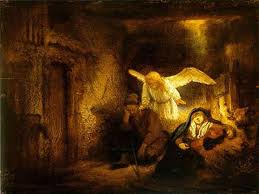
Joseph and the angelIn Luke’s gospel it is Mary who is front and center in the story of the nativity of Jesus, and in our minds I think that is where she stays.  But in Matthew we get more of a glimpse of Joseph.  Joseph is a shadowy figure in the pages of scripture; he is introduced in the genealogy as the “husband of Mary, of whom Jesus was born, who is called the Messiah.”  We see him in this story about Jesus’ birth and again briefly in the events of Jesus’ childhood, the circumcision at the temple, the flight to Egypt to escape Herod, and in a small story about Jesus as a twelve year old when he gets separated from his parents on a trip to Jerusalem and turns up at the temple, teaching the elders. Then Joseph disappears from the story, except for references to Jesus as the carpenter’s son.

But though Joseph seems to be what is called a supporting character, without him the drama of salvation could not have taken place, and I would submit that that is just the way God works, with supporting characters who appear for a little bit and do what needs to be done and then disappear from the story. But they are always a part of the story and the story wouldn’t be complete without them.

And it seems safe to say that without Joseph, Jesus could never have become who he became.  Joseph must have played an important forming and nurturing part in the life of Jesus.  There has been much speculation about Jesus’ upbringing in the carpenter shop in Nazareth.  The scriptures tell us nothing, but if Joseph lived until Jesus was at least twelve, as Matthew indicates, then Joseph becomes the primary male role model for the young Jesus.

One noted scholar speculates that Mary and Joseph were from the ranks of the humble and pious multitudes, the kind of people who loved God and maintained the law as best they could, but without the means to carry it out to the letter in all its intricacy.  If this is true it would go far in explaining Jesus’ attack on the Pharisaic understanding of religion and his quest for a new freedom to live for God.

In any case, in the story of Jesus’ birth Joseph is most remarkable in the way he responded to this crisis in his life. The young woman to whom he is betrothed is found to be pregnant. This is more than a matter of divorce, the law demands her life by stoning for adultery, for betrothal carried the weight of marriage in those days. So Joseph dismissing her quietly to avoid public disgrace was an act of integrity. But what is even more remarkable is that when he has this strange dream, in which an angel of the Lord appears to him and tells him not to be afraid to take Mary as his wife for the child conceived in her is from the Holy Spirit, he believes the angel and does what the angel said to do.

The angel said something else about this child: they are to name him Jesus, for he will save his people from their sins, and that all this fulfills what Isaiah had written: “Behold, a virgin shall conceive and bear a son, and he shall be called Emmanuel,” which means, “God is with us.”

Let me invite you to consider this Christmas the statement that God is with us.  Consider that God is with us not just in high moments of religious insight, in worship and in prayer, or some mystical moment when all seems clear, but rather in the ordinary events that befall us in this life.

One of the implications of the Christian doctrine of the Incarnation of God in Jesus Christ is that God is no longer remote, but is with us in ordinary life and that our story is inextricably wrapped up with God’s story. There is more to it than that to be sure; there is a cross as well as a cradle and we need Easter to interpret Christmas, and perhaps Pentecost to interpret them both for without the Holy Spirit it all becomes just a story from long ago that can touch the heart, but not change the life.

But God is with us now, because of Jesus Christ. We can see his human face and know that there is something of him in the other human faces we see. God is with us in our exalted moments of joy, when we get glimpses of the joy God wants for us.  Perhaps a sunset does it for you, or a sunrise (I’m told they are pretty.)  Or perhaps watching a child at play, or a fresh snowfall.

I saw a fine movie this week called “A River Runs Through It” in which fly-fishing becomes the entranceway into a realm of pure awe and wonder in the midst of some very tragic human life.  To know that our story and God’s story touch and intertwine can transfigure some pretty ordinary stuff into something special. Perhaps it is only as story that we understand our lives, which otherwise remain rather elusive.

In “A River Runs through It” the writer’s father, who is a minister, asks him a question that made Norman wonder if he understood his father at all “You like to tell true stories, don’t you? he asked, and I answered, “Yes, I like to tell stories that are true.”  Then he asked, “After you have finished your true stories some time, why don’t you make up a story and the people to go with it?  Only then will you understand what happened and why.  It is those we live with and love and should know that elude us.”

So it is that our own personal stories may only be understood in the light of this vaster story that begins at the moment of creation and will end in glory in God’s own good time and finds its center around two poor Palestinian peasants wondering what the birth of this child might mean.  That the angel promised that the child means “God is with us” must have addressed their perplexity as it can address ours.

For it means God is with us not just in those fleeting moments of joy, but in moments of confusion and despair, of faithlessness and doubt, the kind that comes to all of us at one time or another.  Emmanuel means God is with us as we try to get our minds around what happened on a Monday night in a neighboring community, as we struggle to understand the incomprehensible fact that an eighteen year old boy walked into a sporting goods store in our community and legally bought an assault rifle and used it to kill people.  The God of Good Friday who is also the God of Christmas was with us as Wayne Lo began killing people, and the first tear that was shed at Simon’s Rock was God’s tear, not only for the dead and wounded and their families but for a world which still makes such moments possible.

So “God with us” is not the stuff of Kodak commercial sentimentality; it means God really with us in all the grandeur and misery of human life, in Bosnia and India and Somalia and the homeless mean streets of our cities as well as by the Christmas tree in the warmth of our living room. The mystery of the Incarnation puts God right in the thick of it all.  For God did not stay remote, high above the heavens, but ventured into the precarious life of an infant born into a marginal family in a precarious political situation.  That should give us pause from turning the Christian religion into something ethereal and apart from human life.  As Frederick Buechner remarked wryly, “One of the blunders religious people are particularly fond of making is the attempt to be more spiritual than God.”

This Christmas I invite you to discover God in the everyday ebb and flow of your life, in the ones you love as well as the ones who drive you up a wall, in your moments of consternation as well as in your high moments of joy.  Take the time this Christmas to take it all in.  If you spend all your time in frenzied preparation, you may just not be paying attention, and miss the time of your visitation, and never learn, as Joseph did, what supporting role you are called to play in this great big story of which our story is valued as an important part by the God who, whatever else he may be, is most assuredly with us, through Jesus Christ our Lord. Amen.

I preached this sermon at First Church of Christ in Pittsfield, Congregational, twenty years ago this week, December 20, 1992, after a gun slaying at a school, in nearby Simon’s Rock College on December 14. I posted this after the Sandy Hook School slayings in Newtown, CT, which were on the 20th anniversary to the day. Lord have mercy.

Unknown's avatar

Christian Teachings about Life after Death: A Pastor Ruminates

stream 2I have been asked to speak about “Christian teachings about the after-life.” This is final installment in a series of helpful presentations on preparing for death. There have been presentations on wills and bequests, end of life care, grieving and the like. And once again Max (Stackhouse) has asked me to bat clean-up and talk about theology.

One of my friends in the church said to me last week, “Oh, your talk is theology, so it won’t be practical.” She was kidding, I think, but let me respond to her remark by suggesting that a theology about death and what comes after it may be the most practical aspect of all for the Christian preparing for death. It is a shame how theology has come to have a bad name, even in the church.

Because theology is not some specialty for professional theologians, but simply the way we talk about God. That is what theology means, the logos of the theos, the word about God. And everybody has a theology, at least implicitly, so the more we can make it examined and explicit the more chance we will get it better rather than worse.

So right off the bat let me suggest a better title for what I hope to do here. I much prefer the phrase “life after death” to the term “afterlife,” because I think the former rightly expresses the Christian belief in the reality of death, while the latter can obscure the boundary between death and whatever comes after it.

I want to explore with you four ideas or concepts: 1. The reality of death, 2. Immortality of the soul, 3. Resurrection of the body, and 4. Eternal Life. Finally, I want to summarize the features of an adequate Christian theology of life after death, and the promises of the Gospel that are our hope in the face of death.

1.The Reality of Death

The first concept to ponder is the reality of death.  Some of the earliest thinking about death in the Bible is about its not only ending one’s natural life, but also severing our relationship with God. For Israel human purpose was to praise God, and death put an end to it. This relational view was visualized in spatial terms, so that places like Sheol and “the Pit” were places far from God.

Christianity inherited this relational view of life with God, and sees death as its cessation and the opposite of the fullness of life that God intends for us. So unlike some other religions that view death as an illusion or an escape, for Christians, death is real, as are the sense of loss and grief that accompany death, which are also real and nothing to ashamed of or denied. I have said at countless funerals: “There is nothing unchristian about grief; Jesus himself cried at the grave of his friend Lazarus.”

Moreover, Jesus himself died, and his own death provides a template for thinking about this. The creeds say quite simply, “He died and was buried.”

So accepting the reality of death is an important first step in thinking about it properly as Christians. In my nearly forty years of ministry I sometimes counseled people who wanted to deny or blunt this reality. People often asked for much-loved sentimental poems to be read at the funeral. I would gently suggest something more appropriate, but I was pastorally sensitive enough to allow their selection to be read if they insisted, knowing that I would get up and say something quite contradictory in my homily.

Let me give you some examples of poems that deny or minimize the reality of death, and I apologize in advance if these are your favorites.

Here’s a line from A. L. Frinks’ the Rose Beyond the Wall:

“Shall claim of death cause us to grieve
And make our courage faint and fall?
Nay! Let us faith and hope receive–
The rose still grows beyond the wall,”

Another and even better known poem about death is James Whitcomb Riley’s Consolatio:

“I cannot say, and will not say
that he is dead. He is just away.
With a cheery smile, and a wave of the hand,
he has wandered into an unknown land.”

“We do not sorrow as those who have no hope” (1 Thess. 4:13), but we do sorrow. So while as Christians we have much more to say than death is real, it is where we must start, reminding ourselves that Jesus, in his human nature, really did die, as all human beings do.

To make this point I once began an Easter sermon years ago by saying that “On Good Friday Jesus was as dead as a doornail.” I wasn’t trying to be shocking, but I was surprised by how many people took offense to this statement.

I know something of death. Both my parents died too young, I have worked in a funeral home, been an EMT, and a minister for nearly four decades. I have been present at many deaths, and each time I have been struck by how clear the line is between the living and the dead. And yet everything I know about death is on this side of it, as it is for us all. But  one thing I do know about death: it is real.

So if the first theme is the reality of death, how shall we properly think and talk about what comes after?

2. Immortality of the Soul.

One very prevalent idea of life after death is immortality of the soul. I would like to explore this popular idea with you, and show you why it is an inadequate view for Christians, admitting that in my early years it was my own view.

Let me share something about that with you. My own theology of death and what comes after it was shaped, at least in part, by my childhood bedtime prayer, a somewhat terrifying one from the New England Primer:

“Now I lay me down to sleep,
I pray the Lord my soul to keep,
If I should die before I wake,
I pray the Lord my soul to take. Amen.”

I didn’t know it at the time, but in my child’s imagination I had adopted a somewhat Platonic dualism about the human person, separating body and soul into the perishable and imperishable.

My own children, at the insistence of my wife, had a more sanitized version of that prayer that didn’t get them pondering sudden death in the nighttime. Whether they are better off for this is open for discussion. But in my own early thought-processes I figured that if such a sad event as my childhood death did take place, it would only be my physical body, and this invisible spiritual thing “the soul” would go swiftly to God. This is the essence of the idea of immortality of the soul.

I was taken aback to be told that this view, while widely held, was not particularly Christian. I learned in seminary that the Hebrew word translated as “soul,” nephesh, more rightly means “self,” in other words, the whole person.  Harrell Beck, my wonderful Old Testament professor, liked to say that your fingernails are as much a part of your soul as any other part, which is to say human selves are embodied. Or as I like to think of it: we don’t have a body so much as we are a body.

It is from the Greeks, and especially from Plato, that we get the notion of a disembodied soul housed in a physical body, an idea that still clings to many Christian ideas about an afterlife.

These ideas were ambient in the ancient Near East and in the Hellenistic world in which the New Testament was written, and they lived in uneasy tension with the more holistic Hebraic views of personhood. We even get a whiff of Greek dualism in the New Testament, such as in First Corinthians, one of the undisputed letters of Paul. He writes in 1 Corinthians 5:1:

For we know that if the earthly tent we live in is destroyed, we have a building from God, a house not made with hands, eternal in the heavens.

So if the disembodied immortal soul flying away from the perishable body is not the Christian theology of life after death, how are we to think about it?

3. The Resurrection of the Dead

Resurrection of the dead is the cardinal Christian idea of life after death. It is rooted in the resurrection of Jesus, which pervades all New Testament thinking. In Jesus’ resurrection God has vindicated the humiliated and crucified Jesus, and begun the eschatological process of the salvation of humanity and the world, a process to be completed at the end of history, when Christ comes in glory to judge the living and the dead.

This distinguishes Christian theology from other views that see life after death as something intrinsic to the human person. Resurrection of the dead, on the other hand, is about the discontinuity between life and life after death. The rupture of death is overcome only from God’s side by God’s action. So resurrection of the dead is not resuscitation, but a new creation analogous to the first creation. It is not resurrection of the flesh, but resurrection of the body, a new kind of life that we can only guess at. When Paul  speculated on what kind of body we would have in the new life he employed the oxymoron “spiritual body” to refer to what form are we raised.

There are clues to this mystery in the post-resurrection appearances of Jesus. After Jesus is raised he appears to the disciples in bodily form; he is the same, but also transfigured in some way. The accounts contain mysteries: sometimes he is recognized, but other times he is not, as in the road to Emmaus story, when the disciples only know him when he breaks bread. Yet he still bears the marks of the Roman nails in his hands and feet.

However we want to take these narratives they point to the consistent conclusion that the new life postmortem is embodied life.  The Christian belief in the resurrection of the dead is a theological interpretation based on the death and raising of Jesus. The expectation of a resurrected body also emphasizes the continuity of personality and the integrity of personhood. I said that Christian views stress discontinuity between life and life after death, but here we see continuity of personality after death. So we have both discontinuity and continuity as the person really dies, but in the new life is the same person as before death, although changed. So it is not some spiritual part of you that lives the new kind of life; it is you, embodied and recognizable to God as you. This contrasts to various views of a disembodied postmortem existence, such as immortality of the soul and reincarnation.

It is important to remind ourselves that, while we are not surprised by the claim of Jesus’ resurrection and have difficulty with the idea of a general resurrection, for the people at the time of Jesus death it was just the opposite. A general resurrection vindicating Israel involving a Davidic messiah or the Son of Man was part of the general religious imagination. The resurrection of an individual however was not, which is why the raising of Jesus was understood as the beginning of the eschaton, the final reckoning, restoration and vindication of God and his faithful. We hear this in the language of Jesus being the first-fruits and the forerunner.

The raising of Jesus then is the primary theological template by which all things are measured, including death and life after death. Consistently in the New Testament death is viewed through the lens of the resurrection of Jesus Christ. In 75 places in the New Testament the principle Greek adjective that means “dead,” nekros, is the object of either egeiro “to awaken” or anastasis, “to raise.

This raising from the dead makes Christianity an Easter faith, and so the Christian sees death in Easter light. Because Jesus is raised we too will be raised with him. This is a far different idea than immortality of the soul. Let us take a few moments to contrast them.

The great scholar Oscar Cullmann wrote an important book in 1956 called Immortality of the Soul or Resurrection of the Dead in which he starkly contrasted these two views. Some of his critics have complained that he contrasted them too sharply. They may be right, but the book remains an important one for understanding the predominant Christian views.

Cullmann’s thesis is, and I quote, “The widely accepted idea of ‘The immortality of the soul’ is one of the greatest misunderstandings of Christianity. The concept of death and resurrection is anchored in the Christ-event, and hence is incompatible with the Greek belief in immortality.”

Cullmann deftly illustrates his point by looking at the death of Socrates in contrast to the death of Jesus. He writes:

The death of Socrates (as described by Plato) is a beautiful death. Nothing is seen here of death’s terror. Socrates cannot fear death, since indeed it sets us free from the body. Whoever fears death proves that he loves the world of the body, that he is thoroughly entangled in the world of sense. Death is the soul’s great friend. So he teaches; and so, in wonderful harmony with his teaching, he dies — this man who embodied the Greek world in its noblest form.

Cullmann then turns to the death of Jesus:

In Gethsemane He knows that death stands before Him, just as Socrates expected death on his last day. The Synoptic Evangelists furnish us, by and large, with a unanimous report. Jesus begins ‘to tremble and be distressed’, writes Mark (14:33). ‘My soul is troubled, even to death.’ . . .

In Luke 12:50 it is completely impossible to explain away the ‘distress’ in the face of death, and also in view of the fact that Jesus is abandoned by God on the Cross [Mark 15:34], it is not possible to explain the Gethsemane scene except through this distress at the prospect of being abandoned by God, an abandonment which will be the work of Death, God’s great enemy.)Jesus is afraid, though not as a coward would be of the men who will kill Him, still less of the pain and grief which precede death. He is afraid in the face of death itself. Death for Him is not something divine : it is something dreadful. . . .

Here (in Jesus’ death) is nothing of the composure of Socrates, who met death peacefully as a friend. To be sure, Jesus already knows the task which has been given Him: to suffer death; and He has already spoken the words: ‘I have a baptism with which I must be baptized, and how distressed (or afraid) I am until it is accomplished’ (Luke 19:50). Now, when God’s enemy stands before Him, He cries to God, whose omnipotence He knows: ‘All things are possible with thee; let this cup pass from me’ (Mark 14:36). And when He concludes, ‘Yet not as I will, but as thou wilt’, this does not mean that at the last He, like Socrates, regards death as the friend, the liberator. No, He means only this: If this greatest of all terrors, death, must befall Me according to Thy will, then I submit to this horror. Jesus knows that in itself, because death is the enemy of God, to die means to be utterly forsaken. Therefore He cries to God; in face of this enemy of God He does not want to be alone. He wants to remain as closely tied to God as He has been throughout His whole earthly life. For whoever is in the hands of death is no longer in the hands of God, but in the hands of God’s enemy. (Oscar Cullmann, Immortality of the Soul or Resurrection of the Dead)

Here Cullmann has eloquently expressed the New Testament view of death as the enemy of God. For another example we can turn to Paul, who calls death “the last enemy.” Because death in the New Testament is not merely the end of biological life, it is also a power that insinuates itself into our living of these days. I’ll say more about this now as we turn to the idea of eternal life.

4. Eternal Life.

The final concept I want to explore is eternal life. One of the problems we have as moderns in understanding the world of the New Testament is its conception of time. There is a persistent eschatology that sees events both in the present and the future. Theologians refer to this as “the already and the not yet.”

Advent is a good time to talk about this, for while we have too often boiled Advent down to merely preparing for celebrating the birth of Christ, it is also a season of anticipating Christ’s second coming.

We see this in the memorial acclamations of many Christian liturgies: “Christ has died, Christ is risen, Christ will come again. ”

Eternal life is one of those concepts that sits in an eschatological frame, or to put it another way, has an “already but not yet” quality about it. In early Christian preaching Jesus is said to offer eternal life to his followers, not just post-mortem, but now before death. In John 5:24, for example, Jesus says. “The one who hears my word . . . has eternal life: he does not come unto judgment, but has passed from death to life.”

But this realized aspect of eternal life does not take away from the reality of death, and the promise is that eternal life in its fullness lies on the other side of the resurrection.

The words said at many graveside committal services speak of “the resurrection to eternal life.” For example, this one from the Book of Common Prayer:

“In sure and certain hope of the resurrection to eternal life
through our Lord Jesus Christ, we commend to Almighty
God our brother or sister N.; and we commit his or her body to the ground;
earth to earth, ashes to ashes, dust to dust.”

Notice the reality of death here expressed in the ashes and dust.

As I mentioned earlier, death in the New Testament is more than the final cessation of biological life, but also a power that can insinuate itself into our living. In some sense the realized eternal life in Christ is the opposite of the power of death, which Christ defeated by his cross and resurrection.

And eternal life is not an individualistic state. Eternal life is life with Christ and in Christ and by extension a life in community, in the church, which is his body. Many contemporary speculations about life after death are very individualistic, but the Christian hope is a corporate and communal hope, the hope to join the communion of saints.

There is a wonderful sermon by Jonathan Edwards, the second pastor of this church, on 1 Corinthians 13: 8-10, called Heaven is a World of Love in which Edwards explores the metaphor of the communion of saints as a heavenly choir.

How many of you know it? (No hands) I wish it were better known because it is a better example of the essential Edwards than the terrifying Enfield sermon, Sinners in the Hands of an Angry God, which everybody seems to know.

In Heaven is a World of Love Edwards begins by beautifully describing heaven and all its social arrangements, and in so doing puts forth a protest against the social arrangements that we know so well on earth; for in Edward’s heaven there is no pride or jealously, there is decency and wisdom, and an equal prosperity among all. He says, “Love (poured out from God) resides and reigns in every heart there.” And then he says: “Every saint there is as a note in a concert of music which sweetly harmonizes with every other note, and all together employed wholly in praising God.” So life after death is life in community.

5. What then can we say about life after death?

Having said all this, and leaving much more out in my brief time today, what can the Christian cling to in the theologies of life after death? I’ll sum up my main points:

  • Christians understand life after death through the lens of the resurrection of Jesus Christ.
  • For the Christian, death is not an illusion or an escape, but a reality. Death is God’s enemy, yet God has overcome it through the cross and the raising of Jesus from the dead.
  • Life after death is not intrinsic to the human person, but a gift of God in the raising of Jesus Christ.
  • Life after death is bodily life with continuity of personality and integrity of personhood. It is not a part of you that lives the new life, but you.
  • Life after death is relational and communal, where we join in the communion of saints across all times and places.
  • Life after death is relational and imagined  as spatial, nearer or farther to God.
  • The purpose of life after death is for the praise of God. In the words of the Shorter Catechism, “The chief end of men and women is to love God and enjoy him forever.”
  • Both the living and the dead live between the times, in “the already but not yet” between the first and second coming, as we wait with the church on earth and the church in heaven for the Day when Christ comes in glory at the consummation of all things.

The basis for all this is, of course, faith in the God we know here and now, the God revealed in Jesus Christ.  In Don Hammond’s (the outgoing interim pastor) graceful ministry among us he has said again and again in a variety of ways something like this, “Whoever you are, whatever you have done, know that you are truly and forever loved.”

The Christian hope for this life and the next is rooted in this Gospel truth about the love of God, that God’s grace is greater than our sin, that God’s love is stronger than anything else in the world, even death, the last enemy, which God defeated on the cross.

There are numerous eloquent witnesses to this love in the New Testament, but none is better than this by the Apostle Paul in Romans 8 and I will close with it:

If God is for us, who is against us? 32 He who did not withhold his own Son, but gave him up for all of us, will he not with him also give us everything else? 33 Who will bring any charge against God’s elect? It is God who justifies. 34 Who is to condemn? It is Christ Jesus, who died, yes, who was raised, who is at the right hand of God, who indeed intercedes for us. 35 Who will separate us from the love of Christ? Will hardship, or distress, or persecution, or famine, or nakedness, or peril, or sword? 36 As it is written, “For your sake we are being killed all day long; we are accounted as sheep to be slaughtered.” 37 No, in all these things we are more than conquerors through him who loved us. 38 For I am convinced that neither death, nor life, nor angels, nor rulers, nor things present, nor things to come, nor powers, 39 nor height, nor depth, nor anything else in all creation, will be able to separate us from the love of God in Christ Jesus our Lord.

Amen.

I delivered this paper at the First Congregational Church of Stockbridge, MA on December 9, 2012, the Second Sunday of Advent.