Unknown's avatar

“What do you know about being God?” Reflections on Job

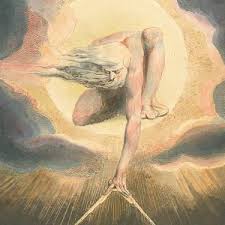
Blake“Where were you when I laid the foundation of the earth?” – Job 38:4

My friend Andy and I had just finished a prayer for the needs of the world when we started lamenting how endless those needs always are.

“If I were God . . .” Andy said, and stopped himself. “Always be suspicious,” he said, “of any sentence that begins, ‘If I were God!'”

We were not the first people to question the troubling gap between what we believe about our God and the immense suffering in our world. The Bible is full of just such questions.

Some of the very best of these questions are found in the Book of Job, which is the story of a good man enduring unbearable suffering. Job desperately wants to know why? His three “friends” offer him their pious answers, which are variants of “You had it coming!”

Their view that suffering is always deserved lingers: “What goes around comes around.”

But what if it isn’t true? What if the divine mystery is more complex than that? What if bad things do happen to good people? What if the punishment doesn’t always fit the crime? Read more. (From my Daily Devotional for today)

Unknown's avatar

“The Church of the Troubled Hearts”

heart3I have seen congregations named “The Church of the Redeemer” and “The Church of the Good Shepherd” and “The Church of All Souls,” but I have never seen a church named “The Church of the Troubled Hearts.” It might not attract a big following, but it would name who we are. Because our hearts are troubled, troubled about our future, our finances, our children, our health, our relationships, our congregations and our faith.

(from my Daily Devotional for today) Read more


Unknown's avatar

“Words to Live By” The King James Bible and its Legacy to the English Language

JamesThe story I want to tell is the story of the creation of the King James Bible, and its enormous influence on the English language. For over 400 years this was the Bible for the English-speaking world, the best selling book of all time, and still the most frequently purchased translation.

It lasting legacy to English is incalculable. It is the Bible that Abraham Lincoln learned to read with, and its sounds and rhythms can be heard in his Gettysburg Address and Second Inaugural Address, as it can in Melville’s Moby Dick, the poetry of Walt Whitman, and the speeches of Martin Luther King, Jr.

How did we get this extraordinary work of literary art that has made such a place in the story of English? It was published in 1611, but there is considerable backstory that needs to be shared before we get there, and so we need to go way back. The English still refer to it as the Authorised Version (AV), but I will use the more popular American title, the King James Version and its abbreviation (KJV.)  Continue reading

Unknown's avatar

Some Lenten Reflections on Forgiveness

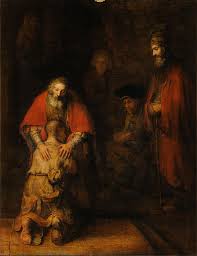
Prodigal son by RembrandtThe idea of forgiveness is so ingrained in our cultural and religious traditions that it is easy for us to overlook what an extraordinary idea it is. Although we tend to separate out “forgiving” and “forgetting” the biblical notion of forgiveness is literally “a forgetting,” in that after the act of forgiveness “it is as if ” the grievance never happened.

It is only the aggrieved party who can do the forgiving, and the act of forgiveness “wipes away” the memory of the grievance so that it no longer has any influence on the relationship. So it is that the phrase “I will remember their sins no more” appears again and again in the Bible, for example, in Isaiah, Jeremiah, and Hebrews.

Before this idea of forgiveness took hold there was simply “revenge,” in which affronts were met with retribution, often disproportionate to the original wrong. These “family feuds,” if we want to call them that, could go on for generations, and still do, as we see sometimes, for example, in the Middle East, where memories of affronts are long.

A moral advance on such indiscriminate retribution was the lex talionis, the “law of retaliation,” which prescribed that the response had to be equal to the offense, as, for example, “an eye for an eye and a tooth for a tooth.”

But the idea of forgiveness moves social relationships into a whole new key, and goes beyond mere justice. Indeed, forgiveness is an affront to justice, which is one of the perpetual accusations made against the Gospel by its critics.

Israel’s God is a god who forgives, but we may recall that the first covenant in the Bible is the covenant with Noah, and in that story God’s forgiveness has limits. “The Lord saw that the wickedness of humankind was great on the earth, and that every inclination of the thoughts of their hearts was only evil continually.” (Genesis 6:5)

So God does not forgive the people and punishes them with a flood. God shows some mercy, enough to save a remnant in the ark, the blameless Noah and his family, and the several species of animals. But God repents of his action, viewing it as a dry run (if you’ll excuse the pun), and promises never to do it again, laying down his arms (so to speak,) and leaving his bow in the sky to remind him.

In Exodus there’s a seeming change in the character and identity of God, in which mercy becomes a key quality. In preparing for today I took two volumes of the Anchor Bible Dictionary, the M volume for “mercy,” and the F volume for “forgiveness.” When I found the entry for “mercy” it said, “see LOVE.”

In Exodus we have a particularly important passage for subsequent Jewish and Christian understandings of God’s identity and character. It is Exodus 34:6-7, when God tells Moses to go up Mt. Sinai with two stone tablets. As you recall, God descended in the cloud, revealed the divine name to Moses, and then proclaimed to him:

“The Lord, the LORD,
a God merciful and gracious,
slow to anger,
and abounding in steadfast love and faithfulness,
keeping steadfast love for the thousandth generation,
forgiving iniquity and transgression and sin,
yet by no means clearing the guilty,
but visiting the iniquity of the parents
upon the children
and the children’s children,
to the third and fourth generation.”

Now this passage is really packed with things to ponder, but I want to highlight three for you.

1. First, this is a big moment in the history of God and his people. The revealing of the divine name tips us off to it, and right after this is the giving of the law and the Sinai covenant. To reveal one’s name is to be in relationship. God chooses to be in relationship with Israel, and renews the previous covenants.

2. Second, while we in our day tend to focus on the individual, and on individual sins, notice that here the emphasis is collective to the people as a people.

3. Third, the relationship is not only collective it is trans-generational, the promise applying across multiple generations.

I would guess that most of what we talk about in this Lenten study over the next few weeks will be about individual acts of forgiveness applied to willful, intentional sins. But the early understandings of forgiveness in the Bible were almost always collective, and almost always for inadvertent sinning.

So I need to say a word about why divine forgiveness was a necessary condition for God and Israel to be in relationship. This is a little hard for us to get our minds around because we tend to think of sin as a moral category, and it was also for Israel. But sin was frequently, perhaps even more frequently, thought about not as morality, but as purity.

God was understood to be holy and humans were not, the creator and the creatures were in different categories. And so we see the development of the elaborate holiness codes in Leviticus, which were designed to produce ritual purity in people so as not to offend God. Even so, it was impossible to keep all the myriad laws required.

Remember I said most sins that needed to be forgiven were inadvertent. So it wasn’t flagrant sinning like robbery, murder, or adultery, the ones we think of in moral categories, which needed to be forgiven so much as the infractions against ritual purity.

This is part of the backstory behind some of Jesus’ conflict with the scribes and the Pharisees who were zealous for the law, the maintaining of ritual purity.

I don’t think I am stating it too strongly to say that our very humanity makes us in need of forgiveness from the God who is holy. And that is why when God chooses to be a forgiving God it is a precondition for us to be in relationship with God at all.

And again, I think if we look at the grand arc of the whole Christian Story in the scriptures of the Old and New Testaments we see how the very identity of God can be understood in terms of forgiveness, the fruits of mercy and love.  So much so that, after Good Friday and Easter, the early disciples of Jesus, all of them Jewish, as he was Jewish, came to call him “Lord,” the name previously reserved for God alone. It is quite remarkable. They saw in his love, mercy, and forgiveness congruence with the character and indenty of their God.

Before I move on to focus on the New Testament I need to mention something else relevant to the idea of forgiveness that will come into play later: that is that the priestly cult in Israel saw one way to blot out the memory of sins was through a blood sacrifice of an animal as an atonement or expiation. The people around Jesus’ had either participated, witnessed, or at least knew about such ritual blood sacrifices from the daily operations of the Jerusalem temple. So when we talk about Jesus’ death as atonement for sin, we are missing the original referent of the metaphor, which is partly why the idea is so hard for us. It’s a dead metaphor. I’ve written a book about all this if you want to know more (see When I Survey the Wondrous Cross: Reflections on the Atonement, Wipf and Stock, 2010)

All these understandings about God’s holiness get carried into the Christian era, so the New Testament also understands sin as an offense against God’s holy law or against another human being. As in the Old Testament forgiveness involves the wiping from memory of the offense by the one affronted so as restore harmony in the relationship.

The seriousness of sin is one of the chief preoccupations of the New Testament. Humans cannot by themselves avoid God’s condemnation. So Jesus says, in the Sermon on the Mount, “Unless your righteousness exceeds that of the scribes and the Pharisees you can not enter the kingdom of heaven.” (Matthew 5:20) And St. Paul flatly declares in his letter to the Romans: “All have sinned and fallen short of the glory of God.” (Romans 3:23)

This is the predicament of the human condition, and the context of Jesus’ ministry. In the retrospective look of the apostolic age it was understood that, as it says in 1Timothy 15, “Christ Jesus came into the world to save sinners.”

Our best example of forgiveness at work is in “The Parable of the Prodigal Son,” (Luke 15:11-32) which I know some of you have been studying. One of the key features of that story is the father’s eagerness to restore his relationship with his lost son. Notice the father forgives the prodigal before the son even has time to deliver his little repentance speech. We should recall that the whole purpose of forgiveness is the restoration of the broken relationship. And in this parable the older brother, who didn’t leave, didn’t sin, and kept all the rules, thinks it is unfair that his deadbeat brother is restored. And it is unfair, because forgiveness is driven not by justice but by love. The older brother thinks he has earned his father’s love by his own achievements. But you don’t earn love. The father loves the prodigal not because he is good, but because he is his.

I’d like to quickly point to two more features of the New Testament idea of forgiveness. The first I have mentioned already: the death of Jesus, which in miniature focuses the whole gospel story. Here the sinless faithful Messiah, betrayed, denied, and abandoned by sinful humanity, obediently goes to his death with forgiveness on his lips, praying to his Father for forgiveness for those who killed him. It is a loving act of atonement.

The second feature, which will come up in our questions, is the way Jesus taught his disciples to pray about forgiveness in the Lord’s Prayer: “forgive us our trespasses (debts, sins), as we forgive those who trespass against us.” Here, and elsewhere, Jesus is saying that the capacity to receive forgiveness is somehow intimately connected to our capacity to forgive. In Matthew 5:23-24, for example, Jesus says, “So when you are offering your gift at the altar, if you remember that your brother or sister has something against you, leave your gift there before the altar and go; first be reconciled to your brother or sister, and then come and offer your gift.” It is as if only those who can forgive can understand it enough to receive it.

( I gave this Lenten Study presentation on March 9, 2014, at the First Congregational Church (UCC), Stockbridge, Massachusetts.)

Picture: The Prodigal Son by Rembrandt

Unknown's avatar

“We Give Thee but Thine Own” A Stewardship Sermon

Wheat“The earth is the Lord’s and everything in it.” (Psalm 24:1)

In late summer Brent (Damrow, our pastor) called me and ask me to preach today as “a witnessing steward.” He said the concept, which was used at Old South Church when he was there, was to have someone with an outsider’s view help the congregation think about stewardship.

I said I would glad to do it, but I didn’t know how much of an outsider’s view it would be since Martha and I had decided to join the church the next time new members were received. Brent assured me that it would be all right, but little did I know it would be on the very same day. Later in this service I will remove my robe and join the other new members. So in these last minutes of my outsider status let me share with you some thoughts about stewardship.

I have preached many stewardship sermons, but this is the first time I have ever preached one where I wasn’t the pastor, and I have to tell you it is very liberating. Since the pastor’s salary is typically one of the largest items in a congregation’s budget, as it should be, we ministers sometimes feel sheepish about preaching on stewardship, as if people might think we have an ulterior motive. So here I am; I don’t need a job or seek a raise. I come to you as one without guile.

But I do have an agenda, and since I come without guile, I’ll tell you what it is. I want to accomplish two things in this sermon. The first thing I want to do is give you a clear understanding of what Christian stewardship is. And the second thing I want to do is to share ideas that will help you be a Christian steward.

So, first things first. What is stewardship? Both Claire and Joanne, in their eloquent testimonies the past two Sundays about what this congregation means to them, expressed that their dictionaries weren’t much help in explaining stewardship. I figured out the problem: they needed a Bible dictionary, and I just happen to have one, two, actually.

Here’s what I found. The principal Greek word for steward is oikonomos. It has the same root from which we get our English words “economy” and “economics.”

The oikonomos was the servant, typically a slave in Jesus’ time, who took care of any household of note. He was entrusted to take care of what belonged to the master. In the Book of Genesis Joseph was steward to Potiphar’s household in Egypt. Everyone in Jesus’s day would have known the term, a house manager who takes care of what belongs to the master.

Now our English word steward is what we call a dynamic equivalent translation. There wasn’t a word in English that meant exactly what oikonomos meant in Greek. So when Tyndale and the other early translators of the Bible were casting about for an equivalent they came up with steward, which originally comes from the Old English “stie-weard.”  “Sty” is the pen where the pigs were kept, pigsty being one of my mother’s favorite metaphors for my room when I was a teenager. And we know “ward” from words like warden, the one in charge. So “a sty-ward,” a steward is literally “the keeper of the pigpen” Not very elegant, but there it is.

Are you still with me?  Good! So we’ve established that the steward is entrusted to look after the master’s possessions. A Christian steward is entrusted with the things that belong to God.

So what belongs to God? This is where we need a good refresher course in theology 101, and especially a good doctrine of creation. And here I turn to the beginning of Psalm 24. “The earth is the Lord’s, and everything in it.” Or for you old timers who grew up on the King James Version, as I did, “The earth is the Lord’s, and the fullness thereof.” Either way, what belongs to God? (Someone shouts out “everything!”) That’s right, everything!

The great creeds of the church say the same thing, “We believe in God Almighty, maker of heaven and earth, and of all things, visible and invisible.”

So you see the weight of these important words, steward and stewardship. They mean the taking care of everything of God’s, and I could preach a whole sermon on the environmental and ecological implications of Christian stewardship, but that’s a sidebar for you to muse on. I expect Brent will do that at some point.

I want to say one more thing about stewardship before I get practical with you and it is this. The steward is expected to make good use of the things with which he or she is entrusted. The keeper of the pigs doesn’t just sit there and watch them in the pigsty. No, the steward must feed them, protect them from predators, and see that they are healthy.

There is an active quality to stewardship. We see that in the reading you just heard, the Parable of the Talents. The servant who buried his money in a field was untrustworthy, not worthy of trust, because he passively protected the money and didn’t actively seek to make it prosper.

So stewardship is the active tending of everything God entrusts to us, which is everything.

And the steward is the one who does it.

You can see it’s a pretty big job! So Part Two of this sermon is to give you some guidance on how to be a trustworthy steward.

But you may be asking, “OK, Rick, I get it, but if stewardship is such a big category and means taking care of everything of God’s, the air, the water, the earth, our health, why in the church does it always lead to talking about money?”

And that’s a great question. And I have a great one-word answer for that: Jesus.

Did you know that Jesus talked about money more than any other topic except the kingdom of God. Why do we think that is? Because he knew the symbolic power of money, and its perils and risks for the disciple. “You can’t serve God and money,” he once said, and he meant not just the physical money, but mammon, who is the personification of wealth, the god of money.

Because Jesus knew money could be an idol. Remember the rich young ruler who went away sorrowful from Jesus because he was too attached to his money, and the rich fool who built bigger barns to store his wealth? These stories and parables Jesus tells are warnings about spiritual health. Because he knew that money can be a bar to discipleship.

Or it can be a bridge. Jesus also said, “Where you treasure is there will your heart be also.” So we have too often sold stewardship backwards when we say, “the church needs your money,” since the more important need is for you to give money to the church.

So the crucial stewardship question for each of us is not, “How much of what I possess shall I give to God?” The crucial stewardship question for each of us is, “How much of everything God has entrusted to me will I keep for myself?.”

And I promised you I would help you with some ideas on how to be a Christian steward, and now I will.  Let us think on what are the values or attributes of Christian stewardship that we find in the Bible. I can identify several:

  • Christian stewardship is intentional. You need a plan. If you wait to look into your purse or wallet in the parking lot to see what’s in there for God, you need to work on that. That is why we will provide you with a pledge card that is simply a written record of your intention for the year.
  • Christian stewardship is regular. Now you have a plan, you need to follow it. To give each week in worship will also remind you of what you are doing; you are being a trustworthy steward.
  • Christian stewardship is generous. In many mainline churches such as our UCC the average pledge is somewhere between 1 and 2 percent of income. It will be hard for a congregation to flourish with poor stewardship like that, and again, I’m not talking about the budget, but about the level of discipleship. Whatever your level of giving it needs to be generous.
  • Christian stewardship means giving God our best: the first fruits of what we have received. We don’t give to God the leftovers; we give off the top. In the agricultural world of the Bible the first fruits meant bringing the early crop to God as a thanksgiving, and a reminder where it had come from. The farmers consecrated the crop before God, and likewise we can consecrate our life and work before God. The great J. S. Bach wrote the Latin words soli Deo Gloria on every piece of music he ever wrote, sacred or secular, because to him his work was for the glory of God. He consecrated his work before God.
  • Christian stewardship is proportional. Remember the widow’s mite? Nowhere in the Bible does it say, “Give fifty-two bucks.” What it does say is “give in proportion to what you have received.” The Biblical tithe, or ten percent, is the most obvious example, but for some a tithe would be easily done and for others, impossible. Whatever we give it should be proportional to our ability to give and to that which God has entrusted to us.
  • I saved the best for last.  Christian stewardship is cheerful. “The Lord loves a cheerful giver.” (2 Corinthians 9:7) When we change the way we think about stewardship from a theology of scarcity to a theology of abundance, something mysterious happens. Giving becomes a personal act of faith for each of us, and a shared act of the compassionate community for all of us. God has provided us with plenty. And if we can enlarge the pie of our available resources by faithful stewardship we can then do more for the glory of God, more for our church, more for our communities, and more for the world. Because God wants more for us and for this congregation than mere survival. God wants us to flourish, and has provided us with more than enough to do so.

So, in conclusion, if I’ve done my job here, you know what a steward is, and you know how to be one. I invite you to enjoy the process of thinking and praying about how you will use all that the master has given.

And as you do so, recall those words that Jesus said the master spoke to the good stewards: ‘Well done, good and trustworthy servants. You have been faithful over a little; I will set you over much. Enter into the joy of your master.’ Amen.

I preached this sermon at First Congregational Church UCC, Stockbridge, Massachusetts on October 27, 2013.

(Photo: R.L. Floyd. Somewhere in NW Iowa)

Unknown's avatar

What to call the first half of the Christian canon? How about The Old Testament!

One of the limitations of being a pastor is that you don’t very often get to hear your colleagues and minister friends (or anybody, really) preach and lead worship, because you yourself are so occupied on the majority of Sunday mornings.

So for the last five years since I retired I have enjoyed from time to time visiting a variety of churches, mostly, but by no means exclusively, in my own denomination, the United Church of Christ.

In doing so I have experienced all manner of worship, some good and not so good preaching, and generally interesting approaches to the Lord’s Day worship of the people.

But one troubling feature of many of the  worship services I attended is the practice of calling the Old Testament reading by another name. I think this is a bad practice, and further adds to the confusion in the pews about just what the role of Scripture is in worship. Because we don’t pick these readings at random, as if we could just as easily pick some other one (say Kahlil Gibran or e.e. cummings.) No, these reading are our canon of Scripture, and define our identity as Christians.  The word canon comes from the word “rule” or “measure,” and it’s one of the ancient rules of our tribe, but now seemingly in jeopardy.

The most common practice that I have noticed is for congregations to call the first reading, “A Reading of the Hebrew Scriptures.”  It sounds good and fair, and who could object?   Well, me for one.

The reasons for calling it this are right-minded (a supposed sensitivity to Jews for one thing), but wrong-headed. For one thing, it isn’t entirely true, as the Hebrew Scriptures differ somewhat, and have an entirely different canonical order. And they are not actually all in Hebrew as there is some Aramaic in them. In academia, where I suspect this bad habit has been picked up by well meaning but misguided ministers, it makes a certain sense to call the academic study of the Hebrew Scriptures “the Hebrew Scriptures,” but congregations aren’t classrooms, and the liturgical use of Scripture is a different creature from the academic study of it (although the latter should certainly inform the other.)

So Sunday service bulletins should call it the Old Testament, which has the advantage of being the near universal practice of the ecumenical church, and also theologically correct, since it precedes the New.Old Testament doesn’t imply super-sessionism (the great fear of the revisionists), only chronology, and points to the arc of the whole Christian narrative, which is obviously contained in both of the two testaments.

Calling the first readings the Hebrew Scriptures also wrongly implies that the New Testament is the Christian Scriptures (sometimes, believe it or not, even just called that in some of our churches), which of course is dangerously false, as the Christian canon is both the Old Testament and the New Testament. Remember Marcion?

Furthermore, we Christians read the Old Testament (or should) through a different set of lenses than the Jewish community, precisely because of the New Testament. Which is to say that we read them in the light of the life, teaching, passion, death, and resurrection of Jesus Christ, or as we say in the jargon of the theological world, Christologically.And other common euphemisms for the old Testament, such “Our Common Scriptures,” or “First Reading” or “First Lesson” are no better, and share the same flaws. Some of this language may well be appropriate in an inter-faith service, but I am talking about it being used in our own worship.

Given the despicable history of Christian anti-Semitism it is understandable that we are trying to be sensitive to our Jewish brothers and sisters, whose faith and ours do indeed share common roots. But my Jewish rabbi colleagues, and I have had many of them, tell me they don’t understand this practice and it gives them no solace.

They (usually) would like to be in conversation with us, but not as a way to find some new religion that is netiher Jewish nor Christian. My best rabbi friend tells me that our honesty with each other comes about because he doesn’t apologize for being a Jew, and I don’t apologize for being a Christian, and so we can talk about where we agree and where we differ.And one of the places where we differ is in having different Scriptures, although they do indeed overlap. And for Christians, our Scriptures are the writings contained in the Old Testament and the New Testament.

So why else do we do this?  I think we do this to signal to ourselves and others how open we are,  and to make our mostly middle class congregants feel good about themselves, which is actually not what divine worship is for.So if you are calling the first reading something else in your congregation, just stop it. It’s proper name is the Old Testament!

(Photo:  Moses the Prophet, Icon from the Eastern Orthodox Church)
Unknown's avatar

Where I Ruminate on Preaching to Folks Who Don’t Know Their Bible

In my thirty years as a preacher I often had the feeling, when confronted by the fact that even the most committted churchmen in my congregation had scant knowledge of the Bible, that I had just missed some golden age when the pews were chockablock with folks who read their  Bible daily. But listen to this from P.T. Forsyth’s Yale Beecher Lectures from 1907, published as Positive Preaching and the Modern Mind:

“The Bible may be his (the preacher’s) text book, but it has ceased to be the text book of his audience. The Bible is not read by the Christian, or even by the churchgoing public, as a means of grace greater even than churchgoing. Our people, as a rule, do not read the Bible, in any sense which makes its language more familiar and dear to them than the language of the novel or the press. And I will go so far as to confess that one of the chief miscalculations I have made in the course of my own ministerial career has been to speak to congregations as if they did know and use the Bible. I was bred where it was well known and loved, and I have spent my ministerial life where it is less so. And it has taken me so long to realize the fact that I still find it difficult to adjust myself to it. I am long accustomed to being called obscure by many whose mental habits and interests are only literary, who have felt but a languid interest in the final questions of the soul as the New Testament stirs them, who treat sin as but lapse, God’s grace as if it were but love, and His love as if it were but paternal kindness.”

Does that strike a chord with any of you preachers?