Unknown's avatar

Retired Clergy in the Pews

Retired clergyI was blessed during my several pastorates to have  a number of clergy sitting in the pews. Some were retired, some were pastoral counselors, and several were seminary professors from nearby schools. With very few exceptions these colleagues were always encouraging and supportive, and I valued their comments, conversation and friendship.

Now I am a pew sitter myself for the most part, except for the odd pulpit supply invitation. I enjoy hearing a good sermon and have been blessed to hear many in recent years.

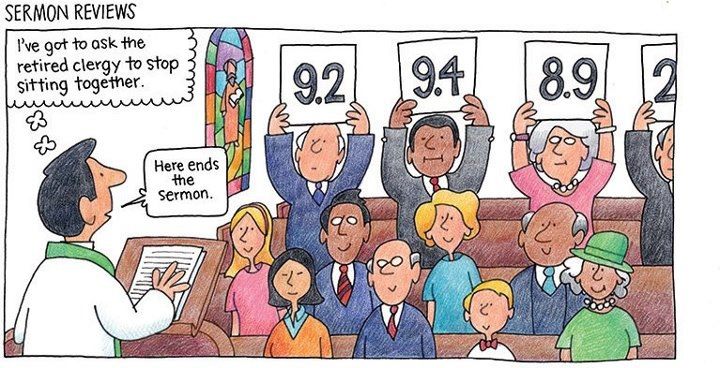
But not everyone finds the presence of clergy in the pews a blessing (see cartoon above). I have active colleagues who tell me that some of their retired clergy colleagues can be a burden to them, that they know they will be critical of them and they make them nervous.

When this happens it is a failure of a basic kind of collegiality that should prevail among the ordained clergy, the ministry of encouragement. Our role as pew sitters is to support our pastors. We of all people know the nature of the job. And out of that knowledge should come from us a great measure of appreciation for all they have to do. We should be praying for them regularly. We were once where they are and were blessed with elder teachers, mentors, and friends.

I have learned these past few years that it is a difficult transition to go from being regularly in the pulpit for decades to finding oneself in the new role of congregant. It takes patience and humility.

But the thing we retired clergy have in common with the one who now leads our community in worship is worship itself, and the reality that pastor and people stand under the Word of God, and the grace and love that is proclaimed in it. And there is a blessing in being a worshipper without the responsibility of presiding, a chance to open oneself to God’s presence and power without having to wonder if the absent-minded reader will find the right lesson or whether the kids will be so sugared up that they will hijack your children’s message.

So sit back my friends and let the new kids on the block take their turn. As our brother Paul said to the church in Corinth, “I planted, Apollos watered, but God gives the growth.”

(I would give attribution to the cartoonist if I knew who they were. If you know let me know.)

(Update on the cartoon from Dave Macy:

“The cartoon appeared on a Church Pension Group (Episcopal Church) calendar. The cartoonist is The Rev. Jay Sidebotham. From this year’s calendar: “Fr. Sidebotham serves as rector of Church of the Holy Spirit, Lake Forest, Illinois. Before hearing a call to ordained ministry, he worked in New York in the fields of animation, illustration and advertising. (Some would say he is still working in advertising.) He is grateful not only for the opportunity that parish work affords to continue expressing himself through his drawing, but also for the abundant supply of cartoon material that emerges in parish life.””

Thanks, Dave.)

Unknown's avatar

The 28th MCCM Summer Barth Session for Pastors

BarthThe Massachusetts Convention of Congregational Ministers will hold the 28th Summer Karl Barth Session for Pastors on June 10 and 11, 2013 at the First Church and Parish in Dedham, Massachusetts. The topic is “Karl Barth’s Theological Ethics and the Public Square: The Economy.” Our leader will be Dr. Daniel L. Migliore, the Charles Hodge Professor Emeritus of Systematic Theology at Princeton Theological Seminary.

We will take up CD III/4, pages 509-64 on work as a part of the active life formed by God’s covenant of creation.. Professor Migliore asks, “Do we have a theology that understands the importance of work from the perspective of God’s intention for human life?” Our afternoon sessions will ponder statements by the administration on “jobs.”

The fee for the two-day session is $50, which includes breakfast and lunch and snacks and an optional dinner at the parsonage on the evening of the 11th. Enrollment is limited. To register e-mail raliweaver@dedhamuu.org or call the Reverend Rali Weaver at 617-495-5979.

These sessions are designed for pastors. They typically have about 15 participants in a seminar setting. I have attended most of them over the years, and we have been led by notable Barth scholars such as Hans Frei, George Hunsinger, Eberhard Busch and Robert Jensen. It has been mostly UCC and UUA pastors, but we are open to all denominations.

Unknown's avatar

Are the banks too big for trial? Seems so!

WarrenMy Senator, Elizabeth Warren, wants to protect you and me from fraudulent and criminal practices that hurt consumers. She fought to create the Consumer Financial Protection Bureau, an agency she should have been asked to lead. If she had she wouldn’t have been free to run and win a seat in the Senate, and some of those who feared her might be wishing now that they had let her run the agency, which Congress is trying to cripple into impotence anyway.

Today we can see why Wall Street and the banking industry poured a record number of dollars into Scott Brown’s campaign to try to defeat her. They fear her honesty and tenacity, and that was on display in her questioning of top regulators.

Many have wondered why nobody went to jail for the criminal banking practices that led to the international financial crisis. Now, because of Warren, we know the answer. Because no governemental regulatory agency brought any one to trial.

That was the ‘take away” from Warren’s first hearing of the Banking, Housing and Urban Affairs Committee.

According to Ryan Grim of the Huffington Post:

Warren questioned top regulators from the alphabet soup that is the nation’s financial regulatory structure: the FDIC, SEC, OCC, CFPB, CFTC, Fed and Treasury.

The Democratic senator from Massachusetts had a straightforward question for them: When was the last time you took a Wall Street bank to trial? It was a harder question than it seemed.

One after another regulators obfuscated until Warren finally got them all to admit that they had never brought anybody to trial. She responded by saying,

There are district attorneys and United States attorneys out there every day squeezing ordinary citizens on sometimes very thin grounds and taking them to trial in order to make an example, as they put it. I’m really concerned that ‘too big to fail’ has become ‘too big for trial.’

I applaud Senator Warren for speaking truth to power and getting at the essential unfairness and inequality of our legal system, and for exposing the federal regulators who are supposed to be protecting us. If banks are too big for trial it means they are above the law.

Warren herself summed it up pretty well when she concluded:

‎If they can break the law and drag in billions in profits, and then turn around and settle, paying out of those profits, they don’t have much incentive to follow the law.

Or no incentive at all. Because several days of a trial would bring out to the public their fraudulent and criminal practices and embarrass them.

So what can any of us do about it? Well, for one thing we can vote and support courageous candidates like Warren. And we can put pressure on our representatives for more transparency and action around these issues. We can pressure Congress to strengthen the Consumer Financial Protection Bureau, and confirm director Richard Cordray. And we can use social media to embarrass the banks and the regulators. Because they should be embarrassed. They should be embarrassed that they made huge sums of money at the public’s expense, and got away with it.

Marilynne Robinson writing about the limits of science criticizes our current culture’s lack of ethics or morality, which she sees as part of the loss of religion (and the religious imagination.) She writes: “Science cannot serve in the place of religion because it cannot generate an ethics or a morality. It can give us no reason to prefer a child to a dog, or to choose honorable poverty over fraudulent wealth.” Religious people may want to speculate on how it is that the disparity between rich and poor in our country grew at the very same time that the world financial system came apart? And why nobody faced any consequences. Was it that nobody was at fault? Seems unlikely.

So those who were at fault should be embarrassed. More correctly they should be ashamed. And some of them should go to trial.

Unknown's avatar

“What’s the Point?” Reflections on a Christian Eschatology

safe_image.php

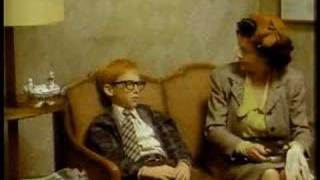
In Woody Allen’s movie Annie Hall, there is a great scene (click picture above) in which Alvy Singer, the character played by Woody Allen, flashes back to his childhood in Brooklyn.  His mother takes him to the family Doctor, Dr. Flicker, an avuncular man wearing a stethoscope, and smoking a cigarette. Alvy’s mom tells Dr. Flicker that 9 year-old Alvy is depressed.

Doctor Flicker: Why are you depressed, Alvy?

Alvy’s Mom: Tell Dr. Flicker.

[Alvy sits, his head down, his mother answers for him]

Alvy’s Mom: It’s something he read.

Doctor Flicker: Something he read, huh?

Alvy: [his head still down, quietly] The universe is expanding.

Doctor Flicker: The universe is expanding?

Alvy: Well, the universe is everything, and if it’s expanding, someday it will break apart and that would be the end of everything!

Alvy’s Mom: What is that your business?

[she turns back to the doctor]

Alvy’s Mom: He stopped doing his homework!

Alvy: What’s the point?

Alvy’s Mom: What has the universe got to do with it? You’re here in Brooklyn! Brooklyn is not expanding!

Doctor Flicker: It won’t be expanding for billions of years yet, Alvy. And we’ve gotta try to enjoy ourselves while we’re here!”

I was looking for this quote yesterday, and when I found it I put the Yahoo clip on my FB page. A child psychologist friend of mine, who is also a professor, wrote this comment:

I always refer to it when I teach developmental psychology, and I ask how many students remember feeling this way: “What’s the point in doing anything because the sun is going to go out in several billion years?” Many, many young people remember the precise moment when they first felt this way….

Alvy the young fatalist is a stand-in for all of us faced with the futility of a finite world, and with our own mortality. Because Alvy is right that everything comes to an end.

That is our topic for today, “the End.” I loved the way Gail (Miller, our chair) framed the subject for us for this meeting: “The End! How do we talk about the End? – End of time – End of life – End of… Where are Christians headed? In this life and the next? What does Christian Eschatology look like?”

There are many directions one could go with this set of questions, but the common assumption that they would all share is that there is an end. And (pun intended) this is where I want to begin.

I want to begin with Alvy Singer’s question, “What’s the point?” If there’s an end, “What’s the point?” And there is an end. Both our life and the life of the planet we live on are finite. The mortality rate as of this morning is still 100%, and the very best science predicts the likelihood that our sun, which is a star, will some day in the distant future blink out leaving earth without the conditions for life. Whether the expanding universe itself is finite is an open question, but for the purposes of this discussion finitude is what we are faced with.

So how do we talk about Christian hope in the face of our finitude and the finitude of our world? My own answer to this is quite simple. First let me say what we cannot do. We cannot construct hope out of the materials given to us by the fact of our finitude. Christian hope lies elsewhere.

Alvy read the best science and rightly despairs of what that narrative has to offer. But that narrative, though the reigning one, is not the only one. Science can tell us what it can tell us and we are grateful for it.

But science, so good at measuring our universe and examining our bodies, can not tell us what either means.

Marilynne Robinson writes,

The modern fable is that science exposed religion as a delusion and more or less supplanted it. But science cannot serve in the place of religion because it cannot generate an ethics or a morality. It can give us no reason to prefer a child to a dog, or to choose honorable poverty over fraudulent wealth. It can give us not grounds for preferring what it is excellent over what is sensationalistic. And this is more or less where we are now. (The Death of Adam, p 71)

To enlarge our thinking and engage our imagination about what the end of things means we need to look elsewhere than science, and the elsewhere I want to look at is the Christian Story, and especially what it tells us about the character and identity of God.

And, as those who know me will not be surprised, that among the many places in the Christian Story we can turn to know the character and identity of God, it is in the cross of Christ that we get a particularly decisive picture. And by the cross I mean, as our brother Paul did, the decisive act of God that focuses on Good Friday and culminates in Easter.

Here is the love that will not let us go, a love so deep, so broad, so high, as one of our hymns describes it, that it will die for us. So again like Paul, to the facts of finitude, “we preach Christ and him crucified.” (1 Corinthians 1:23)

Which is to say I want to argue for a cross-shaped eschatology, one that sees the facts of finitude for us and our world in the template of Good Friday and Easter. ( For a fuller working out of this idea see my “The Cross as an Eschatological Act of God” in Hope for your Future: Theological Voices from the Pastorate. Edited by William H. Lazareth. Eerdmans, 2002.)

Jesus’ death ends his life. But beyond the discontinuity of death, God raises him to new life. There is continuity in that he remains identifiably himself; he bears the marks of the Roman nails on his hands and feet. Yet he is also different. Some don’t recognize him. His glorified body is and isn’t his earthly body.

Imagining this continuity and discontinuity of Good Friday and Easter provide us the model for a proper Christian eschatology.

In that light how do we think and talk about the end? First of all we need to be honest about the impact of the end, just as we need to be honest about the fact of our own death.  I once got in trouble for opening my Easter sermon by saying, “On Good Friday Jesus was as dead as a door-nail.”  But it’s true. Good Friday was a dead end, and symbolizes all the other ends that flesh is heir to, the end of promise, the end of hope, and the end of all human possibilities.

To get a sense for how it felt then, recall that story you all know well when Jesus meets some of his followers on the road to Emmaus. He asked them, “What are you discussing together as you walk along?”

They stood still, their faces downcast. One of them, named Cleopas, asked him, “Are you the only one visiting Jerusalem who does not know the things that have happened there in these days?”

“What things?” Jesus asked.

“About Jesus of Nazareth,” they replied. “He was a prophet, powerful in word and deed before God and all the people. The chief priests and our rulers handed him over to be sentenced to death, and they crucified him; but we had hoped that he was the one who was going to redeem Israel.” (Luke 24:13-35)

That was the end of that, so, as young Alvy would ask, “What’s the point?”

But that wasn’t that. That wasn’t that. The resurrection changed all that, and changed the world.

But it wasn’t too long before the earliest Christians realized that the kingdom of God in its fullness had not arrived, and so they looked for a second Advent, in which what had begun, even in their midst, and what was promised, would be completed and fulfilled.

So even now, all these years later, we Christians, and our church, live between the times, between the first coming and the second coming. We live in the already of Christ’s appearing, and the not yet of his reappearing in glory to consummate all things.

So our faith is profoundly eschatological. But you would often never know it from being in our worship. For example, the church year has a peculiar feature about it. We end the year on Christ the King Sunday with a flurry of eschatological texts, and then we immediately begin a new year in Advent with another flurry of eschatological texts, and then we don’t really have to think about eschatology in between.

But we should think about. I have been reflecting on something Steven (Small, the local pastor) once wrote to me in reflecting on his Advent Christian background:

A deep hope in the return of Christ is at the center of my eschatology in particular and it informs my theology in general. The Adventists gave us some real gifts: a more gracious view of a loving God through their understanding of conditional immortality for one. There is a tendency to snicker in mainline circles when it comes to discussions of the Second Coming. (But) if we truly believe that Christ has died, and Christ is risen, why would we not be quite certain that Christ will come again.

And as pastors, if we have not thought carefully about eschatology, what do we have to say to those who are facing the end, whatever that end may be: the end of their life, the end of their vocation, the end of their marriage, the end of a relationship with a family member, the end of a dream, a hope, a promise?

Alvy’s question, “What’s the point?” has no good answer apart from faith, and that faith is an Easter faith that lies on the other side of Good Friday.

Because when there was no hope, no human possibilities, when we were done and there was no point, God was not done. And that is who we are, the community that looks for more at the end. The community that believes that God is not done. That God is never done.

The end of life is a fearsome thing. But the God who raised Jesus from the dead is the God we worship.  Can that end have dominion over us?

The end of the world is a scary thing. Even 9 year-old Alvy knew this. But the God who created the world, can not this same God redeem and save this world, and create a new heaven and a new earth?

What can we say at the end? What can we say at the several endings that mark our life and our world?

This is what we can say: That God is with us at the end as at the beginning, and all the way through.  “I am the Alpha and Omega, the beginning and the end, saith the Lord. Behold, I make all things new!” Amen.

I preached this sermon on February 7, 2013, at the First Congregational Church (UCC) of West Boylston, Massachusetts for a meeting of the New England chapter of Confessing Christ in the United Church of Christ.

Unknown's avatar

Unity in the United Church of Christ: A Theological Reflection

UCC(This year marks the twentieth anniversary of my address to the Executive Council of the United Church of Christ, which I gave in Cleveland , Ohio, on October 17, 1993. I was asked by the Executive Council to reflect theologically with them prior to their meeting. The address that follows is the result of that invitation. This address was also published in Papers from the Initial Meetings of Confessing Christ, November-December 1993.  I reprint it here as given with a few small editorial changes.)

Let me begin my reflections by invoking the motto of the great Reformed Pastor Richard Baxter (1615-1691), which can be translated as:  “In essentials, unity; in nonessentials, diversity; in all things charity.”  (He seems to have got it from the German Lutheran theologian Peter Meinerlin). Baxter referred to essentials as “necessary things” and to nonessentials as “doubtful things,” and it seems to me that many of the strains we experience in the UCC are because of the difficulty in distinguishing between what is essential and what is nonessential, what is necessary and what is doubtful, by which Baxter meant what is open for discussion. To make these distinctions in the United Church of Christ will not be easy, but I am convinced that unless we carry out a continuing and wide-ranging debate on what constitutes our essentials, both our unity and diversity will continue to be imperiled. I speak to you as a lover of the church, a local church pastor who has been through the chairs of denominational and ecumenical life.

I worry about the church these days. Any alert church person knows that the church is undergoing profound and far–reaching changes.  The church of tomorrow will not look like the church of today, of that we can be certain. A flurry of books has appeared on the decline of the mainline churches, such as Loren Mead’s The Once and Future Church, Leander Keck’s The Church Confident, and Jackson Carroll and Wade Clark Roof’s Beyond Establishment: Protestant Identity in a Post–Protestant Age, just to name a few of the most recent ones. All describe changes that are taking place, using words like “crisis” and “malaise.” All offer some tentative steps that may help the church to move in fruitful and faithful directions. None can see clearly what the future church will look like.  Mead is convinced that the new church that is being born out of the old mainline will not be seen clearly during our lifetimes and I tend to agree with him. God is doing a new thing, of that we can be sure, but just what it is that God is doing is not so easy to say.

To prepare ourselves and our church for this future requires the debate about which I have spoken, a debate grounded in study and prayer, a debate that clarifies and articulates what it is that constitutes the United Church of Christ, a debate that seeks passionately to discern the essential defining marks of our life about which we need unity; that defines, too, what are the nonessentials that can be left to Christian freedom in a wide-ranging diversity, and how do we recover the charity in all things that  the Apostle Paul said is the greatest gift God gives to those in the body of Christ?   Let me share with you some of the threats to our unity that I see.

Threats to Unity

1.  A Faulty Inclusivity

The first threat to our unity that I want to suggest to you is what I call a faulty inclusivity. I believe that the gospel creates its own diversity, addressing and calling all sorts and conditions of people. But diversity of “races, tongues and nations” or even theological viewpoints is not the same thing as diversity of faith. To paraphrase P. T.  Forsyth, “Diversity is a fruit and not a root.” Our diversity is rooted in the unity we have in Christ, and in that unity let us strive to be as diverse as possible. But in many cases our diversity has been regarded as a creed extended to everyone and everything without adequate account for the essentials that define our community.

The church needs to be both authentically inclusive about some things and carefully exclusive about others, and needs always to pray for wisdom to discern the difference. Listen to what Loren Mead has to say about this:  “At its worst, exclusivity becomes rigid and legalistic, separating the righteous from the unrighteous according to manmade standards . . . But exclusivity is important because it speaks of something more important than these limited boundaries.  Exclusivity states that there must be a place where a decision, a belief, or an action marks the difference between who is ‘in’ and who is ‘out.’ Exclusivity demands that one who identifies with the Christian community stands for something, not for everything. At its best it engages and focuses energy and anchors community life. Inclusivity goes in the other direction. It opens its arms wide to the diversity of the world, inviting the stranger into community without question. At its best it represents hospitality and prevenient grace — acceptance before it is asked or earned.  It points to the acceptance of the unacceptable.  At its worst it degrades the meaning of membership to a ‘laissez faire’ anything goes.”  (Loren Mead, The Once and Future Church, Alban Institute, 1991, p. 48)

Now I would be the first to cry foul if I perceived the UCC to be faced with a crisis of exclusivity: of rigid, arbitrary, and legalistic bars to membership or participation, but that is not our problem. In the culture of the United Church of Christ “exclusive” is considered a bad word, “inclusive” is a good word. A friend of mine who is a UCC pastor and spent some of his formative years within the ranks of conservative evangelicalism says that the word “inclusive” in UCC circles reminds him of nothing so much as the word “inerrant” in evangelical circles. Nobody really defines it, he comments, but we all are supposed to know what it means, and if you aren’t you are in trouble. It’s used as law, not as gospel. Our problem is not in the area of exclusion; our problem is a faulty inclusivity that often fails to distinguish between the authentic need for Christian confession around membership and the desire to be tolerant and nice.

Let me offer a personal anecdote.  A decade ago when I was relatively new to Berkshire County my friend, the local rabbi, made an appointment to see me. He seemed uncharacteristically nervous and it soon became clear why. Two of his congregants had informed him that they were “members” of one of our UCC churches in Southern Berkshire, and that the pastor of that church told them that there was no problem belonging to both the synagogue and the church, because we worship the same God, “and we are open here to people of all religions,” including, I later found out, some who identified themselves as Buddhists, and some who are Hindus. I told the rabbi that I found that interpretation of local church autonomy incomprehensible, and would look into it.

When I mentioned this to a member of the Church and Ministry Committee, I was told that each local church is responsible for forming its own covenants and requirements for membership and that this church was within its rights. I can’t imagine that the founders and framers of the United Church of Christ ever imagined that a local church would or could decide to become a syncretistic religious fellowship across faith boundaries.

When I talk this way about excluding people from membership in our churches who clearly are not practicing Christians, who are honest enough to say they do not confess faith in God and do not consider Christ to be the head of the church, I hear in response that we are not a creedal church. That is true in comparison to the way creeds function in other communions. We do not hold them up like litmus paper to test people’s orthodoxy. They are “testimonies and not tests.” Nevertheless, the United Church of Christ is a Christian Church in the classical Christian tradition.  Our constitution says that we honor “the historic creeds and confessions of the Christian Church.” We are a church, not a sect, and though we provide space and freedom for a wide variety of viewpoints and perspectives we do not make it up as we go along. Essentials such as the Trinity, the headship of Christ over the church, the two sacraments of Baptism and the Lord’s Supper, the authority of the Bible, just to name a few, are not optional items to be embraced or discarded at our whim. They belong to the whole Christian church of which we are a part. Members join our congregations by profession of faith and that faith has content. Which leads me to my second threat to our unity.

2.  Amnesia about the Church’s Traditions

We are forgetting our heritage. Leander Keck says the mainline churches are like people who inherit a grand estate, but instead of moving in and inhabiting it they have camped out in the backyard, “because they neither knew nor cared how to live in the house.”  (Leander Keck, The Church Triumphant, p. 16) We live in an ahistorical culture where memories are short and tradition is not valued, and, unfortunately, the church is not exempt from that amnesia. But those who lose touch with the living theological heritage we share are condemned to be constantly reinventing the wheel. Now there is a kind of traditionalism that resists all adaptation and change and elevates tradition to the place that only scripture should occupy. This is not what I am talking about. Rather, I refer to an authentic appreciation for the rich tradition that is a treasure bequeathed to us from the past. The church historian Jaroslav Pelikan offers us this epigram;  “Tradition is the living faith of the dead:  traditionalism is the dead faith of the living.” (Jaroslav Pelikan, The Vindication of Tradition, p. 65)  Edmund Burke (1729-1797), the British politician and writer, called the social contract a “partnership not only between those who are living, but between those who are living, those who are dead, and those who are to be born.”  That is what tradition is in the church, the place where the communion of saints get their say.  As Chesterton put it, “Tradition is only democracy extended though time.”  (G.K. Chesterton (1874-1936), Orthodoxy, 1908)

We will always need to find ways to tolerate those in the church that like to color outside the lines; Jesus and the prophets did no less. But let us have lines, even if we have to struggle about where they need to be drawn. Let us have lines, not as boundaries that exclude so much as plumb lines that give a true measure. There can be no pristine orthodoxy. Even the so-called Vincentian canon, the notion of orthodoxy defined as that which has been believed always and everywhere, is a fiction, and none of the doctrines of the church quite measure up to it. Doctrine develops, orthodoxy gets redefined. John Henry Newman said that “Authentic orthodoxy has to change in order to remain the same. In a higher world it is otherwise, but here below to live is to change, and to be mature is to have changed often.”  (John Henry Newman, Essay on Development, quoted in Jaroslav Pelikan, The Melody of Theology.  Cambridge:  Harvard University Press, 1988, p. 55)

So when I speak of orthodoxy I do not mean a rigid, unchanging set of dogmas, but rather that collection of articulations and expressions that allow the church to give God “right praise” which is what orthodoxy means. This includes knowing whom it is that we are praising.  I am arguing for what Hans Frei called “a generous orthodoxy.”  “Generosity without orthodoxy is nothing,” he said, “but orthodoxy without generosity is worse than nothing.” Such orthodoxy’s lines are never fixed or rigid, and must always be redefined. It is the responsibility, even the duty, of the church to do this, as the preamble to our constitution exhorts:  “[The United Church of Christ] affirms the responsibility of the church in each generation to make this faith its own in reality of worship, in honesty of thought and expression, and in purity of heart before God.” But it is not just any faith that we must make our own, it is this faith, previously defined as the “faith of the historic church expressed in the ancient creeds and reclaimed in the basic insights of the Protestant Reformers.” So the historic faith in its basic contours must be made our own, not something new of our own making. And when what is essential gets redefined by each generation, the ecumenical church must get its vote across space, and the communion of saints must get its vote across time. So deciding what is essential for the church’s life must not be left to the whim of every local church and pastor or judicatory on an ad hoc basis.

In this regard, I am dismayed by reports of local pastors using ad hoc baptismal formulas in their baptismal liturgies in the name of inclusive language. This is putting enormous strains on our unity both within the United Church of Christ and ecumenically. I have represented The Massachusetts Conference of the United Church of Christ on the Massachusetts Commission on Christian Unity for nearly a decade. Over that time I have had to defend us against the questioning of some of my ecumenical brothers and sisters about whether we are a bit loose and free with some things on which we thought we had agreement, such as baptism by water in the “name of the Father, the Son, and the Holy Spirit.” In the past, when somebody asked me about irregular baptisms in UCC congregations, I always explained the nature of our covenantal model of ecclesiology and indicated the traditional formula as it appears in the Book of Worship. At the commission’s annual meeting last year we were told about a neighboring state where a common ecumenical baptismal certificate had been created as a tangible expression of Christian unity. This had been signed by judicatory leaders representing Eastern Orthodoxy, Roman Catholicism, and every mainline denomination except the United Church of Christ.  The fact of a conference embracing such a policy makes my previous defense seem disingenuous. It takes little imagination to foresee the ecumenical implication of such a move.

The United Church of Christ is struggling mightily and at every level over the issue of language, as you all know from following the debate that rages around the New Century Hymnal. But it is not simply a matter of a correct or an incorrect approach to this vexing subject.  Professor Gabriel Fackre has identified at least nine discrete positions in relation to inclusive language. This taxonomy of the issue may well help us to sort out its complexity and come to wise solutions. One wise elder suggests that the Hymnal will only be successful if everyone is a little offended by it. But can we ever get it just right? Leander Keck suggests what is behind the call for flawless words is “a technological view of language.” He writes, “What makes this view of language so attractive during the eclipse of God and the entropy of religious vitality of the mainline churches is the implication that proper (i.e., “politically correct”) manipulation of metaphors can bring God back and vivify proper religious experience. Indeed, wherever the God-Reality has been collapsed into our language for God, one can scarcely avoid thinking that changing God-language changes God too, making us the creators and shapers of God instead of acknowledging that it is we who are the created and the shaped.” (Keck, p. 54-55)

A related form of amnesia that threatens our unity and the integrity of our mission is our forgetfulness of the language of Zion, the biblical and theological thought-world that is or should be the church’s proper primary language. I have been noticing for some time now how therapeutic, managerial and political language dominates the church’s discourse. Where once the church spoke of sin and grace, covenant and promise, holiness and righteousness, now we are more likely to hear other tongues. Therapeutic language speaks of co-dependence and dysfunction; managerial language speaks of goals and objectives and accountability; political language speaks of victimization and oppression. These are helpful perspectives to be sure, and the church has always adopted and even baptized the language of the culture around it, but always in the past as second languages.  I am struck by how much these foreign tongues completely dominate churchly discourse. Like second-generation exiles we have forgotten our native tongue and no longer know how to speak to one another in it. And since we no longer speak it in the home and less and less in church it is highly unlikely that our children will learn it, except a few nostalgic phrases the way many second generation immigrant families hold on to scraps of language they learned from grandma. Which leads me to my next point.

3.  The Failure of Transmission

Related to historical amnesia is our failure to transmit the faith to the next generation. The reasons for this are complex and far beyond our control. The network of support structures that not so long ago supported Protestant America are, for better or worse, gone.  The culture will not make people Christian, and in a church as heavily identified with culture as the UCC is, the intentional transmission of the faith will be all the more critical as the culture changes and becomes more secular.

I am currently involved in a doctoral project entitled “Christian Literacy:  Remedial Catechesis for Adults” in which I have designed an eight-week adult curriculum entitled A Course in Basic Christianity. There are 29 participants from my local church in the program, which is in its fourth week. Already we have learned some interesting things. This sample of people has few birthright members of the UCC or its predecessor bodies. The majority learned the faith elsewhere. Most have more understanding of the basic contours of the Christian faith than they thought, but they have had little experience of thinking and speaking theologically. They find, however, when they do it is empowering and exciting. They are relearning a forgotten language that once they knew. This was truer for the older members than the younger ones, however.

In the late nineteenth century Horace Bushnell wrote Christian Nurture and challenged the prevailing conversion model of his day. But Christian nurture then had the support of the family, the school and the culture as well as the church. That synthesis is over, and Christian nurture is now a failure everywhere. The Puritans worried about an unregenerate clergy. We should worry about an unnurtured clergy and laity, and muster everything in our power at every level to educate and nurture our people in the basics of the faith.

Likewise we need a renewed emphasis on evangelism. We are doing this in my congregation, having participated for three years with the Evangelism Institutes sponsored by the Board of Homeland Ministries. Transmission of the faith is never merely done by Christian education but also by invitational evangelism. But of course, it is not opinions that one feels compelled to evangelize about, it is good news; if you regard what you believe as a preference rather than the truth, evangelism will wither, as it so often has and does in our churches. Which leads me to my next threat to our unity.

4.  The Loss of Truth as Criterion

Another threat to unity is the increasingly accepted belief that there cannot be any such thing as truth, only personal preference.  “You like chocolate, I like vanilla. You like Hinduism, I like Christianity.” This is not what religious tolerance once meant, but as it is increasingly getting to be understood, tolerance is becoming a subtle faith of its own that believes that all religious claims are private and relative. This especially undermines Christian faith, which is not a philosophical system at all, but rather a claim about God acting in history. Christian faith is, as Leslie Newbigin once said, “Primarily news and only secondarily views.”  (A Faith for this One World.)

This ideology of pluralism states that all opinions are equally valid, and in doing so relativizes all religious truth claims. Many of the baby boomers who are joining our churches do not believe the Christian faith is true over other faiths, they merely have a preference for it, out of historical nostalgia or familiarity.  In his new book, A Generation of Seekers, sociologist Wade Clark Roof finds that baby boomers are generally inclined to like choice, tolerance of different lifestyles, mixing religion and psychology, and doing what works for them. Roof calls this religious consumerism and individualism “transformed narcissism,” and he suggests that it is what much of what America’s religious future will look like. The genuine openness (as well as the faulty inclusivity) of the UCC is very attractive to some of these people. That is the good news. The bad news is that their loyalty to denominations is very low, they pick and choose only the parts of the faith of the church that meets their needs, they are notoriously lousy givers, and if they feel moved to leave for a better deal or just stop being interested they will drop out without a thought. Every pastor knows this crowd. According to Roof, for the boomers tolerance is equated not with respect across religious lines so much as the belief that religion is an individual enterprise and one cannot talk of truth but only of preference. In an increasingly pluralistic society this attitude is highest among the best educated, those who make up one of our core constituencies. How we deal with the question of truth in a pluralistic world then becomes a pressing question for us, and has many implications for our unity and diversity.

To my mind the most eloquent of the recent Christian thinkers on this question is Bishop Lesslie Newbigin, a British theologian who was for forty years a missionary in India.  Newbigin makes a convincing case that the learned spokesmen and spokeswomen of contemporary Christianity who argue against making exclusive claims of truth on behalf of the gospel are in fact not making Christianity more available to their contemporaries, as they often argue, but are embracing an alternative view of history, an alternative faith actually, and in so doing are selling their birthright for a mess of pottage.

To judge the gospel by the prevailing worldview is to betray it, for the gospel itself is a view of history that calls into question every other way at looking at human history and destiny. To take but one example of how this works let us look at the interpretation of a biblical text. According to modern views a text is best understood from some outside perspective, an Archimedean point from which the observer can make sense of it. From this point of view we examine the text but the text doesn’t examine us.

Newbigin uses the now well-known example of Karl Barth “as he sat under his apple tree in Safenwil, when he discovered to his astonishment that the Apostle Paul was not only addressing his contemporaries in Rome but was actually addressing Karl Barth, and an answer was required.”  (Newbigin, The Gospel in a Pluralistic Society. Grand Rapids: Eerdmans, 1989, p. 98)

Newbigin might say that we have tried to understand the gospel from the point of view of the world, when in fact the world must be understood from the point of view of the gospel. He in no way rules out dialogue and discussion with other faiths and points of view, but admonishes us as Christians to be clear that we have a position that makes claims for itself, which cannot be denied by deciding in advance that all views are equally valid. That is of course just what the ideology of pluralism asks of those who come to the discussion.

One of the dogmas of the ideology of pluralism is the refusal to even consider the question of truth; even some Christians are now asking that truth questions be put aside for the sake of some elusive unity.  Newbigin wants to claim that the Christian religion is the truth, not a truth, one among many. This of course flies in the face of modernity, challenging perhaps its most widely held dogma, that in “private” matters like religion there can be no truth.

Newbigin argues for a view of the Bible as universal history, not as merely a sectarian story for a peculiar people, but the story for all people.  He supports this claim by arguing for Israel and the church to be seen in terms of election to fulfill God’s intention for all humanity, and, finally, for Jesus Christ to be understood as the clue to history. In spelling this out he articulates an interpretation of history that does justice to the biblical narrative.

Jesus Christ, “the clue to history,” is the clue as well to the church’s mission.  Since we need not be ashamed of the particularity of God’s way with the world, we can abandon the reductionism that tries to distill Jesus’ ethics out of the particularity of Jesus’ person. With the coming of Jesus the kingdom of God can no longer be understood as a formal concept “into which we are free to pour our own content in accordance with the spirit of the age.  The kingdom of God now has a name and a face: the name and the face of Jesus. When we pray, ‘Your kingdom come,’ we are praying, or ought to be praying, as the early church did, ‘Maranatha: Come, Lord Jesus.’ The fact that liberal Protestantism separated these two, was willing to talk about the coming of the kingdom but not about the coming of Jesus, is a sign of betrayal.”  (Newbigin, p. 134)

Newbigin decries the conflict between those who see the purpose of the church as the preaching of the gospel of salvation and those who see it as the doing of God’s will of righteousness and peace in this world. He says, and I agree, that this conflict is profoundly weakening the church’s witness. He suggests both parties would benefit from renewed focus on the new being in Christ, the “prior reality, the givenness, the ontological priority of the new reality which the work of Christ has brought into being.” (Newbigin, p. 136)

5.  Loss of Charity

The final threat to our unity is not about substance, but about style. I will call it the loss of charity, which is the Christian term, although in secular discourse it is often called loss of civility. Christians are admonished “to tell the truth in love,” but in the current climate of the church it gets harder and harder to do that. By charity I do not mean denying or glossing over differences. It should be sufficiently clear to you by now that I have strong opinions and I am willing to share them. I expect that others will do likewise, and let the opinions stand on their own. But that is getting less and less possible in the church. The insight that all politics are personal has made all discussions personal. Attacks are frequently made ad hominem.

Loren Mead names this in The Once and Future Church, “Much of the bitter anger in the theological and political conflicts in our denominations comes from the depths of persons who have a sense of loss of the church they loved. The conflicts may be about substantial concerns, but often the anger that surrounds them comes from those feelings of loss. I see this anger in bitter debates leading to the firing of some pastors. I see it in the way clergy scapegoat their executives or denomination. I see it in the way clergy talk about their lay people and the way lay people talk about clergy. I see it in the way people at all levels engage in civil wars or try to purge one another for one reason or another. I do not deny the fact that there is often truth behind many of the angers, but our age of change and the loss of the familiar puts a bitter edge to the anger, often violating the spirit of community.” He concludes, “Building a church for the future will take all the sense of community we can get.”  (Mead, p. 62-63)

It‘s a hard time. Angry and bitter words are spoken, and they hurt. People are more and more pigeonholed into groups and positions. I find time with my clergy colleagues to be less and less a time of support and solidarity and more and more a time of nervous defensiveness.

I know you as members of the Executive Council have been the targets of hard and hurtful accusations. The conflict with the Biblical Witness Fellowship was hard to understand from the sidelines. I am not now, nor have I ever been, a member of the Biblical Witness Fellowship, but I think I understand their sense of loss that things they hold sacred are not valued by many in the United Church of Christ. At least in the circles I move they have little or no significance or impact. Nevertheless, I have frequently heard very uncharitable things said about them that would be completely beyond the pale if said about any other group in the United Church of Christ, which makes me wonder aloud whether our church’s cherished sensitivity to and concern for marginalized groups can include them. I have also heard and read invitations for them to leave the United Church of Christ if they can’t get with the program. I think it would be most unfortunate for our church if that came to pass.  P.T. Forsyth once said, “The church is not to be sneered at if it refuses to place itself wholly on one side or the other of a mere economic, social, or political question and stake its Lord’s fortunes there.  It is bad for a Church, and it might be fatal, to be only on one side in a civil war.”  (Forsyth, Socialism, the Church and the Poor.  London:  Hodder and Stoughton, 1908, p. 33)

Our Unity is in Christ

Which is to say that our unity can never be based on like-mindedness, on some political solidarity or shared cultural life, movement or cause.  No, we are admonished to have the same mind among us that was in Christ Jesus, and it is our relationship to Christ, the head of the church, that we find our unity with each other. It seems to me that our polity is the attempt to order our life by the fact of our unity in Christ. When I was a theological consultant to the UCC sub-committee on ecclesiology I remember Reuben Sheares returning again and again to the point that the parts of the church are in relationship with each other because of the fact that they are in relationship to Christ. The key phrase in the constitution is “in mutual Christian concern and in dedication to Jesus Christ, the Head of the Church, the one and the many share in common Christian experience and responsibility.” I recall thinking, “My God, he really means that! ” and thinking as well, “What a radical belief that is.” Its implications are crystal clear: unity cannot reside in offices, whether we have bishops or not, nor in liturgies, or in creeds, or in causes, or in polity procedures. That is why both Book of Worship and Manual on the Ministry are more descriptive rather than they are normative.

What it means is that we live our common life out in dizzying freedom, the freedom in which Christ has set us free. And those of you who have been on Church and Ministry Committees and wrestled with vexing decisions in the life of our church know that because of that freedom our polity is a lot like the proverbial little girl with the little curl: “When its good its very very good, but when its bad its horrid.”

So to state the obvious, but often overlooked fact, the United Church of Christ has its unity in Christ. What does that mean?  It means our unity is something God-given that we do not create or make happen. The Statement of Faith of the United Church of Christ declares: “In Jesus Christ, the man of Nazareth, our crucified and Risen Lord, God has come to us, sharing our common lot.” In Jesus Christ, God has come to us. Our unity is the result of an act of God, and therefore we need always to look to the acts and purposes of God as attested in the scriptures.

This means we must give up modern theology’s inclination to look at the life of Jesus alone, as if we could know him by analyzing his teachings or delving into his personality. To know who Jesus is is to know what he does, and chiefly in his cross where he saved us from sin and death. This is how early Christology developed (see, for example, Marinus de Jonge Christology in Context:  the Earliest Christian Response to Jesus, 1988) and it is still the way Christians come to know Jesus personally, by what he does for us, not by contemplating his nature. As Catherine Mowry LaCugna says, “The mystery of God can be thought of only in terms of the mystery of grace and redemption. We can make true statements about God — particularly when the assertions are about the triune nature of God — only on the basis of the economy, corroborated by God’s self-revelation in Christ and the Spirit. Theological statements are possible not because we have some independent insight into God, or can speak from the standpoint of God, but because God has freely revealed and communicated God’s self, God’s personal existence, God’s infinite mystery. Christians believe that God bestows the fullness of divine life in the person of Jesus Christ, and through the person of Christ and the action of the Holy Spirit we are made intimate partakers of the living God.”  (LaCugna, God For Us ,The Trinity and Christian Life.  San Francisco:  Harper & Collins, 1991, pp 2,3) To know Jesus is to know him as Christ crucified, as Christ within the self-revelation of the triune God. The act of God in the cross of Jesus and the raising of Jesus, the Christ-event, disclosed Jesus’ identity within the activity of God, so that the church’s subsequent reflection and articulation of the person of Christ arise from that event.

We see this throughout the New Testament. So C. H. Dodd writes, “The great thinkers of the New Testament period, while they worked out bold, even daring ways of restating the Gospel, were so possessed by its fundamental convictions that their restatements are true to its first intention. Under all variations of form, they continued to affirm that in the events out of which the Christian Church arose there was a conclusive act of God . . . ” (C.H. Dodd, The Apostolic Preaching and Its Developments, 1936, p. 185)

The same is true for the theological discussions of the early centuries. So, for example, the Christological and Trinitarian controversies were focused around the vexing question of how the “man of Nazareth” who died on the cross for our salvation and the Eternal God were related. In these debates it is what God does that tells us who God is. For example, St. Athanasius dedicated his career to defending the notion that Christ is God, since Christ is our Savior and it is only God who can save. The doctrine of the Trinity, which is the specifically Christian way of speaking about God, guards this critical Christian truth from being lost or diminished, for it summarizes what it means to participate in the life of God through Jesus Christ in the Spirit.

Too much modern theology cares little for the Trinity and has either diminished or let go altogether the central Christian affirmation that “God was in Christ, reconciling the world to himself.”  (2 Corinthian 5:19)  That act of God in Christ centers on the cross, the lost chord in modern theology. Jesus Christ is our crucified as well as our risen Lord, and, it should go without saying, he couldn’t be the latter without having undergone the former. So with Paul, we preach “Christ and him crucified.” Otherwise, we are in danger of losing what Forsyth once called “the cruciality of the cross” and with it the whole sense of the triune God’s cosmic intervention and continuing activity in the world over which God holds sovereignty and exercises providence.

It is from this loss but a short leap to John Hick’s dubious conclusion about the non-exclusivity of the gospel, as if the gospel, which is about what God has done could abandon its central claim so that it might take its place among the religions. It should come as no surprise to us that someone who edited a book entitled The Myth of God Incarnate should follow it with one titled The Myth of Christian Exclusivity.   If one denies the incarnation then it is quite true that Christianity has nothing unique to say to the world.

But Christian faith does have something unique to say to the world, that God acted in a certain way at a certain time in a particular person: “Jesus Christ, the man of Nazareth, our crucified and risen Lord.” The reality of our unity as the United Church of Christ lies not in discounting or neglecting the particularity of the Christian revelation, but rather in the very act of recognizing and acknowledging it as a gift from God who has acted on our behalf.

But if the gospel is particular in form, it has universal implications. The act of God in Christ was for all the world, for every people in every age.  The Holy God who created heaven and earth and the atoning Christ who saves humankind from sin and death mutually indwell one another along with the Holy Spirit who makes Christ our contemporary.. Could there be a scheme more cosmic than that? Need we to look any further than the activity of the Triune God for our mission toward our fellow humans and within the whole created order?

In Colossians Paul speaks of this cosmic Christ, in whom dwells all the fullness of God. The universality of the gospel lies in its discrete particularity: “God with us” in the human Jesus Christ. So that biblical scholar Martin Dibelius is able to say in his commentary on Colossians, “As Paul confirmed the cosmic significance of the faith in Christ, he maintained the exclusiveness of Christianity and saved the Christian Church from becoming just one mystery religion among others and from being submerged and overcome by syncretism.” (M. Dibelius, Handbuch zum Nuen Testament 12, 1953, p. 39)

Does Christianity then make exclusive claims for itself against the other religions? You bet! Certainly we must be open to dialogue and conversation with other religions, and there are many things we can learn from them, and many common causes we can make with them. But since the gospel is about an act of God that defines both God and humankind, we cannot abandon our central claim, nor can we accept that there might be other gods. Paul tells the Corinthians they can eat meat sacrificed to idols since the idols do not exist,  ” . . . even though there may be so–called gods in heaven or on earth — as in fact there are many gods and many lords — yet for us there is one God, the Father, from whom are all things and for whom we exist, and one Lord, Jesus Christ, through whom are all things and through whom we exist.”  (1 Corinthians 8:5,6. NRSV)

Likewise the creeds of the early church insist that there can be but one God and Lord. In the Nicene-Constantinopolitan Creed the church confesses its faith in one Lord Jesus Christ (echoing 1 Corinthians 8:5ff); the Apostle’s Creed uses the Johannine rather than the Pauline formula:  ” . . .his only son our Lord” (echoing John 3:16). Both creeds clearly extend the New Testament faith that there can be but one Lord.

It is a challenge for the church today to remain clear and unapologetic about our faith in Jesus Christ, the one in whom God has acted, as the sufficient revelation of the Holy God, while at the same time remaining tolerant and open to others, and carrying about ourselves a proper Christian humility, befitting those who have been given all things by God through no credit of our own.

Many gods vie for our loyalty today, various cults and sects, New Age spirituality, and the subtle secular God’s of success, power, wealth, war, political ideologies of the right and the left, and other forms of seduction. God has made us worshiping creatures. We will worship someone or something and if it is not the Holy God something else will fill the vacuum.

In the face of these other calls to our allegiance, we are challenged to know Jesus Christ not only as the Lord of history and the savior of the world in whom all the fullness of God dwells, but also as our own personal Lord and Savior. We are challenged by him to take our faith with utmost seriousness. He calls us to decision, to commitment, to conversion, to repentance, to a new way of life with him.

I am convinced that the United Church of Christ from the very outset has been a daring ecclesial experiment in Christian freedom. If we seek our unity elsewhere than in Christ, we have no future together. In Christ, our future is promise.

I would like to end with a prayer by P.T. Forsyth, which some of you may know because it is in the back of the Pilgrim Hymnal.  Let us pray:

A Prayer for the Church

We beseech thee, O Lord, for thy Church throughout the world.  May it grow in the faith of the cross and the power of the resurrection.  May thy spirit minister to it continually the redemption and reconciliation of all things.  Keep it in thy eternal unity, in great humility, in godly fear, and in thine own pure and peaceable wisdom so easy to be entreated.  Make it swift and mighty in the cause of the Kingdom of Heaven.  Cover, establish, and enlighten it, that it may see through all that darkens the time, and move in the shadow of thy wing, with faith, obedience, and sober power.  (P.T. Forsyth, Intercessory Services for Aid in Public Worship.  Manchester, England:  John Heywood, Ltd., 1896, p. 8)

Unknown's avatar

Ministry is not a Commodity and Ministers are not Appliances: An Installation Sermon

Dire StraitsI am very glad to be here to celebrate with you the covenant between you and Mike as you begin your ministry here together. Today feels like a homecoming of sorts for me since I began my own ordained ministry 38 years ago, just an hour up the road from here in Northwest York County, Maine.

I was privileged to worship with you this morning, and inspired and humbled by the atmosphere of worship here in this congregation. As we like to say, “We had church today!”

I was also impressed and gratified to discern the obvious affection you already have for Mike and his family after just a few months in life together.

This afternoon I want to think aloud with you about what shape your ministry together might take in the years ahead. I was at a meeting with Mike about a month ago, and we all went around the room and introduced ourselves, and Mike introduced himself as the Pastor and Teacher of the First Parish Church in Dover, New Hampshire. Mike knows that I like that title better than senior minister, first of all because it has a nice old fashioned New England feel about it, but more importantly, it better defines the role of minister as I see it. And understanding the role properly will go far in Mike and you succeeding as pastor and people.

So let me say, first of all, what ministry is not. Ministry is not a commodity. Unfortunately, the search and call process does commodify ministry for both pastor and congregation, and perhaps it has to, but it is a very bad model for ministry.

The very term “installation” further confuses the matter. It occurs to me that the word installation sounds as if what we are doing this afternoon is plugging in a major appliance! And to add to the metaphor, a little later in this service Mike will get not one, but two charges. Let’s be playful with the image of installation for a minute.  I picture a giant cardboard box arriving at the front door. In my imagination the appliance store delivery guys look something like the cartoon characters on the old Dire Straits video, “Money for Nothing:” big burly guys in sleeveless T-shirts with visible tattoos, chomping on the butt-ends of cigars.  “Where do you want it?” they ask.  “How ’bout right over here by the outlet so it can get a charge. It’s a beauty, isn’t it?  much more efficient than the old one, and with many new features. Here’s the operating manual.  It comes with a one year warranty.”  Just about the time of your annual meeting. You get the idea!

I suggest that we regard that little flight of imagination as a cautionary tale for ministry. Because in contemporary America we tend to think of everything as a commodity, which then can be bought and sold. So it is a temptation for churches to think of their new minister as the new and improved model. And equally tempting for ministers to buy into that expectation. Who doesn’t like to be thought of as valuable and more worthy than others?

I caution you not accept that image. Mike is a gifted pastor, smart, well trained, well read, committed, personable and resourceful. But he is not a major appliance! It is precisely because of his vast talents, which make him especially vulnerable to being perceived, and perceiving himself, as a valuable ministerial commodity. And, like most temptations, there is just enough truth in it to give it appeal. For in fact, from a human point of view, Mike is a valuable ministerial commodity, in an age where both the supply and morale of talented clergy are low.

So how shall we think of the role of minister, of pastor and teacher?  In the Fourth Chapter of Paul’s First Epistle to the Corinthians he tells the church how to regard his ministry among them: “Think of us in this way, as servants of Christ, and stewards of the mysteries of God.” The word translated as “servant” here is peculiar to Paul in the New Testament, and, in the common tongue, it was the name given to slaves on a galley ship. I just saw the movie version of Les Miserables, and I picture the shackled convicts in the opening scene who are pulling a great ship into a slip to be like the galley slaves of Paul’s time. It is a harsh metaphor, or it would be except the master in this case is Jesus Christ.

The second of Paul’s images, and the one I want to focus on today is “steward.” We know this word from Stewardship Sunday, when we pledge our time, talent and treasure; or at least we do when we understand stewardship at its best and not at its worst as a dreary fund raising project.

A steward quite simply was a household servant, a sort of house manager, who looked after things for the master.

What’s Paul’s point in employing this humble job description? Paul was dealing with an early version of the cult of the preacher and the commodifying of ministry. That was the pagan way, as it still is. Preaching was all about skill in rhetoric, reading your audience, moving them, engaging them, entertaining them! And there was competition to see who did it best. So some liked Paul, some liked another itinerant preacher named Apollos, and some liked Cephas, which is just another name for Peter.

Paul rejects this cult of the preacher as unworthy of a Christian community. He himself, he writes them, “did not come proclaiming the mystery of God . . . in lofty words of wisdom.” No, he said,  “I decided to know nothing among you except Jesus Christ, and him crucified.” (1Corinthians 2:1,2)

The good steward doesn’t have to please the crowds, only the Lord, who will ask for an accounting when he comes “to bring to light the things now hidden in darkness.” (1 Corinthians 4:5) That is the only judgment that counts for the minister of God.

But what exactly is it to which the steward has been entrusted? “The mysteries of God.”  The NIV calls them “the secret things of God.” Here’s our first hint about the proper role for a pastor and teacher. As Mike and I know a minister can spend inordinate amounts of time in meetings, making plans, reviewing budgets, and managing all matter of things that none of us ever dreamed about or wanted when we received the call to ministry. So be it, it goes with the territory. These are duties of ministry, but not the role of minister, and it is dangerous to confuse duties with role.

The role of a pastor and teacher is to be a faithful house manager of the divine mysteries, a steward of the mysteries of God. And what are the mysteries of God?

Paul says that the divine mysteries are quite simply the Gospel, the good news of God’s vast love for us in Jesus Christ.

This good news tells us that whoever we are, whatever we have done, wherever we have been, wherever we are going, God’s love will not let us go. This love is as deep as the ocean, as fierce as the cross, as powerful as the resurrection, and as forever as time and beyond time.

The Good News about this love, Paul says, was once hidden but is now revealed by the Spirit, which is a good word for this Epiphany Sunday.

Let us think of the many glorious aspects of this Gospel as the secret things of God, secret in that they are not apparent to the eyes of the world, but only to the eyes of faith.

Now we are at the heart of the role. For it is the pastor and teacher’s responsibility to keep the eyes of the congregation on the horizon of eternity, rather than on the wearying preoccupations of the world. The steward of the mysteries reminds us again and again that the church is not our project, but God’s project. This is not easy. The cult of the preacher is easier and more fun. The cult of the preacher lets us assign success and blame depending how the numbers go. Every pastor is pleased when the numbers, members and money, look good, but the smart ones know they don’t control them. Unlike me, Mike with his economics background, actually understands numbers, and he’ll tend to that part of the job, but again that is a duty and not a role.

Too many clergy and congregations today are focused on the numbers, how much money and how many people. It’s a great temptation, and it can be deadly for a church because if the pastor is not a servant of Christ and a steward of the mysteries of God, then the congregation may get disconnected from the Gospel, and lose its way. It happens! And when it happens you may find yourself doggedly presiding over a frenetic activism that is all movement and no substance, what P.T. Forsyth once called the besetting sin of the church: “the sin of bustle.”

Too much of what passes for religion is not about what God is doing among us, but what we are doing ourselves. In this regard we have absorbed from the culture the misguided utopianism that thinks humans can control all things. The Czech dissident poet Vaclav Havel called modern utopianism

an arrogant attempt by human reason to plan life. But it is not possible to force life to conform to some abstract blueprint. Life is something unfathomable, ever-changing, mysterious, and every attempt to confine it within an artificial, abstract structure inevitably ends up homogenizing, regimenting, standardizing and destroying life, as well as curtailing everything that projects beyond, overflows or falls outside the abstract project. What is a concentration camp, after all, but an attempt by utopians to dispose of those elements which do not fit in.” (Interview in Times Literary Supplement)

A steward of the mysteries of God looks for height and depth as well as movement. What might that look like here in Dover?  Part of your role, Mike, is to keep the church in Dover a place where God’s story is not an ancient tale, but a present vibrant reality; a place to expect miracles, because the world is full of them for those with eyes to see and ears to hear. There are divine presences in every mundane transaction, and daily epiphanies around every corner. Keep that sense alive here. Gerard Manley Hopkins was right when he wrote, “The world is charged with the grandeur of God.”

A steward of the mysteries of God believes that all things are possible when God is involved, and helps others to believe it too. And when people believe God’s Spirit and power are among them, who knows what might happen?  Do you remember Thomas Merton’s comment about a Shaker chair?  “The peculiar grace of a Shaker chair is due to the fact that it was made by someone capable of believing that an angel might come and sit on it.” (From the Introduction to Religion in Wood by Edward Deming and Faith Andrews, 1966.)

The other piece of the role of pastor and teacher is the context: the congregation and its life together. Mike is gifted in this regard with a great deal of personal authenticity, warmth and humanity.

Are there any homiletic teachers in the congregation today? No, good, because I want to break a rule? Oh, what do I care, I am retired!? So I’m going to be personal and confessional and say that I met Mike about ten years ago during a particularly difficult time in my life, as I was struggling with the challenges of a new disability. Mike’s response to me was so empathic and tender without being in any way condescending. No one has been a better friend to me these last years, no one, and you are and will be blessed to have him as your pastor.

Mike embodies what the great preacher Gardner Taylor was after when he advised preachers “to look beyond the peripheral signs of preaching greatness to the real source of pastoral insight–the common bond with one’s hearers provided by suffering.” If you let him, Mike will share your lives, will rejoice when you rejoice and weep when you weep, and become your pastor. Gardner Taylor continues:

Now you may tickle people’s fancies, but you will never preach to their hearts, until at some place, some solemn appointment has fallen upon your own life, and you have wept bitter tears, and gone to your own Gethsemene and climbed your own Calvary.  That is where power is.’  The power of preaching is “not in the tone of voice.  It is not in the eloquence of the preacher.  It is not in the gracefulness of the gestures. It is not in the magnificence of the congregation. It is in a heart broken, and put together by the eternal God.

In conclusion, despite the fact that we are “installing” him today your new pastor and teacher is not a major appliance, neither is he a ministerial commodity, nor a quick fix or a paid Christian so everybody else doesn’t have to be one. No, Michael Steven Bennett is a minister of Christ’s church, a servant of Christ and a steward of God’s mysteries.

Mike, if you accept that role you will find that it will be shaped by the cross more that by the judgments and expectations of people. But the only judgment that really matters is the one whose ministry it is anyway. Those who remember their identity and their role as steward, who anticipate the return of the master, look forward to hearing the master’s praise: “Well done, good and faithful servant; you have been faithful over a few things, I will put you in charge of many things; enter into the joy of your Lord.” Amen.

(I preached this sermon at the installation of Michael Steven Bennett as Pastor and Teacher of the First Parish Church (UCC) in Dover, New Hampshire on Epiphany Sunday, 2013.

Unknown's avatar

My Top Posts for 2012


cropped-winter-11.jpg

In keeping with my annual end of the year tradition here are the top posts from “When I Survey . . .” for 2012:

“Confused? Interpreting Your Congregation’s Numbers” was by far the most popular with nearly 3,000 hits.

Other popular posts from this year were:

Posts from previous years that continue to get visited frequently are:

I am working on a book that I hope will be published this coming year with the tentative title of “Prepare Three Envelopes” (and other ruminations on pastoral ministry). It will collect many of the posts from this blog, and from my former blog “Retired Pastor Ruminates” plus some other previously unpublished pieces of mine. I will keep you posted about it. In the meantime thank you all for you support this year. I hope you will continue to visit here in 2013.

Unknown's avatar

“God With Us” A Sermon for the Fourth Sunday of Advent

Joseph and the angelIn Luke’s gospel it is Mary who is front and center in the story of the nativity of Jesus, and in our minds I think that is where she stays.  But in Matthew we get more of a glimpse of Joseph.  Joseph is a shadowy figure in the pages of scripture; he is introduced in the genealogy as the “husband of Mary, of whom Jesus was born, who is called the Messiah.”  We see him in this story about Jesus’ birth and again briefly in the events of Jesus’ childhood, the circumcision at the temple, the flight to Egypt to escape Herod, and in a small story about Jesus as a twelve year old when he gets separated from his parents on a trip to Jerusalem and turns up at the temple, teaching the elders. Then Joseph disappears from the story, except for references to Jesus as the carpenter’s son.

But though Joseph seems to be what is called a supporting character, without him the drama of salvation could not have taken place, and I would submit that that is just the way God works, with supporting characters who appear for a little bit and do what needs to be done and then disappear from the story. But they are always a part of the story and the story wouldn’t be complete without them.

And it seems safe to say that without Joseph, Jesus could never have become who he became.  Joseph must have played an important forming and nurturing part in the life of Jesus.  There has been much speculation about Jesus’ upbringing in the carpenter shop in Nazareth.  The scriptures tell us nothing, but if Joseph lived until Jesus was at least twelve, as Matthew indicates, then Joseph becomes the primary male role model for the young Jesus.

One noted scholar speculates that Mary and Joseph were from the ranks of the humble and pious multitudes, the kind of people who loved God and maintained the law as best they could, but without the means to carry it out to the letter in all its intricacy.  If this is true it would go far in explaining Jesus’ attack on the Pharisaic understanding of religion and his quest for a new freedom to live for God.

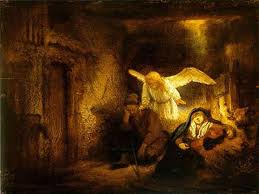
In any case, in the story of Jesus’ birth Joseph is most remarkable in the way he responded to this crisis in his life. The young woman to whom he is betrothed is found to be pregnant. This is more than a matter of divorce, the law demands her life by stoning for adultery, for betrothal carried the weight of marriage in those days. So Joseph dismissing her quietly to avoid public disgrace was an act of integrity. But what is even more remarkable is that when he has this strange dream, in which an angel of the Lord appears to him and tells him not to be afraid to take Mary as his wife for the child conceived in her is from the Holy Spirit, he believes the angel and does what the angel said to do.

The angel said something else about this child: they are to name him Jesus, for he will save his people from their sins, and that all this fulfills what Isaiah had written: “Behold, a virgin shall conceive and bear a son, and he shall be called Emmanuel,” which means, “God is with us.”

Let me invite you to consider this Christmas the statement that God is with us.  Consider that God is with us not just in high moments of religious insight, in worship and in prayer, or some mystical moment when all seems clear, but rather in the ordinary events that befall us in this life.

One of the implications of the Christian doctrine of the Incarnation of God in Jesus Christ is that God is no longer remote, but is with us in ordinary life and that our story is inextricably wrapped up with God’s story. There is more to it than that to be sure; there is a cross as well as a cradle and we need Easter to interpret Christmas, and perhaps Pentecost to interpret them both for without the Holy Spirit it all becomes just a story from long ago that can touch the heart, but not change the life.

But God is with us now, because of Jesus Christ. We can see his human face and know that there is something of him in the other human faces we see. God is with us in our exalted moments of joy, when we get glimpses of the joy God wants for us.  Perhaps a sunset does it for you, or a sunrise (I’m told they are pretty.)  Or perhaps watching a child at play, or a fresh snowfall.

I saw a fine movie this week called “A River Runs Through It” in which fly-fishing becomes the entranceway into a realm of pure awe and wonder in the midst of some very tragic human life.  To know that our story and God’s story touch and intertwine can transfigure some pretty ordinary stuff into something special. Perhaps it is only as story that we understand our lives, which otherwise remain rather elusive.

In “A River Runs through It” the writer’s father, who is a minister, asks him a question that made Norman wonder if he understood his father at all “You like to tell true stories, don’t you? he asked, and I answered, “Yes, I like to tell stories that are true.”  Then he asked, “After you have finished your true stories some time, why don’t you make up a story and the people to go with it?  Only then will you understand what happened and why.  It is those we live with and love and should know that elude us.”

So it is that our own personal stories may only be understood in the light of this vaster story that begins at the moment of creation and will end in glory in God’s own good time and finds its center around two poor Palestinian peasants wondering what the birth of this child might mean.  That the angel promised that the child means “God is with us” must have addressed their perplexity as it can address ours.

For it means God is with us not just in those fleeting moments of joy, but in moments of confusion and despair, of faithlessness and doubt, the kind that comes to all of us at one time or another.  Emmanuel means God is with us as we try to get our minds around what happened on a Monday night in a neighboring community, as we struggle to understand the incomprehensible fact that an eighteen year old boy walked into a sporting goods store in our community and legally bought an assault rifle and used it to kill people.  The God of Good Friday who is also the God of Christmas was with us as Wayne Lo began killing people, and the first tear that was shed at Simon’s Rock was God’s tear, not only for the dead and wounded and their families but for a world which still makes such moments possible.

So “God with us” is not the stuff of Kodak commercial sentimentality; it means God really with us in all the grandeur and misery of human life, in Bosnia and India and Somalia and the homeless mean streets of our cities as well as by the Christmas tree in the warmth of our living room. The mystery of the Incarnation puts God right in the thick of it all.  For God did not stay remote, high above the heavens, but ventured into the precarious life of an infant born into a marginal family in a precarious political situation.  That should give us pause from turning the Christian religion into something ethereal and apart from human life.  As Frederick Buechner remarked wryly, “One of the blunders religious people are particularly fond of making is the attempt to be more spiritual than God.”

This Christmas I invite you to discover God in the everyday ebb and flow of your life, in the ones you love as well as the ones who drive you up a wall, in your moments of consternation as well as in your high moments of joy.  Take the time this Christmas to take it all in.  If you spend all your time in frenzied preparation, you may just not be paying attention, and miss the time of your visitation, and never learn, as Joseph did, what supporting role you are called to play in this great big story of which our story is valued as an important part by the God who, whatever else he may be, is most assuredly with us, through Jesus Christ our Lord. Amen.

I preached this sermon at First Church of Christ in Pittsfield, Congregational, twenty years ago this week, December 20, 1992, after a gun slaying at a school, in nearby Simon’s Rock College on December 14. I posted this after the Sandy Hook School slayings in Newtown, CT, which were on the 20th anniversary to the day. Lord have mercy.

Unknown's avatar

Christian Teachings about Life after Death: A Pastor Ruminates

stream 2I have been asked to speak about “Christian teachings about the after-life.” This is final installment in a series of helpful presentations on preparing for death. There have been presentations on wills and bequests, end of life care, grieving and the like. And once again Max (Stackhouse) has asked me to bat clean-up and talk about theology.

One of my friends in the church said to me last week, “Oh, your talk is theology, so it won’t be practical.” She was kidding, I think, but let me respond to her remark by suggesting that a theology about death and what comes after it may be the most practical aspect of all for the Christian preparing for death. It is a shame how theology has come to have a bad name, even in the church.

Because theology is not some specialty for professional theologians, but simply the way we talk about God. That is what theology means, the logos of the theos, the word about God. And everybody has a theology, at least implicitly, so the more we can make it examined and explicit the more chance we will get it better rather than worse.

So right off the bat let me suggest a better title for what I hope to do here. I much prefer the phrase “life after death” to the term “afterlife,” because I think the former rightly expresses the Christian belief in the reality of death, while the latter can obscure the boundary between death and whatever comes after it.

I want to explore with you four ideas or concepts: 1. The reality of death, 2. Immortality of the soul, 3. Resurrection of the body, and 4. Eternal Life. Finally, I want to summarize the features of an adequate Christian theology of life after death, and the promises of the Gospel that are our hope in the face of death.

1.The Reality of Death

The first concept to ponder is the reality of death.  Some of the earliest thinking about death in the Bible is about its not only ending one’s natural life, but also severing our relationship with God. For Israel human purpose was to praise God, and death put an end to it. This relational view was visualized in spatial terms, so that places like Sheol and “the Pit” were places far from God.

Christianity inherited this relational view of life with God, and sees death as its cessation and the opposite of the fullness of life that God intends for us. So unlike some other religions that view death as an illusion or an escape, for Christians, death is real, as are the sense of loss and grief that accompany death, which are also real and nothing to ashamed of or denied. I have said at countless funerals: “There is nothing unchristian about grief; Jesus himself cried at the grave of his friend Lazarus.”

Moreover, Jesus himself died, and his own death provides a template for thinking about this. The creeds say quite simply, “He died and was buried.”

So accepting the reality of death is an important first step in thinking about it properly as Christians. In my nearly forty years of ministry I sometimes counseled people who wanted to deny or blunt this reality. People often asked for much-loved sentimental poems to be read at the funeral. I would gently suggest something more appropriate, but I was pastorally sensitive enough to allow their selection to be read if they insisted, knowing that I would get up and say something quite contradictory in my homily.

Let me give you some examples of poems that deny or minimize the reality of death, and I apologize in advance if these are your favorites.

Here’s a line from A. L. Frinks’ the Rose Beyond the Wall:

“Shall claim of death cause us to grieve
And make our courage faint and fall?
Nay! Let us faith and hope receive–
The rose still grows beyond the wall,”

Another and even better known poem about death is James Whitcomb Riley’s Consolatio:

“I cannot say, and will not say
that he is dead. He is just away.
With a cheery smile, and a wave of the hand,
he has wandered into an unknown land.”

“We do not sorrow as those who have no hope” (1 Thess. 4:13), but we do sorrow. So while as Christians we have much more to say than death is real, it is where we must start, reminding ourselves that Jesus, in his human nature, really did die, as all human beings do.

To make this point I once began an Easter sermon years ago by saying that “On Good Friday Jesus was as dead as a doornail.” I wasn’t trying to be shocking, but I was surprised by how many people took offense to this statement.

I know something of death. Both my parents died too young, I have worked in a funeral home, been an EMT, and a minister for nearly four decades. I have been present at many deaths, and each time I have been struck by how clear the line is between the living and the dead. And yet everything I know about death is on this side of it, as it is for us all. But  one thing I do know about death: it is real.

So if the first theme is the reality of death, how shall we properly think and talk about what comes after?

2. Immortality of the Soul.

One very prevalent idea of life after death is immortality of the soul. I would like to explore this popular idea with you, and show you why it is an inadequate view for Christians, admitting that in my early years it was my own view.

Let me share something about that with you. My own theology of death and what comes after it was shaped, at least in part, by my childhood bedtime prayer, a somewhat terrifying one from the New England Primer:

“Now I lay me down to sleep,
I pray the Lord my soul to keep,
If I should die before I wake,
I pray the Lord my soul to take. Amen.”

I didn’t know it at the time, but in my child’s imagination I had adopted a somewhat Platonic dualism about the human person, separating body and soul into the perishable and imperishable.

My own children, at the insistence of my wife, had a more sanitized version of that prayer that didn’t get them pondering sudden death in the nighttime. Whether they are better off for this is open for discussion. But in my own early thought-processes I figured that if such a sad event as my childhood death did take place, it would only be my physical body, and this invisible spiritual thing “the soul” would go swiftly to God. This is the essence of the idea of immortality of the soul.

I was taken aback to be told that this view, while widely held, was not particularly Christian. I learned in seminary that the Hebrew word translated as “soul,” nephesh, more rightly means “self,” in other words, the whole person.  Harrell Beck, my wonderful Old Testament professor, liked to say that your fingernails are as much a part of your soul as any other part, which is to say human selves are embodied. Or as I like to think of it: we don’t have a body so much as we are a body.

It is from the Greeks, and especially from Plato, that we get the notion of a disembodied soul housed in a physical body, an idea that still clings to many Christian ideas about an afterlife.

These ideas were ambient in the ancient Near East and in the Hellenistic world in which the New Testament was written, and they lived in uneasy tension with the more holistic Hebraic views of personhood. We even get a whiff of Greek dualism in the New Testament, such as in First Corinthians, one of the undisputed letters of Paul. He writes in 1 Corinthians 5:1:

For we know that if the earthly tent we live in is destroyed, we have a building from God, a house not made with hands, eternal in the heavens.

So if the disembodied immortal soul flying away from the perishable body is not the Christian theology of life after death, how are we to think about it?

3. The Resurrection of the Dead

Resurrection of the dead is the cardinal Christian idea of life after death. It is rooted in the resurrection of Jesus, which pervades all New Testament thinking. In Jesus’ resurrection God has vindicated the humiliated and crucified Jesus, and begun the eschatological process of the salvation of humanity and the world, a process to be completed at the end of history, when Christ comes in glory to judge the living and the dead.

This distinguishes Christian theology from other views that see life after death as something intrinsic to the human person. Resurrection of the dead, on the other hand, is about the discontinuity between life and life after death. The rupture of death is overcome only from God’s side by God’s action. So resurrection of the dead is not resuscitation, but a new creation analogous to the first creation. It is not resurrection of the flesh, but resurrection of the body, a new kind of life that we can only guess at. When Paul  speculated on what kind of body we would have in the new life he employed the oxymoron “spiritual body” to refer to what form are we raised.

There are clues to this mystery in the post-resurrection appearances of Jesus. After Jesus is raised he appears to the disciples in bodily form; he is the same, but also transfigured in some way. The accounts contain mysteries: sometimes he is recognized, but other times he is not, as in the road to Emmaus story, when the disciples only know him when he breaks bread. Yet he still bears the marks of the Roman nails in his hands and feet.

However we want to take these narratives they point to the consistent conclusion that the new life postmortem is embodied life.  The Christian belief in the resurrection of the dead is a theological interpretation based on the death and raising of Jesus. The expectation of a resurrected body also emphasizes the continuity of personality and the integrity of personhood. I said that Christian views stress discontinuity between life and life after death, but here we see continuity of personality after death. So we have both discontinuity and continuity as the person really dies, but in the new life is the same person as before death, although changed. So it is not some spiritual part of you that lives the new kind of life; it is you, embodied and recognizable to God as you. This contrasts to various views of a disembodied postmortem existence, such as immortality of the soul and reincarnation.

It is important to remind ourselves that, while we are not surprised by the claim of Jesus’ resurrection and have difficulty with the idea of a general resurrection, for the people at the time of Jesus death it was just the opposite. A general resurrection vindicating Israel involving a Davidic messiah or the Son of Man was part of the general religious imagination. The resurrection of an individual however was not, which is why the raising of Jesus was understood as the beginning of the eschaton, the final reckoning, restoration and vindication of God and his faithful. We hear this in the language of Jesus being the first-fruits and the forerunner.

The raising of Jesus then is the primary theological template by which all things are measured, including death and life after death. Consistently in the New Testament death is viewed through the lens of the resurrection of Jesus Christ. In 75 places in the New Testament the principle Greek adjective that means “dead,” nekros, is the object of either egeiro “to awaken” or anastasis, “to raise.

This raising from the dead makes Christianity an Easter faith, and so the Christian sees death in Easter light. Because Jesus is raised we too will be raised with him. This is a far different idea than immortality of the soul. Let us take a few moments to contrast them.

The great scholar Oscar Cullmann wrote an important book in 1956 called Immortality of the Soul or Resurrection of the Dead in which he starkly contrasted these two views. Some of his critics have complained that he contrasted them too sharply. They may be right, but the book remains an important one for understanding the predominant Christian views.

Cullmann’s thesis is, and I quote, “The widely accepted idea of ‘The immortality of the soul’ is one of the greatest misunderstandings of Christianity. The concept of death and resurrection is anchored in the Christ-event, and hence is incompatible with the Greek belief in immortality.”

Cullmann deftly illustrates his point by looking at the death of Socrates in contrast to the death of Jesus. He writes:

The death of Socrates (as described by Plato) is a beautiful death. Nothing is seen here of death’s terror. Socrates cannot fear death, since indeed it sets us free from the body. Whoever fears death proves that he loves the world of the body, that he is thoroughly entangled in the world of sense. Death is the soul’s great friend. So he teaches; and so, in wonderful harmony with his teaching, he dies — this man who embodied the Greek world in its noblest form.

Cullmann then turns to the death of Jesus:

In Gethsemane He knows that death stands before Him, just as Socrates expected death on his last day. The Synoptic Evangelists furnish us, by and large, with a unanimous report. Jesus begins ‘to tremble and be distressed’, writes Mark (14:33). ‘My soul is troubled, even to death.’ . . .

In Luke 12:50 it is completely impossible to explain away the ‘distress’ in the face of death, and also in view of the fact that Jesus is abandoned by God on the Cross [Mark 15:34], it is not possible to explain the Gethsemane scene except through this distress at the prospect of being abandoned by God, an abandonment which will be the work of Death, God’s great enemy.)Jesus is afraid, though not as a coward would be of the men who will kill Him, still less of the pain and grief which precede death. He is afraid in the face of death itself. Death for Him is not something divine : it is something dreadful. . . .

Here (in Jesus’ death) is nothing of the composure of Socrates, who met death peacefully as a friend. To be sure, Jesus already knows the task which has been given Him: to suffer death; and He has already spoken the words: ‘I have a baptism with which I must be baptized, and how distressed (or afraid) I am until it is accomplished’ (Luke 19:50). Now, when God’s enemy stands before Him, He cries to God, whose omnipotence He knows: ‘All things are possible with thee; let this cup pass from me’ (Mark 14:36). And when He concludes, ‘Yet not as I will, but as thou wilt’, this does not mean that at the last He, like Socrates, regards death as the friend, the liberator. No, He means only this: If this greatest of all terrors, death, must befall Me according to Thy will, then I submit to this horror. Jesus knows that in itself, because death is the enemy of God, to die means to be utterly forsaken. Therefore He cries to God; in face of this enemy of God He does not want to be alone. He wants to remain as closely tied to God as He has been throughout His whole earthly life. For whoever is in the hands of death is no longer in the hands of God, but in the hands of God’s enemy. (Oscar Cullmann, Immortality of the Soul or Resurrection of the Dead)

Here Cullmann has eloquently expressed the New Testament view of death as the enemy of God. For another example we can turn to Paul, who calls death “the last enemy.” Because death in the New Testament is not merely the end of biological life, it is also a power that insinuates itself into our living of these days. I’ll say more about this now as we turn to the idea of eternal life.

4. Eternal Life.

The final concept I want to explore is eternal life. One of the problems we have as moderns in understanding the world of the New Testament is its conception of time. There is a persistent eschatology that sees events both in the present and the future. Theologians refer to this as “the already and the not yet.”

Advent is a good time to talk about this, for while we have too often boiled Advent down to merely preparing for celebrating the birth of Christ, it is also a season of anticipating Christ’s second coming.

We see this in the memorial acclamations of many Christian liturgies: “Christ has died, Christ is risen, Christ will come again. ”

Eternal life is one of those concepts that sits in an eschatological frame, or to put it another way, has an “already but not yet” quality about it. In early Christian preaching Jesus is said to offer eternal life to his followers, not just post-mortem, but now before death. In John 5:24, for example, Jesus says. “The one who hears my word . . . has eternal life: he does not come unto judgment, but has passed from death to life.”

But this realized aspect of eternal life does not take away from the reality of death, and the promise is that eternal life in its fullness lies on the other side of the resurrection.

The words said at many graveside committal services speak of “the resurrection to eternal life.” For example, this one from the Book of Common Prayer:

“In sure and certain hope of the resurrection to eternal life
through our Lord Jesus Christ, we commend to Almighty
God our brother or sister N.; and we commit his or her body to the ground;
earth to earth, ashes to ashes, dust to dust.”

Notice the reality of death here expressed in the ashes and dust.

As I mentioned earlier, death in the New Testament is more than the final cessation of biological life, but also a power that can insinuate itself into our living. In some sense the realized eternal life in Christ is the opposite of the power of death, which Christ defeated by his cross and resurrection.

And eternal life is not an individualistic state. Eternal life is life with Christ and in Christ and by extension a life in community, in the church, which is his body. Many contemporary speculations about life after death are very individualistic, but the Christian hope is a corporate and communal hope, the hope to join the communion of saints.

There is a wonderful sermon by Jonathan Edwards, the second pastor of this church, on 1 Corinthians 13: 8-10, called Heaven is a World of Love in which Edwards explores the metaphor of the communion of saints as a heavenly choir.

How many of you know it? (No hands) I wish it were better known because it is a better example of the essential Edwards than the terrifying Enfield sermon, Sinners in the Hands of an Angry God, which everybody seems to know.

In Heaven is a World of Love Edwards begins by beautifully describing heaven and all its social arrangements, and in so doing puts forth a protest against the social arrangements that we know so well on earth; for in Edward’s heaven there is no pride or jealously, there is decency and wisdom, and an equal prosperity among all. He says, “Love (poured out from God) resides and reigns in every heart there.” And then he says: “Every saint there is as a note in a concert of music which sweetly harmonizes with every other note, and all together employed wholly in praising God.” So life after death is life in community.

5. What then can we say about life after death?

Having said all this, and leaving much more out in my brief time today, what can the Christian cling to in the theologies of life after death? I’ll sum up my main points:

  • Christians understand life after death through the lens of the resurrection of Jesus Christ.
  • For the Christian, death is not an illusion or an escape, but a reality. Death is God’s enemy, yet God has overcome it through the cross and the raising of Jesus from the dead.
  • Life after death is not intrinsic to the human person, but a gift of God in the raising of Jesus Christ.
  • Life after death is bodily life with continuity of personality and integrity of personhood. It is not a part of you that lives the new life, but you.
  • Life after death is relational and communal, where we join in the communion of saints across all times and places.
  • Life after death is relational and imagined  as spatial, nearer or farther to God.
  • The purpose of life after death is for the praise of God. In the words of the Shorter Catechism, “The chief end of men and women is to love God and enjoy him forever.”
  • Both the living and the dead live between the times, in “the already but not yet” between the first and second coming, as we wait with the church on earth and the church in heaven for the Day when Christ comes in glory at the consummation of all things.

The basis for all this is, of course, faith in the God we know here and now, the God revealed in Jesus Christ.  In Don Hammond’s (the outgoing interim pastor) graceful ministry among us he has said again and again in a variety of ways something like this, “Whoever you are, whatever you have done, know that you are truly and forever loved.”

The Christian hope for this life and the next is rooted in this Gospel truth about the love of God, that God’s grace is greater than our sin, that God’s love is stronger than anything else in the world, even death, the last enemy, which God defeated on the cross.

There are numerous eloquent witnesses to this love in the New Testament, but none is better than this by the Apostle Paul in Romans 8 and I will close with it:

If God is for us, who is against us? 32 He who did not withhold his own Son, but gave him up for all of us, will he not with him also give us everything else? 33 Who will bring any charge against God’s elect? It is God who justifies. 34 Who is to condemn? It is Christ Jesus, who died, yes, who was raised, who is at the right hand of God, who indeed intercedes for us. 35 Who will separate us from the love of Christ? Will hardship, or distress, or persecution, or famine, or nakedness, or peril, or sword? 36 As it is written, “For your sake we are being killed all day long; we are accounted as sheep to be slaughtered.” 37 No, in all these things we are more than conquerors through him who loved us. 38 For I am convinced that neither death, nor life, nor angels, nor rulers, nor things present, nor things to come, nor powers, 39 nor height, nor depth, nor anything else in all creation, will be able to separate us from the love of God in Christ Jesus our Lord.

Amen.

I delivered this paper at the First Congregational Church of Stockbridge, MA on December 9, 2012, the Second Sunday of Advent.

Unknown's avatar

“Anticipation”: A Sermon for the First Sunday of Advent (Year C)

Sandy“There will be signs in the sun, the moon and the stars, and on the earth distress among the nations confused by the roaring of the sea and waves.  People will faint from fear and foreboding for what is coming upon the world, for the powers of the heavens will be shaken. Then they will see the Son of Man coming in a cloud with power and glory.” (Luke 21:25-36)

In this passage the world is being shaken loose. It occurs to me that the upheavals described in apocalyptic texts like this one are very much like the language of creation only in reverse. In the first chapter of Genesis God calls things into being one after the other and pronounces them good. The sun and moon, the earth and waters, and all the living things are summoned into life by God’s creative Word. A world takes shape.

But in our Gospel today that world is shaken to its foundations. The secure, predictable world we have come to know and rely upon is threatened and can no longer be relied upon.  The primordial chaos that the original creation turned back, now threatens to break loose upon the world. Then at the very climax of the distress the Son of Man appears in power and glory.

Those early Christians who heard these words in the New Testament period no doubt heard them as reassuring words. Words that expressed the faith that although the world around them was up for grabs and insecure Christ was still in charge and coming soon.

Isaac Watts expresses the mood of this passage in this hymn:

“Deep are his counsels, and unknown,
But grace and truth support his throne;
Through gloomy clouds his ways surround,
Justice is their eternal ground.

In robes of judgement, lo! he comes,
Shakes the wide earth and cleaves the tombs;
Before him burns devouring fire;
the mountains melt, the seas retire.”

Although we may not share the world view of first century Christians let me suggest that their description of a world where everything is being shaken loose can speak to our own sense of insecurity in a world whose foundations are shaken.

How many of us have felt the secure world we knew was being shaken to its foundations?  Our life is a perpetual series of change. We move, we gain or lose a job, we marry,  have a child, someone we love gets sick or dies, a relationship ends, things change.  In truth we live among flux and change all the time. It is not always cataclysmic change, but change nevertheless.

Last spring I was coming back from my Princeton program and I stopped in Bergen County, New Jersey to visit the little town I grew up in. The small old  church looked very much the same as when I left over forty years ago, but much else had changed. The house I grew up with was torn down shortly after I left, but there were also new roads and developments, and as I drove around I got disoriented sometimes by the changes. The town that exists in my own mind and the town that exists now bear some resemblance, but are not quite the same town, just as I am not the eighteen year old who left that town so many years ago.

There was an obituary this week for someone who worked at The Busy Bee, a Pittsfield restaurant that I have heard about, but was long gone even when I got here in 1982, displaced by the misguided urban renewal of the nineteen sixties, the same plan that took away the much missed train station on Depot Street. Folksinger Dave Mallet sings a song that laments these losses:

“I  miss Main Street, where everyone knew you by name,
I miss Main Street, O how this little town change.
It’s all part of progress, changing the old, for the new.
I miss Main Street, What in the world is this world coming to?”

The point is that the security of the familiar is an illusion of time, and in time we eventually all come to know the feeling of a world that no longer feels secure.

Advent invites us to consider what there is of abiding security in the face of the shaking of the foundations. What can be counted on in a world where everything is shaken loose? Listen to the witness of Psalm 46:

“God is our refuge and strength, a very present help in trouble.
Therefore we will not fear, though the earth should change,
though the mountains shake in the heart of the seas;
though its waters roar and foam,
though the mountains tremble with its tumult.”

We need such a word of hope and reassurance. It is too easy sometimes for us  to become fearful and insecure in the face of the world’s changes. Things will change, of that we can be sure, although the changes are often as unpredictable as the results of the recent election.

There was a good slogan on the sign board at Zion’s Lutheran Church this past week. It said:  “Election results: God Reigns!” That is just right. isn’t it?

Advent reminds us that God comes to us not only at the end of time, but also from time to time, in gentle visitations that we may miss for our preoccupation with making a secure world apart from him.

The Advent word is not just a word of reassurance, but also a word of judgement, a word of challenge and an invitation to change. There are things about all of us that need shaking to the foundations, and surely things in our society that could well be shaken loose to make the world a more just and Godly place.

Our attempts to find security can be idols. There are idols of race and clan and class that tempt us to find security there. There can be a fearful clinging to a secure past which is not open to the new thing that God is doing in our midst.

A world where the solidities we have counted on are shaken loose offers us the opportunity for new life, new hope, and new faith in the God who comes to meet us even as the foundations are shaking.

The language of Advent is the language of anticipation for God’s new future. It is not a future we can make for ourselves. It may be something we can not readily see or even imagine. Through thick and thin, through trying times and good times,  faith waits and watches, alert for the coming of our Lord Jesus Christ. Amen.

(I preached this sermon on December 3, 2000 at the First Church of Christ in Pittsfield, Massachusetts)