Unknown's avatar

The Devil made me do it: C.S. Lewis’ “Screwtape Letters” on the church


C.S. Lewis’ Screwtape Letters, first published in 1942, still are as insightful and painfully funny as ever.  I revisit them from time to time, both in print and in the audio version with a deliciously wicked John Cleese playing Screwtape.  The premise of the book (which, let me be quick to say, is fiction) is that a senior tempter, Screwtape, is writing a series of letters to a novice tempter, his nephew Wormwood, to advise him as to the most effective strategies for procuring the soul of a man who is only called “the patient.”  One of my favorite letters is this one in which Screwtape has just learned that “the patient” has become a Christian, and he writes to Wormwood how this might not be entirely a bad thing and strategizes how to turn this against him.  The church doesn’t come off looking too good.  This is mid-twentieth century Church of England, but making the necessary changes, you just might recognize your own:

“MY DEAR WORMWOOD,

I note with grave displeasure that your patient has become a Christian. Do not indulge the hope that you will escape the usual penalties; indeed, in your better moments, I trust you would hardly even wish to do so. In the meantime we must make the best of the situation. There is no need to despair; hundreds of these adult converts have been reclaimed after a I brief sojourn in the Enemy’s camp and are now with us. All the habits of the patient, both mental and bodily, are still in our favour.

One of our great allies at present is the Church itself. Do not misunderstand me. I do not mean the Church as we see her spread but through all time and space and rooted in eternity, terrible as an army with banners. That, I confess, is a spectacle which makes even our boldest tempters uneasy. But fortunately it is quite invisible to these humans. All your patient sees is the half-finished, sham Gothic erection on the new building estate. When he goes inside, he sees the local grocer with rather an oily expression on his face bustling up to offer him one shiny little book containing a liturgy which neither of them understands, and one shabby little book containing corrupt texts of a number of religious lyrics, mostly bad, and in very small print. When he gets to his pew and looks round him he sees just that selection of his neighbours whom he has hitherto avoided. You want to lean pretty heavily on those neighbours. Make his mind flit to and fro between an expression like “the body of Christ” and the actual faces in the next pew. It matters very little, of course, what kind of people that next pew really contains. You may know one of them to be a great warrior on the Enemy’s side. No matter. Your patient, thanks to Our Father below, is a fool. Provided that any of those neighbours sing out of tune, or have boots that squeak, or double chins, or odd clothes, the patient will quite easily believe that their religion must therefore be somehow ridiculous. At his present stage, you see, he has an idea of “Christians” in his mind which he supposes to be spiritual but which, in fact, is largely pictorial. His mind is full of togas and sandals and armour and bare legs and the mere fact that the other people in church wear modern clothes is a real—though of course an unconscious—difficulty to him. Never let it come to the surface; never let him ask what he expected them to look like. Keep everything hazy in his mind now, and you will have all eternity wherein to amuse yourself by producing in him the peculiar kind of clarity which Hell affords.

Work hard, then, on the disappointment or anticlimax which is certainly coming to the patient during his first few weeks as a churchman. The Enemy allows this disappointment to occur on the threshold of every human endeavour. It occurs when the boy who has been enchanted in the nursery by Stories from the Odyssey buckles down to really learning Greek. It occurs when lovers have got married and begin the real task of learning to live together. In every department of life it marks the transition from dreaming aspiration to laborious doing. The Enemy takes this risk because He has a curious fantasy of making all these disgusting little human vermin into what He calls His “free” lovers and servants—”sons” is the word He uses, with His inveterate love of degrading the whole spiritual world by unnatural liaisons with the two-legged animals. Desiring their freedom, He therefore refuses to carry them, by their mere affections and habits, to any of the goals which He sets before them: He leaves them to “do it on their own”. And there lies our opportunity. But also, remember, there lies our danger. If once they get through this initial dryness successfully, they become much less dependent on emotion and therefore much harder to tempt.

I have been writing hitherto on the assumption that the people in the next pew afford no rational ground for disappointment. Of course if they do—if the patient knows that the woman with the absurd hat is a fanatical bridge-player or the man with squeaky boots a miser and an extortioner—then your task is so much the easier. All you then have to do is to keep out of his mind the question “If I, being what I am, can consider that I am in some sense a Christian, why should the different vices of those people in the next pew prove that their religion is mere hypocrisy and convention?” You may ask whether it is possible to keep such an obvious thought from occurring even to a human mind. It is, Wormwood, it is! Handle him properly and it simply won’t come into his head. He has not been anything like long enough with the Enemy to have any real humility yet. What he says, even on his knees, about his own sinfulness is all parrot talk. At bottom, he still believes he has run up a very favourable credit-balance in the Enemy’s ledger by allowing himself to be converted, and thinks that he is showing great humility and condescension in going to church with these “smug”, commonplace neighbours at all. Keep him in that state of mind as long as you can.

Your affectionate uncle

SCREWTAPE”

(C. S. Lewis, The Screwtape Letters, Geoffrey Bles, 1942.)
Unknown's avatar

Ruminations about the label “Wing Nut”

I never cared much for William Safire’s political views, and often skipped his op-ed pieces in the New York Times where he was for many years the token house conservative, but I loved his column On Language in the NYT Magazine and looked forward to reading it every Sunday. His death on September 27 came as a surprise to me since he had written a column just weeks before, and the paper just said he was on hiatus. I guess he was. I miss him.

I thought of him yesterday when I blogged about Republican Congressman Nathan Deal from Georgia asking to see the President’s birth certificate. In that blogpost I wrote: “I have many fine, smart, and knowledgeable friends who are Republicans, and wouldn’t call one of them a wing nut.”

I was immediately faced with the kind of issue Safire often addressed, how to spell a neologism, especially one from the world of politics. Should it be wing-nut, wingnut, or what I finally went with, wing nut? All three are in use.

The word, of course, originally refers to a piece of hardware, a nut with wings that can be turned without the use of tools.

In its metaphorical usage in American politics it refers to a person of extreme political views, usually conservative. It is usually considered disparaging, and in my post I was careful not to call any particular person a wing nut. In my youth the operative term for a person with extreme views was that they were a member of the “lunatic fringe.”

I imagine the “wing” in “wing nut” comes from the far wing of a party, and the nut comes from the disparaging part, as in “he’s nuts.”  The term is often used to refer to right-wing talk radio hosts, and their TV counterparts.

That it is only the right-wing (or should it be right wing?) that get to be called wing nuts got me ruminating (always dangerous) about political labels in general and how they seem to be party specific. For example, I have heard of “dyed in the wool” Republicans, but never “dyed in the wool” Democrats. The only wool that is used against Democrats is “wooly-headed” (meaning vague or muddled) but never against Republicans. Is it because Republicans are never vague or muddled? I wouldn’t think so.

Republicans can be “staunch,” but not Democrats. I wonder why. Are they too vague and muddled to be staunch? I guess I better quit all this wondering before I go all Andy Rooney on you. I wouldn’t want you to think I’m a wing nut.

(November 13 update:  I just learned that there is a AA baseball team called the Wichita Wingnuts, which caught my eye since my mother grew up and went to college in Wichita, Kansas, which also has of late seems to have more than their share of wing nuts in the sense described above.)

Unknown's avatar

Birthers? The Party of Lincoln today should be ashamed of itself

I rarely step into the mucky ground of politics on this blog. For one thing, I don’t want to get hate mail and have my blog flamed. For another I am a person of generally moderate views and did most of my metaphorical bomb-throwing during my inflamed youth.

For the record I am a Democrat, but a lukewarm one, and I like it when there is some sensible opposition to my own party when they are in power, especially here in Massachusetts where Democrats are in a preponderance.

I have many fine, smart, and knowledgeable friends who are Republicans, and wouldn’t call one of them a wing nut. Well, maybe one. I read the New York Times with appreciation, but I don’t fool myself that it is particularly objective. I chuckle at the description of it as “the parish newsletter of self-satisfied liberalism.” I almost put “self-satisfied liberal” in the space next to political opinions on my Facebook Page. Instead I just put “yes.”

All this is prolegomena to what I am about to say, which is that I have never before seen an opposition party in this country ever so bent on the failure of their opponents at any cost as the Republican Party is now.  It makes me very sad.

I never liked the vitriolic Bush-bashing that I often witnessed for eight years, and never participated in it, despite my strong view that he was not good for the country or the world. Bashing G.W. Bush at a Massachusetts dinner party takes about as much courage as cheering for the Red Sox in a Kenmore Square bar. We are a nation of laws and not men, and I respect the office of President even when I dislike the incumbant.

I don’t take Rush Limbaugh or Glenn Beck any more seriously than I would the guy who breathes fire at the circus. They are entertainers, and the people who take their views from them are benighted. Democrats have John Stewart and Stephen Colbert, who I admit are funnier and more ironic.

But I expect better from our elected officials than from our comedians. First it was Congressman Joe Wilson shouting out “liar” at the President during a speech to a joint session of Congress back in September.

Now, a few days ago, Congressman Nathan Deal, who is also a gubernatorial candidate in the Georgia Rebublican primary, announced that he is signing a letter to the White House with several of his Congressional colleagues asking for a copy of President Obama’s birth certificate. Deal also wants to take away the Fourteenth Amendment’s right for children born on American soil to be citizens.

I long for the days when Ronald Reagan and Tip O’Neil could have a beer together.  Where is the loyal opposition, who could horse-trade and compromise and advance the good of the country. These people today really just don’t like each other, and will not work together, even if the country is harmed by it.

And the country is being harmed by it. We have numerous significant issues before us that will impact our common life and the world’s for years to come. There are honest differences of opinion between the parties as there should be. But this kind of red-meat pandering to the wing nut base erodes the commonweal.

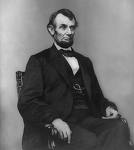
In Abraham Lincoln’s first inaugural address, with the country on the brink of Civil War, he said: “We are not enemies, but friends. We must not be enemies. Though passion may have strained it must not break our bonds of affection. The mystic chords of memory, stretching from every battlefield and patriot grave to every living heart and hearthstone all over this broad land, will yet swell the chorus of the Union, when again touched, as surely they will be, by the better angels of our nature.”

The party of Lincoln today should be ashamed of itself, and quickly recover the better angels of their nature.  This country needs a responsible opposition party and soon.

Unknown's avatar

>“A Word To The Calvinists”
 by Anne Brontë

>

You may rejoice to think yourselves secure,

You may be grateful for the gift divine,

That grace unsought which made your black hearts pure
And fits your earthborn souls in Heaven to shine.
But is it sweet to look around and view

Thousands excluded from that happiness,

Which they deserve at least as much as you,

Their faults not greater nor their virtues less?
And wherefore should you love your God the more

Because to you alone his smiles are given,

Because He chose to pass the many o’er
And only bring the favoured few to Heaven?
And wherefore should your hearts more grateful prove
Because for all the Saviour did not die?
Is yours the God of justice and of love

And are your bosoms warm with charity?
Say does your heart expand to all mankind

And would you ever to your neighbour do,
–
The weak, the strong, the enlightened and the blind -­

As you would have your neighbour do to you?
And, when you, looking on your fellow men
Behold them doomed to endless misery,

How can you talk of joy and rapture then?

May God withhold such cruel joy from me!
That none deserve eternal bliss I know:
Unmerited the grace in mercy given,

But none shall sink to everlasting woe

That have not well deserved the wrath of Heaven.
And, O! there lives within my heart

A hope long nursed by me,

(And should its cheering ray depart

How dark my soul would be)
That as in Adam all have died

In Christ shall all men live

And ever round his throne abide

Eternal praise to give;
That even the wicked shall at last

Be fitted for the skies

And when their dreadful doom is past

To life and light arise.
I ask not how remote the day

Nor what the sinner’s woe

Before their dross is purged away,
Enough for me to know
That when the cup of wrath is drained,
The metal purified,

They’ll cling to what they once disdained,

And live by Him that died.

(On this Five Hundredth anniversary of John Calvin’s birth, many of us who proudly claim his tradition would want to repudiate the doctrines of double predestination and limited atonement so closely linked to his legacy.  Here Anne Brontë, the parson’s daughter, graciously does so in verse.)

Unknown's avatar

Where I Ruminate on the Trinity


The Trinity is not a secondary way of talking about the Christian God within the framework of monotheism, but is in fact the very identity of the Christian God. Robert Jenson even argues “that the phrase ‘Father, Son, and Holy Spirit’ is a proper name for the God whom Christians know in and through Jesus Christ,” and I think that is right.

So in my view monotheism is not a very good starting point to think about the Christian God, although it has often been done. The Western theological tradition has often fallen into a residual Monarchianism, “a tendency to resolve a doctrine of the Trinity in the implicitly unitarian direction of a single and inscrutable divine sovereignty.” (The quote is from John E. Colwell’s Promise and Presence referring to his teacher Colin Gunton’s book The One, The Three, and The Many. And Gunton was a student of Jensen, so there is an intellectual lineage at work here).

The Trinity, in my view, is an inference from the Trinitarian shape of the Gospel narratives, and therefore (although never named as such in scripture) the most biblical of doctrines, even if it took centuries to develop. My friend Willis Elliot, in an e-mail to me about the development of the doctrine of the Trinity, affirms that even the process itself is Spirit-guided:

“From first-stage subordinationism to final stage trinitarianism is a long stretch, too long for Arius and most Christians until after Nicea AD325CE, the council at which Athanasius’ Greek-language Bridge to the Trinity won the day and persuaded Constantine to decide against Arius. It would have been a bridge too far for Augustine’s Latin unaided by the Latinization of Athanasian metaphysics: like Hebrew and Aramaic, Latin did not have the capacity to receive and convey the orthodox Christian doctrine of God. God’s choice of Greek as the founding vehicle of the Christian mind was itself revelational.”

But why a Trinity? Well, if God is God then obviously every form of dualism must be rejected. But God is also love, and love requires some manner of plurality within the divine unity. The Gospel story is a love story among the persons, a love spilling out beyond itself for us. Perhaps this is best apprehended in liturgy, where we pray “to the Father, through the Son, in the Spirit.”

“We pray our prayers to the Father ‘through Jesus Christ our Lord,’ because it is through his Son made man as Jesus of Nazareth that God has shown himself to us. In the words and deeds, in the life, death and resurrection of Jesus we know what God’s attitude towards us is and that he is prepared to reclaim and remake us for himself. That is why Christians worship God not as a remote and distant mystery shrouded in the glory of his deity, but as the one who in his love has come to us, lived among us, died for us and triumphed over our enemies.”(The Forgotten Trinity, p. 5-6)

So the Gospel story is not merely the story of Jesus, but rather the story of Jesus’ relatedness to the Father through the Spirit, and the Father’s relatedness to the Son through the same Spirit. As Colwell puts it:

“The words and actions of the Son are the words and actions of the Father mediated by the Spirit. There is no action within the narrative that is not an action of the undivided Trinity. There is no action within the narrative that is not an action mediated by the Spirit. The Father’s love and calling to the Son is mediated by the Spirit at Jesus’ baptism. The ministry of Jesus is a demonstration of the Father’s kingdom in the power of the Spirit. The sacrifice of the Son is mediated to the Father by the Spirit. The Father’s raising of the son from the dead is mediated by the Spirit. At every point the Spirit is the agent of mediation between Father and Son.” (Colwell, p. 37)

This peculiar way we Christian’s have of thinking about and speaking about God is yet another “scandal of particularity.” Which is why interfaith dialogue (which I’m all for) that uses monotheistic commonalities as the starting point typically sells out Christianity’s particular understanding, and settles for a kind of a “theism plus Jesus.” But that view pervades our churches, too, so its not just outsiders who have trouble with the Trinity.

We teachers in the church share some blame for that. Nevertheless, the one God’s Triune self-relatedness is the true grammar of a Christian theology that would do justice to the Gospel narrative and give true definition to the language of grace. The Christian God really doesn’t make much sense without it.

Unknown's avatar

Rick’s Rich Ragu with Wild Mushrooms over Homemade Tagliatelle

>

This rich meat ragu is my nod to a traditional Bolognese sauce. The wild mushrooms add a wonderful earthiness to it. OK, so I’m showing off just a little here with the homemade pasta, but you really don’t have to serve this sauce over fresh pasta. It is equally delicious over dried pasta such as Rigitoni or Penne. But if you are going to work all day on the sauce, use good quality imported dried pasta like De Cecco.

But if you have the time, homemade pasta is a wonderful thing, and it’s not really hard to make, but, trust me on this, it does take time. When my children were little, and my wife, Martha, who is a nurse, had to work at night, I would muster my little force and the kids would “help” me make fresh pasta. It kept them busy for hours, and at the end of the process we had lovely Tagliatelle hanging from all kinds of drying racks and everybody (and the kitchen) was covered with flour, and Mom didn’t even have to see it.

I have made this pasta several ways: with just a rolling pin and a sharp chef’s knife, with the pasta extruder on my Kitchen-Aid mixer, and with a stainless steel hand-cranked pasta machine. I like the latter best myself. I bought mine at the First Church tag sale many years ago, and it has made a lot of pasta at the Floyd household.

So if you have the better part of a day to hang out in the kitchen this can be a great project on a cold day. Your simmering sauce will fill the house with lovely aromas. And the ragu itself isn’t very hard to put together, although it takes a certain vigilance over many hours. But the nice thing about it is that during that time you can make the pasta, and at the end of the day you will have a lovely comfort food dinner that will delight everyone at the table.

For the Ragu

4 tbs butter

2 tbs extra virgin olive oil
¼ lb. pancetta, finely chopped
1 medium yellow onion chopped fine
1 carrot chopped fine
1 celery stalk chopped fine
½ cup dry white wine
½ cup whole milk
1/8 tsp freshly ground nutmeg
1 28 oz can good whole Italian tomatoes with liquid
2 pounds lean ground beef
1 oz. dried wild Porcini mushrooms

Salt and pepper to taste<

The pancetta is hard to cut fine enough by hand, so I cut it into small chunks and finish it in the food processor with the onions, carrots, and celery, and that keeps it from sticking to the blade.

Cover the porcini mushrooms with hot water and let sit while you do the next stages.

Heat oil and butter in a large heavy-bottomed skillet or casserole, and when the butter foams add the pancetta, onion, carrot and celery and sauté over medium high heat until it takes on some color and is beginning to brown.

Turn the heat down to medium and add the beef. Cook, breaking up the pieces and stirring, until the pink goes out of the beef, but don’t brown it. Add the white wine, turn the heat back up a bit, and let all the wine evaporate, stirring now and again. Turn the heat back down to medium and add the milk and nutmeg, and cook until the milk evaporates, stirring from time to time.

Add the tomatoes, squeezing them between your fingers into the pan. Pour the mushrooms through a sieve lined with cheesecloth (or a coffee filter) into a bowl and retain the liquid. Chop the mushrooms coarsely and add to the pot along with their liquid.

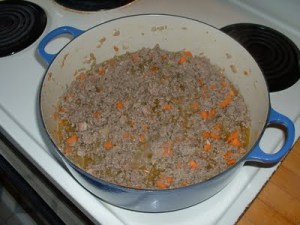
Bring it all to a very gentle simmer, partially cover, and literally put it on a back burner for as many hours as you can, stirring from time to time and watching your heat so it doesn’t start boiling. If you are gentle with this sauce it will reward you. How long? The one I made yesterday had at least six hours, but I would say at least three. It should reduce into a thick rich sauce. Taste and adjust for salt and pepper.

When you are ready to serve it, toss your pasta with just enough of the sauce to moisten it (it’s really rich) and serve bowls of sauce along with it so people can add more if they choose. Top each plate with freshly grated Parmegianno-Reggiano cheese and you’ve got a little bit of heaven on a plate. A salad and some crusty bread will round out this meal. For wine, a good Tuscan red or a Nebbiola-based wine will make you smile.

For the Tagliatelle

Do not be afraid to try this. The dough for this pasta has only two ingredients, flour and eggs. Some people are dogmatic about using pasta flour, but I just use King Arthur All-purpose Flour and extra-large eggs. For six servings I use three cups of flour and four eggs.

Put your flour on a clean counter or pastry board and make a well with it. Then break the eggs into the center of the well (see photo below) and with a fork beat them, while drawing small amounts of flour from the edge of the well. Don’t be impatient; you can do this! Just keep beating the eggs and drawing flour into them until you have a nice soft dough.

Put the dough aside and scrape off your board. Put flour on your hands and on the board and knead your dough for about 10 to 15 minutes. Add extra dough a little at a time until the dough is soft and pliable. When you stick a finger in the dough it shouldn’t be wet, but not too dry. You’ll know.
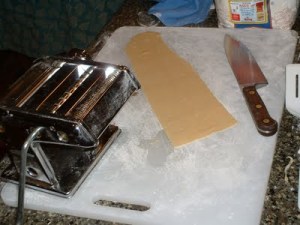
It is now ready for the pasta machine. The pasta machine has two parts, a set of rollers that rolls the dough, and the actual blades that cut the pasta into ribbons. Set the rollers on your machine for the widest width. Cut a piece about the size of a large egg, and put the rest under a towel so it won’t dry out. Run the piece through the rollers 6 or 8 times until the dough is smooth and isn’t sticky. Adjust the roller to the next smallest setting and repeat the process. Keep adjusting the rollers smaller until you get the dough to about 1/16 of an inch, then put it through the cutting blades and make your ribbons of Tagliatelle. You can put the pasta on a rack, or nest it into a small bundle (see photo below). Then start again with another piece and follow the above procedures until you have made pasta from all the dough. This takes some time, but is strangely calming.

When you are ready to cook the pasta, bring a good-sized pot of water to a boil and cook pasta for only about three minutes, then sauce with the ragu. Yum. This is why my kids call me the “Pasta Emeritus!” Enjoy.

(Photos: R.L. Floyd)

Unknown's avatar

Ruminations on Baptism

I am not a Baptist, but I struggled with infant baptism early in my ministry, partly because of Karl Barth’s influence, and partly because of my pain at the casual way it was often regarded in the culture Protestantism of much of New England Congregationalism, where I labored.

But it was the form used by my tradition and so I followed it. Over the years of pastoring I came to embrace it and love it. Nevertheless, I exercised a kind of tough-love discipline around it, requiring parents or sponsors to have a real church connection, and for this, let me say candidly, I sometimes experienced a different kind of pain (as Paul said, “I bear on my body the marks of Christ.”) I firmly believe there must be faith for there to be a baptism, whether it is the faith of the baptized (as in believer baptism) or the faith of the parents or sponsors. But try to explain to your loyal congregant grandparents that you won’t baptize their grandchild because the parents want nothing to do with the church or its faith, when all they want is a nice “Christening” with a party to follow.
I found the Baptism, Eucharist and Ministry (BEM) document from the World Council of Churches to be very useful in thinking about baptism. It speaks directly to variations of form and usage around baptism and tries to find ecumenical consensus where it exists, for example on the prohibition against re-baptism, and to raise issues for conversation where consensus does not.
And some of you will not be surprised to learn that I also have found P. T. Forsyth’s writings on Baptism, chiefly in his book, The Church and Sacraments, to be very useful in my ministry over the years.
Forsyth suggests that both forms (believer and infant) have their inherent emphasis and along with them certain temptations. In the case of believer baptism a temptation is to think it is about me, my faith, my experience, and in infant baptism, the temptation is to a kind of magic. He asks rhetorically,

“Would Christianity really be reformed if it abolished infant baptism? Can that now be hoped for? Is that the only way to keep the magic out? Would it not be burning the house to roast the pig? Would it not reduce the church to the permanent condition of a missionary Church only, amid a quite pagan society?”

For Forsyth, who proposes that both forms be offered and recognized, “What makes baptism real is God’s changeless will of salvation in Christ and the Church. It testifies chiefly to this, and not to a subjective attainment of confession, which might change. Sacraments are modes of the Gospel (not of our experience), and that is what the Gospel reveals.”
Writing about infant baptism he says,

“Baptism is incorporation, not into Christ, but into the body of Christ, with its moral, spiritual, social influence on the soul. The child is not given the Spirit, but placed where the Spirit moves. It must make much difference to a young soul whether it is taught to believe it is a member of Christ’s body, and takes its disciplines as a child of the house, or whether it is taught to regard itself as an outsider, spectator, and by-product of the Church’s grace.”

Now that I am a pew-sitter and not a celebrant I have witnessed several baptisms in a variety of churches and forms and I am moved each time by the power of this gracious sacrament, however it is administered.


Unknown's avatar

Chesterton on Religion and Science


In today’s ongoing culture war between the advocates of various forms of creationism and various forms of scientism, we could well ask if each side represents the best in both religion and science?

The great British writer, polymath and wit G. K. Chesterton wondered just that during the infamous Scopes Trial over the teaching of evolution in 1925 in Dayton, Tennessee.


He wrote:

“But there is another aspect of the case, which illustrates the real truth in the rather rustic Puritanism of the people who made a fuss about Darwinism in Dayton. To some of us it seems strange that such very antiquated Protestantism should be supposed to represent religion. It seems stranger that such very antiquated Darwinism should be supposed to represent science. But as a matter of fact the protest and prosecution on that occasion did represent something. It stood for a strong popular instinct, not without justification, that science is being made to mean more than science ever really says. An evolutionary education is something very different from an education about evolution. Just as a religious school openly and avowedly gives a religious atmosphere, as a scientific class does sometimes covertly or unconsciously give a materialistic atmosphere. A secularist teacher has just as much difficulty as a priest would have, in not giving his own answer to the questions that are most worth answering. He also is a little annoyed at not being allowed to put the first things first. He tends more and more to turn his science into a philosophy.” (The Religious Aim of Education)

I wish he had used “priggishness” instead of Puritanism (as Marilynne Robinson has suggested) lest he perpetuate the commonly received fallacies about our noble forebears. Nonetheless, he was spot on that it is often neither religion’s nor science’s best representatives who enter these fractious debates.

It seems to me that both fundamentalist religion and the more extreme forms of scientism share a certain lack of humility in the face of mysteries that lie beyond human knowing. The need for certainty and control makes strange bedfellows of these seeming antagonists. And how ironic that they deny to the other the same kind of certainties that they hold for their own views.

I am reminded of Hamlet’s words to his friend on the ramparts: “There are more things in heaven and earth, Horatio, than are dreamt of in your philosophy.”

Unknown's avatar

“The Lord Will Provide:” A Sermon on Genesis 22

Abraham is the one who received the promise from God. God’s promise is that Abraham will have his own land and have many descendants, and through his descendants all the peoples of the world will be blessed. This is not only a big promise, but also an astonishing one, given that Abraham is a landless nomad and a childless old man, and his wife Sarah is barren.

Nevertheless, Abraham believes God’s word of promise and the promise is kept. Sarah becomes pregnant and bears a son, whom they name Isaac, which means laughter, for Sarah laughs when God tells her she will have a son. Young Isaac is now the bearer of the promise, but in today’s story the promise is threatened.

As with many biblical stories, we know more than the characters do. We know that God is testing Abraham, but Abraham doesn’t know this. God commands him to take his son, his only son whom he loves, to the land of Moriah to sacrifice him. The form of the command from God echoes the original promise to Abraham. So the God who made the promise seems to be putting the promise in jeopardy. Abraham hears God’s command. He has already lost his first-born son, Ishmael, whom he sent away into the desert with his mother Hagar, so the loss of Isaac will be the end of Abraham’s family, as well as the end of the promise.

Israel would have heard this story as their own story, for in their story the promise is always threatened. And the threat to the promise is the threat to their continued existence. Yet Israel would also have heard it as the story of how, though the promise is always in jeopardy, somehow God “sees” that the promise is kept, that the story continues.

So Abraham does as God has commanded him. He prepares for the sacrifice, takes Isaac and heads out to the land of Moriah on a three-day’s journey. After three days Abraham looks up and sees the place from far away. Father and son climb the hill and Isaac asks Abraham, “Where is the lamb for a burnt offering?” Abraham answers “God himself will provide the lamb for a burnt offering, my son.”

God will provide. The word providence itself derives from this passage, and also from verse 14, after God has produced a ram. Then Abraham called the place, “The Lord will provide” or “The Lord has seen:” Jehova Jireh.

And God does provide. He produces a ram. Abraham passes the test. He is prepared to sacrifice his son, and with him Abraham’s own prospects as the carrier of the promise. But God doesn’t require the sacrifice of Isaac.

It is a disturbing story. It raises any number of troubling questions, and from the beginning interpreters have tried to figure out its implications, from the ancient rabbis to Soren Kierkegaard’s Fear and Trembling. In our own time a psycholoanalyst has suggested that the story is a story of child abuse, and has burdened our religious heritage with a climate in which abuse is tolerated (see Alice Miller, The Untouched Key: Tracing Childhood Trauma in Creativity and Destructiveness (New York: Doubleday, 1990, p 139). A tradition can be misused, of course, but let us leave the psychological and philosophical interpretations aside today and look at this story within the larger Biblical story of the promise.

In its own context within Genesis this episode is the climax of the larger story of the promise. It is a story about human faith, but above all, about divine providence, about the way God keeps his promise from generation to generation in the lives of these ordinary people.

Notice how few details we are told about God. In this story there is no burning bush, no ladder to heaven, just the simple command of God. Does Abraham see God? Does the command come in a dream, in a voice, in a cloud? We don’t know. Although God is the chief actor in the drama of promise and fulfillment, he remains in the background, speaking from mystery, his intentions not fully known.

In comparing this story with the Odyssey of Homer, literary critic Eric Auerbach notices that, unlike the Greek god Zeus, who is comprehensible in his presence, the God of the Bible is not; “It is always ‘something of him’ that appears, he always extends into depths.” The Greek narratives with their gods take place in the foreground, while the biblical narrative with its God remains mysterious and is ‘fraught with background.’ Here in Genesis we are not told everything as Homer would tell us, we are only what we need to know. Homer’s poem is almost photographic in its detail, but here we have few details. We don’t know what Abraham was thinking, what Isaac looked like, what kind of day it was. We are not told of inner states of mind. The narrative is spare. And it is not Abraham’s character, courage or pride that is decisive for the story, but his previous history, as the one to whom God has made the promise. (Eric Auerbach, Mimesis, p 12)

The story keeps us off balance. Its outcome is not predictable. And the spareness of the biblical narrative means we have to look for clues to discern what is going on. One of the clues here is the idea of seeing. Throughout the Genesis story there is the motif of seeing, the human characters seeing, and God seeing. For example when Hagar is told by an angel of the Lord that she will give birth to Ishmael. She says, “Have I really seen God and remained alive after seeing him?”

The human characters see, but only now and then, little bit by bit. Seeing is never complete. They see, to use Paul’s phrase “through a glass darkly.” The characters see only part of the way. But seeing seems to be essential for faith. The characters need to see, at least in part, what God is up to. They need to see how the promise is fulfilled. They won’t see completely, they must act in faith, and perhaps it is faith that lets them see as much as they do.

So Abraham travels for three days and looks up and sees the place for the sacrifice. And when he is about to sacrifice Isaac he looks up and sees the ram. Was the ram already there? Had God prepared for the sacrifice in advance? Could Abraham only see the ram when he trusted the Lord and met the test? We don’t know.

In any case “God says, ‘Do not lay your hand on the boy or do anything to him; for now I know that you fear God, since you have not withheld your son, your only son from me.’ And Abraham looked up and saw a ram, caught in a thicket by the horns. Abraham went and took the ram, and offered it up as a burnt offering instead of his son. So Abraham called that place ‘The Lord will provide.’” The Hebrew means “The Lord will see.”

So God also sees! But this Hebrew verb “to see” is a “warm verb,” so God is not merely a passive seer, but an active doer in response to what he sees. Providence means not just that the Lord sees, but that he “sees to it.” In the Latin, “to see:” Pro video. God will see to it!

So Question 27 of The Heidelberg Catechism:

“What does thou understand by the providence of God? Answer: The almighty and present power of God by which he still upholds and therefore rules as with His hand heaven and earth and every creature, and that leaves and grass, rain and drought, fruitful and unfruitful years, food and drink, health and sickness, riches and poverty and all other things do not come by accident but from his fatherly hand.”

The Lord will provide. He both sees and “sees to it.” Divine providence has often been understood as foreseeing, but that is only half of it. So Karl Barth writes:

“. . . The God who so wonderfully foresees and provides is not a mere supreme being but the God who, in this happening in which Abraham was to spare his son, acted as the Lord of the covenant of grace that Abraham was promised and given his successor Isaac, that he had then (as a prophecy of the One who was to come) to separate and bring him as an offering to God, but that he had not to die but to live as a type of the One who was to come and give life through His real death, a substitute being found for him in the form of a ram.” (Karl Barth, CD 3.3,35)

I am convinced that the earliest Christians were prepared to interpret the death of Jesus as an atoning, sacrificial act by God because they knew this story of Abraham and Isaac. As good Jews they trusted the identity of God as the One who both sees and “sees to it,” and so the crucifixion and resurrection were seen as the ultimate act of divine providence, doing for us what we could not and can not do for ourselves, saving us from sin and death.

A son climbs a holy hill with wood on his back for a sacrifice. They recognized that story! They knew it was a terrible story. But they were able to see in faith that God sees, and in Easter light, they saw with the clarity of 20/20 hindsight, that God did provide the sacrifice, that the promise was kept and the story continues.

(I preached this sermon at the Tabernacle at Craigville, Massachusetts, on Cape Cod, on June 27, 1999. It is also a chapter in my book When I Survey the Wondrous Cross: Reflections on the Atonement, Pickwick, 2000).

Unknown's avatar

In Defense of Blogging

Stefan McDaniel thinks blogging is a bad business. In his own recent blog piece, “Reverence for Words: A Case Against Blogging” (First Things on-line) he argues that the blogosphere is cheapening the value of words.

To make his case he employs Neil Postman’s classic diatribe against TV, Amusing Ourselves To Death, where Postman makes the McCluhanesque charge that what is wrong with TV isn’t that we need better programming (more Ken Burns and Sesame Street) but the medium of TV itself. I read the Postman book nearly twenty years ago and found its thesis persuasive. But I don’t think it is useful in the case of the blogosphere. It’s a different medium and has different issues and challenges.

McDaniel writes:

“Reading Postman for the first time last month gave me clearer language to explain my rage against the rise of blogging. For what he says about media can be said about literary forms—they are biased toward certain kinds of content. The blogpost is biased toward speed, brevity, and cleverness. It thus hands the public square over to bullies, sophists, and clowns.”

Now McDaniel has a point that the blogpost as a literary form is biased toward speed, brevity, and cleverness, but not all blogposts observe that bias. And if we acknowledge the blogpost as a literary form it is certainly an emerging one. We can no more imagine what it will become than Gutenberg could have imagined the novel.
So I don’t think the Postman thesis is an apt one for the blogosphere chiefly because watching TV is a passive activity whereas blogging is interactive. It is true that many blogs are trite and entertainment-driven, but many are not. I have found on numerous, mostly theological blogs, access to great literature from old friends and new ones.

For example, on Jason Goroncy’s substantial site, Per Crucem ad Lucem, he has posted the corpus of the seminal British theologian P.T. Forsyth. Twenty years ago I had to travel to Oxford to find some of the more obscure writings of this important figure. Now I can read him in my pajamas, and converse with clever, knowledgeable people around the world about him.

I would argue that blogging has opened up a vast new global public space for serious discourse. As an author and book reviewer my creations in the past reached a small audience. Some of those same works, now archived on my blog, get regular visits. I wrote a review of Scott Paeth’s book on Christology, Who Do You Say that I Am? for Joy in the Word, a small journal of the Confessing Christ movement in the United Church of Christ, whose distribution is limited to a smallish mailing list. By re-posting this, I have made the review available to a global audience of people interested in Christology, and some of them may find their way to that book. In the past this wouldn’t happen.

McDaniel acknowledges some of this. He writes,

“Some of my very astute pro-blog friends have argued that, whatever their drawbacks, blogs create a democratic public space whose occupants are minimally beholden to state and corporate interests. For the discerning reader, entering the blogosphere is just like listening in on a fascinating conversation among free, brilliant interlocutors. The incompleteness, electicism, and so on are characteristic of good conversation.”

But then he complains that the good blogs aren’t popular. But since when did
 popularity become the criterion for judging any literary form? Some good literature became popular (I’m thinking Dickens) but most popular literature isn’t good.

So what if a good blog isn’t popular? The blogosphere allows bloggers to find their audience, even if the audience is small. I don’t expect Retired Pastor Ruminates to ever rival the Huffington Post in popularity, but I enjoy interacting with people from all over the world who also enjoy P.T. Forsyth, Karl Barth, atonement theology, the Boston Red Sox, home cooking, poetry, and Single Malt Scotch, to name but a few of my pre-oocupations.

And there is a freedom about blogging that is different than writing for print. For example, I have written articles and book reviews for journals, and there is a kind of self-censorship that goes into preparing something for, say Theology Today. You know they have a certain style and point of view, and you try to conform as much as possible to it. And after you submit your piece, it can be edited in ways over which you have no say. For example, a review I wrote of Richard Bauckham’s God Crucified for Theology Today was edited to remove all the masculine personal pronouns for deity, a practice neither Richard Bauckham nor I follow. I was able to put the review up on my blog the way I wrote it.

Now blogging may lack the discipline that McDaniel values in print, but it is free from the constraints that one is subject to in dealing with editors and publishers, which means fresh and new writings now have a place to flourish. This may threaten journals and publishers, but it may be a good thing for the world to have unfettered access to many points of view.

And in a strange way, blogging makes people focus more on words. Because the blogpost is a literary medium, people who blog spend time at keyboards and have to think abou the best way to express themselves with words. Unlike Postman’s catatonic TV watchers, bloggers minds are active as they think about what to blog and then use their creativity to produce the post. And there are many very creative blogs out there, engaging, interesting, funny, and informative, and there are more and more all the time.

And, finally, let me offer a personal confession of how important blogging has become for me. I am a retired pastor with a disability that prohibits me from working anymore. I was an active pastor for thirty years and for the last five I have been missing my work and the creative outlets it provided. Blogging lets me express my thoughts and ideas, and I have come to view it as a ministry. I have had commenters e-mail me to thank me for what I have written. And though the audience is small, it is world-wide.

So I defend blogging. I think some of McDaniel’s concerns are legitimate, but at the end of the day I don’t believe the blogpost is either good or evil, but neutral, and it is the way it is used that will be decisive. Like every other human enterprise it is subject to the pull of temptation and sin. It remains to be seen just how it will be used. Therefore, it is hasty to condemn this new literary form and the communication technology that makes it possible. Gutenberg was so condemned in his day. But the wheat and the tares grow together, and on the Day they will be sorted out.

So let a thousand blogs bloom and flourish!