Unknown's avatar

Should the church ever hitch its wagon to one political party?

My post on Monday, “Pastors aren’t Prophets: Some Unsolicited Advice for Newly-Minted Ministers,” got some good discussion going, both on my site, and particularly on Jason Goroncy’s always lively blog site “Per Crucem Ad Lucem.”  I also received quite a lot of e-mails about it.

But there were concerns.  One concern about my post was that I was arguing on behalf of a Constantinian church in a post-Constantianian age. That may be partly right.  I am not one of those people who think the Constantinian church was an unmitigated evil (stand in Chartres Cathedral sometime and think about it), but I do concede that it is now gone in many places, and fading fast in most others.  So we do need new models, and the emerging church, while interesting, isn’t it.

When I left seminary (in 1975) I served one congregation (I had two) that was the only religious institution of any kind in this little town of 400 souls.  It was, by necessity, a chapel to its community, and it felt a real mission to that community’s well-being and to every member in it of any persuasion or none.  When I went to the hospital I asked at the desk for the town census and not the church’s to make my visits, and was expected to.

I think that there is a lot of truth to the slogan “let the church be the church” and not to have the church running around doing errands for the society.  But Christians do live in societies, and in addition to being signs of the kingdom of God, albeit imperfect ones,  our congregations have responsibilities to them.   I don’t think it is our Lord’s intention that we let them fall apart around our ears.

At the same time I think the idea of a Christian nation, popular here in America in some quarters, is a really bad idea.  In fact, it scares me to death, because I am not sure that their definition of “Christian” would include me or most of the church people I know. And I have lived in Europe for long enough to know that state churches are a millstone around the neck of the Gospel.

Most small town and village congregations I know have an authentic Christian ministry within their communities, and I want to affirm that.  I have been as critical of “Culture Protestantism” as anyone, but ecclesiology, like most of life, is complicated.  The hill-town churches haven’t got the memo yet that the  Constantianian era is over, and most of them are not reading Stanley Hauerwas and John Milbank.

Another second critical concern about my post was that I was saying that the church should not be prophetic, which would shock those who have known me for any length of time.  What I was warning about is the romantic idea of the pastor as the solo, heroic prophet. I was worrying that new ministers might think this is their primary role, and as I think I made clear, I don’t believe it is.  But that doesn’t mean that pastors have no prophetic role at all, or that the congregation doesn’t have one as well.

The prophetic role is part of Jesus Christ’s vocation, and by extension, the congregation’s.  The pastor’s role is to equip the saints for their ministry, which includes the prophetic one.  And any faithful preacher who is breaking open the Word of God from Scripture each Sunday is inevitably inviting many questions that have profound political implications.

But you must realize that the context out of which I am writing is a politically polarized America where both parties tend to claim that God is on their side. And so, most conservative Christians are Republicans, and most mainline Christians are Democrats.

I think this is bad for the church.  My ideal congregation contains steadfast ideological foes who disagree on hot-button issues, but, because they are baptized and must walk to the table together to share the bread and cup, have to deal with each’s other’s humanity as well as their own on a regular basis.  And maybe deal as well with their own spiritual blindness and sin.

But that isn’t happening very much, at least not here.  More likely we gather up the like-minded who then congratulate ourselves for not being like those other benighted Christians.   And the continuing trend of denominations to find ideological niches as their primary identity is a scandal.  Our primary identity is found in Jesus Christ, and only there.

I notice that more and more websites of congregations in my own denomination have dropped the first sentence of our preamble, “Jesus Christ is the sole head of the church,” for  the more  user-friendly “Everybody is welcome here.”  I like the fact that everybody is welcome in our churches,  and can think of no other way to be the church.  But that is a fruit and not a root.  The root is that “Jesus Christ is the sole head of the church,” which is why everybody is welcome here.

A church that defines its identity by fruits and not by roots is cutting itself off at the source and will eventually wither and die. Or else survive as a kind of social club.  So I worry that our marketing strategies just might kill us as a church.

I got ruminating about this, and went back and found a paper I wrote in 1989 on the Ecclesiology of P.T. Forsyth, who has shaped me profoundly.  His church was almost completely aligned with one party, and he warned them about it.

I found the following nugget, which if nothing else, confirms my opinion that, as the French say, “the more things change the more they stay the same,” although they say it in French so it sounds better.

Take careful notice of the last sentence at the end of the page. I wrote:

“What is the relationship between a church whose source and goal is redemption and the society in which it finds itself?” Forsyth refuses to identify the church with any particular form of society. The church outlasted feudalism and Forsyth expects it to outlast democracy.  “Christianity is not bound up with any particular scheme, dream, or programme of social order.  Its essence is redemption as forgiveness or eternal life, and the Kingdom of God as flowing from these.  And the eternal life can be led under almost any form of government.”  (Forsyth, Socialism, the Church, and the Poor,  p. 6)

 Forsyth is not in favor of the church identifying itself as church with a particular political party or ideology, although individual Christians can and should be involved in political life.  But when Christianity gets involved with ideologies it is not as a passive recipient or an uncritical cheerleader, but as that which has its own charter and goal, its own life and energy given by God in the act of redemption in the cross of Jesus Christ.  Forsyth writes,

‘Discuss Socialism by all means on its economic side.  Let Christian people descend from their impatient idealism, and harness their resentful pity to discuss the economics of the position more and more.  But do not forget that Christianity has the right of moral criticism on every scheme of economics or fraternity, because it represents the greatest moral, fraternal, and international force that has entered history as yet.  Fraternity means the unity of the race, and the race is one only in God, and in His Christ.  The Church is not committed to any theories or classes of Society which do not rest on that.  And it is not to be sneered at if it refuses to place itself wholly on one side or the other of a mere economic, social, or political question and stake its Lord’s fortunes there.  It is bad for a Church, and it might be fatal, to be only on one side in a civil war . Forsyth, “Socialism, the Church, and the Poor,” p. 33.

 ( Excerpt from Richard L. Floyd.  The Cross and the Church: The Soteriology and Ecclesiology of P. T. Forsyth. Andover Newton Review, Volume 3, Number 1,1992.)

(Photo:  A Bridge to Cross, Windham, Maine)

Unknown's avatar

Crash helmets and life jackets in church? So suggests Annie Dillard

A week ago I posted one of my favorite quotes from Annie Dillard.  My friend and former Baptist colleague (former colleague, not former Baptist) Ashley Smith commented (on my Facebook Page): “Dillard is one of my favorites as well; I’ve read Holy the Firm over and over, and used these quotes more than once in preaching and writing.”

I wrote her back: “Ashley, her (Dillard’s) words maintain their freshness, don’t they? The other perennial quote from her, which I can’t seem to find, is about how people should be wearing crash helmets during church services because of the danger of the holy.”

And she found it.  Thanks Ashley!

It’s from the essay “An Expedition to the Pole” in Dillard’s volume Teaching a Stone to Talk:

“On the whole, I do not find Christians, outside of the catacombs, sufficiently sensible of conditions. Does anyone have the foggiest idea what sort of power we so blithely invoke? Or, as I suspect, does no one believe a word of it? The churches are children playing on the floor with their chemistry sets, mixing up a batch of TNT to kill a Sunday morning. It is madness to wear ladies’ straw hats and velvet hats to church; we should all be wearing crash helmets. Ushers should issue life preservers and signal flares; they should lash us to our pews. For the sleeping god may wake someday and take offense, or the waking god may draw us out to where we can never return.”  (Annie Dillard, Teaching a Stone to Talk. Harper and Row, 1982)

Unknown's avatar

A Cloud of Witnesses: Ruminations on All Saints’ Day

Some thoughts for All Saints Day: How might we picture the presence of the communion of saints with us? “We are surrounded by so great a cloud of witnesses . . .” says the writer of Hebrews. The image is drawn from the stadium where the athletic games were held. The cloud of witnesses is the huge throng of spectators cheering on the competitors, who are admonished to “lay aside every weight and the sin that clings so closely” just as a bicycle racer will try to have the lightest materials possible. This one is a foot race, though, and here Jesus is pictured as the lead runner, the pacesetter, “the pioneer and perfecter of our faith.”

“We are surrounded by so great a cloud of witnesses. . .” In 1980, when I was a number of years younger and many pounds lighter, I ran in my one and only marathon road race, the Paul Bunyan Marathon in Bangor, Maine. This 26-mile race began at the Paul Bunyan statue in Bangor and meandered through adjoining towns until it ended on the oval of the football stadium at the University of Maine in Orono. I will never forget the ending of that race.

You have heard about the “loneliness of the long distance runner.” There’s truth in that phrase, for even when you are physically prepared for these long races there is a mental and emotional side that is quite daunting. The first half of my race was fun and at about mile ten or twelve I was euphoric, but around mile twenty I began to run out of gas and I had to struggle to keep on running. A solitary debate began in my mind: “Can I finish?” “Should I quit?” “Will this cramp go away, this ache subside, this tiredness abate?” By the time I hit that oval track in the stadium at Orono I was just glad to be finishing. And then a strange thing happened. I was pulled out of my reverie by the sound of cheering, and, since I knew that my wife and her parents were the only ones present at the race who knew me, I wondered who the cheering was for. I looked ahead and saw that there was no one else on the track. What’s more, many of the cheers were naming me by name, “Way to go, Rick!” “You can do it, Rick!” which puzzled me still more.

What it was, of course, was the cheering of the other runners who had finished ahead of me. With my race time of three hours and forty–seven minutes there were scores of other runners ahead of me and there were many other spectators and they all had a program sheet with the names and numbers of the runners and I had my number pinned to my shirt. Those cheers were wonderful for my morale, and I straightened my shoulders a bit and quickened my step and put on a little burst of speed for that last lap.

I carry that image in my mind as the very image that the writer of Hebrews wants to evoke here. The communion of saints are the ones who have finished the race before us. They are in the stadium seats watching us, they have finished the course, and now “from their labors rest.” We in the church militant are engaged in the same task as they were and they cheer us on, encourage us, support us, and call us by name. They are the great cloud of witnesses.

The word “witness” has a nice double meaning. It can mean merely spectators, which carries through the athletic metaphor of the passage. But witnesses here are more than passive spectators. They are those who bear witness to the truth they have known. Keep in mind that the Greek word we have translated as “witness” is martyr. During the early generations of the church so many witnesses sacrificed their lives for their faith that in time the word “martyr” took on that additional meaning.

So these witness who surround us are not idle spectators. Do any of you remember the comedian Flip Wilson of “The Church of What’s Happening Now!”? He once said, “I’m a Jehovah’s Bystander. They asked me to be a Witness, but I didn’t want to get involved.” So the cloud of witnesses not only supports us by their presence, they bear witness to the truth of God they have known

This is an excerpt from my sermon “Mystic Sweet Communion.”

Unknown's avatar

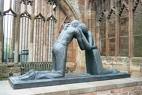
Ambassadors of Reconciliation

The theme for today’s meeting is reconciliation. It’s a big word for Christians, for it lies at the very heart of our identity. From the beginning the biblical story makes it clear that we humans are at enmity with God and with each other. The harmony of a God–given paradise quickly gives way to disobedience and death. Adam and Eve soon separate from God and their offspring soon have blood on their hands.

And still the mark of Cain can be seen in the human family, as Tsutsi’s and Hutus, Irish Protestants and Catholics, Muslims and Hindus, Arabs and Jews, Bosnians and Serbs murder each other each day. In our own land great rifts remain between blacks and whites, hostility to aliens grows daily and guns seem to be the problem–solving method of choice for many.

We are increasingly a tribal culture: each of us preferring the enclaves of those who share our ideas, our class, our skin color, our ethnic heritage, our prejudices. In the business community, downsizing produces a culture of survivors, a bunker mentality that fractures community, creativity and innovation. In politics the infighting and rhetoric of abuse so dominates that the final victor is unable to govern effectively. Even in the church we are a fractured people, separated by walls of our own making, walls of race and sex, of creed and ideology. We meet in our small caucuses and interests groups and label those unlike ourselves, building ever higher and more complex walls to keep us apart from each other.

The biblical word for all this is sin, which means separation from God and one another. It would seem that from a human point of view there is no reconciliation. Yet it is into this broken and estranged world that the Word of God breaks forth with the message of reconciliation. “Hear the good news!” God declares. “While we were yet sinners Christ died for us!” What we cannot do for ourselves God has done for us.

The Christian story is a story of reconciliation and its very center is the cross of Christ, where God’s reconciling work is accomplished. In fact, the Greek word we translate as reconciliation also means atonement, at-one-ment, the bringing together of that which was separated. The biblical story is quite clear that the basic rift is between God and us and that our inhumanity to each other is a symptom rather than a cause. That rift is not something we can overcome by ourselves, but God could and did. On Calvary all the hatred and enmity of the world were nailed to the bloody cross with Jesus, and in that saving event Jesus represented us to God and represented God to us in a freely chosen act of obedience which is an atonement for the sins of the whole world. As John the Baptist said of Jesus at his baptism, “Behold the lamb of God who takes away the sins of the world.”

The Easter faith we profess is that God has come among us in Jesus Christ, and has died and been raised for us so that we may now live a new kind of life. “If anyone is in Christ,” Paul says, “there is a new creation: everything old has past away; see everything has become new! All this is from God, who reconciled us to himself through Christ, and has given us the ministry of reconciliation; that is, in Christ God was reconciling the world to himself. Not counting their trespasses against them, and entrusting the message of reconciliation to us. So we are ambassadors for Christ, since God is making his appeal through us; we entreat you on behalf of Christ, be reconciled to God. For our sake he made him to be sin who knew no sin, so that in him we might become the righteousness of God.”

This reconciliation was no abstraction for the church in the first century. A church comprised of Jews and Gentiles struggled to be reconciled against the weight of hundreds of years of custom and tradition reinforced by numerous religious laws. The potential for division was enormous and we can see the working out of it throughout the New Testament where the issues get joined. Must Gentile converts to Christianity be circumcised? Do they have to observe the dietary laws of Judaism? We see the separation of rich and poor in 1st Corinthians, where the rich come and eat the supper for the communion before the poor can arrive.

Which is to say that it has never been easy to be the church, the community of reconciliation.. Reconciliation means hanging in there with those you would just as soon write off, but can’t because they belong to Christ as you belong to Christ and so they are your brothers and sisters in Christ. The church is to model for the rest of the world the reconciliation that God intends for the whole world. That is why it is such a scandal when the church itself is divided.

I believe our own United Church of Christ is in for a very difficult struggle for the next generation. We are no longer a homogeneous church but exhibit a dizzying variety of folks, many who come from other religious traditions. The United Church of Christ means many different things to different people. There are many issues in contention among us at this time, including such core questions as what theology is appropriate for our church and what language shall we use to express our faith in liturgy and hymnody. Feelings about these issues are very strong. There seems little room for compromise between the opponents. Who will be the winners and the losers? A friend of mine who is a historian at Harvard tells me that the German Reformed Church, one of the predecessor bodies in the United Church of Christ, endured fierce debate over their liturgy in the 19th century, but somehow they stayed together. Can we stay together in covenant?

From a human point of view, it seems doubtful. And yet, how can we be a voice and witness to reconciliation in our society, to schools and businesses, to our decaying cities and streets of wrath, to marriages and families in turmoil and children at risk if we cannot live among ourselves? How are we to be ambassadors of reconciliation if our own household is at enmity?

The challenge before us for the days ahead and for a long time to come is to be the church, to live in such a way that we are a living witness to the message of reconciliation that has been given to us. This means tolerating a fairly high level of conflict for a long time. It will test our faith. We will need the gifts that God’s Spirit sends to the faithful. It will require that we tell the truth in love. It will require soul–searching and the capacity to give and accept forgiveness. In other words, it will mean being the church, which was never easy and isn’t easy now.

Formerly we may have regarded some people as our enemies and opponents, and perhaps they are as the world sees it. But from now on we are to regard no one from a human point of view, because if we believe our own gospel then “by God” there is a new creation, the old has passed away, behold the new has come. So we entreat you, my brothers and sisters in Christ, by the power God gives you “be reconciled to God” and be the church, the community of the reconciled. And be the church as hard as that is and as long as it takes, which may be a long long time. Which is perhaps why, before Jesus left the disciples, he promised to be with us even to the end of the age. Amen.

(A sermon to the Berkshire Association, United Church of Christ, Annual Meeting on April 21, 1996, meeting at First Church of Christ (UCC) in Pittsfield, Massachusetts, where I was, at the time, the Pastor.)

Unknown's avatar

“Prepare Three Envelopes:” A Parable about Pastoral Ministry

In a certain city there lived a young pastor who was starting her first day at her first solo pastorate. She had met the staff, put all her books on the shelves, and was arranging her desk when a curious thing happened. She opened the desk drawer, and there were three sealed envelopes, numbered one, two, and three, encircled with a rubber band, and with a note attached.

She eagerly unfolded the note, and this is what it said: “Dear Successor. Welcome to the Old Church on the Green. When I arrived here many years ago I found three envelopes in my desk as you just have. They were from my predecessor and his note told me to open each of them in turn whenever I found myself in difficulty in the parish. This was very helpful to me, so I am providing you with three numbered envelopes to open when you need them. Blessings on your ministry. Your Predecessor.”

She didn’t know what to make of this, but soon forgot about the envelopes amidst the whirlwind of starting a new ministry, meeting new people, putting names with faces, in the general excitement and anxiety of the first months. And truth to tell, she had a joyful honeymoon period where she learned to love the congregation and they learned to love her, and everybody was very happy and content.

But in the fullness of time some discontents could be discerned among the faithful. Well-meaning advisors came to her to tell her things they had heard, not that they felt that way, but others did. None of the complaints were major, but they ate at her morale. Some said she had annoying mannerisms in the pulpit, that she was never in the office, that she didn’t do enough pastoral visitation, that she had been seen coming out of a yoga class during the daytime when honest hard-working people are at their jobs.

All these things got her down, and one day she spotted the forgotten envelopes in her desk drawer. She wondered if she should open the first one, and after some struggling and prayer about it, she did so. Inside was a single sheet of paper and on it were the words: “Blame your predecessor.”

She had once taken interim ministry training so she knew how to do this and immediately put the strategy into play. She told her boards and committee that congregations were really dysfunctional family systems and the dysfunction was caused by the former pastor. They all nodded their heads and agreed to be healthier, and they forgot all about their complaints against her, since it is always easier to judge someone that isn’t around. And once again everybody was happy and content.

There came a time, however, when new discontents emerged. The economy went South, pledges were down, fuel cost were up, the endowment which many worshipped had taken a hit, new members were slow to arrive to help pay the bills. She was no longer the new pastor, and there were hints and rumors that a different kind of a leader might fix the problems. She didn’t know what to do. She tried everything she could think of. She went to a centering prayer workshop, she got a Day-Timer, and she attended the Alban Institute conference called “When your Job Sucks.” But none of it seemed to help, so one day, after much struggle and prayer, she opened the second envelope. Once again it was a single sheet of paper and on it were the words: “Reorganize.”

So she convinced her board to create a long-term planning committee, write a new mission statement, and re-write the by-laws. And everybody got very busy, and worked hard together, and there wasn’t enough energy left to complain, and the church thrived for many seasons, and everybody in the congregation felt proud of themselves for having such a well-organized church and such a clever pastor. And, once again, everybody was happy and content.

By this time our pastor was frankly getting a little bored, and not a little burned-out, and wondered just how long she could put out the energy it was taking to keep such a well-organized church going. And her soul was disquited within her.

Once again she tried everything she could think of. She joined a pastor’s support group, she went on a Conference Committee on pastoral excellence, she bought herself a smart-phone and started a blog. But none of it seemed to help, so finally one day in desperation she went to her desk drawer and she opened the third envelope. Once again inside was a single sheet of paper and on it were the words: “Prepare three envelopes.”

Unknown's avatar

“Mystic Sweet Communion”

There are a lot of us here tonight: organists, choristers and choir members, family of the singers, parishioners, visitors. We make a grand congregation! But as impressive as we are, there is another important group involved with us in our worship that we shouldn’t overlook. The church from its beginning has pictured its life and mission, and especially its worship, as taking place in the unseen but very real presence of our ancestors in the faith. Our liturgies nod to it. We pray phrases such as “with the church on earth and the saints in heaven” or “ with angels and archangels and all the company of heaven.”

So how might we picture the presence of the communion of saints with us? “We are surrounded by so great a cloud of witnesses . . .” says the writer of Hebrews. The image is drawn from the stadium where the athletic games were held. The cloud of witnesses is the huge throng of spectators cheering on the competitors, who are admonished to “lay aside every weight and the sin that clings so closely” just as a bicycle racer will try to have the lightest materials possible. This one is a foot race, though, and here Jesus is pictured as the lead runner, the pacesetter, “the pioneer and perfecter of our faith.”

“We are surrounded by so great a cloud of witnesses. . .” In 1980, when I was a number of years younger and many pounds lighter, I ran in my one and only marathon road race, the Paul Bunyan Marathon in Bangor, Maine.This 26-mile race began at the Paul Bunyan statue in Bangor and meandered through adjoining towns until it ended on the oval of the football stadium at the University of Maine in Orono. I will never forget the ending of that race.

You have heard about the “loneliness of the long distance runner.” There’s truth in that phrase, for even when you are physically prepared for these long races there is a mental and emotional side that is quite daunting. The first half of my race was fun and at about mile ten or twelve I was euphoric, but around mile twenty I began to run out of gas and I had to struggle to keep on running. A solitary debate began in my mind:“Can I finish?” “Should I quit?” “Will this cramp go away, this ache subside, this tiredness abate?” By the time I hit that oval track in the stadium at Orono I was just glad to be finishing. And then a strange thing happened. I was pulled out of my reverie by the sound of cheering, and, since I knew that my wife and her parents were the only ones present at the race who knew me, I wondered who the cheering was for.I looked ahead and saw that there was no one else on the track. What’s more, many of the cheers were naming me by name, “Way to go, Rick!”“You can do it, Rick!” which puzzled me still more.

What it was, of course, was the cheering of the other runners who had finished ahead of me. With my race time of three hours and forty–seven minutes there were scores of other runners ahead of me and there were many other spectators and they all had a program sheet with the names and numbers of the runners and I had my number pinned to my shirt. Those cheers were wonderful for my morale, and I straightened my shoulders a bit and quickened my step and put on a little burst of speed for that last lap.

I carry that image in my mind as the very image that the writer of Hebrews wants to evoke here. The communion of saints are the ones who have finished the race before us. They are in the stadium seats watching us, they have finished the course, and now “from their labors rest.” We in the church militant are engaged in the same task as they were and they cheer us on, encourage us, support us, and call us by name. They are the great cloud of witnesses.

The word “witness” has a nice double meaning. It can mean merely spectators, which carries through the athletic metaphor of the passage. But witnesses here are more than passive spectators. They are those who bear witness to the truth they have known. Keep in mind that the Greek word we have translated as “witness” is martyr. During the early generations of the church so many witnesses sacrificed their lives for their faith that in time the word “martyr” took on that additional meaning.

So these witness who surround us are not idle spectators. Do any of you remember the comedian Flip Wilson of “The Church of What’s Happening Now!”? He once said, “I’m a Jehovah’s Bystander.They asked me to be a Witness, but I didn’t want to get involved.” So the cloud of witnesses not only supports us by their presence, they bear witness to the truth of God they have known.

This is such an important way to think about the church. In this century we have been learning to think of the church ecumenically; to consider the breadth of the church across denominational lines and national boundaries. But how quickly we forget the length of the church, its trans–temporal reality across the generations.That is where the role of tradition comes to play in the church, the place where the communion of saints gets their say. As Chesterton put it, “Tradition is only democracy extended through time.” Jaroslav Pelikan’s famous epigram rightly distinguishes between, tradition, “the living faith of the dead,” and “traditionalism, the dead faith of the living.” Too often, traditionalism has given tradition a bad name.

But a church that forgets what the saints have learned from generation to generation will hardly be equipped to be the church in its own generation.So the church rightly remembers the communion of saints, and even more than that, claims that in Christ, we share with them in the divine life.

Let me change the metaphor so that we might imagine the communion of saints as a choir;a large choir, like one of those Welsh men’s choirs made up of a thousand voices. When I was in high school our choir would go to county–wide and state–wide choral events with thousands of voices.Do they do that any more?

So let us imagine that as we sing tonight we sing together along with the voices of the great cloud of witnesses. Let us take quite seriously the claim of our various liturgies that when we sing we join our voices “with all the faithful in every time and place.”

There is a wonderful sermon by Jonathan Edwards on 1 Corinthians 13: 8-10, called Heaven is a World of Love in which Edwards explores the metaphor of the communion of saints as a heavenly choir. First he beautifully describes heaven and all its social arrangements, and in so doing puts forth a protest against the social arrangements that we know so well on earth, for in Edward’s heaven there is no pride or jealously, there is decency and wisdom, and an equal prosperity among all. He says that “love (poured out from God) resides and reigns in every heart there.” And then he says: “Every saint there is as a note in a concert of music which sweetly harmonizes with every other note, and all together employed wholly in praising God.”

Heaven is a world of love, and here below the church with all its imperfections witnesses by word and deed to the truth of that love. “We feebly struggle, they in glory shine.” So we are not alone. We carry out the mission and work of the church by sharing in the very life of God, and we are surrounded as well by so great a cloud of witnesses who cheer us on.

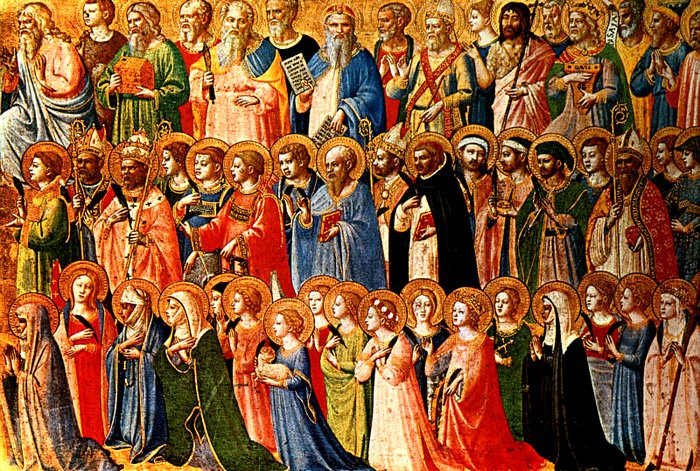
When I was a small boy I thought that God dwelled somewhere above the chancel of my local church, not exclusively, but especially there. And as I came to hear about the communion of saints I pictured them surrounding God, as one might see in medieval paintings, a big crowd of folks in white robes. Most of the people I had known in my short life were still living, so the crowd was for the most part an abstraction. My father’s parents, who had died before I was born were there, I was sure, and the little boy from my Sunday School class who had been run over by a car when his sled went into the road.Kim was his name.Kim was there, I knew.

The Puritans had a saying that, “The commonwealth of heaven becomes more dear with each loss below.” As I have grown older and have known many more people who have died I have returned to something very like that childhood picture I thought I had outgrown. I invite you to do so as well. In the eye of your imagination you will no doubt picture different saints than I picture. You will picture people you have known among the crowd of witnesses, a Sunday School teacher, a parent or a grandparent, a neighbor, perhaps even an organist or a minister. These were people who showed you what love is by loving, what service is by serving, what witness is by witnessing to what they had seen and known and believed. In our mind’s eye, too, there will need to be ones we have not known but have only known about. Those whose lives and art, whose words and deeds have cheered us on as we have run the race and tried to be the church. It is the great cloud of witnesses. It is the church, in heaven with all its glory, and on earth with all its brokenness and folly. It is like a great choir and its song goes on, on a grand night like this and wherever two or three gather in the Lord’s name. “Yet she on earth has union with God, the Three in One, and mystic sweet communion with those whose rest is won. O happy Ones and holy, Lord give us grace that we, like them the meek and lowly, on high may dwell with thee.”Amen.

(I delivered this sermon to the opening worship of the New England Regional Convention of the American Guild of Organists on June 22, 1997 at the First Church of Christ in Pittsfield, Massachusetts where I was then pastor.)