Unknown's avatar

“God With Us” A Sermon for the Fourth Sunday of Advent

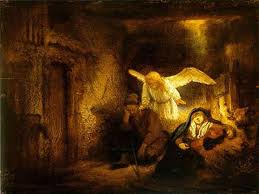
Joseph and the angelIn Luke’s gospel it is Mary who is front and center in the story of the nativity of Jesus, and in our minds I think that is where she stays.  But in Matthew we get more of a glimpse of Joseph.  Joseph is a shadowy figure in the pages of scripture; he is introduced in the genealogy as the “husband of Mary, of whom Jesus was born, who is called the Messiah.”  We see him in this story about Jesus’ birth and again briefly in the events of Jesus’ childhood, the circumcision at the temple, the flight to Egypt to escape Herod, and in a small story about Jesus as a twelve year old when he gets separated from his parents on a trip to Jerusalem and turns up at the temple, teaching the elders. Then Joseph disappears from the story, except for references to Jesus as the carpenter’s son.

But though Joseph seems to be what is called a supporting character, without him the drama of salvation could not have taken place, and I would submit that that is just the way God works, with supporting characters who appear for a little bit and do what needs to be done and then disappear from the story. But they are always a part of the story and the story wouldn’t be complete without them.

And it seems safe to say that without Joseph, Jesus could never have become who he became.  Joseph must have played an important forming and nurturing part in the life of Jesus.  There has been much speculation about Jesus’ upbringing in the carpenter shop in Nazareth.  The scriptures tell us nothing, but if Joseph lived until Jesus was at least twelve, as Matthew indicates, then Joseph becomes the primary male role model for the young Jesus.

One noted scholar speculates that Mary and Joseph were from the ranks of the humble and pious multitudes, the kind of people who loved God and maintained the law as best they could, but without the means to carry it out to the letter in all its intricacy.  If this is true it would go far in explaining Jesus’ attack on the Pharisaic understanding of religion and his quest for a new freedom to live for God.

In any case, in the story of Jesus’ birth Joseph is most remarkable in the way he responded to this crisis in his life. The young woman to whom he is betrothed is found to be pregnant. This is more than a matter of divorce, the law demands her life by stoning for adultery, for betrothal carried the weight of marriage in those days. So Joseph dismissing her quietly to avoid public disgrace was an act of integrity. But what is even more remarkable is that when he has this strange dream, in which an angel of the Lord appears to him and tells him not to be afraid to take Mary as his wife for the child conceived in her is from the Holy Spirit, he believes the angel and does what the angel said to do.

The angel said something else about this child: they are to name him Jesus, for he will save his people from their sins, and that all this fulfills what Isaiah had written: “Behold, a virgin shall conceive and bear a son, and he shall be called Emmanuel,” which means, “God is with us.”

Let me invite you to consider this Christmas the statement that God is with us.  Consider that God is with us not just in high moments of religious insight, in worship and in prayer, or some mystical moment when all seems clear, but rather in the ordinary events that befall us in this life.

One of the implications of the Christian doctrine of the Incarnation of God in Jesus Christ is that God is no longer remote, but is with us in ordinary life and that our story is inextricably wrapped up with God’s story. There is more to it than that to be sure; there is a cross as well as a cradle and we need Easter to interpret Christmas, and perhaps Pentecost to interpret them both for without the Holy Spirit it all becomes just a story from long ago that can touch the heart, but not change the life.

But God is with us now, because of Jesus Christ. We can see his human face and know that there is something of him in the other human faces we see. God is with us in our exalted moments of joy, when we get glimpses of the joy God wants for us.  Perhaps a sunset does it for you, or a sunrise (I’m told they are pretty.)  Or perhaps watching a child at play, or a fresh snowfall.

I saw a fine movie this week called “A River Runs Through It” in which fly-fishing becomes the entranceway into a realm of pure awe and wonder in the midst of some very tragic human life.  To know that our story and God’s story touch and intertwine can transfigure some pretty ordinary stuff into something special. Perhaps it is only as story that we understand our lives, which otherwise remain rather elusive.

In “A River Runs through It” the writer’s father, who is a minister, asks him a question that made Norman wonder if he understood his father at all “You like to tell true stories, don’t you? he asked, and I answered, “Yes, I like to tell stories that are true.”  Then he asked, “After you have finished your true stories some time, why don’t you make up a story and the people to go with it?  Only then will you understand what happened and why.  It is those we live with and love and should know that elude us.”

So it is that our own personal stories may only be understood in the light of this vaster story that begins at the moment of creation and will end in glory in God’s own good time and finds its center around two poor Palestinian peasants wondering what the birth of this child might mean.  That the angel promised that the child means “God is with us” must have addressed their perplexity as it can address ours.

For it means God is with us not just in those fleeting moments of joy, but in moments of confusion and despair, of faithlessness and doubt, the kind that comes to all of us at one time or another.  Emmanuel means God is with us as we try to get our minds around what happened on a Monday night in a neighboring community, as we struggle to understand the incomprehensible fact that an eighteen year old boy walked into a sporting goods store in our community and legally bought an assault rifle and used it to kill people.  The God of Good Friday who is also the God of Christmas was with us as Wayne Lo began killing people, and the first tear that was shed at Simon’s Rock was God’s tear, not only for the dead and wounded and their families but for a world which still makes such moments possible.

So “God with us” is not the stuff of Kodak commercial sentimentality; it means God really with us in all the grandeur and misery of human life, in Bosnia and India and Somalia and the homeless mean streets of our cities as well as by the Christmas tree in the warmth of our living room. The mystery of the Incarnation puts God right in the thick of it all.  For God did not stay remote, high above the heavens, but ventured into the precarious life of an infant born into a marginal family in a precarious political situation.  That should give us pause from turning the Christian religion into something ethereal and apart from human life.  As Frederick Buechner remarked wryly, “One of the blunders religious people are particularly fond of making is the attempt to be more spiritual than God.”

This Christmas I invite you to discover God in the everyday ebb and flow of your life, in the ones you love as well as the ones who drive you up a wall, in your moments of consternation as well as in your high moments of joy.  Take the time this Christmas to take it all in.  If you spend all your time in frenzied preparation, you may just not be paying attention, and miss the time of your visitation, and never learn, as Joseph did, what supporting role you are called to play in this great big story of which our story is valued as an important part by the God who, whatever else he may be, is most assuredly with us, through Jesus Christ our Lord. Amen.

I preached this sermon at First Church of Christ in Pittsfield, Congregational, twenty years ago this week, December 20, 1992, after a gun slaying at a school, in nearby Simon’s Rock College on December 14. I posted this after the Sandy Hook School slayings in Newtown, CT, which were on the 20th anniversary to the day. Lord have mercy.

Unknown's avatar

Christian Teachings about Life after Death: A Pastor Ruminates

stream 2I have been asked to speak about “Christian teachings about the after-life.” This is final installment in a series of helpful presentations on preparing for death. There have been presentations on wills and bequests, end of life care, grieving and the like. And once again Max (Stackhouse) has asked me to bat clean-up and talk about theology.

One of my friends in the church said to me last week, “Oh, your talk is theology, so it won’t be practical.” She was kidding, I think, but let me respond to her remark by suggesting that a theology about death and what comes after it may be the most practical aspect of all for the Christian preparing for death. It is a shame how theology has come to have a bad name, even in the church.

Because theology is not some specialty for professional theologians, but simply the way we talk about God. That is what theology means, the logos of the theos, the word about God. And everybody has a theology, at least implicitly, so the more we can make it examined and explicit the more chance we will get it better rather than worse.

So right off the bat let me suggest a better title for what I hope to do here. I much prefer the phrase “life after death” to the term “afterlife,” because I think the former rightly expresses the Christian belief in the reality of death, while the latter can obscure the boundary between death and whatever comes after it.

I want to explore with you four ideas or concepts: 1. The reality of death, 2. Immortality of the soul, 3. Resurrection of the body, and 4. Eternal Life. Finally, I want to summarize the features of an adequate Christian theology of life after death, and the promises of the Gospel that are our hope in the face of death.

1.The Reality of Death

The first concept to ponder is the reality of death.  Some of the earliest thinking about death in the Bible is about its not only ending one’s natural life, but also severing our relationship with God. For Israel human purpose was to praise God, and death put an end to it. This relational view was visualized in spatial terms, so that places like Sheol and “the Pit” were places far from God.

Christianity inherited this relational view of life with God, and sees death as its cessation and the opposite of the fullness of life that God intends for us. So unlike some other religions that view death as an illusion or an escape, for Christians, death is real, as are the sense of loss and grief that accompany death, which are also real and nothing to ashamed of or denied. I have said at countless funerals: “There is nothing unchristian about grief; Jesus himself cried at the grave of his friend Lazarus.”

Moreover, Jesus himself died, and his own death provides a template for thinking about this. The creeds say quite simply, “He died and was buried.”

So accepting the reality of death is an important first step in thinking about it properly as Christians. In my nearly forty years of ministry I sometimes counseled people who wanted to deny or blunt this reality. People often asked for much-loved sentimental poems to be read at the funeral. I would gently suggest something more appropriate, but I was pastorally sensitive enough to allow their selection to be read if they insisted, knowing that I would get up and say something quite contradictory in my homily.

Let me give you some examples of poems that deny or minimize the reality of death, and I apologize in advance if these are your favorites.

Here’s a line from A. L. Frinks’ the Rose Beyond the Wall:

“Shall claim of death cause us to grieve
And make our courage faint and fall?
Nay! Let us faith and hope receive–
The rose still grows beyond the wall,”

Another and even better known poem about death is James Whitcomb Riley’s Consolatio:

“I cannot say, and will not say
that he is dead. He is just away.
With a cheery smile, and a wave of the hand,
he has wandered into an unknown land.”

“We do not sorrow as those who have no hope” (1 Thess. 4:13), but we do sorrow. So while as Christians we have much more to say than death is real, it is where we must start, reminding ourselves that Jesus, in his human nature, really did die, as all human beings do.

To make this point I once began an Easter sermon years ago by saying that “On Good Friday Jesus was as dead as a doornail.” I wasn’t trying to be shocking, but I was surprised by how many people took offense to this statement.

I know something of death. Both my parents died too young, I have worked in a funeral home, been an EMT, and a minister for nearly four decades. I have been present at many deaths, and each time I have been struck by how clear the line is between the living and the dead. And yet everything I know about death is on this side of it, as it is for us all. But  one thing I do know about death: it is real.

So if the first theme is the reality of death, how shall we properly think and talk about what comes after?

2. Immortality of the Soul.

One very prevalent idea of life after death is immortality of the soul. I would like to explore this popular idea with you, and show you why it is an inadequate view for Christians, admitting that in my early years it was my own view.

Let me share something about that with you. My own theology of death and what comes after it was shaped, at least in part, by my childhood bedtime prayer, a somewhat terrifying one from the New England Primer:

“Now I lay me down to sleep,
I pray the Lord my soul to keep,
If I should die before I wake,
I pray the Lord my soul to take. Amen.”

I didn’t know it at the time, but in my child’s imagination I had adopted a somewhat Platonic dualism about the human person, separating body and soul into the perishable and imperishable.

My own children, at the insistence of my wife, had a more sanitized version of that prayer that didn’t get them pondering sudden death in the nighttime. Whether they are better off for this is open for discussion. But in my own early thought-processes I figured that if such a sad event as my childhood death did take place, it would only be my physical body, and this invisible spiritual thing “the soul” would go swiftly to God. This is the essence of the idea of immortality of the soul.

I was taken aback to be told that this view, while widely held, was not particularly Christian. I learned in seminary that the Hebrew word translated as “soul,” nephesh, more rightly means “self,” in other words, the whole person.  Harrell Beck, my wonderful Old Testament professor, liked to say that your fingernails are as much a part of your soul as any other part, which is to say human selves are embodied. Or as I like to think of it: we don’t have a body so much as we are a body.

It is from the Greeks, and especially from Plato, that we get the notion of a disembodied soul housed in a physical body, an idea that still clings to many Christian ideas about an afterlife.

These ideas were ambient in the ancient Near East and in the Hellenistic world in which the New Testament was written, and they lived in uneasy tension with the more holistic Hebraic views of personhood. We even get a whiff of Greek dualism in the New Testament, such as in First Corinthians, one of the undisputed letters of Paul. He writes in 1 Corinthians 5:1:

For we know that if the earthly tent we live in is destroyed, we have a building from God, a house not made with hands, eternal in the heavens.

So if the disembodied immortal soul flying away from the perishable body is not the Christian theology of life after death, how are we to think about it?

3. The Resurrection of the Dead

Resurrection of the dead is the cardinal Christian idea of life after death. It is rooted in the resurrection of Jesus, which pervades all New Testament thinking. In Jesus’ resurrection God has vindicated the humiliated and crucified Jesus, and begun the eschatological process of the salvation of humanity and the world, a process to be completed at the end of history, when Christ comes in glory to judge the living and the dead.

This distinguishes Christian theology from other views that see life after death as something intrinsic to the human person. Resurrection of the dead, on the other hand, is about the discontinuity between life and life after death. The rupture of death is overcome only from God’s side by God’s action. So resurrection of the dead is not resuscitation, but a new creation analogous to the first creation. It is not resurrection of the flesh, but resurrection of the body, a new kind of life that we can only guess at. When Paul  speculated on what kind of body we would have in the new life he employed the oxymoron “spiritual body” to refer to what form are we raised.

There are clues to this mystery in the post-resurrection appearances of Jesus. After Jesus is raised he appears to the disciples in bodily form; he is the same, but also transfigured in some way. The accounts contain mysteries: sometimes he is recognized, but other times he is not, as in the road to Emmaus story, when the disciples only know him when he breaks bread. Yet he still bears the marks of the Roman nails in his hands and feet.

However we want to take these narratives they point to the consistent conclusion that the new life postmortem is embodied life.  The Christian belief in the resurrection of the dead is a theological interpretation based on the death and raising of Jesus. The expectation of a resurrected body also emphasizes the continuity of personality and the integrity of personhood. I said that Christian views stress discontinuity between life and life after death, but here we see continuity of personality after death. So we have both discontinuity and continuity as the person really dies, but in the new life is the same person as before death, although changed. So it is not some spiritual part of you that lives the new kind of life; it is you, embodied and recognizable to God as you. This contrasts to various views of a disembodied postmortem existence, such as immortality of the soul and reincarnation.

It is important to remind ourselves that, while we are not surprised by the claim of Jesus’ resurrection and have difficulty with the idea of a general resurrection, for the people at the time of Jesus death it was just the opposite. A general resurrection vindicating Israel involving a Davidic messiah or the Son of Man was part of the general religious imagination. The resurrection of an individual however was not, which is why the raising of Jesus was understood as the beginning of the eschaton, the final reckoning, restoration and vindication of God and his faithful. We hear this in the language of Jesus being the first-fruits and the forerunner.

The raising of Jesus then is the primary theological template by which all things are measured, including death and life after death. Consistently in the New Testament death is viewed through the lens of the resurrection of Jesus Christ. In 75 places in the New Testament the principle Greek adjective that means “dead,” nekros, is the object of either egeiro “to awaken” or anastasis, “to raise.

This raising from the dead makes Christianity an Easter faith, and so the Christian sees death in Easter light. Because Jesus is raised we too will be raised with him. This is a far different idea than immortality of the soul. Let us take a few moments to contrast them.

The great scholar Oscar Cullmann wrote an important book in 1956 called Immortality of the Soul or Resurrection of the Dead in which he starkly contrasted these two views. Some of his critics have complained that he contrasted them too sharply. They may be right, but the book remains an important one for understanding the predominant Christian views.

Cullmann’s thesis is, and I quote, “The widely accepted idea of ‘The immortality of the soul’ is one of the greatest misunderstandings of Christianity. The concept of death and resurrection is anchored in the Christ-event, and hence is incompatible with the Greek belief in immortality.”

Cullmann deftly illustrates his point by looking at the death of Socrates in contrast to the death of Jesus. He writes:

The death of Socrates (as described by Plato) is a beautiful death. Nothing is seen here of death’s terror. Socrates cannot fear death, since indeed it sets us free from the body. Whoever fears death proves that he loves the world of the body, that he is thoroughly entangled in the world of sense. Death is the soul’s great friend. So he teaches; and so, in wonderful harmony with his teaching, he dies — this man who embodied the Greek world in its noblest form.

Cullmann then turns to the death of Jesus:

In Gethsemane He knows that death stands before Him, just as Socrates expected death on his last day. The Synoptic Evangelists furnish us, by and large, with a unanimous report. Jesus begins ‘to tremble and be distressed’, writes Mark (14:33). ‘My soul is troubled, even to death.’ . . .

In Luke 12:50 it is completely impossible to explain away the ‘distress’ in the face of death, and also in view of the fact that Jesus is abandoned by God on the Cross [Mark 15:34], it is not possible to explain the Gethsemane scene except through this distress at the prospect of being abandoned by God, an abandonment which will be the work of Death, God’s great enemy.)Jesus is afraid, though not as a coward would be of the men who will kill Him, still less of the pain and grief which precede death. He is afraid in the face of death itself. Death for Him is not something divine : it is something dreadful. . . .

Here (in Jesus’ death) is nothing of the composure of Socrates, who met death peacefully as a friend. To be sure, Jesus already knows the task which has been given Him: to suffer death; and He has already spoken the words: ‘I have a baptism with which I must be baptized, and how distressed (or afraid) I am until it is accomplished’ (Luke 19:50). Now, when God’s enemy stands before Him, He cries to God, whose omnipotence He knows: ‘All things are possible with thee; let this cup pass from me’ (Mark 14:36). And when He concludes, ‘Yet not as I will, but as thou wilt’, this does not mean that at the last He, like Socrates, regards death as the friend, the liberator. No, He means only this: If this greatest of all terrors, death, must befall Me according to Thy will, then I submit to this horror. Jesus knows that in itself, because death is the enemy of God, to die means to be utterly forsaken. Therefore He cries to God; in face of this enemy of God He does not want to be alone. He wants to remain as closely tied to God as He has been throughout His whole earthly life. For whoever is in the hands of death is no longer in the hands of God, but in the hands of God’s enemy. (Oscar Cullmann, Immortality of the Soul or Resurrection of the Dead)

Here Cullmann has eloquently expressed the New Testament view of death as the enemy of God. For another example we can turn to Paul, who calls death “the last enemy.” Because death in the New Testament is not merely the end of biological life, it is also a power that insinuates itself into our living of these days. I’ll say more about this now as we turn to the idea of eternal life.

4. Eternal Life.

The final concept I want to explore is eternal life. One of the problems we have as moderns in understanding the world of the New Testament is its conception of time. There is a persistent eschatology that sees events both in the present and the future. Theologians refer to this as “the already and the not yet.”

Advent is a good time to talk about this, for while we have too often boiled Advent down to merely preparing for celebrating the birth of Christ, it is also a season of anticipating Christ’s second coming.

We see this in the memorial acclamations of many Christian liturgies: “Christ has died, Christ is risen, Christ will come again. ”

Eternal life is one of those concepts that sits in an eschatological frame, or to put it another way, has an “already but not yet” quality about it. In early Christian preaching Jesus is said to offer eternal life to his followers, not just post-mortem, but now before death. In John 5:24, for example, Jesus says. “The one who hears my word . . . has eternal life: he does not come unto judgment, but has passed from death to life.”

But this realized aspect of eternal life does not take away from the reality of death, and the promise is that eternal life in its fullness lies on the other side of the resurrection.

The words said at many graveside committal services speak of “the resurrection to eternal life.” For example, this one from the Book of Common Prayer:

“In sure and certain hope of the resurrection to eternal life
through our Lord Jesus Christ, we commend to Almighty
God our brother or sister N.; and we commit his or her body to the ground;
earth to earth, ashes to ashes, dust to dust.”

Notice the reality of death here expressed in the ashes and dust.

As I mentioned earlier, death in the New Testament is more than the final cessation of biological life, but also a power that can insinuate itself into our living. In some sense the realized eternal life in Christ is the opposite of the power of death, which Christ defeated by his cross and resurrection.

And eternal life is not an individualistic state. Eternal life is life with Christ and in Christ and by extension a life in community, in the church, which is his body. Many contemporary speculations about life after death are very individualistic, but the Christian hope is a corporate and communal hope, the hope to join the communion of saints.

There is a wonderful sermon by Jonathan Edwards, the second pastor of this church, on 1 Corinthians 13: 8-10, called Heaven is a World of Love in which Edwards explores the metaphor of the communion of saints as a heavenly choir.

How many of you know it? (No hands) I wish it were better known because it is a better example of the essential Edwards than the terrifying Enfield sermon, Sinners in the Hands of an Angry God, which everybody seems to know.

In Heaven is a World of Love Edwards begins by beautifully describing heaven and all its social arrangements, and in so doing puts forth a protest against the social arrangements that we know so well on earth; for in Edward’s heaven there is no pride or jealously, there is decency and wisdom, and an equal prosperity among all. He says, “Love (poured out from God) resides and reigns in every heart there.” And then he says: “Every saint there is as a note in a concert of music which sweetly harmonizes with every other note, and all together employed wholly in praising God.” So life after death is life in community.

5. What then can we say about life after death?

Having said all this, and leaving much more out in my brief time today, what can the Christian cling to in the theologies of life after death? I’ll sum up my main points:

  • Christians understand life after death through the lens of the resurrection of Jesus Christ.
  • For the Christian, death is not an illusion or an escape, but a reality. Death is God’s enemy, yet God has overcome it through the cross and the raising of Jesus from the dead.
  • Life after death is not intrinsic to the human person, but a gift of God in the raising of Jesus Christ.
  • Life after death is bodily life with continuity of personality and integrity of personhood. It is not a part of you that lives the new life, but you.
  • Life after death is relational and communal, where we join in the communion of saints across all times and places.
  • Life after death is relational and imagined  as spatial, nearer or farther to God.
  • The purpose of life after death is for the praise of God. In the words of the Shorter Catechism, “The chief end of men and women is to love God and enjoy him forever.”
  • Both the living and the dead live between the times, in “the already but not yet” between the first and second coming, as we wait with the church on earth and the church in heaven for the Day when Christ comes in glory at the consummation of all things.

The basis for all this is, of course, faith in the God we know here and now, the God revealed in Jesus Christ.  In Don Hammond’s (the outgoing interim pastor) graceful ministry among us he has said again and again in a variety of ways something like this, “Whoever you are, whatever you have done, know that you are truly and forever loved.”

The Christian hope for this life and the next is rooted in this Gospel truth about the love of God, that God’s grace is greater than our sin, that God’s love is stronger than anything else in the world, even death, the last enemy, which God defeated on the cross.

There are numerous eloquent witnesses to this love in the New Testament, but none is better than this by the Apostle Paul in Romans 8 and I will close with it:

If God is for us, who is against us? 32 He who did not withhold his own Son, but gave him up for all of us, will he not with him also give us everything else? 33 Who will bring any charge against God’s elect? It is God who justifies. 34 Who is to condemn? It is Christ Jesus, who died, yes, who was raised, who is at the right hand of God, who indeed intercedes for us. 35 Who will separate us from the love of Christ? Will hardship, or distress, or persecution, or famine, or nakedness, or peril, or sword? 36 As it is written, “For your sake we are being killed all day long; we are accounted as sheep to be slaughtered.” 37 No, in all these things we are more than conquerors through him who loved us. 38 For I am convinced that neither death, nor life, nor angels, nor rulers, nor things present, nor things to come, nor powers, 39 nor height, nor depth, nor anything else in all creation, will be able to separate us from the love of God in Christ Jesus our Lord.

Amen.

I delivered this paper at the First Congregational Church of Stockbridge, MA on December 9, 2012, the Second Sunday of Advent.

Unknown's avatar

When Theologians Order Apple Pie


Not long ago I had a lovely lunch with my wife and my daughter at The Student Prince, the iconic German restaurant in Springfield, Massachusetts. After I had completed my würst plate, the waitress asked me if I would like dessert, and I said, as I patted my stomach, “The spirit is willing, but the flesh is weak.” She said, “Excuse me?” My daughter, who is a student at Yale Divinity School, shot me a look, and said, “She didn’t get your biblical reference, Dad.” “No thank you,” I quickly added, “I’m full.”

I don’t know why I do this. My family is habituated to my obscure asides. My own family of origin was a biblically literate outfit, and biblical references were sprinkled liberally into our conversation. Perhaps I am nostalgic for a day gone by. I started ruminating about Hans Frei’s The Eclipse of Biblical Narrative; his magisterial account of how we got from a society where people place themselves within the Biblical story to a society where most people don’t even know it. That got me thinking about one of Stanley Hauerwas’ probing questions: “What story do you tell yourself after you have told yourself you have no story?” Or something like that.

That got me thinking about what Stanley might have said to the waitress: “What kind of apple pie do I order after I have told myself there is no apple pie?” And, just like that, a new game was born called “When Theologians Order Apple Pie.”

Please feel free to add your own examples. Here are some of mine.

Waitress, “Would you like dessert?
Reinhold Neibuhr: “The apple pie here isn’t as good as people think it is!”

Waitress: “Would you like dessert?”
Karl Barth: “Yes . . . and no.”

Waitress: “Would you like dessert?”
Rudoph Bultmann: The widespread belief that it was an apple that tempted Eve is not in the text, which merely says fruit. It could have been a date or a pomegranate. We don’t know, but the mythic form of the pericope suggests it doesn’t matter. Do you have anything with dates?

Waitress: Would you like dessert?”
Marcus Borg: I know that the apple pie here isn’t really apple pie, but I believe it might be satisfying nonetheless.”

Waitress: “Would you like dessert?”
Walter Brueggemann: “I will eschew the apple pie, which symbolizes the hegemony of the American Empire, from which the church is, or should be, in exile. Just black coffee.”

Waitress: Would you like dessert?
Mary Daly: I choose to call you, not a waitress or a server, for those are demeaning andro-centric and hierarchical signifiers. You are a “pie BRINGer.”

Waitress: “Would you like dessert?”
Paul Tillich: “The apple pie represents our eternal human longing for a pre-lapsarian Eden, despite the obvious fact that apple pie cannot be turned back into apples.

Waitress: “Would you like dessert?”
Jonathan Edwards: “We can see in a piece of apple pie the deep essence of God’s love, a reflection of the love each of the persons of the Trinity have for one another. But, no, just a glass of water for me, thanks.”

Waitress: “Would you like dessert?”
P.T. Forsyth: “Whenever I eat apple pie, I am reminded that God the holy Father acted decisively in the atoning cross of Jesus Christ to overcome the great breach between God and humans caused by our sin. Do you have any shortbread?

OK, kids, you get the idea.  All you theo-bloggers and bored theological grad students who read too much and don’t have anybody that’s interested, here’s your chance to shine.  I want to see Rahner, Van Balthasar, Aquinas, Anselm and the Cappadocians before the week is out.  Best entries get to buy a piece of apple pie for themselves.
Unknown's avatar

Why I love Wisconsin

Thanks to Google Analytics and other widgets and whistles I can see where the visitors to my blog come from. On days when I have too much time on my hands (like when the Red Sox don’t advance in the playoffs, for example) I can entertain myself by analyzing the patterns of visits.

The state with the most visits is, as one might expect, Massachusetts, where I live and move and have my being, as do many of my friends and family. Other states with good representation include some of the adjacent New England states, Maine, especially, where my brother and his family live.

But one demographic that has been a surprise is the number of visitors I get from Wisconsin. Now I do have some family in Wisconsin, and a number of friends, which might account for some of it. But I have another theory about why I get so many visits from Wisconsin. My blog is mostly about theology and secondarily about food, and Wisconsinites apparently like both theology and food.

Here’s the evidence. I first noticed a big spike in Wisconsin traffic after I posted my first recipe (for chicken enchiladas) and I figured this was because it was laden with cheese. I don’t think of Wisconsin as a hotbed of Tex-Mex cusine, but apparently the cheese carries the day, for the same thing happened when I posted my shrimp saganaki recipe (also laden with cheese.) Two of my Facebook friends reposted the saganaki recipe, both from Wisconsin. Coincidence? I don’t think so. So food in general and cheese in particular seem to be a factor. Not much Wisconsin traffic on my mussels recipe, but then again, not many mussels there either.

Now I know that Wisconsin folks like their chow, and they have some good chow to like. And it is not just the cheese, although that is a wonderful thing. They have a whole pork fat love thing going for them, too. I once went to Mader’s, a German restaurant in Milwaukee, and ate a pork shank that could be barely contained on a platter nearly as big as home plate. And for Christmas my Wisconsin in-laws sent us this applewood smoked bacon from Nueske’s that makes it hard to eat any other bacon ever again (but I force myself.)

I’ve been visiting Wisconsin since my college days in the sixties when I went to Coe College in nearby Iowa. My first trip was with the Coe choir, when we did a concert in Janesville. We stayed with host families, and my roommate and I stayed with some lovely people of modest means, and it was clear that the bed we shared was our hosts’ and they had slept on a couch to extend us hospitality. That kind of hospitality impressed me, and I still think of Wisconsin as a hospitable place.

I’ve been back there several times since college days. When my brother-in-law went to Badger U to get his law degree I returned to Madison to visit for his graduation (he reminds me that I commented that I didn’t recognize the place without the smell of tear gas in the air) and I came back a few years later for his marriage as he settled down there to stay. I had my first beer and brats dinner there with him. He’s become such a Wisconsinite that he’s even abandoned his once beloved Patriots for the Packers, but I guess “when in Rome” and all that.

Anyway, I think my theory about food and theology makes a certain sense. First of all, Wisconsin is a farming state, and so good food is an important part of it’s life. To celebrate this they have lots of “fests” in Wisconsin: Oktoberfest, Summerfest, German Fest, Irish Fest, Festa Italiana, not to mention Cheese Days, and the ever-popular Brat Days in Sheboygan.

And the interest in theology makes sense, too, as 85% of the population are Christian, of which 55% are Protestant and 29% are Roman Catholic. And the Christians in Wisconsin aren’t theologically lazy latitudinarians like so many of us here in New England, but folks who approach doctrine with a certain rigor, like the Lutherans, who make up 23% of the population. Lutherans care enough about doctrine to split over it sometimes, so there are three good-sized Lutheran tribes there.

Even my own United Church of Christ, which comprises but 2% of the population of Wisconsin, displays significantly more interest in theology there than in most places I know.

So to all my Wisconsin blog readers who enjoy good food and good theology, thank you for your support, and keep up the good work. On Wisconsin!

Unknown's avatar

Marilynne Robinson writes: “I miss civilization and I want it back.”

Marilynne Robinson may be as close as we get these days to an old fashion person of letters. She has produced three astonishingly good novels, Housekeeping, Gilead (for which she won the Pulitzer Prize), and Home.

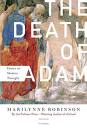
I have been re-reading, with great pleasure, her book of essays entitled The Death of Adam: Essays on Modern Thought. This is one of the most insightful examinations of the intellectual underpinnings of American life one can find. For people who read, and especially for people who read theology, like many who come to this blog, Robinson is a gift: a public intellectual who thinks theology is important. At the same time her amateur status frees her from the binding templates of the theological guild, and she views theology as an art.
 
Here is a sample from Death of Adam. Note how prophetic she was in naming the monism of free market economics as the reigning model for “how things are.” In the last year many have lost confidence in that false god:
 
“It seems to me that there is now the assumption of an intrinsic fraudulence in the old arts of civilization. Religion, politics, philosophy, music are all seen by us as means of consolidating the power of the ruling elite, or something of the kind. I suspect this is a way of granting these things significance, since we are still in the habit of attending them, though they are no longer to be conceded meaning in their own terms. If they have, by their nature, other motives than the ones they claim, if their impulse is not to explore or confide or question but only to manipulate, they cannot speak to us about meaning, or expand or refine our sense of human experience. Economics, the great model among us now, indulges and deprives, builds and abandons, threatens and promises. Its imperium is manifest, irrefragable—as in fact it has been since antiquity. Yet suddenly we act as if the reality of economics was reality itself, the one Truth to which everything must refer. I can only suggest that terror at complexity has driven us back on this very crude monism. We have reached a point where cosmology permits us to say that everything might in fact be made of nothing, so we cling desperately to the idea that something is real and necessary, and we have chosen, oddly enough, competition and market forces, taking refuge from the wild epic of cosmic ontogeny by hiding our head in the ledger.
 
I want to overhear passionate arguments about what we are and what we are doing and what we ought to do. I want to feel that art is an utterance made in good faith by one human being to another. I want to believe that there are geniuses scheming to astonish the rest of us, just for the pleasure of it. I miss civilization and I want it back.”
(The Death of Adam: Essays of Modern Thought, Picador, 1998, p. 3, 4)


Unknown's avatar

A Brief Historical Sketch: The Religious Life of the Berkshires during the time of the Mercersburg Movement

Welcome to Pittsfield. I believe this is the first time that the Mercersburg Society has traveled so far from its geographical center of gravity in Pennsylvania to cross into New England.

Since two of the historical traditions that went into the creation of the United Church of Christ are the German Reformed and the New England Congregationalists I thought it might be interesting to explore the question: “What was happening here in Pittsfield during the Mercersburg Movement?

To answer that question we need to go back to the gathering of this church (First Church of Christ in Pittsfield) in 1764, and trace the contours of its life through the tenure of its first eight pastors, which will bring us to 1873, the year John Todd died (pictured, above left.)

Pittsfield was settled late by Massachusetts standards. The Berkshires are naturally isolated (or protected) from the rest of the world by the Taconic range on the West, which you traversed if you came in from New York State and the Hoosac Range to the East, which you climbed if you came up the Mass Pike. When Jonathan Edwards was exiled from Northampton to Stockbridge in 1750 the description of the Berkshire Hills as “a howling wilderness” was not metaphorical. Thomas Allen sometimes referred to Pittsfield as the farthest outpost of Christendom; never mind that for centuries French Jesuits had been up and down the Mississippi, and Spanish Conquistadors had been in Florida and the Southwest, the perception had the ring of truth to this eighteenth century New England Puritan.

The Berkshires have always been insular, politically independent, and somewhat suspicious of the outside world. This area was a hot spot for the insurrection known as Shays’ Rebellion in 1786, and you can still hear locals speak with suspicion of Boston or congregants of the Conference at Framingham. Before the Massachusetts Turnpike came through the hills it is fair to say that New York was a greater influence than Boston, but both were less than proximity would seem to dictate.

In the days of this church’s gathering Northampton was the outpost of civilization which influenced Pittsfield the most. Colonel John Stoddard, a brother to Solomon Stoddard of Northampton and an uncle to Jonathan Edwards, was one of the original grantees of Pontoosic Township, the early name for Pittsfield. Parson Allen himself and four of the “eight foundation men” who gathered the church were from Northampton. On February 7, 1764 these eight laymen signed a document, made up of two parts, a Confession of Faith and A Covenant, which formed a Church of Christ in Pittsfield. Present at that gathering were representatives of other churches, including the Reverend Stephen West of Stockbridge, Jonathan Edward’s successor and The Reverend Samuel Hopkins of Great Barrington, two important figures in the Edwardsean School and the emerging “New Divinity,” which would help to spark the Second Great Awakening around the turn of the nineteenth century. Two months after the gathering of the church, the first pastor, Thomas Allen, age twenty, a newly-minted Harvard graduate, was duly ordained on April 18.

Even in 1764 the foundations of Puritanism were eroding. Jonathan Edwards is the last best example of Puritanism, in much the same way as J. S. Bach is the final flower of the Baroque. In both cases, others would claim the name, but the movement’s best days were behind it. The presence of Samuel Hopkins at the gathering of this church is intriguing. I am inclined to think that the camel’s nose of liberalism was already in the tent of orthodoxy, for Hopkins’s theology was trimming the doctrines of human sin and divine sovereignty to fit his moral and evangelistic vision.

For Hopkins sin was “actual” rather than “original,” and conversion was the result of the active enterprise of the human will. These motifs would be taken still further by the next generation in men like Nathaniel Taylor and Lyman Beecher. It is not hard to see how these impulses would provide fertile soil for the controversial “new measures” of the Second Great Awakening, and later the excesses of Charles Finney to which John Williamson Nevin took such exception.

Pittsfield’s Thomas Allen has become a legendary figure, “The Fighting Parson,” who carried a musket into the pulpit and was chaplain to the revolutionary forces at White Plains and Bennington, where he is reputed to have fired the first shot. He was a fiery Patriot during the war and a fiery Jeffersonian Democrat after it, and continued to harass the Federalist parishioners from the pulpit, so much so that a large number of deacons and members seceded in 1807 and formed and incorporated a Union Parish in 1808. Allen served for 46 years and died in 1810. During his tenure, in 1793, the second meeting house was built, from a Bulfinch design (Some years after this paper was given the first citation mentioning baseball in America was discovered in the Berkshire Atheneum, in a statute prohibiting ball-playing outside the new meeting house.)

Parson Allen was followed by one of his sons, the Reverend William Allen, who resigned in 1817 on the same day as the pastor of the Union Parish to facilitate a reunion of the two congregations. He became Professor of Theology at Dartmouth under the presidency of his father–in–law, John Wheelock, and later he was appointed president of Bowdoin College in Maine.

The Reverend Heman Humphrey was invited in 1817 by the newly reunited church to serve as the third minister of the First Church. You can see his portrait in the church parlor. A Connecticut man and Yale graduate he had studied with President Timothy Dwight, and come from the pastorate of the First Church in Fairfield, Connecticut. A supporter of the revivals Humphrey invited the evangelist Ashahel Nettleton as a guest to the church on several occasions. Humphrey left First Church in 1823 to accept the presidency of Amherst College.

He was succeeded by the Reverend Rufus Bailey, who had a short pastorate of three years, during which time the highlight was the hosting of General Lafayette at a lavish reception in the church. In later years Bailly became President of Austin College in Austin, Texas.

The fifth minister here was the Reverend Henry Philip Tappan. Tappan also had a short pastorate of three years. Like Nevin he was a graduate of Union College in Schenectady, at roughly the same time. Union College was a united effort between the Congregationalists, Presbyterians, and Dutch Reformed. Tappan had done his divinity degree at Auburn Seminary, the new Prsbyterian school in Western New York, and he had been an assistant of Dr. Van Vechten of Schenectady. Tappan left Pittsfield to become Professor of Moral Philosophy at NYU, and later became president of the University of Michigan and the creator of their curriculum.

The Reverend John Williams Yeomans was the sixth minister of the First Church. He graduated from Williams in 1824, with the second honor of his class, Mark Hopkins taking the first. He completed his theological studies at Andover in 1827 and came to Pittsfield in 1831, remaining for over two years. In 1834 he became Pastor of the First Presbyterian church in Trenton, New Jersey, and lived out his days as a Presbyterian. In 1841 he became President of Lafayette College in Easton, Pennsylvania.

The seventh minister, The Reverend Horatio Nelson Brinsmade, came in 1835 and left in 1841 to become pastor of the Presbyterian Church of Newark. New Jersey. He became president of Beloit College in Wisconsin in 1879, the sixth consecutive pastor of First Church to become a college president.

The eighth pastor was the Reverend John Todd, the quintessential nineteenth century man, who was born in 1800, and came to Pittsfield from Philadelphia as a 42 year–old man with several successful pastorates behind him to build his ecclesiastical empire during Pittsfield’s growing period. It was during his tenure and by his impetus that the present Victorian Gothic church (no longer called a “meeting house”) was constructed. He led First Church out of the period of waning Puritanism, disestablishment, and into Congregationalism and the emerging theological liberalism. His “carriage trade” congregation was proud of their “prince of the pulpit” and the new meeting house was the pride of Pittsfield. Todd still contained some lingering vestiges of Puritanism and more than a little Calvinism, but we need to view him as a transitional figure into the period that Yale historian Sydney Ahlstrom calls “The Golden Age of Liberal Theology” (see Chapter 46 in Ahlstrom, The Religious History of the American People. New Haven: Yale University Press, 1972.)

This brings us from the beginnings of the church to its heyday at the time of the waning of the Mercersburg theology. What patterns can we discern? First, that six pastors became college presidents should alert us to the fact that Congregationalism during this period was not a denomination so much as a civilization rooted in the old New England theocracy, but moving well beyond it in scope and substance. The founding of colleges, missionary movements, and other voluntary associations was an important part of the religious impulse of these New Englanders.

Notice too, how many of the pastors of this church either came or went from or to Presbyterian churches and institutions. This period from 1800 to 1850 was during the time of the Plan of Union between New York State and Western Presbyterians and the Consociated Congregationalism of Connecticut. Nothing illustrates this discovery better than the fact that Jonathan Edwards, Jr., a Connecticut Congregationalist became President of Union College, and later was a Presbyterian delegate to the Plan of Union meetings. Keep in mind that there was no Unitarian Schism in Western Massachusetts. Here the influences were not Harvard’s Arminianism, so much as Yale’s New Divinity and the Second Great Awakening, a somewhat different response to the Enlightenment, but one no less shaped by it.

Geography, too, no doubt played a part in this county’s religious traditions. I remarked on the early influence of Northampton, but later both men and ideas seem to flow up the Housatonic from Connecticut. There was some interaction with the Dutch Reformed Churches 50 miles west on the Hudson in Albany and Schenectady, but it was limited by language and ethnictiy. There was a great deal of interaction with Presbyterians during the Plan of Union years. The Congregational Synod of Albany in 1850 was the real beginning of Congregationalism as a denomination as well as the official end of the Plan of Union.

Then Pittsfield saw itself less as on the boundaries of the mission field and more in the thick of things. John Todd’s crowning moment was giving the invocation at the driving of the golden spike in 1869 at Promontory Point, Utah, when the Union Pacific and Central Pacific Railroads met to form the first transcontiinental rail line. The enterprise was no longer the churches of the established order, but the vast new continent that stretched from shore to shore.

The Berkshires place on the edge of New England gave it a front row seat on the expansion to the west in the early years of the nineteenth century. The Second Great Awakening washed over its towns and churches. The modern missionary movement began under a haystack at Williams College in 1806. Shakerism, that very American phenomenom, flourished at Hancock on the edges of Pittsfield. And it was also just over the mountain in New Lebanon, New York, near the mother colony of Shakerism, where, in 1827 Charles Finney met with his theological opponents from New England and defended his new measures. Among the accusers were Lyman Beecher and Asahel Nettleton. Not long after that Finney led a successful revival in Lancaster, Pennsylvania, and, well, you know all about that!

So Pittsfield, and its surrounding county, represent in micrcosm the contours of America’s religious story from Puritanism to the Gilded Age. That story tells of the rise and fall of the evangelical consensus, and the erosian of a vital Reformed Theology. It tells too of the strange failure of the churches of the Congregational Way to maintain themselves as a churchly movement rather than as a loose federation of congregations. I think one strong clue to the question of why a vital theological movement such as Puritanism, for all its contributions to American life, failed to perpetuate itself institutionally in the churches can be seen in this comment by Douglas Horton:

For the first two hundred years of the history of Massachusetts and Connecticut the state in completely Erastian fashion did duty as the denominational framework for the churches: it provided a unifying bond between them. No inter–colony or inter–state, and remarkably few intra–colony and intra–state synods were called in American Congregationalism between 1648 and 1852 because none or few were needed, since the colonial and, later, the state legislative assemblies were available for the discussion of all relationships among the churches. Meetings of ministers and, in the early nineteenth century, of voluntary associations, such as those which launched the American Board of Commissioners for Foreign Missions, provided forums for the fellowship, but the bedrock legislation as to the founding, maintenance, and ministry of the churches was in the hands of the state in Connecticut until 1818 and in Massachusetts until 1834. It is not strange that the overwhelming number of congregations under the Plan of Union in the early part of the nineteenth century became Presbyterian: the wonder is that more of them did not, for when a Congregationalist crossed the Western border of Massachusetts or Connecticut into New York State, he left behind him the primary symbol and organ of connection in Congregationalism  (Introduction to Williston Walker, Creeds and Platforms of Congregationalism, p xiii)

That legacy is still alive in the churches of New England, as it is indeed elsewhere in America, and the insights of the Mercersburg theologians offer much that can correct it.

(This is a paper I delivered to the Mercersburg Society at their Annual Meeting held at the First Church of Christ in Pittsfield, Massachusetts on June 18, 1997. It was published in the Fall 1997 issue of The Mercersburg Review)

Unknown's avatar

Abraham Kuyper on Glorifying God with your Intellect


In one of threads on our Confessing Christ internet conversation we recently discussed the role of emotion versus intellect in Christian faith. It was agreed that these are not mutually exclusive domains, but that different figures have put more emphasis on one or the other.

Under the influence of my friend and fellow Confessing Christ blogger Clifford Anderson of the Princeton Theological Seminary Library I’ve started reading Abraham Kuyper (1837-1920). A fascinating figure, Kuyper was a Dutch pastor, theologian, author, editor and politician, who served from 1901 to 1905 as Prime Minister of the Netherlands. He also founded the Free Univeristy of Amsterdam.

Last night I was reading his 1898 Stone Lectures at Princeton, published as Lectures on Calvinism, and I was struck by this passage:

“If everything that is, exists for the sake of God, then it follows that the whole creation must give glory to God. The sun, moon, and stars in the firmament, the birds of the air, the whole of Nature around us, but, above all man himself, who, priestlike, must concentrate to God the whole of creation, and all life thriving in it. And although sin has deadened a large part of creation to the glory of God, the demand,—the ideal, remains unchangeable, that every creature must be immersed in the stream of religion, and end by lying as a religious offering on the altar of the Almighty. A religion confined to feeling or will is therefore unthinkable to the Calvinist. The sacred anointing of the priest of creation must reach down to his beard and to the hem of his garment. His whole being, including all his abilities and powers, must be pervaded by the sensus divinitatis, and how then could he exclude his rational consciousness,— the λογος which is in him, the light of thought which comes from God Himself to irradiate him? To possess his God for the underground world of his feelings, and in the outworks of the exertion of his will, but not in his inner self, in the very center of his consciousness, and thought: to have fixed starting –points for the study of nature and axiomatic strongholds for the practical life, but to have no fixed support in his thoughts about the Creator Himself,—all of this was, for the Calvinist, the very denying of the Eternal Logos.” Lectures on Calvinism, P. 52. Eerdmans, 1931