

Prayer: May the words of my mouth, and the meditations of our hearts, be acceptable in your sight, O Lord, our Rock and our Redeemer. Amen.
Happy All Saints Sunday! I contemplated calling this sermon “The Saints Preserve Us!” but I thought that might be too alarming just two days before a fraught election.
But I do want to talk about the saints, both those “here below” as the Doxology says, and those among “the heavenly host.”
What is a saint? In some of our sister denominations a saint is an exemplary person recognized by the church through an official process of canonization. Someone like St. Francis or Mother Theresa.
But Martin Luther and the Protestant Reformers rejected that idea and returned to the New Testament use of the term to refer to any and all Christians in both heaven and on earth.
So, you are the saints of the First Congregational Church of Stockbridge. The word saint comes from the Latin sanctus, which means holy. This room is a “sanctuary” because it is a receptacle for the holy. It has no intrinsic holiness, but is holy because we do holy things here. Likewise, you are holy by virtue of your relationship to God in Christ. You may or may not be saintly in the common use of the words, but you are a saint nonetheless.
So, we Protestants don’t pray to the saints or venerate them in worship, but we do rememberthem. And I want to talk about remembering. It’s an important idea in both Judaism and Christianity.
That’s what we are doing today with our photos and candles, we are remembering those we love who have died. By bringing them to mind they in some sense still live in our memory. When someone dies our Jewish neighbors will often say, “May their memory be a blessing.”
But, in the church we have more to say about the saints above than mere memory. When someone dies many Christians say, “Rest in peace and rise in glory” which alludes to the doctrine of the resurrection of the dead.
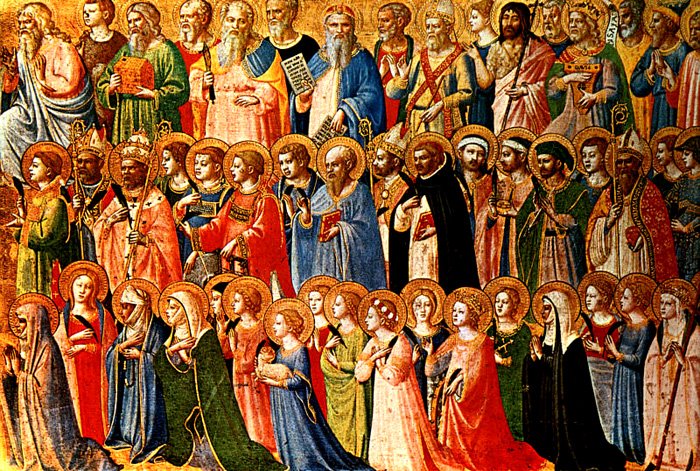
The church from its beginning has pictured its life and mission, and especially its worship, as taking place in the unseen but very real presence of our ancestors in the faith. Our liturgies nod to it. We pray phrases such as “with the church on earth and the saints in heaven” or “with angels and archangels and all the company of heaven.”
So, how might we picture the presence of the communion of saints with us this morning? “We are surrounded by so great a cloud of witnesses . . .” says the writer of Hebrews. The image is drawn from the stadium where the athletic games were held. I have been to the ruins of ancient Greek and Roman stadiums in Delphi, Greece, and Nîmes in Southern France, and I picture these arenas packed row by row with spectators.
So, the great cloud of witnesses is this huge throng cheering on the competitors, who are admonished to “lay aside every weight and the sin that clings so closely” just as a bicycle racer will try to have the lightest materials possible. This one is a foot race, though, and here Jesus is pictured as the lead runner, the pacesetter, “the pioneer and perfecter of our faith.”
Let me tell you a story about a race I was in. It was in 1980, and it was my one and only marathon, the Paul Bunyan Marathon in Bangor, Maine. This 26.2mile road race began at the big Paul Bunyan statue in Bangor, and meandered through adjoining small towns until it ended on the oval track in the football stadium at the University of Maine in Orono. I will never forget the ending of that race.
You have heard about the “loneliness of the long-distance runner.” There’s truth in that phrase, for even when you are physically prepared for these long races there is a mental and emotional side that is quite daunting. The first half of my race was fun, and at about mile ten I was euphoric, but around mile twenty I began to run out of gas and I had to struggle to keep on running. My running partner had dropped out and I was alone with my thoughts.
A solitary debate began in my mind: “Can I finish?” “Should I quit?” “Will this cramp go away, will this ache subside, will this tiredness abate?” By the time I hit that oval track in the stadium at Orono I was just really, really, glad to be finishing.
And then a strange thing happened. I was pulled out of my reverie by the sound of cheering, and, since I knew that Martha and her parents were the only ones present at the race who actually knew me, I wondered who the cheering might be for. I looked ahead and saw that there was no one else on the track. What’s more, many of the cheers were naming me by name, “Way to go, Rick!” “You can do it, Rick!” which puzzled me still more.
What it was, of course, was the cheering of the other runners who had finished ahead of me. With my race time of three hours and forty–seven minutes there were scores of other faster runners ahead of me, and there were many other spectators, and they all had a program sheet with the names and numbers of the runners and I had my number pinned to my shirt. Those cheers were wonderful for my morale, and I straightened my shoulders a bit and quickened my step and put on a little burst of speed for that last lap.
I carry that image in my mind as the very image that the writer of Hebrews wants to evoke here. The communion of saints are the ones who have finished the race before us. They are in the stadium seats watching us, they have finished the course, and now “from their labors rest.” We in the church militant are engaged in the same task as they were and they cheer us on, encourage us, support us, and call us by name. They are the great cloud of witnesses.
This is such an important way to think about the church. We have been learning to think of the church ecumenically; to consider the breadth of the church across denominational lines and national boundaries.
But how quickly we forget the length of the church, its trans–temporal reality across the generations. That is where the role of tradition comes to play in the church, the place where the communion of saints gets their say. As C.K. Chesterton put it, “Tradition is only democracy extended through time.”
And that’s important because a church that forgets what the saints have learned from generation to generation will hardly be equipped to be the church in its own generation. So, the church rightly remembers the communion of saints, and even more than that, claims that in Christ, we share with them in the divine life.
Let me change the metaphor, that we might imagine the communion of saints as a choir; a large choir, like one of those Welsh men’s choirs made up of a thousand voices.
So let us imagine that as we sing this morning we sing together along with the voices of the great cloud of witnesses. Let us take quite seriously the claim of our various liturgies that when we sing, we join our voices “with all the faithful in every time and place.”
There is a wonderful sermon by Jonathan Edwards on 1 Corinthians 13: 8-10, called Heaven is a World of Love. I wish it were better known. Edwards, as you know, was the second pastor of this church. In his sermon Heaven is a World of Love, he explores the metaphor of the communion of saints as a heavenly choir. First, he beautifully describes heaven and all its social arrangements, and in so doing puts forth a protest against the social arrangements that we know so well on earth, for in Edward’s heaven there is no pride or jealously, there is decency, kindness, wisdom, and an equal prosperity among all. No income inequality there. No nasty political divisions.
No, Edwards says, that “love (poured out from God) resides and reigns in every heart there.” And then he says: “Every saint there is as a note in a concert of music which sweetly harmonizes with every other note, and all together employed wholly in praising God.”
Heaven is a world of love, and here below the church with all its imperfections witnesses by word and deed to the truth of that love. “We feebly struggle, they in glory shine.” And speaking of “feebly struggling,” what has happened to our country? As we stand so bitterly divided on the brink of a particularly contentious election we must wonder?
But whatever the outcome is, we, the saints of Stockbridge, will be here next Sunday, to sing hymns and hear the Word of God, to offer prayers, and to consecrate our annual pledges.
We will still be the church, feeding people through our pop-up pantry and at the Cathedral of the Beloved, teaching our children and youth and adults about Jesus and his love. We will still be the church to face whatever challenges the world offers, and whoever our leaders are there will be challenges.
Heaven is a world of love, but “here below” life is less perfect and more complicated. In 1516, Thomas More wrote a famous book about an imaginary island. In it he describes a perfect society with perfect laws, customs, and religion. His fictional island was much like Jonathan Edwards’ perfect heaven. And do you know what Thomas More called the island (and the book)? He called it Utopia, which is Greek for “No place.”
That’s right: “No place.” Because here on earth, there is no Utopia! Which is why we pray each Sunday, “Thy Kingdom Come, Thy Will be done. On earth as it is in heaven.” We live as the church attempting in our feeble way to bridge the gap between the Kingdom of God that Jesus both preached and embodied and the fragile and broken world in which we live.
And our recognizing the Communion of Saints reminds us that we are not alone as we try to be church. We carry out the mission and work of the church by sharing in the very life of God, and we are surrounded as well by so great a cloud of witnesses who cheer us on.
The Puritans had a saying, “The commonwealth of heaven becomes more dear with each loss below.” I invite you to picture people you have known and loved that have died. Perhaps you will picture a beloved Sunday School teacher, a parent or a grandparent, a mentor, perhaps a neighbor. You may picture saints from this congregation who once sat in these pews with us. I know I do.
These were people who showed you what love is by loving, what service is by serving, what witness is by witnessing to what they had seen and known and believed.
It is the great cloud of witnesses. It is the church, in heaven with all its glory, and on earth with all its brokenness and folly. It is like that great choir, and its song goes on every time the church gathers, wherever two or three are gathered in the Lord’s name.
The church “on earth has union with God, the Three in One, and mystic sweet communion with those whose rest is won. O happy Ones and holy, Lord give us grace that we, like them the meek and lowly, on high may dwell with thee.” Amen.
(I preached this sermon on November 3, 2024, at the First Congregational Church of Stockbridge, Massachusetts. To view the video of the service go to: https://www.youtube.com/watch?v=RXIUF01wV2c
 When I Survey . . .